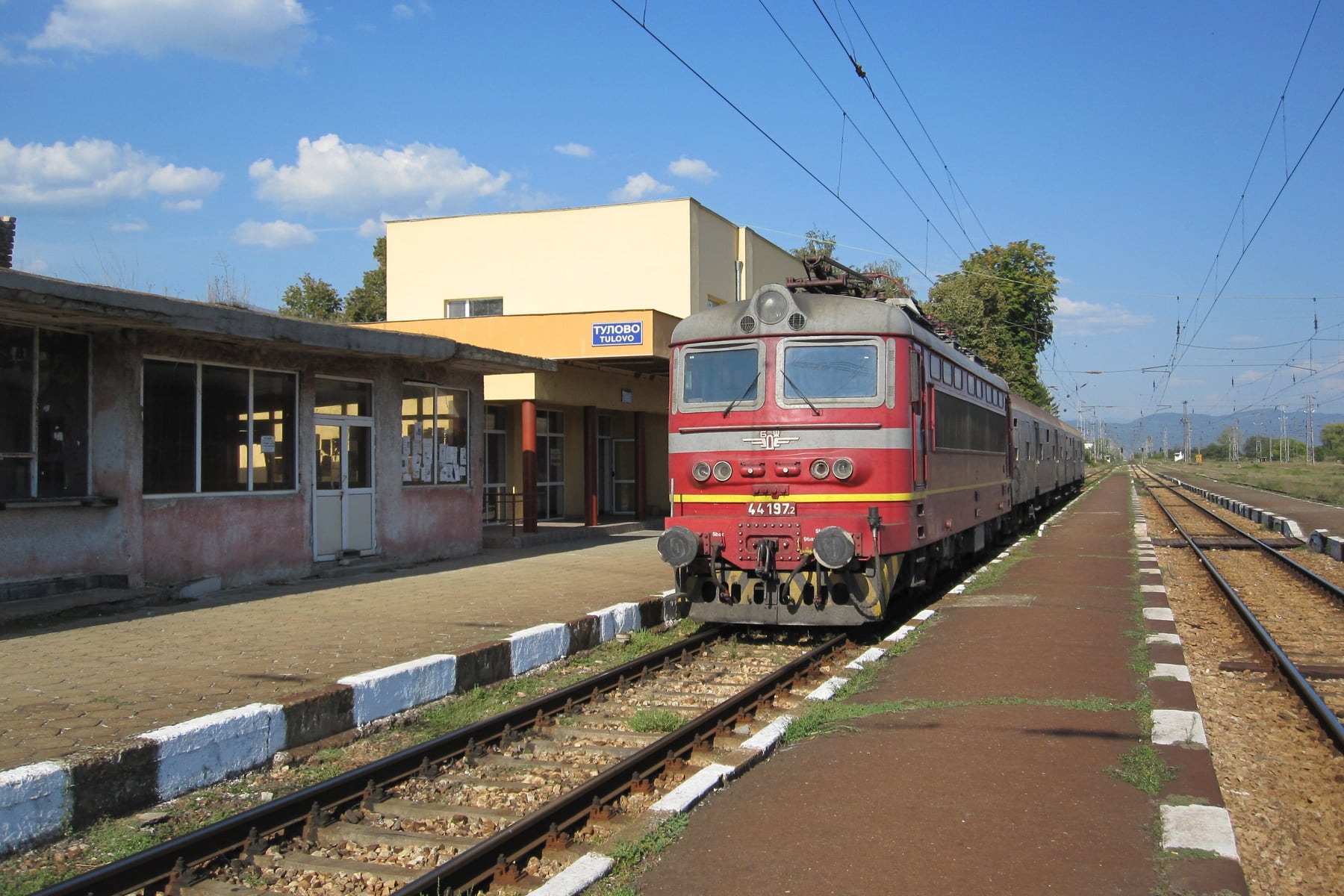
Over the Balkan by Tryavna
Phil Richards from London, UK / Wikimedia Commons · CC BY-SA 2.0
- DistanceVeliko Tarnovo–Stara Zagora · 128 km
- Duration2 h 19 to 3 h 11
- Best seasonAll year · five trains a day each way
Introduction
The Balkan range runs the whole width of Bulgaria, and most of its railways treat it as something to go round or through. The Sub-Balkan line keeps to the valleys along its southern side; the Iskar line follows a river through a gorge. The line from Veliko Tarnovo to Stara Zagora does neither. It goes straight over the top, and it does it on two loops known in Bulgarian by numbers: the Six on the way up and the Eight on the way down.
On the northern side, beyond Plachkovtsi, the track winds through 16.6 kilometres to gain 357 metres. On the southern side, between Yavorovets and Radunci, it runs on three levels of the same hillside and loses 303 metres in 14.6 kilometres. In between are seventeen tunnels, one of them cut directly above another, and a summit section the builders took until 1913 to finish.
What the ride is actually like
It is an ordinary BDŽ train — five a day each way, second class only, in compartment coaches — and the full 128 kilometres cost €4.29 to €4.76. The first hour runs south from Veliko Tarnovo by Dryanovo and Tsareva Livada to the old craft town of Tryavna. Then comes the mountain: Plachkovtsi, the Six up to Krastets, the tunnels, the Eight down to Radunci, and out at Dabovo onto the plain, with Stara Zagora about three hours from where you started.
The Journey
This is the middle of BDŽ's main line 4, which runs from Ruse on the Danube to Podkova near the Greek border and is one of only three railways that cross the Balkan range from north to south. Almost every train on this stretch starts at Gorna Oryahovitsa, calls at Veliko Tarnovo about twenty minutes later, and runs through to Stara Zagora; one comes from Varna and one carries on to Dimitrovgrad.
Why it goes over the top
When the state decided to cross the mountains here, three routes had been studied: a western one by Gabrovo and the Shipka pass that needed a summit tunnel of 7.2 kilometres, a central one by Hainboaz, and an eastern one by Elena. In 1904 the government took none of them. It chose a variant by the engineer L. Valchev over the ridge between Plachkovtsi and Borushtitsa, with the line itself at 883 metres — the least favourable crossing of the lot, and the one that passed closest to the coal of the Tryavna Balkan and the Prince Boris mine, worked at the time by a foreign company. Its owner had begun laying a 750 mm line of his own from Plachkovtsi towards Tarnovo to press the point, and when Bulgaria raised a 100-million loan in Paris that year, 16,183,000 gold leva of it was set aside for a railway by Borushtitsa.
Building it took far longer than the contracts allowed. Tarnovo to Plachkovtsi opened on 17 July 1910 and Dabovo to Stara Zagora on 15 August 1911; the hard middle followed in two pieces, Borushtitsa to Dabovo on 10 February 1913 and Plachkovtsi to Borushtitsa on 1 September 1913.
The Six and the Eight
The mountain section holds the two most elaborate development loops on any standard-gauge line in Bulgaria. The northern one, the Six, takes the line from Plachkovtsi to Krastets through 16.6 km of track to climb 357 m. The southern one, the Eight, between Yavorovets and Radunci, lays the line on three levels and drops it 303 m in 14.6 km. On both the actual gradient reaches 25.5 ‰. Between Plachkovtsi and Dabovo there are 17 tunnels; number 23, at 1,100 metres, was the longest in Bulgaria when it was dug, and number 22 runs through the same slope directly above number 24.
The northern half was electrified to Plachkovtsi in 1976 and the rest over the mountain in 1979. Between Dabovo and Tulovo it shares 8.3 km of double track, doubled in 1965, with the Sub-Balkan main line.
Along the way
Veliko Tarnovo, the medieval capital, is the obvious place to start: its fortress hills of Tsarevets and Trapezitsa sit either side of the Yantra, and the regional trains also stop at a halt named for Trapezitsa. South of the city the line passes Dryanovo and the Bacho Kiro halt, named for the cave beside the Dryanovo Monastery, to the junction at Tsareva Livada, where a 17 km branch drops to Gabrovo — eight trains a day down it, each taking 32 minutes. Tryavna, the next stop, is the place to break the journey: a National Revival craft town with a clock tower of 1814 and a museum of woodcarving.
After Tryavna it is mountain all the way to Radunci. At Dabovo the line meets the Sub-Balkan route from Sofia to Burgas, runs beside it to Tulovo, and turns south across the plain to Stara Zagora, a city that was already old when Trajan renamed it Augusta Traiana in 106.
Along the route
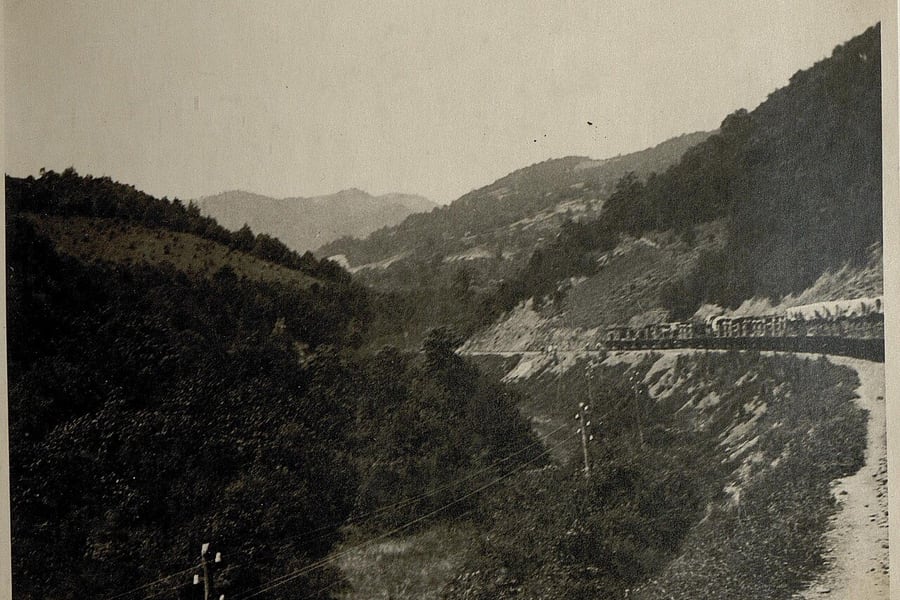
 Unknown photographer, Bulgarian State Archives / Wikimedia Commons · public domain
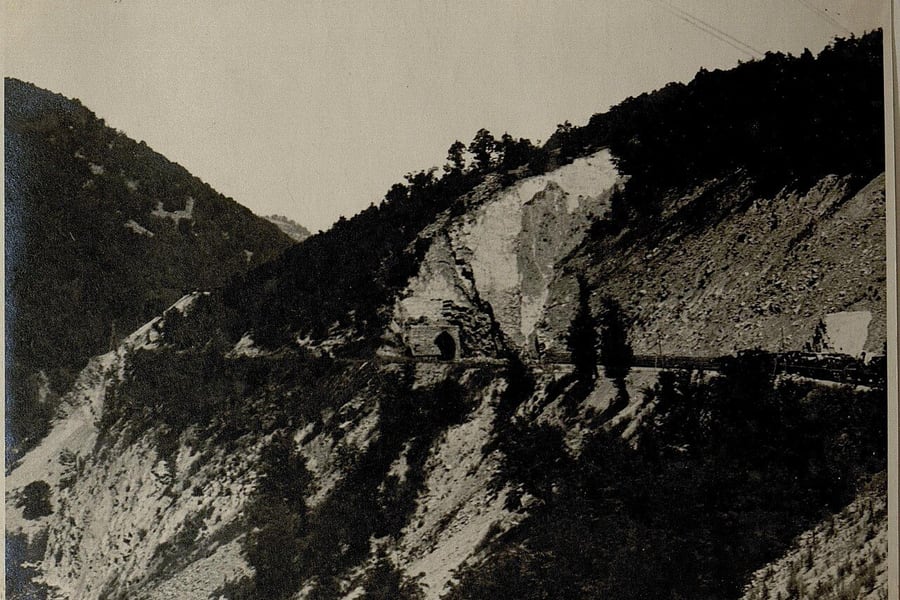
Up on the Six
Beyond Plachkovtsi the line climbs the northern side of the range on a loop known as the Six. It takes 16.6 km of track to gain 357 metres to Krastets, on gradients up to 25.5 ‰.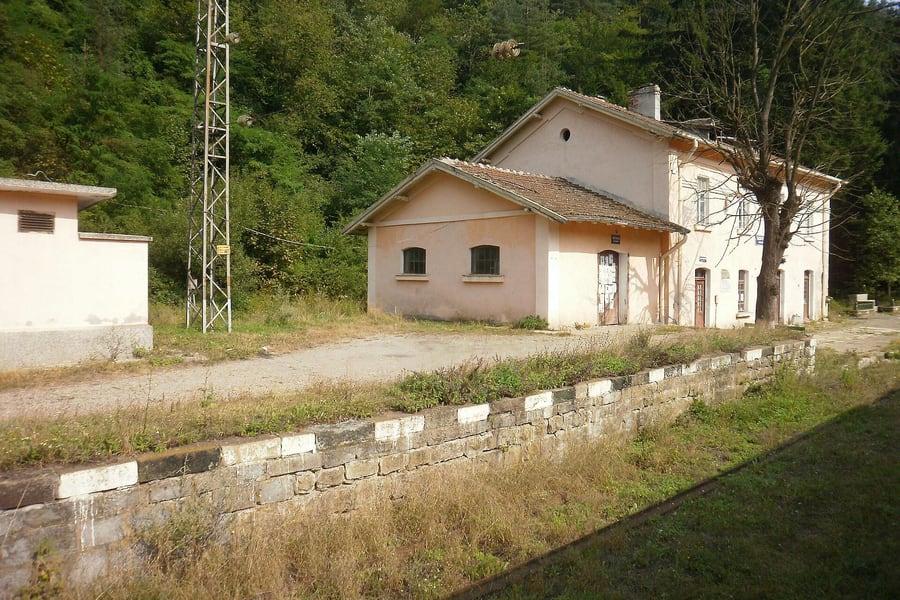 Спасимир / Wikimedia Commons · CC BY 3.0
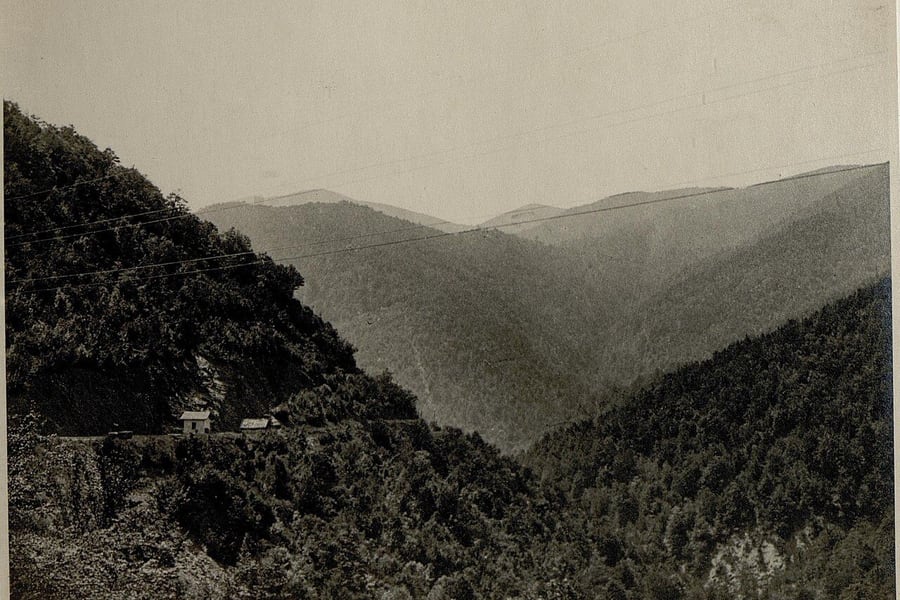
Down on the Eight
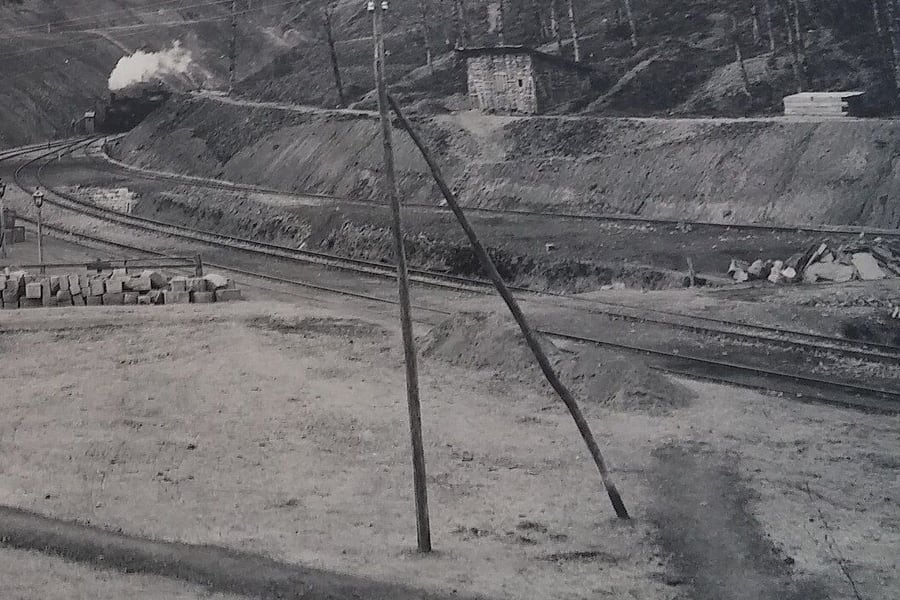
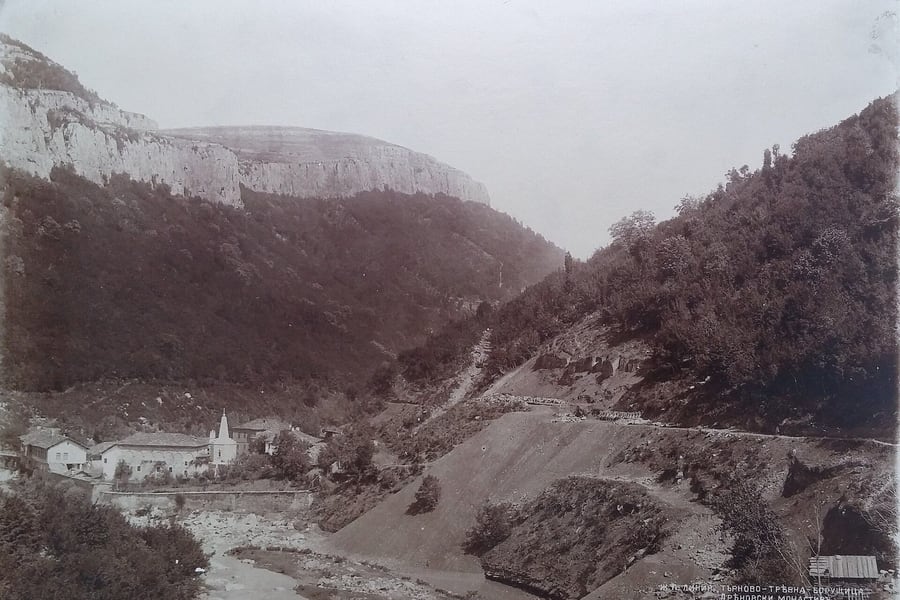
The southern descent between Yavorovets and Radunci is the Eight: the line runs on three levels of the same hillside and drops 303 metres in 14.6 km, at the same 25.5 ‰ as the climb.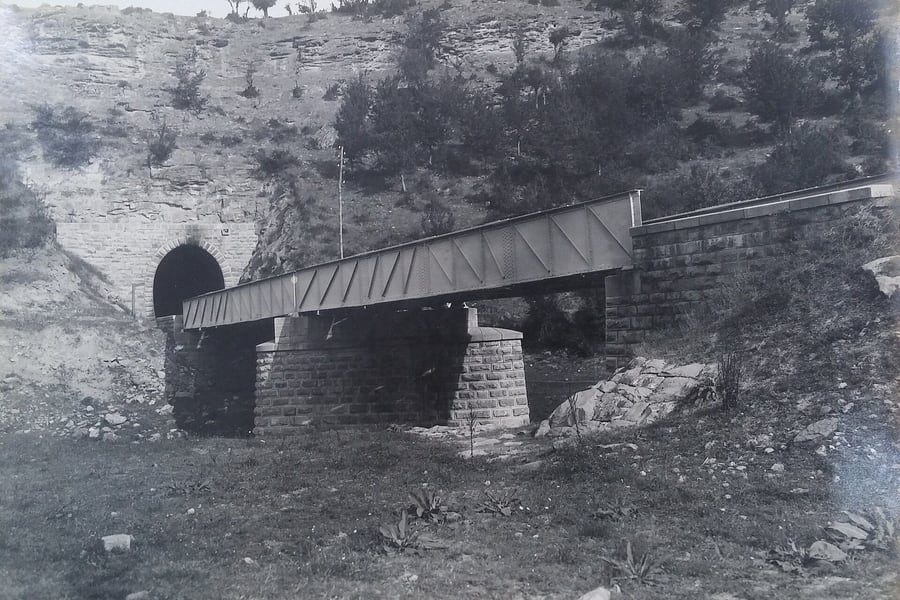 Unknown photographer, Bulgarian State Archives / Wikimedia Commons · public domain
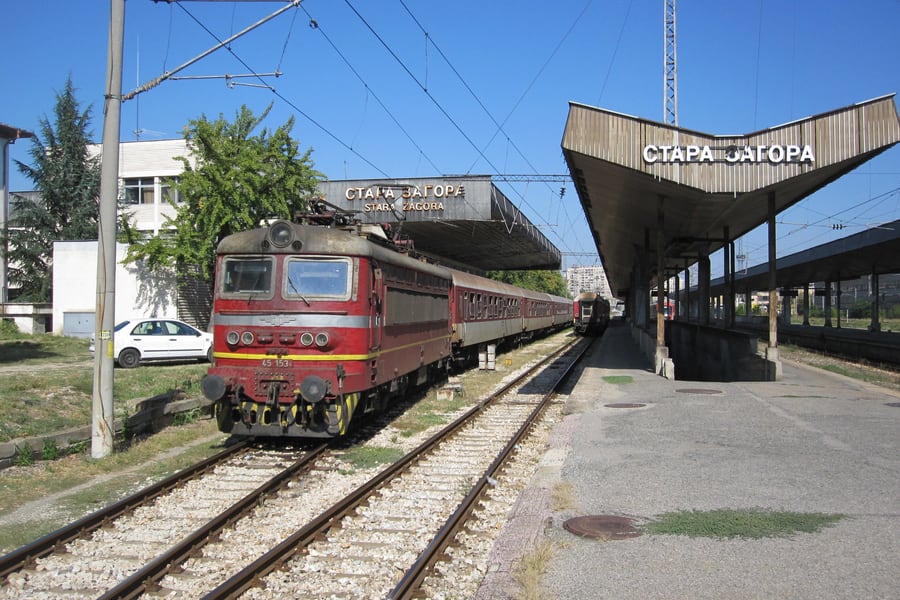
A tunnel above a tunnel
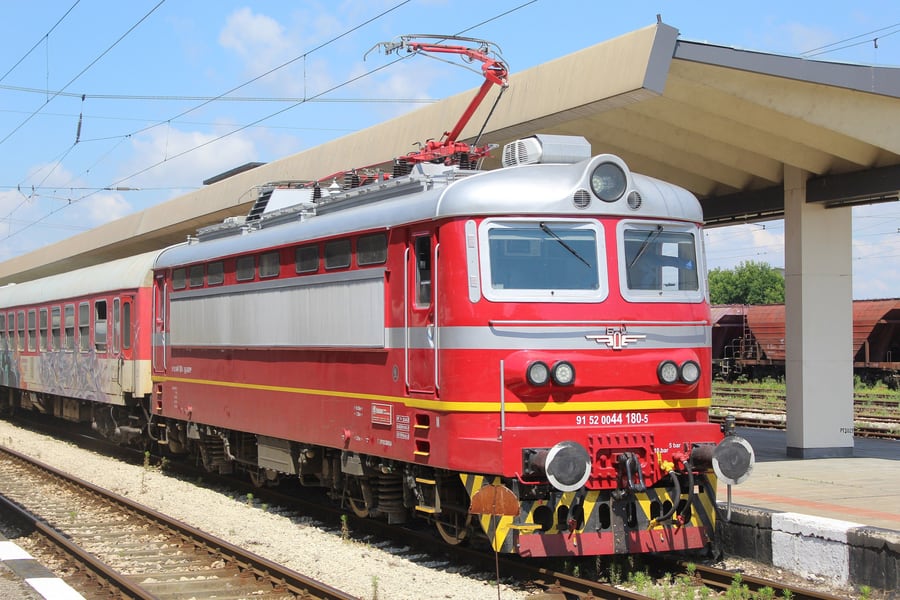
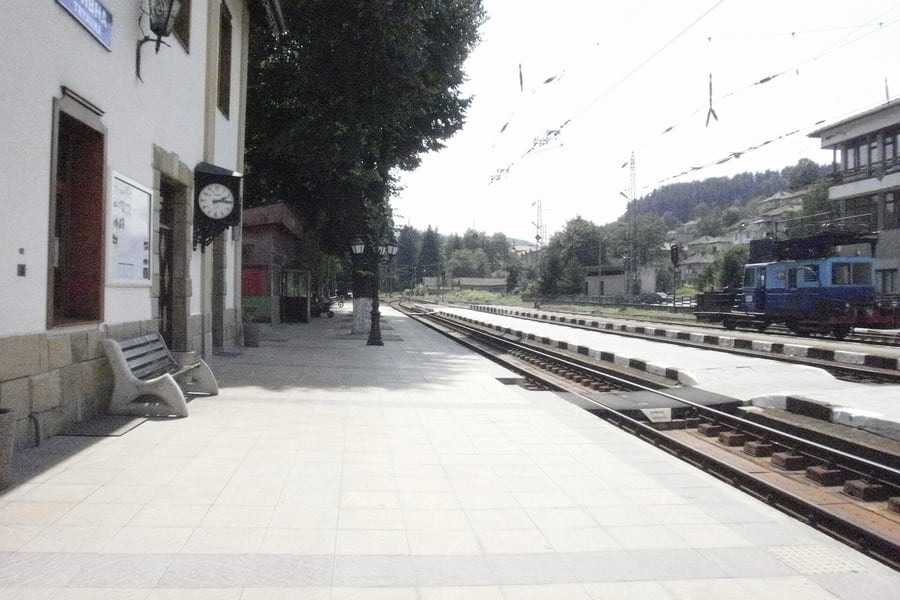
Tunnel 22 is cut into the same slope directly above tunnel 24. Tunnel 23, at 1,100 metres, was the longest yet built in Bulgaria when the line opened. Seventeen tunnels lie between Plachkovtsi and Dabovo.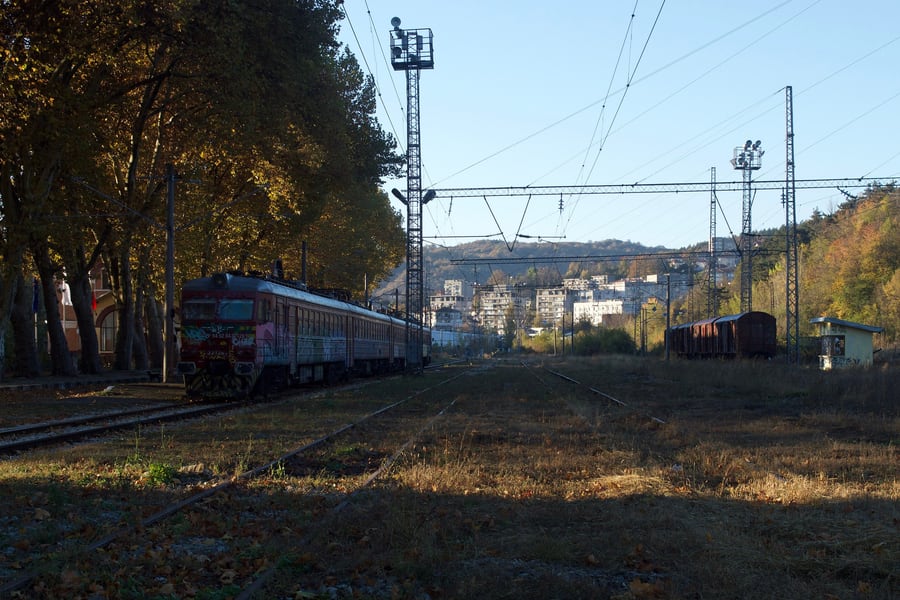 Phil Richards from London, UK / Wikimedia Commons · CC BY-SA 2.0
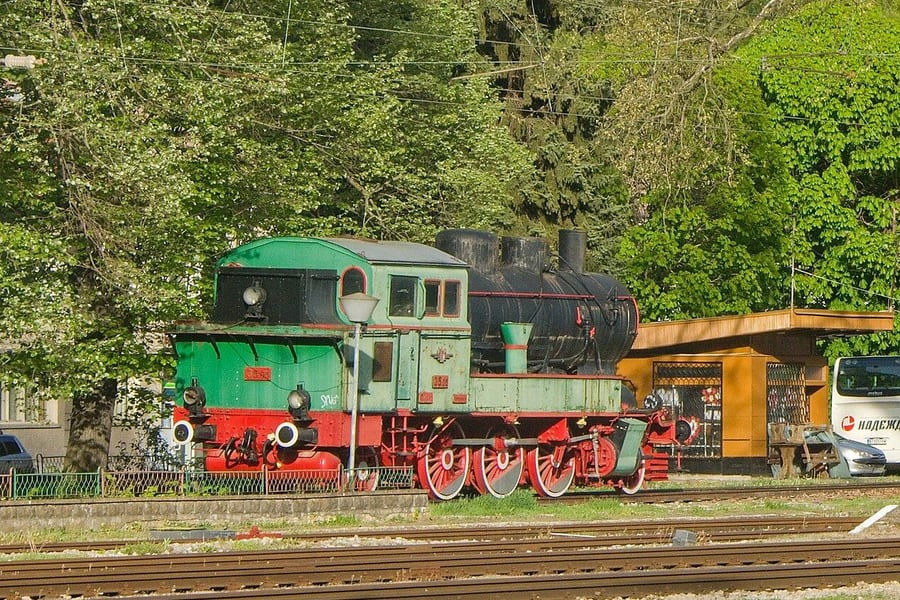
The Gabrovo branch
At Tsareva Livada a 17 km branch runs down to Gabrovo. Eight trains a day make the trip in 32 minutes. The class 32 electric unit in the photograph was one of the few of its kind still at work in 2018.A bit of history
Culture & experiences along the way
 Unknown photographer, Bulgarian State Archives / Wikimedia Commons · public domain
The coal that chose the pass
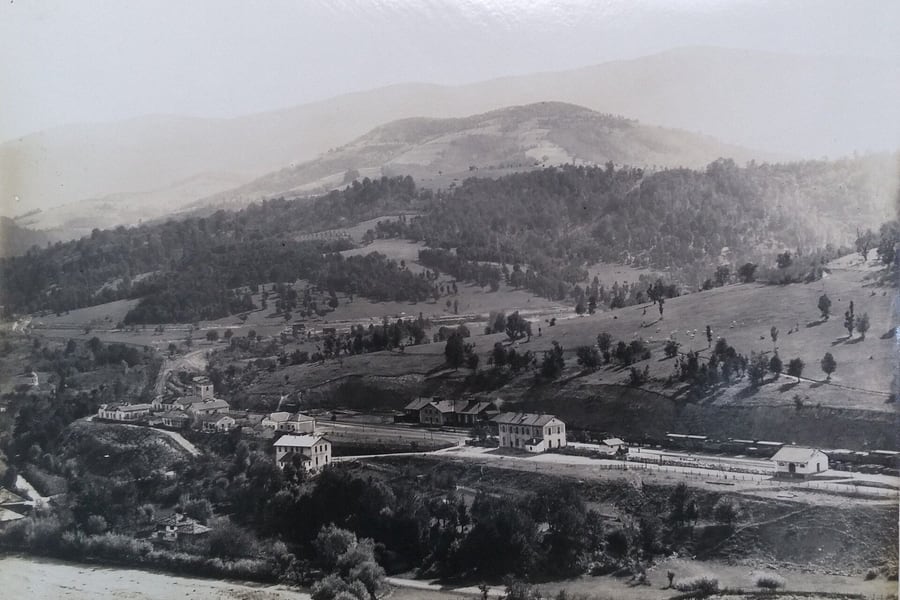
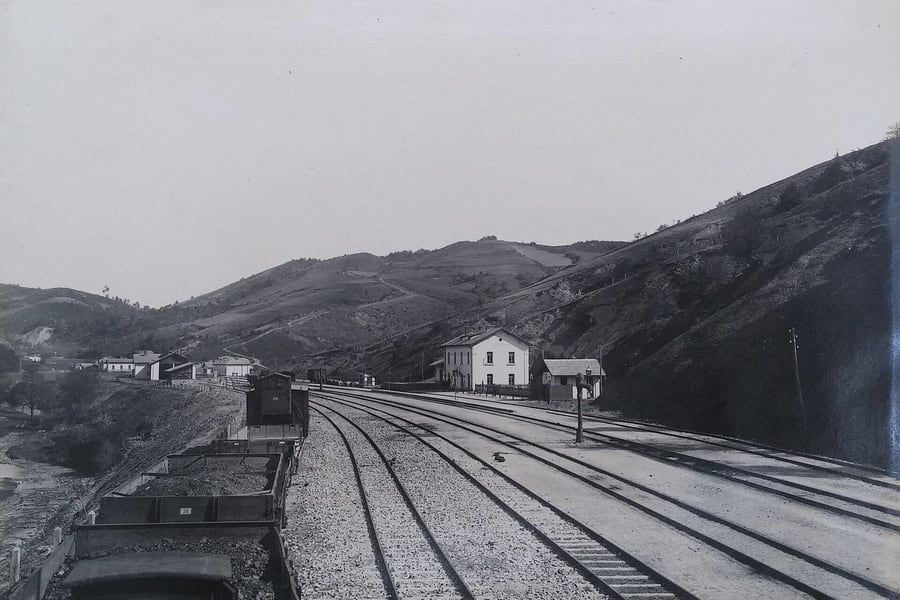
Surveyors had studied crossings by Shipka, by Hainboaz and by Elena. In 1904 the government took a fourth, the least favourable, with the line at 883 metres, to bring it close to the coal of the Tryavna Balkan and the foreign-owned Prince Boris mine. The loan raised that year in Paris set aside 16,183,000 gold leva for it.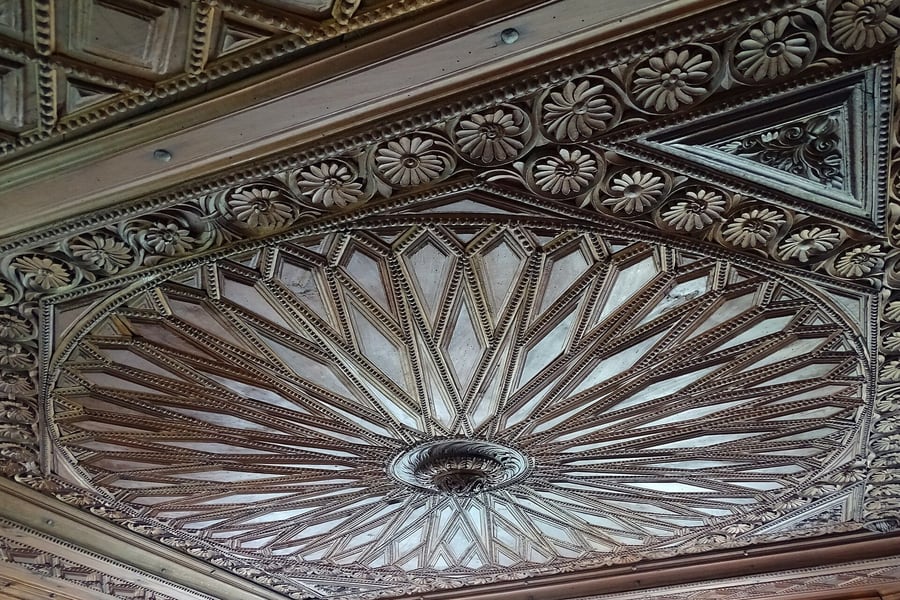 Adam Jones from Kelowna, BC, Canada / Wikimedia Commons · CC BY-SA 2.0
Two suns carved in competition
The Daskalov House in Tryavna was built in 1808 for a rose-oil and silk merchant. Its master builder Dimitar Oshanetsa and his apprentice Ivan Buchukovetsa each carved a ceiling in rivalry — the May Sun and the July Sun. The house is now Tryavna's museum of woodcarving and icon painting.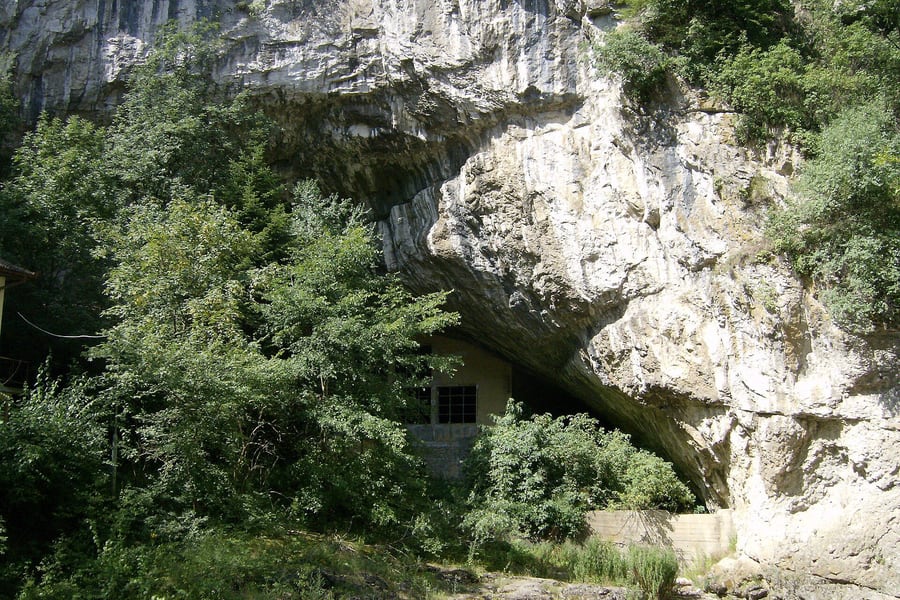 Izvora / Wikimedia Commons · public domain
Europe's earliest Homo sapiens
Bacho Kiro Cave, named in 1940 after a hero of the April Uprising, has 3,600 metres of galleries and 700 of them lit for visitors. Human remains found here, about 46,000 years old, are among the earliest evidence of our own species anywhere in Europe.Timetables
Five trains a day run the whole way in each direction. All times below were read from BDŽ's own timetable (opens in a new tab) on 23 November 2026, for Wednesday 25 November, and the same five trains appeared on the boards for Saturday 28 and Sunday 29 November. Every one of them calls at Tryavna and Plachkovtsi and crosses the mountain.
Veliko Tarnovo to Stara Zagora
| Train | Veliko Tarnovo | Tryavna | Plachkovtsi | Dabovo | Stara Zagora | Time |
|---|---|---|---|---|---|---|
| REG 40121 | 05:29 | 06:22 | 06:33 | 07:34 | 08:25 | 2 h 56 |
| ICF 4661 | 08:54 | 09:51 | 10:10 | 11:13 | 12:05 | 3 h 11 |
| REG 40123 | 11:52 | 12:45 | 12:56 | 13:58 | 14:35 | 2 h 43 |
| REG 40125 | 14:44 | 15:40 | 15:51 | 16:52 | 17:29 | 2 h 45 |
| IC 465 | 17:50 | 18:42 | 18:54 | 20:02 | 20:43 | 2 h 53 |
Stara Zagora to Veliko Tarnovo
| Train | Stara Zagora | Dabovo | Plachkovtsi | Tryavna | Veliko Tarnovo | Time |
|---|---|---|---|---|---|---|
| REG 40100 | 07:15 | 07:54 | 09:01 | 09:14 | 10:22 | 3 h 07 |
| IC 464 | 08:41 | 09:17 | 10:09 | 10:18 | 11:00 | 2 h 19 |
| REG 40120 | 10:55 | 11:32 | 12:33 | 12:46 | 13:42 | 2 h 47 |
| REG 40122 | 13:15 | 13:59 | 15:03 | 15:14 | 16:09 | 2 h 54 |
| ICF 4660 | 16:10 | 17:06 | 18:05 | 18:16 | 19:11 | 3 h 01 |
Where the trains come from
The regional trains start and finish at Gorna Oryahovitsa, about twenty minutes beyond Veliko Tarnovo — the 05:29, for instance, leaves there at 05:10. ICF 4661 sets out from Varna at 05:00 and 4660 goes back there, arriving at 23:18. IC 465 runs on from Stara Zagora to Dimitrovgrad (21:57), and IC 464 starts there at 07:10; it calls at fewer stations than the rest, which is why it is the quickest crossing of the day.
Every train is second class only and none needs a reservation. Most run as compartment coaches; the 14:44 from Veliko Tarnovo includes an electric multiple-unit section.
The December timetable change
On 23 November the board showed the same five trains on every date sampled up to 11 December 2026, and nothing at all from 13 December — not on this line and not between Sofia and Plovdiv either, which points to a new timetable period rather than a cancellation. Check the day's board before travelling after that date.
Tickets
This is an ordinary domestic BDŽ journey, priced in euros. For the 128 kilometres from Veliko Tarnovo to Stara Zagora the fare panel gave €4.29 in second class on the regional trains and €4.76 on the ICF and IC services, with children aged 7 to 10 at €2.15 and €2.38, a group rate for three to six people and an indicative return of €7.77 or €8.59. BDŽ says its prices can vary by day, so treat these as one reading, taken on 23 November 2026.
There is no first class on any of the ten trains and no reservation to buy. Tickets are sold at the station and on BDŽ's own booking site.
Book your tickets
Veliko Tarnovo – Stara Zagora
128 km, second class only
€4.29 on the regional trains and €4.76 on the faster ones when this page was written, with children aged 7 to 10 at about half that and no reservation needed.
Book Tickets (opens in a new tab, on Bulgarian State Railways (BDŽ))via Bulgarian State Railways (BDŽ)Booking online with BDŽ
The operator's own ticketing site
Tickets are sold at station counters and through BDŽ's own booking site.
Book Tickets (opens in a new tab, on Bulgarian State Railways (BDŽ))via Bulgarian State Railways (BDŽ)Rail Passes
Bulgaria is covered by Interrail and Eurail passes, and BDŽ, which runs every train on this line, is included for its suburban, regional and IC fast trains alike.
Whether a pass is worth it for this journey
Not on its own. The whole crossing costs €4.29 to €4.76 in second class, and the Interrail Bulgaria Pass costs €67 for an adult for three travel days within a month (€50 for a youth, which is the price the booking page shows first). A pass only pays here as part of a longer trip that already needs one.
Reservations
None are needed. Interrail lists the routes on which BDŽ's fast trains require a reservation — Sofia to Burgas, Varna, Stara Zagora and Gorna Oryahovitsa, Plovdiv to Varna, and Sofia to Kulata — and Veliko Tarnovo to Stara Zagora over the mountain is not among them.
Pass conditions as of November 2026, from interrail.com's railway companies table (opens in a new tab) and its Bulgaria Pass page.
Places to Visit
The line is best ridden in pieces. Veliko Tarnovo is worth a day before setting out, Tryavna makes a natural night in the middle, and the Dryanovo Monastery and Bacho Kiro Cave are reached from the Bacho Kiro halt on the way. Tarnovo's Tsarevets fortress and the village of Arbanasi already have their own cards on the Iskar Gorge and Sofia–Varna journeys, so the four below cover the rest of the line.
 Vislupus / Wikimedia Commons · CC BY-SA 4.0 · cropped
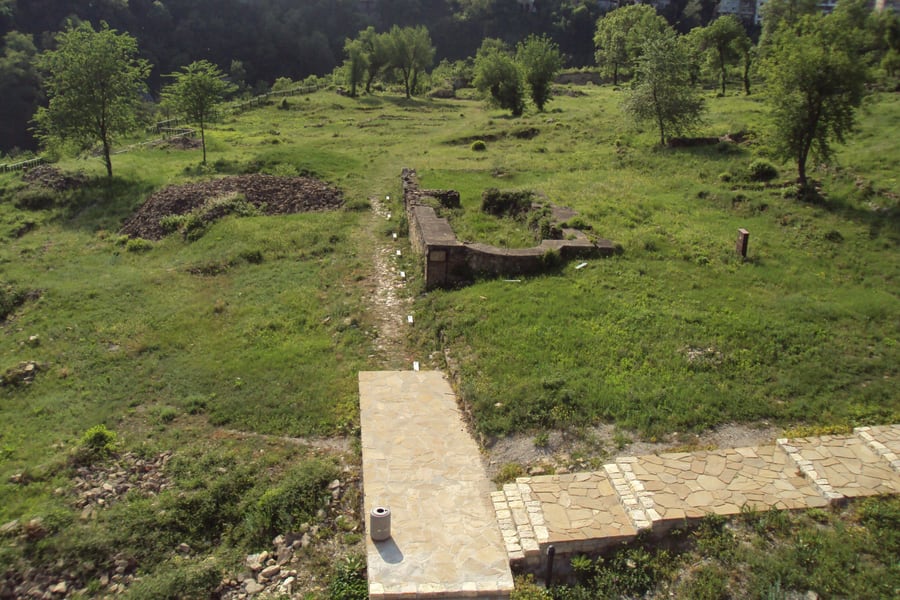
Trapezitsa, the other hill of Tarnovo
The second fortified hill of medieval Tarnovo, across the Yantra from Tsarevets and girdled by the river on three sides. Digs in 1884 and 1900 uncovered the foundations of 17 churches, once decorated with frescoes, mosaics and glazed ceramic bowls set into the walls. Tsar Ivan Asen I brought the relics of St Ivan of Rila to Tarnovo from Sofia in 1195. The regional trains stop at Trapezitsa station, one before Veliko Tarnovo.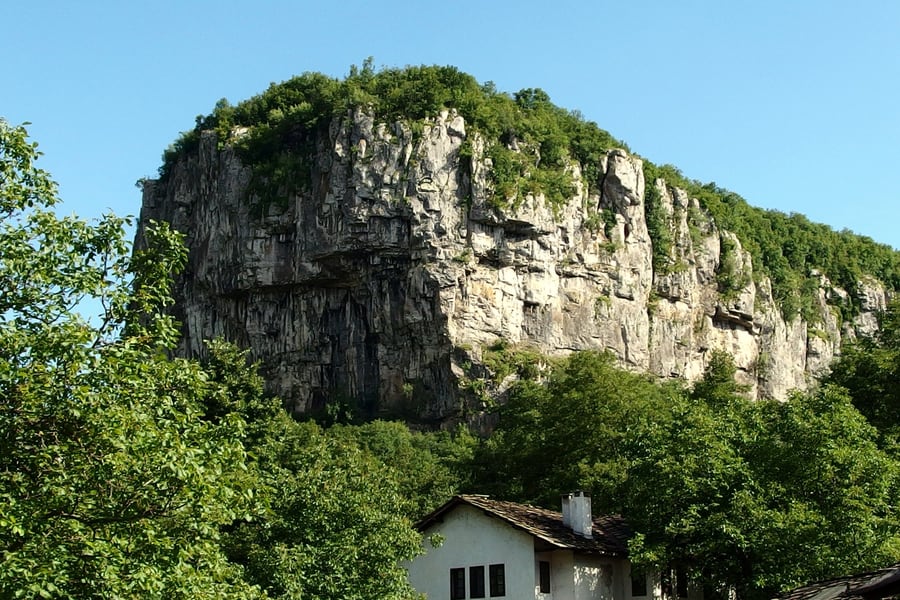 Mark Ahsmann / Wikimedia Commons · CC BY-SA 4.0
The Dryanovo Monastery
A working monastery of St Michael the Archangel in the Andaka gorge, founded in the twelfth century and burnt twice under Ottoman rule before it was rebuilt where it stands in 1845. Several battles of the April Uprising were fought here in 1876. It stands inside the Bulgarka Nature Park, and Bacho Kiro Cave opens 300 metres away.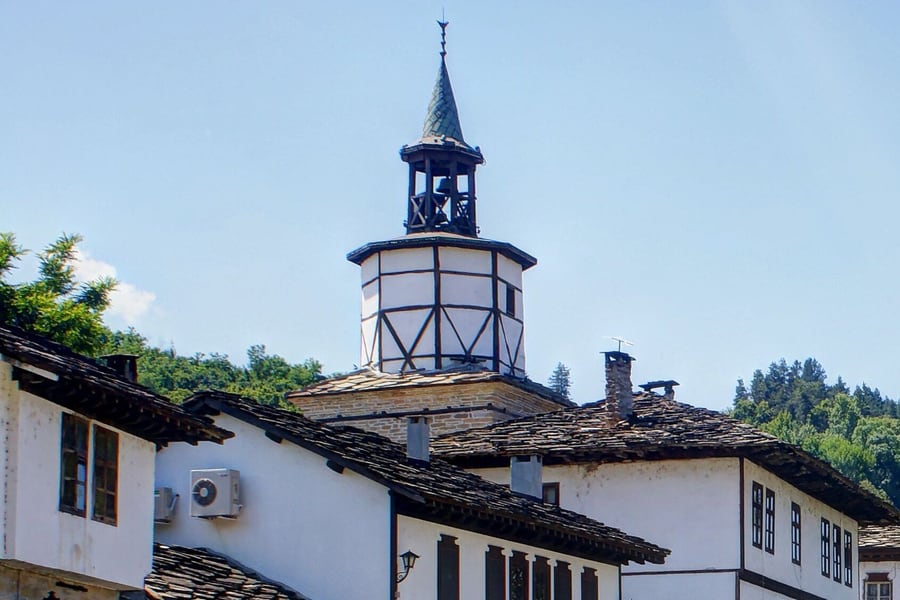 Gitanes232 / Wikimedia Commons · CC0 · cropped
Tryavna's clock tower and old square
Tryavna is known for its National Revival architecture, with 140 cultural monuments, museums and collections. The clock tower on the main square dates from 1814, and the humped stone bridge crosses the river behind it. The writer Pencho Slaveykov was born here, and one of the first secular schools in Bulgaria stands on the same square.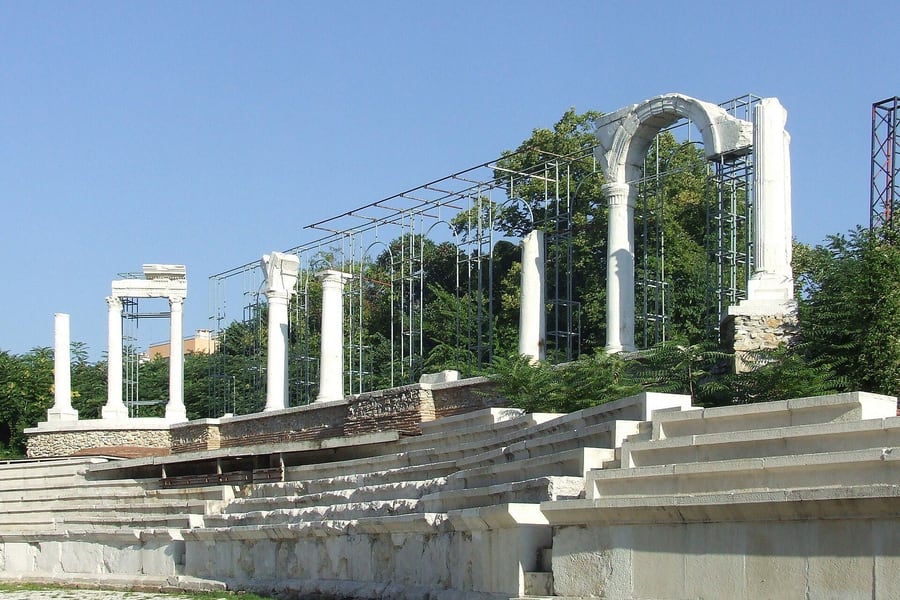 DALIBRI / Wikimedia Commons · CC BY-SA 3.0 de
Augusta Traiana, under Stara Zagora
In 106 the emperor Trajan gave the Thracian town of Beroe its own government and his own name, and Augusta Traiana became the second city of the Roman province of Thrace after Philippopolis. Part of the Roman city has been excavated beneath the modern one, including tiers of marble seating. Ammianus Marcellinus counted it with Philippopolis as the great cities that adorned Thrace.Where to Sleep
The three hotels below sit at either end of the line, in Veliko Tarnovo and Stara Zagora. None of them is booked through this site: each card links to the hotel's own website, and no price, rating or star count appears on any of them, because none has been verified here.
Where to stay
Grand Hotel Yantra
Veliko Tarnovo, facing Tsarevets
In the centre of Veliko Tarnovo, with rooms looking across to Tsarevets, Trapezitsa and Arbanasi, a panoramic restaurant and a spa with a 4 by 8 metre pool.
Check Availability (opens in a new tab, on yantrabg.com)via yantrabg.comMeridian Bolyarski
Veliko Tarnovo, near Samovodska charshiya
Built down fifteen levels of the hillside from the main street to Gurko Street, with 69 rooms, a view over the Yantra and murals of the Second Bulgarian Empire covering 140 square metres.
Check Availability (opens in a new tab, on bolyarski.com)via bolyarski.comMerian Palace
Stara Zagora, beside the lake park
About 500 metres from the centre of Stara Zagora next to a park with a lake, with a restaurant overlooking it and individually decorated rooms.
Check Availability (opens in a new tab, on merianpalace.com)via merianpalace.comQuestions or corrections
Planning this trip and stuck on something, or spotted a time, fare or detail that has changed? Send us a message about Over the Balkan by Tryavna. We read every one, and we update this page when something has changed.