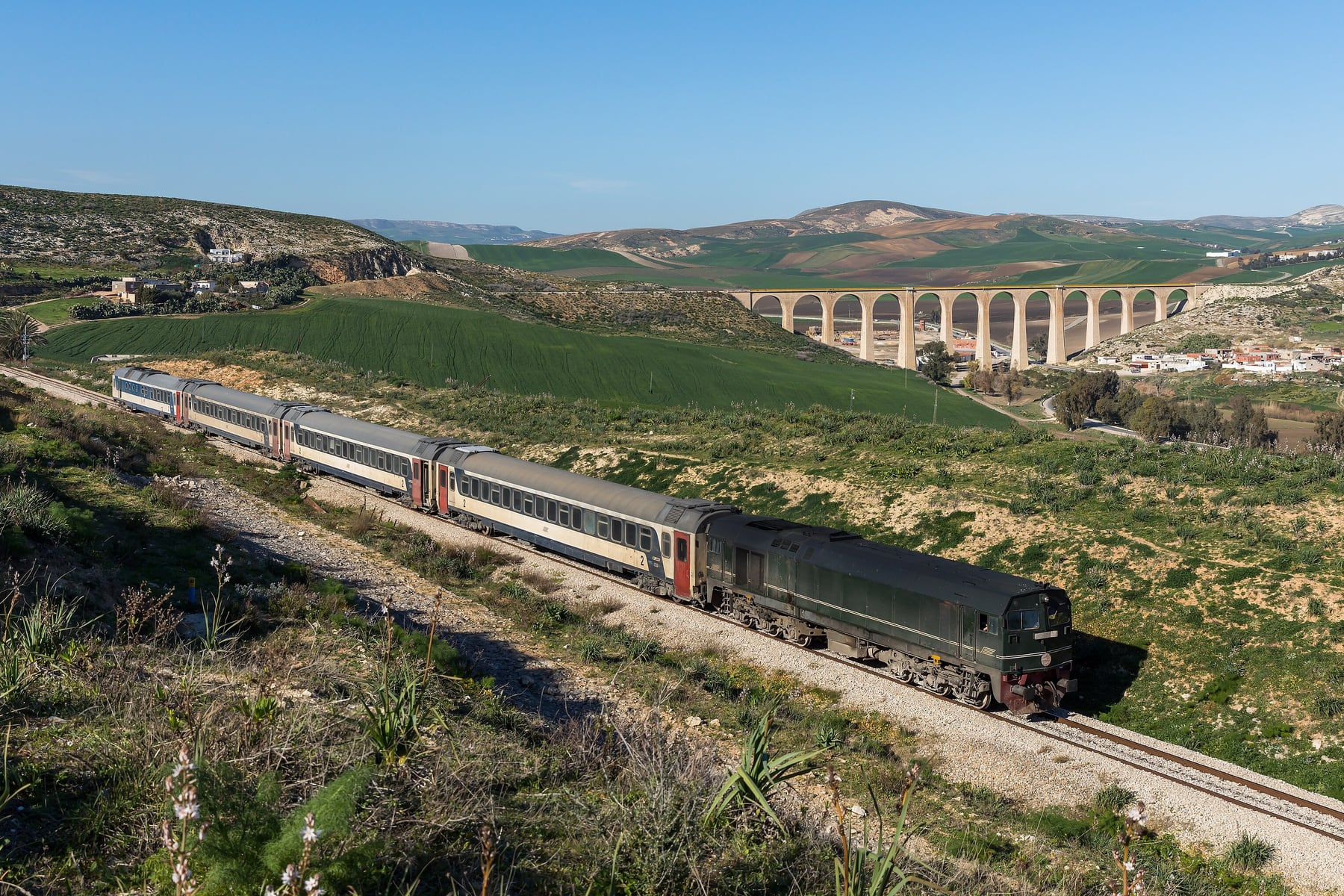
Tunis to Annaba
Kabelleger / David Gubler / Wikimedia Commons · CC BY-SA 4.0 · cropped
- DistanceTunis Ville–Annaba · about 357 km
- Duration9 hours 55 minutes eastbound · 9 hours 38 minutes westbound
- Best seasonAll year · three days a week each way, outside the month of Ramadan
Introduction
At twenty-five past eight on a Monday, Wednesday or Friday morning, a train leaves Tunis for another country.
It is the only passenger train that crosses the frontier between Tunisia and Algeria, and for most of the last thirty years it did not run at all. It leaves Tunis Ville, runs west up the valley of the Medjerda through Béja and Jendouba, stops for an hour and a half at Ghardimaou while Tunisia lets you go, stops for another hour at Souk Ahras while Algeria lets you in, and comes down to the Mediterranean again at Annaba at twenty past six in the evening. Three days a week each way, one train each day, about 357 kilometres.
A line older than the border posts
The railway was laid by one French company across two French territories. The Compagnie des chemins de fer Bône-Guelma — Bône being the colonial name for Annaba — was granted the line from Tunis to the Algerian network in 1877, opened it as far as Jendouba in 1879, and completed the link through Souk Ahras in 1884. For most of its life it was simply the way between the two countries.
Passenger trains across the border stopped in 1995, for security reasons. They came back briefly in 2003 and stopped again. On 11 August 2024 SNCFT ran the first commercial train from Tunis to Annaba in nearly three decades, with about eighty passengers aboard from Tunis and more joining along the way.
What kind of journey this is
An ordinary diesel train of older rolling stock: at the relaunch it ran with two first-class carriages and two second, for about three hundred passengers. It is not fast, and the two border stops are long by design: passports and customs are done at the stations, so the train simply waits. Both countries keep the same clock, so the times on the poster mean what they say on both sides.
What it gives you is the Medjerda — wheat country, Roman towns and wooded frontier hills — and the rare experience of arriving in Algeria by rail, at a city where Saint Augustine was bishop.
The Journey
The train leaves from Tunis Ville, SNCFT's terminus on the Place de Barcelone, at 08:25. The first stretch west through Manouba, Jedeida and Tebourba is shared with the stopping trains to Jendouba and Ghardimaou, but the international train calls at none of their stations: its first stop is Béja, more than two hours out.
Into the Medjerda
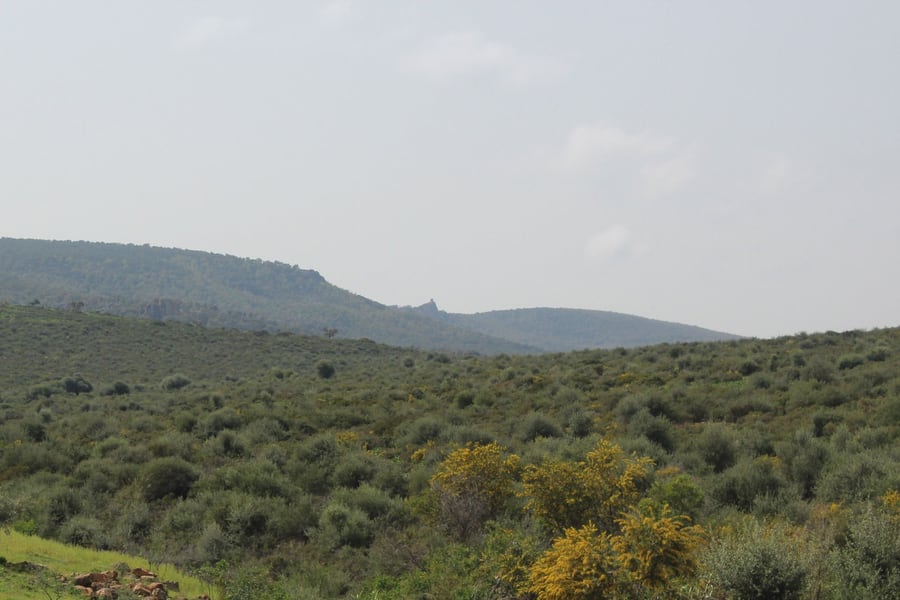
The Medjerda, the Bagradas of the Romans, rises in north-east Algeria and runs 450 kilometres to the Gulf of Tunis — the longest river in Tunisia. The railway follows its valley up to the frontier, through open farming country of wheat fields and eucalyptus windbreaks.
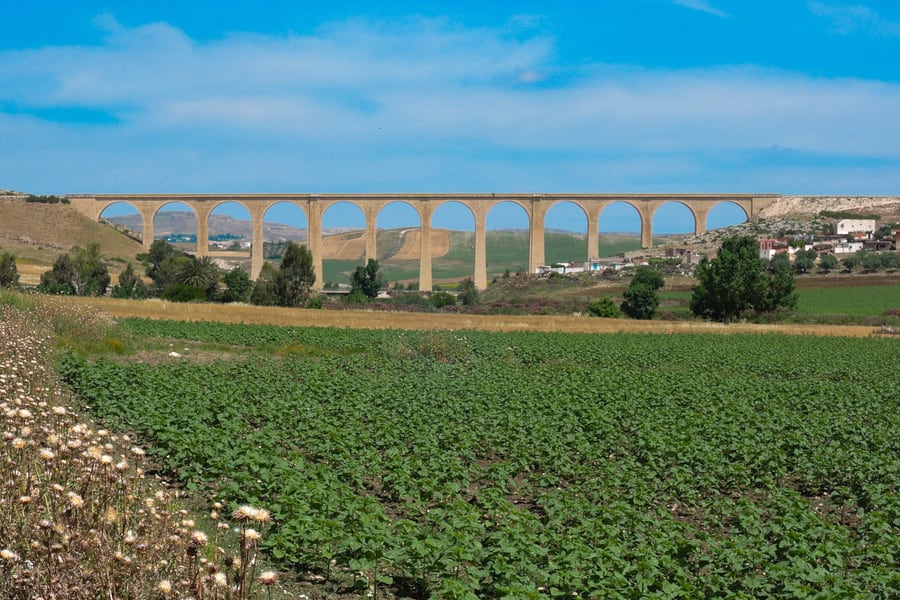
Béja at 10:43. The town sits on the slopes of Djebel Acheb in the foothills of the Kroumirie, white walls and red roofs under the ruins of an old Roman fortress. Near it the line crosses the tall stone arches of the viaduct known as the Pont Cinquième — the bridge in the photograph at the top of this page.
Jendouba and the Roman north-west
Jendouba at 11:38. Called Souk El Arba until 1966, it is a crossroads town for the whole north-west, and the stop for two of the best Roman sites in the country: Bulla Regia, where the wealthy lived in houses built half underground against the summer heat, and Chemtou, the quarry that supplied Rome with its yellow Numidian marble.
Ghardimaou
Ghardimaou at 12:03, the last town in Tunisia, under the 1,300-metre Djebel el Ghorra. The train stands here until 13:30 for the Tunisian border and customs formalities; the station was refurbished for the relaunch. Between 1995 and 2024, apart from a brief spell in 2003, this was where every passenger train up the valley ended.
Souk Ahras
Across the frontier, Souk Ahras at 14:47, and the Algerian formalities until 15:45. This is ancient Thagaste, where Augustine was born in 354, and the first Algerian city on the line.
Down to Annaba
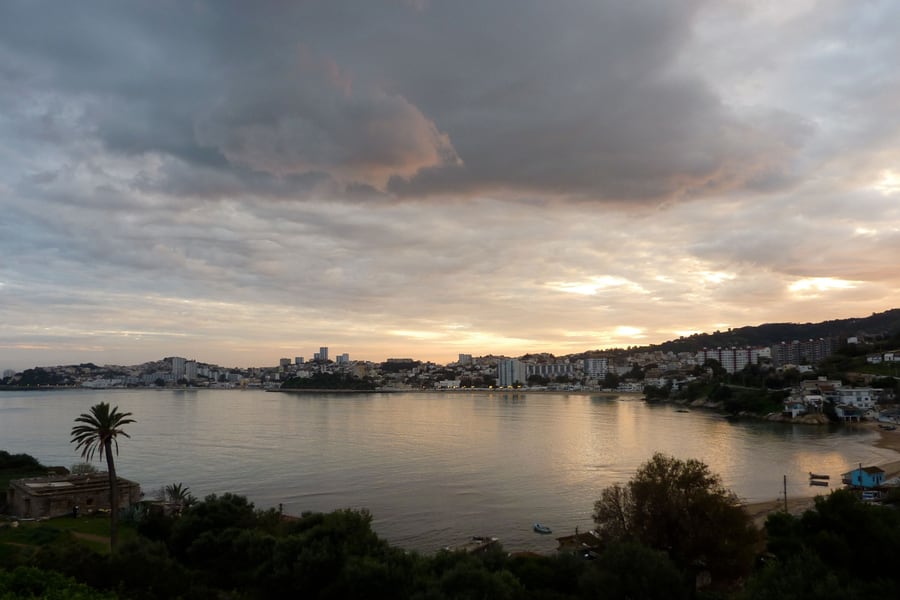
The last leg takes two and a half hours, down out of the hills towards the coast. Annaba at 18:20: a seaport, the third-largest city in Algeria and its leading industrial centre. Beside the ruins of Hippo Regius — the city where Augustine was bishop, and where he died in 430 — stands the basilica built in his name.
Practical notes for the ride
- Carry your passport where you can reach it, and whatever visa your nationality needs for Algeria — the checks are done at Ghardimaou and Souk Ahras stations, not at a road post.
- Buy food in Tunis. Nothing published says the train carries catering, and the border stops are long.
- The Tunisian dinar is a closed currency: spend or change what you have before you leave.
- The return train leaves Annaba at 09:00 on Tuesdays, Thursdays and Sundays, and reaches Tunis at 18:38.
Along the route
 Elgollimoh / Wikimedia Commons · CC BY-SA 3.0 · cropped
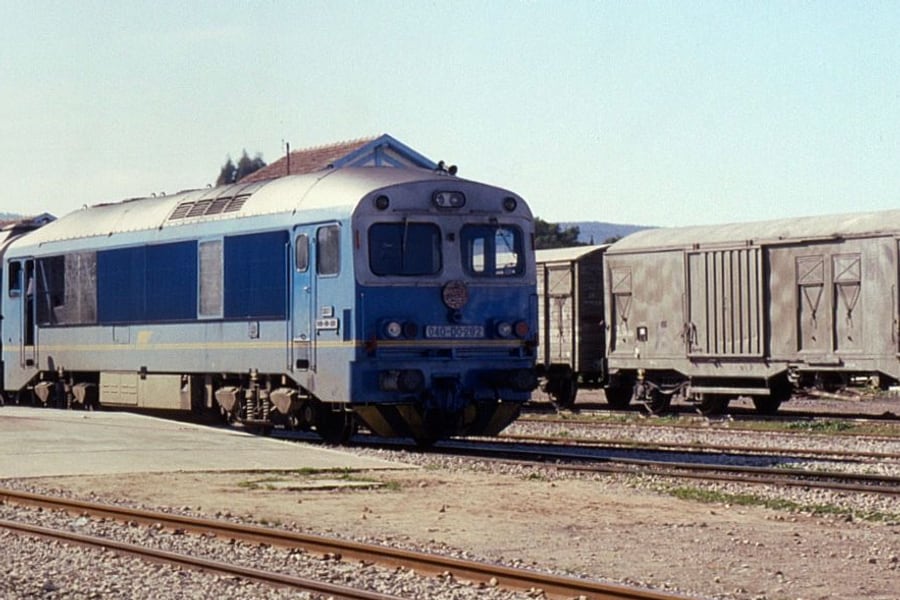
A railway older than the border posts
The Bône-Guelma company, named for Bône — colonial Annaba — and Guelma, was granted the line in 1877, opened Tunis to Jendouba in 1879 and joined it to the Algerian network through Souk Ahras in 1884. It was built as one railway, not two.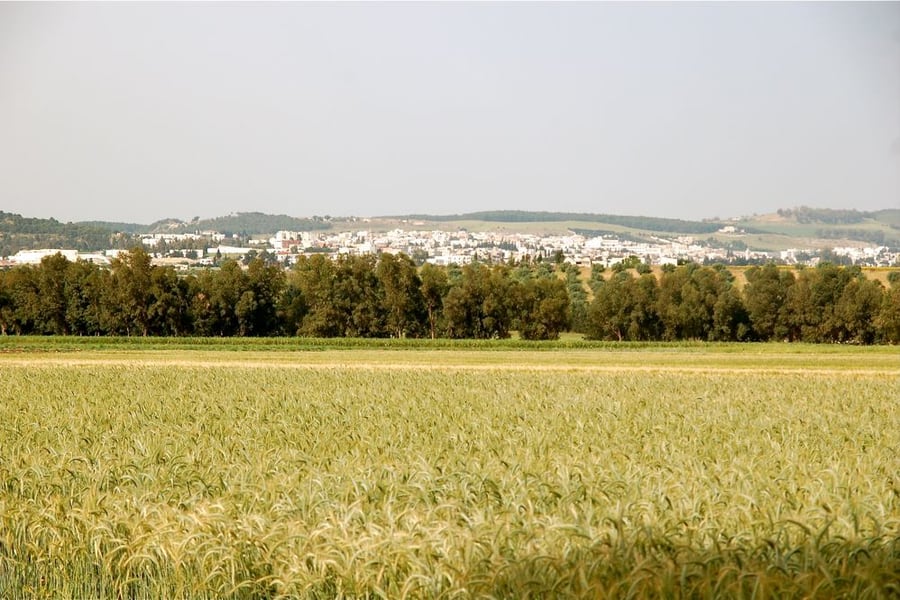 IanRiley / Wikimedia Commons · CC BY-SA 3.0 · cropped
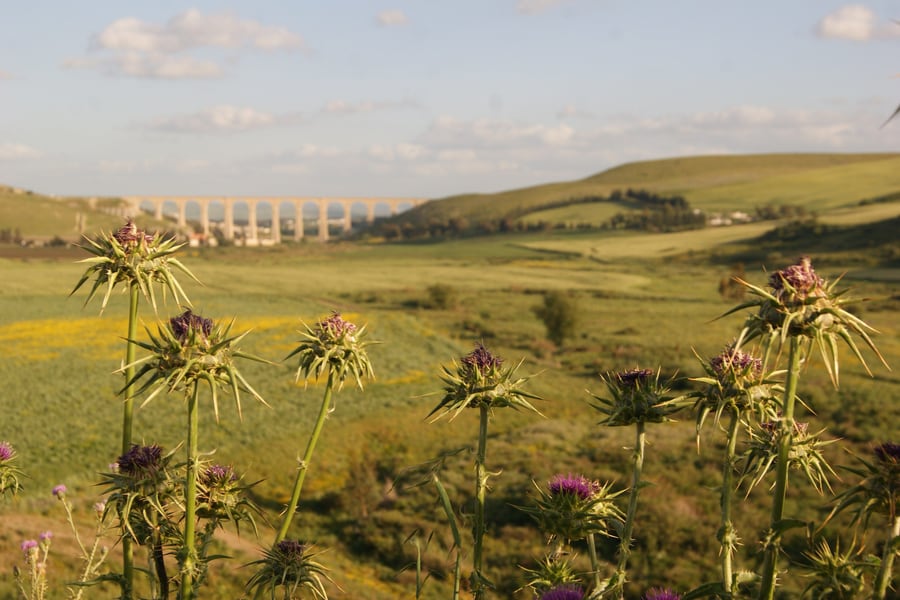
Up the Medjerda
The line follows the Medjerda, the Bagradas of the Romans and at 450 kilometres the longest river in Tunisia, up its valley from Tunis to the frontier, through wheat fields and eucalyptus windbreaks around Béja.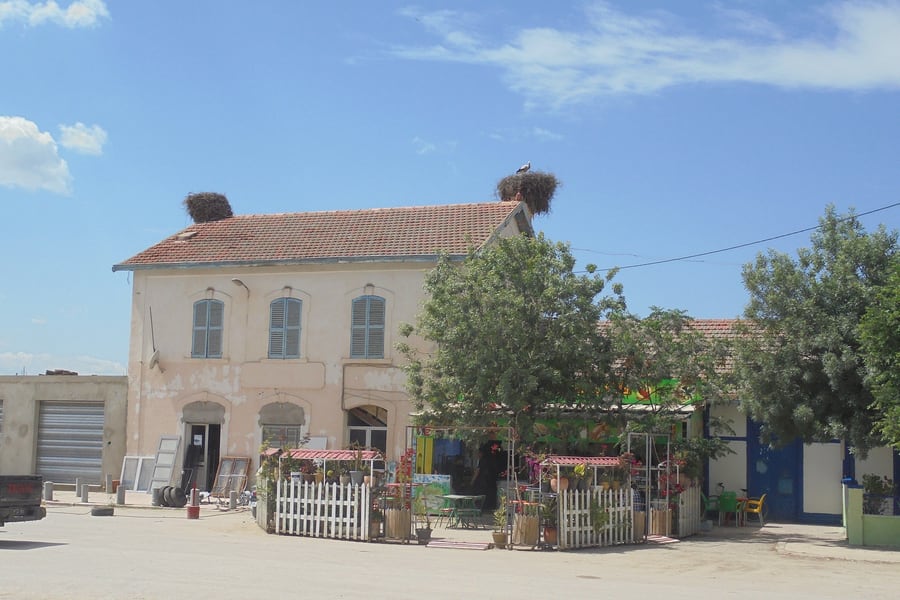 Camille56 / Wikimedia Commons · CC BY 4.0 · cropped
Back after thirty years
Trains across the border stopped in 1995, ran briefly in 2003 and stopped again. SNCFT restarted the service on 11 August 2024, and refurbished the station at Ghardimaou, where the Tunisian checks are done, for the occasion.A bit of history
Culture & experiences along the way
 Ayoub chaabi / Wikimedia Commons · CC BY-SA 3.0 · cropped
Two frontiers, two long stops
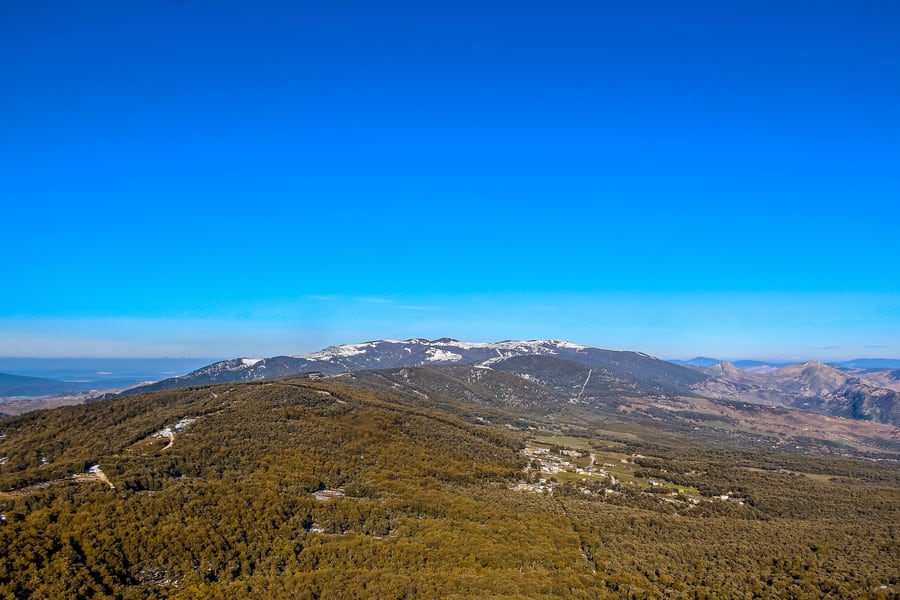
There is no border post on a road to queue at: the train simply stands still. Eastbound it waits almost an hour and a half at Ghardimaou under Djebel el Ghorra for the Tunisian formalities, then an hour at Souk Ahras for the Algerian ones. Have your passport, and any visa you need for Algeria, to hand.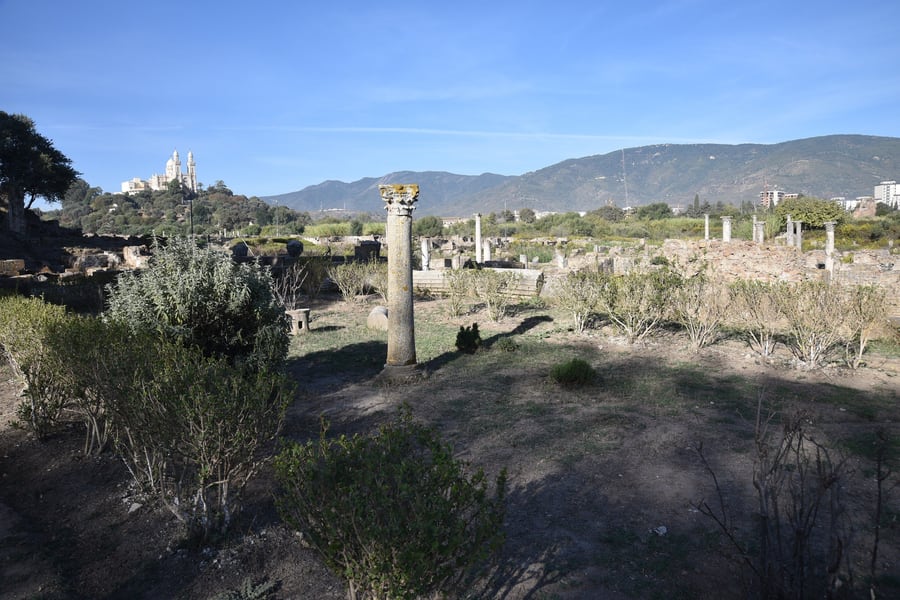 Carole Raddato / Wikimedia Commons · CC BY-SA 2.0 · cropped
Augustine at both ends of the line
Augustine was born at Thagaste, today's Souk Ahras, in 354, and died bishop of Hippo Regius — Annaba — in 430. The train covers the road between the two in two and a half hours. The ruins of Hippo lie below the basilica built in his name, which keeps a bone from his arm inside a marble statue of him.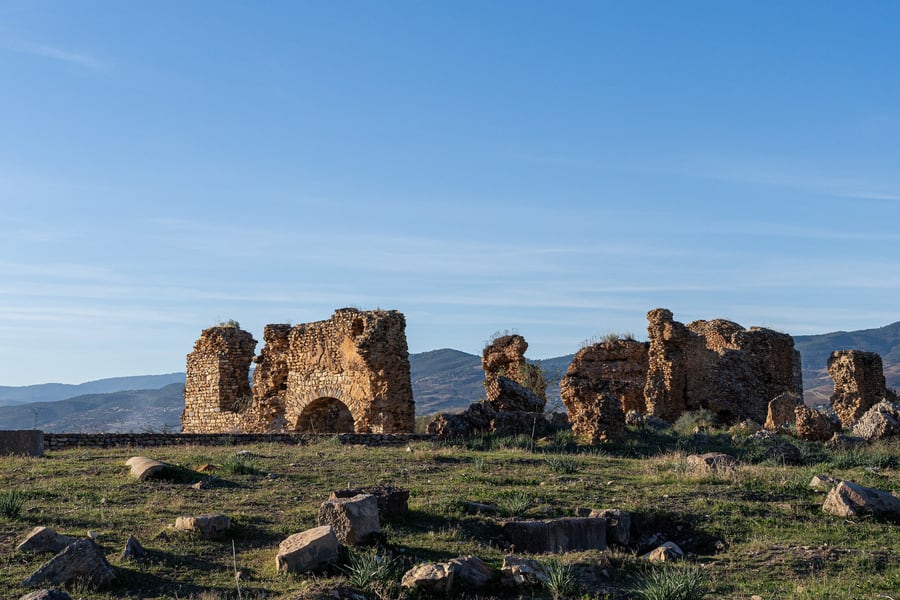 Skander zarrad / Wikimedia Commons · CC BY-SA 4.0 · cropped
The yellow marble of Chemtou
Twenty kilometres from Jendouba, Chemtou quarried giallo antico, the yellow Numidian marble that was among the most precious stones in the Roman Empire. A Tunisian-German team has excavated it since the late 1960s, and its museum shows the finds, including pieces of a Numidian royal monument.Timetables
The times below are SNCFT's own, from its "Horaires des trains grandes lignes" poster for 1 September 2026 to 30 June 2027, which applies outside the month of Ramadan. There is one train each way on three days a week: the two directions alternate, so there is a train every day except Saturday.
Tunis to Annaba — train TM1, Mondays, Wednesdays and Fridays
| Station | |
|---|---|
| Tunis Ville | 08:25 |
| Béja | 10:43 |
| Jendouba | 11:38 |
| Ghardimaou (Tunisian formalities) | arr 12:03 · dep 13:30 |
| Souk Ahras (Algerian formalities) | arr 14:47 · dep 15:45 |
| Annaba | 18:20 |
9 hours 55 minutes end to end.
Annaba to Tunis — train TM2, Tuesdays, Thursdays and Sundays
| Station | |
|---|---|
| Annaba | 09:00 |
| Souk Ahras (Algerian formalities) | arr 11:10 · dep 12:10 |
| Ghardimaou (Tunisian formalities) | arr 13:21 · dep 14:50 |
| Jendouba | 15:19 |
| Béja | 16:17 |
| Tunis Ville | 18:38 |
9 hours 38 minutes end to end. SNTF's own announcement of October 2026 gives the arrival in Tunis as 18:27; the times above are SNCFT's.
Tunisia and Algeria keep the same time, so every time on this page is the local time at that station.
Stopping trains on the Tunisian side
If you only want the Medjerda valley, SNCFT's domestic trains to Ghardimaou call at the intermediate stations from Manouba to Oued Meliz. Train 7 leaves Tunis at 06:35 and reaches Ghardimaou at 10:49; train 13 leaves at 13:05 (Ghardimaou 17:06); train 17 at 17:15 (Ghardimaou 21:16). Back towards Tunis, trains leave Ghardimaou at 04:05, 09:00 and 12:10.
Disruption
Works on the Algerian side interrupted the train more than once in 2026. A single departure from Tunis was cancelled on 14 September; from 1 to 20 October a bus replaced the train between Souk Ahras and Annaba while ANESRIF, Algeria's rail-investment agency, carried out works between Aïn Sennour and Souk Ahras. Through trains returned on 21 October 2026.
Practical
- Each direction runs only three days a week, so plan the return before you go.
- No restaurant service is advertised. Take food and water for ten hours.
- The poster does not apply during Ramadan. Check SNCFT's announcements for that month.
Operator: SNCFT — timetables at sncft.com.tn (opens in a new tab). Times above as of November 2026.
Tickets
Each railway sells the train from its own end. In Tunisia the ticket is SNCFT's, in Tunisian dinars; at the relaunch in August 2024 it set one-way fares of 38 dinars in second class and 44 in first, with returns at 71 and 81 that must be reserved before the journey back. In Algeria SNTF sells it at Annaba and Souk Ahras and at Algiers, Oran, Constantine, Sétif and El Eulma stations, for 1,900 Algerian dinars in first class and 1,640 in second one way, as announced in October 2026.
Children under four travel free and children from four to twelve pay a reduced fare. Buy ahead at a station: there are only three departures a week in each direction.
Book your tickets
Tunis to Annaba · train TM1
Mondays, Wednesdays and Fridays
Leaves Tunis Ville at 08:25 and reaches Annaba at 18:20, sold by SNCFT in Tunisian dinars.
Book Tickets (opens in a new tab, on SNCFT)via SNCFTAnnaba to Tunis · train TM2
Tuesdays, Thursdays and Sundays
Leaves Annaba at 09:00 for Tunis, sold by SNTF in Algerian dinars at its stations.
Book Tickets (opens in a new tab, on SNCFT)via SNCFTRail Passes
No rail pass covers this journey. Each railway sells its own ticket at its own stations, and the fare for the whole run is low.
Checked November 2026.
Places to Visit
Five places are worth stopping for, one at each of the train's calls. The two Roman sites near Jendouba need a day of their own and a night in the valley; the international train only stops three times a week, so the stopping trains between Tunis and Ghardimaou are the way to see the Tunisian half at leisure.
 Causseni Nour / Wikimedia Commons · CC BY-SA 4.0 · cropped
Béja
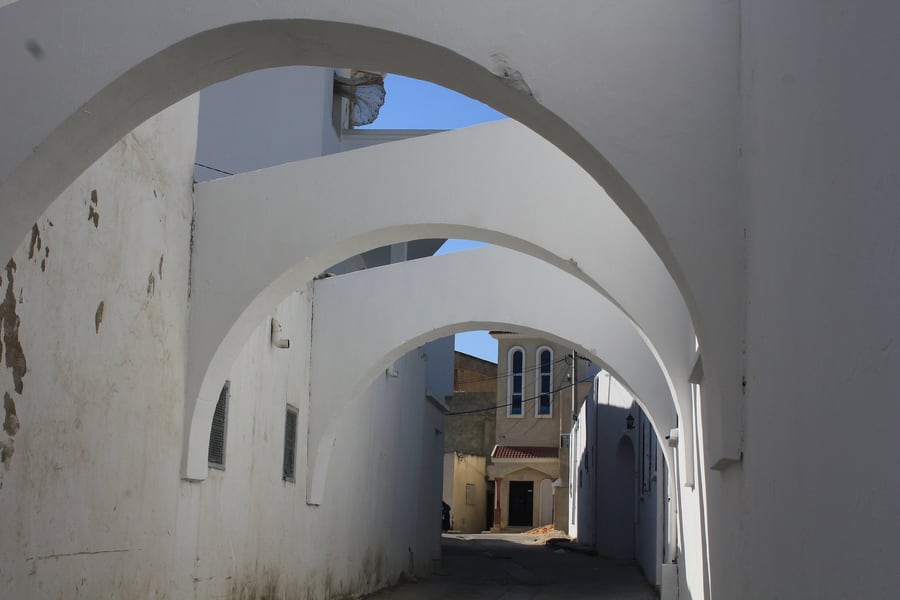
A hill town on the slopes of Djebel Acheb, 105 kilometres from Tunis, between the Medjerda and the Mediterranean in the foothills of the Kroumirie. White terraces and red roofs climb towards the ruins of the old Roman fortress at the top, and the lanes below are stitched together with whitewashed arches. The westbound train calls at 16:17.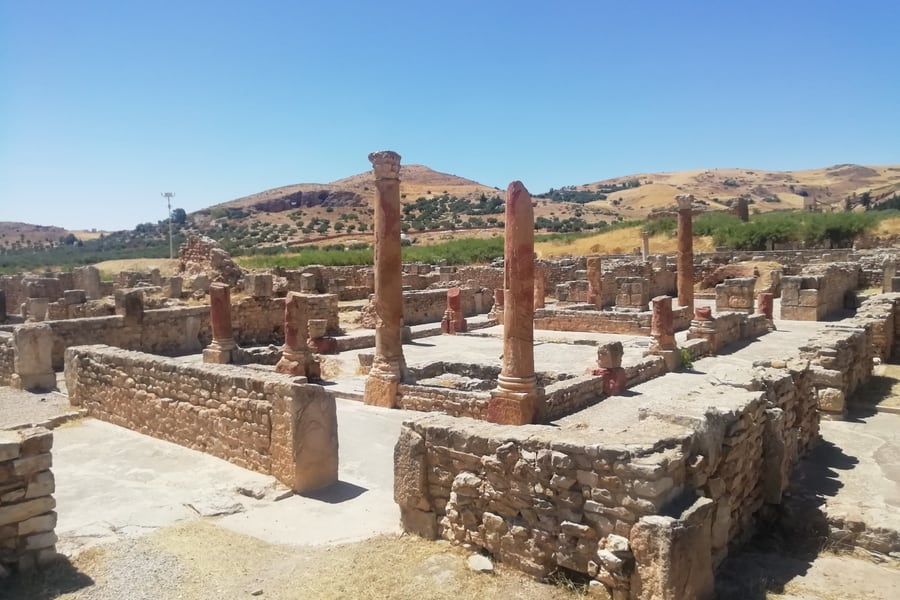 Houss 2020 / Wikimedia Commons · CC BY-SA 4.0 · cropped
Bulla Regia
A Berber, Punic and Roman town near Jendouba, and a royal seat of the Numidian king Masinissa from 156 BC. Its fame is its houses: in the reign of Hadrian the rich built them half underground, out of reach of the summer heat, and many of their mosaic floors are still in place. A small museum stands by the site.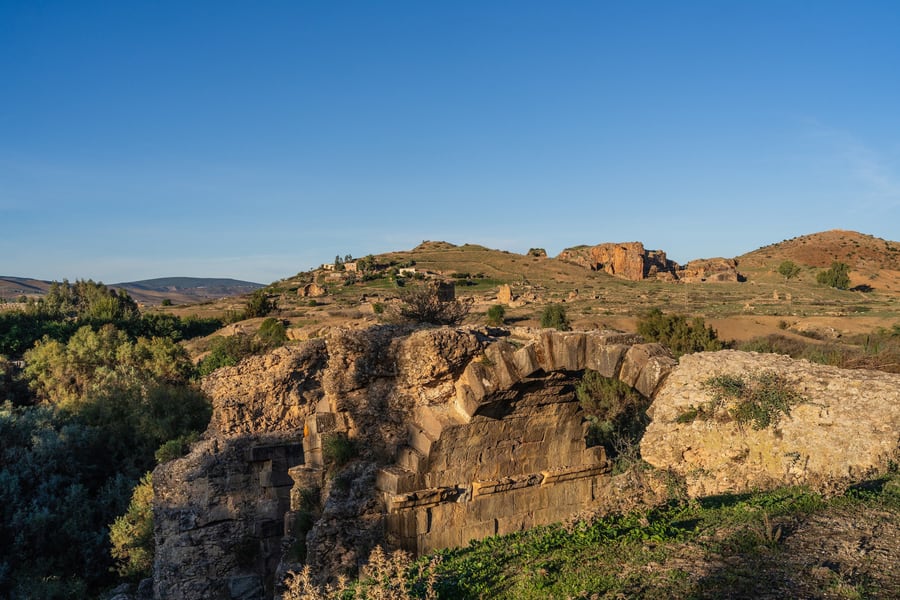 Skander zarrad / Wikimedia Commons · CC BY-SA 4.0 · cropped
Chemtou and Trajan's bridge
Ancient Simitthu lies 20 kilometres from Jendouba near the Algerian frontier, where the Roman road from Carthage to Hippo crossed the road from Tabarka to El Kef. Below the town the Medjerda is crossed by the remains of a bridge built in 112 AD under Trajan, one of the largest Roman bridges in North Africa, and the site museum holds its dedication.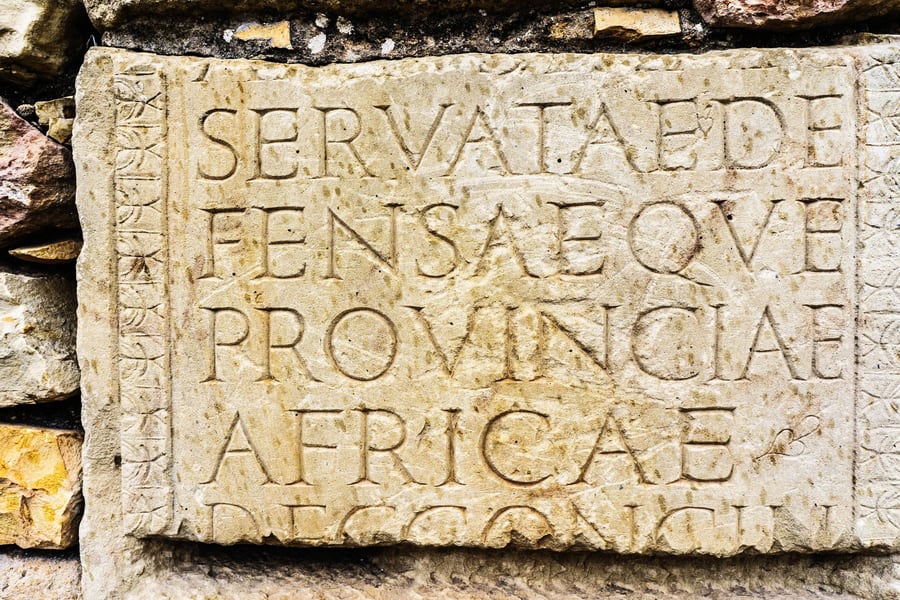 Dan Sloan / Wikimedia Commons · CC BY-SA 2.0 · cropped
Souk Ahras, once Thagaste
The first Algerian city on the line is built on the ruins of Thagaste, a Numidian town and a centre of Berber culture, where Augustine was born in 354. Latin inscriptions from the Roman town survive among the remains. The eastbound train stands here for an hour, from 14:47 to 15:45, while the Algerian formalities are done.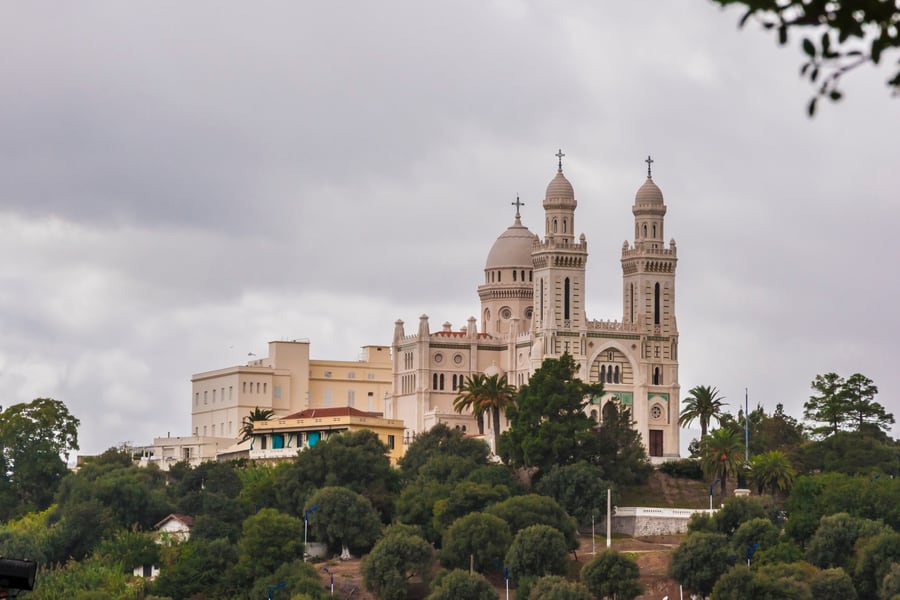 alioueche mokhtar / Wikimedia Commons · CC BY-SA 4.0 · cropped
Annaba and the basilica of Saint Augustine
Annaba was Hippo Regius to the Romans and Bône to the French. On a hill beside the ruins of Hippo stands the Basilica of Saint Augustine, begun in 1881 and finished in 1900, built of stone brought from France with Carrara marble inside; a bone from Augustine's right arm, returned from Pavia in 1842, rests in a glass tube in the arm of his statue.Where to Sleep
Ten hours is a long day, and the train's three-days-a-week pattern decides where you sleep more than anything else does.
Tunis
Start here. Hotels along the Avenue Habib Bourguiba and around the Place de Barcelone are within walking distance of Tunis Ville, which matters for an 08:25 departure. In the medina, restored dar guesthouses offer a few rooms around a courtyard.
Béja and Jendouba
Modest, practical hotels in both towns. Jendouba is the base for Bulla Regia and Chemtou, and the stopping trains from Tunis make it an easy first night if you want to see the valley before crossing.
Annaba
The widest choice on the line, in a metropolitan area of about a million people. The train gets in at 18:20, after dark in winter, so book the first night before you leave Tunis. The next train back leaves the following morning at 09:00 — except after a Friday arrival, when the next one is on Sunday.
Questions or corrections
Planning this trip and stuck on something, or spotted a time, fare or detail that has changed? Send us a message about Tunis to Annaba. We read every one, and we update this page when something has changed.