Verde Canyon Railroad
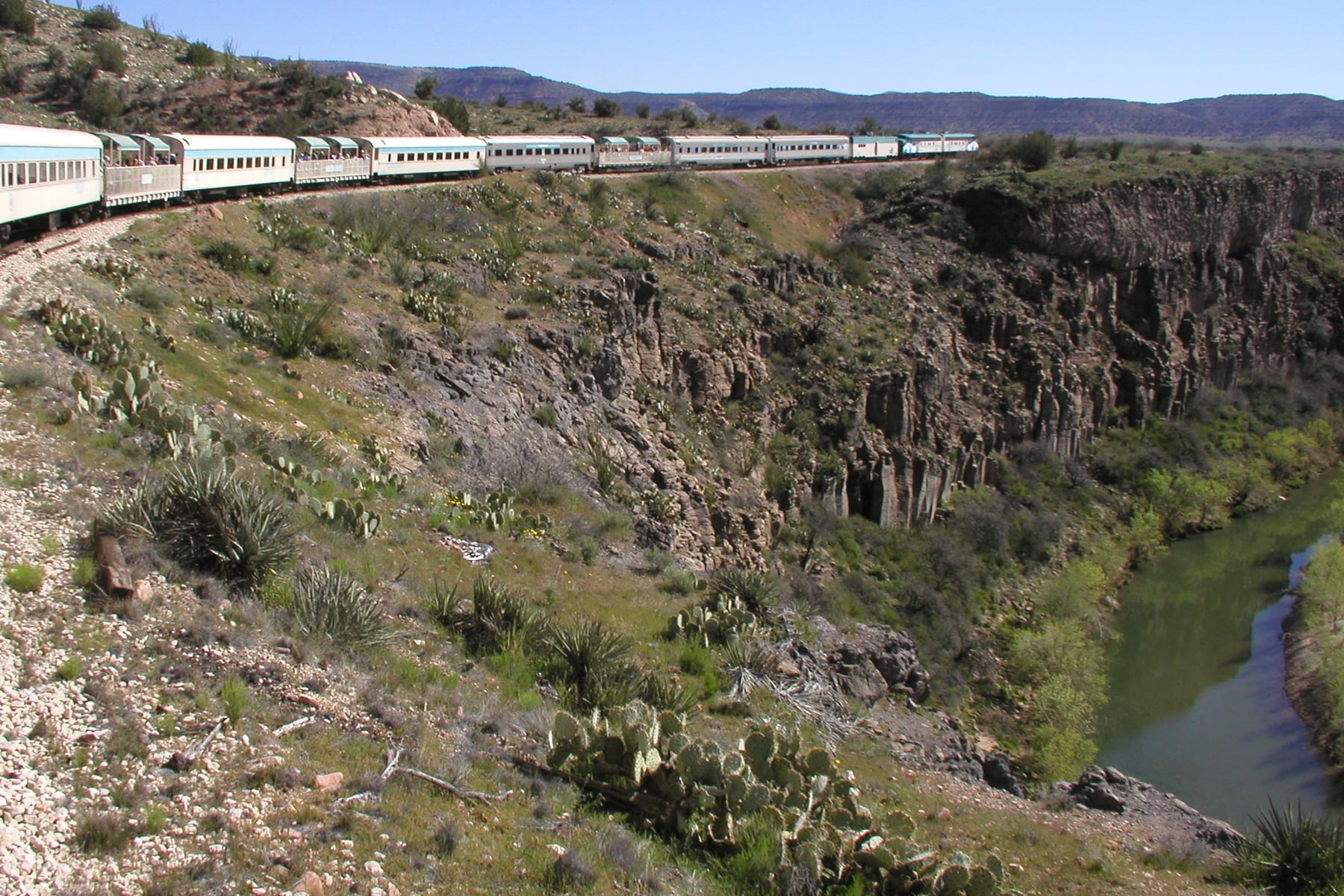
Alan Levine / Flickr · CC0 · cropped
- Distance40 miles round trip, Clarkdale to Perkinsville and back
- Duration3½ to 4 hours
- Best seasonAll year; eagles in winter, gold cottonwoods in autumn
Introduction
North of Clarkdale, Arizona, the Verde River runs for 20 miles through a canyon that no road crosses: dirt tracks come to an end at either side, and between them there are only the river, the red-rock walls and a railroad. It was built in 1911 and 1912 by 750 men with picks, shovels, donkeys and dynamite, to carry copper from the smelter at Clarkdale to the Santa Fe main line, and it took them a single year.
Since 1990 the Verde Canyon Railroad has carried passengers instead. Its trains leave Clarkdale behind a pair of EMD FP7s built in 1953, cross the basalt gorges on steel trestles, follow the river past Sinagua cliff dwellings and the trees where bald eagles spend the winter, pass through a curved 734-foot tunnel blasted out of solid limestone, and turn back at the old ranch station of Perkinsville. The round trip is 40 miles and takes three and a half to four hours, and every seat comes with a place on an open-air car.
Trains run all year, most days at 1 p.m.
The Journey
The trip starts at the depot on North Broadway in Clarkdale, a company town founded in 1912 by the copper magnate William A. Clark. Give yourself an hour and a half before the train: there is the Copper Spike Café, whose lunches you can carry on board, the Boxcar Gift Store, and the John Bell Museum in an old boxcar, while storyboards run the quarter-mile length of the platform. From the depot you can see the mining town of Jerome halfway up the mountain, and the ruins of Tuzigoot on their ridge across the valley.
Every seat is assigned. The passenger cars have couches that face each other in fours and chairs for two at bistro tables, and each is coupled to an open-air viewing car, shaded by a canopy, that anyone may use. Narration comes over the speakers, or through the AudioFetch app on your own earphones.
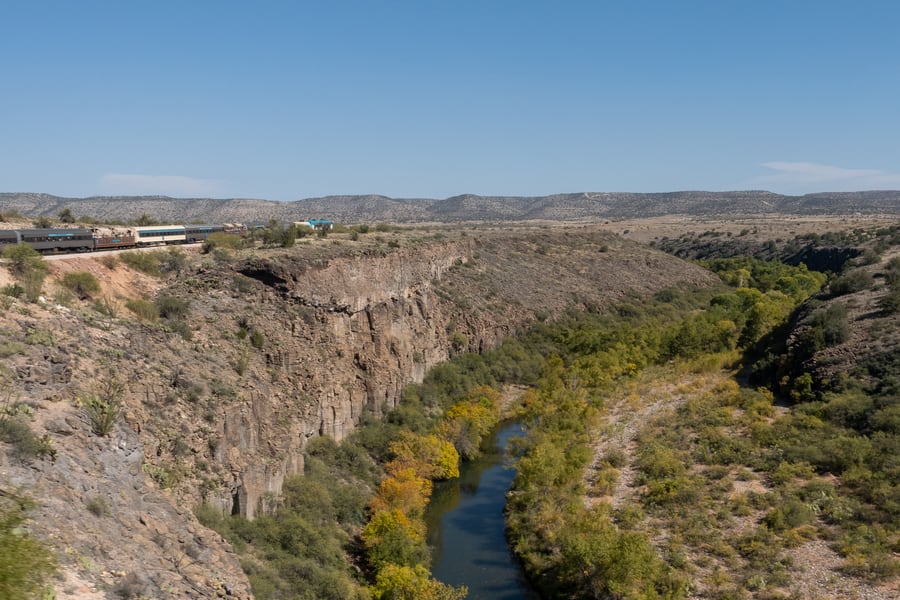
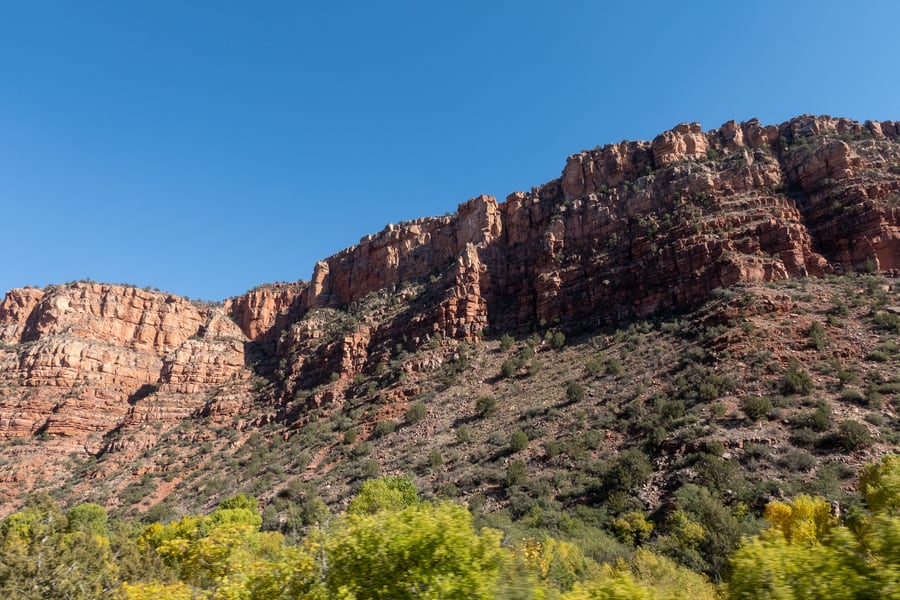
The train leaves past the black slag heap of the old smelter, Sinagua cliff dwellings high in the rock and the smokestack of a power plant of 1918, then crosses its first bridge, built from the turntable of the Prescott roundhouse. For the next three miles it runs on basalt above the river's inner gorge, crossing the highest and longest bridge on the line at S.O.B. Canyon. At milepost 30, where Sycamore Creek comes in, the Coconino and Prescott National Forests close in on both sides. Just before it, a monocline tips the red rock on end beside the track; in winter, bald and golden eagles hunt along the river. Between the termini the line drops almost 500 feet.
The tunnel
At milepost 22.5 the construction crews met a point they could not go around. A crew of Swedes spent six months in 1911 blasting through solid limestone, and the result is 734 feet long and curved, so you cannot see the exit from the entrance. Timbers support it only for about 30 feet at each end; the rest is bare rock, close on both sides of the cars.
The trains
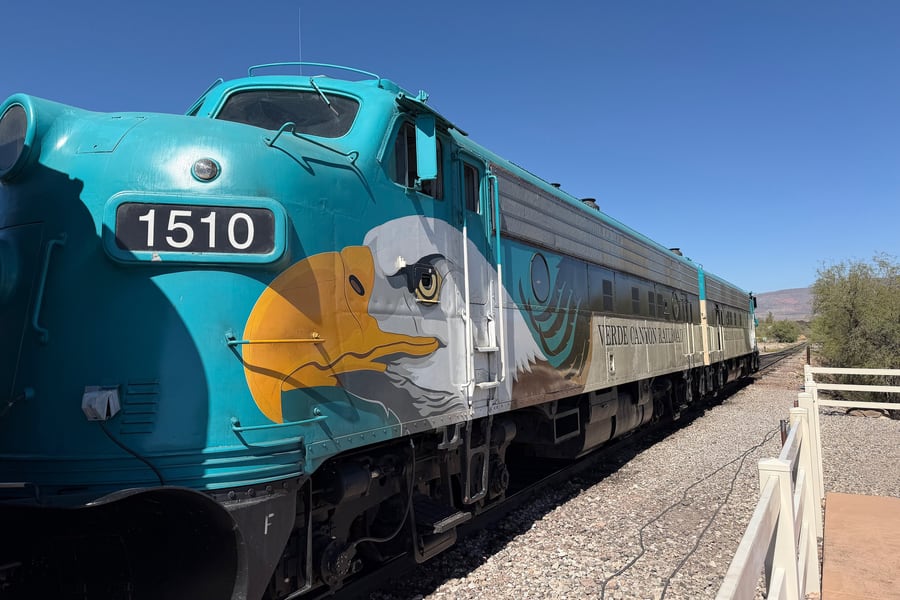
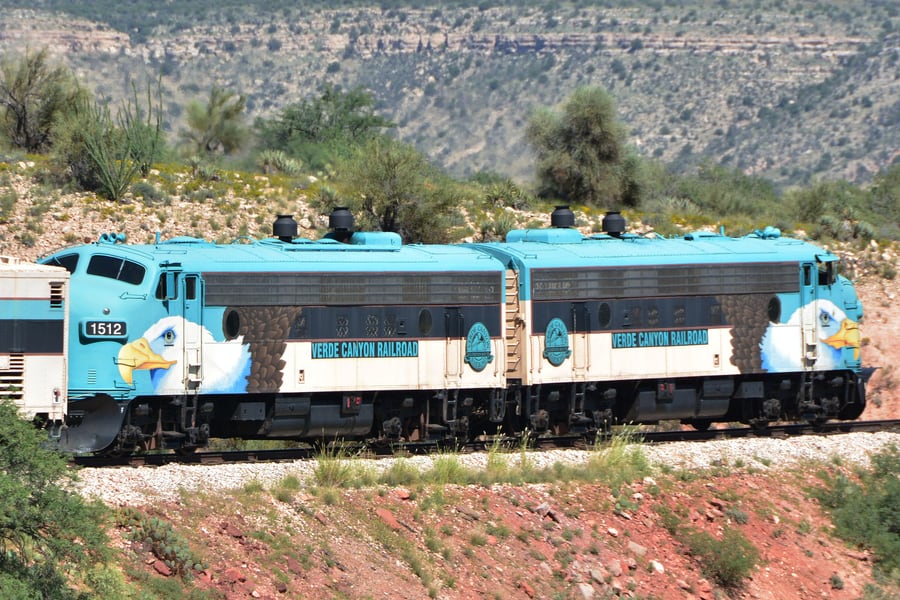
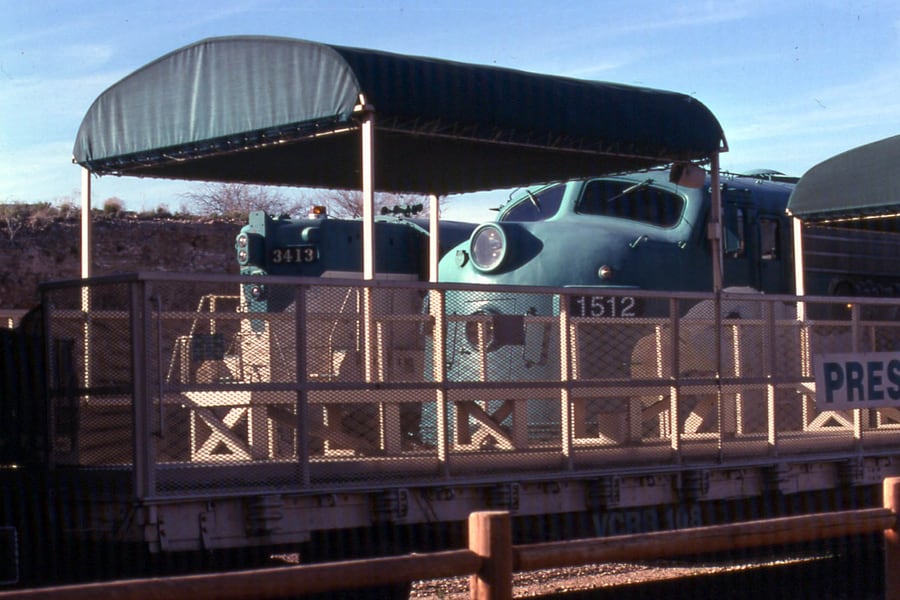
The train is pulled by two EMD FP7s, Nos. 1510 and 1512, built by General Motors at LaGrange, Illinois, in 1953 for the Alaska Railroad, and among the last ten of their kind still at work in North America. They first ran here on 8 March 1997, and in 2019 they were repainted, turquoise, with a bald eagle hand-painted on each side. Behind them come twelve passenger cars, the open-air cars and a red caboose of 1929.
At Perkinsville, a ranch station of 1912 where scenes of How the West Was Won were filmed, the locomotives run round the train and couple onto the other end for the ride back. Passengers stay on board; the light has moved by then, and the canyon looks different on the way home.
Along the route
 Rob Bixby / Flickr · CC BY 2.0 · cropped
The mountain of slag
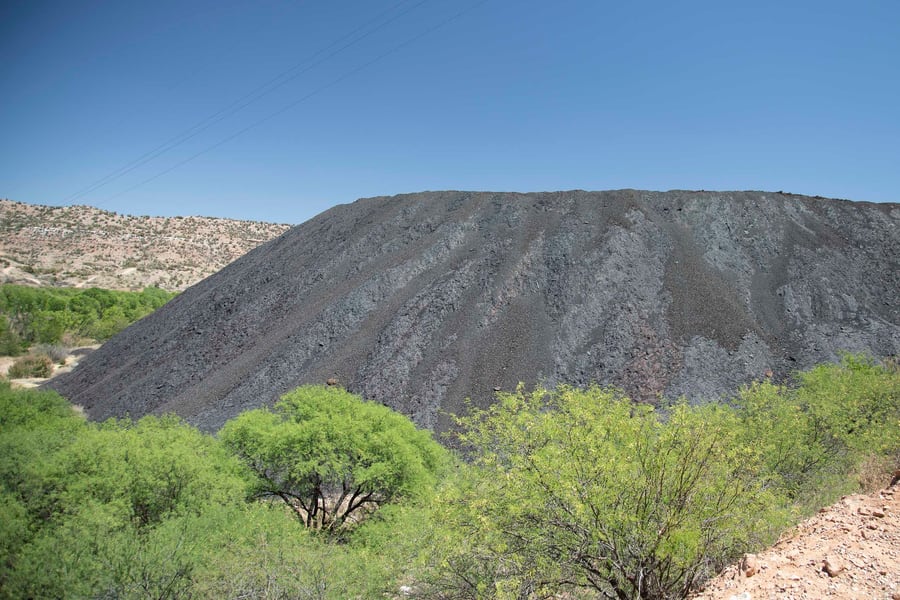
Leaving Clarkdale, the train runs past a black mountain of slag, some 40 acres of waste poured molten from the copper smelter for almost 40 years. Rusted iron pipes and sheets still line the track, where they held the molten slag back from the rails.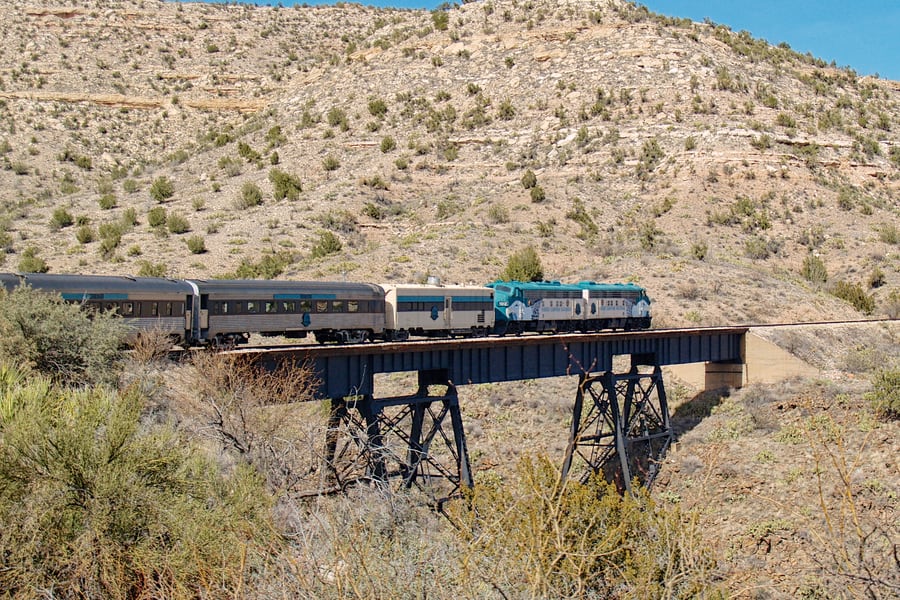 Clay Gilliland / Wikimedia Commons · CC BY-SA 2.0 · cropped
Bridges over the gorges
The line crosses 24 bridges, most of them steel. The first was built from an old turntable at the Prescott roundhouse; the highest and longest spans S.O.B. Canyon, named, the railroad says, for the Superintendent of Bridges.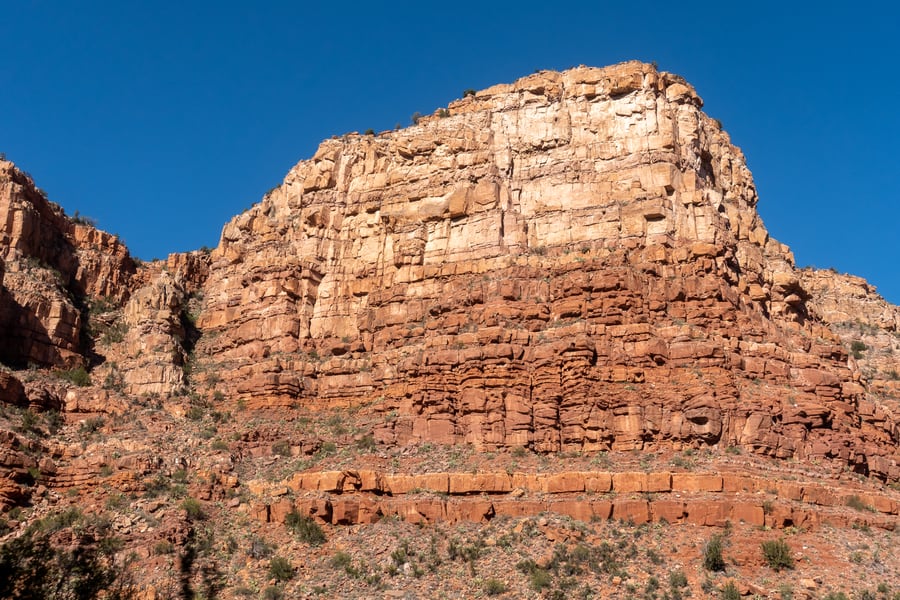 Xander Ashburn / Wikimedia Commons · CC BY 2.0
Into the red rock
Past the mouth of Sycamore Canyon, national forest closes in on both sides and the walls turn red and cream. Watch for Elephant Rock at milepost 28.3, a stone head with its trunk raised, and Turtle Rock four miles on.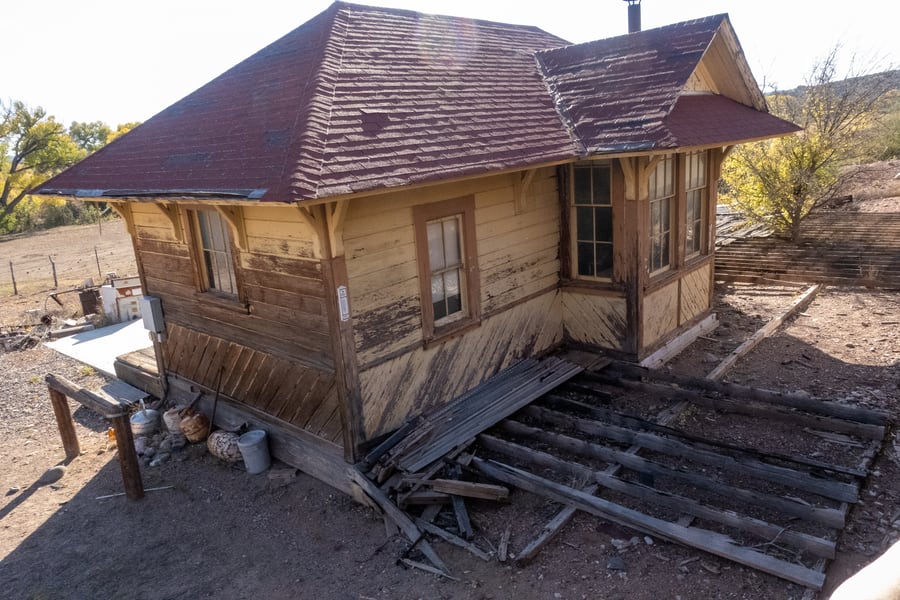 Xander Ashburn / Wikimedia Commons · CC BY 2.0
Perkinsville
The line ends at a ranch station of 1912: a section house, the base of a water tower used until the last steam engines in 1952, and a depot that was also the post office and school. Scenes of How the West Was Won were filmed here.A bit of history
Culture & experiences along the way
 David Wilson / Wikimedia Commons · CC BY 2.0 · cropped
The open-air cars
Every ticket includes a seat indoors and the run of an open-air viewing car next to it, under a shaded canopy. Attendants out there know the canyon's history, rocks and wildlife; in winter, look for bald and golden eagles, and for Great Blue Herons along the river.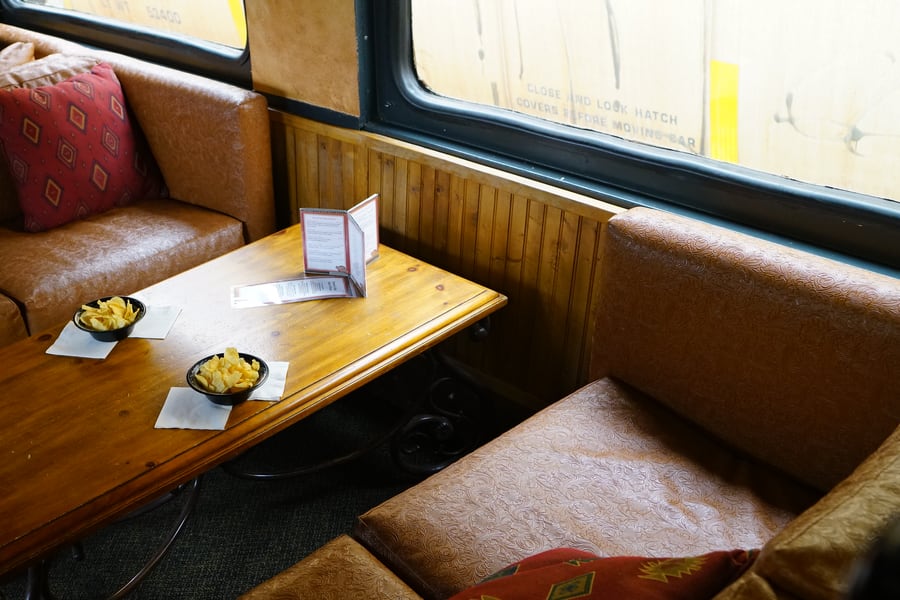 Patrick Finnegan / Flickr · CC BY 2.0 · cropped
A living-room car
Seats are couches facing each other in fours, or chairs for two at a bistro table, in twelve climate-controlled cars. Everyone gets a charcuterie tray, each pair a small bottle of sparkling wine or cider, and the history of the line is told over the speakers between railroad songs.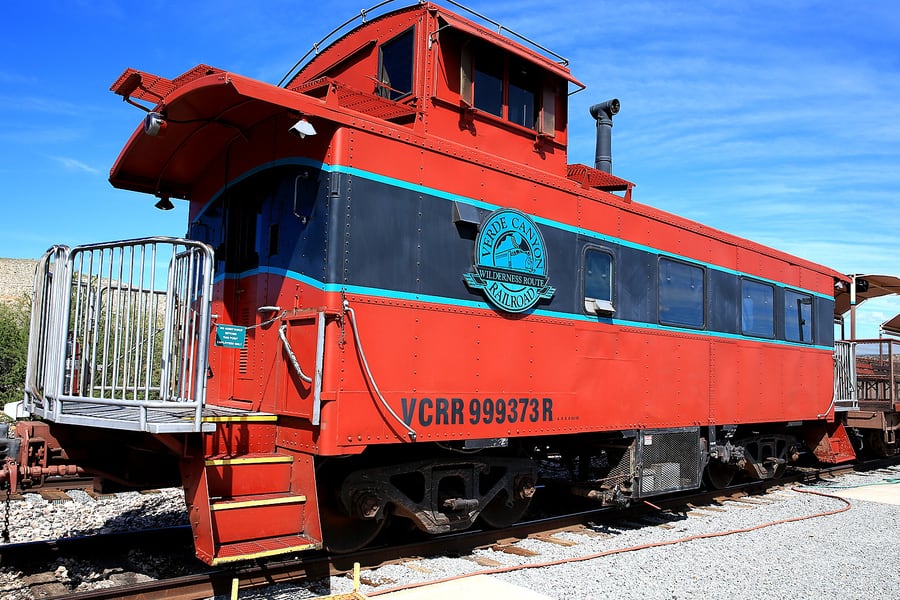 Bill Morrow / Wikimedia Commons · CC BY 2.0 · cropped
The caboose
A red caboose of 1929, restored in 2005, carries one private party of up to six adults, with swivel chairs, seats up in the cupola and two private outside platforms. A valet pours the Champagne and brings the appetizers.Timetables
The train runs all year, from the depot at 300 North Broadway, Clarkdale, to Perkinsville and back. There is usually one train a day, at 1 p.m.; on Saturdays from March to December there are two instead, a morning ride and a later Starlight ride. Every trip takes 3½ to 4 hours.
| Departure | Runs |
|---|---|
| 13:00 | Daily except Saturdays in spring and autumn; four or five days a week in January, February and summer |
| Morning ride, 09:30 (11:00 from May to September) | Saturdays, March to December |
| Starlight ride, 15:30 (17:30 from May to September) | Saturdays, March to December |
From late November to 23 December many evenings go to The Magical Christmas Journey, a separate one-hour ride, and between Christmas and New Year the morning and Starlight rides run daily. Some days, most often early in the week in winter and summer, have no train at all.
Good to know:
- Book ahead. Trains often sell out well ahead, especially in peak season and on event days. Payment is taken in full when you book.
- Arrive early. The railroad asks you to be at the depot an hour and a half before departure, and you must be checked in at least 15 minutes before it, or your seats may go to standby passengers.
- Rain or snow, the train runs.
- Parking is free, across the street from the depot.
Departures as of September 2026, from the railroad's monthly calendars for January to December 2026. Confirm before travelling on verdecanyonrr.com (opens in a new tab).
Tickets
There is one fare for everyone aged one and over, and all the passenger cars are the same class: a seat on a couch or at a bistro table, the open-air car, and a charcuterie tray with a sparkling toast. Babies under one ride free on a lap. Drinks and snacks on board are extra, paid by card only, and a $2 preservation fee is added at booking. Most festival trains cost more, and the caboose is sold to one party at a time.
Up to 48 hours before departure you can cancel for a 90% refund, or move to another date for $5 a ticket; after that there are no refunds. Fares checked September 2026 at verdecanyonrr.com (opens in a new tab); US dollars.
Book your tickets
Passenger car
Round trip · 3½ to 4 hours
A seat on a couch or at a bistro table, an open-air car, and a charcuterie tray with a sparkling toast.
Book Tickets (opens in a new tab, on Verde Canyon Railroad)via Verde Canyon RailroadCaboose
One private party of up to six adults
The 1929 caboose to yourselves, with a cupola, two outside platforms and a valet.
Book Tickets (opens in a new tab, on Verde Canyon Railroad)via Verde Canyon RailroadFestival trains
Chocolate in February · wine in May and summer
The regular ride with a festival added, from chocolate in February to wine tasting in May and on summer Saturday evenings for riders aged 21 and over.
Book Tickets (opens in a new tab, on Verde Canyon Railroad)via Verde Canyon RailroadRail Passes
No rail pass covers the Verde Canyon Railroad. It is a private heritage railroad that sells its own tickets. Amtrak's USA Rail Pass is valid only on Amtrak's own services, and Interrail and Eurail do not apply anywhere in the United States.
The nearest Amtrak station is Flagstaff, on the Southwest Chief, about 40 miles away by road. The railroad's own offers go to groups of 20 or more and to guests on its room-and-ride packages.
Checked September 2026 against verdecanyonrr.com (opens in a new tab) and amtrak.com (opens in a new tab).
Places to Visit
Clarkdale, a town of about 4,400 people, sits in the Verde Valley some 40 miles south-west of Flagstaff. Tuzigoot is just across the river, Jerome is up the mountain behind the town, and Cottonwood and Camp Verde are further down the valley.
 Burley Packwood / Wikimedia Commons · CC BY-SA 4.0 · cropped
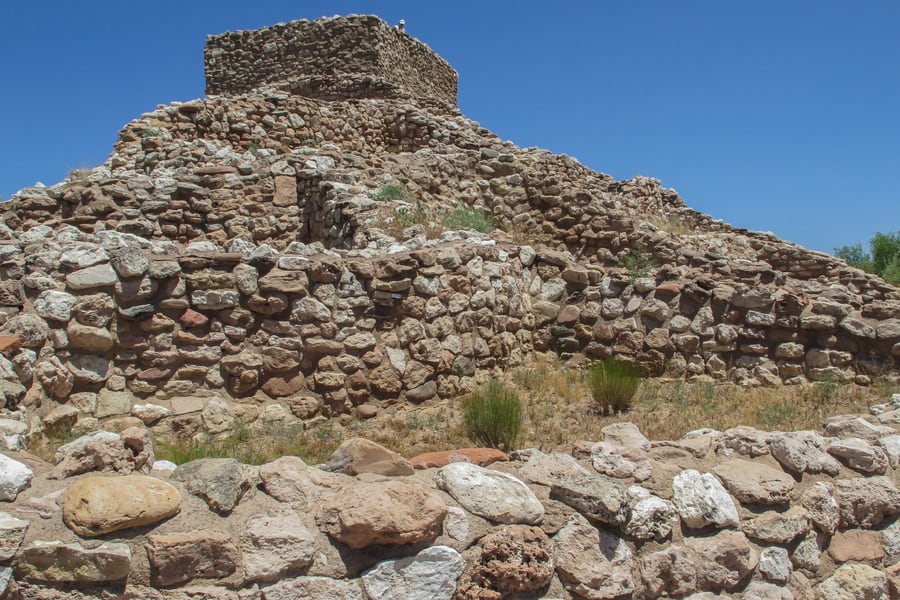
Tuzigoot National Monument
You can see it from the station platform: a stone pueblo of 110 rooms along the spine of a ridge 120 feet above the Verde. The Sinagua built it between about 1125 and 1400, entering most rooms by ladders through the roof. The museum holds what was found on the site, and the Tavasci Marsh below is a rare perennial wetland, full of birds and wildlife.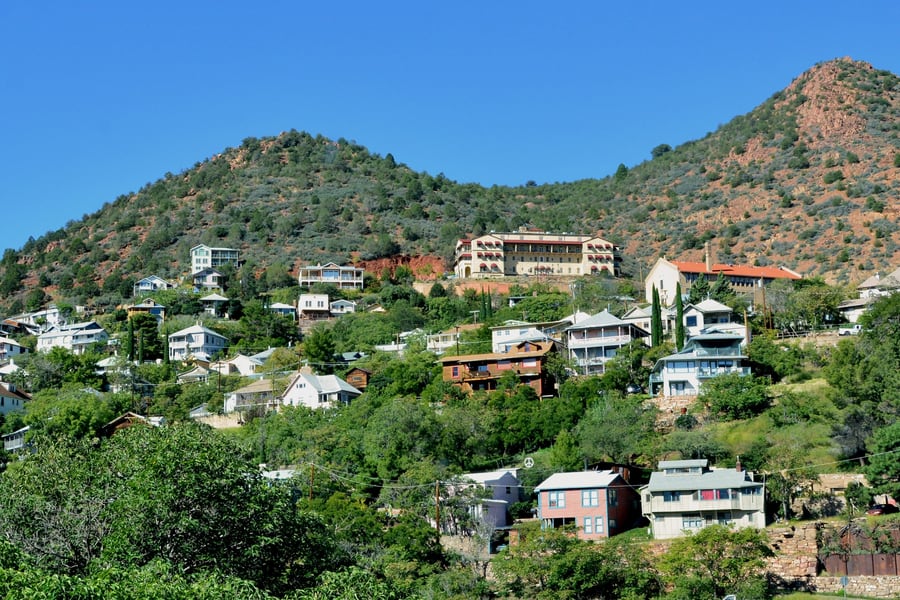 Mike McBey / Wikimedia Commons · CC BY 2.0 · cropped
Jerome
The copper that paid for the railroad came out of this hill. Jerome had more than 10,000 people in the 1920s and fewer than 100 after the mines closed in 1953; it survived as a town of galleries, coffee houses and restaurants in the old buildings, stacked up the slope. It has been a National Historic Landmark since 1967, and you can see it from the depot.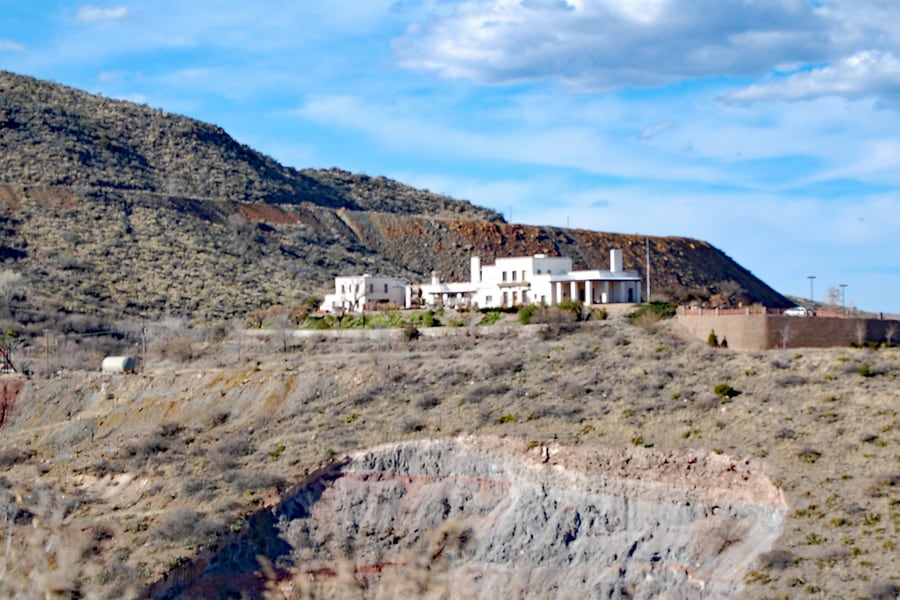 Laurelle Stoughton / Wikimedia Commons · CC BY-SA 4.0 · cropped
Jerome State Historic Park
James Douglas built his adobe mansion in 1916 on the hill above his Little Daisy Mine, as a home and a hotel for mining men. It is now a museum of Jerome and the Douglas family, with minerals, photographs and a 3-D model of the town and the mines beneath it, and the picnic area outside looks out over the whole Verde Valley.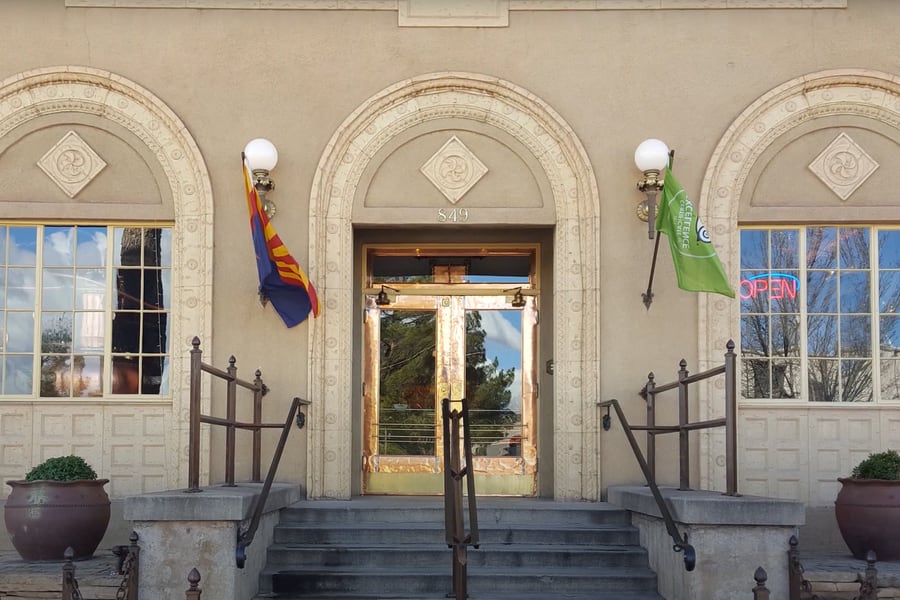 Ramblin Pam / Wikimedia Commons · CC BY-SA 4.0 · cropped
Arizona Copper Art Museum
Clarkdale's high school of 1928, empty for four decades, reopened in 2012 as a museum of over 5,000 pieces of copper: kitchenware, stills, artillery shell cases, art and architecture, from 3500 BC to the present. It is the collection of the Meinke family, who began buying copper in 1958 and spent eight years restoring the school. A fitting stop in the town the copper smelter built.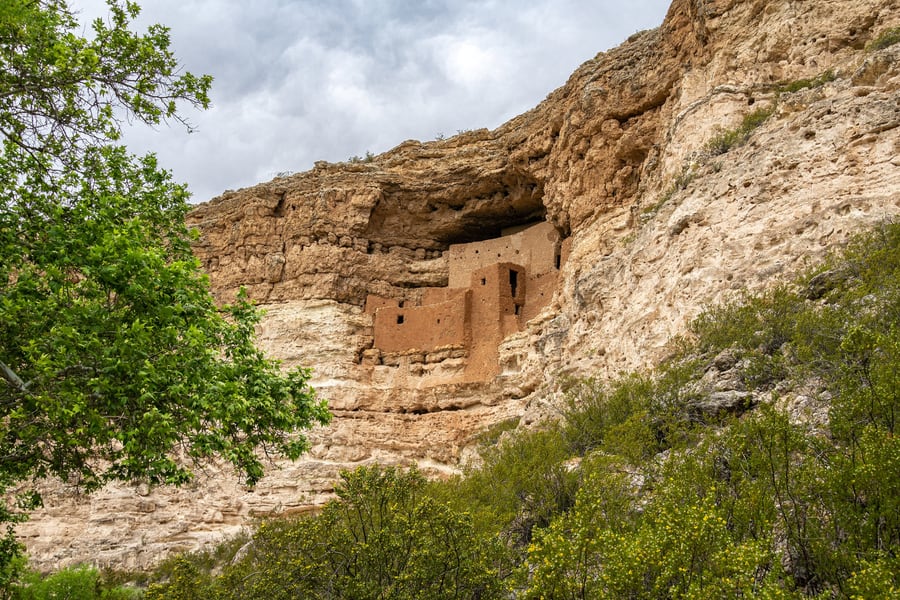 dconvertini / Wikimedia Commons · CC BY-SA 2.0 · cropped
Montezuma Castle National Monument
Five stories of Sinagua cliff dwelling, built in an alcove some 90 feet up a limestone cliff above Beaver Creek and lived in until around 1400. The overhang has sheltered it so well that it is one of the best-preserved cliff dwellings in North America. It has nothing to do with Montezuma, and it is not a castle. In December 1906 Theodore Roosevelt made it one of the first four national monuments. Benjamin Cody / Wikimedia Commons · CC BY-SA 3.0 · cropped
Dead Horse Ranch State Park
A park on the river at Cottonwood, with trails out into the Coconino National Forest, camping and eight log cabins by the river. It is named for a dead horse the Ireys children saw by the road when the family was looking for a ranch in the late 1940s; they made keeping the name a condition of the sale to the state in 1973.Where to Sleep
Clarkdale has a handful of places to stay within a few minutes of the depot, and there is more choice in Cottonwood next door and up the hill in Jerome. The railroad sells its own room-and-ride packages with its sister hotel, the Taawaki Inn.
Where to stay
Taawaki Inn Resort
Clarkdale · the railroad's sister hotel
A hotel hung with original Hopi art, a couple of minutes' drive from the depot and from Tuzigoot, sold with the train as a room-and-ride package.
Check Availability (opens in a new tab, on taawakiinn.com)via taawakiinn.comPark Hotel
Clarkdale · eight rooms in a building of 1915
A small hotel above the Smelter Town Brewery, facing the town park, within walking distance of the depot.
Check Availability (opens in a new tab, on clarkdaleparkhotel.com)via clarkdaleparkhotel.comThe Surgeon's House
Jerome · a bed and breakfast with four rooms
A house high on the mountainside in Jerome, with gardens and a view over the Verde Valley to the red rocks of Sedona.
Check Availability (opens in a new tab, on surgeonshouse.com)via surgeonshouse.comQuestions or corrections
Planning this trip and stuck on something, or spotted a time, fare or detail that has changed? Send us a message about Verde Canyon Railroad. We read every one, and we update this page when something has changed.