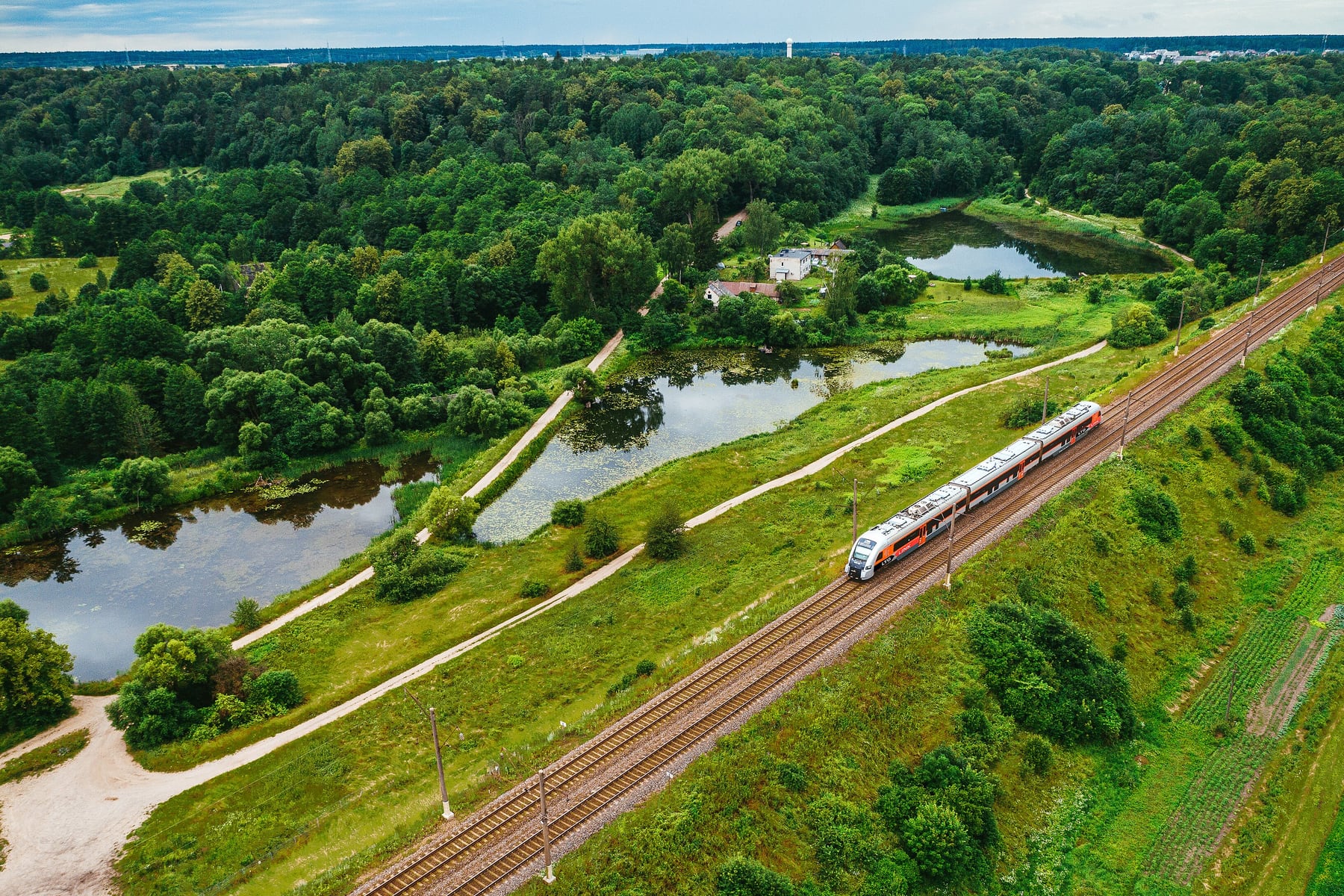
Vilnius to Klaipėda — across Samogitia to the sea
LTG Link / Wikimedia Commons · CC0
- Distance376 km · broad gauge
- Duration4 hr 17 min – 4 hr 44 min
- Best seasonFive trains a day each way, all year
Introduction
For nine years after the Klaipėda region joined Lithuania in 1923, a train from the capital to the country's only seaport had to leave the country to get there. The way from Kaunas, the capital between the wars, ran north-west past Šiauliai to Priekulė in Latvia and then turned south for the coast, crossing the border twice. So Lithuania built a line of its own across Samogitia, the uplands of the west: Kužiai to Telšiai by 1926, then Telšiai to Kretinga, opened by President Antanas Smetona on 29 October 1932. It was the most expensive project the state had yet carried out, and it took 60 kilometres off the journey.
The line it completed is now the busiest in Lithuania, 376 kilometres from Vilnius to Klaipėda, and it is stitched together from the work of four different builders: the St Petersburg–Warsaw Railway out of Vilnius, the Libau–Romny Railway of 1871 from Kaišiadorys to Šiauliai, the 1920s and 1930s line across Samogitia, and Prussian and German lines at the coast. A railway through Samogitia had been asked for in 1897 and again in 1910–11; the tsarist government refused it both times, because it would have competed with the port of Liepāja.
Five trains a day run each way, taking between 4 hours 17 minutes and 4 hours 44 minutes, most of them three-car diesel units. Overhead wires now cover the whole route, and LTG Link plans to put electric trains on most journeys by the end of 2026. At the far end, Klaipėda is the way to the Curonian Spit, a short ferry ride across the strait.
The Journey
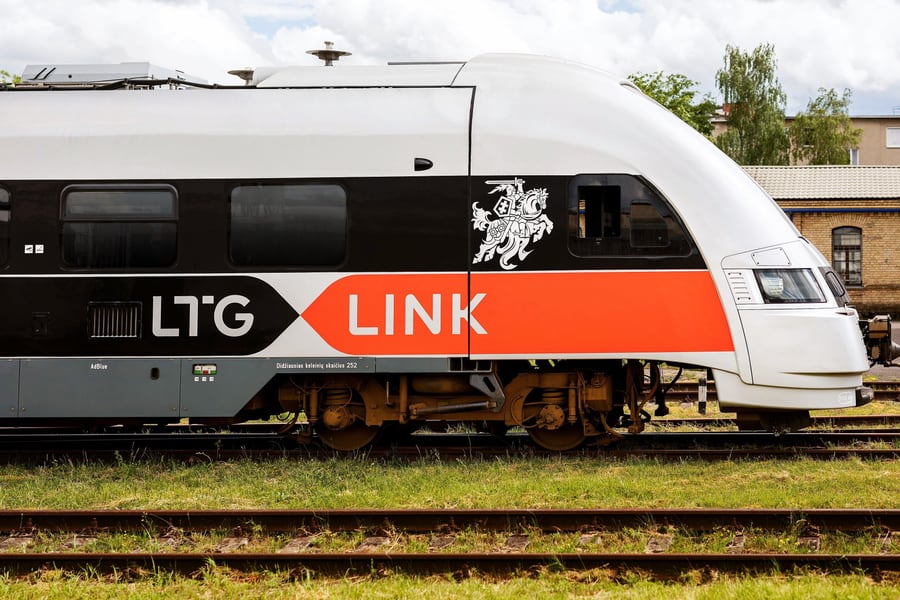
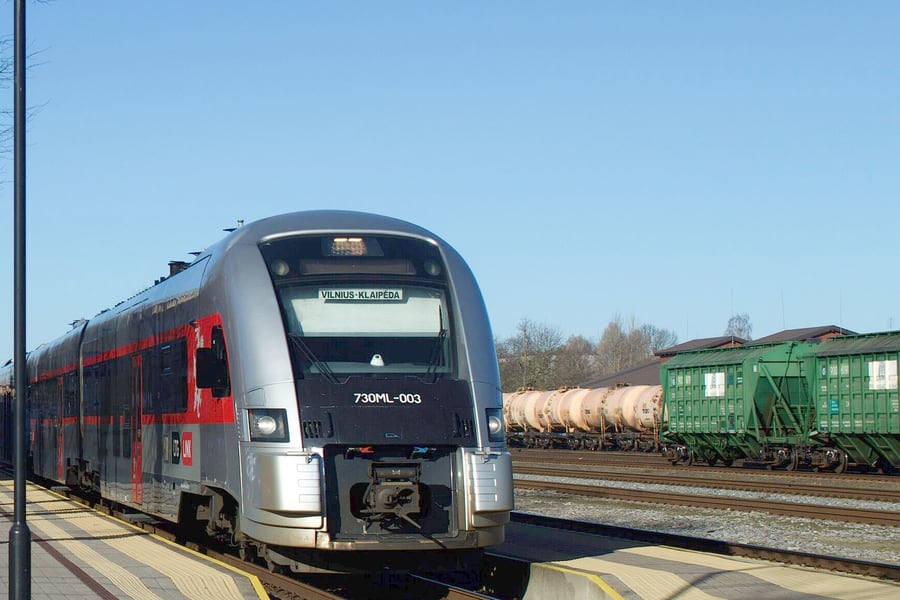
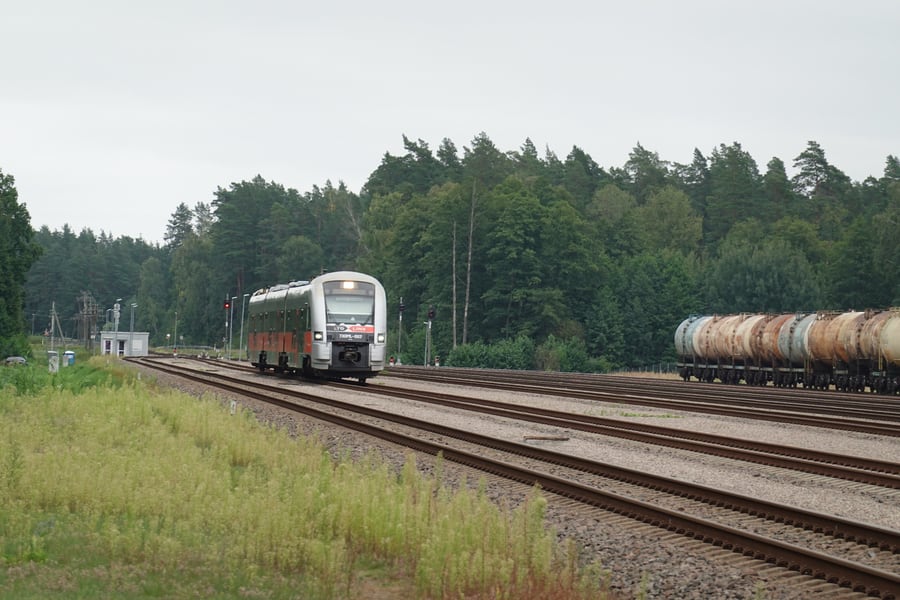
Most trains are PESA 730ML units: three-car diesels from the Polish builder PESA, put on the route in the spring of 2016, with first and second class, Wi-Fi, air-conditioning, a quiet zone and spaces for six bicycles. On some days a train runs instead as a rake of locomotive-hauled carriages, the only kind on the route with a third class; LTG Link's booking page shows which, train by train and date by date. Both are about to give way to Stadler FLIRT electric trains, which entered service between Vilnius and Kaunas on 22 October 2026 and are due on this route once the newly wired line has been certified.
Vilnius to Šiauliai
Trains leave Vilnius on the old St Petersburg–Warsaw Railway and turn off at Lentvaris along its branch towards Virbalis, reaching Kaišiadorys, 67 kilometres out, where the lines to Kaunas and to the coast part. From here the route is the Libau–Romny Railway, opened over this stretch in 1871. It runs north through Jonava and Kėdainiai, on the Nevėžis, to Radviliškis, the junction for Panevėžys, and on to Šiauliai, 212 kilometres from Vilnius. The faster trains, 780 to 783, run without a stop from Vilnius to Šiauliai.
Across Samogitia
At Kužiai, just beyond Šiauliai, the old line carries on north-west for Latvia, and the line to the coast turns west. This is the railway Lithuania built for itself. The 56 kilometres to Telšiai, laid out by the engineer Adolfas Murza and paid for with a British loan, took from September 1924 to May 1926. The 71 kilometres on to Kretinga waited until the government found a lender, and were built in 1930–32 by the Danish firm Højgaard & Schultz, with rails made in Germany and Russia.
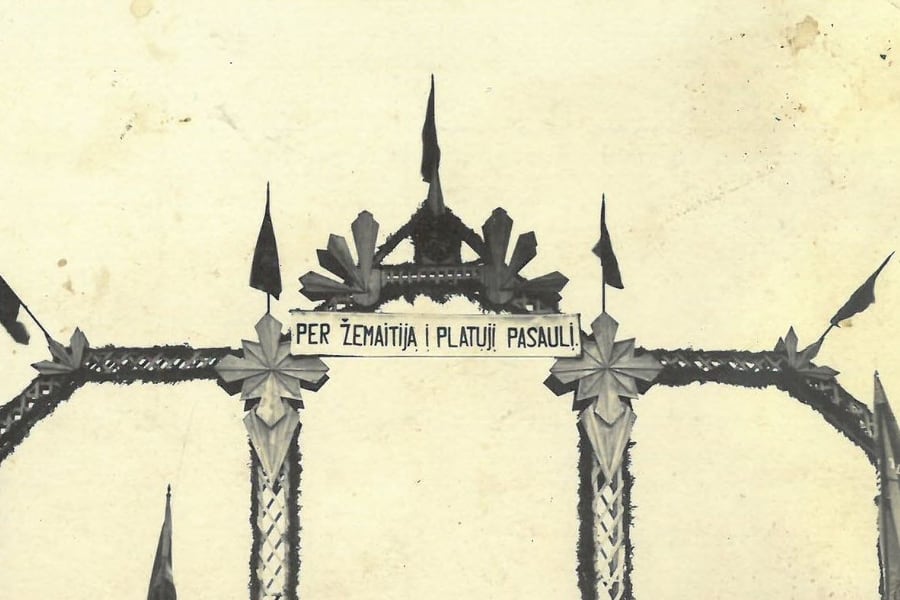
When the special train from Kaunas opened the line on 29 October 1932, it stopped only at Kėdainiai and Šiauliai before Telšiai, where Bishop Justinas Staugaitis blessed the new railway and the train passed through a gate of three arches. It called at every new station beyond, and after dark paused at the Salantas embankment, a kilometre long and on average 26 metres high, where the line crosses the river at Kūlupėnai on one of the tallest railway bridges in Lithuania. It reached Kretinga in the evening. Telšiai and Plungė stations were built to the same design, and in 1939 the trains between Šiauliai and Kretinga could run at up to 120 km/h.
Kretinga and Klaipėda
Kretinga was the last station before the German-ruled Klaipėda region until 1923; its first station was built by the German army in 1915 for a military line north to Priekulė, and the first Lithuanian train arrived there from Kaunas on 3 February 1920. Beyond Bajorai, the last 21 kilometres into Klaipėda are a Prussian line of 1892. Klaipėda's station opened in 1875, at the end of the line from Tilsit, and is the westernmost in Lithuania. Its yellow-brick building of 1881 stands beside a red-brick extension of 1983, and to the east of it a steam locomotive, L-1160, built in Bryansk in 1949 and worked in Lithuania until 1976, is kept as a monument.
Along the route
 Unknown photographer / Wikimedia Commons · Public domain · 1932 · cropped
Through Samogitia into the wide world
When the line to Kretinga opened on 29 October 1932, a gate of three arches stood at Telšiai station, where the new section began. Its banner read Per Žemaitiją į platųjį pasaulį: through Samogitia into the wide world.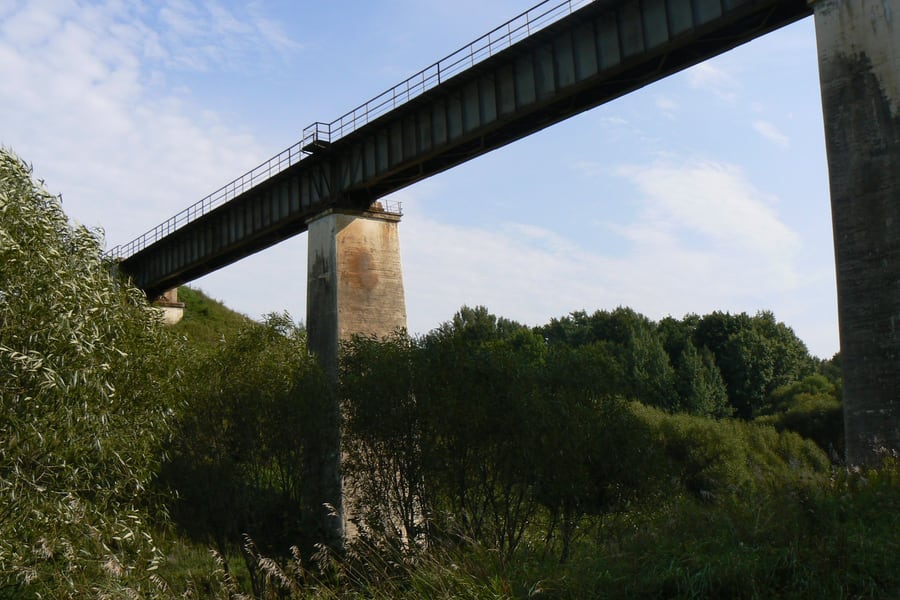 Kusurija / Wikimedia Commons · CC BY-SA 4.0 · 2017 · cropped
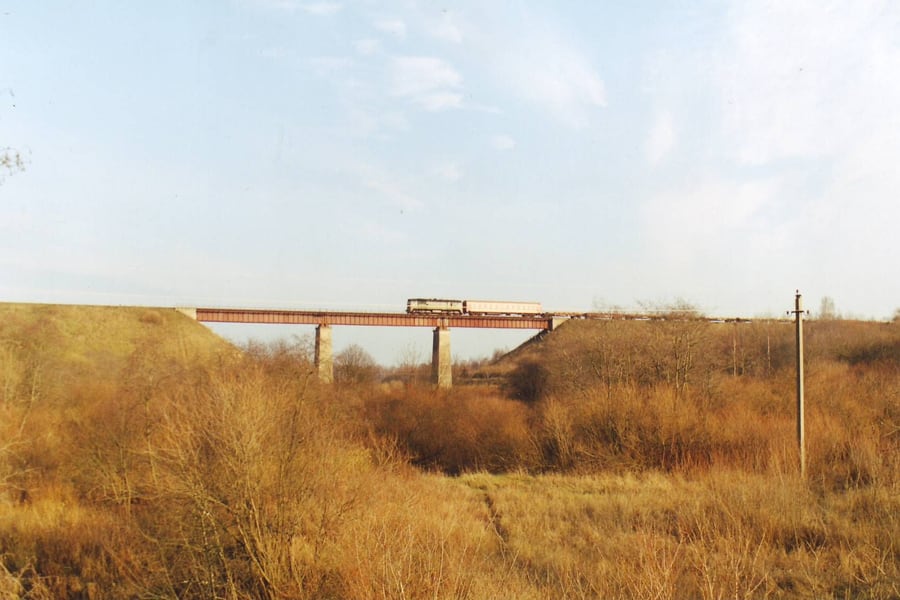
The Salantas crossing
Between Plungė and Kretinga the line crosses the Salantas on a bridge 112.8 metres long and 27.5 metres high, among the tallest railway bridges in Lithuania, approached on an embankment about a kilometre long. The bridge is a protected monument.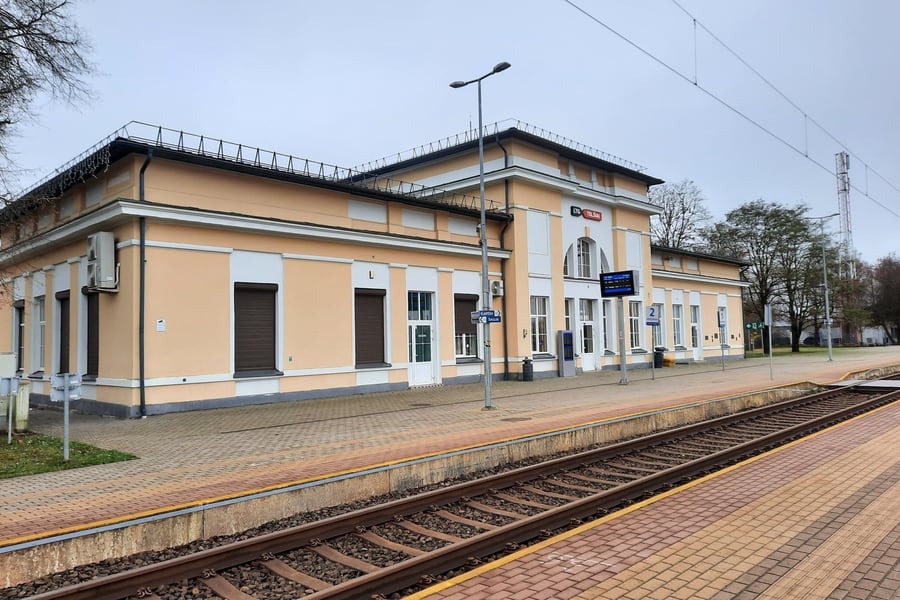 CD / Wikimedia Commons · CC BY-SA 4.0 · 2025 · cropped
Wires to the coast
Overhead wires now run the whole way from Vilnius to Klaipėda. The last test runs, between Radviliškis and Klaipėda, finished in October 2026, and the line is being certified before electric trains can carry passengers on it.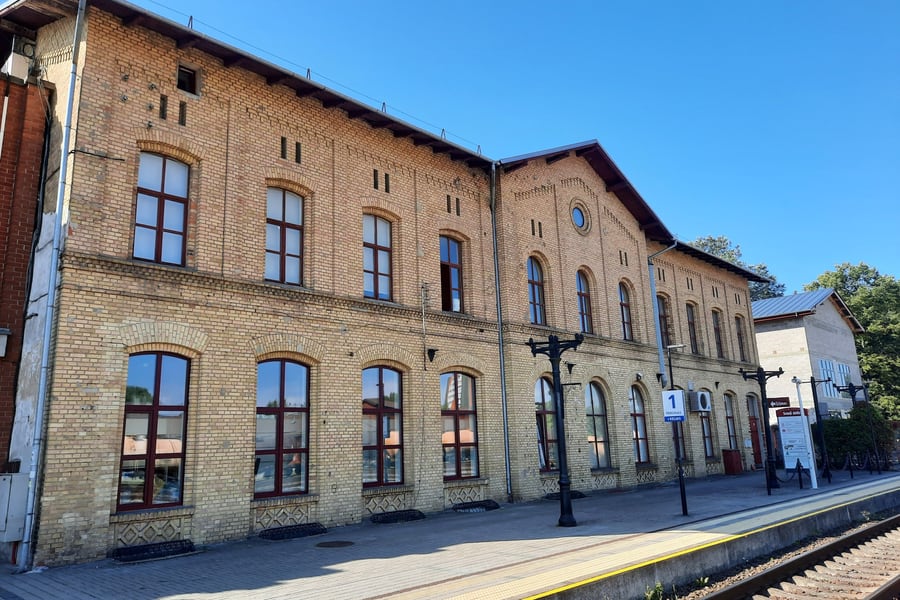 CD / Wikimedia Commons · CC BY-SA 4.0 · 2023 · cropped
A Prussian terminus
Klaipėda's station opened in 1875 on the Prussian line from Tilsit, and the yellow-brick building beside platform 1 dates from 1881. A red-brick extension of 1983 now holds the station; the old building has been sold and houses a restaurant.A bit of history
Culture & experiences along the way
 Zidikai1 / Wikimedia Commons · CC BY-SA 4.0 · 2018
Čiurlionis's school band
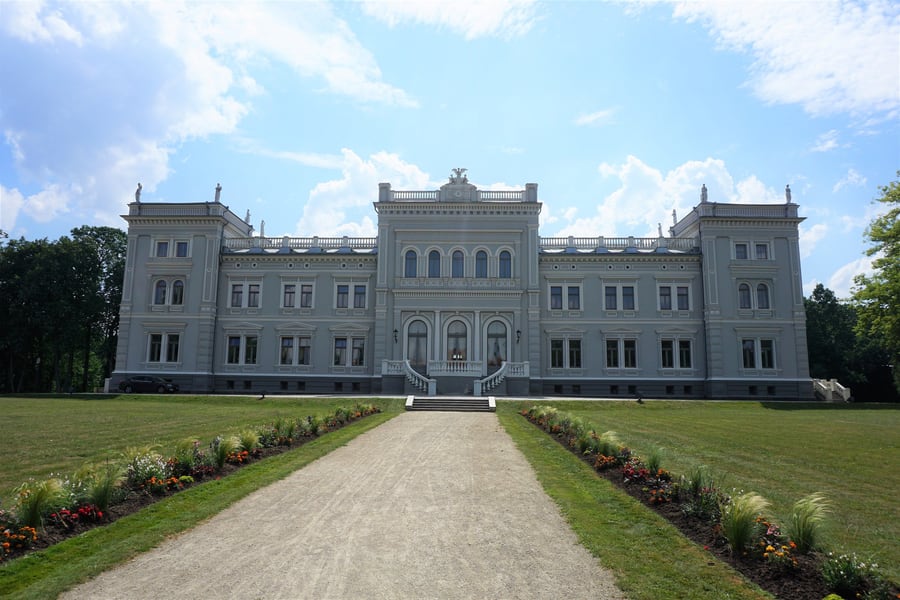
From 1873 to 1902 Prince Michał Ogiński kept an orchestra school at his manor in Plungė, and its musicians once played on the Eiffel Tower. Mikalojus Konstantinas Čiurlionis, later Lithuania's great composer and painter, studied there from 1889 to 1893, playing the flute. The 1879 palace is now the Samogitian Art Museum.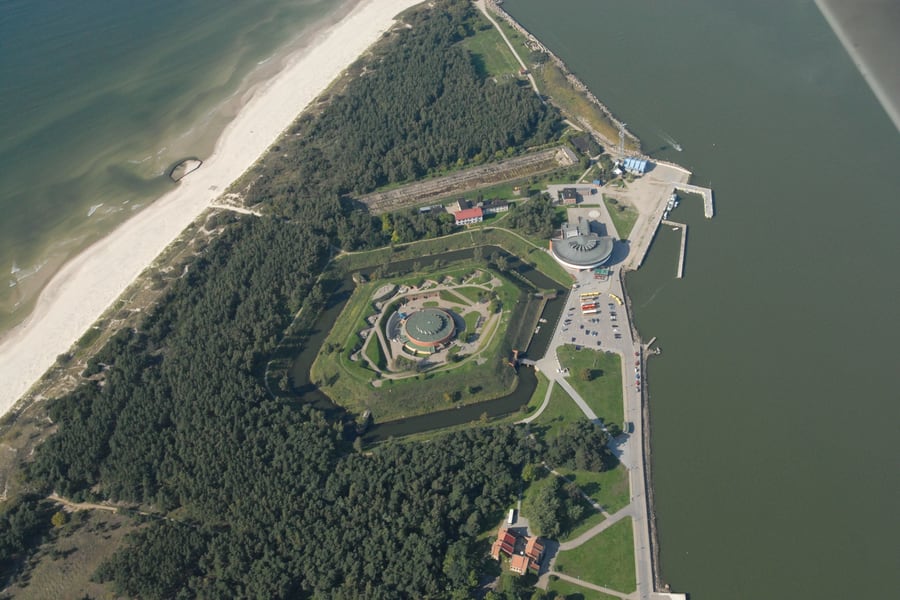 Kusurija / Wikimedia Commons · CC BY-SA 3.0 · 2008 · cropped
A fort full of fish
At the tip of the Curonian Spit, the Prussians began a fort in 1865 to guard the harbour mouth; retreating German troops blew it up in 1945. Restored in the 1970s, it opened in 1979 as the Lithuanian Sea Museum, with an aquarium inside the ramparts and, since 1994, a dolphinarium.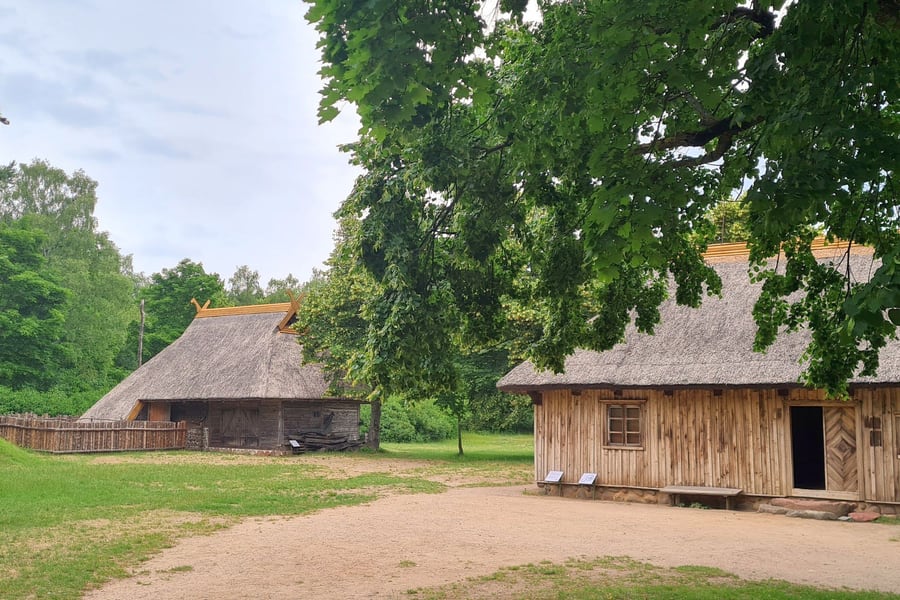 Derbrauni / Wikimedia Commons · CC BY 4.0 · 2023 · cropped
A fisherman's farmstead
Beside the museum stands a coastal farmstead, put together in 1979 after the homes of fishermen around Šventoji and Palanga in the nineteenth and early twentieth centuries: a house, cattle-shed, granary, bathhouse, cellar and smokehouse, with poles for drying nets and fish. It belongs to a family who farmed as well as fished.Timetables
Five trains run between Vilnius and Klaipėda in each direction every day, and a sixth each way on Fridays. Every one is a through train, and seats are reserved. The times below were read from LTG Link's own booking system in October 2026, for travel in the first half of November.
Vilnius to Klaipėda
| Train | Vilnius | Kaišiadorys | Šiauliai | Telšiai | Klaipėda | Journey |
|---|---|---|---|---|---|---|
| 15 | 06:38 | 07:21 | 09:22 | 10:12 | 11:19 | 4 hr 41 |
| 781 | 10:54 | — | 13:22 | 14:10 | 15:11 | 4 hr 17 |
| 17 | 13:03 | 13:44 | 15:43 | 16:30 | 17:36 | 4 hr 33 |
| 783 | 17:17 | — | 19:48 | 20:37 | 21:37 | 4 hr 20 |
| 19 | 18:48 | 19:29 | 21:29 | 22:17 | 23:23 | 4 hr 35 |
On Fridays train 13 leaves Vilnius at 05:20 and reaches Klaipėda at 09:49. On Wednesdays trains 783 and 19 arrive eight minutes later, at 21:45 and 23:31.
Klaipėda to Vilnius
| Train | Klaipėda | Telšiai | Šiauliai | Kaišiadorys | Vilnius | Journey |
|---|---|---|---|---|---|---|
| 16 | 05:45 | 06:52 | 07:36 | 09:39 | 10:22 | 4 hr 37 |
| 780 | 07:33 | 08:38 | 09:22 | — | 11:59 | 4 hr 26 |
| 18 | 12:18 | 13:26 | 14:13 | 16:16 | 17:02 | 4 hr 44 |
| 782 | 16:39 | 17:42 | 18:26 | — | 21:04 | 4 hr 25 |
| 20 | 18:12 | 19:20 | 20:06 | 22:11 | 22:54 | 4 hr 42 |
On Fridays train 786 leaves Klaipėda at 10:25 and reaches Vilnius at 14:58.
Stops on the way
Trains 15 to 20 call at Kaišiadorys, Jonava, Kėdainiai, Radviliškis, Šiauliai, Telšiai, Plungė and Kretinga. The faster 780 to 783 run without a stop between Vilnius and Šiauliai and call at Telšiai; beyond it, 780 stops at Plungė, 781 and 782 at Kretinga, and 783 runs through to Klaipėda.
Times are published by the operator: LTG Link · tickets and timetables (opens in a new tab).
Tickets
LTG Link is charging half fare on every domestic journey from 9 October to 31 December 2026, and the fares below are those halved fares. Vilnius to Klaipėda costs €13.40 in second class and €19.10 in first on a 730ML. When a train runs with locomotive-hauled carriages instead, it is €7.35 in third class, €11.00 in second and €15.55 in first; the booking page shows which a train will be on the day you choose. From January the full fares, twice these, are due to return.
Every ticket carries a reserved seat. Tickets are sold on ltglink.lt and the LTG Link app, at ticket machines and Perlas terminals, and on board. Checked against LTG Link, October 2026.
Book your tickets
Vilnius to Klaipėda, LTG Link
€13.40 second class · €19.10 first, to 31 December 2026
A seat on a 730ML diesel unit, at the half fare LTG Link is charging until the end of 2026.
Book Tickets (opens in a new tab, on ltglink.lt)via ltglink.ltThird class, LTG Link
€7.35 when the train runs with carriages
Third class exists only on the trains made up of locomotive-hauled carriages, which the booking page shows by date.
Book Tickets (opens in a new tab, on ltglink.lt)via ltglink.ltRail Passes
A pass covers this line, but it does not pay for this journey alone.
Interrail's table of the companies a pass is valid with in Lithuania — checked in October 2026, when it carried a last updated 21 October 2026 stamp — lists LTG Link under both the Global Pass and the One Country Pass, with reservations compulsory on selected domestic routes. LTG Link's own page for pass holders names Vilnius–Klaipėda as one of them: a pass holder takes a free ticket, but must book a seat in first, second or third class for a €3 fee, on ltglink.lt, in the app or on board.
An adult Interrail Lithuania Pass in second class costs €67 for three travel days within a month, €84 for four, €100 for five, €118 for six and €150 for eight; for travellers aged 12 to 27 it is €50, €63, €75, €89 and €113. A second-class Vilnius–Klaipėda return is €26.80 at the fares charged to the end of 2026, and would be about twice that afterwards — still less than the cheapest pass plus two reservations.
Hold a pass for this line only as part of a longer trip across Lithuania or the Baltic states, where a Global Pass is the one to carry.
Prices and conditions read on interrail.com (opens in a new tab) and ltglink.lt (opens in a new tab) in October 2026.
Places to Visit
Everything below is reached from a station on the line, and the times given are taken from the 06:38 from Vilnius, train 15, which is at Kėdainiai by 08:10, Šiauliai by 09:22, Telšiai by 10:12, Kretinga by 10:59 and Klaipėda by 11:19.
They come in the order the railway meets them: an old town on the Nevėžis, Šiauliai's cathedral, the Samogitian capital, the Tyszkiewicz manor at Kretinga, and at the end of the line Klaipėda and the Curonian Spit across the water.
 Hugo.arg / Wikimedia Commons · Public domain · 2012 · cropped
Kėdainiai old town
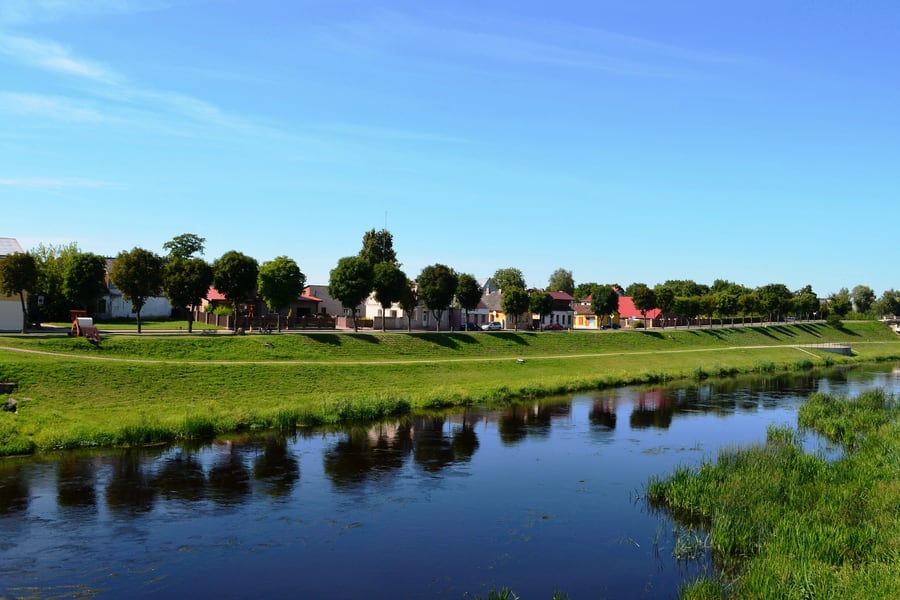
First recorded in 1372 and a town from 1590, Kėdainiai belonged to the Radziwiłłs, who signed a short-lived treaty with Sweden in their castle here in 1655; their tombs lie in the crypt of the Calvinist church of 1631. Scottish Protestants settled in the 16th and 17th centuries, and merchants' houses still called the Scottish Houses stand around the market square, above the Nevėžis.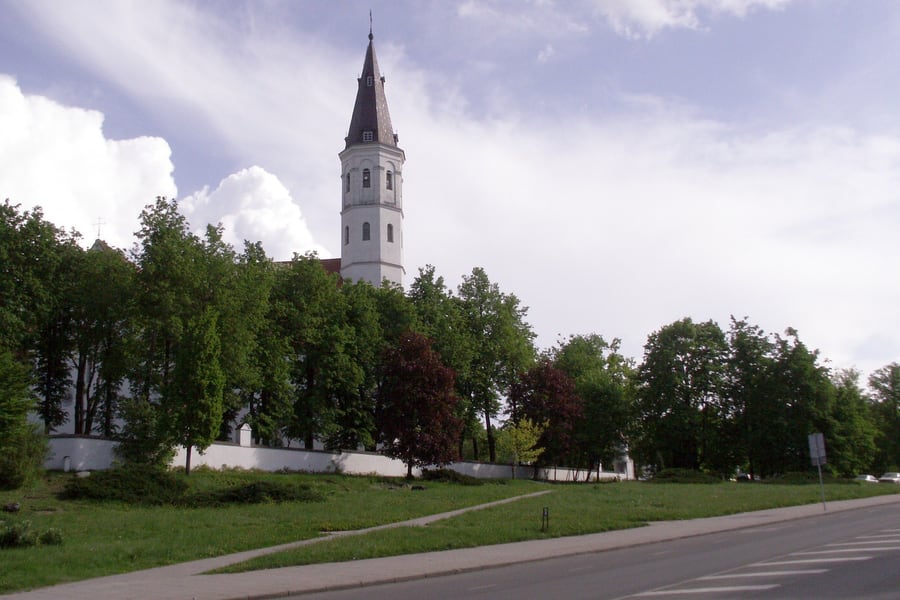 Rimantas Lazdynas / Wikimedia Commons · CC BY-SA 3.0 · 2010 · cropped
Šiauliai Cathedral
The Church of Saints Peter and Paul was built between 1617 and 1626, in a Renaissance and Mannerist style, and became a cathedral when the diocese of Šiauliai was created in 1997. Lightning struck its tower in 1880 and the church was badly damaged in 1944. The Hill of Crosses, a place of pilgrimage covered in tens of thousands of crosses, is about 12 km north of the city.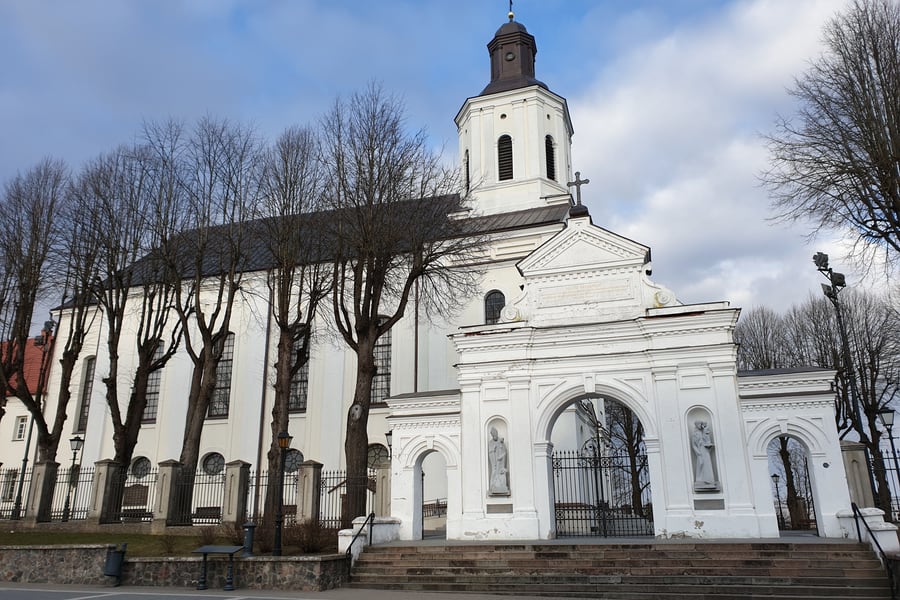 MichalPL / Wikimedia Commons · CC BY-SA 4.0 · 2019 · cropped
Telšiai
The capital of Samogitia stands on the shore of Lake Mastis. Its cathedral of St Anthony of Padua was built for the Franciscans between 1762 and 1794 on the hill at the centre of the town and became a cathedral in 1926; Bishop Justinas Staugaitis, who blessed the new railway in 1932, lies in its crypt.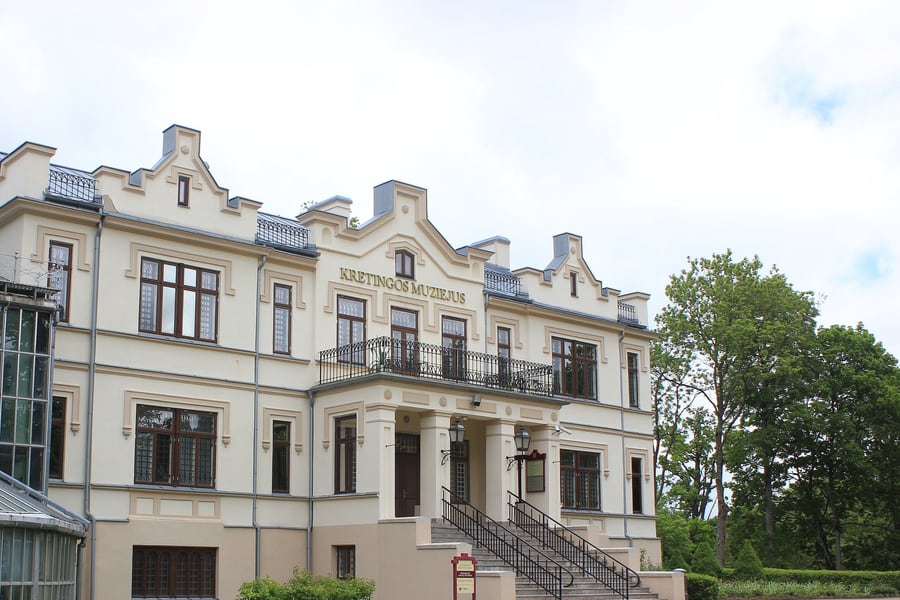 Andrzej Otrębski / Wikimedia Commons · CC BY-SA 4.0 · 2017 · cropped
Kretinga manor
Count Tyszkiewicz bought the estate at auction in 1874, turned the house into a palace and built an orangery, the Winter Garden, among cascading ponds and fountains. The gardens were destroyed in the Second World War and the orangery rebuilt in 1987. Since 1992 the palace has been the Kretinga Museum, with the family's rooms, folk art and archaeology.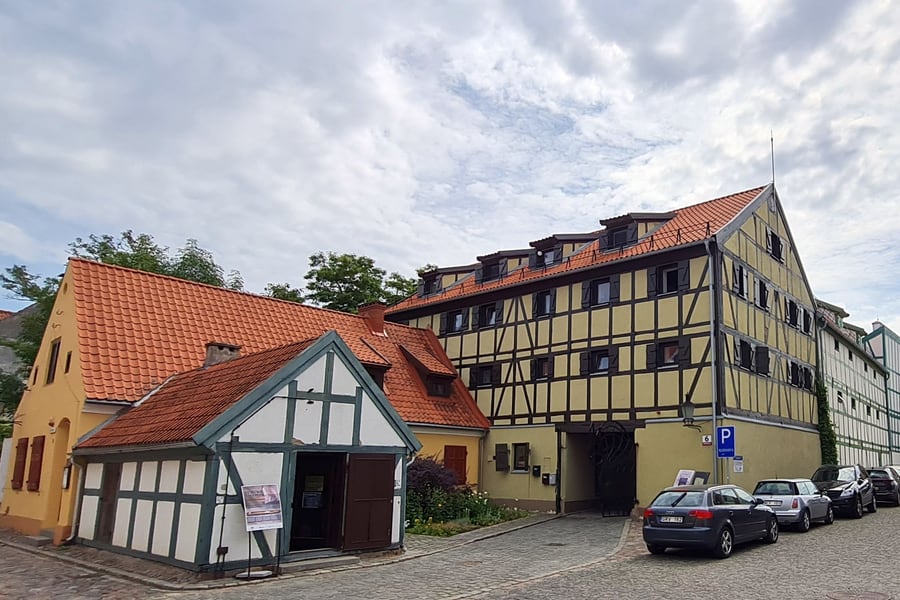 Derbrauni / Wikimedia Commons · CC BY 4.0 · 2023 · cropped
Klaipėda old town
The Teutonic Knights built a castle called Memelburg here in 1252, and the town was Memel until 1923. It is the only major seaport in Lithuania. Between the castle site on the Danė and the theatre square, the old town keeps cobbled lanes and timber-framed warehouses from its Prussian centuries.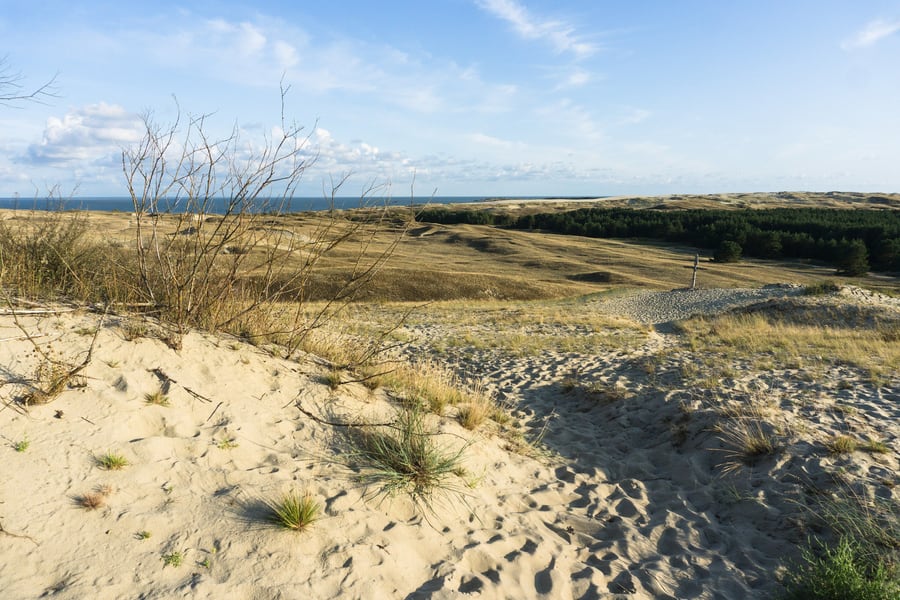 Alexey Komarov / Wikimedia Commons · CC BY-SA 4.0 · 2019
The Curonian Spit
A curved bar of dunes 98 km long, separating the Curonian Lagoon from the Baltic, its northern 52 km in Lithuania and the rest in Russia. It has been on UNESCO's World Heritage List since 2000 as a traditional landscape of settlement shaped by the struggle with moving sand. Ferries cross the narrow strait from Klaipėda to Smiltynė, where a single road runs south.Where to Sleep
Klaipėda is four and a half hours from Vilnius, and the Curonian Spit across the strait is a day of its own, so the house below is for a night at the far end, in the old town. Everything described is what it says about itself on its own site, read in October 2026. No price, grade or star count appears here, because none has been verified.
Where to stay
Euterpė
Between Aukštoji and Daržų streets, in Klaipėda's old town
A hotel of 35 rooms built on an archaeological site in the old town, named after a Renaissance stove tile of the muse Euterpe found there in 2006, with a restaurant, inner courtyard and parking.
Check Availability (opens in a new tab, on euterpe.lt)via euterpe.ltQuestions or corrections
Planning this trip and stuck on something, or spotted a time, fare or detail that has changed? Send us a message about Vilnius to Klaipėda — across Samogitia to the sea. We read every one, and we update this page when something has changed.