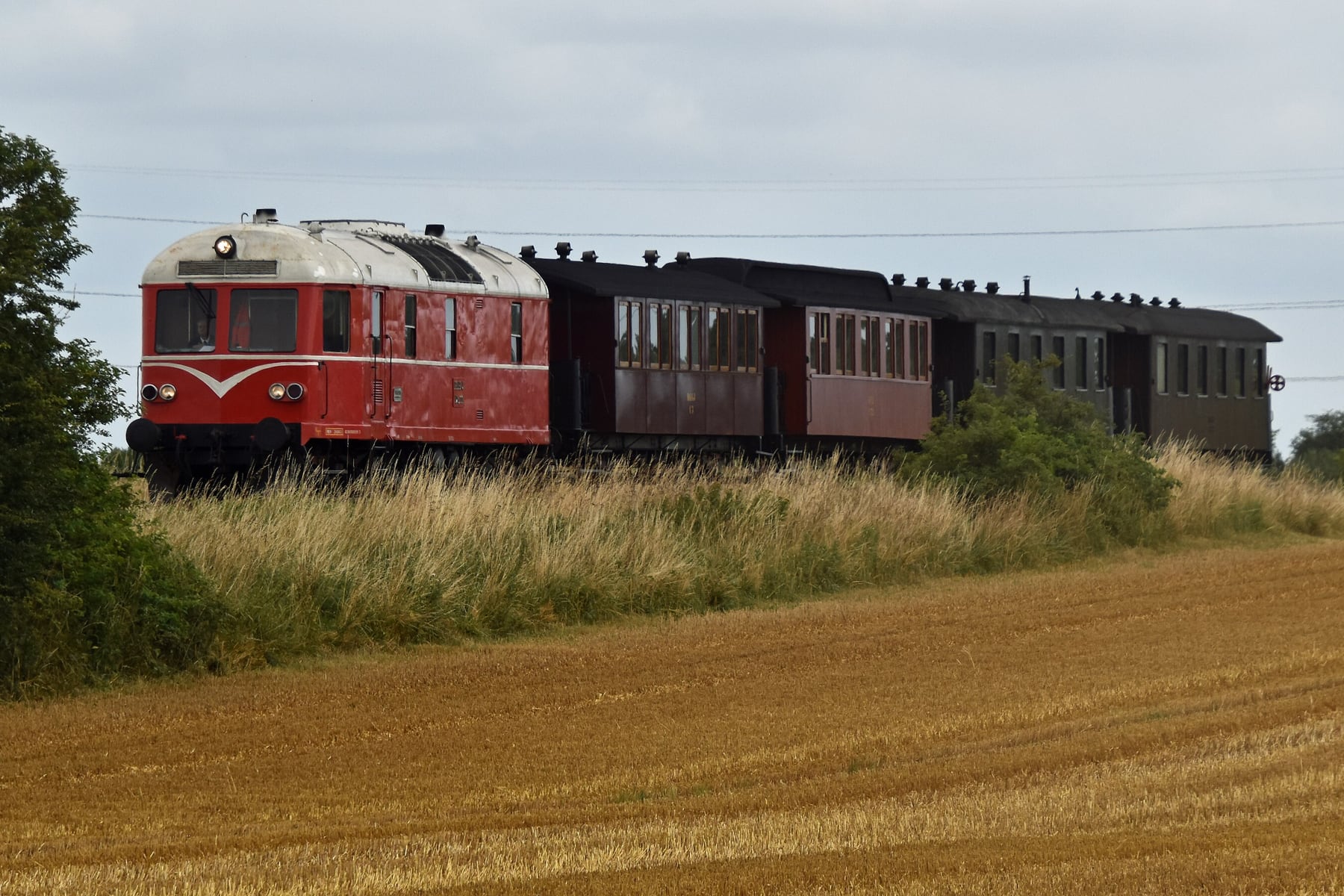
Vojens to Haderslev: The Railway That Owns No Trains
Thomas Dahlstrøm Nielsen / Wikimedia Commons · CC BY-SA 4.0
- Distance13 km · Vojens to Haderslev Vest
- DurationThree return trips per running day
- Best seasonFour days a year · late July to early August
Introduction
The society that saved this railway did not buy a single train.
Thirteen kilometres of state-owned track run west to east across Sønderjylland, from a junction on the Fredericia–Padborg main line to the edge of a cathedral town that has had no scheduled train since 1974. In 2011, when Banedanmark's plan for the line was to tear up the rails and lay a cycle path, volunteers from Haderslev, Vojens and Gram formed an association and took on the railway instead. What they took on, precisely, was the infrastructure: the rails, the signals, the level crossings and the vegetation along the line. The association puts it plainly on its own website — "Vi har således ingen materiel", we therefore have no rolling stock — apart from a works trolley with a crane and one open goods wagon.
So the Veteranbanen Haderslev Vojens is a railway that has to invite somebody else's trains onto its track. Two societies bring them. Veterantog Vest comes up from Bramming with Danish State Railways branch-line stock of 1950 to 1965: steel carriages, leather-upholstered seats, a few compartments, and an excursion-and-dance car that appeared in an Olsen Gang film. Sydjysk Veterantog comes from the Lunderskov engine shed with what may be the oldest passenger carriages running anywhere in Denmark — wooden bodies from between 1898 and the mid-1920s, hard wooden seats, and a locomotive built in 1916.
Which of them you ride depends on the day. The line does not change; the train does.
The Journey
The railway exists because of the lie of the land. When the Sønderjyske Længdebane — the north–south spine of the peninsula — was staked out in the 1860s, the broken ground around the Sønderjylland fjords kept it inland, and both Haderslev and Aabenraa were left off it. Each was given a stub branch instead. Haderslev's opened on 2 May 1866, built by the British contracting consortium of Peto, Brassey and Betts, and ran 11.9 kilometres from the main line down to a terminus on the edge of town, next door to the Fuglsang brewery.
The junction at the other end was a hamlet. Vojens grew up around the station that the through trains stopped at, and it is a stationsby in the literal Danish sense — a town made by a railway. It has about 7,400 people now. Haderslev, thirteen kilometres away, is an old market town with a cathedral and 22,000 people, and it is the one without a train.
The line that was suspended and never resumed
Passenger service ended on 2 January 1974, and the word used at the time was temporarily — the oil crisis was the reason given. The Danish State Railways never restarted it. From 1974 the timetable entry for the branch carried only bus times, and in May 1978 the line disappeared from the timetable altogether. Goods traffic kept it alive until 1999, and on 1 January 2001 Banestyrelsen closed it. In 2009 the cost of bringing it back for freight was assessed at 60 million kroner: the rails were judged to be in reasonable condition, but 40 per cent of the sleepers needed replacing at once.
A proposal to lift the rails and convert the formation to a cycle path was put forward in 2003. A local working group argued instead for reopening it as a heritage line, and won. The association took over the right of use and the maintenance obligation on 1 May 2011, the Danish Transport Authority approved the line for veteran operation, and the first train ran on 13 July 2011 — five carriages roughly a hundred years old behind DSB Museumstog's locomotive F 441, with 240 people aboard, in rain that lasted all day. More than 25,000 passengers have travelled since.
Along the thirteen kilometres
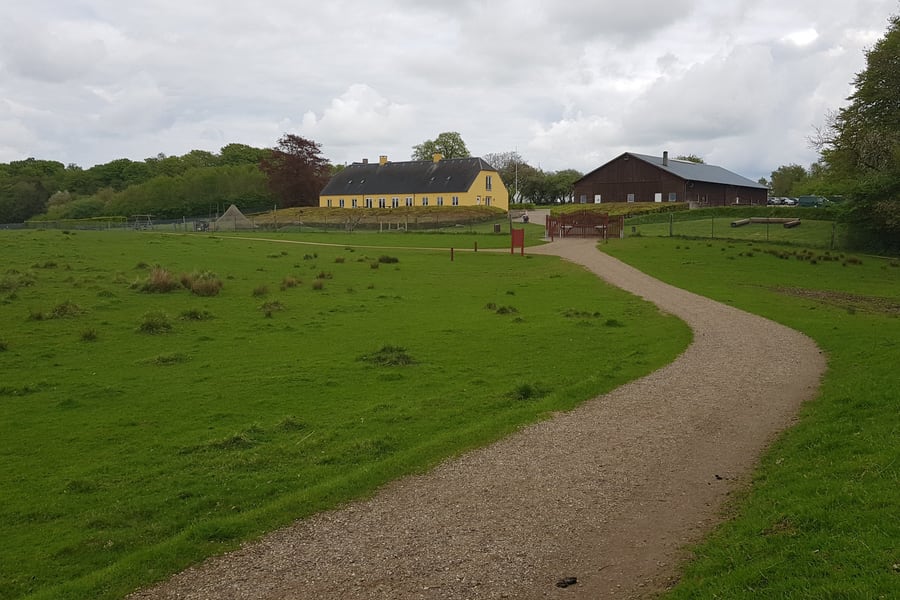
Leaving Vojens the train swings away from the main line and out into arable Sønderjylland, on an embankment above stubble and barley with hedgerows either side and a scatter of pylons on the skyline. This is the top of the Haderslev–Vojens tunneldal, a meltwater valley that runs the whole way between the two towns and gives the railway its gentle, unhurried gradient.
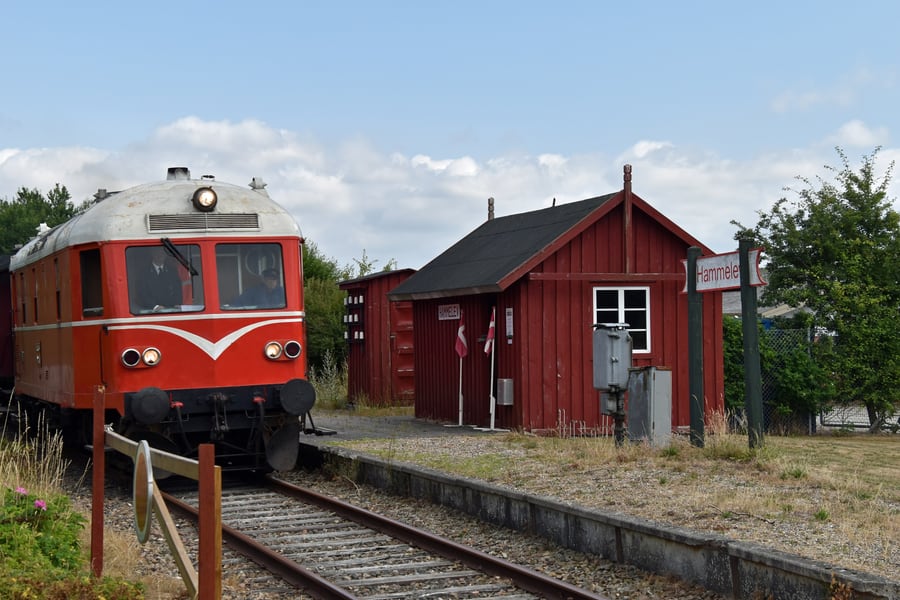
Styding comes at kilometre 4.4 and has been a halt for most of its life — a stopping place from 1878, briefly a ticket office, a bare halt again from 1920. Hammelev, at kilometre 6.2, was a station between 1922 and 1953 and had a siding that closed for good in 1963; its station building was pulled down in the 1950s, and what waits beside the track today is a small red-painted wooden hut with the name board on the gable. Strengløkke, at kilometre 10, exists only because the heritage railway made it.
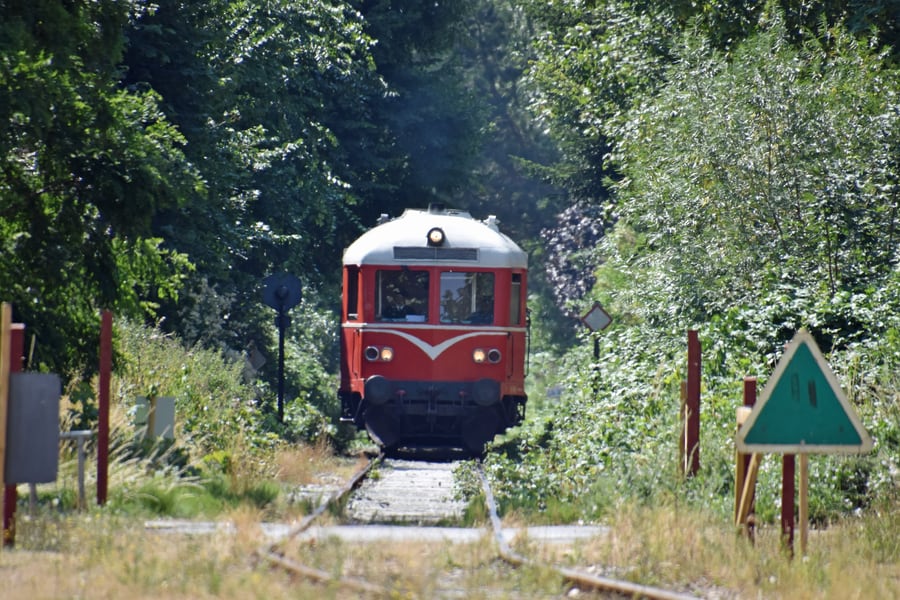
The approach to Haderslev runs into a green tunnel of overgrown lineside, past the old engine shed built in 1951 and still standing, and ends at Haderslev Vest on Simmerstedvej — the station that has been renamed more often than any other on the line. It opened as plain Haderslev, became Haderslev Statsbanestation in 1928, Haderslev Vestbanegård in 1934, Haderslev H in 1943 and Haderslev Vest again in 1967. Its building came down in 1985 and the wide spread of sidings was cut back in the early 1990s to a run-round loop and two stubs. The brewery is still there behind it.
What runs, and why it varies
The association's works fleet is a trolley with a crane and an open wagon, so every passenger train is a guest. Veterantog Vest's carriages are the DSB branch-line stock of the 1950s and 1960s, steel-bodied and comfortable, and one of them is the udflugts- og dansevogn, the excursion and dance car, which the association notes was used in the filming of Olsenbanden på sporet. Sydjysk Veterantog's are wooden, the oldest dating from 1898, with hard wooden seats and a 1916 locomotive, TKVJ 12, that worked the Troldhede–Kolding–Vejen railway until 1968. Trains from the Danish Railway Museum in Odense turn up as well.
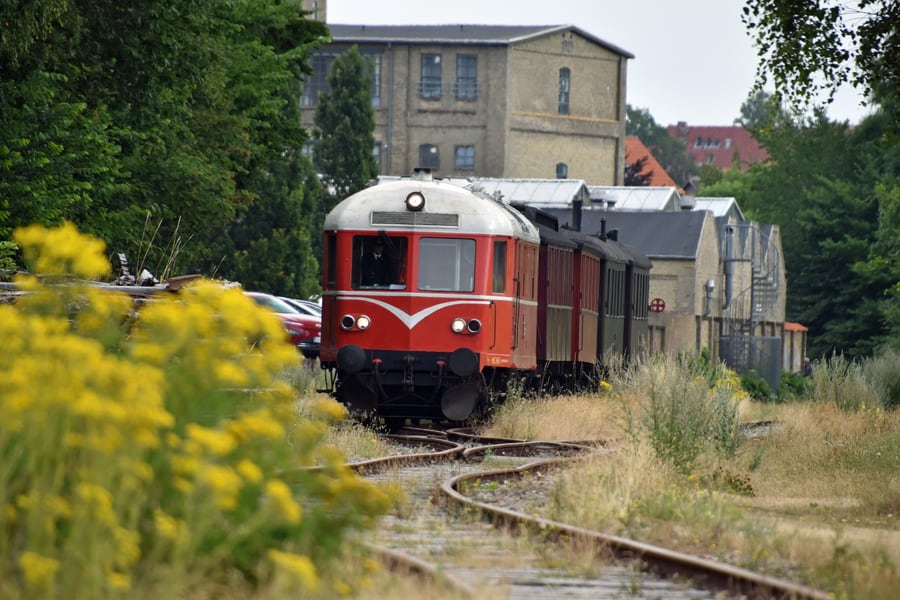
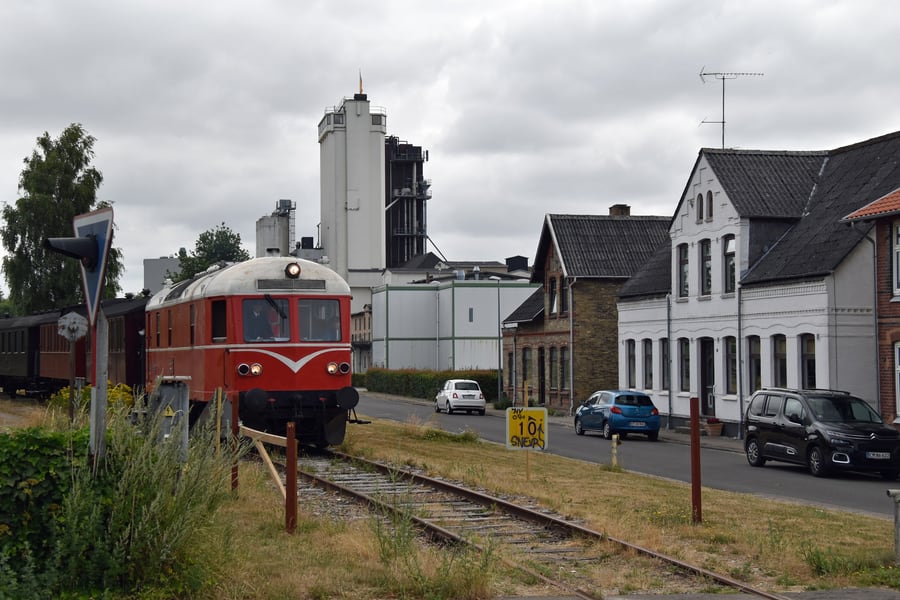
Recent summers have been worked by a red Frichs railcar, HHJ M3 / DL 11, built for the Hads-Ning Herreders Jernbane and now hauling four wooden carriages the colour of dried blood. In 2025 the operator ran a class MT diesel, MT 152, instead. The photographs on this page show what was running when they were taken, which is the honest way to describe a line whose trains are borrowed.
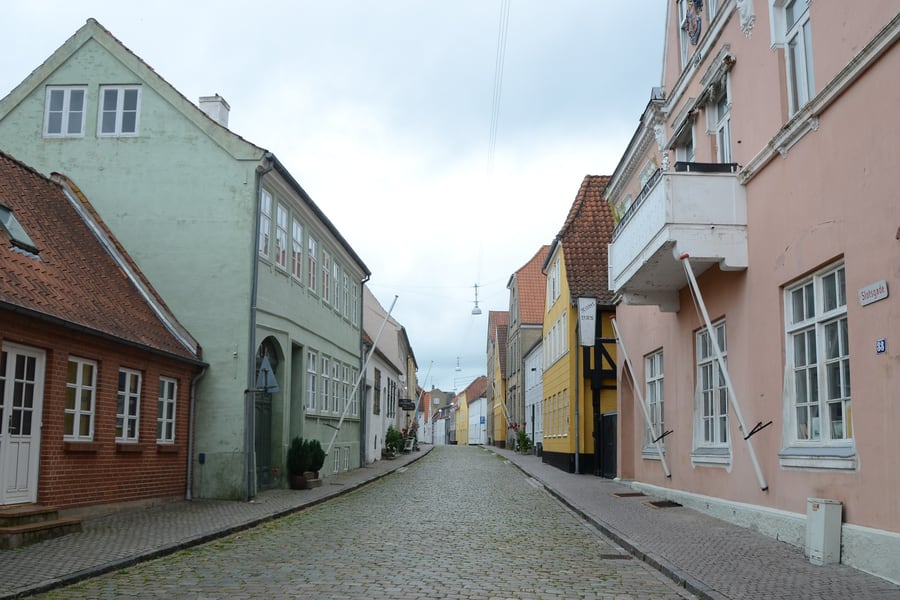
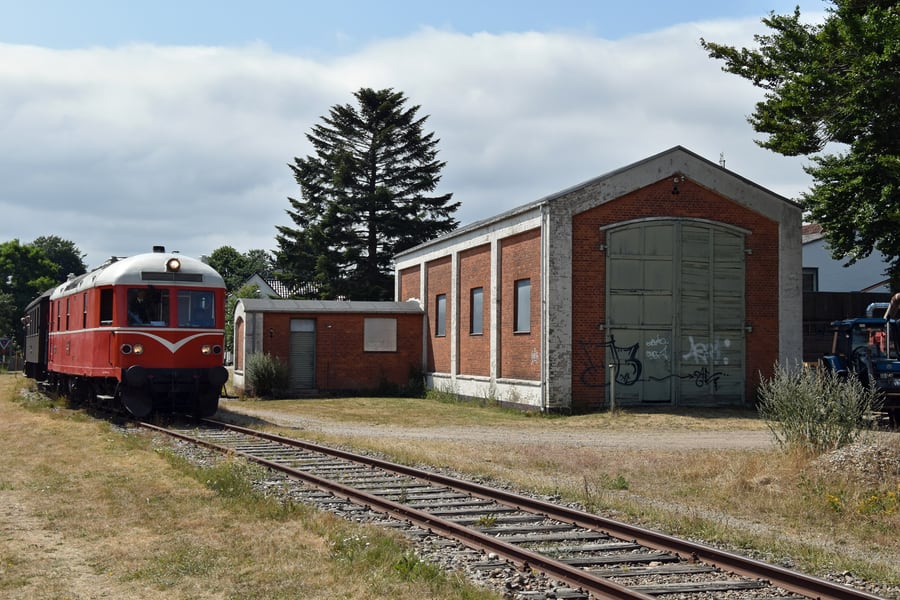
Along the route
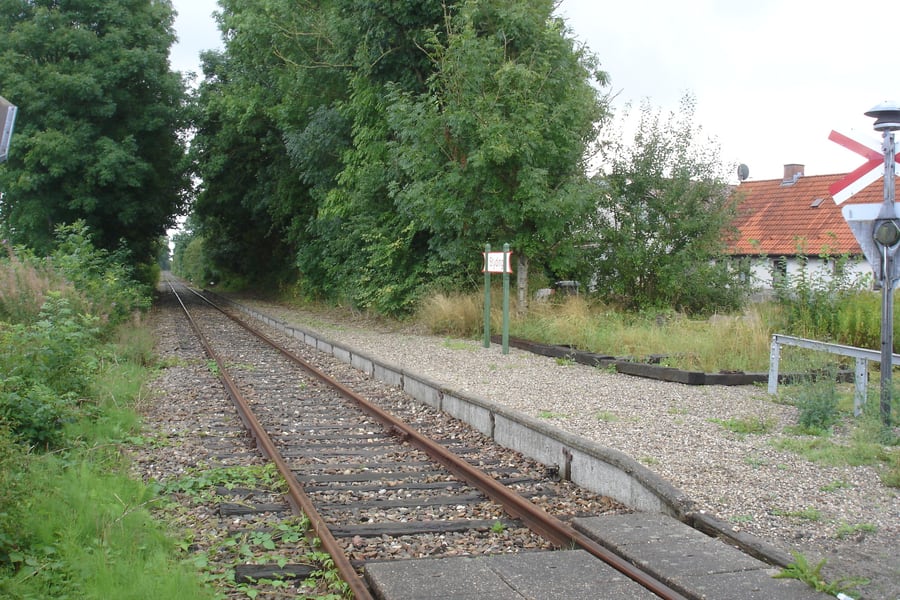 Beethoven9 / Wikimedia Commons · CC BY-SA 4.0 · cropped
An infrastructure manager with no trains
The association calls itself the line's infrastructure manager and says the rest without hedging — we therefore have no rolling stock. Approved operators bring their own locomotives and certified crews onto thirteen kilometres of track that volunteers keep fit for them. The rails are theirs to look after; the trains never are.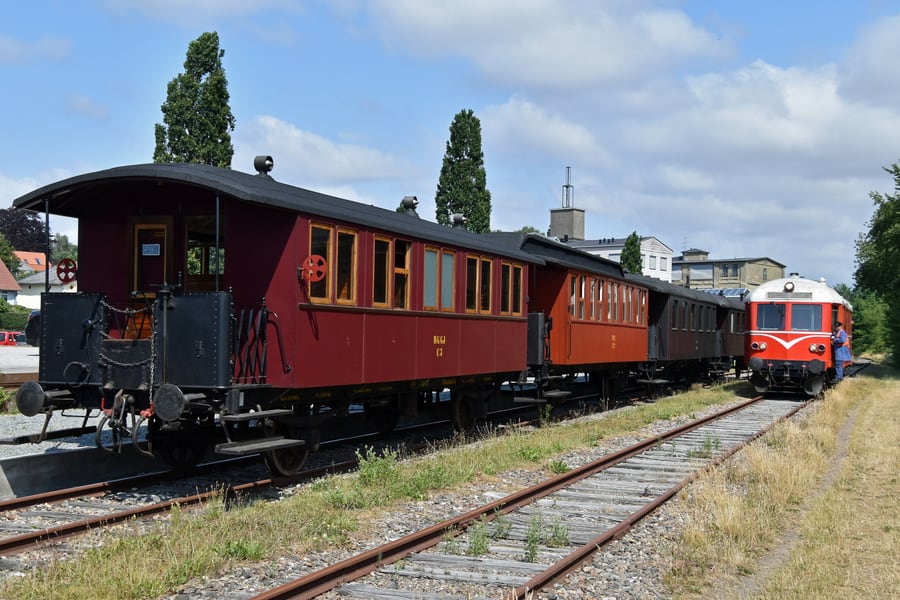 Thomas Dahlstrøm Nielsen / Wikimedia Commons · CC BY-SA 4.0 · cropped
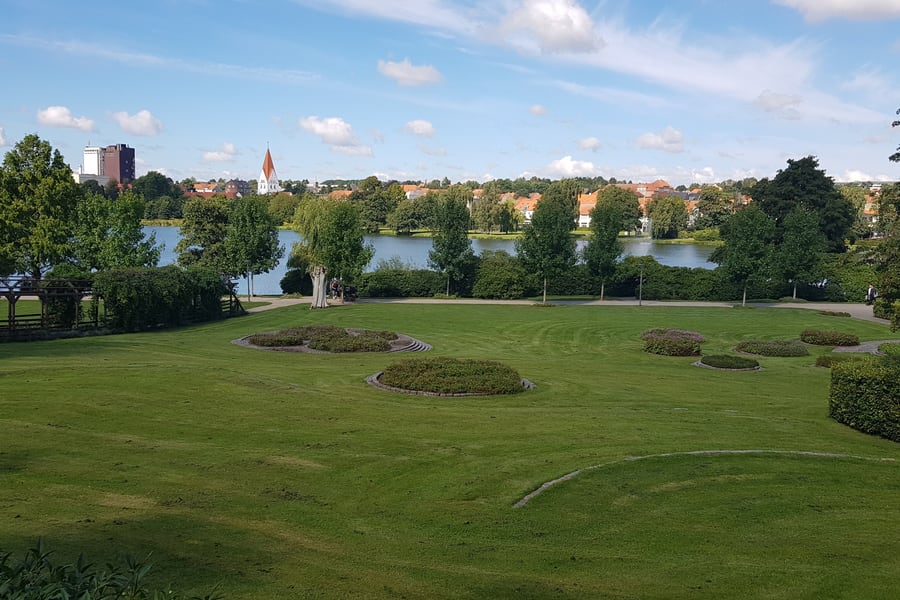
Two societies, two different centuries
One comes from Bramming with state-railway stock of 1950 to 1965 — steel bodies, leather seats, and a dance car filmed for Olsenbanden på sporet. The other comes from Lunderskov with wooden carriages, the oldest from 1898, and a locomotive of 1916.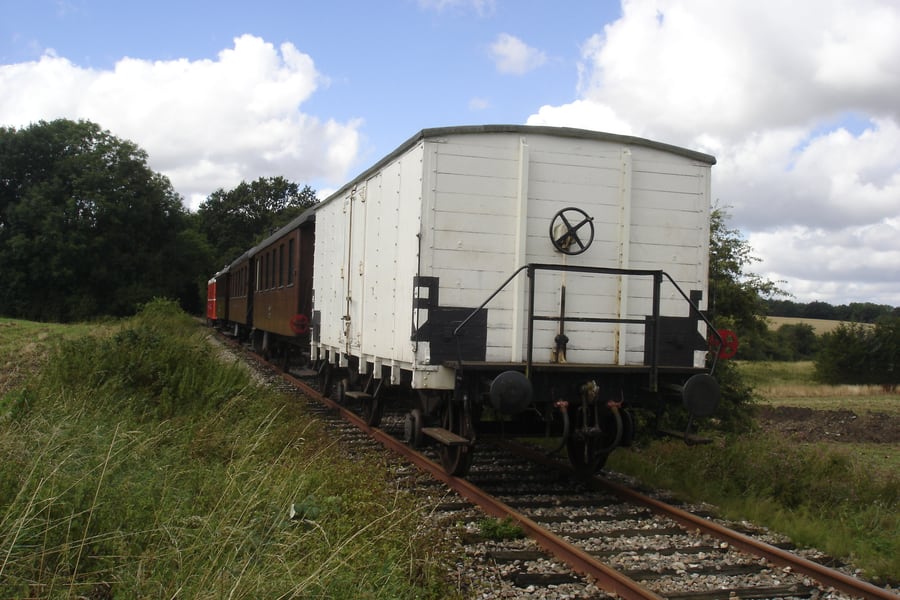 Beethoven9 / Wikimedia Commons · CC BY-SA 4.0 · cropped
The suspension that lasted fifty-two years
Passenger trains stopped on 2 January 1974 and the word used was midlertidigt — temporarily. The reason given was the oil crisis. They never came back, and the line closed outright in 2001. The replacement bus still calls at Hammelev and Styding today.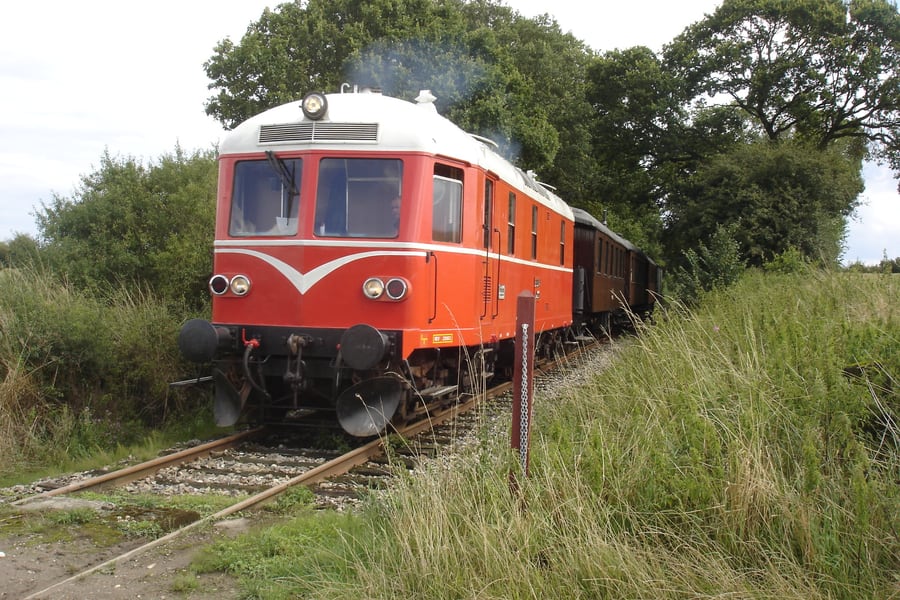 Beethoven9 / Wikimedia Commons · CC BY-SA 4.0 · cropped
Two hundred and forty people, in all-day rain
The association took over the maintenance obligation in May 2011 and had to get the line certified before anything could run. The first train went on 13 July 2011: five carriages about a hundred years old, 240 people aboard, and rain from morning to night.A bit of history
Culture & experiences along the way
 Hjart / Wikimedia Commons · CC BY-SA 4.0 · cropped
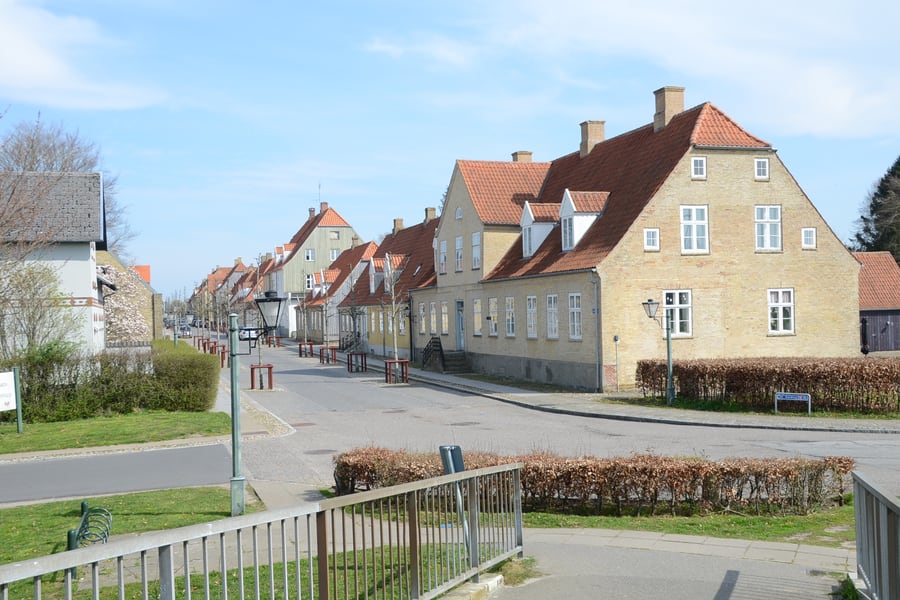
Honningkager from Christiansfeld
The Moravian settlement a few kilometres south has baked honey cakes since 1783, when the first were made on Lindegade. Christiansfeld went on the UNESCO list in 2015 — a town laid out on a strict grid in 1773 by Herrnhut settlers from Saxony — and the bakery is still on the street it started on.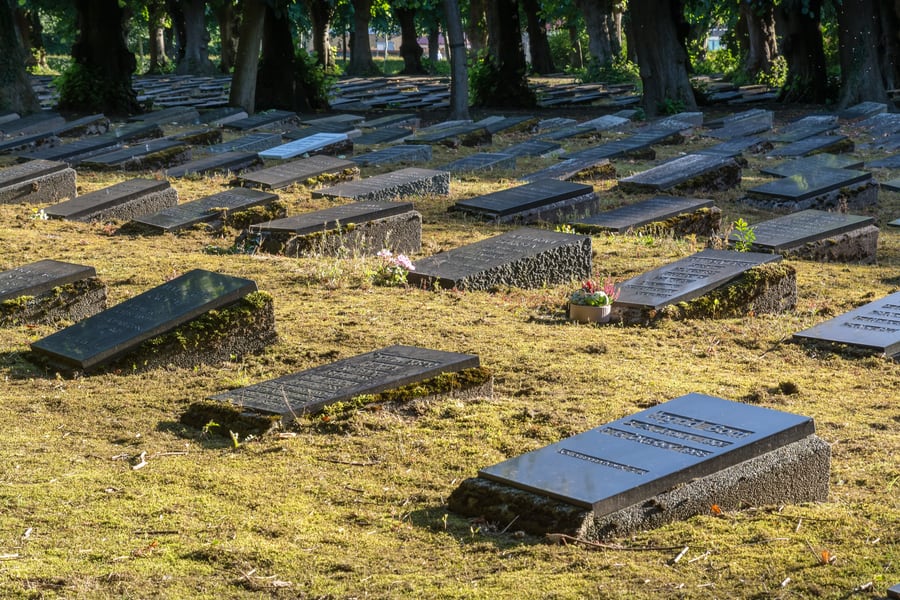 Ajepbah / Wikimedia Commons · CC BY-SA 3.0 de · cropped
A graveyard of identical stones
The Moravians' Gudsageren — God's Acre — lays everyone under the same flat slab, men on one side of the avenue and women on the other, in the order they died rather than by family or by means. It is a burial ground built to argue that everybody arrives equal, and it is still in use.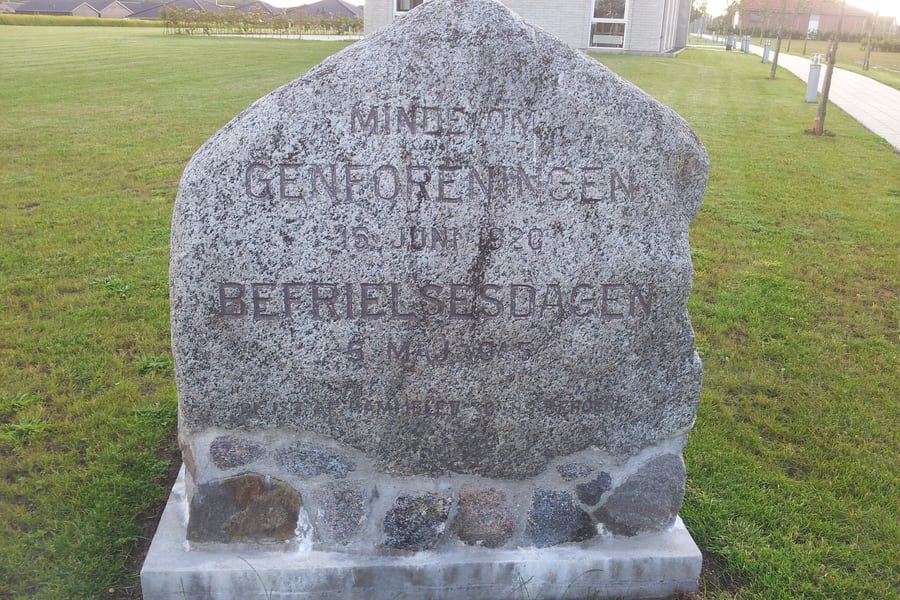 Inc / Wikimedia Commons · CC BY-SA 3.0 · cropped
The stones that mark 1920
After the plebiscite of 1920 returned this country to Denmark, village after village put up a genforeningssten — a plain granite boulder cut with the date and not much else. Sønderjylland is thick with them. One stands at Hammelev, at kilometre 6.2, a few steps from the halt the train calls at.Timetables
This is a four-day-a-year railway, and the four days fall in the last week of July and the first of August.
Summer 2026 — the days it ran
The association published this as its Sommerkørsel 2026:
| Running days | Departures from Vojens | Departures from Haderslev |
|---|---|---|
| Thursday 23 July | 09:20 · 11:30 · 14:00 | 10:30 · 13:00 · 15:00 |
| Sunday 26 July | 09:20 · 11:30 · 14:00 | 10:30 · 13:00 · 15:00 |
| Thursday 30 July | 09:20 · 11:30 · 14:00 | 10:30 · 13:00 · 15:00 |
| Sunday 2 August | 09:20 · 11:30 · 14:00 | 10:30 · 13:00 · 15:00 |
The 15:00 from Haderslev is the last working of the day and does not come back — the operator notes that it "returnerer ikke til Haderslev". Everything else is a there-and-back shuttle, three round trips, with the train laying over at each end.
The pattern is stable from year to year. In 2025 the line ran on Thursday 24 and Sunday 27 July and Thursday 31 July and Sunday 3 August, at exactly the same times, worked that season by Veterantog Vest with the class MT diesel MT 152. Anyone planning ahead can reasonably expect two Thursdays and two Sundays across the turn of July and August.
What is running now
As of August 2026 the train season has closed. The last departure of the year was on Sunday 2 August, and the association's ticket shop currently lists no train events at all. What is running on the rails instead, from Tuesday 11 August, is the rail-bike operation described under Tickets below.
Autumn and Advent trains have appeared on this line in past years, and the association announces them on its own site and Facebook page rather than in any published annual timetable. The authoritative source is the operator: veteranbanen-haderslev-vojens.dk (opens in a new tab).
Getting to the start
Vojens is on the Fredericia–Padborg main line and has roughly two trains an hour in each direction — DSB InterCity and InterCity Lyn services towards Fredericia one way and Sønderborg or Flensburg the other. Fredericia to Vojens is 36 minutes direct. Copenhagen to Vojens is about 2 hours 45 minutes with one change, and Hamburg about 3 hours 20 minutes with two.
Haderslev has no railway station — that is the whole point of the branch, and it has been true of the national timetable since 1978. The bus does the job the train used to. Sydtrafik route 136 links Haderslev Busstation with Vojens Station in 20 minutes, two-hourly on weekdays, and it calls at Hammelev and Styding on the way, the same two halts the heritage train serves. The printed timetable even shows the connection into the train at Vojens. Routes 135 and 138 cover the same stretch.
Train times checked against ÖBB's timetable service and the Sydtrafik route 136 timetable valid from 28 June 2026; heritage running days from the operator's own site. All as of August 2026.
Tickets
Tickets for the veteran train are sold on board — the association's standing instruction is that they kan købes i toget, with advance booking offered as a convenience rather than a requirement. So nobody needs to arrange anything before turning up at Vojens or Haderslev Vest on a running day. No fare is quoted here, because none is currently published: the season closed on 2 August 2026 and the figures on third-party listings disagree with one another by a wide margin.
The same rails now carry rail bikes, and that product is on sale, so its prices are verifiable: 130 kr for a two-person bike and 225 kr for a four-person family one, in three-hour slots from Haderslev Vest out to Hammelev and back. Hirers must be 18 or over, and children under 15 may not steer. Read from the operator's checkout on 20 August 2026.
Book your tickets
Rail bike, two people
130 kr for a three-hour slot
Pedal-driven, out to Hammelev and back — about two and a half hours of the slot.
Book Tickets (opens in a new tab, on veteranbanen-haderslev-vojens.dk)via veteranbanen-haderslev-vojens.dkFamily rail bike, four people
225 kr for a three-hour slot
One in the fleet, so it is the booking to make first on a fine weekend.
Book Tickets (opens in a new tab, on veteranbanen-haderslev-vojens.dk)via veteranbanen-haderslev-vojens.dkThe veteran train
Bought on board, on a running day
No fare is published between seasons; the operator posts it when the next one opens.
Book Tickets (opens in a new tab, on veteranbanen-haderslev-vojens.dk)via veteranbanen-haderslev-vojens.dkRail Passes
No rail pass covers this train, and buying one for it would be a mistake. The Veteranbanen Haderslev Vojens is a volunteer heritage operation on a closed state branch, not a scheduled railway service. It sits outside the national fare system entirely: its tickets are sold on board by the society that runs the train, and Interrail, Eurail, Orange and the regional zone fares have nothing to do with it.
Where a pass does earn its keep is getting to Vojens, which is on the Fredericia–Padborg main line with about two trains an hour in each direction.
What the passes cover on the way in
Interrail and Eurail list the Danish State Railways (DSB) as fully included, along with S-tog in Copenhagen, Nordjyske Jernbaner and Lokaltog on Zealand. The InterCity and InterCity Lyn services that call at Vojens are DSB, so a pass covers them outright, and seat reservations are optional on domestic Danish journeys. Coming from Germany, the Eurocity Express and Railjet services between Hamburg and Copenhagen are included but reservations are compulsory from 26 June to 16 August — which is exactly the window the heritage line runs in, so that is the one booking worth making in advance.
⚠️ Denmark's excluded-operator list is short but real: Midtjyske Jernbaner is excluded from Interrail passes. It is nowhere near this line, but it catches people combining a Jutland trip with the Lemvig line.
Whether a pass is worth it here
For a visitor coming to ride thirteen kilometres of heritage railway on one of four days a year, almost certainly not. A pass pays for itself on long or repeated main-line journeys, and this is a day out. A single DSB ticket to Vojens, or a Orange fare booked ahead, will normally cost less than a pass day. DSB Orange fares are valid between DSB, GoCollective and Nordjyske Jernbaner stations, and expressly not on bus, metro, light rail or local and private railways.
The calculation changes if Vojens is one stop on a wider Danish or Danish-German itinerary, in which case the branch simply rides along free on a pass you already hold — the heritage fare on board is the only thing you pay for the railway itself.
Interrail also sells the Nordic Pass (opens in a new tab), valid in Denmark, Norway, Sweden and Finland and across the borders between them: €218 for 3 travel days in a month for an adult in second class, against €137 for the Denmark Pass. It cannot be used in the country you live in, only in the other three. It pays only when the trip goes on into another Nordic country. Checked October 2026.
Pass conditions checked against Interrail's own Denmark page and DSB's Orange conditions, August 2026.
Places to Visit
The railway joins two towns that have almost nothing in common. Vojens grew out of a junction and is barely a century and a half old; Haderslev has a cathedral, a castle lake and streets laid out in the Middle Ages. In between, the meltwater valley the line follows holds a watermill that has been turning since the 1200s.
All four of these are within reach of a stop on the line, and the bus that replaced the train — Sydtrafik route 136 — calls at the same halts if the timing works out better that way.
 Hjart / Wikimedia Commons · CC BY-SA 4.0 · cropped
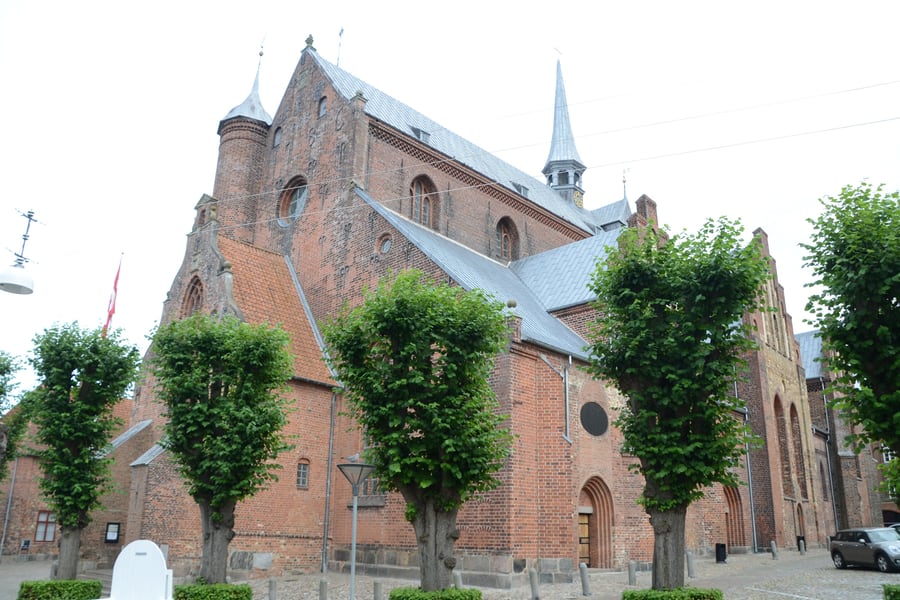
Haderslev Domkirke
The cathedral — Vor Frue Kirke — stands on roughly the highest point in Haderslev. A Romanesque church of dressed granite went up here around the middle of the 1100s; a century later it was taken down and replaced by a much larger brick building in mixed Romanesque and Gothic style, fit for a town that was growing. The granite blocks were reused in the new foundations, and in the transept the yellow and pink monk bricks separate clearly from the darker later work.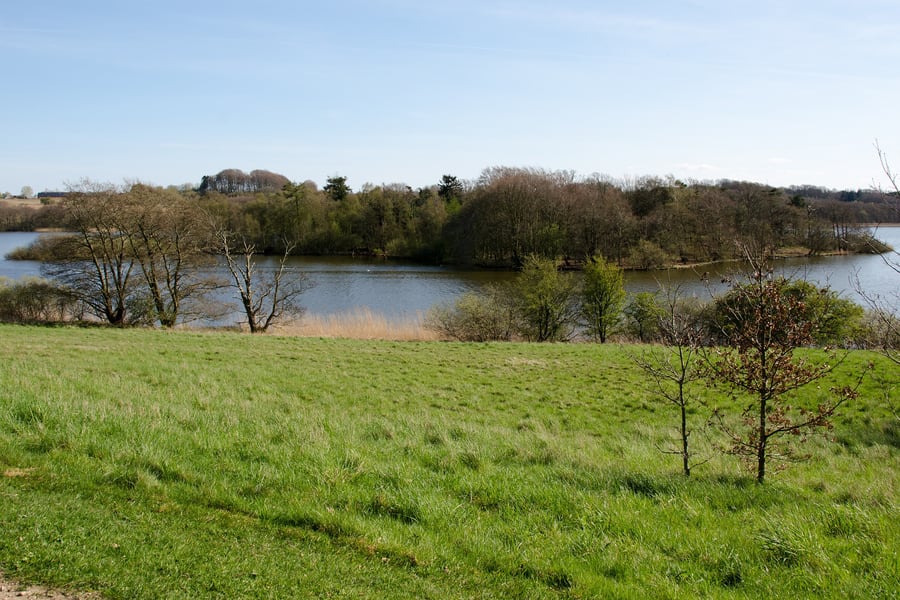 JEK / Wikimedia Commons · CC BY-SA 3.0 · cropped
Haderslev Dam
The long lake immediately west of the town, filling the floor of the meltwater valley the railway runs along. Haderslev itself sits on a bank of deposited sand between the Dam and Haderslev Fjord, which is a large part of why the main line stayed inland and the town got a branch instead of a through route. The shore is walkable from the middle of town, with meadow, reed and wooded islands, and Damparken at the town end is laid out as a public park down to the water.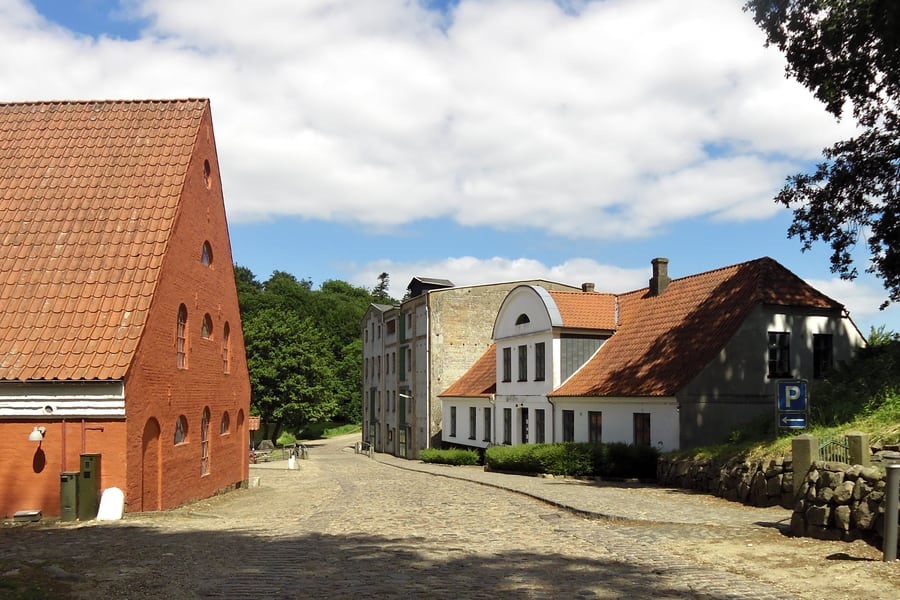 Hjart / Wikimedia Commons · CC BY-SA 4.0 · cropped
Tørning Mølle
A watermill in the Haderslev–Vojens tunneldal, west of Haderslev at the end of Stevning Dam and driven by the Tørning Å — the same valley the railway follows, a few kilometres off the line near Hammelev. The stream has been turning wheels here since the 1200s, and the mill later generated electricity for industry across eastern Sønderjylland. It has burnt and been rebuilt more than once. A self-governing institution owns it now, and the buildings are used for theatre, music and meetings.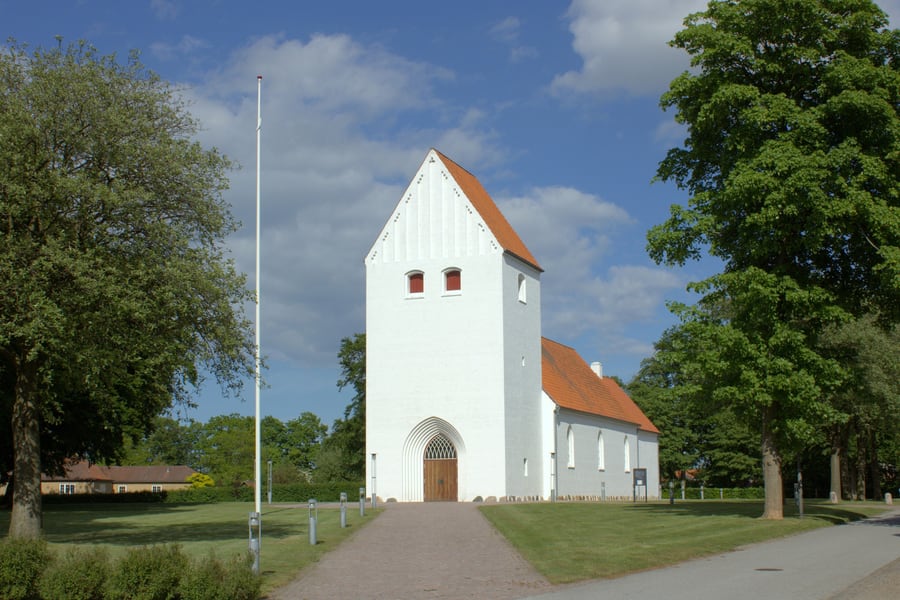 S.Juhl / Wikimedia Commons · CC0
Vojens Kirke
A genforeningskirke — a reunification church — in the eastern part of Vojens, and the first parish church built anywhere in the region after the 1920 reunification with Denmark. Its foundation stone was laid on 10 August 1924 and it was consecrated on 6 September 1925. The churchyard is older than the church by nearly fifty years, opened on 28 January 1878, and the small red chapel at its centre served as the parish church from 1914 until the church was finished.Where to Sleep
Haderslev has the choice, which is convenient given that the last train of the day does not return there. Vojens has one hotel, and it is directly across from the station where the veteran train starts — a useful thing on a morning departure.
None of the three is a railway hotel in the preserved sense. They are working houses in two working towns, and each is listed here for what can be checked: where it stands, how many rooms it has, and what it is.
Where to stay
Banegaardshotellet
In the middle of Vojens, the town the station made
The house calls itself "et klassisk lille provins hotel" — a classic small provincial hotel — with 18 rooms and a restaurant doing home-made Danish cooking from local suppliers, everything from breakfast and lunch to party menus and food to take away. It stands at Nørregade 2, in the middle of the stationsby, close to parking, shops and public transport, and it replaced the old Hotel Vojens on 1 January 2024. For an 09:20 departure it is the shortest walk to the platform of anywhere on this page.
Check Availability (opens in a new tab, on banegaardshotellet.dk)via banegaardshotellet.dkHarmonien
A listed house in the middle of Haderslev
A town hotel and cultural house beside Haderslev's pedestrian street, with its own car park. The building is fredet — listed — and the house has received several Danish monarchs over the years. There are 33 rooms, all with private bath, flat-screen television and wireless internet. Attached to it is a multisal built in 1997 that holds up to 800 people and takes everything from theatre and symphony concerts to rock gigs and conferences, so what is on in the evening varies a good deal.
Check Availability (opens in a new tab, on harmonien.dk)via harmonien.dkHotel Norden
By the lake and park, under the cathedral
68 rooms in a modern house set in the lake and park district of Haderslev, with the 13th-century cathedral in view and the pedestrian street 100 metres away. Some rooms look directly over Haderslev Dampark. Every room has its own bathroom, a flat-screen television, a hairdryer and free wireless internet, and the hotel has a tiered restaurant, a bar and several function and course rooms. It holds Green Key environmental certification, has chargers for electric cars, and is one of the 27 houses in the Danske Hoteller group.
Check Availability (opens in a new tab, on hotelnorden.dk)via hotelnorden.dkQuestions or corrections
Planning this trip and stuck on something, or spotted a time, fare or detail that has changed? Send us a message about Vojens to Haderslev: The Railway That Owns No Trains. We read every one, and we update this page when something has changed.