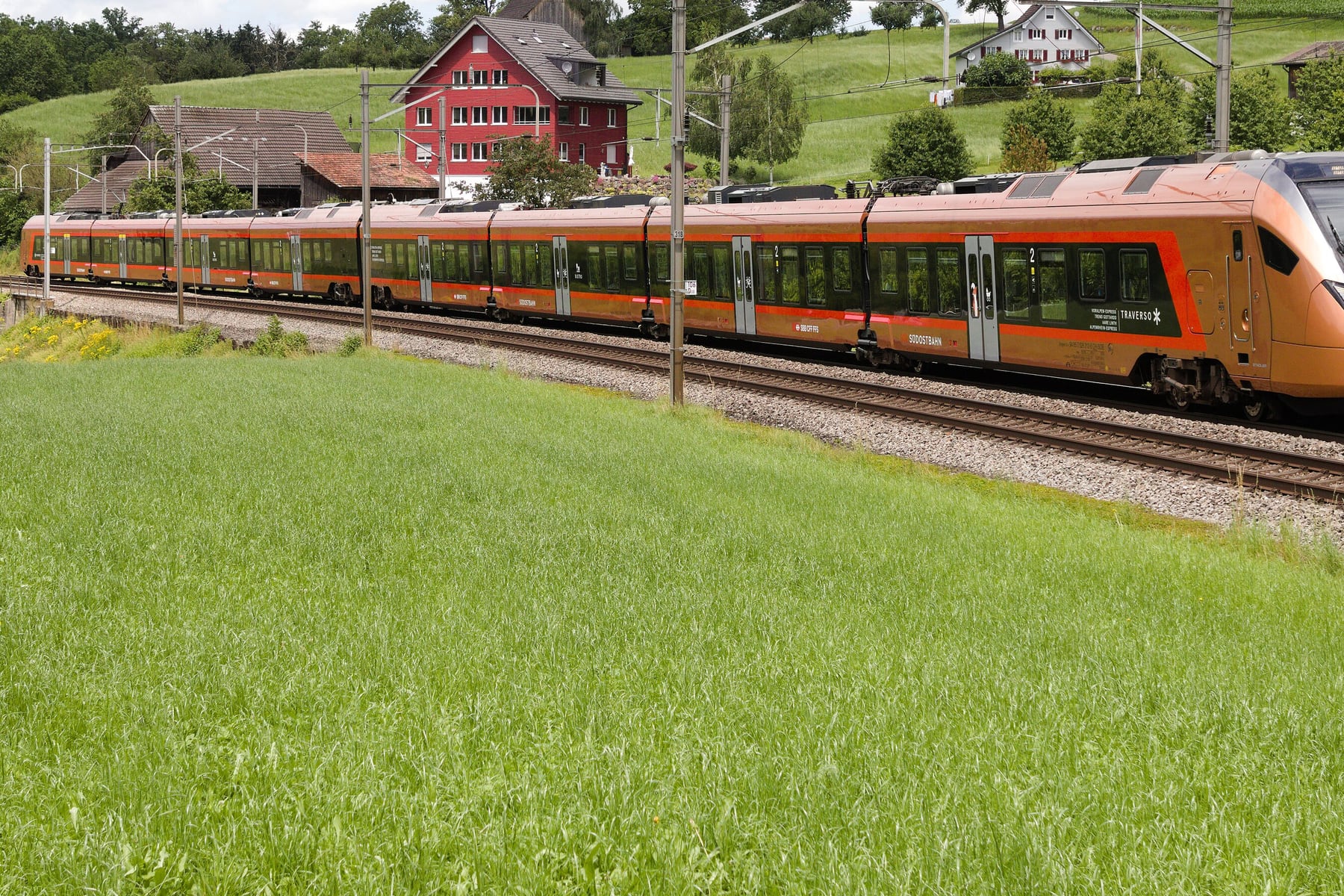
Voralpen-Express
Alex Noble / Wikimedia Commons · CC0 · 2024 · cropped
- Distance125 km
- Duration2 hr 16 min
- Best seasonHourly all year · 13 trains each way
Introduction
The Swiss railway map is a wheel, and Zurich is the hub. Nearly everything that crosses the country touches it, which is why the quickest way from Lucerne to St. Gallen is to ride north-east into Zurich, change platforms, and ride north-east again — an hour and fifty-five minutes, two trains. The Voralpen-Express does not go that way. It leaves Lucerne along the lake, turns inland at Küssnacht, climbs to nine hundred metres over a raised bog, crosses Lake Zurich on a causeway at the wrong end, and comes into St. Gallen over the highest railway bridge in Switzerland. It takes two hours and sixteen minutes, it never once looks at Zurich, and thirteen times a day in each direction people choose it anyway.
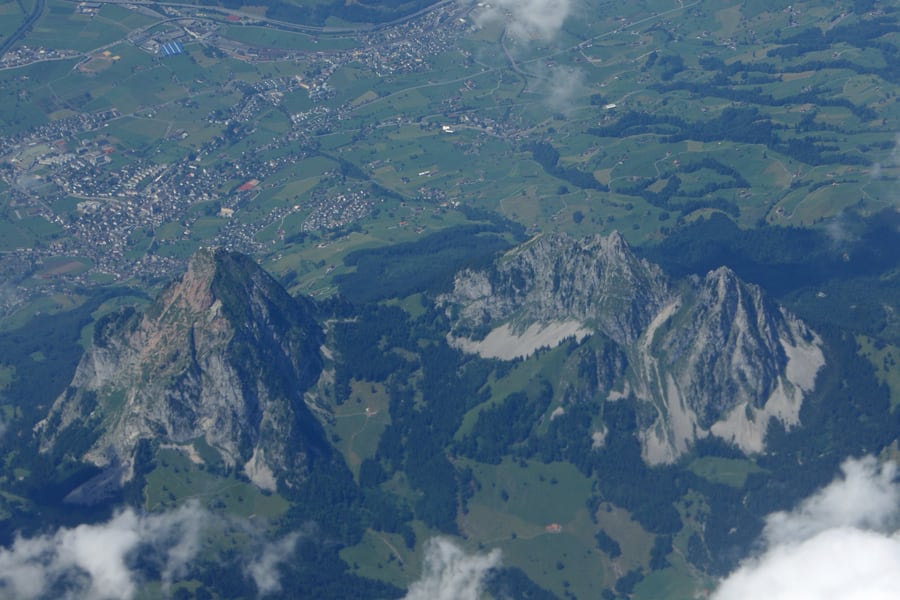
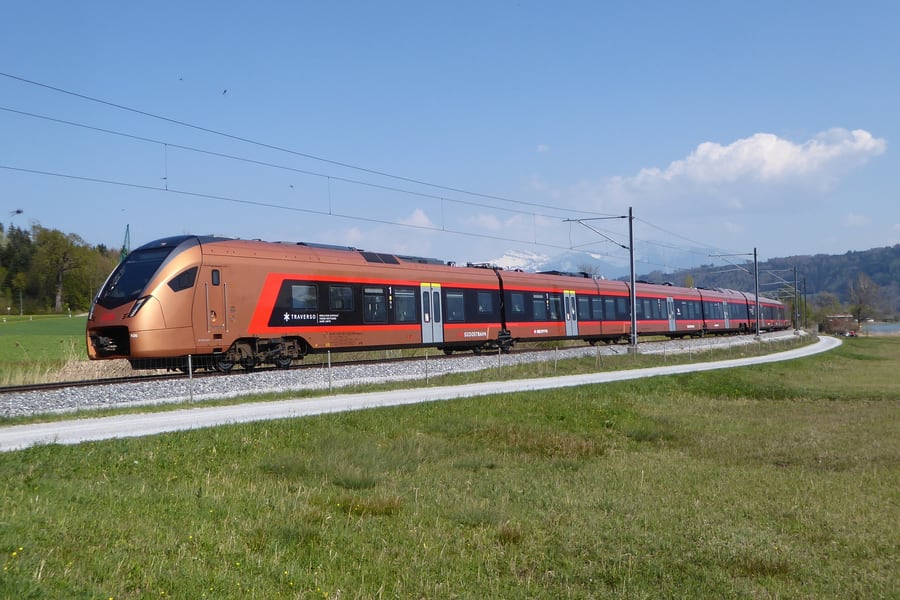
They choose it because the long way round is the good way round. The route follows the northern edge of the Alps, through the country the Germans call the Voralpen — the ground between the plateau and the high peaks — and it is one continuous view of them: the Rigi and the Mythen over the first hour, the moorland at Rothenthurm, the Obersee and the castle at Rapperswil in the middle, the Churfirsten and the Säntis over the last. The train is a copper-coloured eight-car Stadler unit called a Traverso, run not by the Swiss Federal Railways but by the Südostbahn, a small company from St. Gallen that has worked this corridor since 1940. There is no supplement, no compulsory reservation and no season. It is an ordinary InterRegio that happens to be beautiful.
The Journey
There is no railway between Lucerne and St. Gallen. There are seven, and the Voralpen-Express runs over pieces of all of them: the Lucerne–Immensee line out of the city, a stretch of the Gotthard main line into Arth-Goldau, the Südostbahn's own climb from there over the watershed to Pfäffikon, the Seedamm crossing to Rapperswil, the line towards Ziegelbrücke as far as Uznach, the Ricken route up to Wattwil, and finally the old Bodensee–Toggenburg railway over the hills into St. Gallen. They were laid by different companies, for different reasons, and the last of them opened in 1910. Nothing was joined up until 1940, when through trains began running, and the name did not appear in a Swiss timetable until 1992.
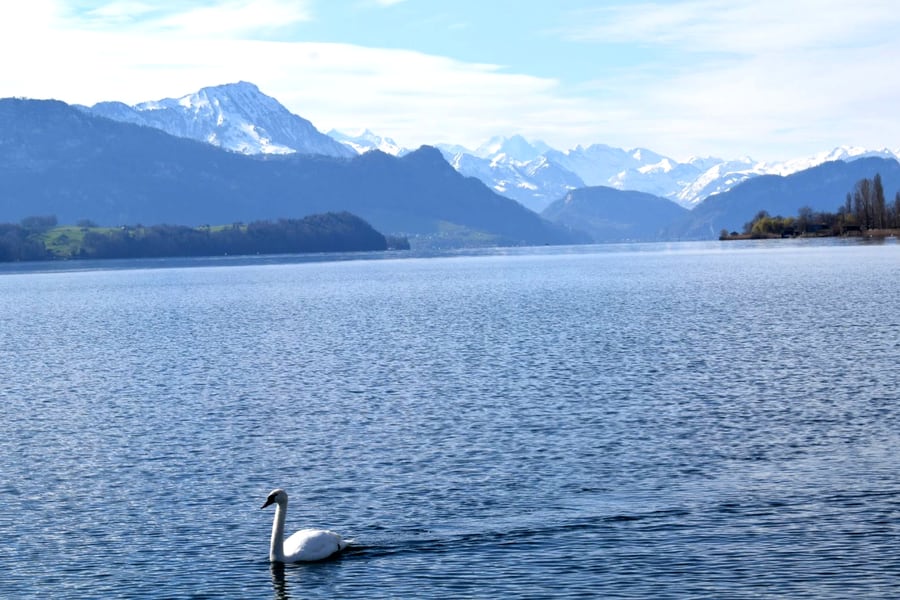
Going east, the first half-hour is the gentlest part of the day. The train leaves the terminus at Lucerne, calls at Verkehrshaus — the platform for the Swiss Museum of Transport, which is a reasonable place to break a rail journey — and runs along the north shore of Lake Lucerne through Meggen to Küssnacht am Rigi, with the Rigi filling the window on the right. Then it turns away from the water, joins the Gotthard line at Immensee and comes into Arth-Goldau, the junction under the Rigi where the Gotthard trains to Ticino and the rack railway to the summit both call.
The climb over the moor
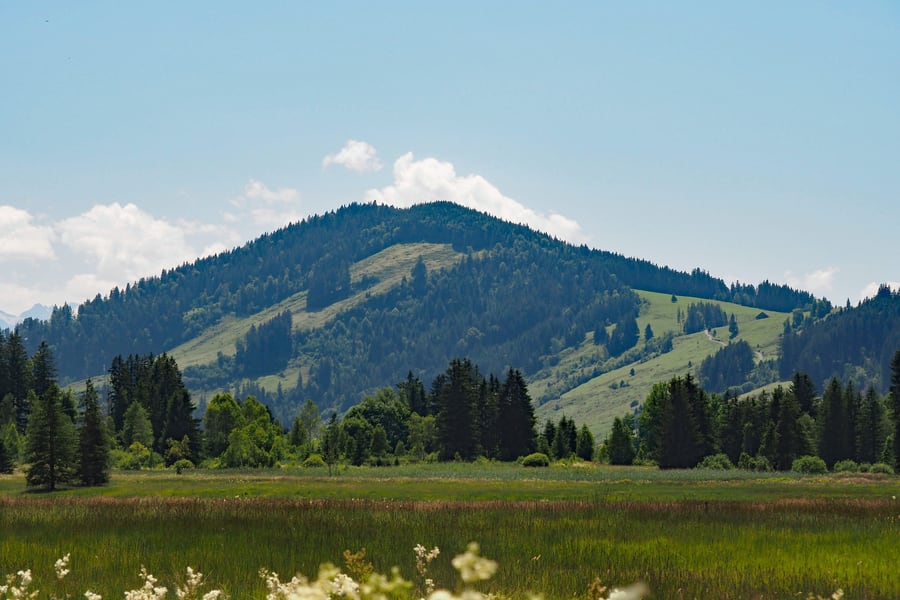
Out of Arth-Goldau the line goes up, and it goes up hard. The Südostbahn's own figures put the steepest gradient at fifty per mille — one in twenty — on two separate stretches, Arth-Goldau to Biberegg and Pfäffikon to Biberbrugg, which is severe for an adhesion main line and used to dictate how the trains were formed. The summit is at Biberegg, 933 metres, near Rothenthurm, and the country up there is the reason to make the trip. This is the largest continuous area of upland moorland in Switzerland: some eleven square kilometres of peat bog, spruce, standing water and almost no buildings. It is intact because the army wanted it. A plan to put a weapons training ground here ran into thirty years of local resistance and became a national argument, and on 6 December 1987 the country voted to protect its moors in the constitution rather than let this one be built on. The train crosses the middle of it, within walking distance of the boardwalks.
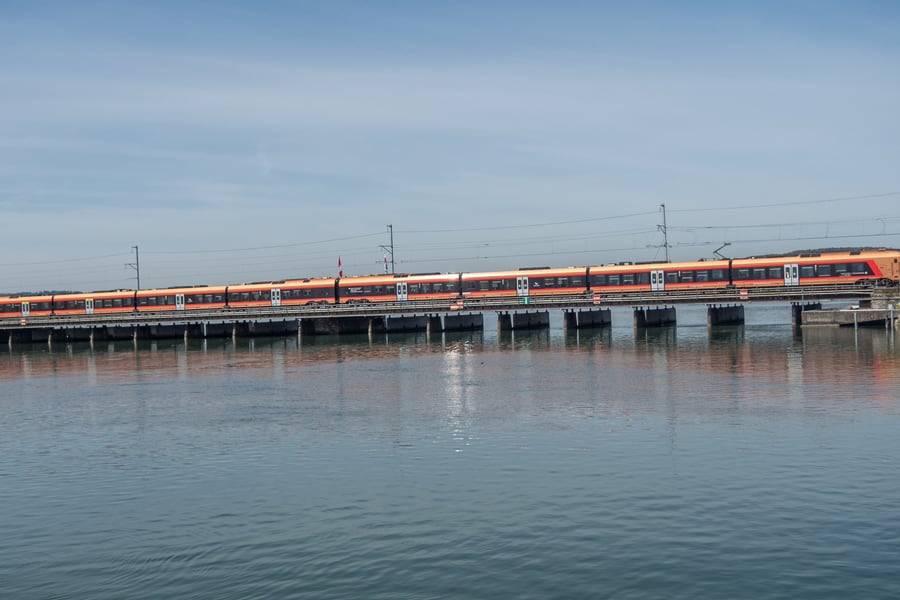
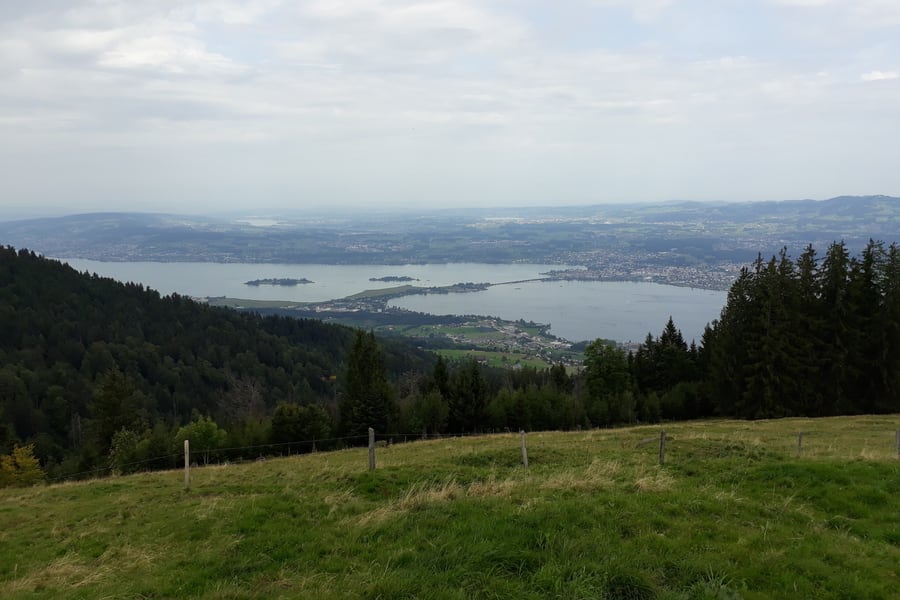
Then it drops just as steeply to Biberbrugg, where the branch to the abbey at Einsiedeln goes off, and down again to Pfäffikon on the shore of Lake Zurich. From there the route crosses the water. The Seedamm is a moraine left by the ice, and the railway runs along it beside the road, over the narrows that divide the Obersee from the main lake, with the castle at Rapperswil ahead and the islands of Ufenau and Lützelau off to the left.
The Toggenburg, and the bridge into St. Gallen
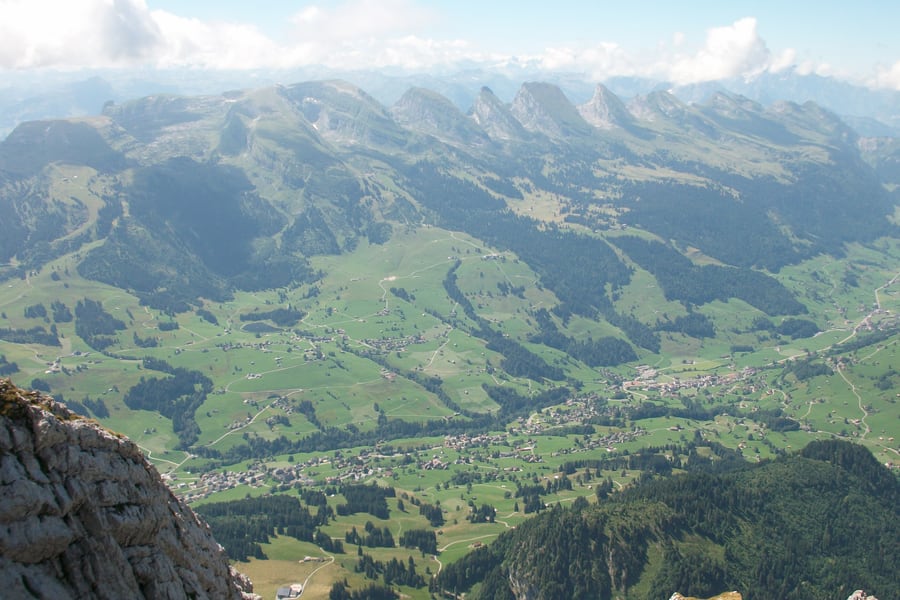
East of Rapperswil the line runs along the flat ground behind the lake to Uznach — passing Schmerikon, at 408 metres the lowest point of the whole route, which the express no longer stops at — and then enters the Ricken tunnel, 8,603 metres of it, the longest on the journey. It comes out in the Toggenburg, the valley of the Thur, with the Churfirsten ridge and the Säntis to the east. After Wattwil there is a second long bore, the Wasserfluh tunnel, and then the hardest engineering of the day: the Weissenbach viaduct between Degersheim and Herisau, thirteen stone arches finished in 1910 and standing a little over sixty metres above the Wissbach, and then the Glatttal viaduct on the approach to Herisau itself.
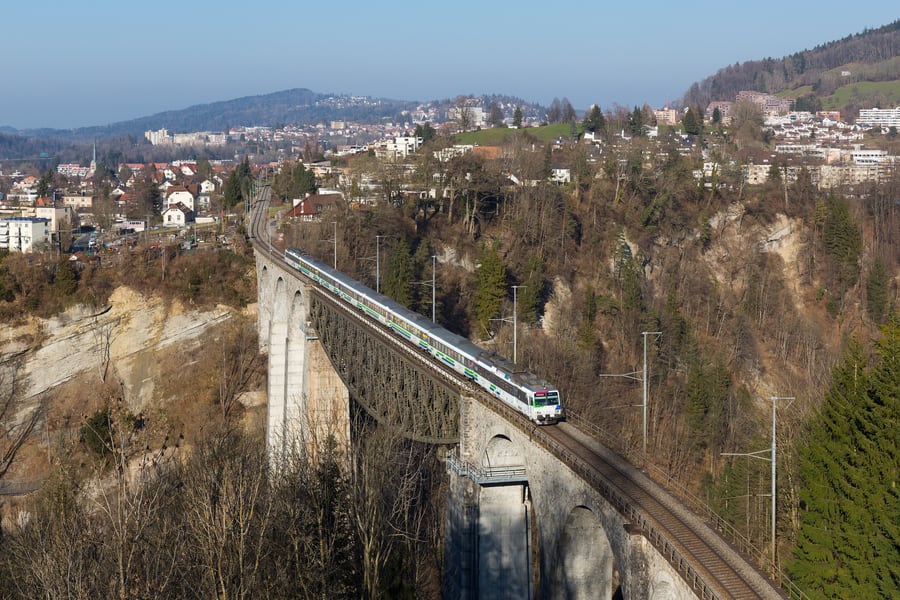
The last of them is the best. Between Herisau and St. Gallen the line crosses the Sitter gorge 99 metres up, on a bridge 365 metres long whose middle is a riveted steel span of 120 metres, bowed downwards like the belly of a fish. It is the highest railway bridge in Switzerland; the 120-metre span is still the longest on any Swiss railway bridge; and the pier beside the Kubel power station, 93 metres from footing to parapet, is the tallest structure in the city of St. Gallen. It was built between 1908 and 1910, it is single track, and it carries every Voralpen-Express. From the window you can see the other Sitter bridge, the Federal Railways' one on the Zurich line, four hundred metres downstream. A few minutes later the train runs into the roof at St. Gallen, and the abbey district with its library is a ten-minute walk away.
What runs, and what used to
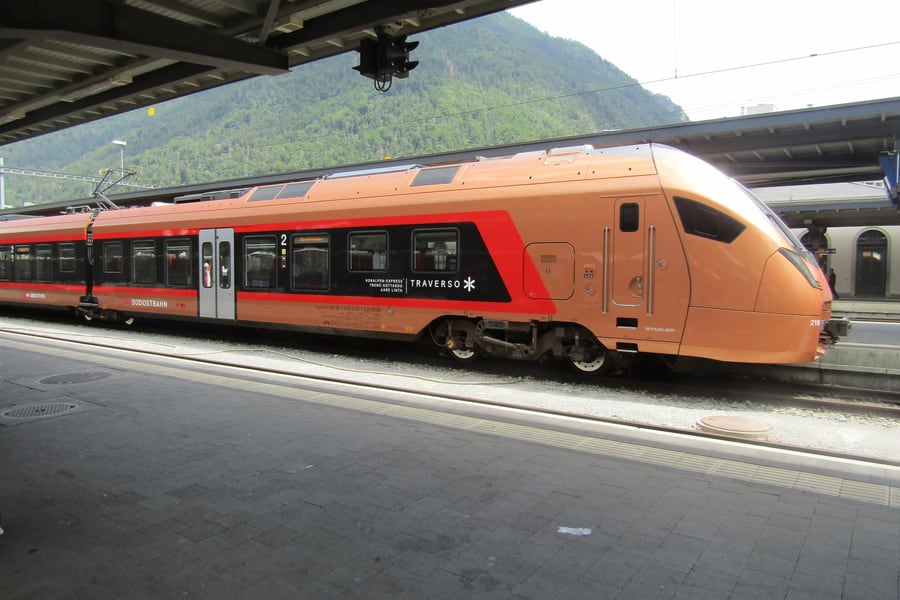
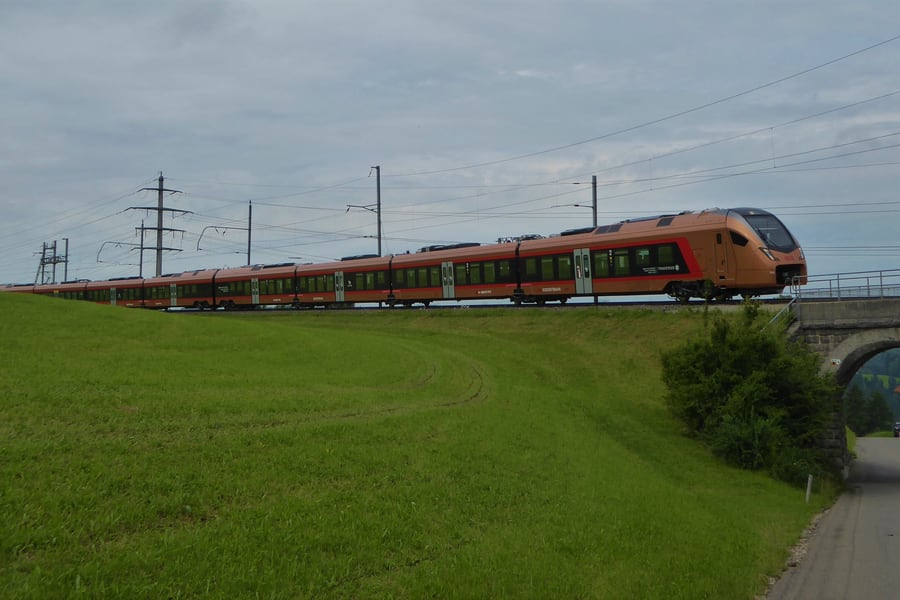
Since December 2019 the whole service has been worked by the Traverso: an eight-car Stadler FLIRT 3 in copper and red, 150 metres long, 380 seats, 160 km/h. The name is Italian for across, and it was chosen — along with the copper livery — by the Zurich design office NOSE, on the argument that these trains would traverse Switzerland in both directions at once. Thirty of them have been delivered in four batches since 2019. Every seat has a socket, the whole train is step-free, and there are two self-service bistro zones with drinks and snack machines that take cards and cash in francs or euros. At busy times a shorter silver FLIRT is coupled on between Rapperswil and St. Gallen and detached again on the way back, so that passengers can reach Einsiedeln without changing.
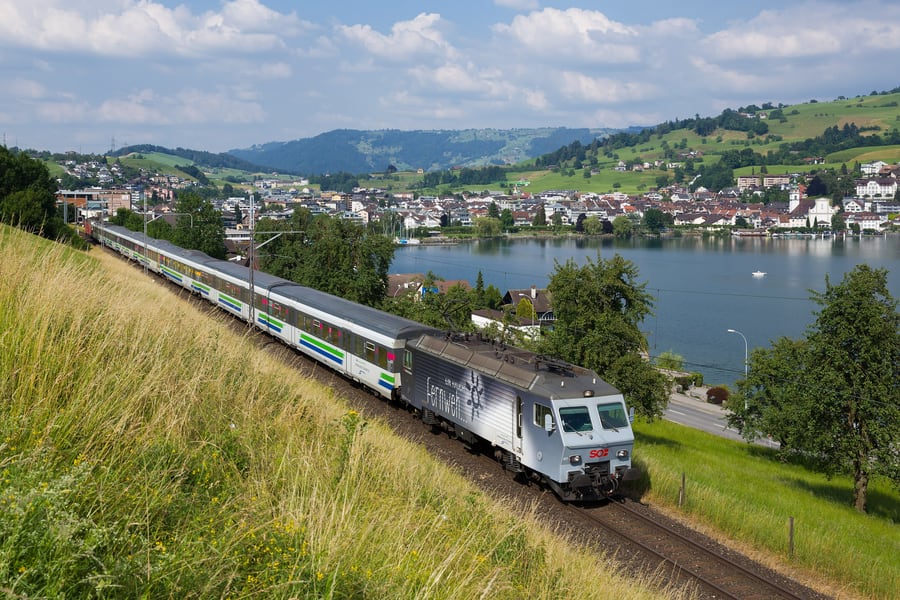
Before that the Voralpen-Express was locomotive-hauled, and it was hauled at both ends: because of those fifty-per-mille ramps, a set of more than six coaches needed power at the front and the back, so the trains ran with a locomotive or a motor coach at each end and no driving trailer. Fourteen machines were kept for it. That formation ran until the timetable change of December 2019 and is gone; two of the photographs on this page show it while it was still working, and the dates are in the captions.
Along the route
 Kabelleger / David Gubler / Wikimedia Commons · CC BY-SA 3.0 · 2014 · cropped
Ninety-nine metres over the Sitter
The last bridge before St. Gallen is the highest railway bridge in Switzerland — 365 metres long, 99 metres above the river, with a riveted steel span of 120 metres bowed downwards like the belly of a fish. It was built between 1908 and 1910, and it is single track.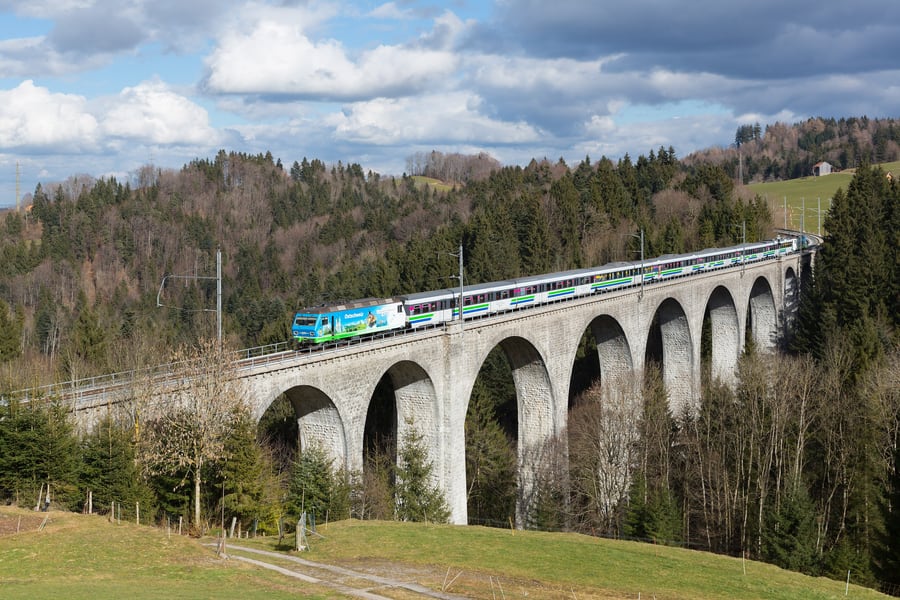 Kabelleger / David Gubler / Wikimedia Commons · CC BY-SA 3.0 · 2014 · cropped
The stone arches at Degersheim
Between Wattwil and Herisau the line crosses the Wissbach on thirteen stone arches finished in 1910, a little over sixty metres above the stream. Masonry rather than steel, and the last of the seven railways this journey uses.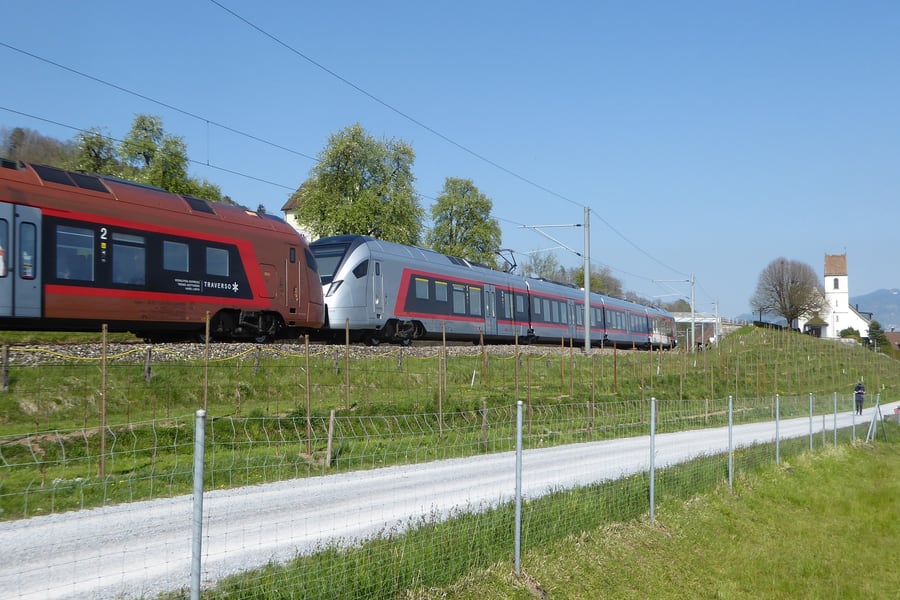 Plutowiki / Wikimedia Commons · CC0 · 2021 · cropped
Two trains, one number
At busy times a shorter silver FLIRT is coupled to the copper Traverso at Rapperswil. The short set then works the S40 up the branch to Einsiedeln, so a passenger from St. Gallen reaches the abbey without changing. The split takes about a minute.A bit of history
Culture & experiences along the way
 Pechristener / Wikimedia Commons · CC BY-SA 4.0 · 2023 · cropped
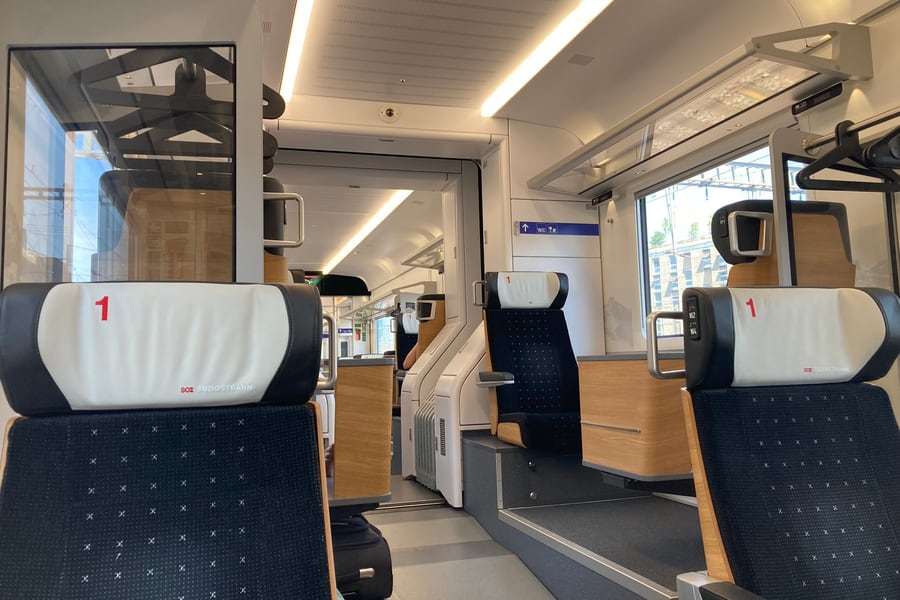
First class, and what it costs
The Traverso has 68 first-class seats in a quiet section at one end, with large windows, wide tables and a socket at every place. The upgrade is CHF 22.60 on a single from Lucerne to St. Gallen, which is a modest premium for two and a quarter hours, and it is the part of the train that empties out between the commuter peaks. There are 291 second-class seats and 21 tip-up seats besides.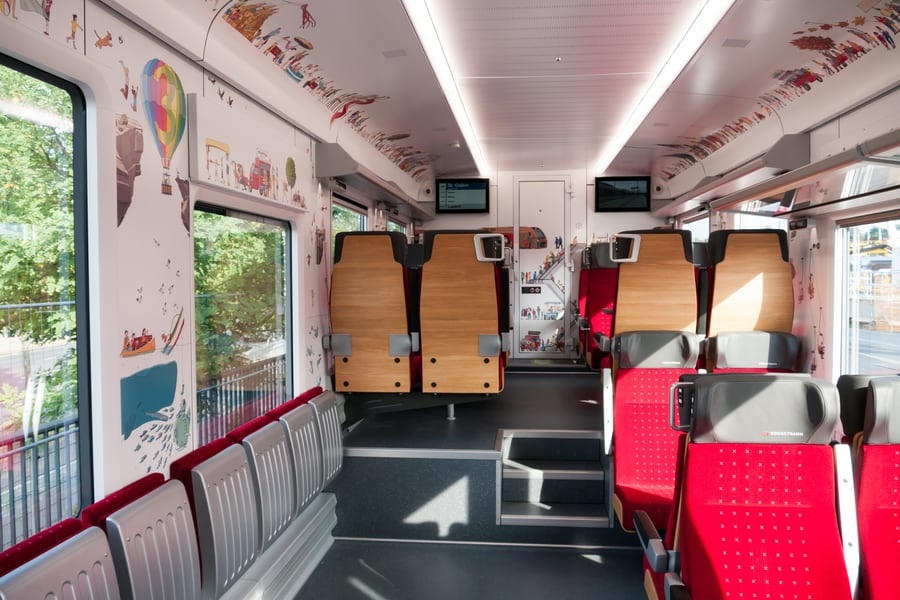 Matti Blume / Wikimedia Commons · CC BY-SA 4.0 · 2018 · cropped
The family compartment
One end of the train is given over to families, with seasonal search-and-find panels by the illustrator Konrad Beck covering the walls and ceiling, and tables big enough to spread toys across. A colouring book featuring Zoe the vixen, and the crayons to go with it, are handed out free by the conductor on request. There are two self-service bistro zones elsewhere in the train with drink and snack machines that take cards, Twint or cash in francs or euros.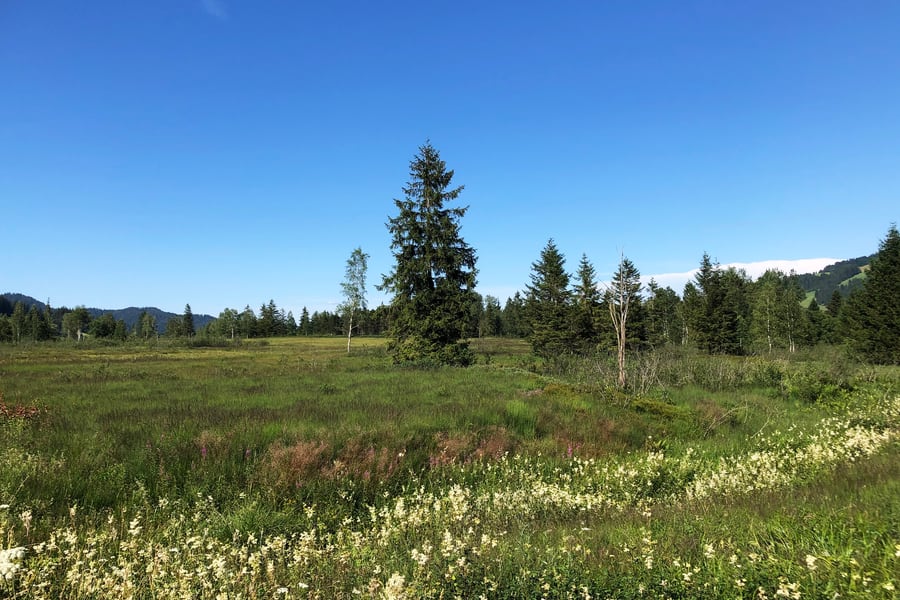 Arkelin / Wikimedia Commons · CC BY 4.0 · 2024 · cropped
Getting off in the moor
Rothenthurm is a request to break the journey in the emptiest place on the route. The moorland around the station covers some eleven square kilometres of raised and low bog, and there are marked paths and boardwalks across it from the village — the Moorweg being the obvious one. It is protected because a plan to build an army training ground here was defeated by a national vote in December 1987, which put moor protection into the Swiss constitution.Timetables
The Voralpen-Express runs to a clock-face timetable with no season in it. Thirteen trains a day work the whole route in each direction, hourly, and the pattern is identical seven days a week — the departures below were queried against the Swiss national timetable database for a Wednesday, a Saturday and a Sunday in September 2026 and came back the same on all three.
Eastbound trains leave Lucerne at 39 minutes past the hour, from 07:39 to 19:39. Westbound trains leave St. Gallen at five past, from 07:05 to 19:05. The run takes 2 hours 16 minutes either way.
Every departure calls at all thirteen stations, and the intermediate times shift by exactly one hour from one train to the next. The first, a midday and the last are set out below; add or subtract whole hours for the rest.
Lucerne to St. Gallen
| Station | First | Midday | Last |
|---|---|---|---|
| Luzern | 07:39 | 10:39 | 19:39 |
| Luzern Verkehrshaus | 07:46 | 10:46 | 19:46 |
| Meggen Zentrum | 07:51 | 10:51 | 19:51 |
| Küssnacht am Rigi | 08:00 | 11:00 | 20:00 |
| Arth-Goldau | 08:16 | 11:16 | 20:16 |
| Rothenthurm | 08:29 | 11:29 | 20:29 |
| Biberbrugg | 08:38 | 11:38 | 20:38 |
| Pfäffikon SZ | 08:54 | 11:54 | 20:54 |
| Rapperswil | 09:07 | 12:07 | 21:07 |
| Uznach | 09:17 | 12:17 | 21:17 |
| Wattwil | 09:27 | 12:27 | 21:27 |
| Herisau | 09:47 | 12:47 | 21:47 |
| St. Gallen | 09:55 | 12:55 | 21:55 |
St. Gallen to Lucerne
| Station | First | Midday | Last |
|---|---|---|---|
| St. Gallen | 07:05 | 11:05 | 19:05 |
| Herisau | 07:13 | 11:13 | 19:13 |
| Wattwil | 07:32 | 11:32 | 19:32 |
| Uznach | 07:43 | 11:43 | 19:43 |
| Rapperswil | 07:56 | 11:56 | 19:56 |
| Pfäffikon SZ | 08:02 | 12:02 | 20:02 |
| Biberbrugg | 08:20 | 12:20 | 20:20 |
| Rothenthurm | 08:29 | 12:29 | 20:29 |
| Arth-Goldau | 08:49 | 12:49 | 20:49 |
| Küssnacht am Rigi | 09:01 | 13:01 | 21:01 |
| Meggen Zentrum | 09:07 | 13:07 | 21:07 |
| Luzern Verkehrshaus | 09:13 | 13:13 | 21:13 |
| Luzern | 09:21 | 13:21 | 21:21 |
Before and after the through service
A handful of extra workings carry the Voralpen-Express name outside those hours but do not run the whole way. Eastbound, trains start from Arth-Goldau at 06:15 and 07:15. Westbound, the 05:05 and 06:05 out of St. Gallen terminate at Biberbrugg, the 20:05, 21:05 and 22:05 at Arth-Goldau, and the 23:05 and 00:05 at Rapperswil. For a journey end to end, the thirteen daytime trains are the service.
Connections
The Swiss timetable is built around clock-face connections, and every junction on this line is one. Arth-Goldau has the Gotthard trains to Ticino, the Zug and Zurich services, and the rack railway to the Rigi. Biberbrugg connects for Einsiedeln. Pfäffikon SZ has trains to Chur and the Rhaetian Railway network. Rapperswil has the Zurich S-Bahn and the Lake Zurich boats. Wattwil is the gateway to the upper Toggenburg, and Herisau connects to the Appenzeller Bahnen. Both termini are on the national network, so the Voralpen-Express is easy to attach to a longer itinerary at either end.
The faster alternative is worth knowing about: Federal Railways services via Zurich cover Lucerne to St. Gallen in about 1 hour 55 minutes with one change, and there is a direct InterRegio the same way in around 2 hours 13. Neither goes anywhere near the moor.
Times as published in the Swiss national timetable for the 2026 timetable year and checked in August 2026. Operator: sob.ch (opens in a new tab).
Tickets
The Voralpen-Express is sold as an ordinary Swiss train, which is the best thing about buying a ticket for it. There is no named-train fare, no panorama supplement and no compulsory reservation: the price is the standard national fare for the 125-kilometre distance, so anything that carries you across the Swiss network carries you on this train. A point-to-point single from Lucerne to St. Gallen is CHF 51.00, valid on the chosen route all day and until five the next morning, so a break at Rapperswil or Arth-Goldau costs nothing.
Supersaver tickets exist on this connection, which is not true of every Swiss line, and from CHF 29.60 they are the cheapest way to ride it — tied to one departure, not refundable, and priced by demand. A reservation is never required; the Südostbahn will sell one for CHF 5. Bicycles need their own ticket and cannot be reserved at all. Fares read from sbb.ch (opens in a new tab) in August 2026.
Book your tickets
Lucerne – St. Gallen, single
CHF 51.00 second class · CHF 25.50 with a Half Fare Travelcard
The flexible point-to-point ticket, valid all day, so breaking the journey costs nothing.
Book Tickets (opens in a new tab, on sbb.ch)via sbb.chSupersaver, one train only
From CHF 29.60 second class · from CHF 19.00 with a Half Fare Travelcard
Tied to a single named departure, not refundable, and the cheapest way to ride the line.
Book Tickets (opens in a new tab, on sbb.ch)via sbb.chSaver Day Pass
Quoted at CHF 79.00 three weeks ahead · CHF 54.00 with a Half Fare Travelcard
A day on everything the GA Travelcard covers, which can undercut a flexible return.
Book Tickets (opens in a new tab, on sbb.ch)via sbb.chRail Passes
This is the journey in the Swiss batch where a pass gives the clearest answer: every rail pass that covers Switzerland covers the Voralpen-Express outright, with no supplement to pay and no exception to read around. It is an InterRegio on the national network, not a private mountain railway with a house tariff, so the ordinary rules apply from end to end.
Swiss Travel Pass
Included in full, both classes, for as many journeys as you like on a travel day. The Swiss Travel Pass covers train, bus and boat across the country, plus local transport in more than ninety towns and cities — which means the walk from St. Gallen station to the abbey can be a bus ride instead, and the boats on Lake Lucerne are covered as well. It comes in 3, 4, 6, 8 or 15 consecutive days, or the same number of days chosen freely within a month as the Swiss Travel Pass Flex. It is sold only to people who do not live in Switzerland or Liechtenstein, and it is checked against a passport or identity card.
GA Travelcard and Half Fare Travelcard
The Südostbahn states plainly that travel on the Voralpen-Express is included for GA Travelcard holders. A Half Fare Travelcard halves the fare, and on this route that is CHF 25.50 for a flexible single instead of CHF 51.00.
Interrail and Eurail
Free, for the whole route, which takes a moment to establish because the journey runs over two operators' tracks. The 2026 Swiss validity document lists the entire Federal Railways network in the free-travel column, and lists the Südostbahn separately — "Nesslau–Neu St. Johann–St. Gallen– Romanshorn, Arth–Goldau–Biberbrugg–Rapperswil/Wädenswil/Einsiedeln" — which is precisely the Südostbahn mileage this train uses. Between them the two entries cover Lucerne to St. Gallen completely. The Südostbahn does not appear anywhere in the separate list of companies that give pass holders a percentage discount, and that is the right way round: it is free, not discounted.
One caveat has nothing to do with this train and everything to do with the pass. An Interrail One Country Pass for Switzerland cannot be used to travel into or out of the country — it is valid only for journeys within it. That does not affect the Voralpen-Express, which is domestic from first station to last, but it does affect how you get to Lucerne or leave St. Gallen.
Is a pass worth it here?
For this journey alone, no. A flexible return costs CHF 102.00 at full price, and a Saver Day Pass covering the whole country for a day was quoted at CHF 79.00 three weeks ahead, so a rail pass has to be earning its keep on other days to make sense. Where it does pay is the obvious thing to do with this route: ride it as one leg of a bigger circuit. Both ends are junctions, and the mountain railways within reach of them — the Rigi from Arth-Goldau, the Pilatus from Lucerne, the Appenzell lines from Herisau — are the kind of thing a Swiss Travel Pass exists for. The Rigi is one of only three mountains covered outright by the Swiss Travel Pass; the Pilatus is a discount rather than a free ride.
Reservations
Optional on every train, at every time of year, for CHF 5. No pass holder is required to buy one, and no pass is invalid without one.
Pass conditions checked in August 2026 against sbb.ch (opens in a new tab), the Südostbahn's own ticketing page and the 2026 Interrail/Eurail Switzerland validity document.
Places to Visit
A journey with thirteen stops and a flexible ticket is really an invitation to break it. The point-to-point fare is valid all day on the chosen route, so getting off at Rapperswil for two hours and catching the next one costs nothing at all, and the hourly interval means nothing is ever more than sixty minutes away. Four of the stops below are worth a whole afternoon; two of them are worth a whole day.
The order here is west to east, the way the train runs; westbound passengers meet them in reverse.
 Ikiwaner / Wikimedia Commons · CC BY-SA 3.0 · cropped
Lucerne
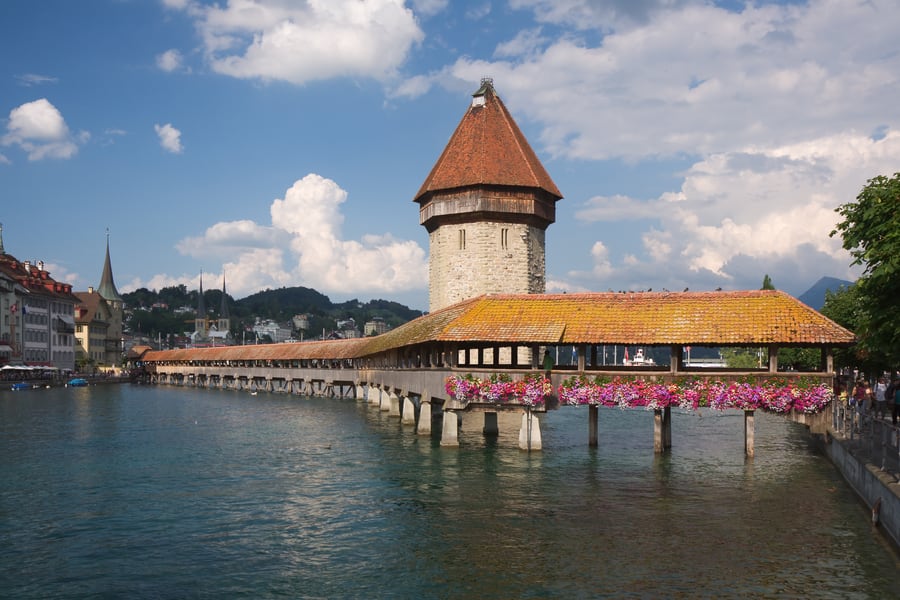
The train starts in the middle of the old town, at a terminus on the Reuss where the river leaves the lake. The Kapellbrücke is two minutes' walk: a covered wooden footbridge carrying seventeenth-century painted panels in its roof, the oldest wooden covered bridge in Europe and the oldest surviving truss bridge anywhere, rebuilt after a fire destroyed most of it in 1993. The boats of Lake Lucerne leave from beside the station, and the rack railway up Pilatus starts a short bus ride away.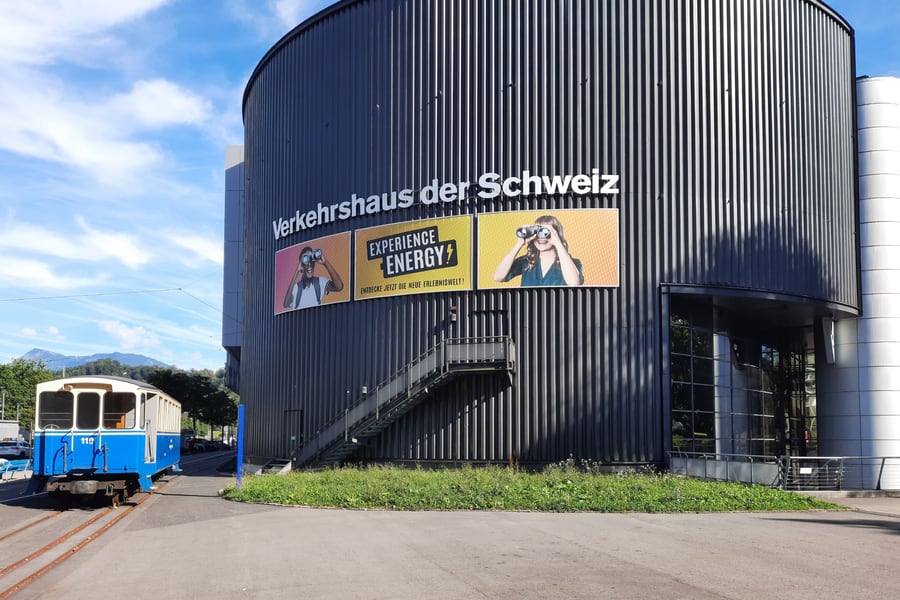 Bybbisch94 / Wikimedia Commons · CC BY 4.0 · 2024 · cropped
Luzern Verkehrshaus
The Swiss Museum of Transport has its own station, and the Voralpen-Express calls there. It opened in July 1959, it covers rail, road, water, air and space in one place, and it is the most visited museum in Switzerland. For anyone riding this line for the railway rather than the view it is the obvious first stop, and getting off costs nothing on a point-to-point ticket. The collection of work by the Lucerne painter Hans Erni is here too.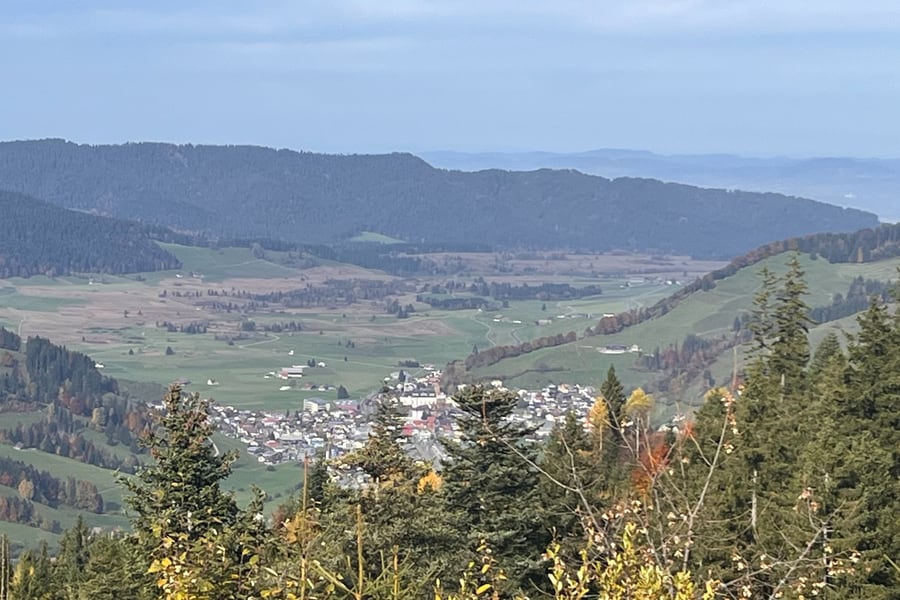 Albinfo / Wikimedia Commons · CC BY-SA 4.0 · 2025 · cropped
Rothenthurm
A village on a high plateau between the Höhronen and the Chatzenstrick, and the reason the line is worth riding for its own sake. Some eleven square kilometres of raised and low bog stretch north from the village past the Altmatt to Biberbrugg — the largest continuous area of its kind in Switzerland, kept intact by farmers who never fertilised it and cut it once a year. Marked paths and boardwalks run out from the station across the middle of it.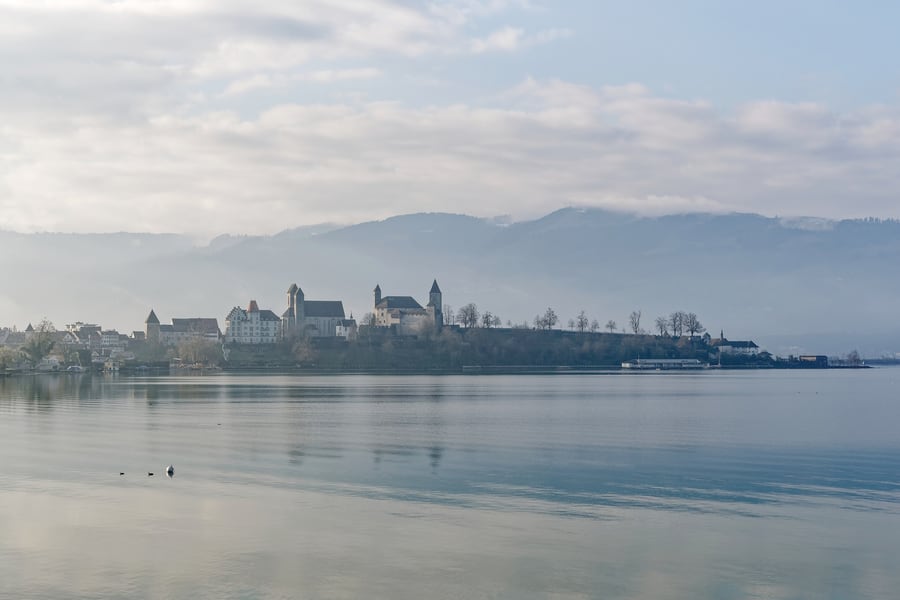 Jakub Hałun / Wikimedia Commons · CC BY 4.0 · 2025 · cropped
Rapperswil
The medieval town on its promontory over the lake, with a castle built by the House of Rapperswil in the early thirteenth century standing above it. The station is a few minutes from the old town, the Lake Zurich boats leave from below the castle, Knie's Kinderzoo is a short walk along the shore, and the wooden pedestrian bridge to Hurden — 841 metres, the longest in Switzerland, opened in April 2001 — runs beside the railway causeway.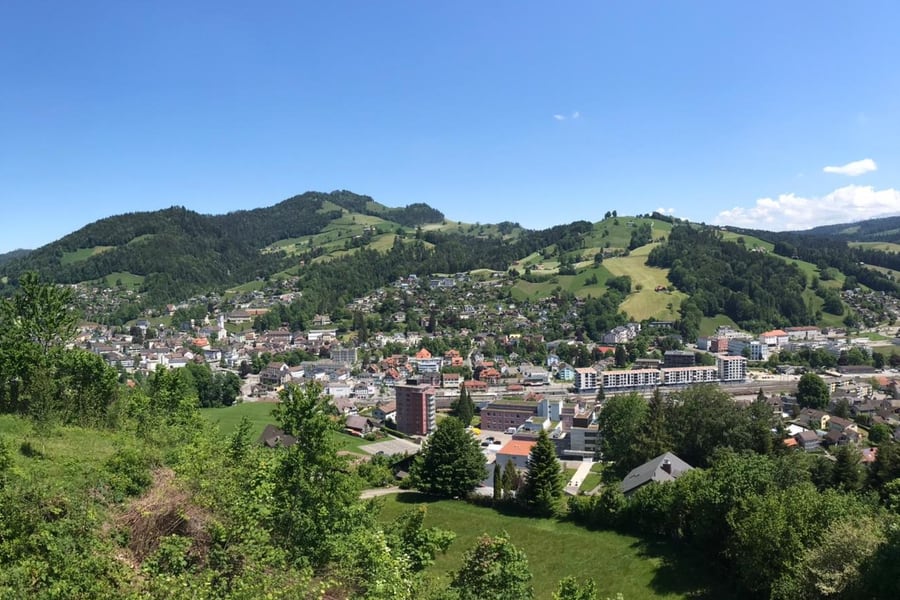 Aurelius1717 / Wikimedia Commons · CC BY-SA 4.0 · cropped
Wattwil
The town in the middle of the Toggenburg, the valley of the upper Thur, and the junction where the branch from Wil comes in and the line to Nesslau goes off. It is the practical way into a walking region that runs east to the Churfirsten and the Säntis, and the ruined Iburg on the hillside above the town is a short climb from the station. The train is between two long tunnels here, the Ricken behind it and the Wasserfluh ahead.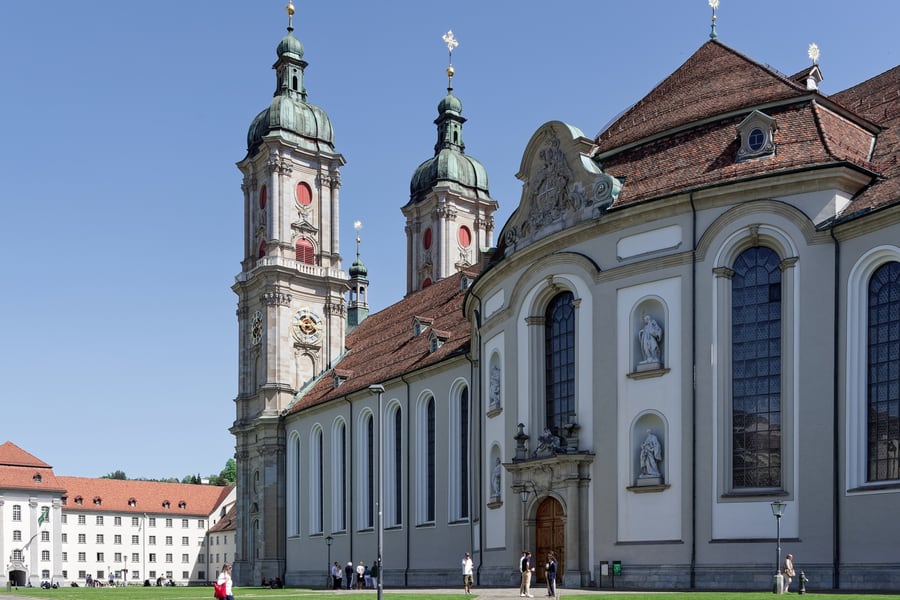 Jakub Hałun / Wikimedia Commons · CC BY 4.0 · 2025 · cropped
St. Gallen
The city grew from a hermitage founded in the seventh century, and the abbey district ten minutes' walk from the station has been a UNESCO World Heritage Site since 1983. The abbey library is one of the oldest monastic libraries in the world and still holds the manuscripts that made this one of the great cultural centres of Europe between the eighth century and its secularisation in 1805. The cathedral beside it is free to enter.Where to Sleep
This is a day journey, and the obvious way to ride it is to sleep at one end and travel to the other. Lucerne and St. Gallen are very different propositions: Lucerne is one of the busiest tourist towns in Switzerland and prices behave accordingly, while St. Gallen is a working city of about seventy-nine thousand people with a UNESCO abbey in the middle of it and far less competition for a bed. If the trip is one-way, staying in St. Gallen is usually the cheaper half of it.
The other option is to stop somewhere in the middle, and the route makes that easy. Rapperswil sits almost exactly halfway, is a proper medieval town rather than a junction, and has an hourly train in both directions until the evening. Herisau, twelve minutes short of St. Gallen, is the quiet alternative for the eastern end.
All four properties below were opened and read in a browser in August 2026. No price, rating or star count appears on any of these cards, because none of that has been verified here — what is on them is what the hotel says about itself. Two of them have no photograph on Wikimedia Commons and are shown without one rather than with a stand-in.
Where to stay
 Paebi / Wikimedia Commons · CC BY-SA 4.0 · cropped
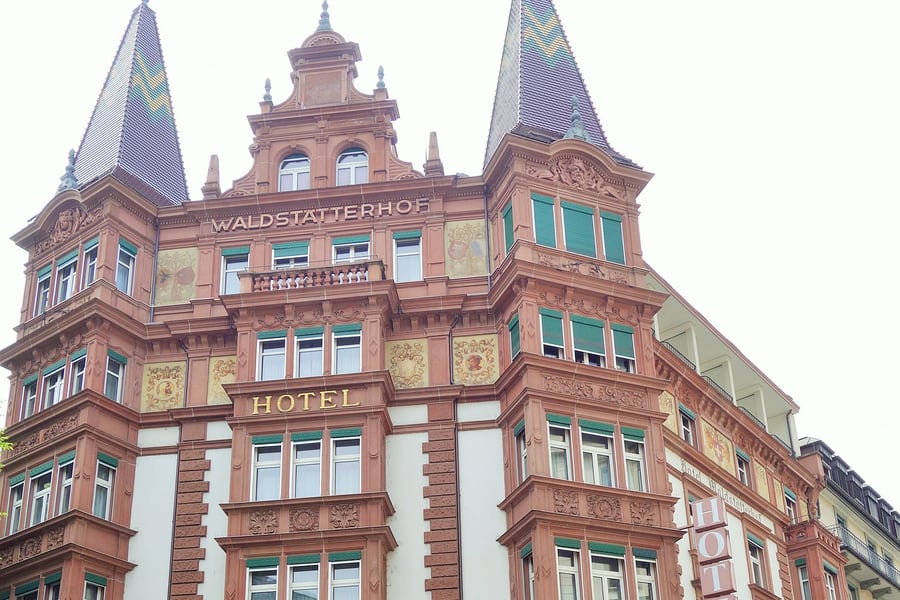
Hotel Waldstätterhof
Across the square from Lucerne station
A red sandstone building of 1899–1900 with two corner turrets, standing directly opposite the terminus where the Voralpen-Express starts. It reopened in 2024 after a refurbishment and lists 91 rooms from singles to suites, along with Restaurant Gleis 1 — named after the platform outside — its own bar and a terrace. The lake and the old town are both a few minutes' walk in the other direction.
Check Availability (opens in a new tab, on hotel-waldstaetterhof.ch)via hotel-waldstaetterhof.chHotel & Restaurant Jakob
On the Hauptplatz in Rapperswil, halfway along the line
Twenty rooms on the main square of the car-free old town, two minutes from Rapperswil station and therefore two minutes from an hourly train in either direction. The house restaurant looks up at the castle and describes its cooking as seasonal and unfussy. For anyone who wants to ride the Voralpen-Express in two halves on consecutive days, this is the place to break it.
Check Availability (opens in a new tab, on jakob-rapperswil.ch)via jakob-rapperswil.chHotel Herisau
In the village centre, twelve minutes short of St. Gallen
Thirty-three rooms in the middle of Herisau, with the station and the bus stop close by, Restaurant MOO on the ground floor and a sauna, whirlpool and fitness room included. The house is completely wheelchair accessible and offers a reduced room rate to guests with a disability, and it holds the tourist information point for Herisau. Parking is free, which it very rarely is in St. Gallen.
Check Availability (opens in a new tab, on hotelherisau.ch)via hotelherisau.ch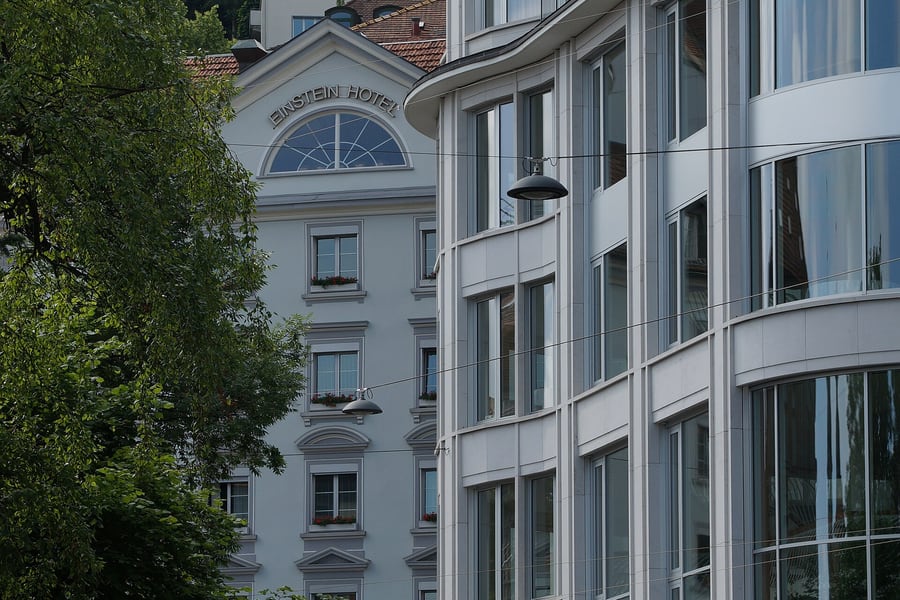 albinfo / Wikimedia Commons · CC BY-SA 3.0 · cropped
Einstein St.Gallen
A few minutes from the abbey district
A hotel, congress house and wellness address in the historic centre of St. Gallen, a short walk from the UNESCO abbey quarter and about ten minutes from the station on foot. It runs a gourmet restaurant and a bistro serving from seven in the morning until ten at night, and the bar hosts a regular jazz and blues series. The older wing carries the name across its pediment; the glass rotunda beside it is the congress half.
Check Availability (opens in a new tab, on einstein.ch)via einstein.chQuestions or corrections
Planning this trip and stuck on something, or spotted a time, fare or detail that has changed? Send us a message about Voralpen-Express. We read every one, and we update this page when something has changed.