Wachaubahn
Oleksandr Dede / Wikimedia Commons · CC BY-SA 4.0
- Distance34 km
- Duration45 minutes
- Best seasonDaily 24 April – 1 November 2026; Fri–Sun from 13 March to 15 November
Introduction
The Wachaubahn is part of what it shows you. The railway along the Danube's north bank through the Wachau was placed under protection as a monument in 1998, and it belongs to the Wachau Cultural Landscape, which UNESCO added to the World Heritage list in 2000: the terraced vineyards, the walled churches, the abbeys and the line that runs between them.
It opened in 1909 as part of a local railway from Krems along the river to Grein, laid high on the valley side, above the road. For a century it carried the valley's own traffic. In December 2010 the last scheduled trains were replaced by buses, and the State of Lower Austria took the line over from the federal railways to keep it for visitors. Since 16 April 2011 its transport company, NÖVOG, has run the 34 kilometres from Krems to Emmersdorf, opposite Melk, as a seasonal panorama line.
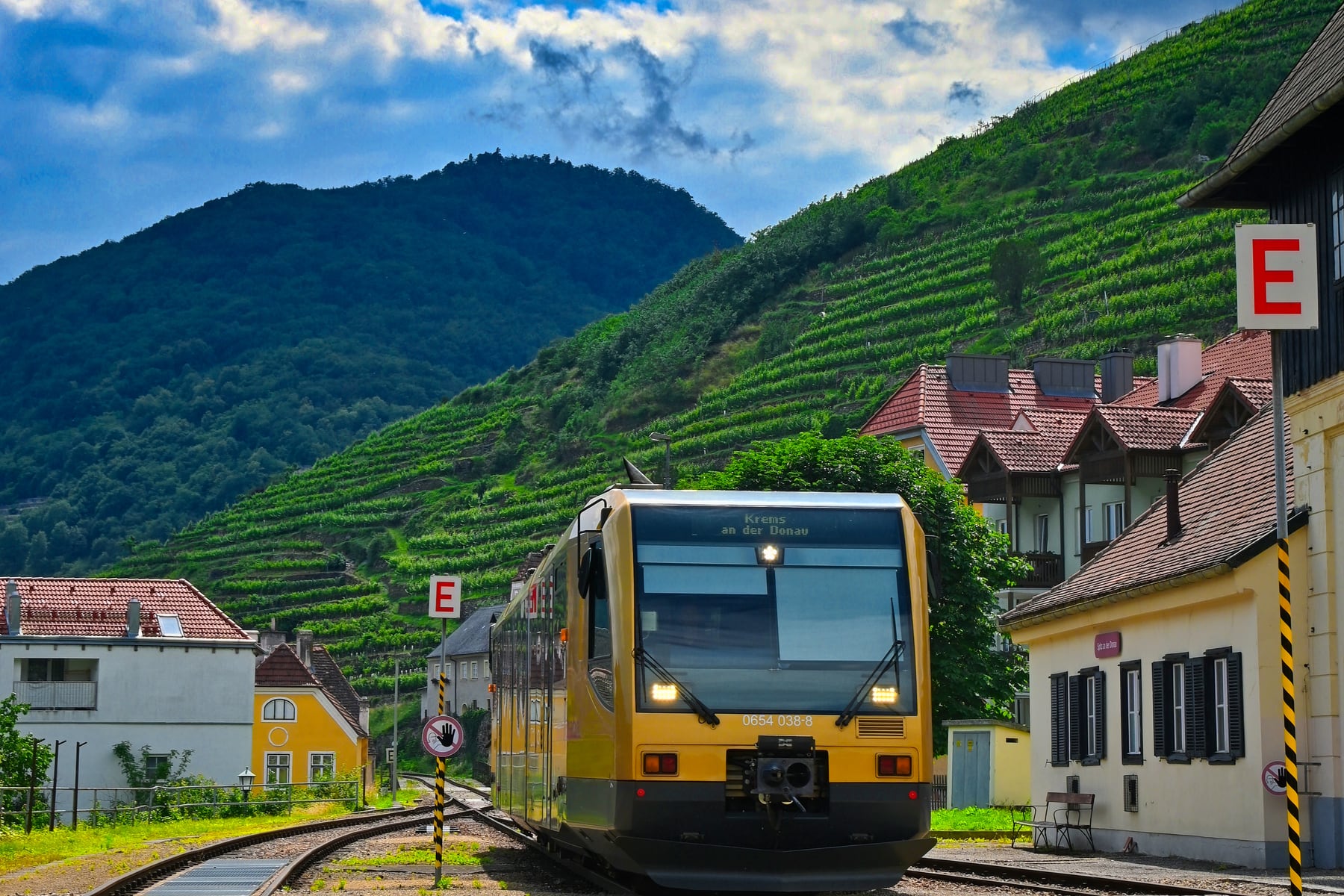
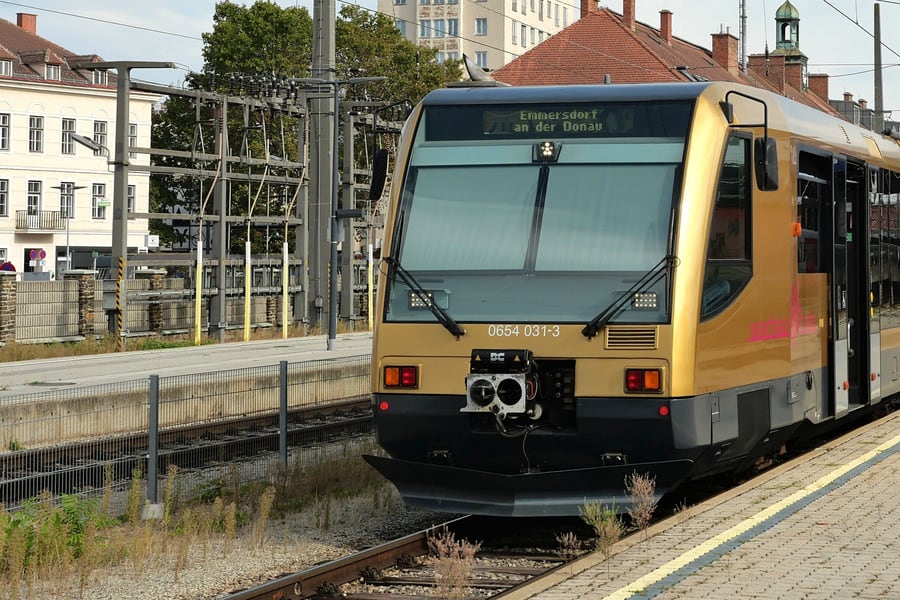
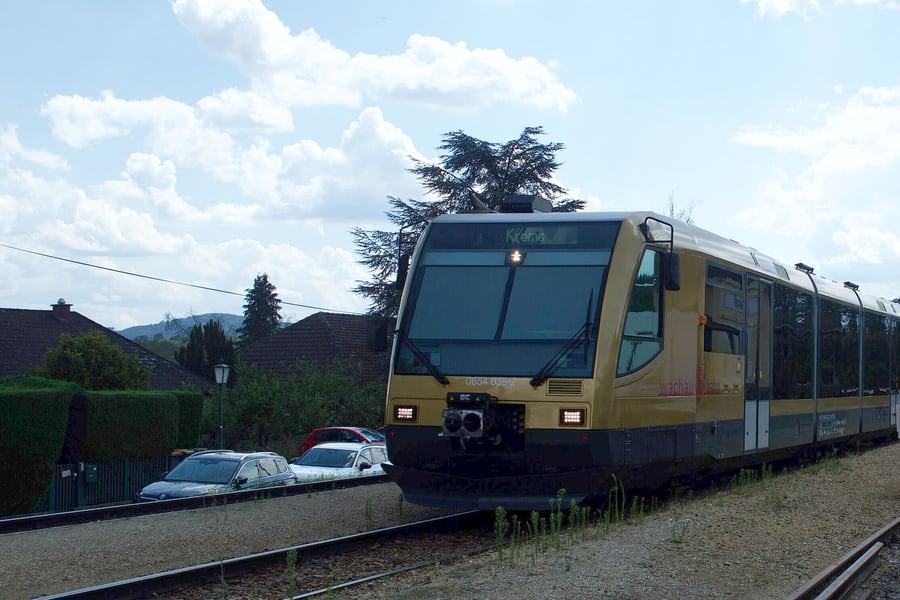
The trains are golden railcars with wide windows, air conditioning and room for bicycles, which travel free. The whole run takes 45 minutes and calls at thirteen stations, from Krems past Dürnstein, Weißenkirchen and Spitz to Emmersdorf; most of the small ones are request stops. In 2026 the trains run at weekends from 13 March and every day from 24 April to 1 November.
The Journey
The Wachaubahn starts at Krems an der Donau, from a platform at the ÖBB station where the trains from Vienna's Franz-Josefs-Bahnhof arrive. Two minutes out it stops at Krems Campus-Kunstmeile, by the university campus and the museums of the Kunstmeile, then at Stein-Mautern, in the old riverside quarter of Stein.
Dürnstein and Weißenkirchen
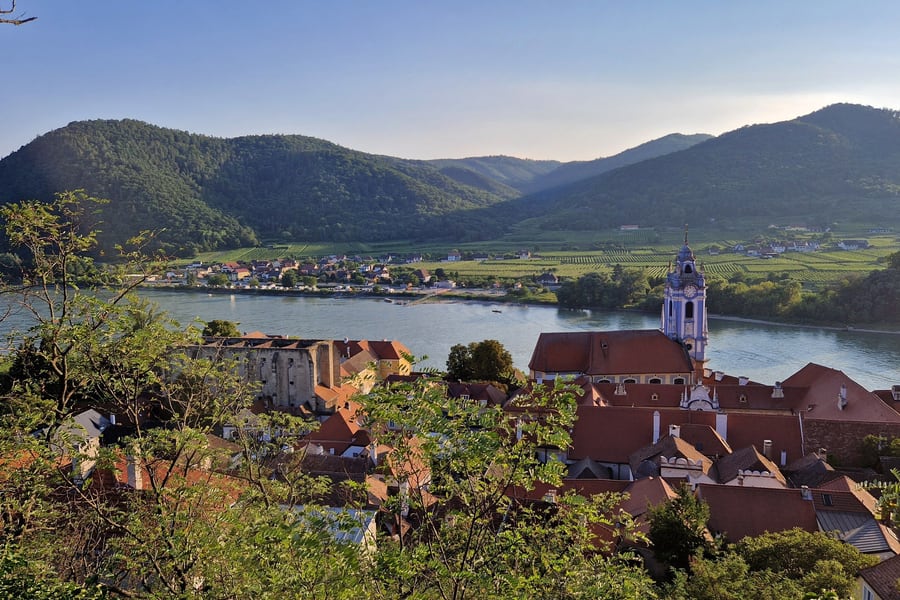
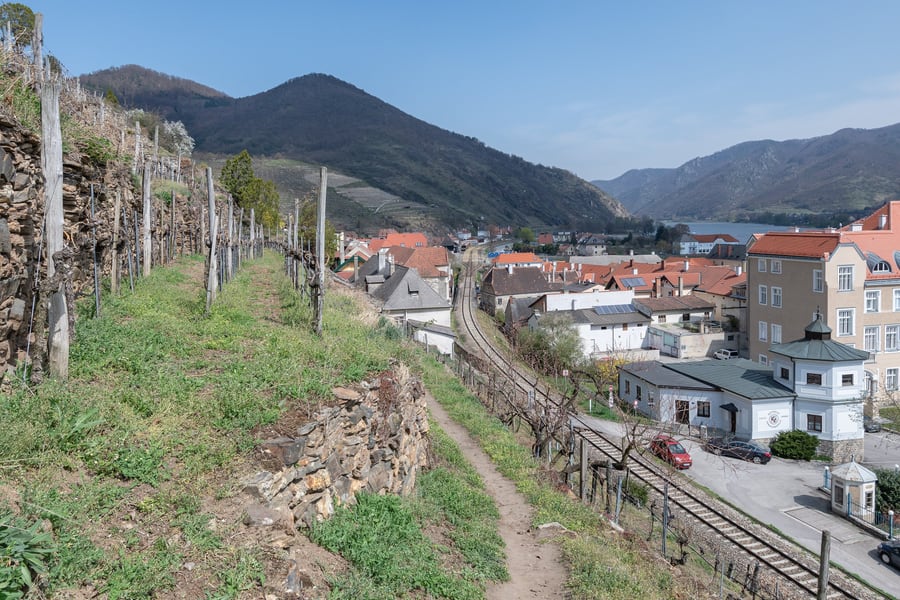
Past Stein the valley closes in and the vineyards begin, terrace above terrace on the slopes to the right. The train calls on request at Unterloiben and then at Dürnstein-Oberloiben, thirteen minutes from Krems, below the ruin of the castle where Richard the Lionheart was held prisoner. Dürnstein's blue abbey tower stands by the river on the left as the line tunnels under the castle hill.
Twenty minutes from Krems it reaches Weißenkirchen, the largest wine-growing community in the Wachau, its Gothic church on a rise above the houses. Beyond it the line emerges from a short tunnel beside the fortified church of St. Michael, once the mother church of the whole valley.
Spitz and the narrow valley
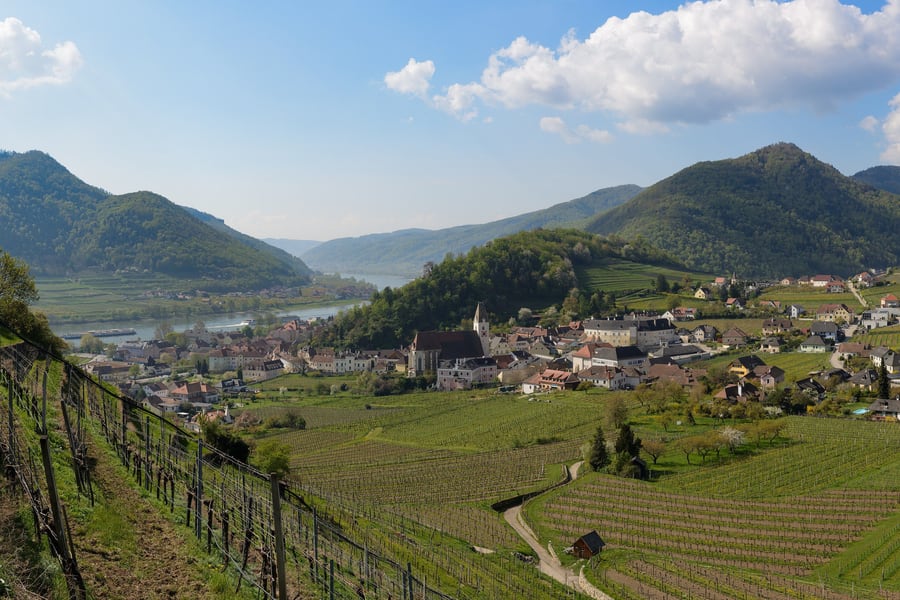
At Spitz an der Donau, 27 minutes out, the village wraps around the Tausendeimerberg, a hill of vine terraces. Its station was rebuilt with step-free platforms over the winter of 2023–24, and it is the natural place to break the journey: for the village, the shipping museum and the walk up to the castle ruin of Hinterhaus.
Beyond Spitz the line runs closest to the Danube. The tunnels range from the Goldberg tunnel at Stein, 569 metres, to the Teufelsmauer tunnel near Spitz, just 12.43 metres long and once the shortest railway tunnel on the Austrian federal network. The train then calls on request at Schwallenbach, at Willendorf, where the Venus of Willendorf was found while this line was being built, at Aggsbach Markt and at Grimsing.
Emmersdorf
The line ends at Emmersdorf an der Donau, 45 minutes from Krems. The track once ran on west towards Grein; the stone viaduct of eight arches over the village, a few minutes' walk from the station, carried it. Scheduled passenger trains west of Emmersdorf ended in 2009, and much of that track has since been lifted. Bus 721 leaves from the station forecourt and crosses the river to Melk in ten minutes.
The trains
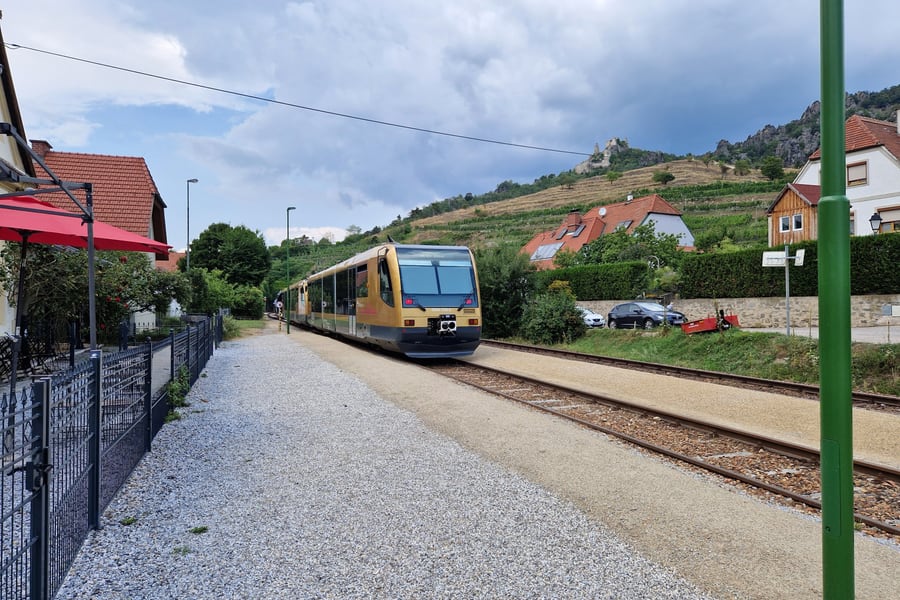
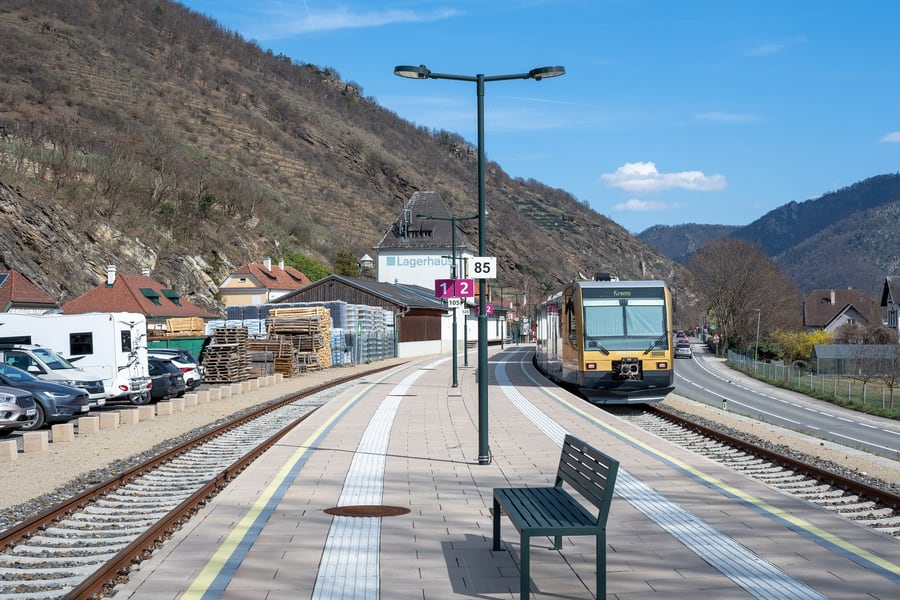
The golden railcars are RegioSprinters, built for the Vogtlandbahn in Saxony. NÖVOG bought five of them second-hand in 2016 for €3.5 million and fitted them with closed toilets, air conditioning and extra space for bicycles before painting them gold and grey. The first three were presented at Spitz on 31 March 2016, when the apricot trees were in blossom, and they took over the line for that season. Two-thirds of each car is low-floor, with wide doors, a ramp and a wheelchair space.
Along the route
 Naturpuur / Wikimedia Commons · CC BY-SA 4.0
Loiben
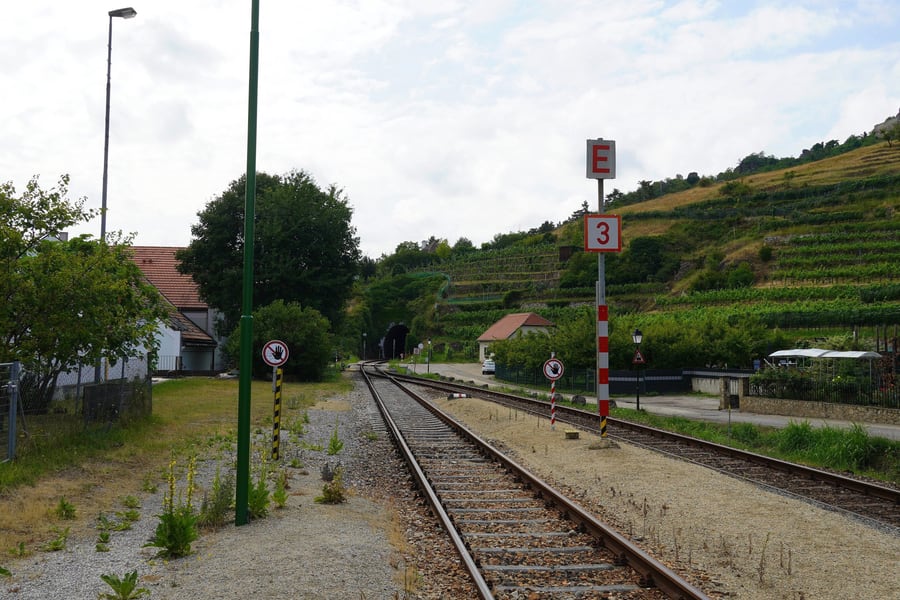
Ten minutes out of Krems the train stops on request at Unterloiben, then at Dürnstein-Oberloiben, among the terraced vineyards. Loiben's winemakers pour their own wine with a Heurigen-Jause, the cold platter of the wine tavern.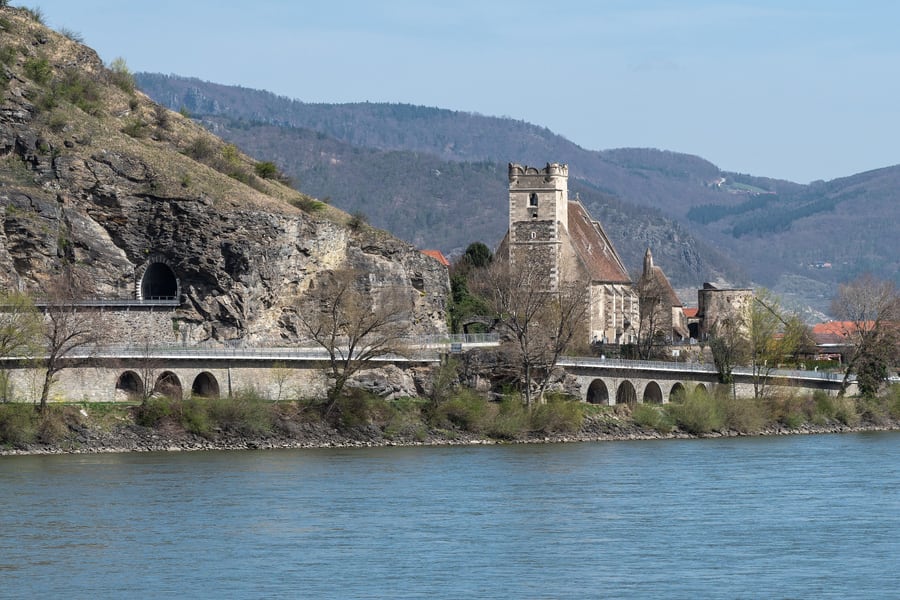 Isiwal / Wikimedia Commons · CC BY-SA 4.0
St. Michael
Past Weißenkirchen the line comes out of a 77-metre tunnel beside the walled church of St. Michael, first recorded in 987 and once the mother church of the whole Wachau. Its walls and towers went up between 1500 and 1530.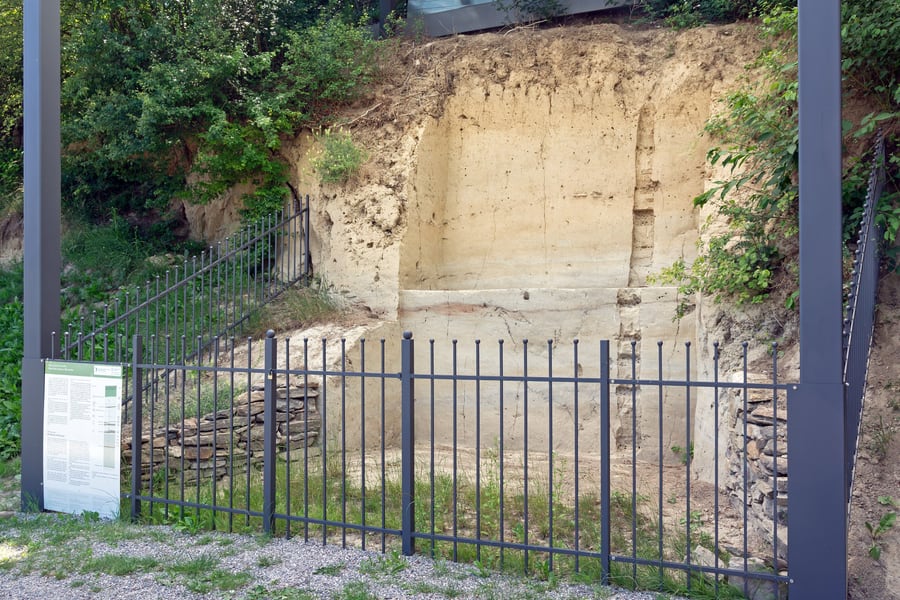 Thilo Parg / Wikimedia Commons · CC BY-SA 4.0
Willendorf
On 7 August 1908, while this line was being built, the workman Johann Veran found an 11-centimetre limestone figure here, about 29,500 years old: the Venus of Willendorf. The find site is marked, and the original is in Vienna.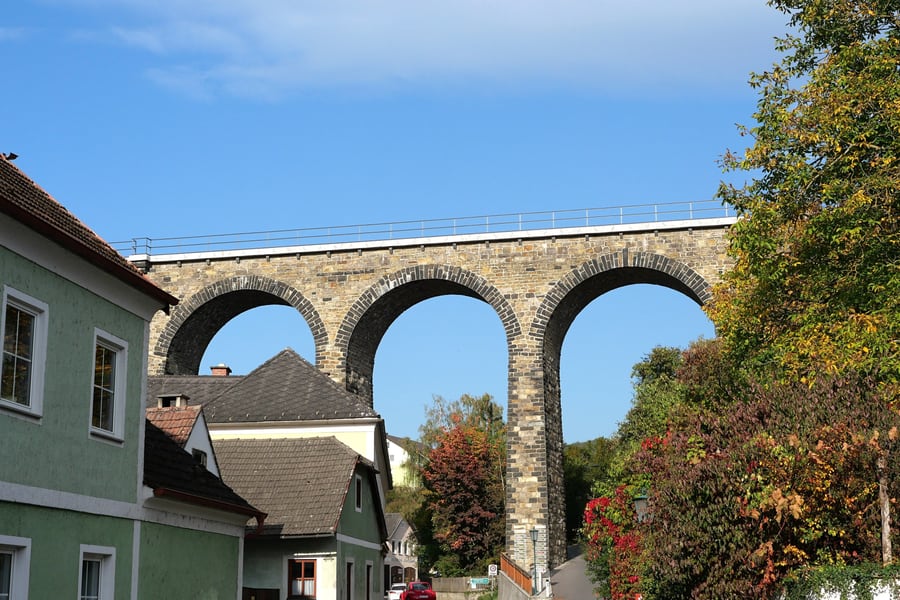 Herbert Ortner / Wikimedia Commons · CC BY 4.0
The Emmersdorf viaduct
Just past the end of the line, eight stone arches carry the old track over Emmersdorf, the village's landmark. Passenger trains last crossed it in 2009; it is a few minutes' walk from the station.A bit of history
Culture & experiences along the way
 Naturpuur / Wikimedia Commons · CC BY-SA 4.0
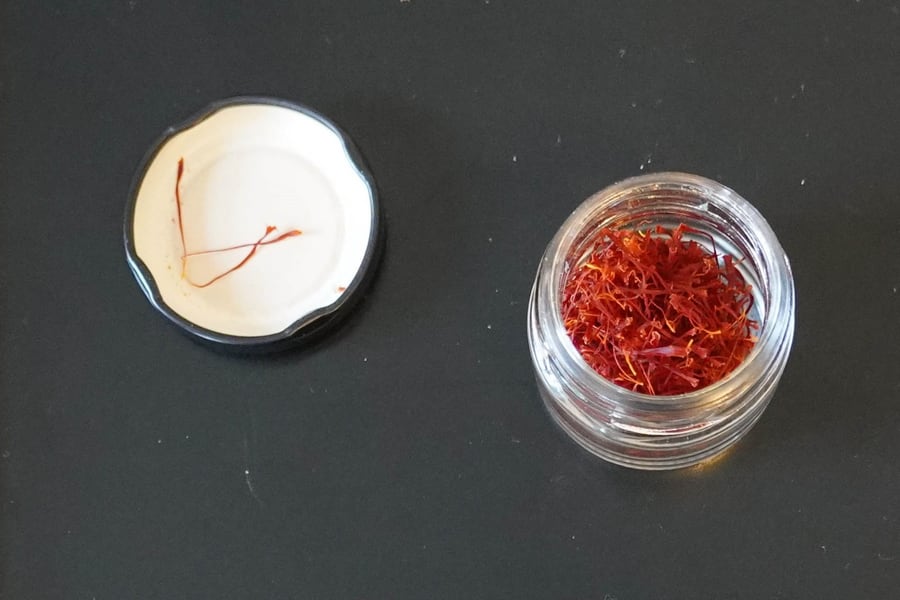
Saffron at Dürnstein station
Saffron was grown in Lower Austria from around 1200 until the 19th century. Since 2007 Bernhard Kaar has planted it again on Wachau slopes, and his Wachauer Safran Manufaktur, at Dürnstein station, sells saffron honey, vinegar and chocolate. The crocuses flower in its show garden in October and November.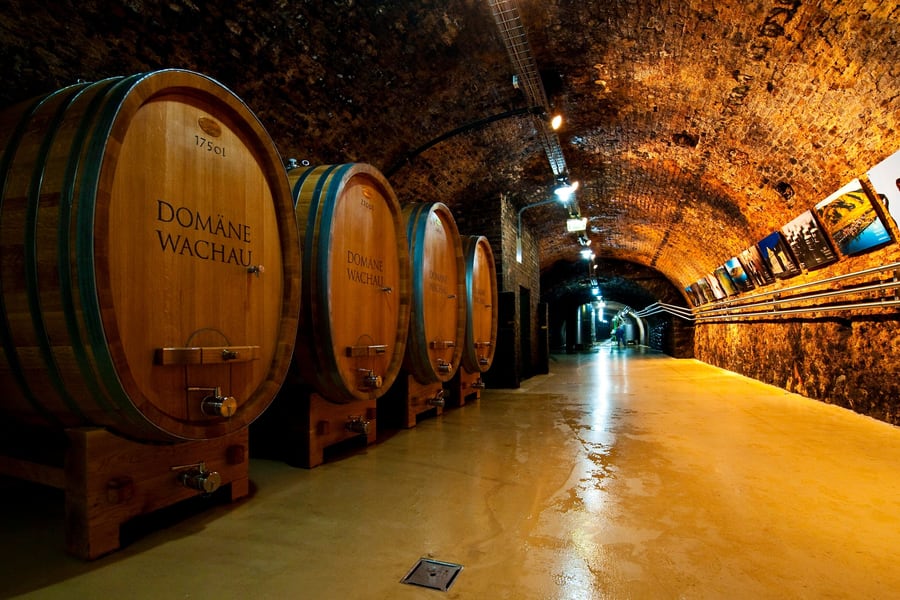 Domäne Wachau / Wikimedia Commons · CC BY-SA 4.0 · cropped
The Domäne Wachau's cellars
Under the Kellerschlössel in Dürnstein, the Domäne Wachau leads tours through its baroque cellars and explains the Wachau's own grades of dry wine, Steinfeder, Federspiel and Smaragd, then pours four of them. April to October, Fridays at 14:00 and Saturdays at 11:00; in English on Fridays at 15:00.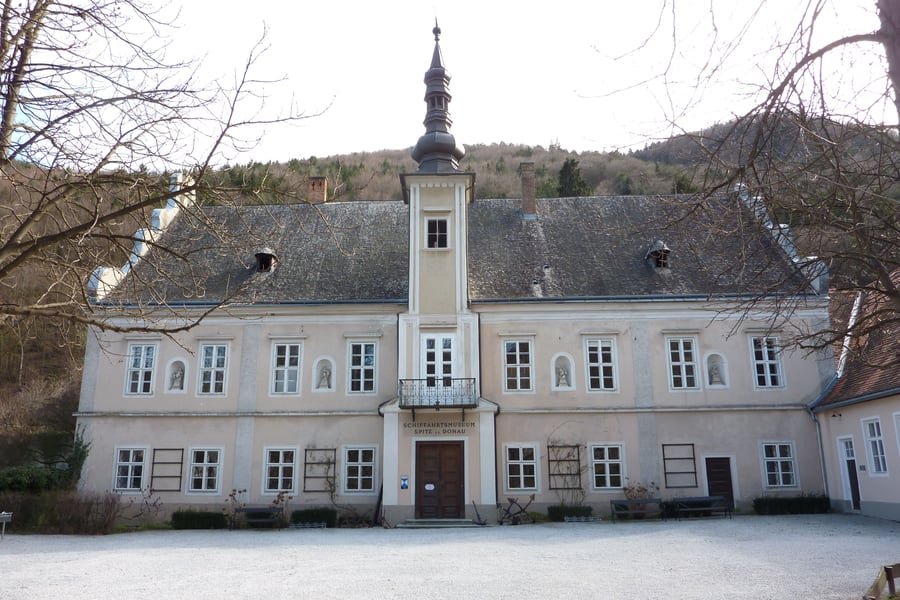 BSonne / Wikimedia Commons · CC BY-SA 3.0 · cropped
The shipping museum at Spitz
In Schloss Erlahof, a museum of the Danube in the age of wooden boats and rafts, before the steamers came in the mid-19th century, its precise models set out in old vaulted rooms. Open daily from April to October, 10:00 to 16:00, twenty minutes' walk from Spitz station.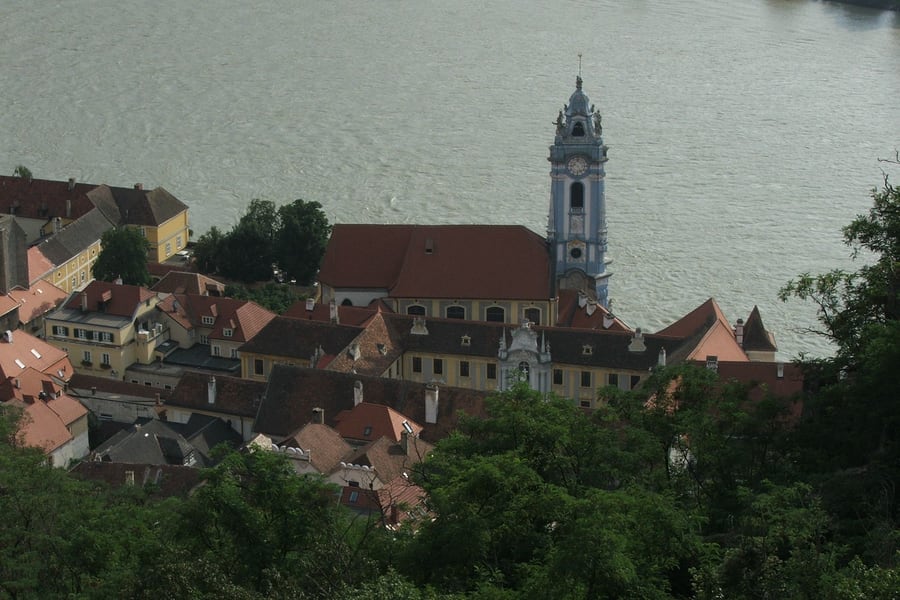 Xell / Wikimedia Commons · CC BY-SA 2.0 at · cropped
The blue tower of Dürnstein abbey
Founded for Augustinian canons in 1410, rebuilt in the baroque three hundred years later and dissolved in 1788, the abbey has the blue tower that stands for the whole Wachau. A one-hour circuit leads out onto the terrace around it. Until 26 October 2026.Timetables
The 2026 season runs on Fridays, weekends and public holidays from 13 March to 15 November, and every day from 24 April to 1 November. Four trains a day run each way over the whole line, the same timetable on every running day. Smaller stations not shown below are request stops: press the stop button in good time.
Krems to Emmersdorf
| Krems | Dürnstein-Oberloiben | Weißenkirchen | Spitz | Emmersdorf |
|---|---|---|---|---|
| 09:18 | 09:31 | 09:38 | 09:45 | 10:03 |
| 11:18 | 11:31 | 11:38 | 11:45 | 12:03 |
| 13:18 | 13:31 | 13:38 | 13:45 | 14:03 |
| 16:18 | 16:31 | 16:38 | 16:45 | 17:03 |
Emmersdorf to Krems
| Emmersdorf | Spitz | Weißenkirchen | Dürnstein-Oberloiben | Krems |
|---|---|---|---|---|
| 10:17 | 10:36 | 10:43 | 10:50 | 11:02 |
| 12:17 | 12:36 | 12:43 | 12:50 | 13:02 |
| 14:57 | 15:16 | 15:23 | 15:30 | 15:42 |
| 17:57 | 18:16 | 18:23 | 18:30 | 18:42 |
The last train back to Krems leaves Emmersdorf at 17:57. Bicycles need a reserved space, which is free; seats can be reserved free as well.
Connections
ÖBB trains from Wien Franz-Josefs-Bahnhof at 08:00, 10:00, 12:00 and 15:00 reach Krems at eight minutes past the hour, ten minutes before each Wachaubahn departure. From St. Pölten there are connections at 08:06 and 10:06. Back from Krems, trains leave for Vienna at 18:52, arriving 20:01, and for St. Pölten at 19:19.
At Emmersdorf, bus 721 meets the trains and runs to Melk station in ten minutes: from Emmersdorf at 10:15, 12:15, 14:15 and 17:15, and from Melk at 10:00, 12:00, 14:40 and 17:40.
Advent trains
From 20 November to 13 December 2026, on Fridays, weekends, holidays and bridge days, Advent trains run between Krems and Spitz only, for the Advent markets along the river. They leave Krems at 10:18, 12:18, 14:18, 16:18 and 18:18, with extra trains on Saturdays at 11:16, 13:16, 15:16, 17:16 and 19:16, and come back from Spitz at sixteen minutes past the hour, the last at 20:16 on Saturdays and 19:16 on the other days. The 2027 season is not yet published.
Times as of October 2026, from the Wachaubahn's timetable (opens in a new tab) and its Advent timetable (opens in a new tab).
Tickets
Tickets are sold in the Niederösterreich Bahnen webshop. There are no classes: you buy a single over the whole line, or a day ticket for as many rides as you like, which lets you stop at Dürnstein or Spitz and take a later train on. Short hops are priced per station, from €2.60. Bicycles travel free, though their space must be reserved, and dogs pay €6.
Children from 6 to 14 pay the child fare and under-6s ride free. Seniors from 65 and KlimaTicket holders pay the reduced fare. ÖBB railcards are not accepted. Read from the operator in October 2026.
Book your tickets
Krems – Emmersdorf single
€21 adult · €10 child 6–14 · €18 reduced
One ride over the whole line, in either direction.
Book Tickets (opens in a new tab, on Niederösterreich Bahnen)via Niederösterreich BahnenDay ticket
€28.50 adult · €13.50 child 6–14 · €24 reduced
As many rides as you like on the day, to stop off along the line.
Book Tickets (opens in a new tab, on Niederösterreich Bahnen)via Niederösterreich BahnenSeason card
€146 adult · €73 child
Every scheduled train from 13 March to 13 December 2026, Advent included.
Book Tickets (opens in a new tab, on Niederösterreich Bahnen)via Niederösterreich BahnenRail Passes
No rail pass covers the Wachaubahn. Interrail lists it by name among the Austrian trains its passes are not valid on, and the KlimaTicket, Austria's annual all-network ticket, names it among the services it does not cover. KlimaTicket holders do pay the reduced fare, €18 instead of €21.
A pass still gets you to Krems: the ÖBB trains from Vienna and St. Pölten are covered by an Interrail Austria or Global Pass, with no reservation needed, and by the KlimaTicket. For this trip alone a pass is not worth buying. The card that helps is the Niederösterreich-CARD, the province's sightseeing pass, which gives one free day on the Wachaubahn each year, with as many rides as you like.
Checked October 2026 against Interrail's table of railway companies (opens in a new tab), the KlimaTicket's validity page (opens in a new tab) and the Wachaubahn's fares page (opens in a new tab).
Places to Visit
The Wachau is short enough to see in a day and full enough to fill a week. These five are the town where the line begins, three of the villages it serves, and the abbey a bus ride from its end.
 Jakub Hałun / Wikimedia Commons · CC BY-SA 4.0 · cropped
Krems an der Donau
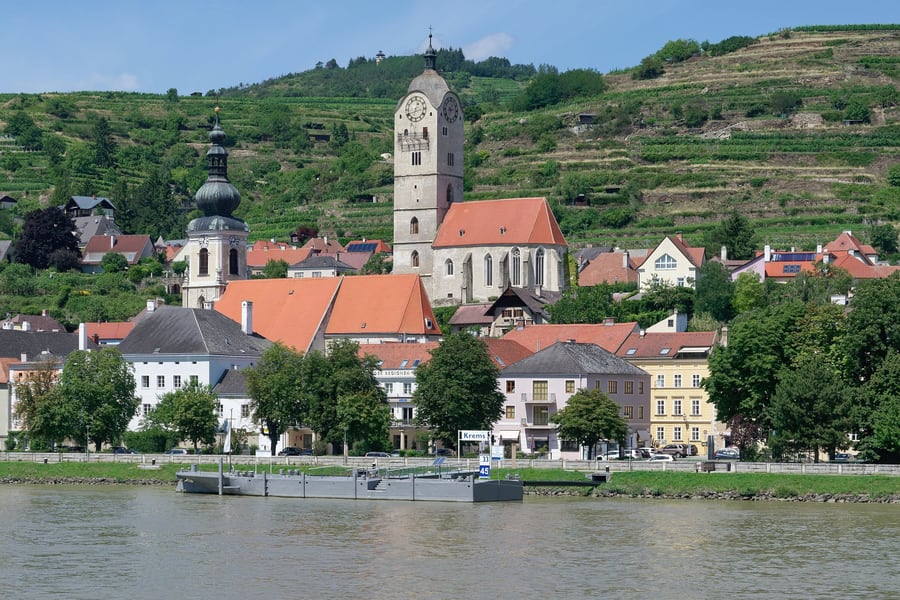
The gateway to the Wachau, a town more than a thousand years old that has kept its historic centre, with Stein, its old riverside quarter, on a narrow strip of bank below steep terraces. The line's second stop, Krems Campus-Kunstmeile, is a few minutes' walk from the Kunsthalle, the Karikaturmuseum and the Landesgalerie Niederösterreich.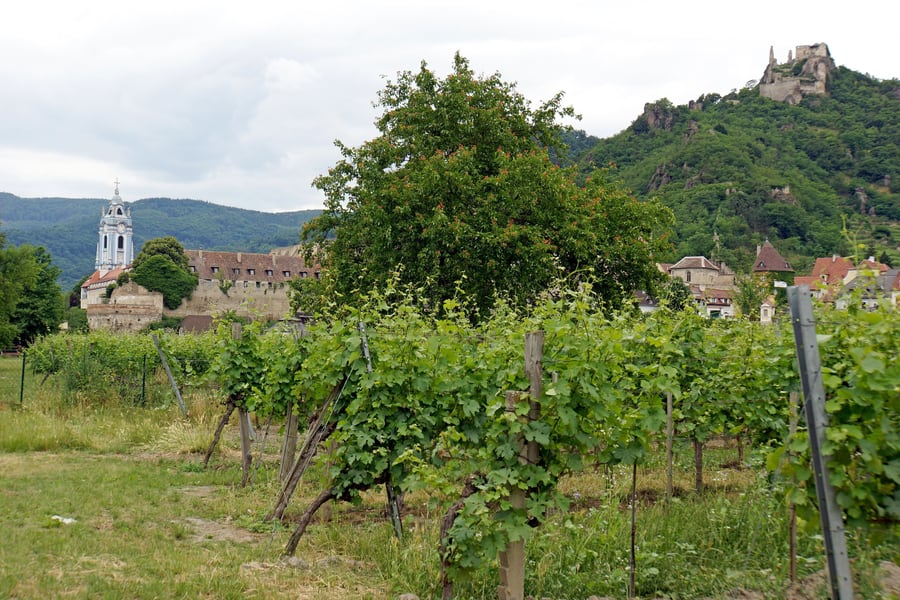 Dennis G. Jarvis / Wikimedia Commons · CC BY-SA 2.0
Dürnstein
Above the village stands the castle built in 1140–45 where Duke Leopold V held Richard the Lionheart in 1192–93, until a ransom of 150,000 marks of silver was paid. The legend of the minstrel Blondel, who found his king by singing a verse he answered, grew from it. The ruin is open all year, free, with a view down the whole valley.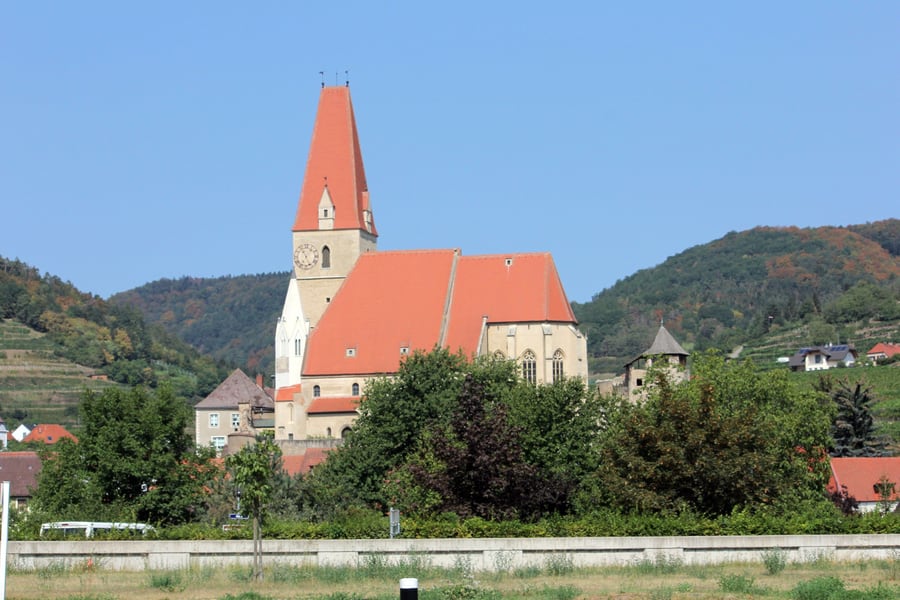 Karl Gruber / Wikimedia Commons · CC BY-SA 4.0
Weißenkirchen in der Wachau
With Joching, Wösendorf and St. Michael, the largest wine-growing community in the Wachau. Its Gothic parish church rises over sunny vine slopes, with a massive tower once built for defence against the Turks, and the fortifications take in the Teisenhoferhof, one of the finest Renaissance courtyards in the Wachau.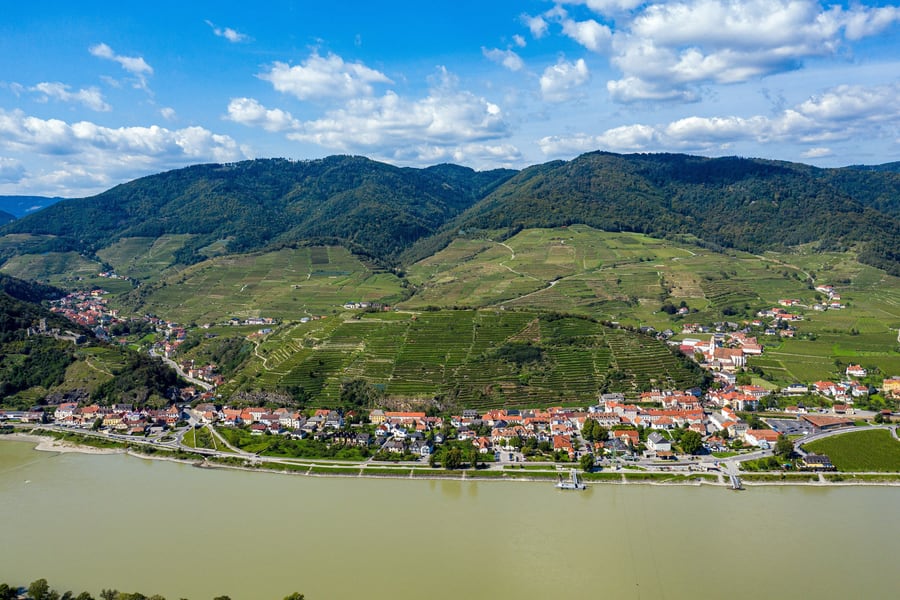 Kasa Fue / Wikimedia Commons · CC BY-SA 4.0
Spitz an der Donau
An old wine village wrapped around the Tausendeimerberg, the "thousand-bucket hill" of vine terraces, with Renaissance and baroque houses and a late-Gothic church with three naves. From the village a path climbs to the castle ruin of Hinterhaus above the river. The rebuilt, step-free station makes Spitz the easiest place to break the journey.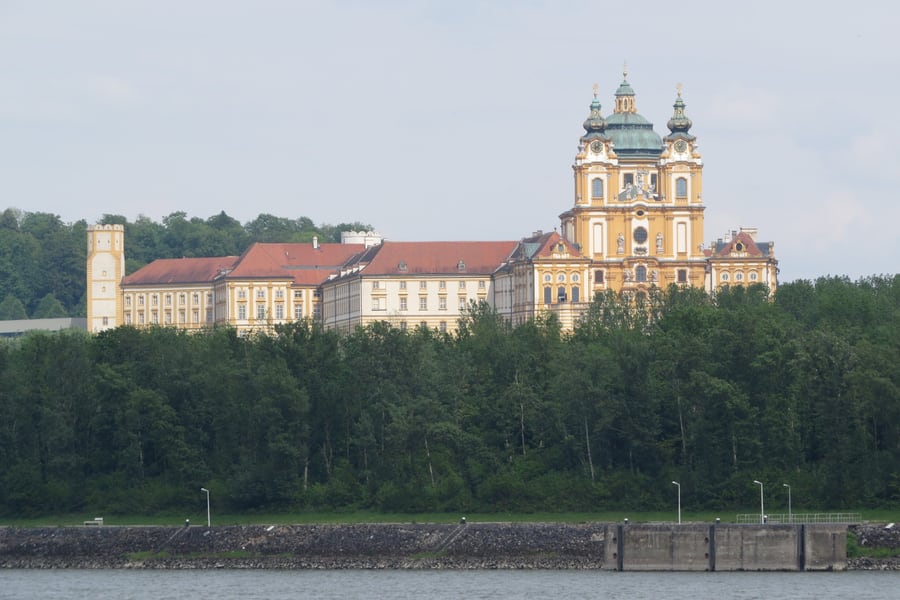 GT1976 / Wikimedia Commons · CC BY-SA 4.0
Melk Abbey
Benedictine monks have lived and worked here since 1089. A visit takes in the Marble Hall, the library and the Altane, the balcony between them with its view over the Danube valley, and the abbey church, a masterpiece of the high baroque. In the park, part baroque and part English landscape garden, a pavilion is painted with frescoes by Johann Wenzel Bergl. Open daily from April to October, 9:00 to 17:30.Where to Sleep
Stay in Dürnstein, a third of the way along the line, between its castle ruin and the Danube; both hotels below stand on the river in the old town.
Where to stay
 Haeferl / Wikimedia Commons · CC BY-SA 4.0 · cropped
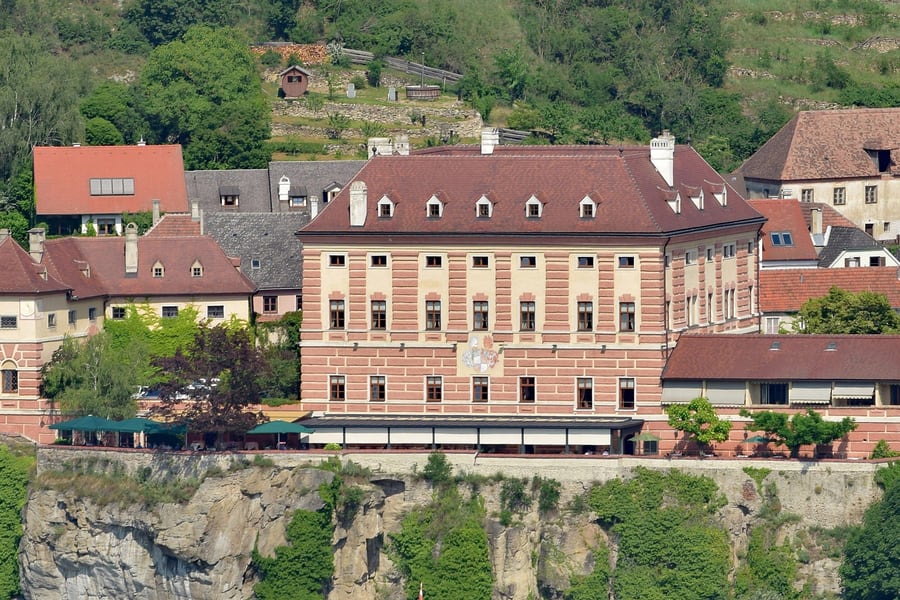
Hotel Schloss Dürnstein
On the Danube in Dürnstein
In the castle the Princes of Starhemberg built at the start of the 17th century, directly on the river, with a restaurant terrace over the Danube.
Check Availability (opens in a new tab, on schloss.at)via schloss.at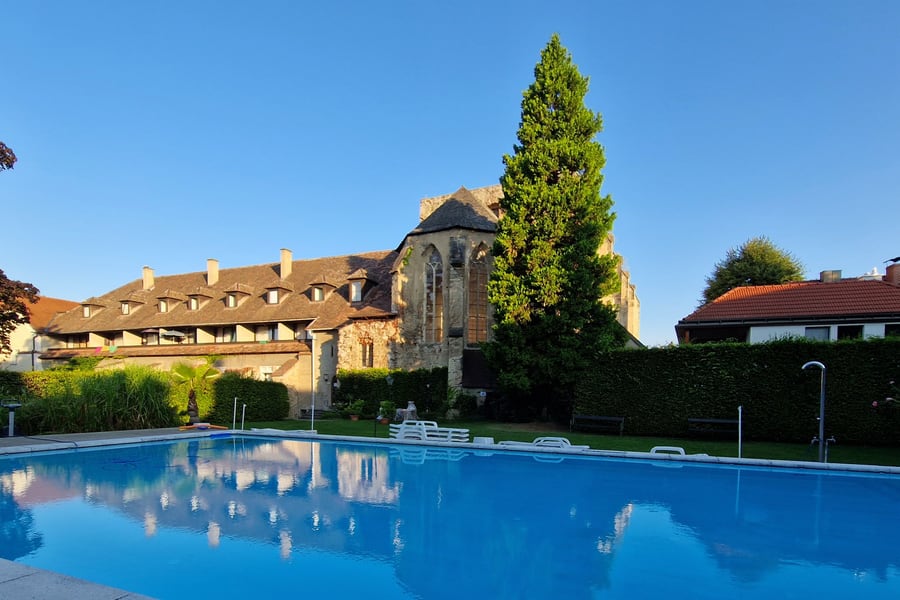 Geolina163 / Wikimedia Commons · CC BY-SA 4.0 · cropped
Hotel Richard Löwenherz
On the Danube in Dürnstein
In the convent of the Poor Clares founded in 1289, an inn from 1880 and a hotel since 1938, with a pool in the old convent garden.
Check Availability (opens in a new tab, on richardloewenherz.at)via richardloewenherz.atQuestions or corrections
Planning this trip and stuck on something, or spotted a time, fare or detail that has changed? Send us a message about Wachaubahn. We read every one, and we update this page when something has changed.