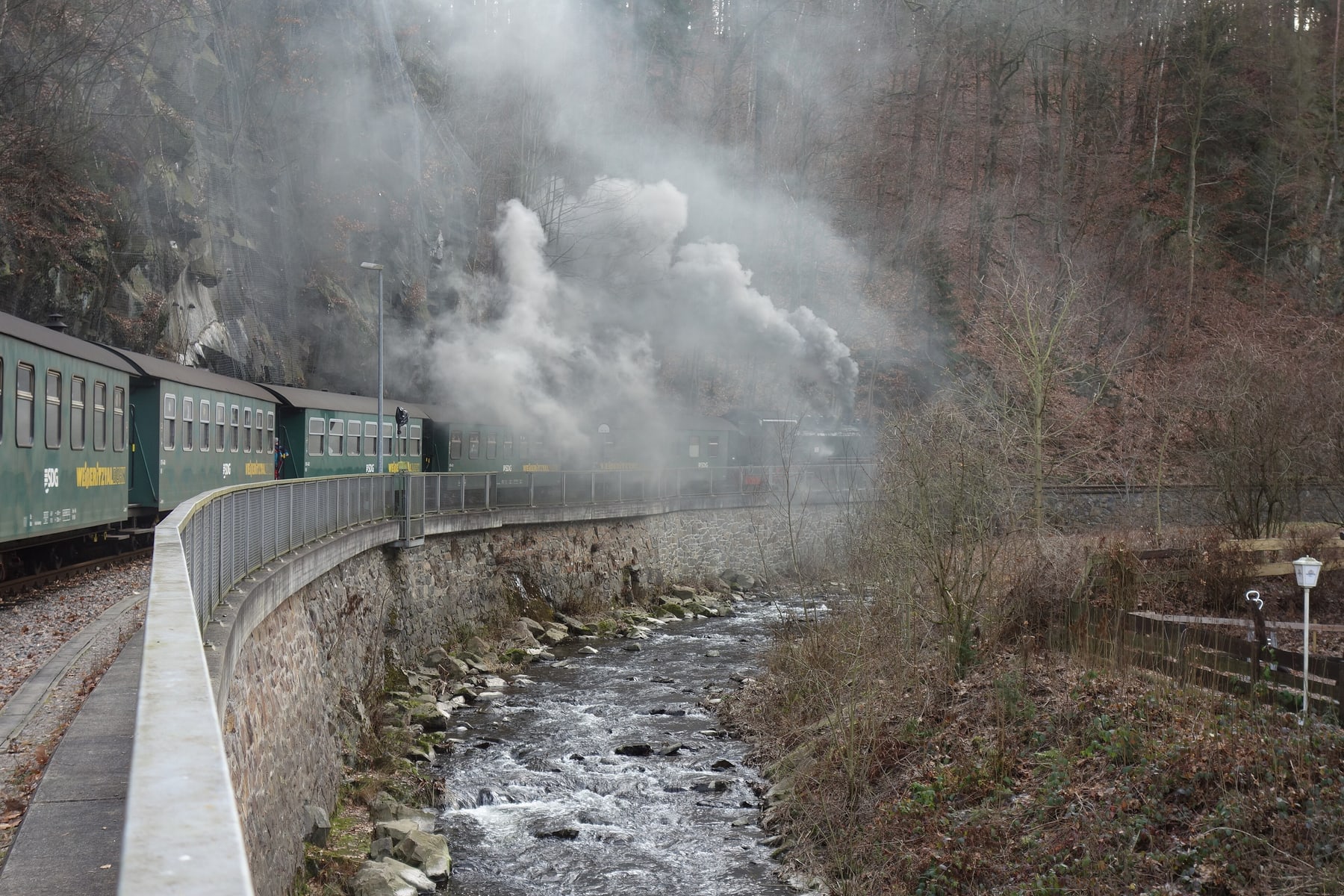
The Weißeritztalbahn to Kurort Kipsdorf
Bybbisch94, Christian Gebhardt / Wikimedia Commons · CC BY-SA 4.0
- Distance26.3 km (Freital-Hainsberg–Kurort Kipsdorf)
- Duration1 h 26 up, 1 h 19 down
- Best seasonYear-round — two trains a day in February as in August
Introduction
The Weißeritztalbahn runs twenty-six kilometres from Freital-Hainsberg, twenty minutes out of Dresden, up the valley of the Rote Weißeritz to Kurort Kipsdorf in the eastern Ore Mountains. The track is 750 millimetres wide, the line speed is 30 km/h, and a steam locomotive takes an hour and twenty-six minutes to climb the three hundred and fifty metres between the two ends.
It opened in 1882, and it has been carrying the public ever since — which makes it, on the operator's own description, the longest-serving publicly operated narrow-gauge railway in Germany. That is the line's headline, and it is true. What it leaves out is that the railway has twice been destroyed by the river it follows, and that the two recoveries could hardly have been less alike.
Six weeks, and then fourteen years
On 29 July 1897 a flood damaged or destroyed almost all forty of the line's bridges. Trains were running again between Hainsberg and Rabenau on 25 August, and over the whole line — on temporary works — on 10 September. Six weeks.
On 13 August 2002 the Rote Weißeritz did it again. In the Rabenauer Grund the track and bridges were largely swept away; above Buschmühle the formation itself went. The lower half of the line reopened on 14 December 2008. The upper half, to Kipsdorf, reopened on 17 June 2017 — fourteen years and ten months after the water, and at about the same time of day the trains had stopped. Something near forty million euros was spent getting there.
The gap between six weeks and fifteen years is not really about engineering. In 1897 the line was a working state railway hauling timber, iron and chair-frames, and putting it back was not a decision anybody had to take. By 2002 it had already survived three separate attempts to close it, and every stage of the rebuild had to be argued for again.
What came back, and what did not
The track came back in full. The service did not.
Before the flood the Weißeritztalbahn ran eight train pairs a day on weekdays, roughly every two hours, and carried around 200,000 passengers a year. The timetable that now runs the rebuilt line is two through trains each way a day — 09:55 and 13:55 up, 11:41 and 15:41 down — with a third pair at weekends that turns back at Dippoldiswalde. When the money for the upper section was found in 2012, the service on the lower section was thinned from six pairs to five to help pay for it.
So this is a railway that was restored rather than revived, and the honest way to describe the result is that a full-length historic line now runs a tourist frequency. It is worth knowing before you plan a day around it: miss the 13:55 and there is no later train to the top.
Why go anyway
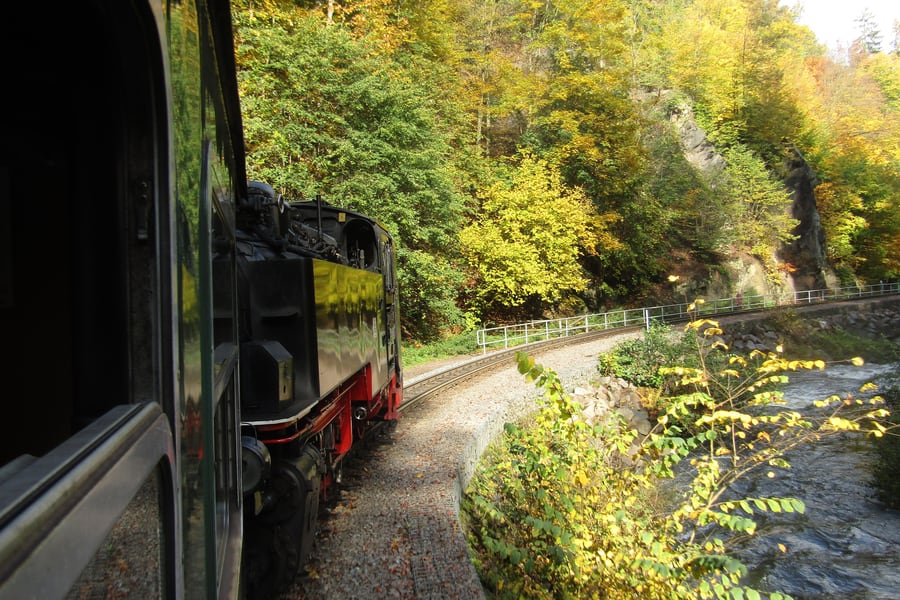
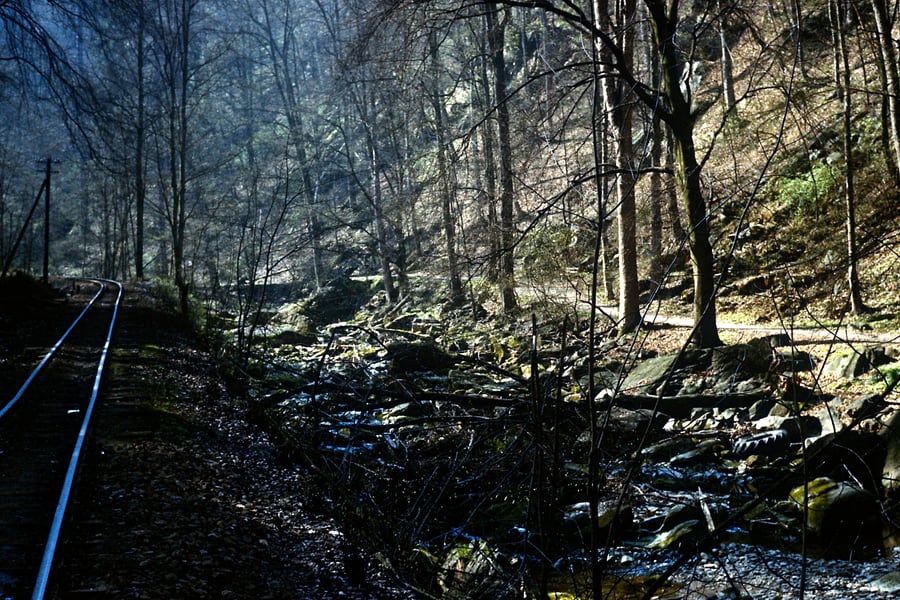
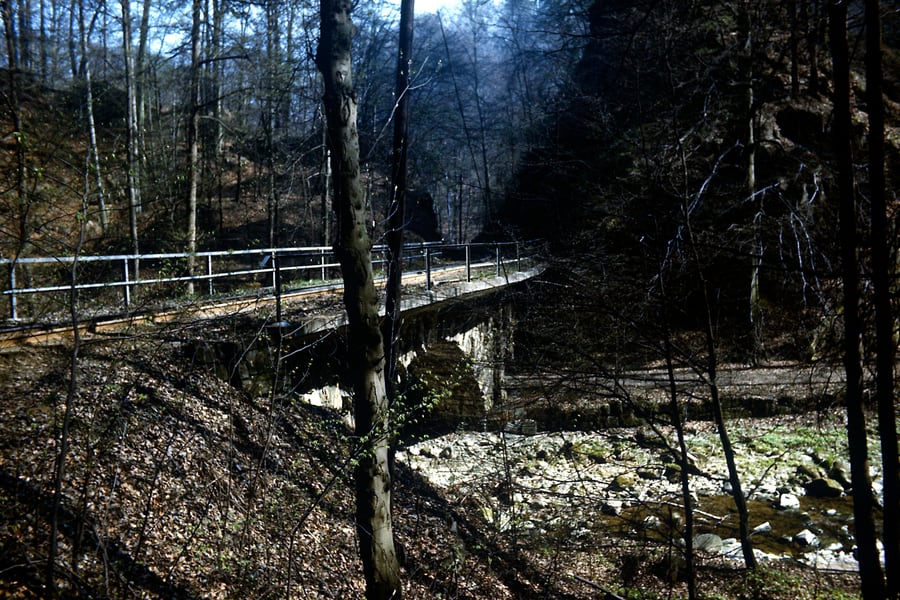
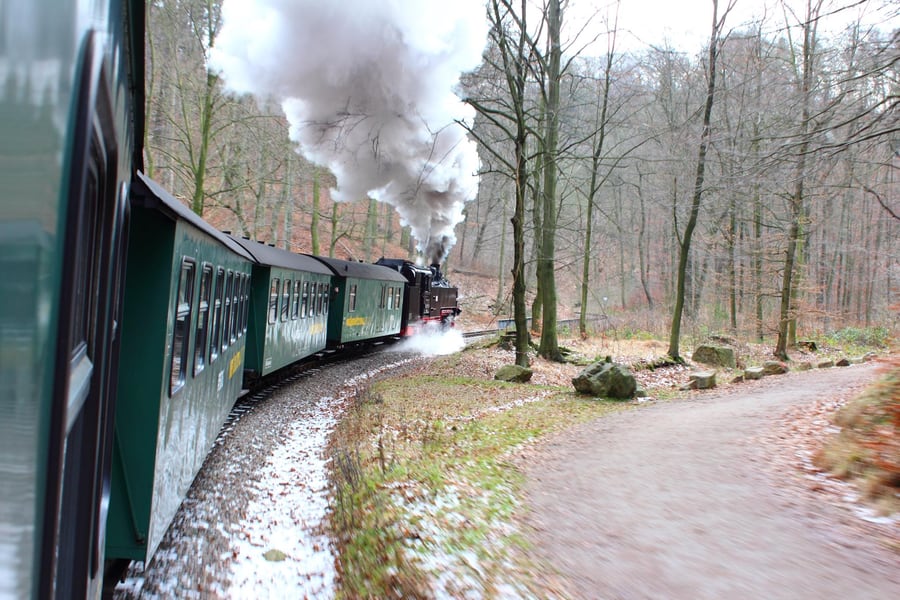
Because the first eight kilometres are among the best on any German narrow-gauge line. Out of Coßmannsdorf the railway enters the Rabenauer Grund, a gorge up to eighty metres deep that no road follows, crosses the river twelve times before Rabenau, and turns through two curves of fifty-metre radius — tighter than anything on the Harz or the Fichtelberg lines. The drystone walls holding it up were built by Italian masons in 1881, rebuilt after 1897, and rebuilt again after 2002.
Then the valley opens, the reservoir at Malter arrives, and the line climbs steadily through Dippoldiswalde and Schmiedeberg to a terminus at 534 metres whose station building the flood emptied and the rebuild turned into the village hall.
The Journey
The train leaves from a bay at Freital-Hainsberg (184 m), alongside the standard-gauge platforms where the S3 from Dresden arrives eight minutes earlier. For the first kilometre the narrow gauge simply runs beside the main line; only where the Wilde and the Rote Weißeritz meet does it turn away and start climbing.
The Rabenauer Grund
At Freital-Coßmannsdorf (192 m) the valley closes in and the railway enters the Rabenauer Grund, which is the reason the line is 750 millimetres wide at all. When surveying began in December 1878 the plan was a standard-gauge secondary railway to Schmiedeberg; the gorge turned out to be too narrow for one. The alternative — a longer route from Niedersedlitz by way of Kreischa — would have needed gradients of 25 per mille where the Rabenauer Grund needed only 17. Saxony chose the gorge, and chose narrow gauge to get through it.
The result is the finest stretch of the journey. The Rote Weißeritz is crossed twelve times between Coßmannsdorf and Rabenau, mostly on stone arches; the two tightest curves on the line, of fifty-metre radius, are just beyond Rabenau station (250 m) where the Spechtritzgrund begins. There was once a seventeen-metre tunnel at the Einsiedlerfelsen; it was taken down completely in the summer of 1905 rather than widened, because standard-gauge wagons carried on narrow-gauge transporter trucks needed the room.
A forest path follows the gorge for its whole length, and it is the only other way through: no road reaches the middle of it. The gorge has been a nature reserve since 1961.
Spechtritz, and what the flood left
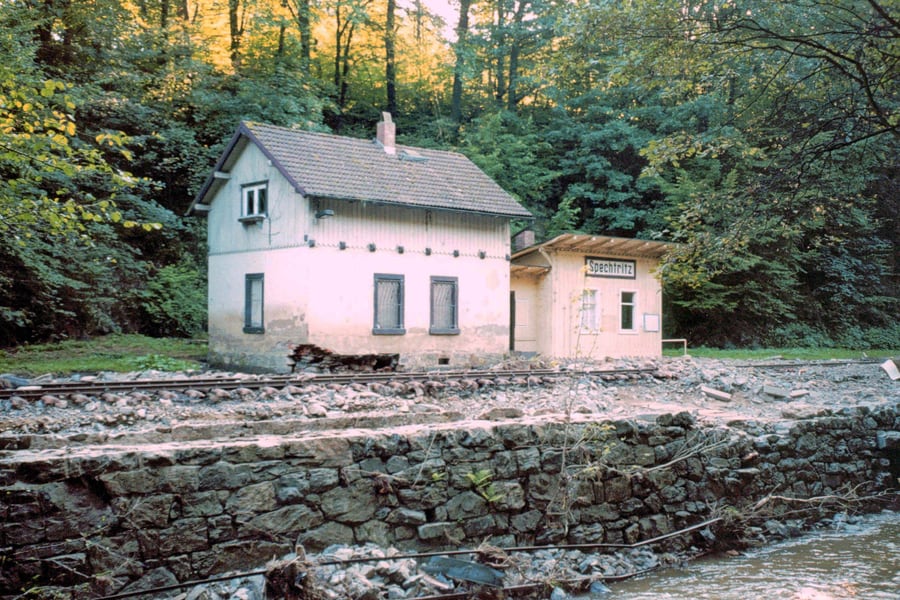
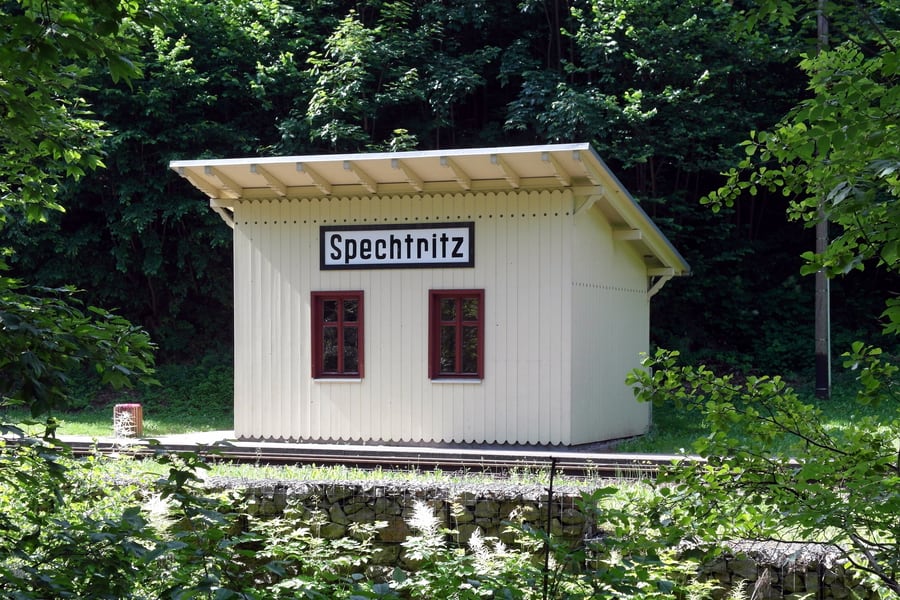
Spechtritz (274 m) is a request halt with a white timber waiting hall. It is worth looking at, because it is the clearest single piece of evidence of what happened here. The original buildings — a railwaymen's house and a shelter — stood until 2002 and were demolished in early 2008 because the flood had finished them. What stands today is a replacement, built to the historic pattern at the insistence of the monument authority.
Just past Spechtritz the line begins a sustained 25 per mille climb to the dam at Malter, then runs almost level along the shore of the reservoir. This is not the original alignment. When the Talsperre Malter was built between 1908 and 1913 — itself part of the flood-protection scheme drawn up after 1897 — seven kilometres of railway had to be lifted out of the valley floor and re-laid on the hillside, two metres above top water level. The new route opened on 15 April 1912.
Dippoldiswalde to the top
Dippoldiswalde (348 m) is the operational middle of the line and the only place where a train stands for more than a moment: uphill services wait seven minutes, downhill ones two. It is also where the railway stopped for nine years, between the two halves of the rebuild.
Above the town the line follows the B 170 as far as Obercarsdorf (395 m), then leaves it to swing round the hillside above Schmiedeberg on a shelf built between 1920 and 1924 as unemployment relief work — a hundred and twenty-five men from the town and its neighbours. Its one large structure, the Schmiedeberg viaduct, some 170 metres long over the mouth of the Pöbel valley, is the biggest thing the railway ever built. The last train left the old street-side station in Schmiedeberg at 12:20 on 1 December 1924; the new alignment was slotted in the same afternoon.
From Schmiedeberg (444 m) the climb steepens for the last four kilometres. Shortly before Kurort Kipsdorf (534 m) the gradient reaches 34.7 per mille — one in twenty-nine, the steepest on the line. The terminus was rebuilt in 1933–34 to take trains of up to fifty-six axles; in the winter-sports years, services of thirteen coaches and a luggage van, seating over five hundred and fifty people, ran up here as a matter of course. Two trains a day come now.
Along the route
Jörg Blobelt / Wikimedia Commons · CC BY-SA 4.0Six weeks in 1897, fifteen years in 2002
The same river has destroyed this railway twice. The flood of 1897 wrecked almost all forty of its bridges and trains were running again by September. The flood of 2002 took the formation itself; the lower half reopened in 2008 and the top not until 2017 — about forty million euros, and fourteen years.Falk2 / Wikimedia Commons · CC BY-SA 4.0The track came back; the timetable did not
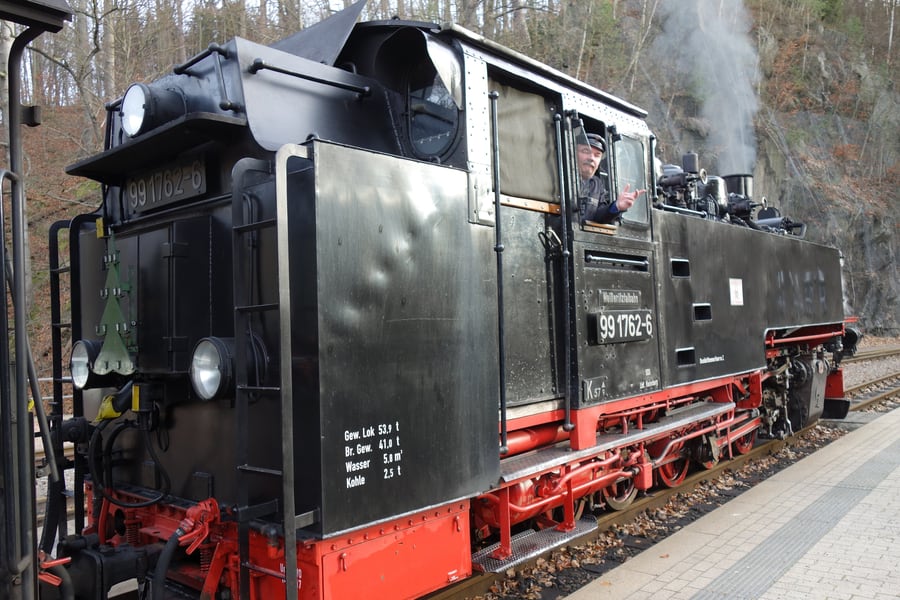
Before 2002 the line ran eight train pairs a day and carried two hundred thousand passengers a year. The rebuilt railway runs two through pairs. It was restored rather than revived, and that is the thing to know before building a day around it.Falk2 / Wikimedia Commons · CC BY-SA 4.0A gorge that decided the gauge
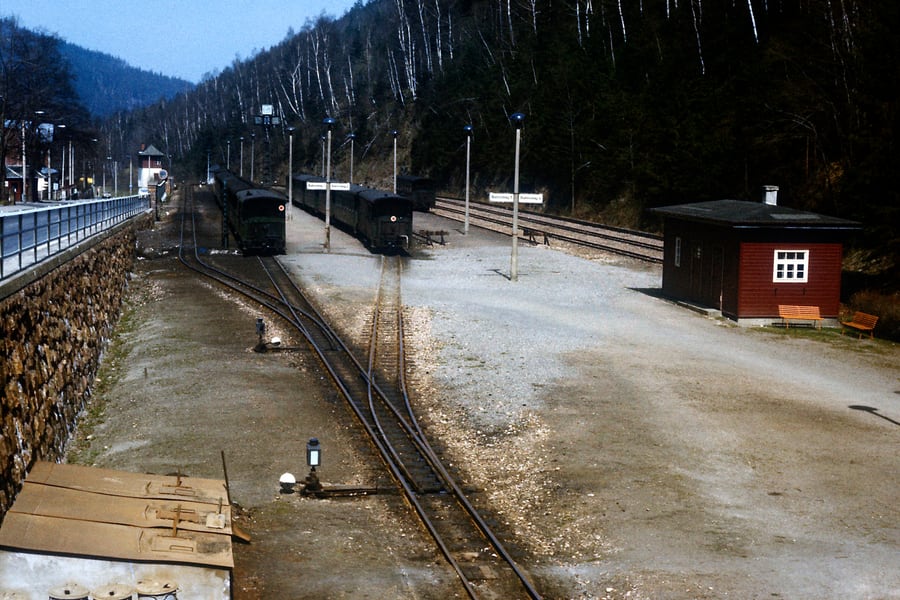
Surveying began in 1878 for a standard-gauge line, and the Rabenauer Grund turned out too narrow for one. Saxony took the gorge anyway and built it at 750 millimetres. The railway crosses the Rote Weißeritz twelve times in the first eight kilometres.A bit of history
Culture & experiences along the way
Falk2 / Wikimedia Commons · CC BY-SA 4.0Walk the gorge one way, ride it the other
A forest path runs the full length of the Rabenauer Grund, from the Weißeritz bridge above Freital to the Rabenauer Mühle at Rabenau station, and it is the only other way through — no road reaches the middle. The gorge has been a nature reserve since 1961 and is up to eighty metres deep. Walking up and riding down turns a two-train day into a full one, and it is the only way to see the retaining walls from below.Fiver, der Hellseher / Wikimedia Commons · CC BY-SA 4.0Ride the open coach, if it is running
Between 1 May and 30 September certain trains carry an open observation coach, marked in the printed timetable. It is the only way to hear the engine properly through the gorge, where the walls throw the exhaust straight back at you. Not every departure has one, and with two trains a day it is worth checking which before choosing.R.D. — Rolf-Dresden / Wikimedia Commons · CC BY 3.0Go on the first Advent weekend
On 28 and 29 November 2026 the line runs an extended timetable for "Bimmelbahn & Lichterglanz", when the stations and halts along the route hold what the operator calls the longest rideable Christmas market in Germany, and every passenger coach on the railway is put into a train. It has run since 2019. Reservations are not possible on those two days, which tells you how busy they are.Timetables
Two through trains each way a day, every day of the year. The times are the same in February as in August. A third pair runs at weekends and on Saxon public holidays, but only as far as Dippoldiswalde and back.
Checked against Deutsche Bahn's schedule data and the operator's own timetable sheet for the year running 14 December 2025 to 12 December 2026, sampled across weekdays, weekends and December 2026.
Up the valley — Freital-Hainsberg to Kurort Kipsdorf
| Train | Freital-Hainsberg | Rabenau | Dippoldiswalde | Schmiedeberg | Kurort Kipsdorf |
|---|---|---|---|---|---|
| P 5000 | 09:55 | 10:13 | 10:41 / 10:48 | 11:11 | 11:21 |
| P 5002 | 13:55 | 14:13 | 14:41 / 14:48 | 15:11 | 15:21 |
| P 5004 ✱ | 17:35 | 17:52 | 18:20 | — | — |
Down again — Kurort Kipsdorf to Freital-Hainsberg
| Train | Kurort Kipsdorf | Schmiedeberg | Dippoldiswalde | Rabenau | Freital-Hainsberg |
|---|---|---|---|---|---|
| P 5001 | 11:41 | 11:51 | 12:13 / 12:15 | 12:44 | 13:00 |
| P 5003 | 15:41 | 15:51 | 16:13 / 16:15 | 16:44 | 17:00 |
| P 5005 ✱ | — | — | 18:32 | 19:01 | 19:17 |
Uphill takes 1 h 26, downhill 1 h 19. The two figures either side of Dippoldiswalde are arrival and departure — uphill trains stand there for seven minutes, which is long enough to buy something and not long enough to see the town.
✱ P 5004 and P 5005 run only on some days, and only to Dippoldiswalde. Between 28 March and 1 November 2026 they run on Saturdays, Sundays and Saxon public holidays; between 26–27 November and 3–12 December 2026 they run on Thursdays, Fridays and Saturdays. They are useful for an evening in Dippoldiswalde rather than for reaching the top.
Getting to Freital-Hainsberg
The S3 and the RB 30 from Dresden Hauptbahnhof take about twenty minutes. The connections are built to work: main-line arrivals at 09:47 and 13:47 give eight minutes for the 09:55 and the 13:55, and the 17:21 arrival connects into the 17:35 as far as Dippoldiswalde. Coming home, the 13:00 and 17:00 are met by departures for Dresden at 13:08 and 17:08, and by trains to Tharandt at 13:21 and 17:21.
Two closures a year, with no replacement
The line shuts completely for maintenance on 9–27 March and 2–20 November 2026. The operator's sheet says plainly that the trains are cancelled and there is no replacement bus; a journey planner queried inside the November window returns no departures at all.
Special timetables
A different timetable applies on 5–6 April, 14 May and 24–25 May 2026. On 28–29 November 2026 the line runs an extended special service for "Bimmelbahn & Lichterglanz", when the stations and halts along the route hold what the operator calls the longest rideable Christmas market in Germany and every passenger coach on the line is put into a train. Reservations are not possible on those two days.
The open coach
Between 1 May and 30 September 2026 certain trains carry an open observation coach, marked in the printed timetable. Not every departure has one, so it is worth checking which do before choosing a train.
Timetables and current notices at the operator: weisseritztalbahn.com (opens in a new tab).
Tickets
The railway sells its own tickets on a tariff in force since 1 January 2026. The line is divided into five price stages by distance, and end to end — Freital-Hainsberg to Kurort Kipsdorf — is stage 5: €15.80 one way, €31.60 return for an adult. A day ticket is €33.10. There are offices at Freital-Hainsberg and Dippoldiswalde, and at every other station the train crew sell tickets on board with no surcharge, so an unstaffed platform is not a problem. Reservations are needed only for groups of fifteen or more.
A Deutschlandticket does not carry you on this railway. What it entitles you to is the €12.00 historic-railway supplement, bought on the day and valid as a day ticket — and it covers all three of the operator's narrow-gauge lines the same day. For anyone travelling alone that is the largest saving available here.
Book your tickets
Single and return
€15.80 single · €31.60 return, end to end
Five price stages by distance, sold on board at any unstaffed station.
Book Tickets (opens in a new tab, on Weißeritztalbahn (SDG))via Weißeritztalbahn (SDG)Day ticket
€33.10, unlimited breaks of journey
The one to buy if you get off at all, on a line strung out along a gorge.
Book Tickets (opens in a new tab, on Weißeritztalbahn (SDG))via Weißeritztalbahn (SDG)Deutschlandticket supplement
€12, and it covers three railways
A day ticket for one person, good on the Lößnitzgrundbahn and Fichtelbergbahn too.
Book Tickets (opens in a new tab, on Weißeritztalbahn (SDG))via Weißeritztalbahn (SDG)Rail Passes
No rail pass is valid on the Weißeritztalbahn. An Interrail or Eurail pass, a German Rail Pass, a BahnCard 100 — none of them carries you between Freital-Hainsberg and Kurort Kipsdorf. The railway is privately operated, outside the national network, and it accepts its own tickets and VVO season tickets and nothing else.
Interrail settles the first of those from its own side. Its coverage table for Germany names DB and the regional carriers, and sends every company it has not named to a closed roster of some fifty operators — the ones running scheduled public services under the national tariff. The Sächsische Dampfeisenbahngesellschaft, which works this line and two others, is not on it.
That is worth saying plainly, because a pass will get you to the foot of the line and then stop. Dresden to Freital-Hainsberg on the S3 is ordinary regional travel and is covered by the usual passes; the narrow gauge beyond it is not.
The one national ticket that helps
The Deutschlandticket is the exception, and only obliquely. It does not carry you on this line either, but it entitles the holder to buy the operator's SDG-Historik-Zuschlag for €12.00, which then works as a day ticket. That is €21.10 less than the railway's own day ticket at €33.10, and it covers the operator's other two Saxon narrow-gauge lines — the Lößnitzgrundbahn at Radebeul and the Fichtelbergbahn at Cranzahl — on the same day.
Three steam railways for twelve euros is a genuinely good deal, though the geography makes it a hard one to use: Radebeul and Freital are close enough to combine, Cranzahl is a two-hour journey away on the other side of the Erzgebirge.
Is a pass worth buying for this trip?
For this journey alone, no. A return over the whole line is €31.60 and a day ticket €33.10, and no pass reduces either. If you already hold a Deutschlandticket, use it to reach Freital and buy the €12.00 supplement. If you do not, the day ticket is the one to buy the moment you intend to get off more than once — which, with two trains a day and a gorge worth walking, is likely.
Pass conditions and the operator's tariff were checked on 20 August 2026 against weisseritztalbahn.com (opens in a new tab) and Interrail's published list of railway companies.
Places to Visit
With only two trains a day to the top, breaking the journey is a decision rather than an afterthought. The day ticket makes it free to do, and the places below are set out in the order a train from Freital reaches them.
The one that repays the most time is the Rabenauer Grund itself, because it is the only part of the line you cannot see properly from a carriage. A footpath runs the whole length of the gorge, from the Weißeritz bridge above Freital to the Rabenauer Mühle at Rabenau station, and walking one direction and riding the other is the obvious shape for a day. The mill at the head of the gorge is where the first sod of the railway was cut on 16 July 1881; its hotel and restaurant closed in 2022 and it is now let for events, so it is a landmark to walk to rather than somewhere to plan lunch.
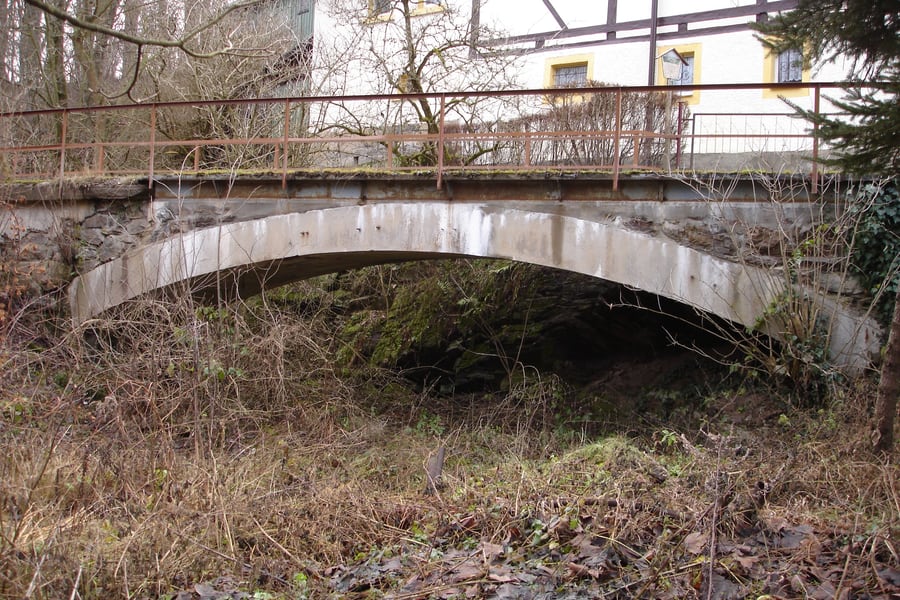
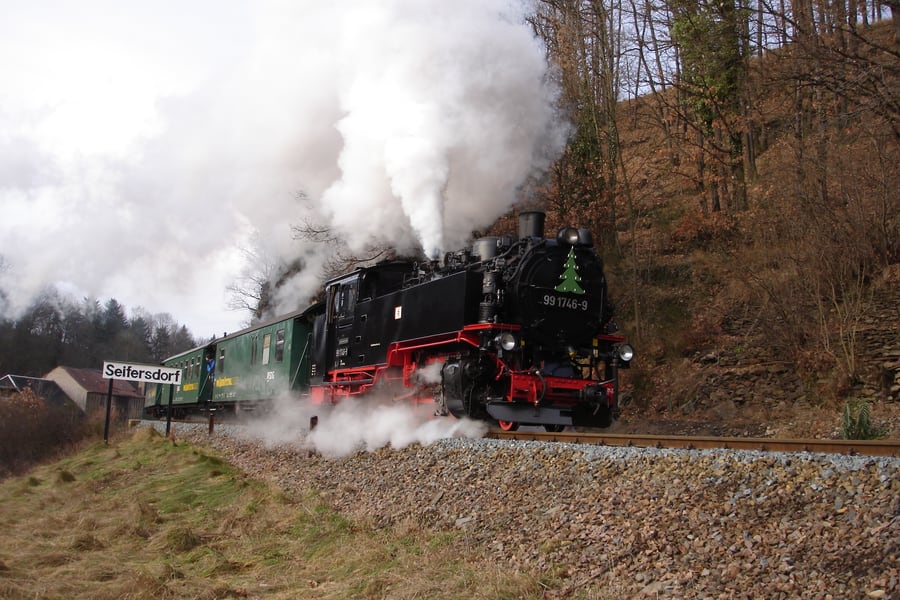
Two things along the line do not have cards of their own and are worth naming. The Mühlgrabenbrücke at Seifersdorf, built in 1882, is reckoned to be the oldest concrete bridge in Germany; it carries the railway over a mill leat a short walk from the station, and it looks like nothing at all, which is rather the point. And at Schmiedeberg the Church of the Holy Trinity, built between 1713 and 1718 to designs by George Bähr — the architect of the Frauenkirche in Dresden — stands ten minutes from the platform.
Freight on this line ended on 31 December 1994, and the last customer of any size was the iron foundry at Schmiedeberg. It is still there, still casting, with something like two hundred and fifty employees, on a site where a hammer mill is documented from 1492. It is a working factory rather than a visitor attraction, but it explains why the railway survived the 1960s when so many others did not.
 Jörg Blobelt / Wikimedia Commons · CC BY-SA 4.0 · cropped
The Rabenauer Grund
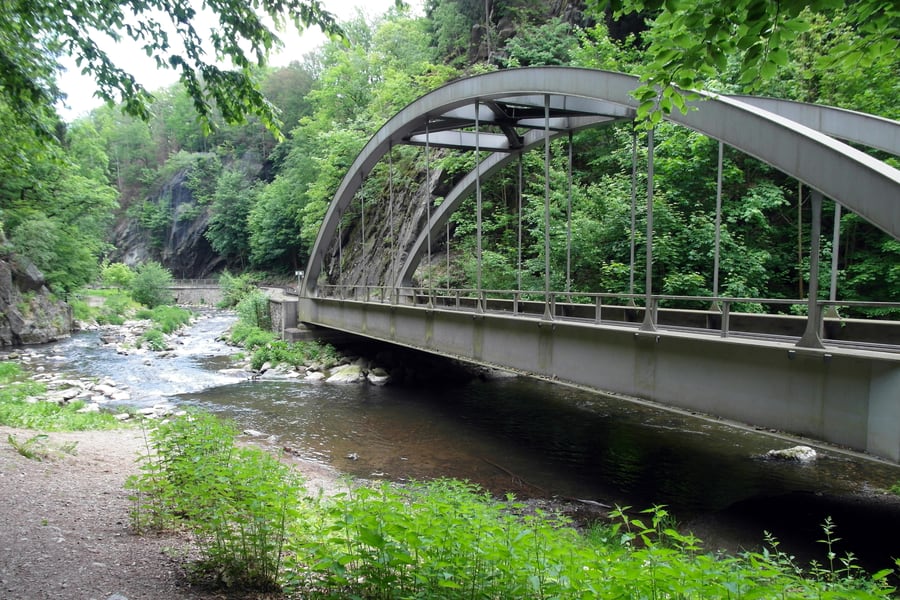
A notch valley cut by the Rote Weißeritz through granite, up to eighty metres deep, a nature reserve since 1961 and part of a Natura 2000 site. A forest path runs its whole length and is the only alternative to the train. The clean-up after 2002 was hard on it: heavy machinery straightened much of the river into an even discharge channel and cleared the bank zones, which is the part of the rebuild nobody put on a plaque.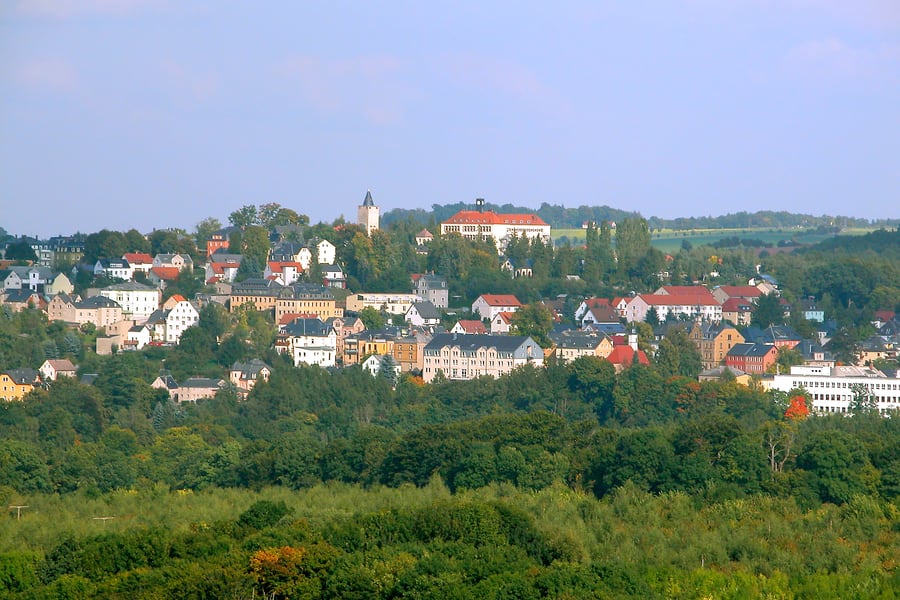 Jörg Blobelt / Wikimedia Commons · CC BY-SA 4.0 · cropped
Rabenau, the chair town
Chairs have been made here since the sixteenth century, and in 1720 the cartographer Adam Friedrich Zürner recorded that almost every inhabitant was a chair maker. The Deutsches Stuhlbaumuseum, founded in 1922 and enlarged in 2005 around the workshop of the master craftsman Kurt Aehlig, calls itself the only specialist museum of its kind in Germany. The town sits at 320 metres and was first named in 1235.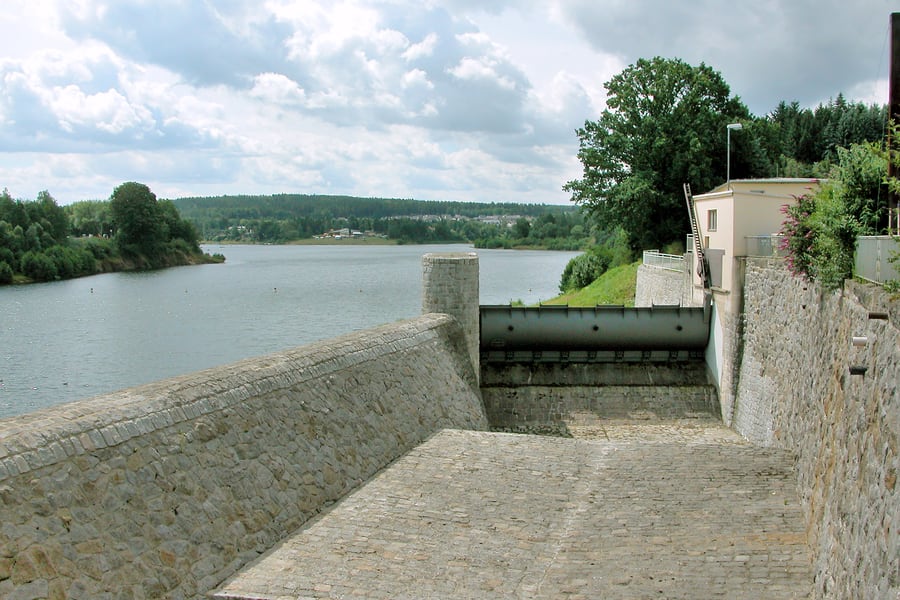 Jörg Blobelt / Wikimedia Commons · CC BY-SA 4.0 · cropped
The Malter reservoir
Built between 1908 and 1913 as part of the flood-protection scheme drawn up after 1897, to a design by the Dresden firm Lossow und Kühne that had come third in a competition of fifty-two entries. The dam stands thirty-four metres above its foundation with a crest of 193 metres, and holds 8.78 million cubic metres over eighty-four hectares. Swimming and watersports are allowed, there are four public beaches, and motorboat trips have run since 1914.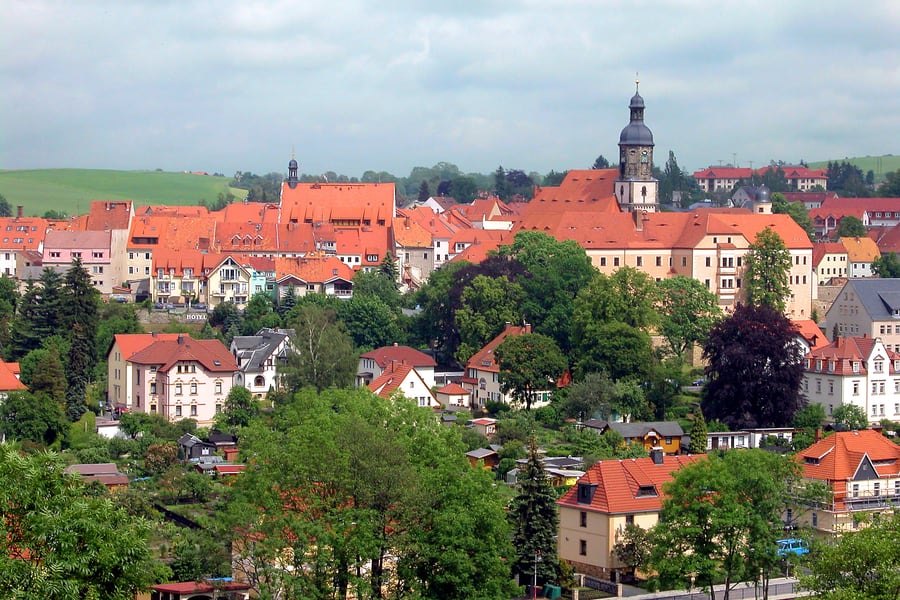 Jörg Blobelt / Wikimedia Commons · CC BY-SA 4.0 · cropped
Dippoldiswalde and the mines under it
Archaeologists working under the town found medieval silver workings whose oldest dated mine timbers come from 1158 — older than the strike at Freiberg that is usually taken as the start of Saxon silver mining. Shaft supports, turned wooden bowls and rope survive. The Schloss, a margravial fortress from around 1200 rebuilt in the Renaissance, holds the Osterzgebirgsmuseum and, since autumn 2018, a museum of that medieval mining.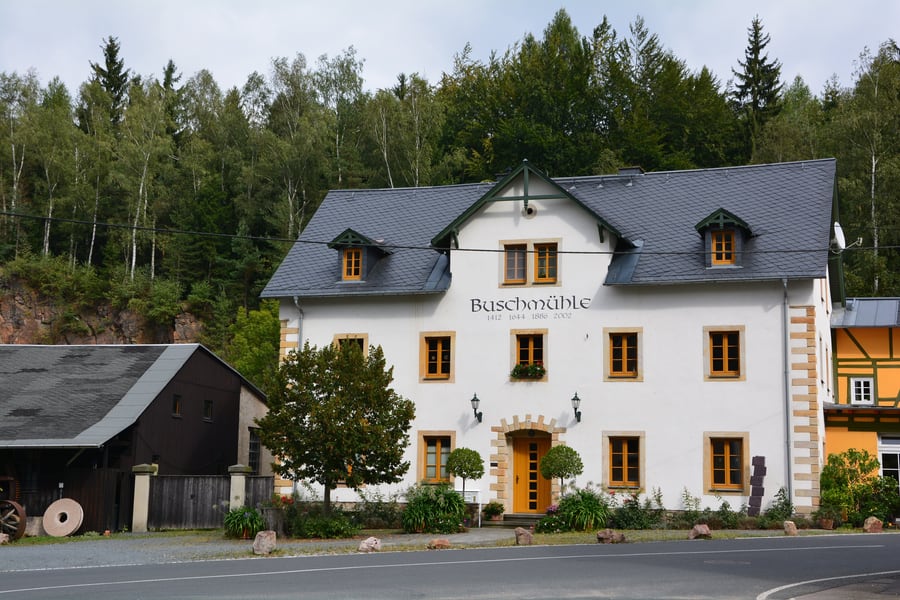 Bybbisch94, Christian Gebhardt / Wikimedia Commons · CC BY-SA 4.0 · cropped
The Buschmühle
The last stop before the terminus, a mill house on the road up the valley with the railway halt immediately outside it, four hundred and sixty-three metres up. It is the quietest place on the line to get off: from here the track climbs its final gradient of one in twenty-nine, and the walk on up to Kipsdorf takes about twenty minutes on the old formation.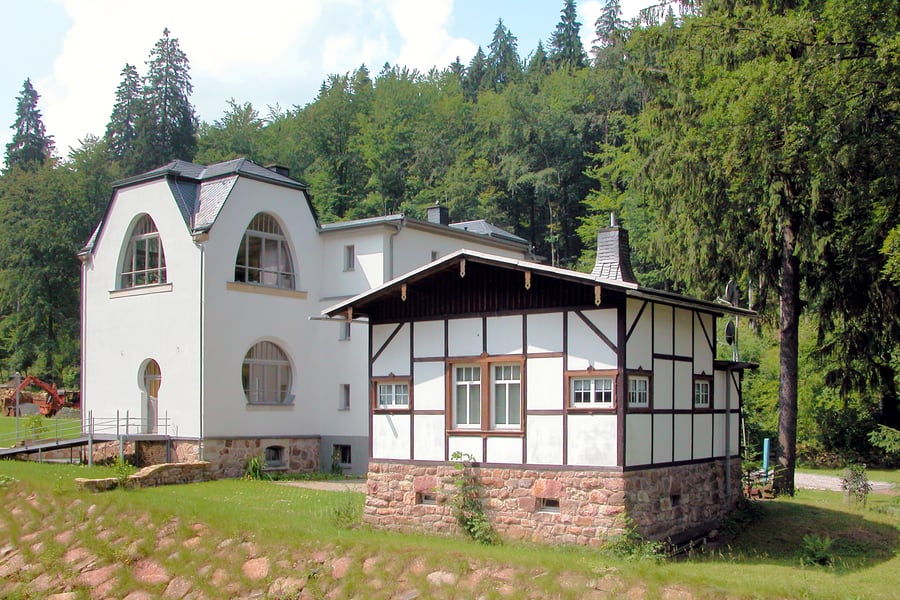 Jörg Blobelt / Wikimedia Commons · CC BY-SA 4.0 · cropped
Kurort Kipsdorf
A village of about two hundred and fifty people at 531 metres, which became a resort because the railway arrived: the line reached it on 3 September 1883, and by 1910 it was taking ten thousand holiday guests a year. The Bäderhaus and the Bergkirche of 1908 are both from that period. The station building itself was gutted by the 2002 flood, fully restored during the rebuild, and now serves the village as its community hall.Where to Sleep
Most people ride the Weißeritztalbahn as a day out from Dresden, which is twenty minutes from Freital-Hainsberg on the S3 and has every kind of bed. That is the sensible default, and it is what the timetable is built around: the 09:55 up and the 17:00 back give a full day in the valley without an overnight stay.
Staying on the line itself changes the day rather than lengthening it. The two through trains are inconveniently spaced for a visitor arriving from outside and well spaced for someone already there — an early walk in the gorge, the 11:41 down, the 13:55 back up. The valley is also quiet in a way Dresden is not; above Dippoldiswalde the last few kilometres are forest and hillside, and Kipsdorf at 534 metres is dark at night.
One house is easy to recommend for that, and it is above the terminus rather than on the line. Beds nearer the middle of the route are thinner on the ground than the number of listings suggests: the Rabenauer Mühle at Rabenau station, which would have been the obvious choice, closed its hotel and restaurant for good in November 2022 and now takes event bookings only.
One thing is worth having in mind when picking dates: the line closes completely for maintenance in March and November, so a bed booked in Kipsdorf during those weeks comes with no train at all, and there is no replacement bus.
Where to stay
Naturhotel Gasthof Bärenfels
In the woods above the terminus
An inn at Bärenfels, the next village above Kurort Kipsdorf, which describes itself as one of the oldest in the Ore Mountains. Rooms and apartments each with a sitting area and private bathroom, a restaurant cooking regional food, a small spa offering massages and natural cosmetics, and a grill hut. It also runs a ticket and excursion desk, which on this line is more useful than it sounds.
Check Availability (opens in a new tab, on naturhotel-baerenfels.de)via naturhotel-baerenfels.deQuestions or corrections
Planning this trip and stuck on something, or spotted a time, fare or detail that has changed? Send us a message about The Weißeritztalbahn to Kurort Kipsdorf. We read every one, and we update this page when something has changed.