The Wendelstein Rack Railway
Geogast / Wikimedia Commons · CC BY 3.0 · cropped
- Distance7.6 km, Brannenburg to the Wendelstein · 1,217 m climb
- DurationAbout 25 minutes up, 30 down · hourly
- Best seasonMay to mid-November for the summit · winter for skiing · closed before Christmas
Introduction
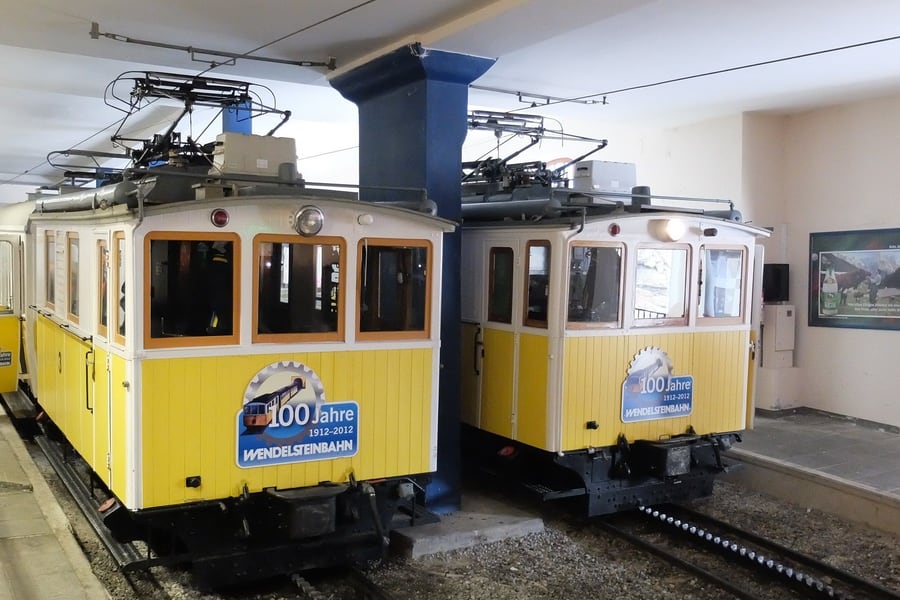
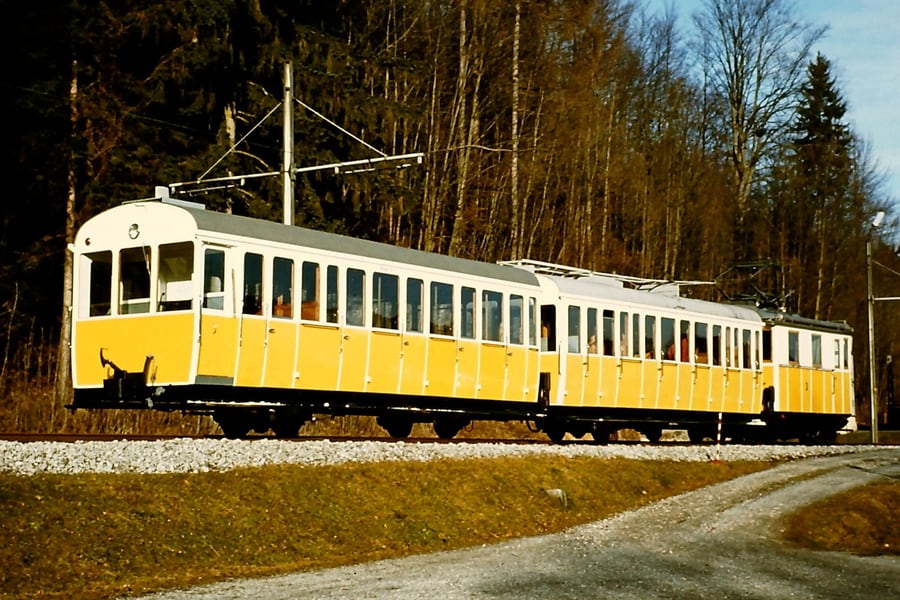
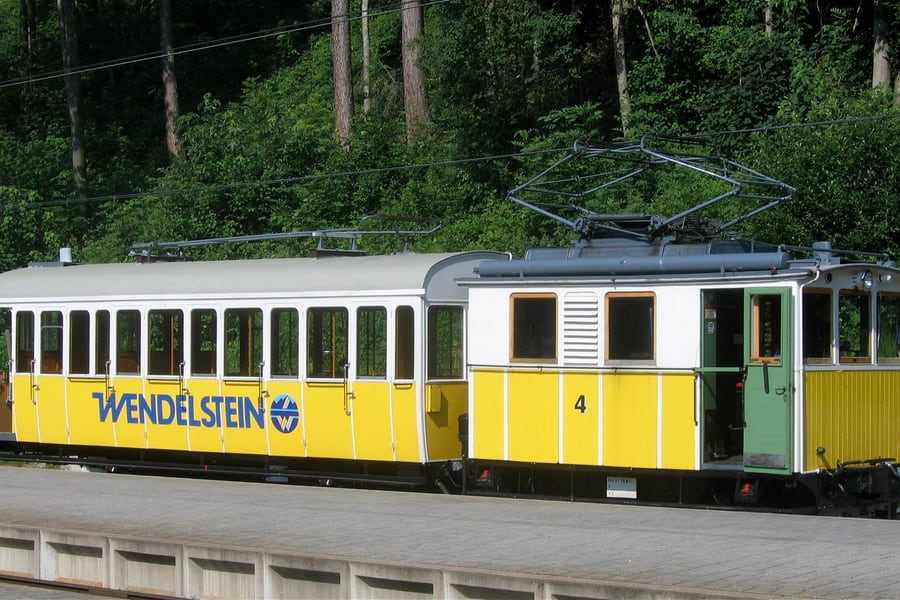
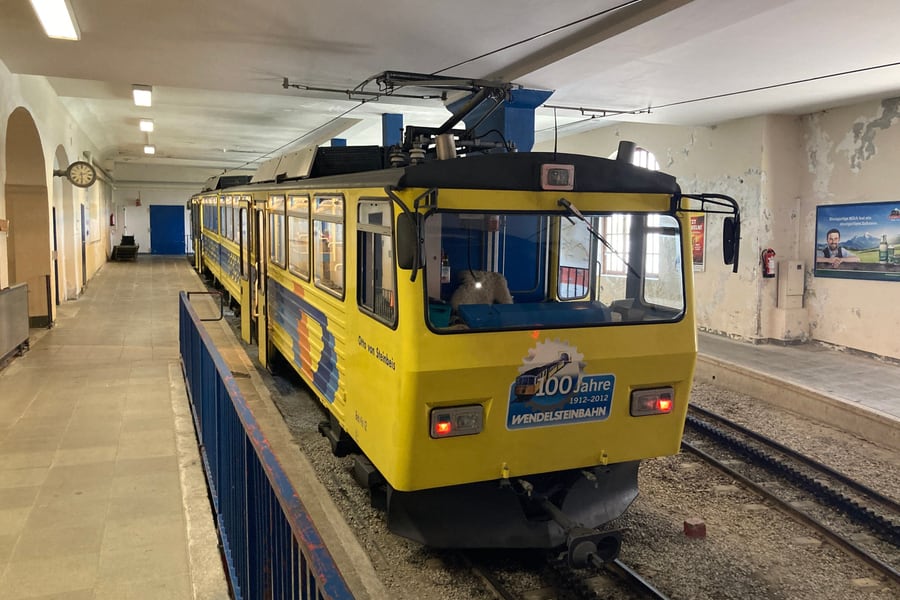
On the Wendelstein, the oldest carriages are the spare ones. The rack railway's everyday trains are two railcars of 1990, and when one of them goes into the workshop the service is run with passenger cars built for the line's opening in 1912. In May 2022 the railway explained why it had just bought a new locomotive: the 1990 railcars could no longer get spare parts, and while they were fitted with new electric drives the new engine and the original carriages would carry the passengers. Lok 5, a 700 kW machine built in Switzerland, now pushes the 1912 cars up the mountain to the timetable. From 19 October 2026, with a railcar's overhaul brought forward, they are standing in again.
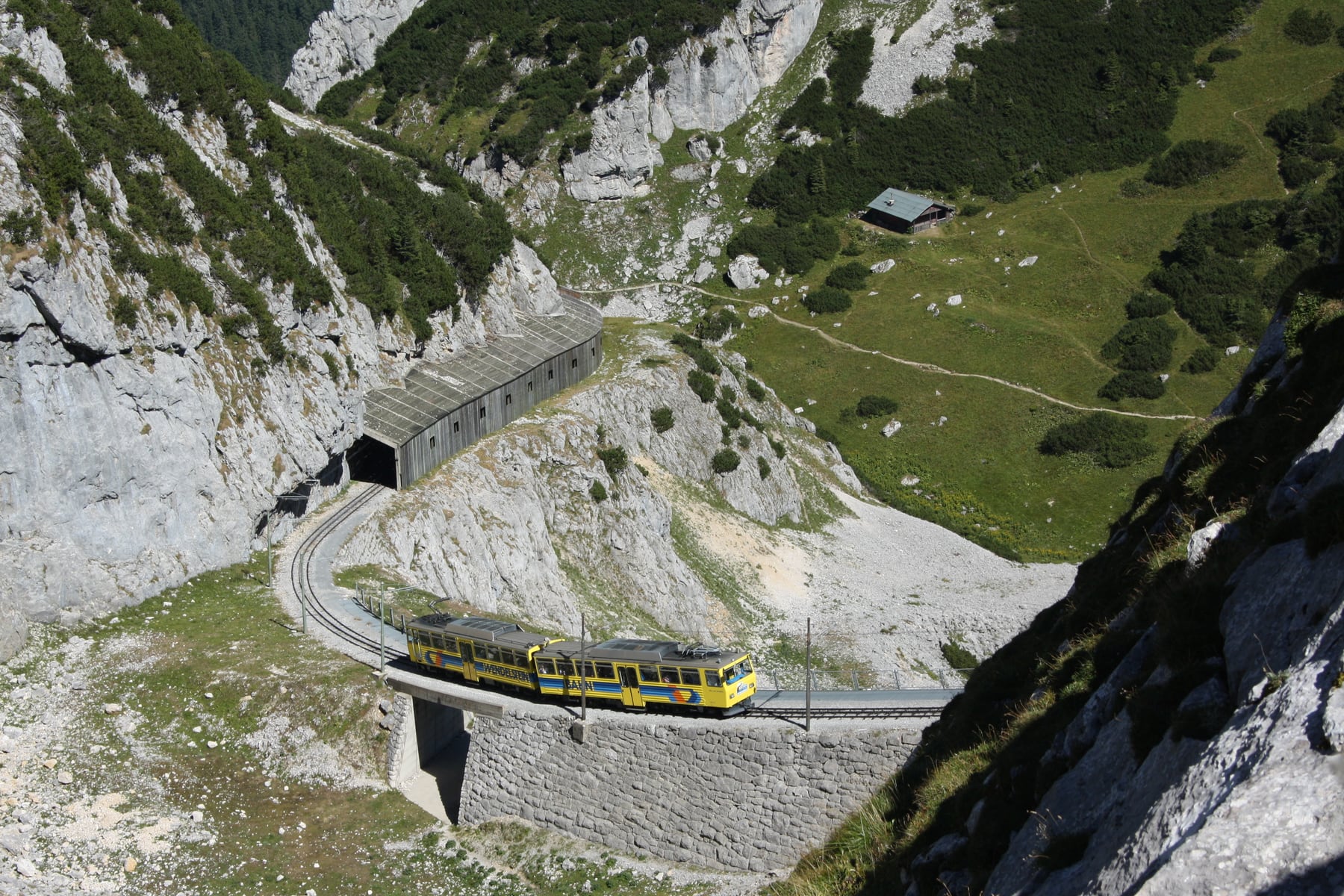
The line climbs 1,217 metres in 7.6 kilometres, from Brannenburg in the Inn valley to a station at 1,723 metres, just below the summit. A toothed rack between the rails takes it up gradients of as much as 23.7 per cent, through forest, past two request stops on the pastures, and along the cliffs of the north face through seven tunnels and eight galleries. The operator calls it Germany's oldest high-mountain railway, and it opened in May 1912.
From May to mid-November a train goes up every hour from 09:00 to 15:00, and the ride takes about 25 minutes. There are no seat reservations. Brannenburg is an hour from Munich on the regional train, and the valley station a half-hour walk from there.
The Journey
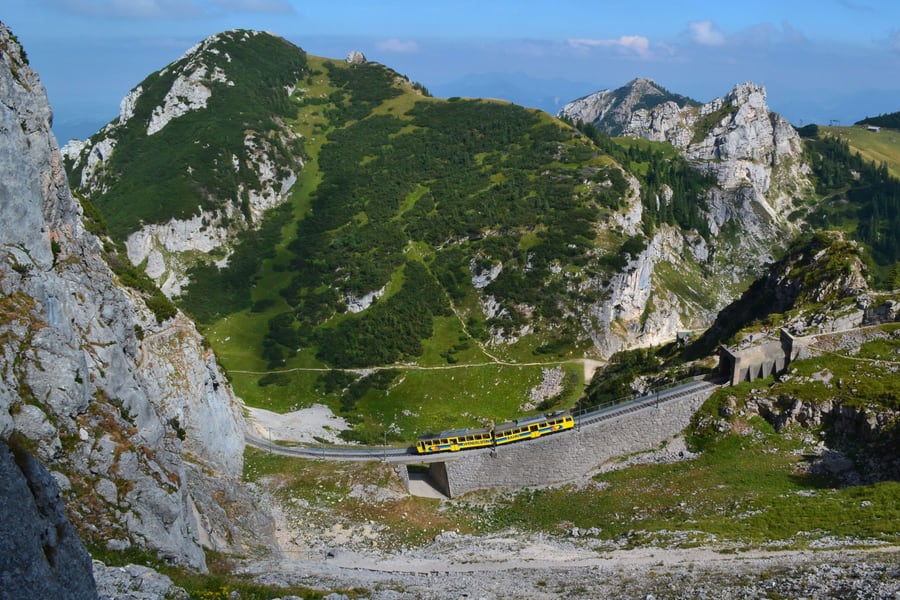
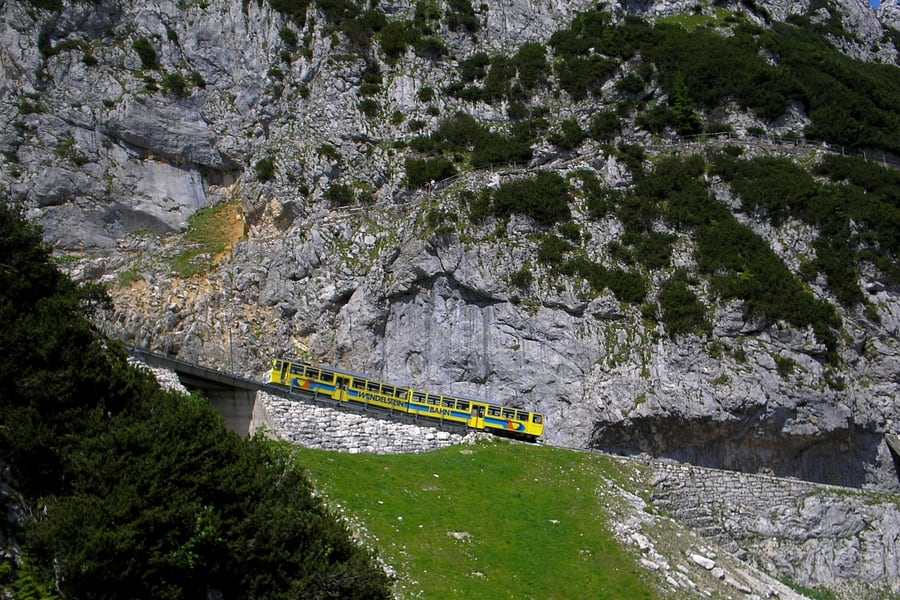
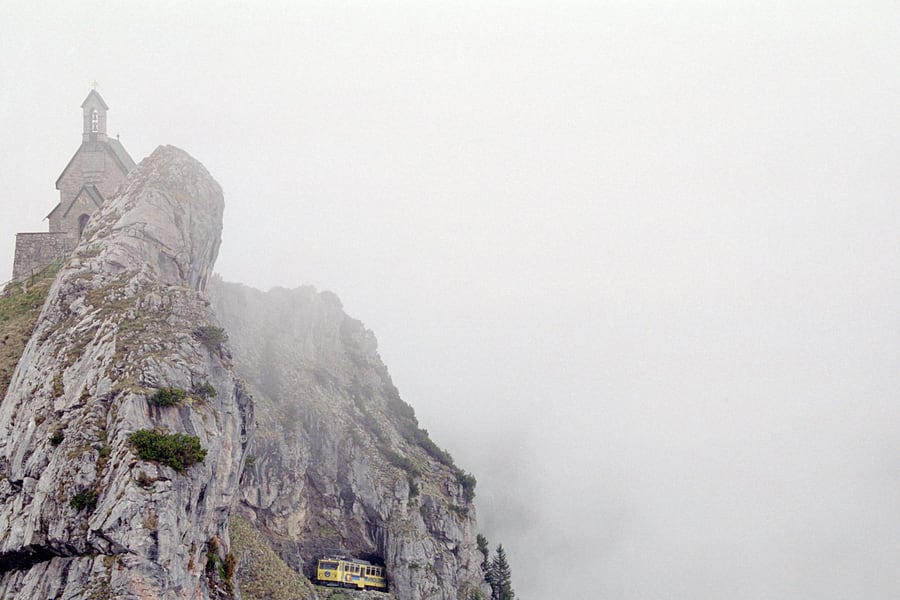
The valley station stands at 508 metres on the edge of Brannenburg, with a free car park and the line's depot just above it. The train starts on ordinary rails through the forest, picks up the rack at Gembachau, and climbs through woods and over small bridges to Aipl, at 980 metres, where it passes the train coming down. Above Mitteralm, at 1,200 metres, the line leaves the pastures and the hardest stretch begins: the builders took it along the steep north faces of the Wildalpjoch and the Soin, the most difficult of the possible routes, to keep it clear of rockfall and avalanches. Tunnels, galleries and walls follow one another to the Hohe Mauer, a stone embankment 127 metres long and 17 metres high, and two tunnels through the rock below the church bring the train into the summit station. The Wendelsteinhaus inn is a few steps away.
Built in two years
Otto von Steinbeis, an industrialist from Baden who had built narrow-gauge forest railways in Bosnia, chose his adopted village of Brannenburg as the starting point, and Prince Regent Luitpold signed the concession on 4 February 1910. Some 800 workers, most of them from Bosnia, built the line in two years, and it opened on 25 May 1912. Steinbeis wanted it electric, although the valley had no electricity at all, so he built a hydroelectric plant in 1910. The trains coming down brake by generating current, which is fed back for the trains going up. The plant also lit Brannenburg and Flintsbach, and the railway company still supplies electricity to about 5,000 customers.
The 1912 trains
The railway opened with three electric rack locomotives from the Maschinenfabrik Esslingen and Brown Boveri, and carriages by MAN of Nuremberg, with wooden benches and luggage nets. A fourth locomotive followed in 1935. Until the railcars arrived in 1991 these trains ran the whole service. Locomotive 1 is now in the Lokwelt museum at Freilassing, locomotive 4 has been out of use since a motor failure in 2019, and locomotives 2 and 3 still work, on special trains such as the full-moon evening runs.
In 1961 the line was cut back from Brannenburg's main-line station to the present valley station, 2.3 kilometres short, because it crossed the main road on the level. When the cable car from Bayrischzell opened in 1970 it was meant in time to replace the rack railway, which did not pay its way. Instead the line was modernised between 1987 and 1991, and two double railcars built by Siemens and SLM, named Otto von Steinbeis and Prinzregent Luitpold, cut the climb to 25 minutes.
The newest machine on the mountain is Lok 5, built by Stadler in Switzerland, delivered in October 2021 and put into service on 12 May 2022, 110 years after the first train. On the way up it pushes the carriages ahead of it, driven by remote control from the platform of the leading car, and it is the reason the 1912 cars can still stand in for a railcar on the timetable.
Along the route
 Rufus46 / Wikimedia Commons · CC BY-SA 4.0 · cropped
Onto the rack
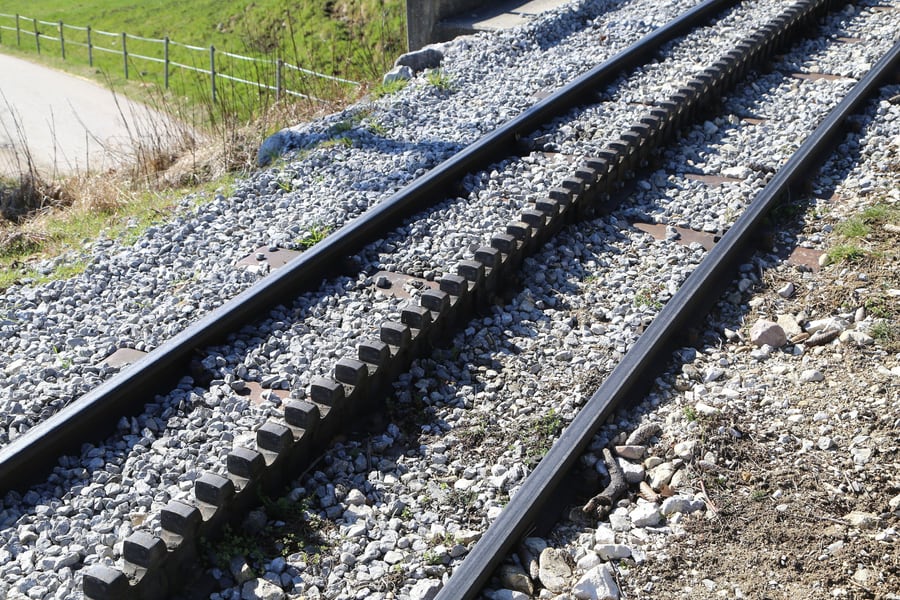
The train leaves the valley station through forest, and at Gembachau it engages the toothed Strub rack laid between the rails. The rack runs over most of the line and is what lets it climb gradients of up to 23.7 per cent.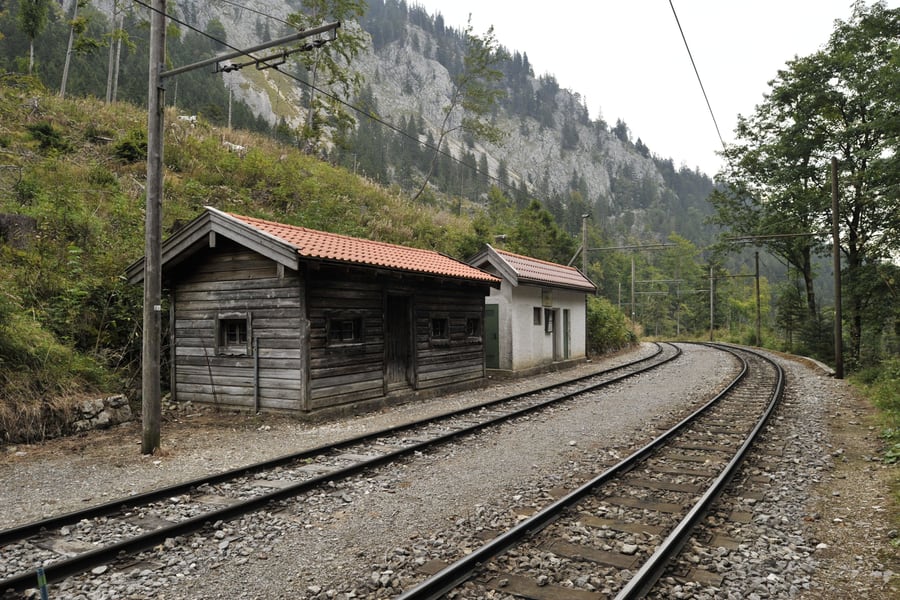 Fentriss / Wikimedia Commons · CC0 · cropped
Aipl, the passing loop
At Aipl, 980 metres up, the single track divides so that trains going up and down can pass each other. It is also a request stop, with two old huts beside the line, for walkers heading down through the woods.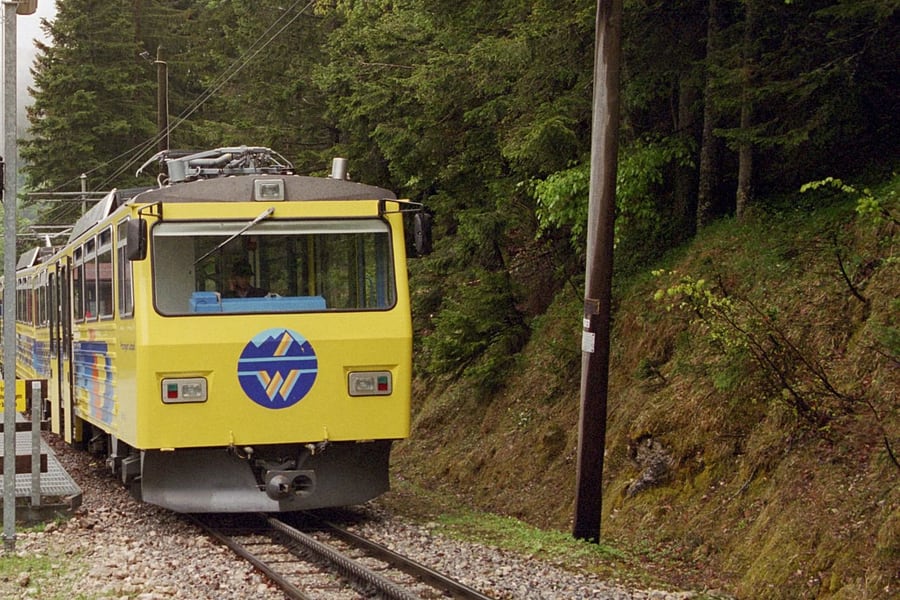 Herbert Ortner / Wikimedia Commons · CC BY 2.5 · cropped
The Mitteralm halt
The second request stop, at 1,200 metres, serves the Mitteralm, an Alpine Club hut on the pastures. Trains pick up here only when there are seats free, so walkers coming down on a busy day may have to wait for the next one.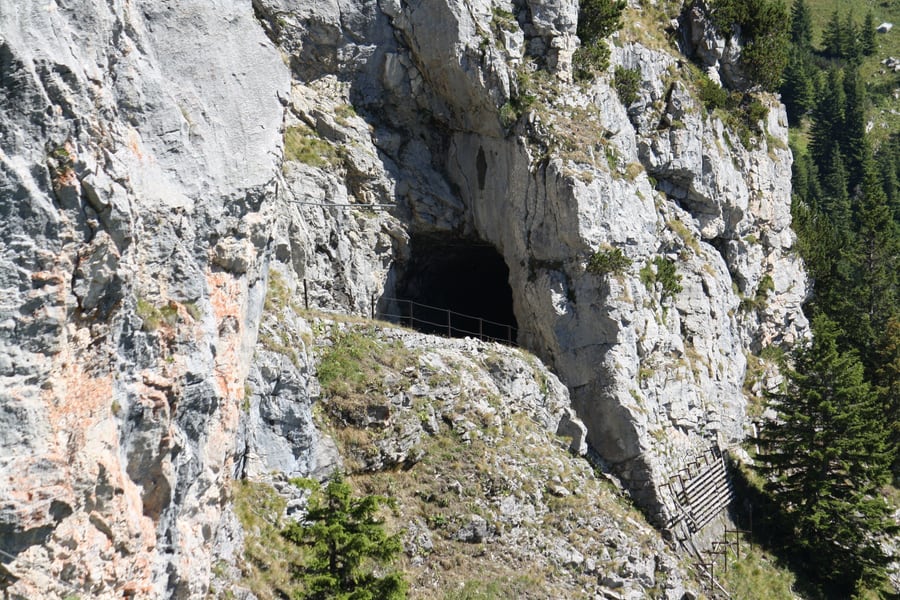 Geogast / Wikimedia Commons · CC BY 3.0 · cropped
Through the north face
The last stretch was cut along the steep north faces of the Wildalpjoch and the Soin. In its last two kilometres the train passes five short tunnels, a 120-metre gallery and the Hohe Mauer, then runs under the church into the summit station.A bit of history
Culture & experiences along the way
 Fentriss / Wikimedia Commons · CC0 · cropped
Germany's highest church
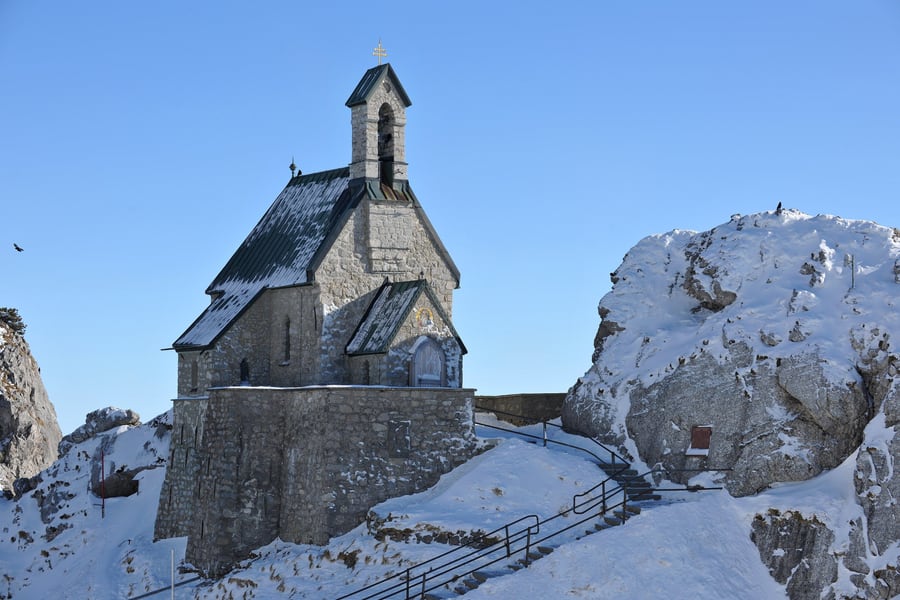
The first landlady of the Wendelsteinhaus missed having a church on the mountain, so Max Kleiber built one: the foundation stone was laid on 1 July 1889 and it was consecrated in 1890. It counts as Germany's highest church. Kleiber carried its gilded 40 kg cross up himself. Mass is said on Sundays at 11, May to October.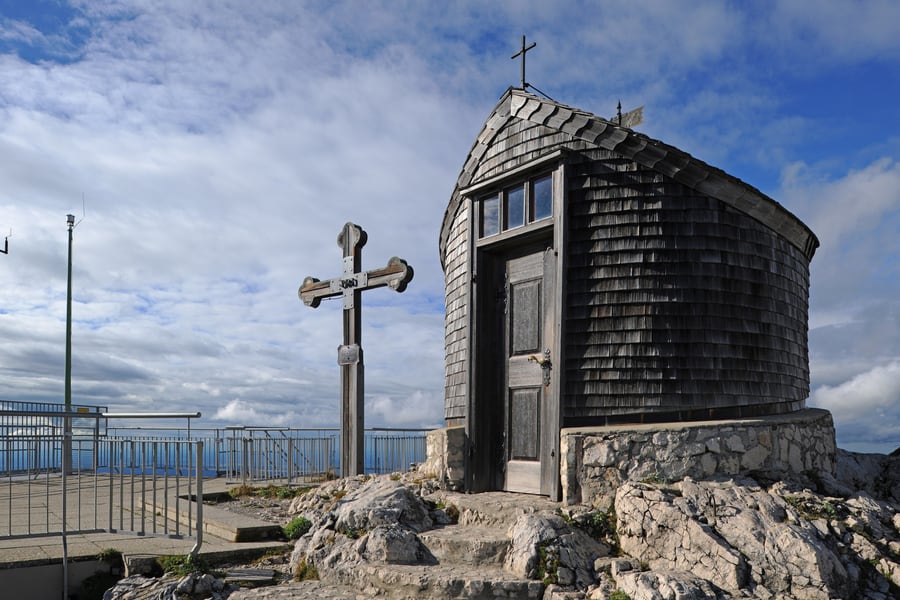 Fentriss / Wikimedia Commons · CC0 · cropped
The Wendelin chapel on the summit
On the summit itself stands a smaller and older building, the Wendelinkapelle. A farmer from Bayrischzell built it in 1718, in thanks for finding his horses after they had been lost in the fog. It sits beside the summit cross, a short climb above the church.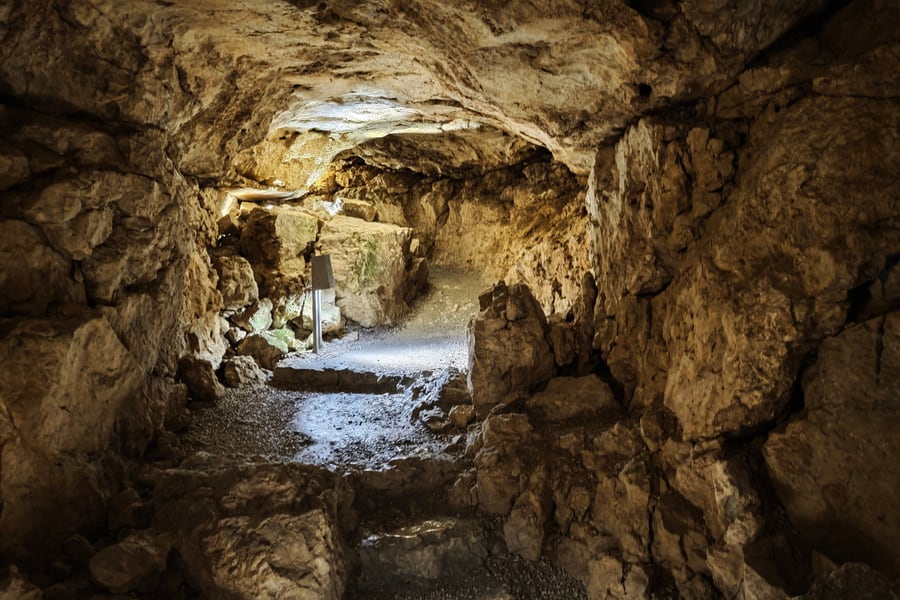 Wikitarisch / Wikimedia Commons · CC BY 4.0 · cropped
A cave inside the mountain
About four minutes' walk from the station, 82 steps lead down into the Wendelsteinhöhle, found in 1864 and counted as Germany's highest show cave, at 1,711 metres. It stays at about 3 °C all year, and snow can last into summer in its cold trap. Entry is a €2 coin.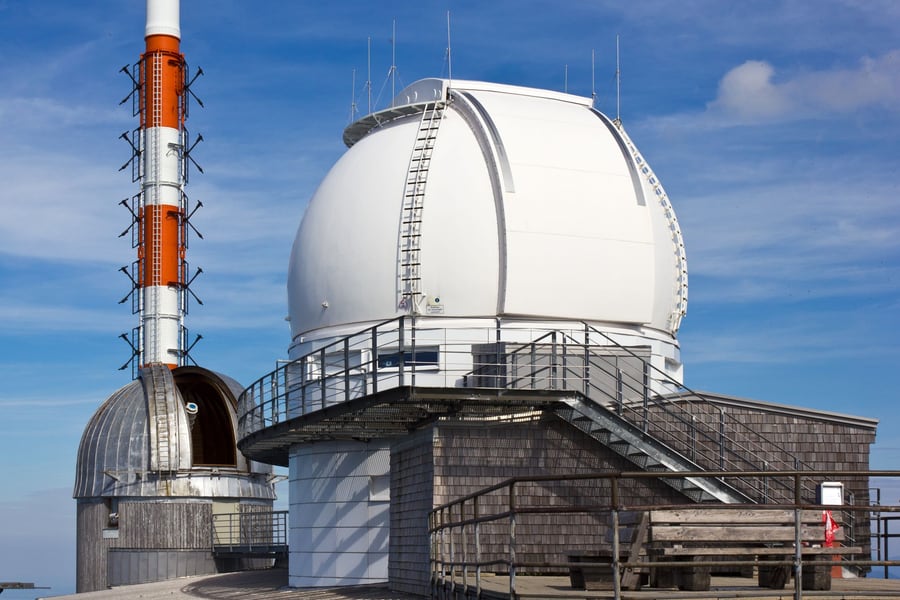 H. Raab / Wikimedia Commons · CC BY-SA 4.0 · cropped
An observatory at the top
The domes on the summit belong to the Wendelstein University Observatory, which began in 1941 as a solar observatory. The larger now houses a 2-metre reflecting telescope. Guided visits of about 50 minutes run from about June to September and must be booked with the university at least two weeks ahead.Timetables
The rack railway runs almost all year, with a break for maintenance before Christmas. Trains climb on the hour and take about 25 minutes up and 30 down; on busy days extra trains run every half hour. Seats cannot be reserved, and at Aipl and Mitteralm trains pick up only when there are seats free.
Times below are from the Wendelsteinbahn's summer timetable 2026 and winter timetable 2026/27, read in October 2026. The line also posts a timetable for each day, from about 08:30, at wendelsteinbahn.de (opens in a new tab).
Summer: daily, 1 May to 15 November 2026
| Up | |||||||
|---|---|---|---|---|---|---|---|
| Brannenburg, valley station | 09:00 | 10:00 | 11:00 | 12:00 | 13:00 | 14:00 | 15:00 |
| Wendelstein, summit station | 09:25 | 10:25 | 11:25 | 12:25 | 13:25 | 14:25 | 15:25 |
| Down | ||||||||
|---|---|---|---|---|---|---|---|---|
| Wendelstein, summit station | 09:55 | 10:55 | 11:55 | 12:55 | 13:55 | 14:55 | 15:55 | 17:00 |
| Brannenburg, valley station | 10:30 | 11:30 | 12:30 | 13:30 | 14:30 | 15:30 | 16:30 | 17:30 |
The 17:00 down runs from 1 June to 30 September only.
Winter: 23 December 2026 to 30 April 2027
Trains go up at 10:00, 12:00 and 14:00 every day, and also at 09:00, 11:00 and 13:00 at weekends and on holidays; the 09:00 runs only when the ski runs are open, and so do the 11:00 and 13:00 on weekdays. The last train down leaves the summit at 16:00. There is no service from 16 November to 22 December 2026.
Getting to Brannenburg
The RB 54 of the Bayerische Regiobahn runs hourly from München Hbf to Brannenburg in about an hour, and on to Kufstein. In the timetable from 13 December 2026, the 08:43 from Munich reaches Brannenburg at 09:41, in time to walk up for the 10:00, and the 17:19 from Brannenburg is back in Munich at 18:18. Bus 337 links the station and the valley station hourly, except on Sundays and holidays.
Tickets
Tickets are sold at the valley station. From 1 May 2026 to 30 April 2027 a return to the summit costs €49 for adults and €24 for children aged 6 to 17, a single €31, and a family return €111. Anyone arriving on a Bayern-Ticket, a Guten-Tag-Ticket or an MVV ticket valid that day pays €40 for the return; the discount does not apply to the Deutschlandticket. Dogs cost €7.
To ride up in the 1912 carriages, the Nostalgie-Express runs on the first Friday of each month from May to October 2027, up at 09:50 and down at 13:30, for €8 on top of the return fare. The full-moon trains, with the old locomotives, an evening buffet at the Wendelsteinhaus and music, cost €105. Both are booked in the operator's online shop.
Book your tickets
Return ticket
Brannenburg to the summit and back
A return on the rack railway between the valley station at Brannenburg and the summit station; children aged 6 to 17 pay €24.
Book Tickets (opens in a new tab, on wendelsteinbahn.de)via wendelsteinbahn.deReturn with a rail day ticket
Bayern-Ticket, Guten-Tag-Ticket or MVV ticket
Show a day ticket you travelled on and the return costs less, though not with the Deutschlandticket.
Book Tickets (opens in a new tab, on wendelsteinbahn.de)via wendelsteinbahn.deNostalgie-Express
The 1912 carriages, on set days
A supplement to the normal fare for a ride up in the original carriages, booked online with a reserved seat.
Book Tickets (opens in a new tab, on wendelsteinbahn.de)via wendelsteinbahn.deRail Passes
Interrail and Eurail passes cover the train to Brannenburg but not the rack railway. Interrail's table of German operators includes regional trains (RB) run by DB "and all other Regional carriers", so the Bayerische Regiobahn's RB 54 from Munich is covered. The Wendelsteinbahn is a private mountain railway and is not on the list, so the fare up the mountain has to be paid in full. The same is true of the Deutschlandticket: it covers the RB 54 but not the rack railway, and it does not earn the discount given to day-ticket holders.
For this journey a pass is not worth buying. A Bayern-Ticket covers the return trip from Munich, from €29 for one traveller, and it also takes €9 off the rack railway's return fare.
Pass conditions checked against Interrail's railway-companies page, last updated 21 October 2026. Conditions change with each season, and the pass issuer's page is the one that binds.
Places to Visit
The rack railway is a half-day on its own, and a full day with the summit, the church and the cave. Brannenburg is at the foot of the line. The summit platform is beside the top station. The cable car to Bayrischzell makes a round trip of it, and Kufstein is a short ride further on the same regional train.
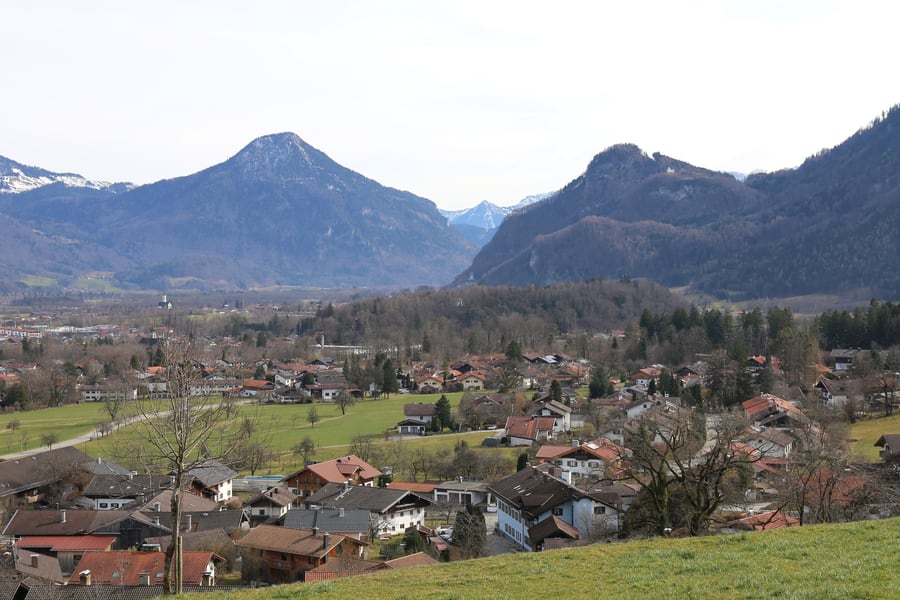 Rufus46 / Wikimedia Commons · CC BY-SA 4.0 · cropped
Brannenburg
Brannenburg in the Inn valley was Otto von Steinbeis's adopted home, and he made it the start of his railway. From the main-line station a signed path of about 30 minutes follows the Kirchbach up to the valley station, past a memorial to Steinbeis, a nature trail and a Kneipp foot bath. Bus 337 covers the same ground hourly, except on Sundays and holidays.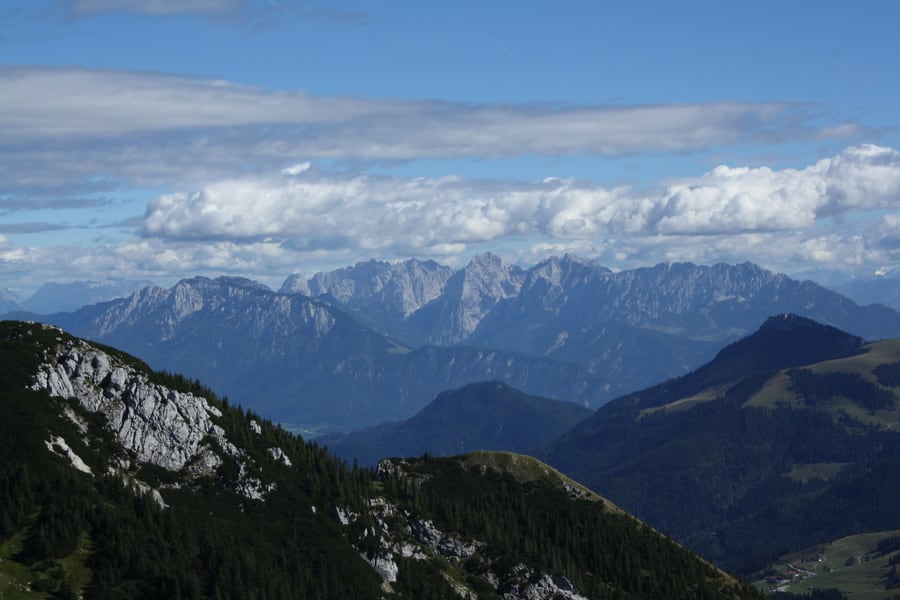 Geogast / Wikimedia Commons · CC BY-SA 3.0 · cropped
The summit and the Gacher Blick
A few steps from the station, the Gacher Blick viewing platform looks out over some 200 peaks, from the Kampenwand above the Chiemsee and the Wilder Kaiser to the Großglockner, the Großvenediger and the Zugspitze, with a board naming them. The summit path climbs on to 1,838 metres; it is high alpine ground, with no way through for wheelchairs.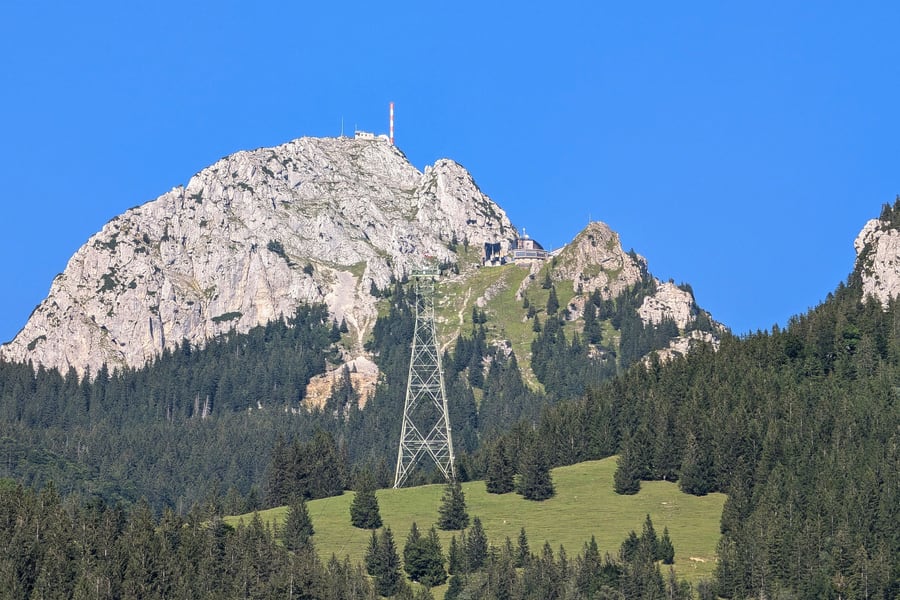 Thomas Kniess / Wikimedia Commons · CC BY-SA 4.0 · cropped
Down to Bayrischzell by cable car
The other way off the mountain is the cable car of 1970, seven minutes down 932 metres to Osterhofen near Bayrischzell, up to 170 metres above the ground. A combined ticket covers the rack railway one way and the cable car the other, and from May into the autumn the Wendelstein ring bus, line 349, links the two valley stations.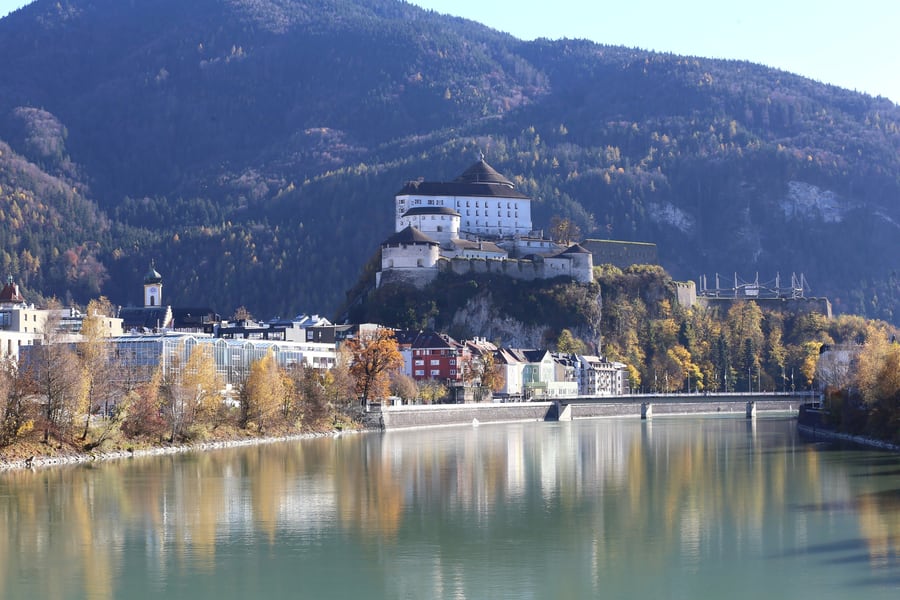 Rufus46 / Wikimedia Commons · CC BY-SA 4.0 · cropped
Kufstein and its fortress
The RB 54 runs on over the border to Kufstein, whose fortress was first recorded in 1205 and was fought over by Bavaria and Tyrol for centuries. Every day at noon, and at 6 pm in July and August, the Heldenorgel plays from its tower; with 4,948 pipes it is the largest open-air organ in the world. Adults pay €15 in summer 2026, the lift included.Where to Sleep
The ride takes under half an hour, so the mountain is an easy day out from Munich or Rosenheim. The Wendelsteinhaus at the top no longer takes overnight guests, so the one place to sleep on the mountain is the Alpine Club hut at the Mitteralm request stop. In the valley, the villages below the Wendelstein have inns with views over the Inn.
The places below keep their own websites and take direct bookings.
Where to stay
Mitteralm
An Alpine Club hut at the request stop
A German Alpine Club hut at 1,200 metres with rooms and dormitories for about 40, reached by the train's Mitteralm halt or on foot.
Check Availability (opens in a new tab, on mitteralm-wendelstein.de)via mitteralm-wendelstein.deBerggasthaus Kraxenberger
At St. Margarethen, above Brannenburg
A family-run inn with rooms at the foot of the Wendelstein, looking out over the Inn valley.
Check Availability (opens in a new tab, on berggasthaus-kraxenberger.de)via berggasthaus-kraxenberger.deQuestions or corrections
Planning this trip and stuck on something, or spotted a time, fare or detail that has changed? Send us a message about The Wendelstein Rack Railway. We read every one, and we update this page when something has changed.