Wengernalpbahn
Kabelleger / David Gubler / Wikimedia Commons · CC BY-SA 3.0 · 2013 · cropped
- Distance19.11 km
- Duration38 min up · 32 min down the far side
- Best seasonAll year · half-hourly on both arms
Introduction
The Wengernalpbahn built its way up to Wengen twice, and then took the first line back off the mountain.
The original route of 1893 climbed straight out of the Lauterbrunnen valley at 250 ‰ — one in four — across a shelf that caught rock and ice every winter, so the railway simply closed that section for the cold months and offered no winter service at all until 1909. A longer and gentler alignment opened alongside it in 1910, carried through tunnels including a spiral of 248 metres below Wengwald, and every passenger has used it since. The first line was kept on for goods and empty stock, and each September it carried timetabled nostalgia trains during the Jungfrau Marathon that anyone could ride on an ordinary ticket. It worked its last train at the end of 2007, and in 2009 the rails came up — partly because the old route cost too much to hold, and partly because the ground it crossed below Wengen is a slipping slope that decades of stabilising work have never settled.
What is left is 19.11 kilometres of 800-millimetre track with a rack between the rails along every metre of it, which makes the Wengernalpbahn the longest continuous rack railway in the world — a record that comes from the shape of the route rather than from ambition, because this is a rack railway that crosses a pass instead of stopping at a summit. It starts at Lauterbrunnen at 797 metres, climbs to Kleine Scheidegg at 2,061, and drops to Grindelwald Grund at 944 before climbing 90 metres again in its last kilometre. No single train does the whole of it: every vehicle has a permanent downhill end, with the driving pinions on the valley side and even the seats raked to suit, so anyone crossing the pass changes at the top. In between lies Wengen, thirteen hundred people on a terrace at 1,275 metres with no road to the valley, for whom this railway is the high street, the lorry route and the refuse collection.
The Journey
Lauterbrunnen station sits at 797 metres on the floor of a glacial trench walled by cliffs on both sides, and three railways share it. The Berner Oberland-Bahn arrives from Interlaken, the funicular to Grütschalp and Mürren leaves from a bay on the far side, and the Wengernalpbahn stands on its own platforms with the rack already between the rails. There is no run-up: the pinion engages within a few metres of the buffer stop, and the train begins to climb.
The first kilometre crosses the Weisse Lütschine on a 72-metre bridge and reaches Witimatte, which is a junction with nothing left to junction with. Until 2007 the original 1893 alignment turned off here and went up the fall line to Wengen at one in four; today the train swings the other way, climbs through the Wurmschopf tunnel to Rohrfluh at 994 metres, and then turns a full half-circle inside a 248-metre spiral tunnel to come out at Wengwald, 1,182 metres, facing the way it came. The two tunnels called obere and untere Brend follow. Wengwald is a request stop, and some trains call there only to set passengers down.
Wengen
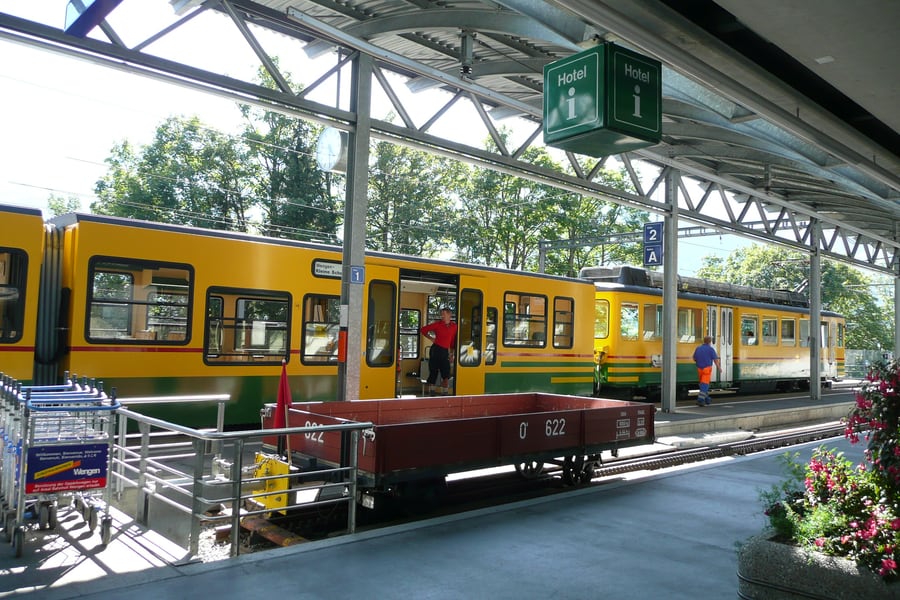
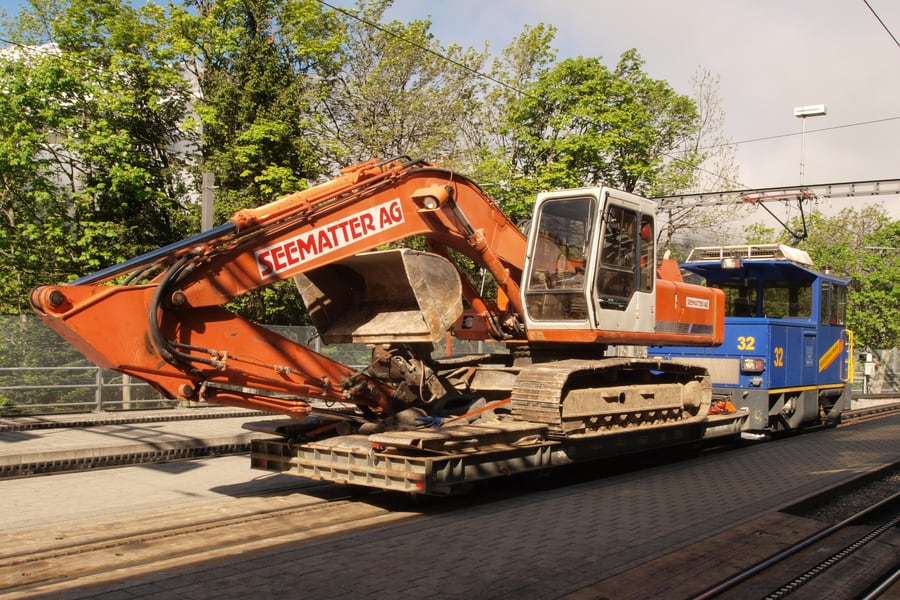
Twelve minutes from Lauterbrunnen, the train runs into a village that has no road to the valley. Wengen has about thirteen hundred permanent residents, more than ten thousand in the winter high season, and a street network that connects to nothing outside itself. The few vehicles on those streets — hotel cars, a handful of electric municipal machines, the doctor's — were all brought up here on a railway wagon, and so was everything else: the fuel, the building materials, the beer, the post, and each spring a certain amount of plant. A crawler excavator on a WAB flat wagon is not a special working; it is a Tuesday.
That is why the fleet list of a nineteen-kilometre mountain railway includes a tank wagon, a container flat, a heavy-transport wagon and a wagon built for carrying road vehicles, alongside goods vans that go back to 1893. It is also why the passenger service to Wengen keeps going long after the tourist trains have stopped: the last departure from Lauterbrunnen is at 02:40, and the first back down leaves Wengen at 05:04.
Above the village the line stops pretending to be public transport and becomes a mountain railway again. The passing places at Sengg and In Gassen go by at 1,320 and 1,428 metres, the station at Allmend at 1,509, and the valley falls away behind until the Staubbach — 297 metres in one drop — is a white thread on the far wall.
Wengernalp
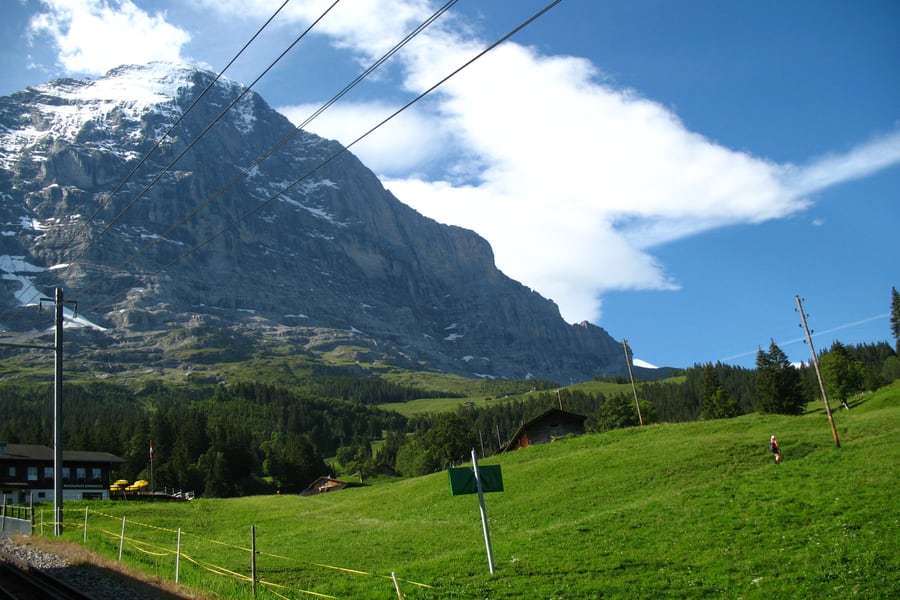
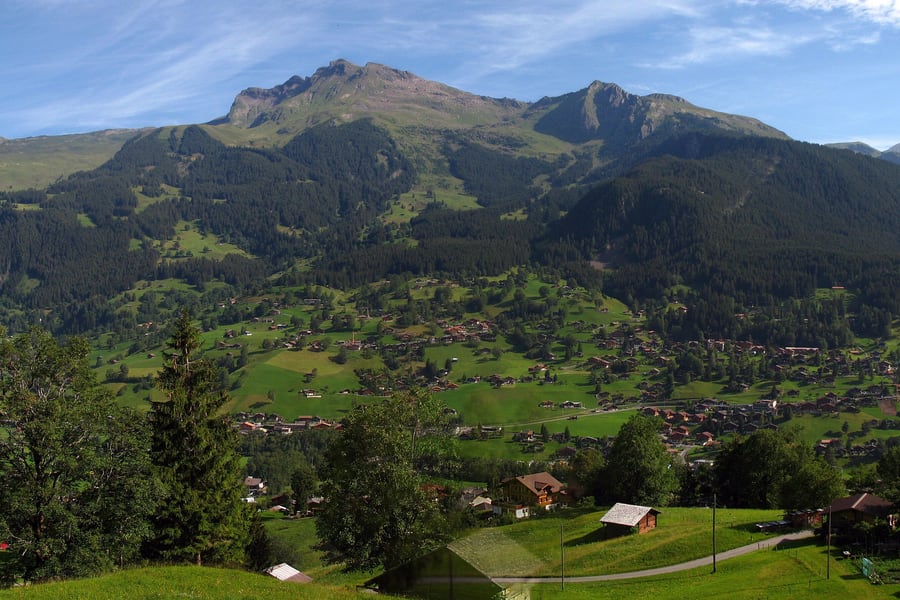
At 1,874 metres the train stops on an open alp with a hotel, a station and very little else, and the reason to look up is straight ahead. The north walls of the Eiger, the Mönch and the Jungfrau stand across the Trümmelbach valley, close enough that the scale stops working. The alp was first described in a traveller's account in 1760, and by the time the railway was proposed it had been drawing painters, poets and composers for a century; the railway is named after it rather than after either of the towns it connects.
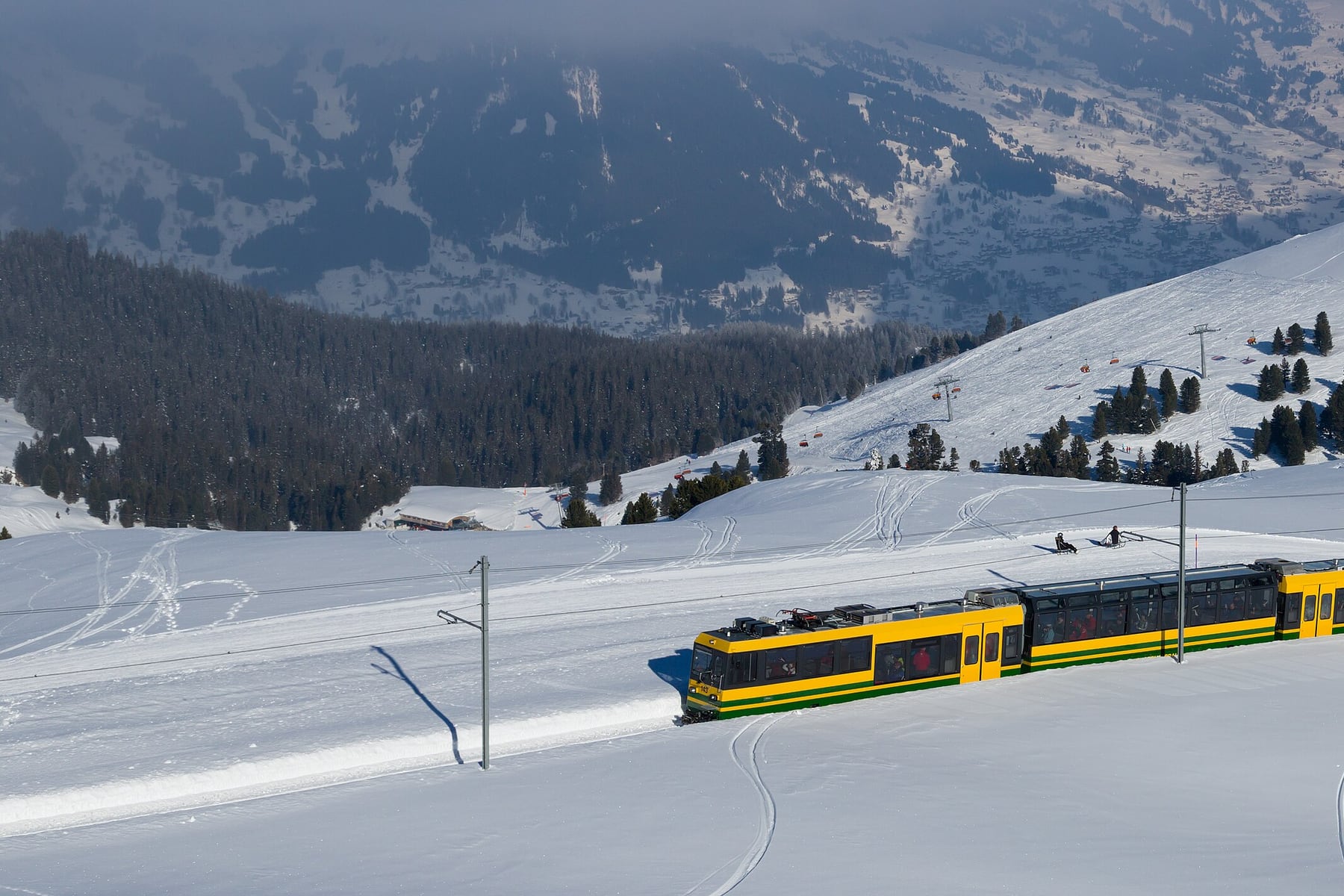
From here the climb steepens to Kleine Scheidegg. In January, the section between the two stations carries the middle of the Lauberhorn downhill on the slope below it, and the mid-course grandstand is a hillock beside Wengernalp station.
Kleine Scheidegg, and the change
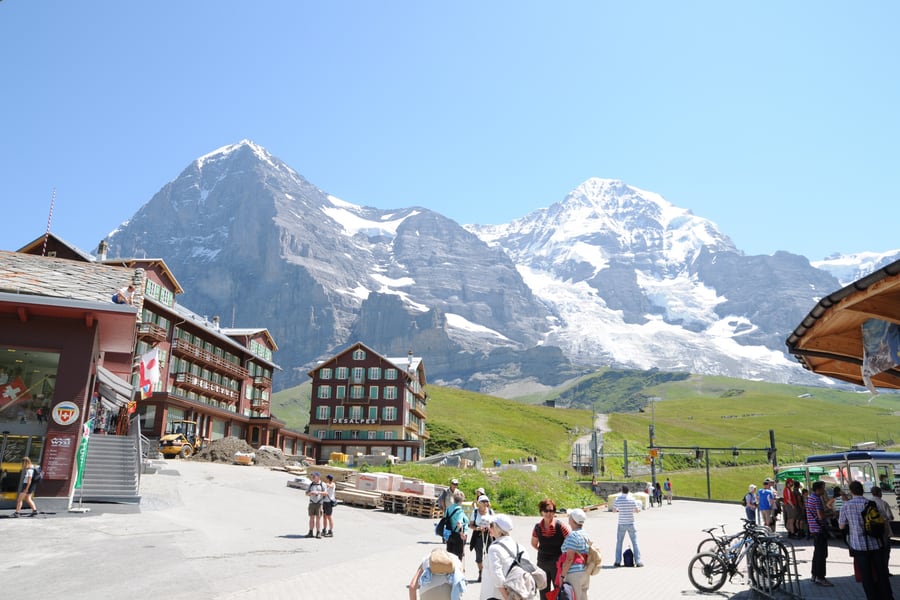
The pass at 2,061 metres is not a village. It is two hotels, a scatter of restaurant terraces, a set of platforms and a great deal of weather. The Wengernalpbahn arrives here from Lauterbrunnen on one side and from Grindelwald on the other, the Jungfraubahn starts here for the tunnel to the Jungfraujoch, and almost everybody standing on the platform is changing trains.
They change because the vehicles cannot cross the pass. On a railway this steep the drives are asymmetric — the driving pinion sits on the downhill side of each bogie, the braking equipment is arranged for descent in one direction only, and the seats are raked accordingly — so every vehicle has a permanent mountain end and a permanent valley end. Moving stock between the two halves of the line was originally done on a turntable; in 1947 that was replaced by a triangle whose tail is a 110-metre tunnel driven into the mountain, long enough to turn a whole train. It is not used in the timetable, and it is the reason the world's longest continuous rack railway has never run a train over its own summit.
Down the Eiger side
The Grindelwald arm is the wilder half. It leaves Kleine Scheidegg, passes Salzegg at 1,995 metres and runs beneath the Eiger through three avalanche galleries — 473, 538 and 505 metres — with the station at Strättli inside the middle one. This is exposed ground: an artificially released avalanche buried two trains between Alpiglen and Salzegg on 18 February 1985 and killed two railwaymen, and on 11 November 1996 a föhn storm gusting to 150 km/h blew a double railcar onto its side near Salzegg while it was bringing down people who had been stranded on the Jungfraujoch.
Alpiglen, at 1,616 metres, is the closest a train comes to the Eiger north face, and the Eiger Trail from Eigergletscher comes down to its platform along the foot of the wall. Below it the gradient reaches its steepest — the Grindelwald Grund to Alpiglen section is the 250 ‰ part of the modern line — and the train drops through Brandegg at 1,333 metres into the meadows above Grindelwald. It crosses the Schwarze Lütschine, runs into Grindelwald Grund at 944 metres beside the depot, and then does the one thing nobody expects of a train that has spent forty minutes coming downhill: it climbs the last kilometre, ninety metres up, to finish at Grindelwald station at 1,034.
What runs
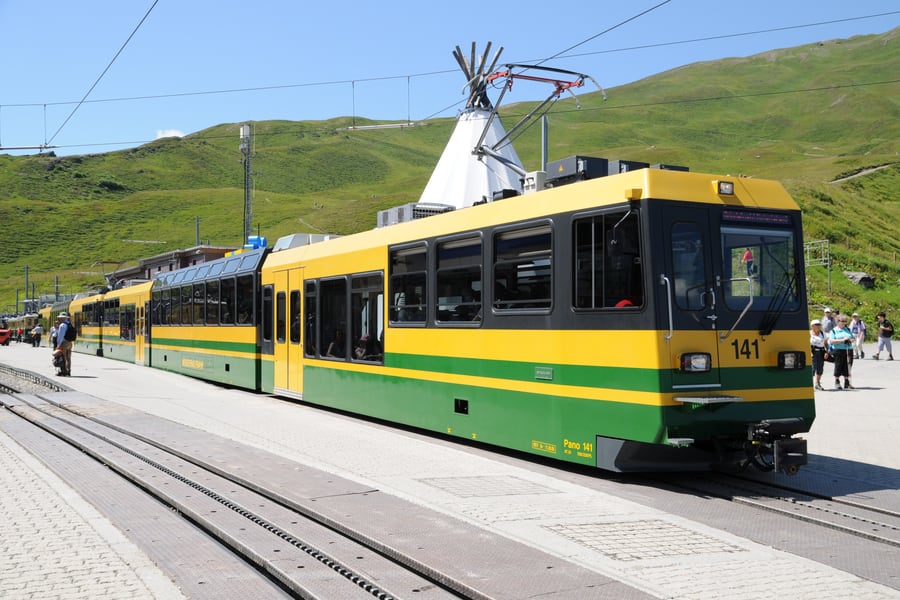
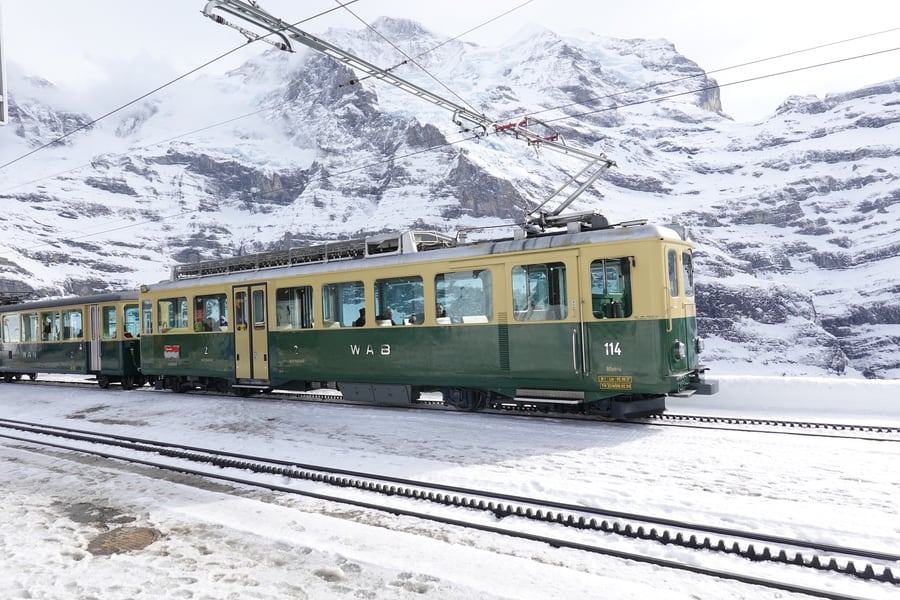
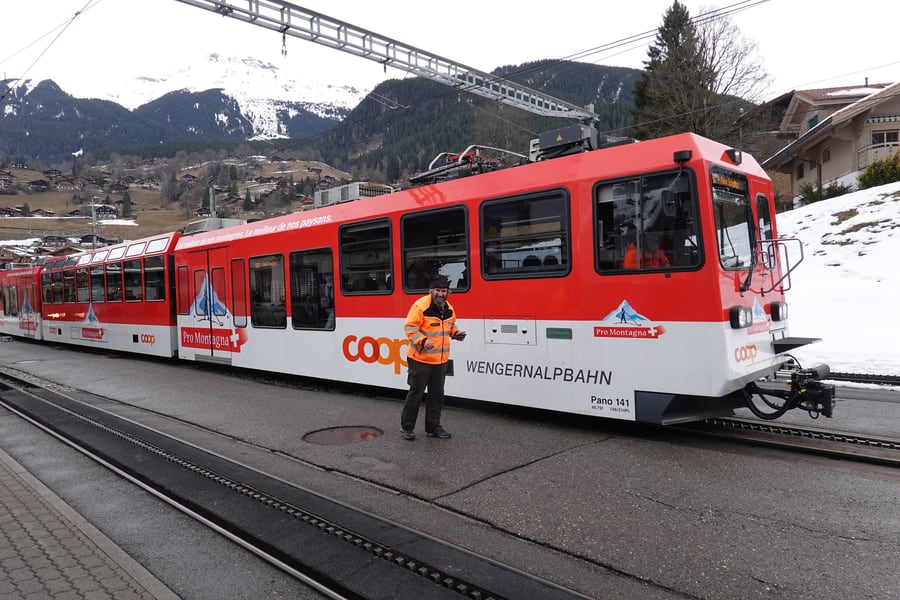
The service is worked by three generations at once. The Bhe 4/8 "Pano" sets — ten of them, built by Stadler in 2004 and 2014–15, 152 seats, low-floor, 28 km/h on the mountain — are the front line; number 141 wears an all-over red advertising livery and is the odd one out on a green-and-yellow railway. Behind them come the BDhe 4/8 double railcars of 1988 and the BDhe 4/4 single cars of 1951 to 1964, which still turn out in the old cream-and-green and still work the goods trains. Since December 2023 a Wengen Shuttle runs on busy days between Lauterbrunnen and Wengen, worked by three He(m) 4/4 locomotives Stadler delivered in 2023 with articulated driving trailers.
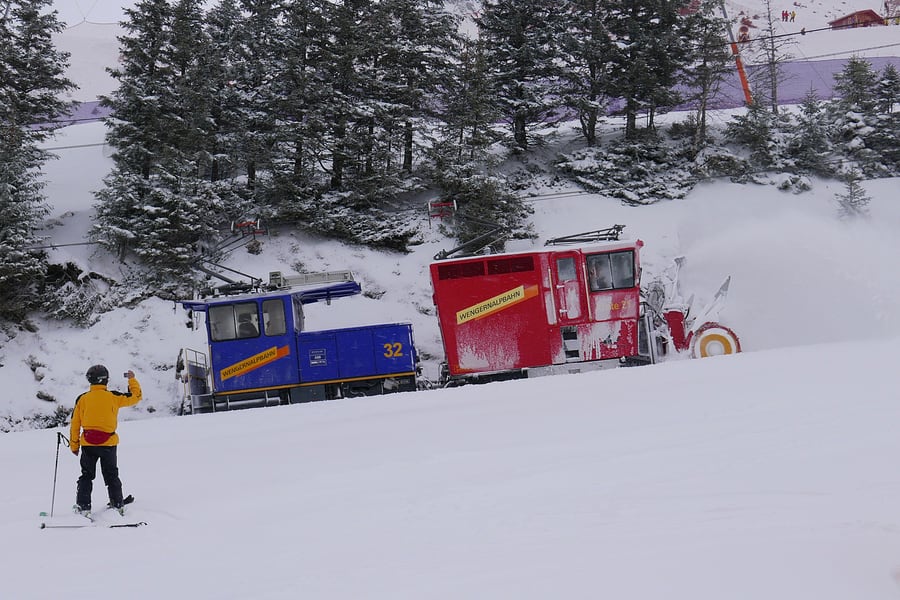
Shunting and goods are the business of the blue He 2/2 locomotives of 1995, and the snow is the business of the red Xrote 21 rotary plough they push in front of them. Two He 2/2 electric locomotives built in 1909 are still on the company's rolling-stock register. The passenger fleet lost its first-class compartments in the reclassification of 1982, and the whole line has been second class ever since.
Along the route
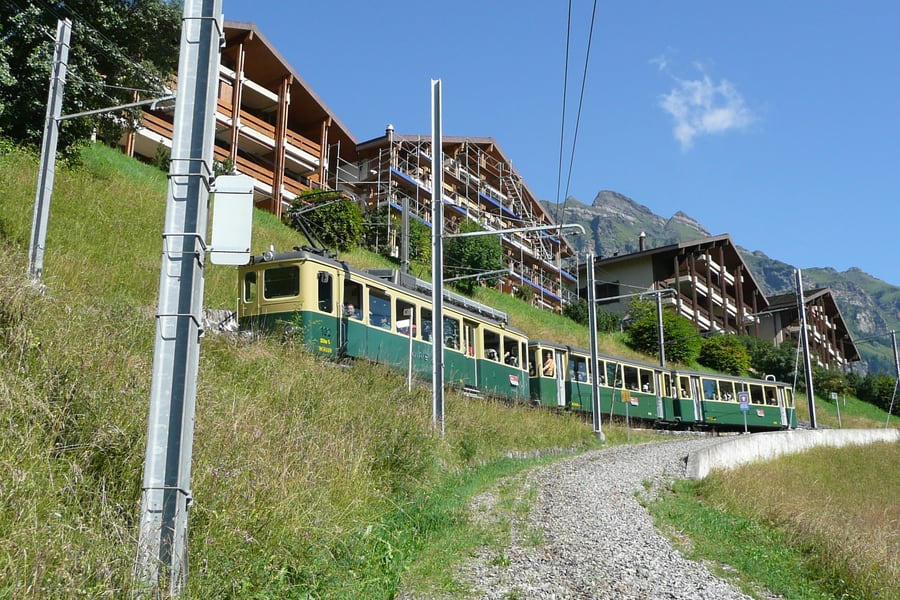 Rahimsa Images / Wikimedia Commons · public domain · August 2009, both alignments in one frame · cropped
The line that was taken back off the mountain
The 1893 route out of Lauterbrunnen climbed at 250 ‰ across ground that caught rock and ice, and shut every winter until 1909. A gentler line replaced it in 1910; the old one carried goods until 2007, and in 2009 the rails were lifted.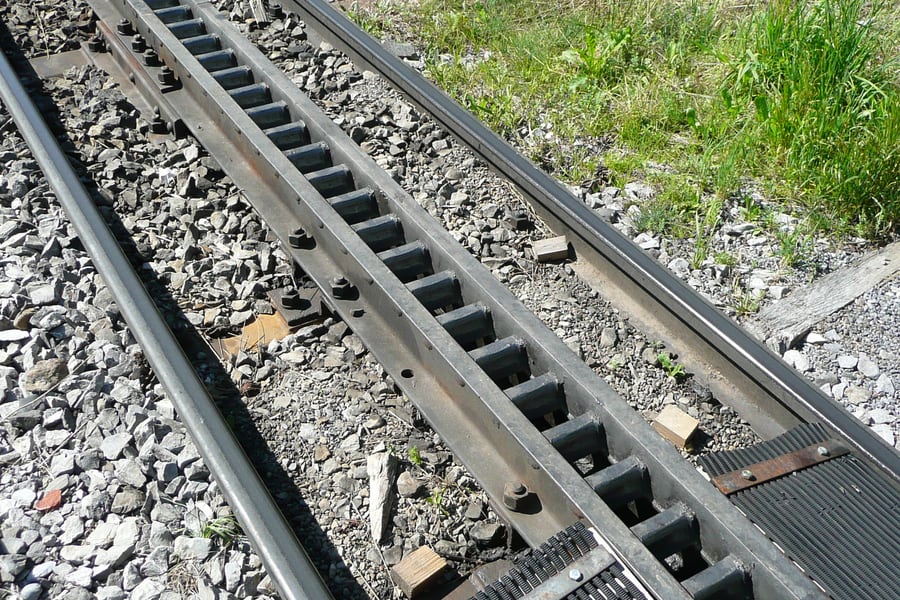 Rahimsa Images / Wikimedia Commons · public domain · cropped
Rack for all 19.11 kilometres
There is no adhesion section anywhere on this railway. The rack runs from buffer stop to buffer stop, which makes it the longest continuous rack railway in the world — a record it holds because it crosses a pass rather than stopping at a summit.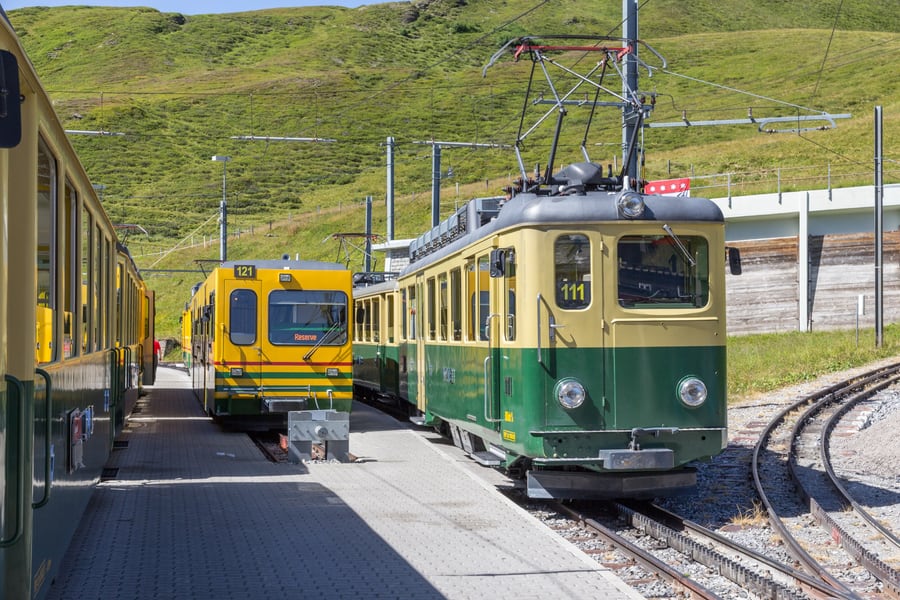 JoachimKohlerBremen / Wikimedia Commons · CC BY-SA 4.0 · cropped
Why everybody changes at the top
The drives are asymmetric — pinion on the downhill side, brakes working one way, seats raked to match — so every vehicle has a permanent mountain end. A train up from Lauterbrunnen faces the wrong way to go down to Grindelwald.A bit of history
Culture & experiences along the way
 Smiley.toerist / Wikimedia Commons · CC BY-SA 4.0 · 2026 · cropped
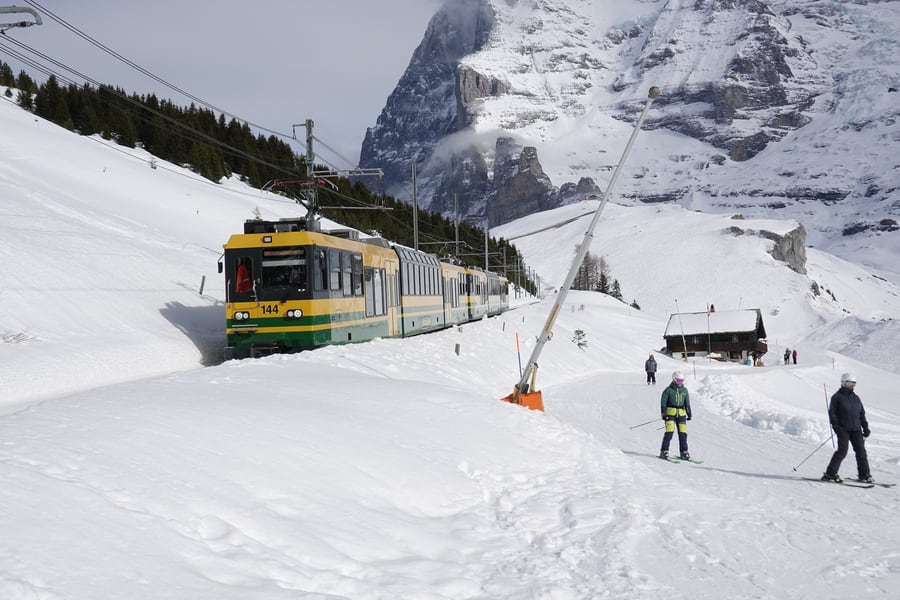
The Lauberhorn, from the mid-course hill
The World Cup's longest downhill runs beside the railway below Wengernalp every January, and passes under the track through a nine-metre tunnel — the only place on the circuit where a course goes uphill afterwards.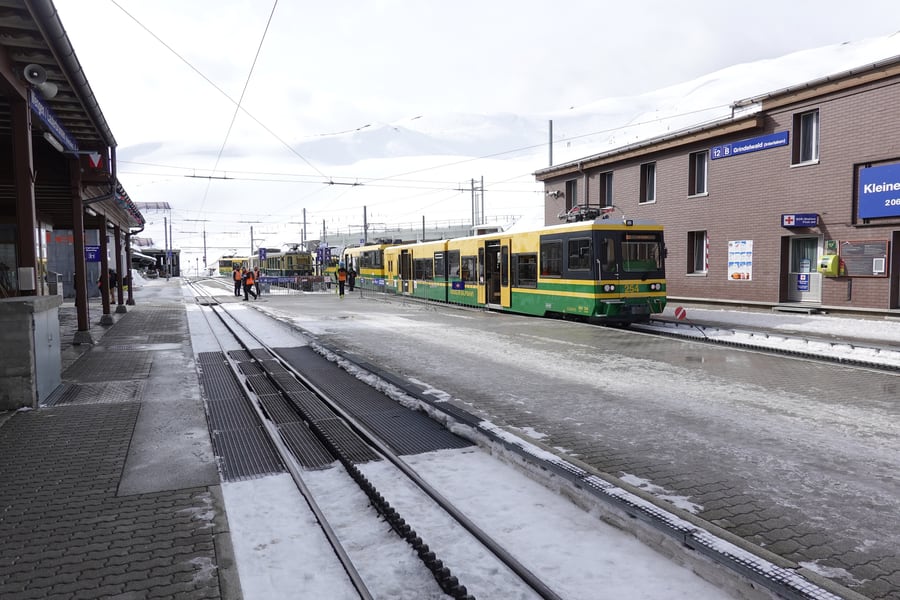 Smiley.toerist / Wikimedia Commons · CC BY-SA 4.0 · 2026 · cropped
On to the Jungfraujoch
The Jungfraubahn starts from the far platform at Kleine Scheidegg and tunnels through the Eiger to Europe's highest railway station at 3,454 metres. A seat reservation is CHF 10 and compulsory from May to October.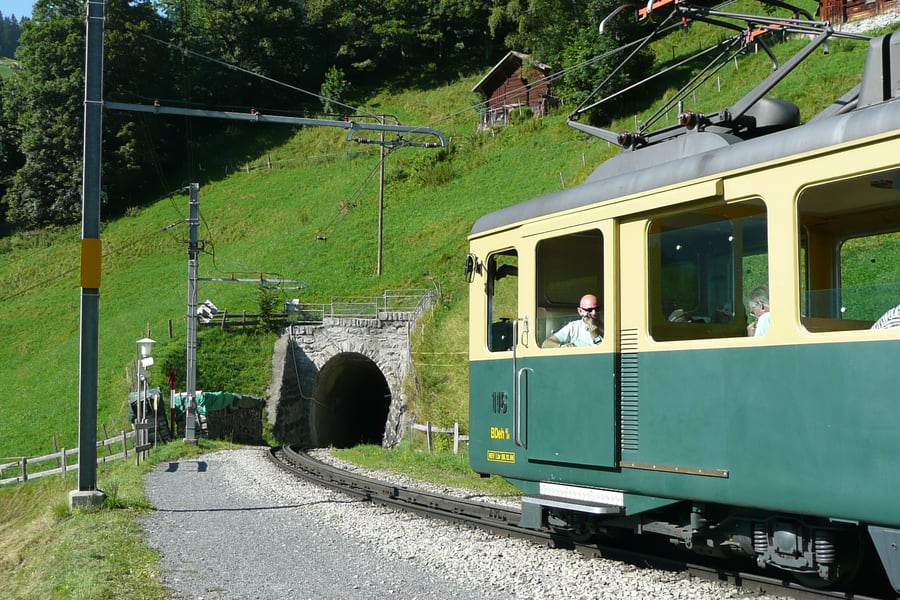 Rahimsa Images / Wikimedia Commons · public domain · cropped
The spiral tunnel below Wengwald
The 1910 deviation turns a complete half-circle inside 248 metres of tunnel to gain height gently where the first line went straight up. It is the best evidence on the ground of why the original route was abandoned.Timetables
The Wengernalpbahn runs every day of the year, half-hourly on both arms, and a passenger going right across the pass changes trains at Kleine Scheidegg.
Times below are the Swiss national timetable for timetable year 2026 — tables 311 and 312, valid 14 December 2025 to 12 December 2026 — checked against the operator in August 2026. The core pattern is clock-face and holds all year; individual trains at the edges of the day carry seasonal footnotes.
Lauterbrunnen → Wengen → Kleine Scheidegg
Through trains leave Lauterbrunnen at :00 and :30, take 38 minutes to Kleine Scheidegg, and stand about five minutes at Wengen on the way. The first one to cross to the pass is the 07:30, and the last is the 18:00.
| Lauterbrunnen | Wengwald | Wengen | Allmend | Wengernalp | Kleine Scheidegg |
|---|---|---|---|---|---|
| 07:30 | 07:37 | 07:41 / 07:46 | 07:51 | 08:00 | 08:08 |
| 08:00 | 08:07 | 08:11 / 08:16 | 08:21 | 08:30 | 08:38 |
| 08:30 | 08:37 | 08:41 / 08:46 | 08:51 | 09:00 | 09:08 |
| …every 30 minutes… | |||||
| 17:30 | 17:37 | 17:41 / 17:46 | 17:51 | 18:00 | 18:08 |
| 18:00 | 18:07 | 18:11 / 18:16 | 18:21 | 18:30 | 18:38 |
Kleine Scheidegg → Wengen → Lauterbrunnen
Down trains leave Kleine Scheidegg at :14 and :44 and take 41 minutes, the descent being the slower direction because a rack train comes down under brake. The first is the 08:14 and the last the 18:44.
| Kleine Scheidegg | Wengernalp | Allmend | Wengen | Wengwald | Lauterbrunnen |
|---|---|---|---|---|---|
| 08:14 | 08:22 | 08:30 | 08:38 / 08:41 | 08:43 | 08:55 |
| 08:44 | 08:52 | 09:00 | 09:08 / 09:11 | 09:13 | 09:25 |
| 09:14 | 09:22 | 09:30 | 09:38 / 09:41 | 09:43 | 09:55 |
| …every 30 minutes… | |||||
| 18:14 | 18:22 | 18:30 | 18:38 / 18:41 | 18:43 | 18:55 |
| 18:44 | 18:52 | 19:00 | 19:08 / 19:11 | 19:13 | 19:25 |
Grindelwald → Kleine Scheidegg, and back
The Grindelwald arm is also half-hourly. Trains leave Grindelwald at :15 and :45, call at Grindelwald Grund five minutes later, and reach Kleine Scheidegg 32 minutes after leaving Grindelwald — 24 minutes from Grund. The first departure is the 07:45 and the last the 19:15.
| Grindelwald | Grindelwald Grund | Brandegg | Alpiglen | Kleine Scheidegg |
|---|---|---|---|---|
| 07:45 | 07:50 / 07:53 | 08:00 | 08:05 | 08:17 |
| 08:15 | 08:20 / 08:23 | 08:30 | 08:35 | 08:47 |
| 08:45 | 08:50 / 08:53 | 09:00 | 09:05 | 09:17 |
| …every 30 minutes… | ||||
| 18:45 | 18:50 / 18:53 | 19:00 | 19:05 | 19:17 |
| 19:15 | 19:20 / 19:23 | 19:30 | 19:35 | 19:47 |
Coming back, trains leave Kleine Scheidegg at :01 and :31, reach Grindelwald Grund 32 minutes later and Grindelwald station at :40 and :10 — 39 minutes in all. The first is the 08:31 and the last the 18:31. Later in the evening a further set of trains works down from Alpiglen rather than from the pass, the last of them at 23:00, and several of these carry the timetable's note that they run only in good snow and weather.
The Wengen Shuttle, and the night service
Wengen has no road, so its train service is not a tourist timetable. On top of the through trains, extra shuttles run Lauterbrunnen to Wengen at :19 and :49 on busy days, taking 13 minutes, and back down at :11 and :41, taking 13 minutes. The shuttle has run since December 2023 and is worked by the He(m) 4/4 locomotives and articulated driving trailers Stadler delivered that year.
The village service starts long before and ends long after the mountain one. The first train up from Lauterbrunnen is at 04:48 and the last at 02:40; the first down from Wengen is at 05:04 and the last at 01:26.
Connections
From Interlaken Ost, the Berner Oberland-Bahn runs half-hourly and splits at Zweilütschinen — one portion to Lauterbrunnen, the other to Grindelwald. Lauterbrunnen is about 22 minutes from Interlaken Ost and Grindelwald about 38, in both cases without changing.
At Kleine Scheidegg, the Jungfraubahn leaves for Eigergletscher and the Jungfraujoch several times an hour, and the timetable is built so that a Wengernalpbahn arrival meets it.
Bicycles are refused on a good many of these trains — the timetable marks them individually — and self-loading at Wengen is possible only from 15:45.
Current times and any disruption notices are at jungfrau.ch (opens in a new tab).
Tickets
There are two quite different railways here as far as the tariff is concerned, and the boundary is Wengen. Lauterbrunnen to Wengen is ordinary Swiss public transport — subsidised, inside the national fare system, and CHF 7.20 for twelve minutes of rack railway, because it is priced for the people who live at the top of it. Everything above Wengen, and the whole Grindelwald side, is the Jungfraubahnen house tariff: CHF 46.00 to Kleine Scheidegg, CHF 84.40 right across the pass to Grindelwald. There is one class, so there is nothing to upgrade to.
A ticket over the pass is issued via Wengen or via Grindelwald Terminal, so it is equally valid by the Eiger Express gondola. It lasts until 5 a.m. the next morning, which covers a late descent. No reservation is needed or sold for the Wengernalpbahn; the Jungfraubahn above Kleine Scheidegg is a different matter. Fares read off the SBB checkout in August 2026.
Book your tickets
Lauterbrunnen – Kleine Scheidegg
CHF 46.00 full fare · CHF 23.00 with a Half-Fare Card · 25% off with a Swiss Travel Pass or Interrail
Thirty-eight minutes and 1,264 metres of climb, with a five-minute stand at Wengen on the way.
Book Tickets (opens in a new tab, on Jungfraubahnen)via JungfraubahnenLauterbrunnen – Grindelwald over the pass
CHF 84.40 full fare · CHF 42.20 with a Half-Fare Card
The whole railway end to end, about an hour and forty minutes including the change at Kleine Scheidegg. The same ticket is valid by the Eiger Express gondola on the Grindelwald side, for anyone who wants to come back a different way.
Book Tickets (opens in a new tab, on Jungfraubahnen)via JungfraubahnenLauterbrunnen – Wengen
CHF 7.20 full fare · CHF 3.60 with a Half-Fare Card · free with a Swiss Travel Pass or GA
Twelve minutes to a village with no road. This section is subsidised public transport inside the national fare network, which is why it costs what a bus ride costs.
Book Tickets (opens in a new tab, on Jungfraubahnen)via Jungfraubahnen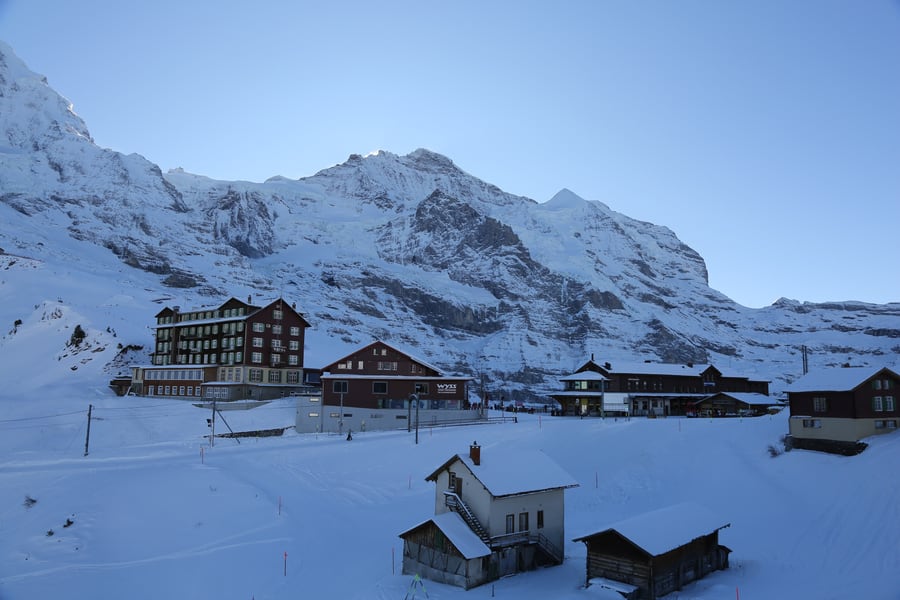
Jungfrau Travel Pass
3 to 8 days · the whole Wengernalpbahn included, with no percentage attached
Unlimited travel on the Wengernalpbahn, the Berner Oberland-Bahn, Schynige Platte, Harder Kulm, Grindelwald-First, Lauterbrunnen–Mürren, both Männlichen cableways, the Eiger Express, the Grindelwald buses and the Thun and Brienz lake steamers. The Jungfraujoch is extra, at a connecting fare.
Compare Passes (opens in a new tab, on Jungfraubahnen)via JungfraubahnenRail Passes
Every rail pass that works in Switzerland stops at Wengen. This is the most useful thing to know before buying one for this journey, and no pass page says it plainly.
The reason is the subsidy. Lauterbrunnen to Wengen is publicly supported public transport for a village with no road, so it sits inside the national fare network and the national passes cover it in full. Above Wengen, and on the whole Grindelwald arm, the Jungfraubahnen charge their own tariff, and the passes drop to a percentage.
Swiss Travel Pass
Lauterbrunnen – Wengen: free travel. Wengen – Kleine Scheidegg and Grindelwald – Kleine Scheidegg: 25 % off. That is the 2026 area-of-validity map published by SBB and the Swiss Travel System, where those two sections carry the footnote marking a 25 % reduction rather than sitting inside the free network. The same footnote covers Kleine Scheidegg–Jungfraujoch and Grindelwald Terminal–Eigergletscher.
A GA Travelcard behaves the same way. The Swiss Half Fare Card does something different and, for this line, better: it halves the whole ticket, house tariff included, so Lauterbrunnen to Kleine Scheidegg comes to CHF 23.00 rather than CHF 46.00 — a bigger cut than a quarter off the mountain section.
Interrail and Eurail
The same split, confirmed independently. The Interrail operator list for Switzerland names "WAB Wengernalpbahn: Lauterbrunnen–Wengen" among the lines a pass covers outright, and its Bonuses table then gives Jungfrau Region Railways (JB, WAB, LWM) 25 % — the Wengernalpbahn above Wengen, the Jungfraubahn, and the Wengen–Männlichen cableway. The Schynige Platte railway, the Harder funicular, Grindelwald-First and the Grindelwald–Männlichen gondola are in the 50 % group instead.
⚠️ An Interrail One Country Pass for Switzerland cannot be used to travel into or out of Switzerland, which matters if the plan is to arrive from Italy or France.
Jungfrau Travel Pass
This is the regional pass, and it is the one that actually covers the whole railway. It gives unlimited travel on Lauterbrunnen – Kleine Scheidegg – Grindelwald with no percentages attached, plus the Berner Oberland-Bahn, the Schynige Platte railway, Harder Kulm, Grindelwald-First, the Lauterbrunnen–Mürren line, both Männlichen cableways, the Eiger Express, the local Grindelwald buses and the lake steamers on Thun and Brienz.
| Days | Adult | Reduced | Children 6–15 |
|---|---|---|---|
| 3 | CHF 210 | CHF 165 | CHF 30 |
| 4 | CHF 235 | CHF 180 | CHF 30 |
| 5 | CHF 270 | CHF 210 | CHF 30 |
| 6 | CHF 290 | CHF 225 | CHF 30 |
| 7 | CHF 310 | CHF 240 | CHF 30 |
| 8 | CHF 330 | CHF 255 | CHF 30 |
Prices from jungfrau.ch, August 2026. The Jungfraujoch is not included but comes at a connecting fare of CHF 63, or CHF 89 between 1 May and 31 October 2026 with the compulsory seat reservation built in. An extension day costs CHF 45, or CHF 35 reduced, and children go free.
Is a pass worth it here?
For this journey alone, no. Riding right across the pass is CHF 84.40, and the cheapest Jungfrau Travel Pass is CHF 210. A Swiss Travel Pass saves 25 % on the expensive part and nothing on the cheap part.
For three or four days in the Jungfrau region, the Jungfrau Travel Pass is the one that pays, and it pays quickly: the Wengernalpbahn across the pass, one Jungfraujoch connecting ticket, a Schynige Platte return and a Grindelwald-First ride together exceed the three-day price. For a longer Swiss trip that happens to include this railway, a Swiss Travel Pass or a Half Fare Card is still worth having — just not because of the Wengernalpbahn.
Places to Visit
The Wengernalpbahn calls at five places worth getting off at, and four of the five cannot be reached by car at all. What follows takes them in order from Lauterbrunnen over the pass to the Eiger side.
 chensiyuan / Wikimedia Commons · CC BY-SA 4.0 · cropped
Lauterbrunnen
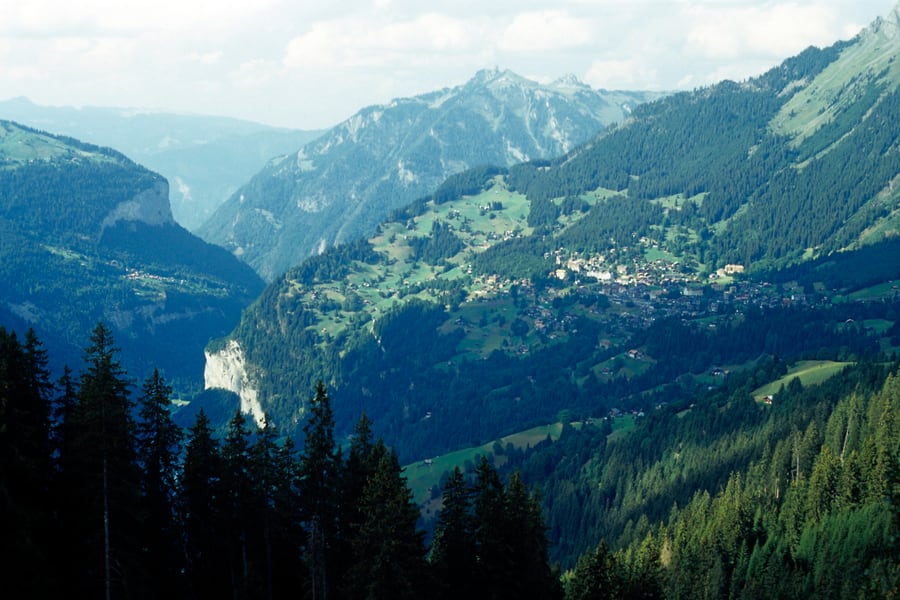
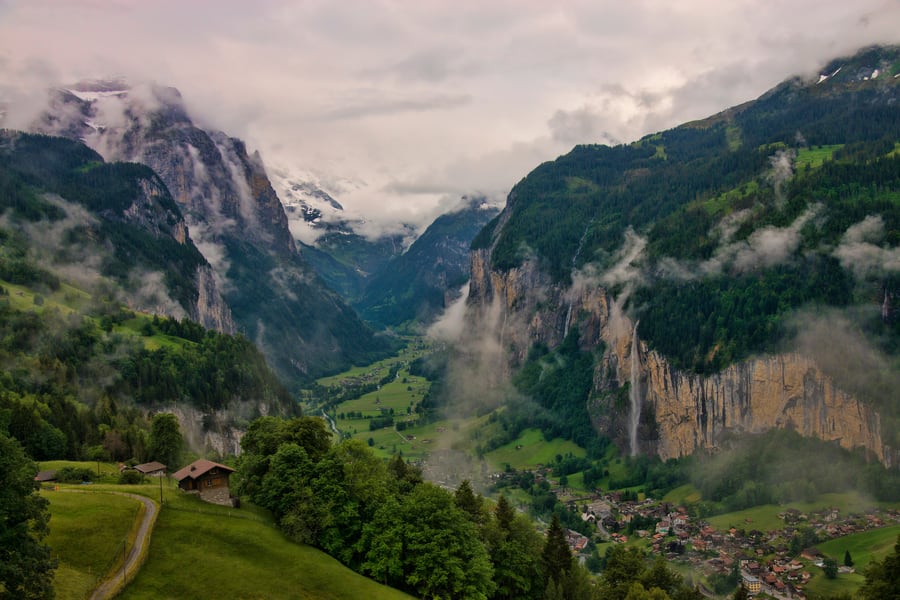
A village on the floor of a glacial trench with vertical cliffs on both sides and waterfalls coming off them wherever a stream reaches the edge. The Staubbach drops 297 metres in one fall behind the houses; Goethe stood under it in 1779 and wrote the Gesang der Geister über den Wassern there, and the valley is the one Tolkien had in mind for Rivendell. Three railways use the station — the Berner Oberland-Bahn from Interlaken, the Wengernalpbahn, and the funicular to Grütschalp for Mürren.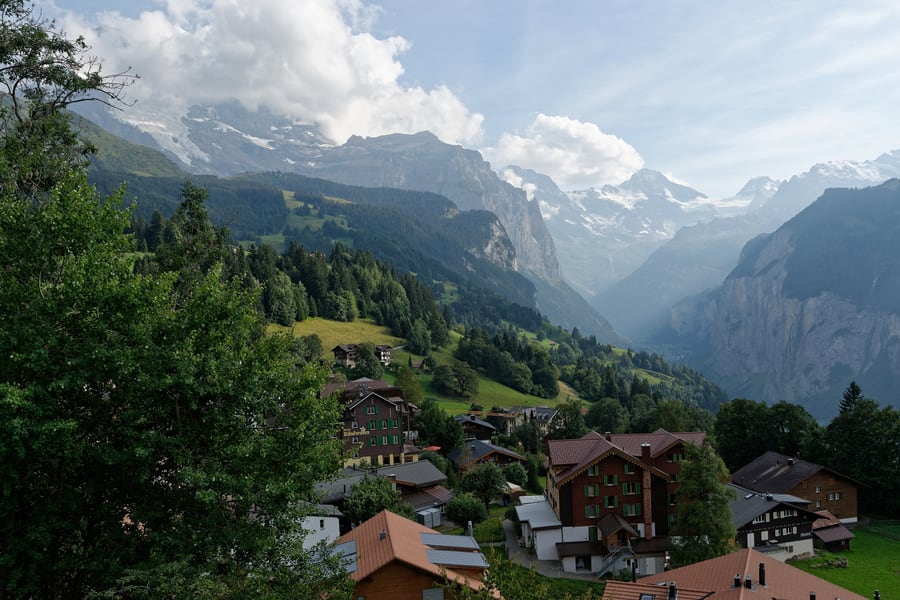 Marie-Lan Nguyen / Wikimedia Commons · CC BY 4.0 · cropped
Wengen
About thirteen hundred people live on this terrace four hundred metres above the valley floor, and more than ten thousand are here at the height of winter. There is a street network but it joins nothing outside the village: the few vehicles on it came up by train, and so does everything else. The first guesthouse opened at Innerwengen in 1859. The Lauberhorn races have run here every January since 1930, and a cableway climbs from the village to the Männlichen ridge.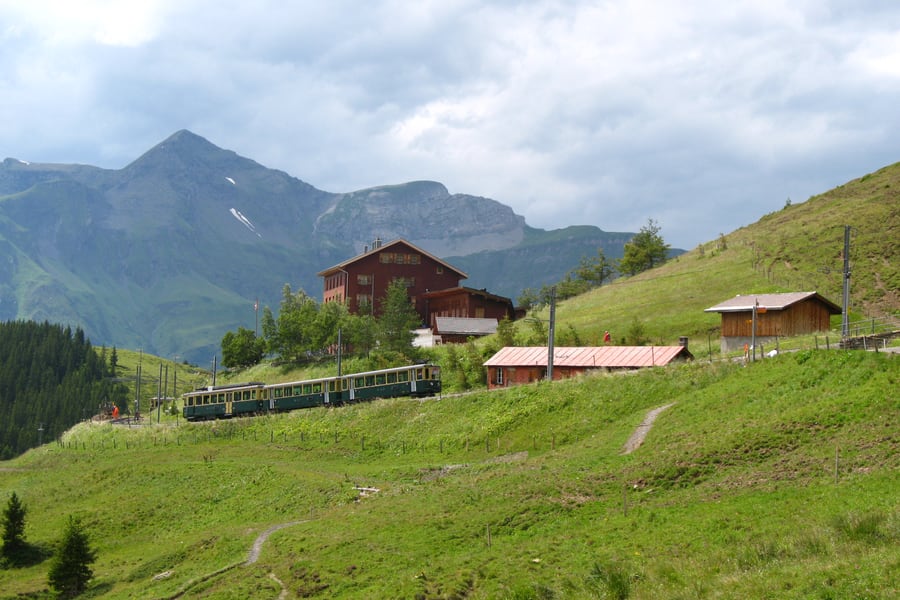 Andrew Bossi / Wikimedia Commons · CC BY-SA 2.5 · cropped
Wengernalp
An open shelf of pasture with a station, a hotel and almost nothing else, facing the north walls of the Eiger, the Mönch and the Jungfrau across the Trümmelbach valley. It appears in a traveller's account as early as 1760, and by the nineteenth century it was drawing painters, poets and composers — Calame, Hodler, Byron, Mark Twain, Tchaikovsky and Wagner among them. The railway is named after this alp rather than after either town it joins.Paradise Chronicle / Wikimedia Commons · CC BY-SA 4.0 · croppedKleine Scheidegg
Not a village: two hotels, some restaurant terraces, a group of platforms and a lot of weather, in the saddle between the Lauberhorn and the Eiger. A wrestling champion called Christian Seiler put a guesthouse here in 1840, half a century before there was a railway. Today the Wengernalpbahn arrives from both valleys and the Jungfraubahn leaves for the tunnel through the Eiger, and nearly everyone on the platform is changing trains. No road reaches it in summer or winter.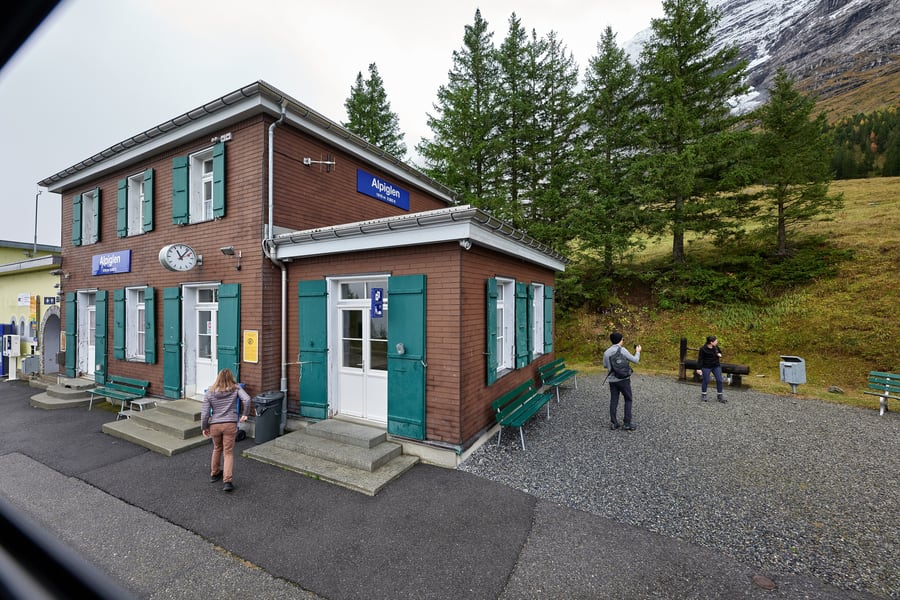 Leonhard Lenz / Wikimedia Commons · CC0 · cropped
Alpiglen
A station, a mountain restaurant and a few farm buildings on the Grindelwald side, directly beneath the Eiger's north wall — close enough that a pair of binoculars will pick out a rope party on it. The Eiger Trail comes down here from Eigergletscher along the foot of the face, which is the reason most people get off. Below Alpiglen the line reaches its steepest, 250 ‰ down to Grindelwald Grund, and above it runs the three avalanche galleries.Where to Sleep
Three of the places to stay on this line are reached only by the railway, which changes what staying means. Luggage goes up on the train, deliveries go up on the train, and after the last mountain service there is no other way down.
The houses below are the ones on the railway itself, at Wengen, at Wengernalp and on the pass. The two above Wengen shut between seasons altogether, so their published dates matter more than usual — and the one on the pass is closed for the whole of the 2026 summer while its roof is rebuilt.
Where to stay
Hotel Falken
In Wengen since 1895, in one family the whole time
Built in 1895 above the village with the Jungfrau in front of it and the Lauterbrunnen valley below, thirty-seven rooms, and run by the von Allmen–Cova family from that year to this — today by Sina Cova with her daughters Jessica and Vanessa. Andrea Cova, who ran it with his mother for many years, was the mover behind the listing of the Jungfrau–Aletsch–Bietschhorn area as a UNESCO World Heritage site. The hotel's own account of the village is blunt: the rack railway has been there since 1893 and is still the only connection to the valley.
Check Availability (opens in a new tab, on hotelfalken.com)via hotelfalken.comHotel Jungfrau Wengernalp
Twenty-four rooms on the alp, facing three north walls
A nineteenth-century mountain inn standing alone on the Wengernalp at about 1,900 metres, directly opposite the Eiger, Mönch and Jungfrau, family-run by Urs and Patricia von Almen. Twenty-four double rooms, a bar, a salon, a sauna, open fireplaces and a sun terrace, and no way to reach any of it except the train. The seasons are short and published: 4 June to 13 September 2026, then 19 December 2026 to the end of March 2027.
Check Availability (opens in a new tab, on wengernalp.ch)via wengernalp.ch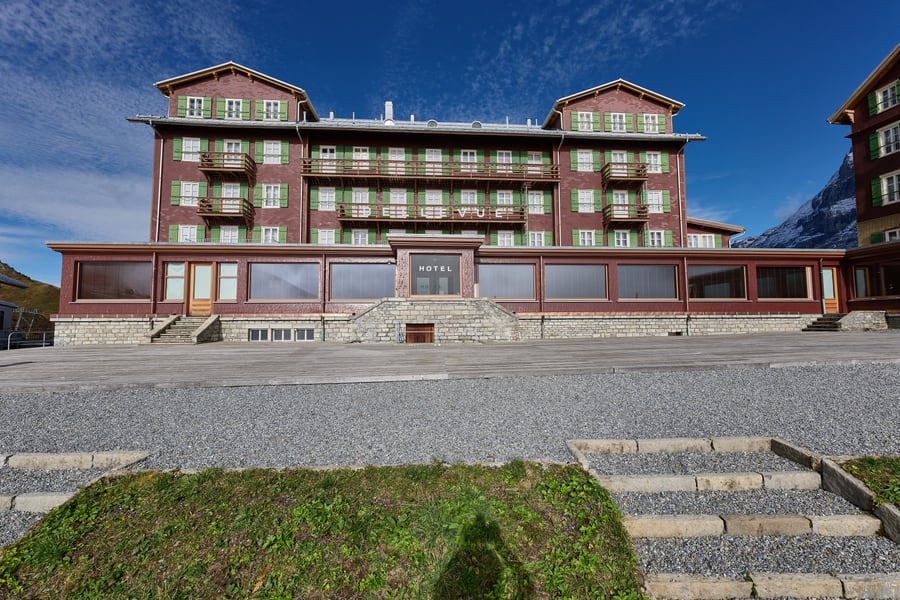 Leonhard Lenz / Wikimedia Commons · CC0 · cropped
Hotel Bellevue des Alpes
On the pass itself — closed for the 2026 summer, reopening 18 December 2026
One of the few nineteenth-century grand hotels still working as one, standing on Kleine Scheidegg at the foot of the Eiger with ninety beds and a 120-seat day restaurant attached, and still run as a family business. ICOMOS made it Swiss Historic Hotel of the year in 2011. It is reached only by the Wengernalpbahn, summer and winter alike. The whole 2026 summer season is cancelled for a full renovation of the roof; the house reopens for the winter on 18 December 2026, and it takes bookings through its own reception rather than any platform.
Check Availability (opens in a new tab, on scheidegg-hotels.ch)via scheidegg-hotels.chQuestions or corrections
Planning this trip and stuck on something, or spotted a time, fare or detail that has changed? Send us a message about Wengernalpbahn. We read every one, and we update this page when something has changed.