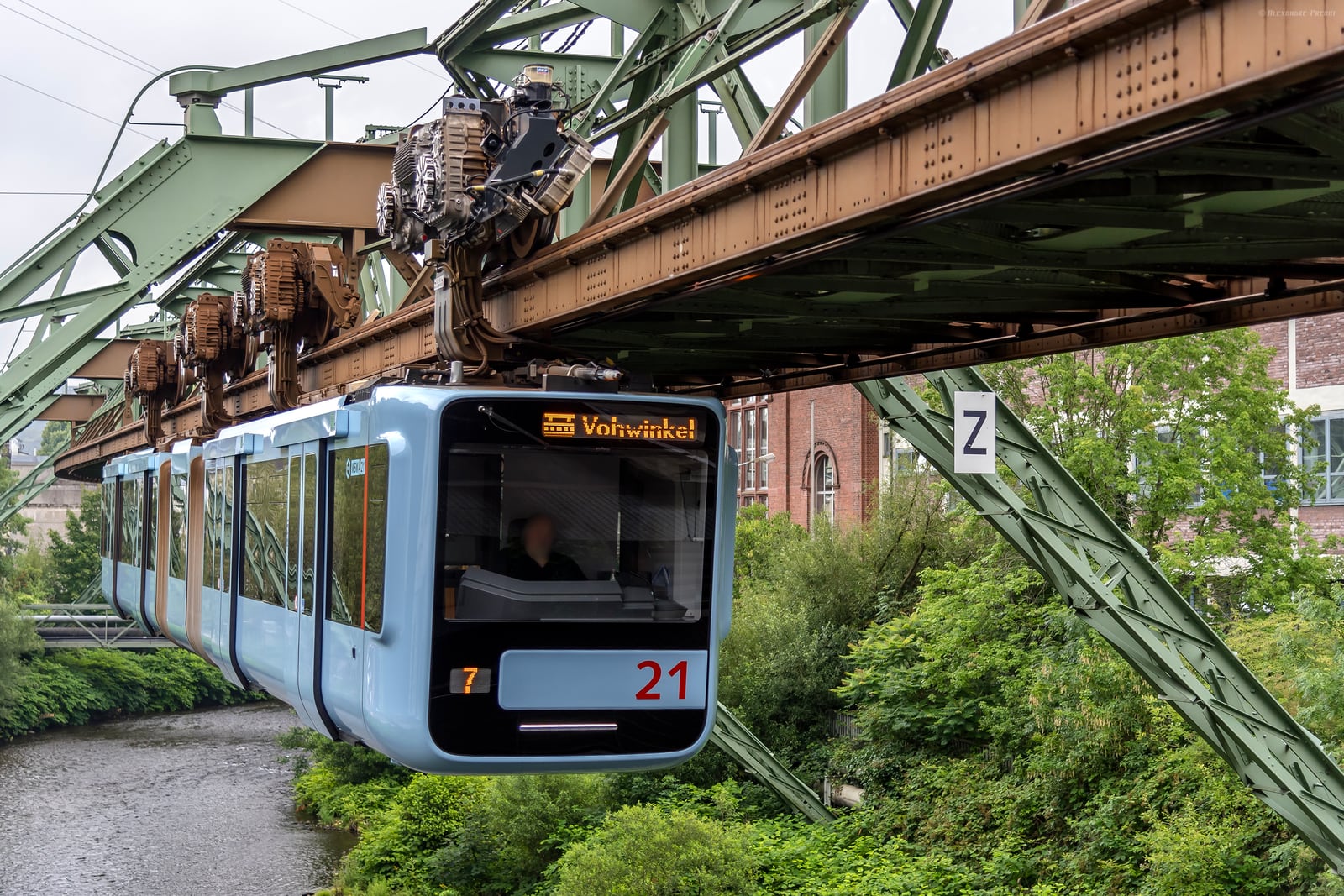
The Wuppertal Schwebebahn
Qwertzu111111 / Wikimedia Commons · CC BY-SA 4.0 · cropped
- Distance13.3 km (Vohwinkel–Oberbarmen)
- Duration29–30 minutes end to end
- Best seasonYear-round · 2026 is the 125th-anniversary year
Introduction
The Wuppertal Schwebebahn turned 125 on 1 March 2026. Almost none of it is 125 years old.
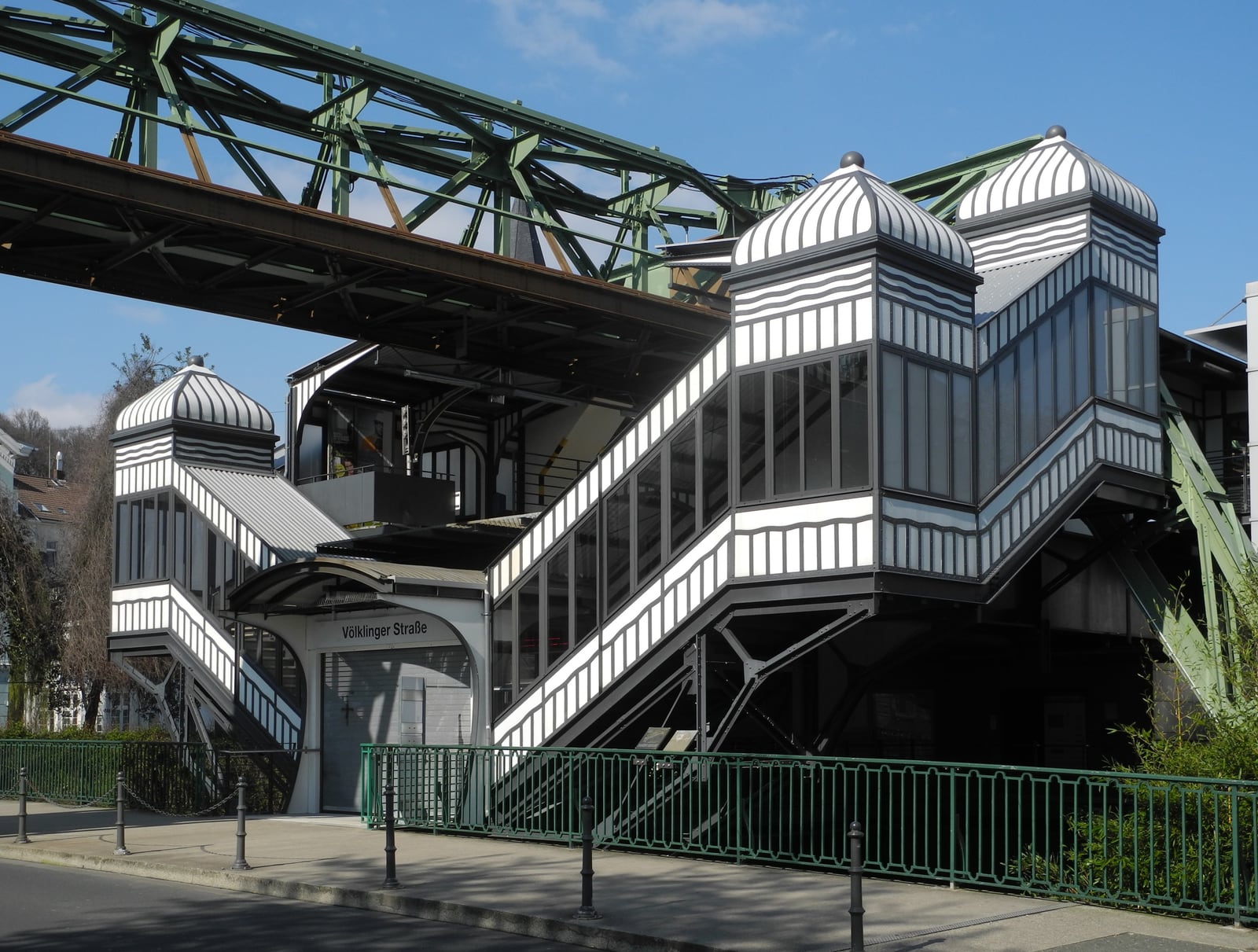
That is not a complaint. It is the reason the thing still runs. Thirteen kilometres of blue-and-white carriages hang from a green steel lattice above the river Wupper and, for the last three kilometres, above the middle of a shopping street — and the whole of that lattice was taken down and rebuilt between 1995 and 2014, one support and one span at a time, weekend after weekend, without ever closing the line for longer than six weeks at a stretch. Around 40,000 tonnes of new steel went up, roughly twice the weight of the original, riveted rather than welded so that it would look exactly like what it replaced. It looks so exactly like it that architecture critics called the result a Disney railway, and the Schwebebahn lost most of its status as a protected monument in the process.
So this is not a heritage ride. It is Wuppertal's main road. In 2023 it carried 57,260 people on an average calendar day, more than four times the city's busiest bus route, and in 2025 it was available 99 per cent of the time — one of the most reliable urban railways in Germany. School children get on at Werther Brücke. Somebody's shopping is on the seat opposite. The tourists are the ones facing backwards with their phones up, and there are a lot of them.
What you ride is a 1901 idea executed in 21st-century steel: Eugen Langen's Einschienige Hängebahn, a single rail carried overhead so that the vehicle swings free beneath it, taking almost no ground from a valley that had none to give. Nobody else has ever built a full-size urban one. The renewal has not stopped either — stations are being rebuilt on a programme that runs to the end of 2031, and the very last original piece of 1901 infrastructure, the car shed at Vohwinkel, is due to be replaced from 2032, in a shutdown planned to last fifteen to eighteen months.
Which means the oldest thing about the Wuppertal Schwebebahn is the idea. Everything else has been renewed at least once, and that is what a working railway looks like at 125.
The Journey
Thirteen point three kilometres, twenty stations, twenty-eight to thirty minutes end to end. The line is a single diameter across a city built along the bottom of a narrow valley, which is why it works: Wuppertal is a ribbon, and the Schwebebahn is the ribbon's spine.
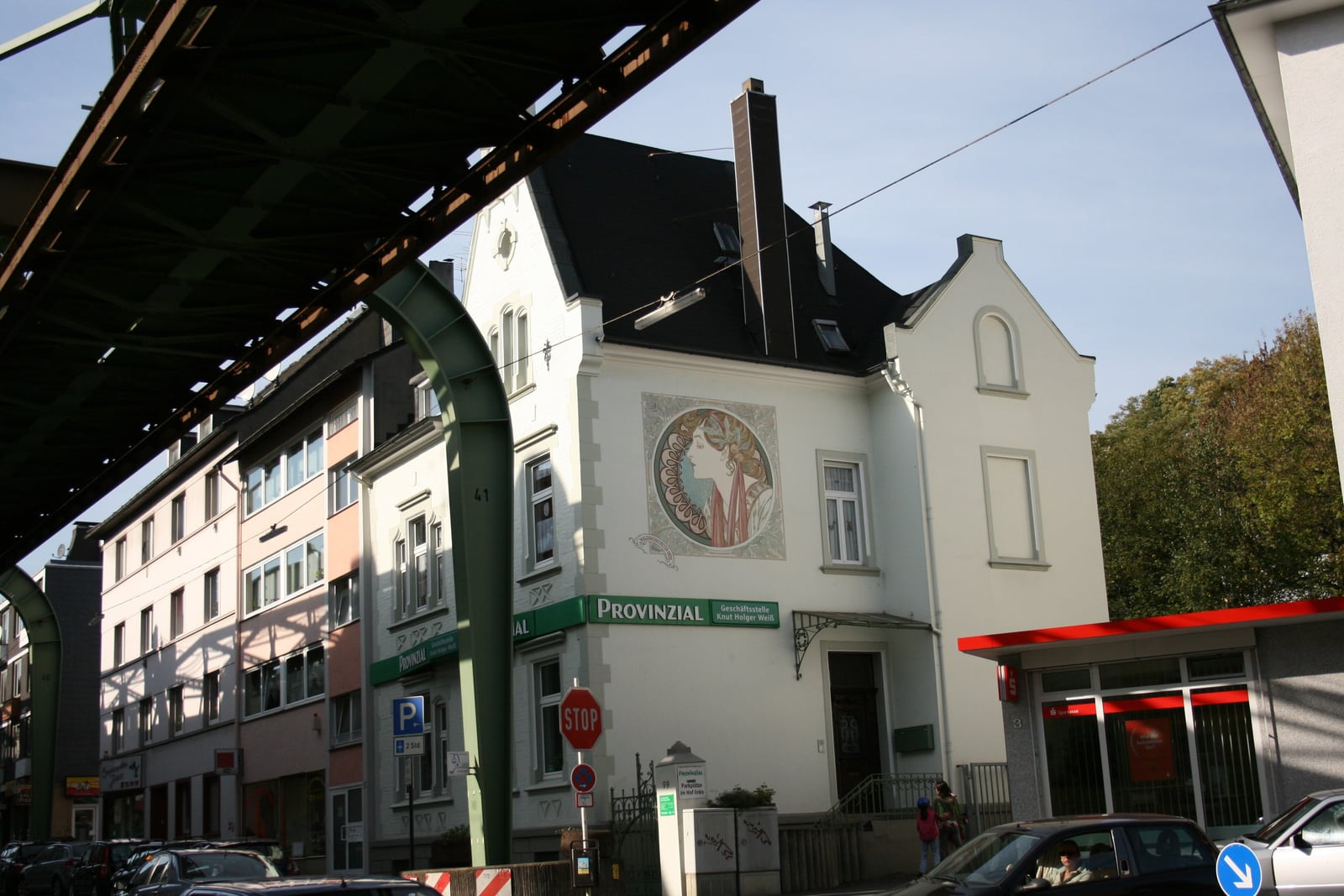
It divides into two unequal halves that feel completely different, and locals have names for both. The first 2.7 kilometres out of Vohwinkel are the Landstrecke — the land section, or in the Wuppertal joke, the Gardinenstangenstrecke, the curtain-rail stretch. Here the railway is not over water at all. It runs down the middle of Vohwinkeler Straße, Kaiserstraße, Eugen-Langen-Straße and Sonnborner Straße at about eight metres above the road, on portal supports planted between the traffic lanes, with first-floor windows on either side at eye level. Leaving Vohwinkel the track has to swing round the old imperial post office at Vohwinkeler Straße 14 on a 30-metre radius — the tightest curve on the line, and one you feel.
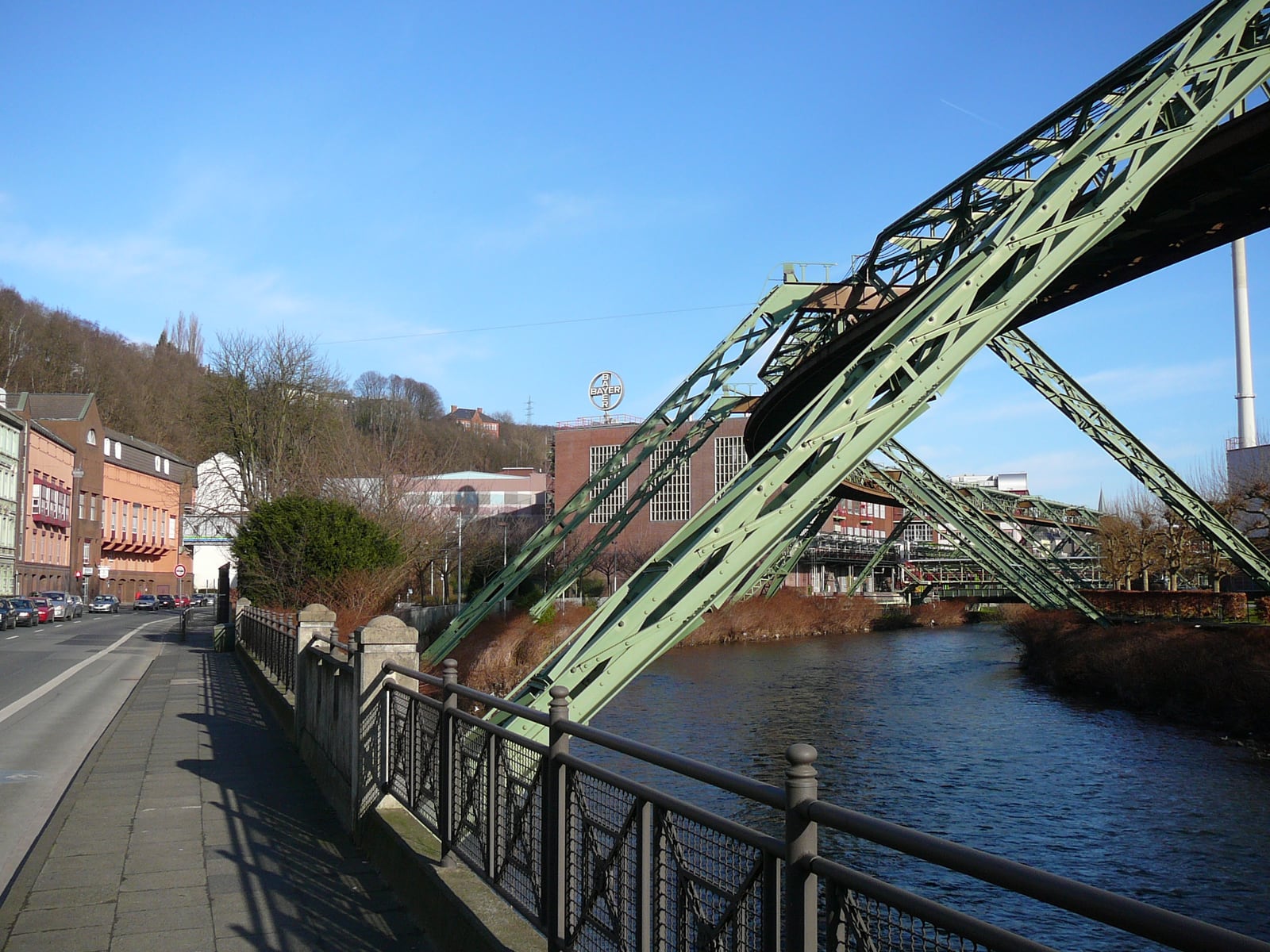
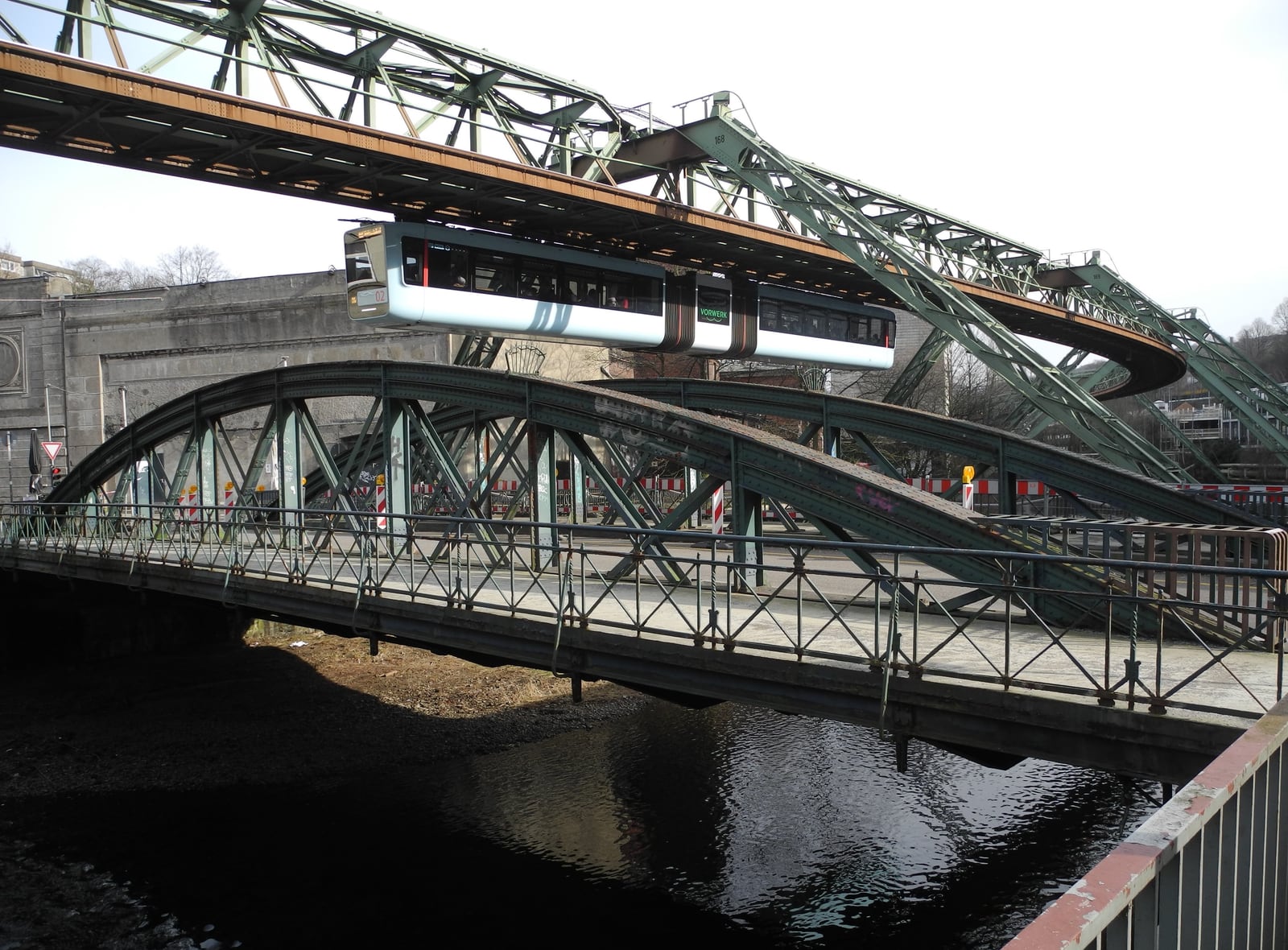
At the Hauptkirche in Sonnborn the line crosses the B228 and drops onto the water. From there the remaining 10.5 kilometres are the Wasserstrecke, following the Wupper upstream at twelve to fourteen metres above the normal river level, the height fixed in 1898 by the river's flood line and the clearance needed over the road bridges. The lowest point on the whole railway is here, at the Sonnborner Kreuz motorway interchange, 132 metres above sea level; the highest is the terminus you just left, at 179.97.
What to look for, west to east
Just after Sonnborn the line passes under the Sonnborner Eisenbahnbrücke, where the Düsseldorf–Elberfeld main line crosses overhead. It is the only structure in the city that goes over the Schwebebahn rather than under it. A moment later comes Zoo/Stadion, and then a stretch that surprises most first-timers: 1.3 kilometres straight through the Bayer works, chemical plant on both sides of the glass, between the railway bridge and Westende station.
Elberfeld is the middle third and the busy one — Robert-Daum-Platz, Ohligsmühle with the Historische Stadthalle directly above the platform, Wuppertal Hauptbahnhof, Kluse. Between Kluse and Landgericht the valley pinches into the Klusebogen, the one place where the river, the Schwebebahn and the main-line railway all run within a few metres of each other. Then Barmen: Loher Brücke, Adlerbrücke, Alter Markt, Werther Brücke, Wupperfeld, and Oberbarmen, where the shed swallows the train and it comes out facing the other way.
The physics of hanging
A suspended car swings. The engineers of the 1890s knew it would and designed the curves around it: every transition curve is long enough for the vehicle to complete a double oscillation, so that the swing has damped itself out by the time you are properly in the bend. Get it right and the passenger never notices; get it wrong and everyone does. The general minimum radius on the running line is 90 metres, kept as close as possible to the middle of the river bed or the street.
The permitted maximum is 60 km/h, and it has not always been available. After a car brushed the structure between Pestalozzistraße and Westende on 19 May 2017 the supervising authority cut the limit to 40 and then 30 km/h, which stretched the run to 31 minutes; full speed was re-authorised on 15 December 2022 and only appeared in the timetable on 17 April 2023, once the drivers had been retrained. Speed restrictions remain over much of the line, enforced to the metre by the digital control system, and the 60 is genuinely reached only on the long straights — uphill from Bruch to Vohwinkel, between Varresbecker Straße and Westende, and between Loher Brücke and Alter Markt.
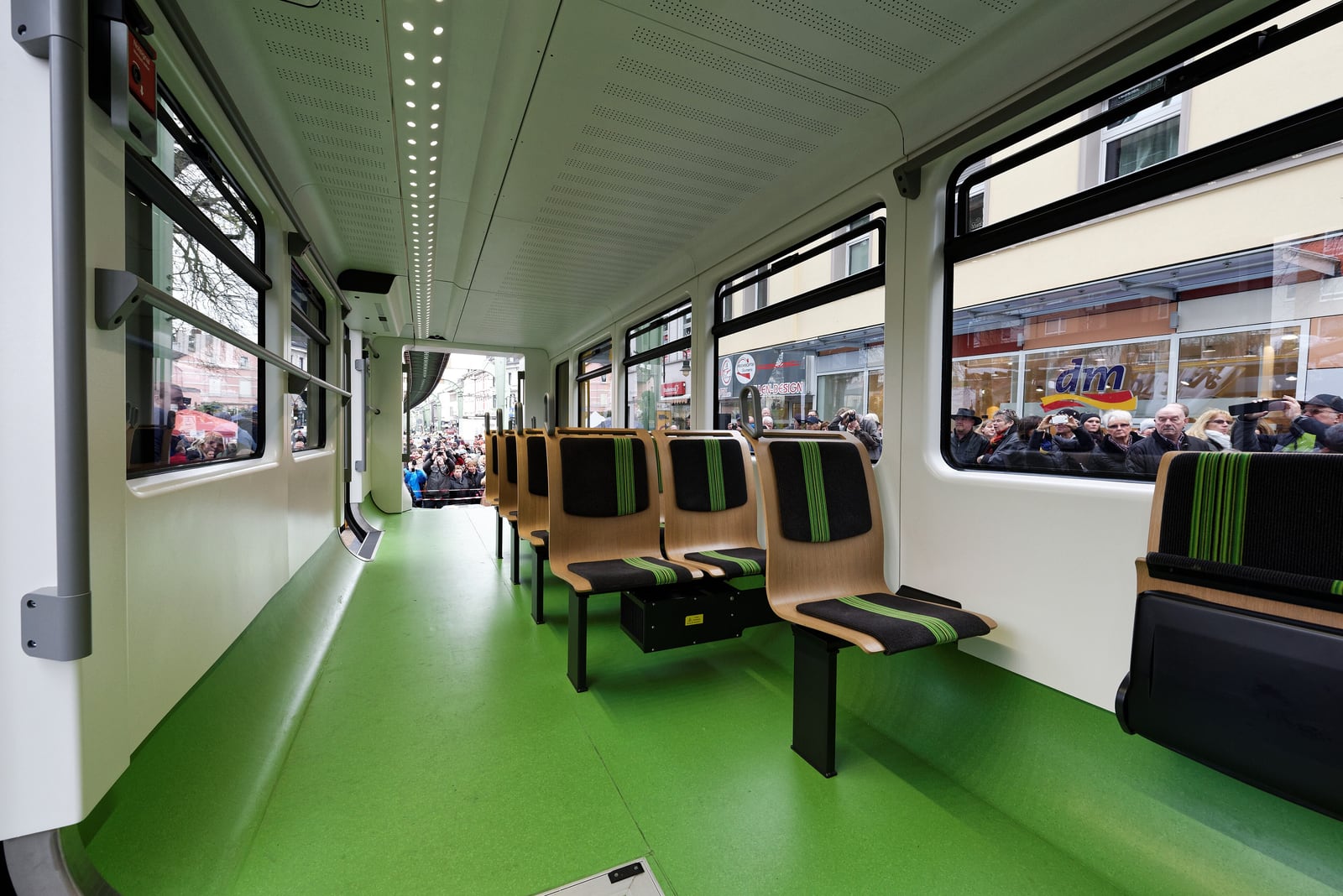
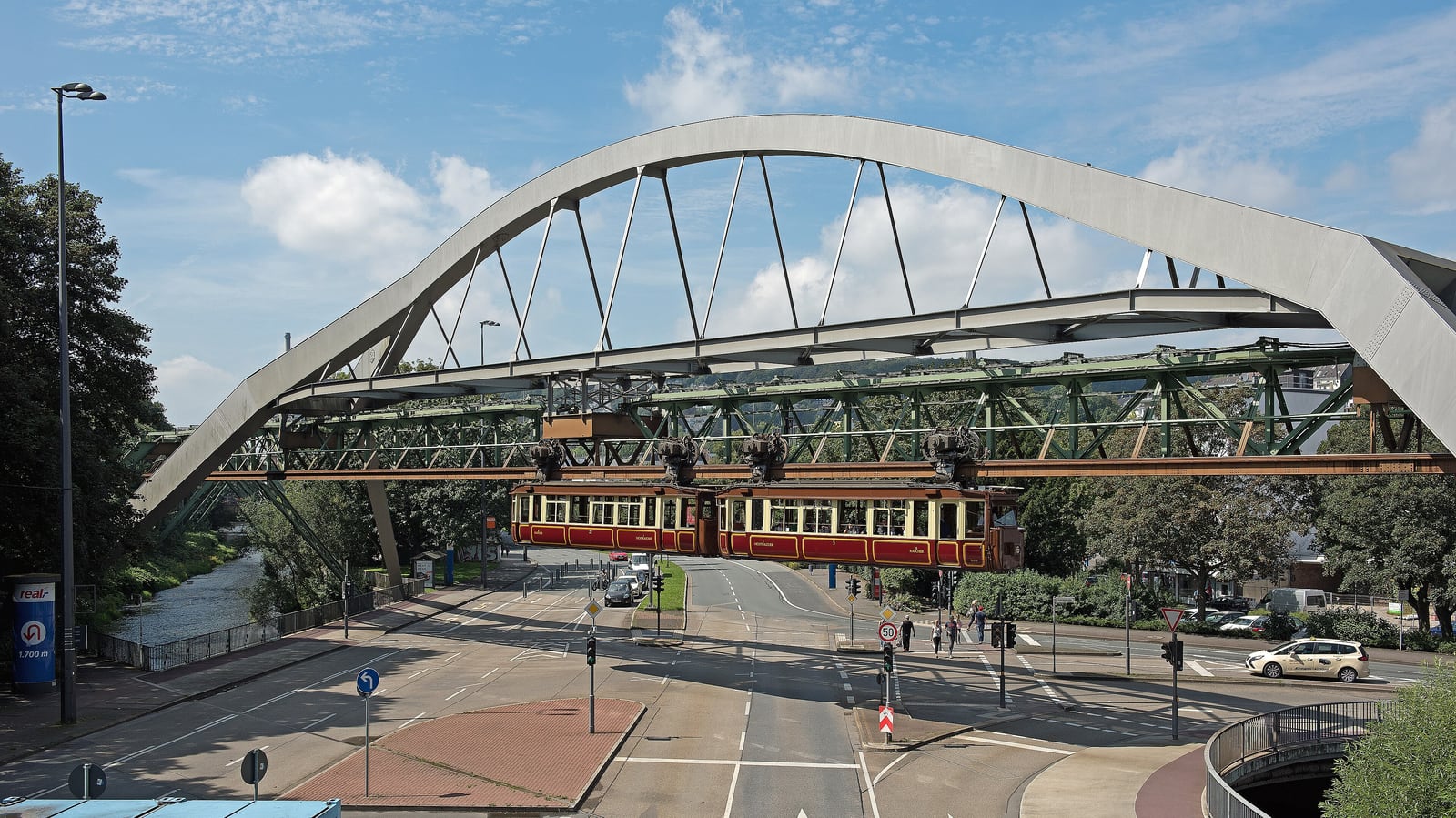
The carriages are unusually narrow for a railway — 2.2 metres, narrower than a Berlin U-Bahn car — and tapered at the bottom corners so they cannot catch the platform edge as they sway in. There is no headlight, because there is nothing ahead to light: the current fleet marks its front with a horizontal bar of white LEDs and its back with a red one. There are 31 cars, built by Vossloh Kiepe and in passenger service since 2016; the fleet they replaced ran from 1972 to 2018. For the 125th anniversary year one modernised car has been put back into the classic orange-and-blue livery of that older generation, so if you see one, it is the new train wearing the old paint.
Along the route
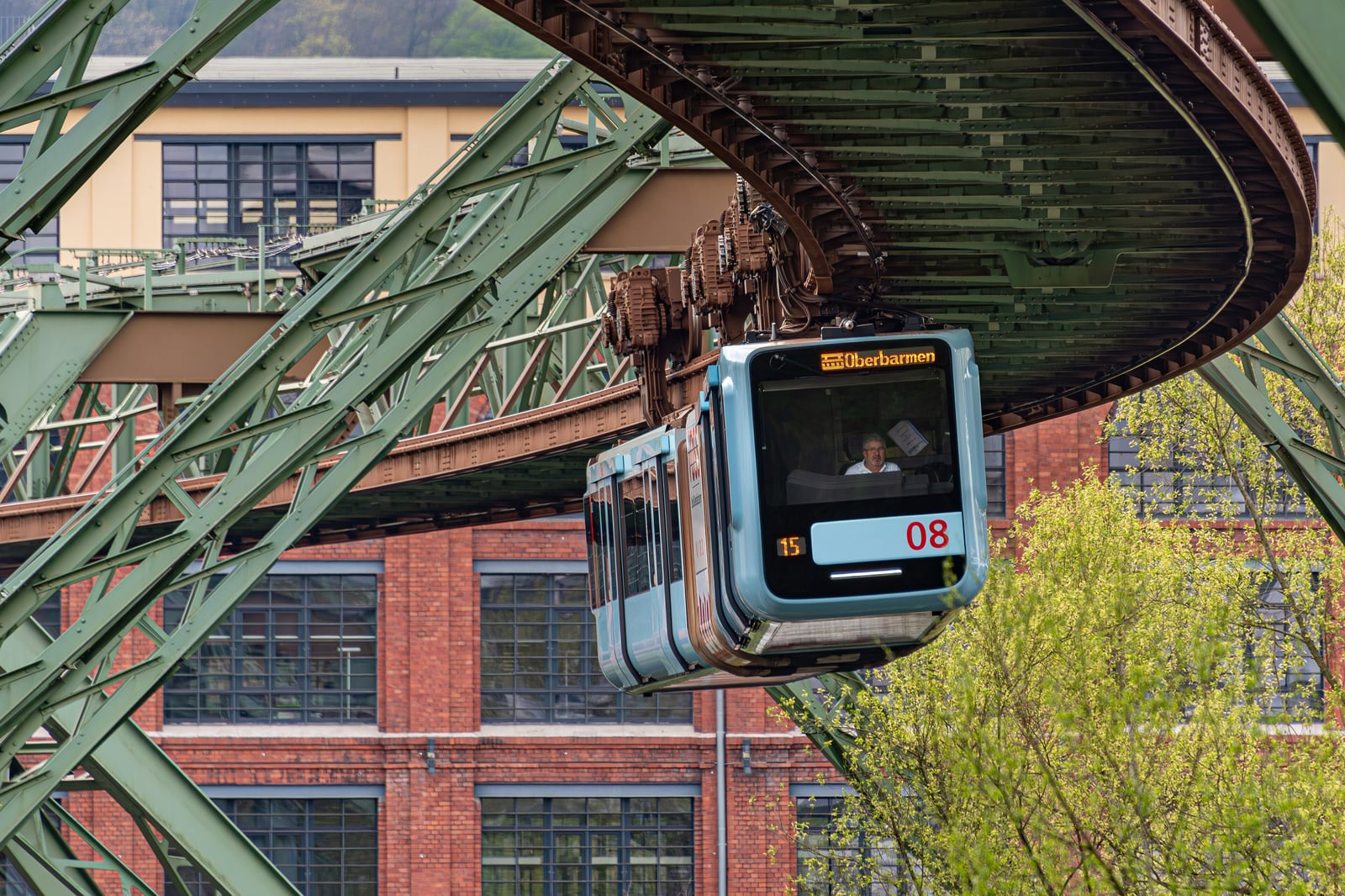
Jorge Franganillo / Wikimedia Commons · CC BY 4.0A hundred and twenty-five years old, and almost none of it is
Between 1995 and 2014 the entire supporting structure was replaced — one span at a time, weekend after weekend, never closing the line for more than six weeks. About forty thousand tonnes of steel went up, riveted rather than welded so the result would be indistinguishable. It is why it still runs.Frank Vincentz / Wikimedia Commons · CC BY-SA 3.0Two railways in one, and only one is over water
Almost every photograph shows the carriages over the Wupper, and for ten and a half kilometres they are. The first 2.7 out of Vohwinkel are something else: the Landstrecke, running down the centre of a shopping street eight metres up, on portals planted between the traffic lanes.Im Fokus / Wikimedia Commons · CC BY-SA 4.0Not a heritage railway — the city's main road
In 2023 the Schwebebahn carried 57,260 people on an average day, more than four times the busiest bus route in Wuppertal, and in 2025 it was available 99 per cent of the time. The passengers around you are going to work. The novelty is entirely yours.A bit of history
Culture & experiences along the way
Matthias Böhm / Wikimedia Commons · CC BY-SA 4.0Stand at the front window
There is no headlight, because there is nothing ahead to illuminate — just a rail disappearing into the middle distance and, below it, the river or the street. The end windows of a Generation 15 car look straight down the line and they are the reason people come. They are also the first seats taken; if the front is full at Vohwinkel, take the back and watch the track unspool behind you instead.Im Fokus / Wikimedia Commons · CC BY-SA 4.0Ride it end to end, then ride it back
Half an hour each way, and the two directions are not the same trip — the light is on the other side of the valley and the street section arrives at the beginning instead of the end. A 24-hour ticket is €7.60, which makes the round trip cheaper than two singles and leaves the rest of the day paid for. Most visitors do it once and wish they had done it twice.Rob Dammers / Wikimedia Commons · CC BY 2.0Come in 2026, while the anniversary is on
The 125th year is being run under the slogan that all of Wuppertal is Schwebebahn. The Kaiserwagen went back into service on 1 June 2026, one modernised car is running in the orange-and-blue livery of the fleet retired in 2018, and there is a family festival at Wuppertal Hauptbahnhof on 19 September 2026, from noon to six.Timetables
There is one line, it is numbered 60, and it runs from end to end all day. You do not need a timetable to ride it — at almost any reasonable hour the wait is under six minutes, and in the morning peak it is three. What follows is what the operator's own printed sheet actually says, so that you can plan a first or last train.
End to end takes 29–30 minutes in both directions, at every hour of the day.
First and last departures
| Vohwinkel → Oberbarmen | Oberbarmen → Vohwinkel | |
|---|---|---|
| Monday–Friday, first | 05:12 (arr 05:41) | 05:15 (arr 05:44) |
| Saturday, first | 05:22 (arr 05:52) | 05:22 (arr 05:52) |
| Sunday & holidays, first | 06:52 (arr 07:21) | 06:52 (arr 07:22) |
| Every day, last | 22:52 (arr 23:21) | 22:52 (arr 23:22) |
How often
The interval steps up and down through the day. These are the sheet's own bands:
| Roughly | Mon–Fri | Saturday | Sunday & holidays |
|---|---|---|---|
| Before 06:00 | every 10 min | every 15 min | — |
| 06:00–07:00 | every 7–8, then 4 | every 15 | — |
| 07:00–09:00 | every 3–5 | every 10, then 7–8 | every 15 |
| 09:00–12:00 | every 4–5 | every 6, then 5 | every 10, then 7–8 |
| 12:00–17:00 | every 4–5 | every 4 | every 6 |
| 17:00–18:30 | every 3–5 | every 4, then 5 | every 6 |
| 18:30–20:00 | every 5 | every 5–6 | every 6, then 7–8 |
| 20:00–21:20 | every 6, then 10 | every 6, then 10 | every 7–8 |
| 21:20–22:50 | every 10 | every 10 | every 10 |
| After 22:50 | every 15 | every 15 | every 15 |
WSW quotes the peak headway as every three minutes on weekdays, every four on Saturdays and every six on Sundays and holidays, and since 13 April 2026 the shortest scheduled interval has been three and a half minutes — back to where it was before the fleet's early wheel problems forced it out to four. Nineteen trains are in circulation to hold it, and one full round trip takes 66 minutes.
Good to know
- ⚠️ School holidays thin the morning out. During North Rhine-Westphalia's holidays the Monday– Friday service runs to a reduced timetable in the morning and late morning; the first and last trains are unchanged.
- Christmas Eve, New Year's Eve and New Year's night run to the 15-minute interval.
- The line is running. Availability was 99.1 per cent in May 2026 and 99.4 per cent in June 2026. There is no full closure planned before the rebuilding of the Vohwinkel car shed, pencilled in from 2032.
- ⚠️ Individual stations are being rebuilt, and access can be restricted while they are. The renewal programme runs to the end of 2031 — Alter Markt is under work from June 2026 into late 2027, and lifts at Ohligsmühle and Varresbecker Straße have been out in turn during 2026. The trains still stop; a lift or one platform entrance may be shut. Check the operator's site the week you travel if step-free access matters.
- Sit at the very front or the very back. The driver's cab is glazed across the whole width and the end windows look straight down the rail, which is the view everyone comes for. It is also the first place to fill.
Times from the operator's own timetable sheet for Linie 60, Wuppertaler Stadtwerke, dated 12 December 2025 and valid for the 2026 timetable year; both directions, read August 2026. Headway and availability figures from WSW. German timetables change every December.
Tickets
The Schwebebahn is ordinary public transport with an extraordinary shape. The whole city sits in one fare zone, so a ticket that covers Wuppertal covers the entire line, buses included. A single is €3.80 and a 24-hour ticket €7.60, with each of up to four companions added at €5.10 — and the 24-hour is the one to buy, because almost nobody rides this line once. Two singles already cost as much, and the point of the Schwebebahn is getting off it and straight back on.
⚠️ Validate a paper single before you board. A machine-bought ticket may need stamping in the platform validator, and the operator says plainly that this catches people out; app tickets are already timed. The Deutschlandticket is valid here. Fares checked against WSW's own pages, August 2026.
Book your tickets
The 24-StundenTicket
€7.60, and the one to buy
Twenty-four hours of unlimited travel on the Schwebebahn and every WSW bus in Wuppertal, for one person, with each of up to four more added at €5.10. Two single fares already cost as much, and the point of this line is getting off it and back on again. Sold at every platform machine and in the WSW apps.
Book Tickets (opens in a new tab, on WSW mobil)via WSW mobilThe EinzelTicket, Preisstufe A
€3.80 for a single ride
One journey of up to ninety minutes anywhere in Wuppertal, which includes the full thirteen kilometres from Vohwinkel to Oberbarmen. Children aged six to fourteen pay €2.10 and under-sixes travel free. A paper ticket from a machine may need stamping in the platform validator before you board.
Book Tickets (opens in a new tab, on WSW mobil)via WSW mobilThe Kaiserwagen
The 1900 car, as a 65-minute coffee excursion
Car 5 carried Kaiser Wilhelm II on the trial run of 24 October 1900 and is the one part of the railway that genuinely is old. It runs as a booked excursion with guides in period costume, leaving Vohwinkel at 13:50 and 16:50, and it returned to service for the anniversary season on 1 June 2026. The fare includes VRR travel to and from the trip.
Book Tickets (opens in a new tab, on Wuppertal Marketing)via Wuppertal MarketingRail Passes
This is the one section where the answer is short and unhelpful, so it is worth saying clearly.
Interrail and Eurail
Not valid. Interrail's own coverage table for Germany lists what a pass covers in this country: ICE, IC and EC, Regional-Express, RegionalBahn, Interregio-Express and the S-Bahn, from DB and the regional carriers. The Schwebebahn is none of them, and WSW mobil is not on the roster of German companies the table falls back on for everything it has not named. It is a municipal light-rail service run under Germany's tramway regulations, in the same legal class as a U-Bahn or a tram — and passes do not cover urban transport in Germany.
That is a genuine gap, because a pass-holder arriving at Wuppertal Hauptbahnhof on a covered Regional-Express steps out of the station directly underneath a railway their pass will not carry them on. Budget €3.80 for the ride, or €7.60 for the day.
The Deutschlandticket
€63 a month, and it works. The nationwide monthly subscription is valid on the Schwebebahn in full, along with every bus in Wuppertal and every regional train to it. If you are in Germany for even a couple of weeks and moving around, it removes the question entirely.
⚠️ It is sold only as a rolling subscription in your own name, cancellable monthly — not as a one-off tourist ticket. Buy it before the month you travel in, not on the platform.
Is a pass worth buying for this journey?
No — and there is no version of this where it is. A ride costs less than four euros, a day costs less than eight, and no rail pass covers it at any price. The Deutschlandticket pays for itself in Germany generally, never in Wuppertal specifically.
What is worth planning is the connection. Wuppertal sits on the Cologne–Hagen–Dortmund main line, and the regional trains that serve it from Düsseldorf and Cologne are covered by a pass. The Schwebebahn's Hauptbahnhof station is directly above the main-line platforms, so a pass gets you here for nothing and the last thirteen kilometres are the ones you pay for.
Pass coverage checked against Interrail's own Germany page and its published list of railway companies, and the Deutschlandticket conditions at WSW, on 20 August 2026.
Places to Visit
Everything here is within a few minutes' walk of a Schwebebahn platform, and they are listed in the order a train from Vohwinkel reaches them. That is the whole trick of Wuppertal: the city is too narrow to spread out, so the railway passes almost everything worth stopping for.
 Im Fokus / Wikimedia Commons · CC BY-SA 4.0 · cropped
Vohwinkel and the Schwebebahnpark
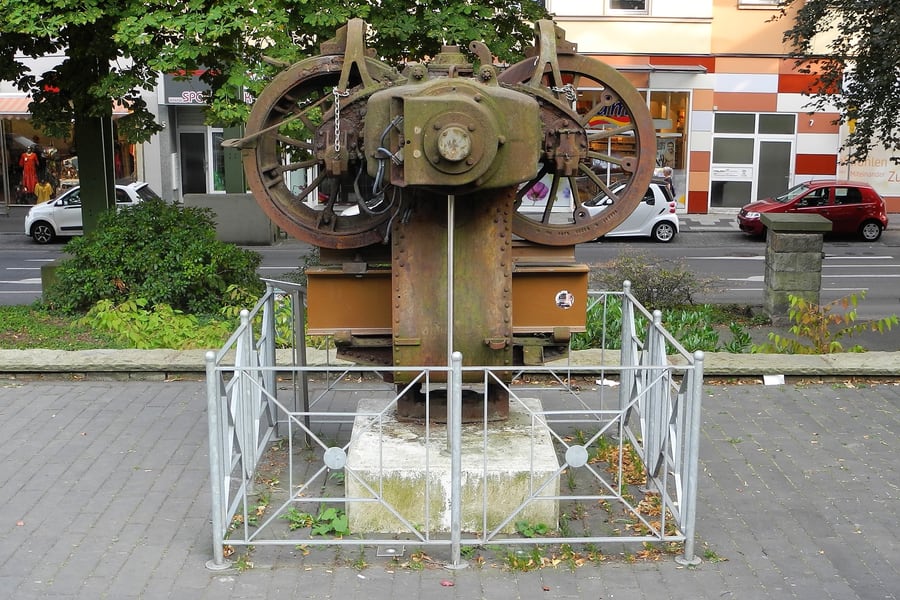
The line starts at its highest point and immediately does its strangest trick, swinging round the old imperial post office on a thirty-metre curve and setting off down the middle of the street. In the Stationsgarten beside the terminus, an open-air display set up in 2015 puts at eye level the parts nobody normally sees: an original bogie and rail, lattice nodes, the foot of a swing support. Given how much has been renewed, it is the easiest place to stand next to the 1901 railway.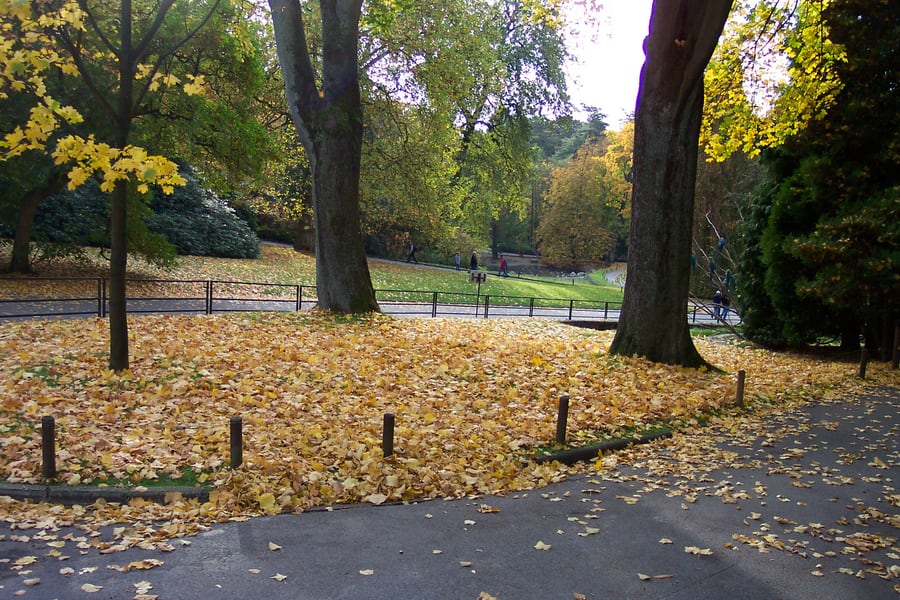 Atamari / Wikimedia Commons · CC BY-SA 3.0 · cropped
Der Grüne Zoo
Wuppertal got its zoo in 1881 and built it into a hillside, which is why it is still one of the most attractive in Germany — a wooded landscape park with the enclosures set into the slope rather than laid out on a grid. It is a few minutes' walk from the Zoo/Stadion platform, open every day of the year except Christmas Day, 9:00 to 18:00 in summer and 9:00 to 17:00 in winter, with the animal houses closing a little before the gates.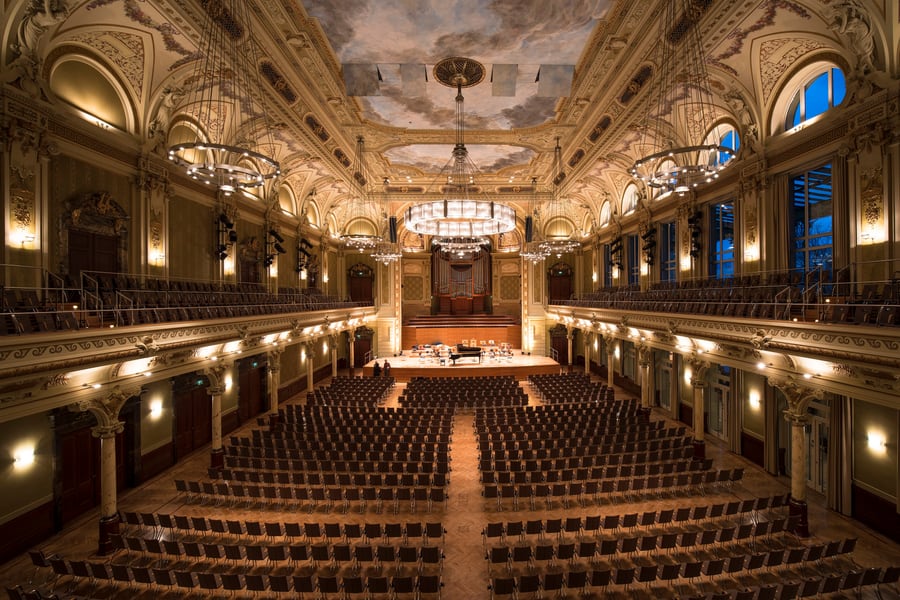 Donat Nussbaumer / Wikimedia Commons · CC BY-SA 4.0 · cropped
Historische Stadthalle
Built 1896–1900 and opened over three days in July 1900 with the young Richard Strauss conducting, stripped of its decoration in the 1950s and restored between 1991 and 1995. The Großer Saal is taken seriously by people who measure such things: a team from Aalto University compared nineteen European halls with a loudspeaker orchestra and put it among the best. Simon Rattle's verdict, which the hall prints on its front page, is that Wuppertal has one of the world's finest-sounding concert halls.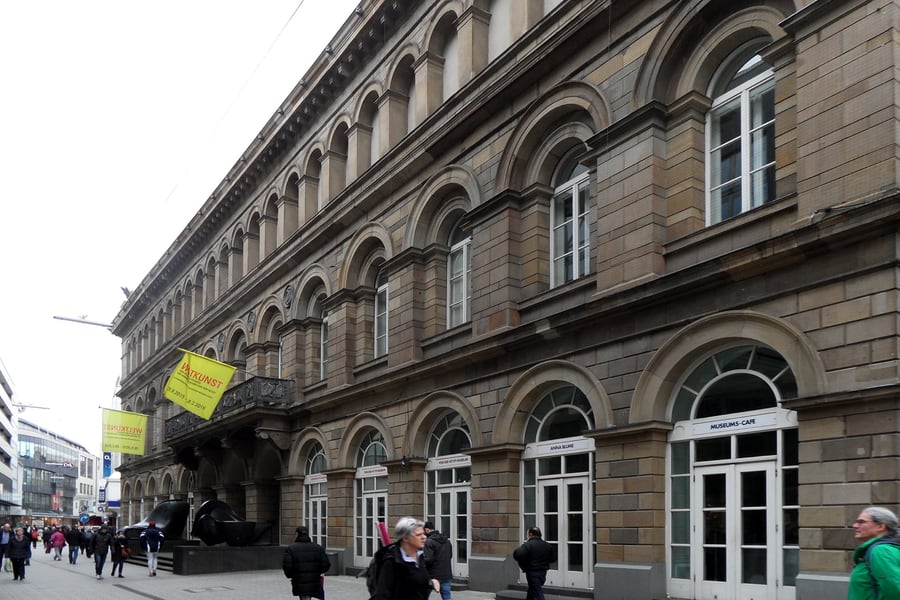 onnola / Wikimedia Commons · CC BY-SA 2.0 · cropped
Von der Heydt-Museum
A provincial industrial city with a first-rate collection of French nineteenth-century painting and European modernism — over two thousand paintings, five hundred sculptures and thirty thousand works on paper, in the old Elberfeld town hall of 1828–1842, which the museum moved into in October 1902. Open 11:00 to 18:00, Wednesdays until 20:00. ⚠️ Part of the first floor is shut for modernisation, and admission is reduced to €10 until 30 August.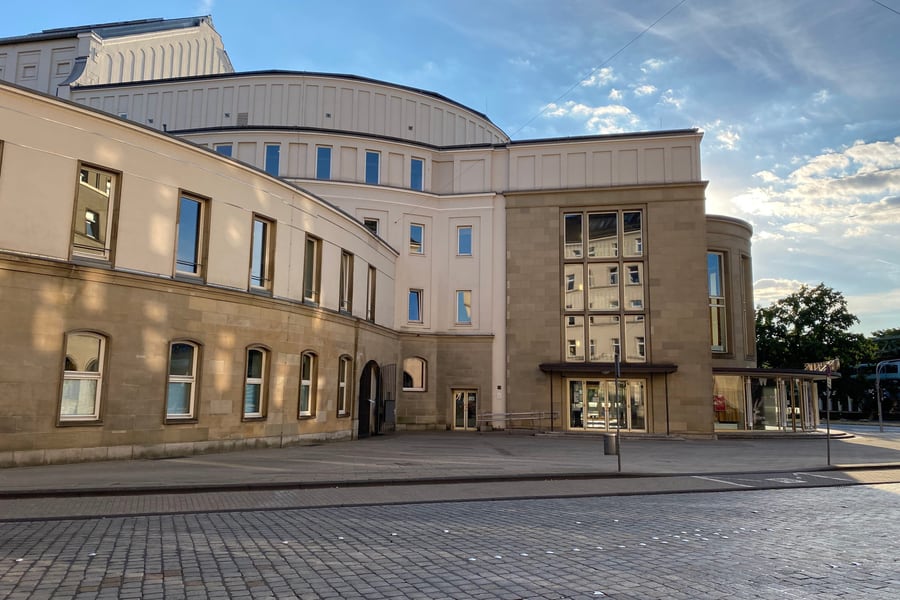 -wuppertaler / Wikimedia Commons · CC BY 4.0 · cropped
Opernhaus Wuppertal
The other thing this city is famous for. The Opernhaus is the main house of the Wuppertaler Bühnen and the home stage of the Tanztheater Wuppertal Pina Bausch, which has gone on making and touring her work since her death in 2009 and is playing its 2026/27 season here. Seeing a Bausch piece in the theatre it was made for is a different proposition from seeing it on tour, and the station is round the corner.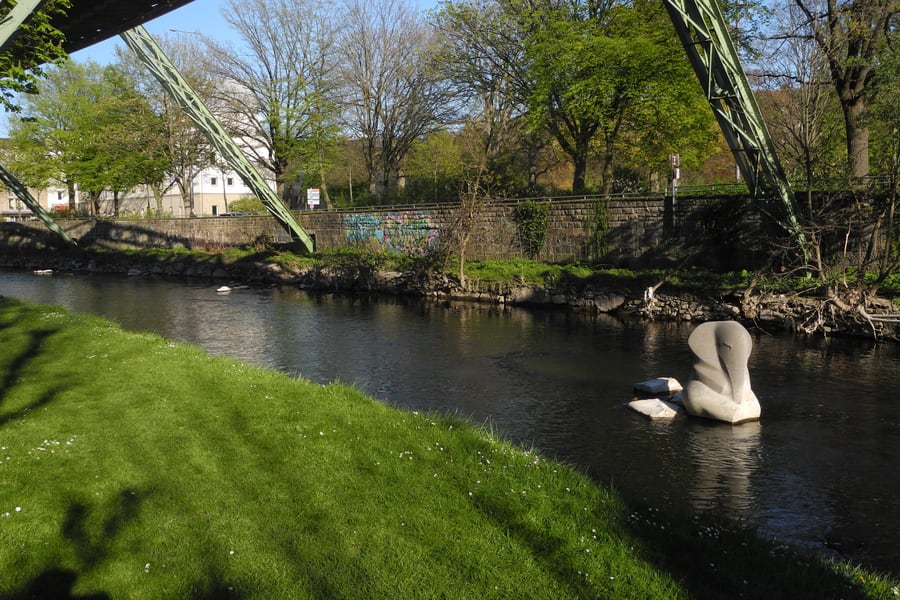 Im Fokus / Wikimedia Commons · CC BY-SA 4.0 · cropped
Where Tuffi jumped
On 21 July 1950 the Althoff circus put a young elephant called Tuffi on a Schwebebahn car as a publicity stunt. A few metres out she panicked at the noise and the swaying, went through the side of the carriage and landed in the Wupper, barely hurt; the reporters on board came off worse. Every famous photograph is a montage — every photographer was inside the train. A pale stone elephant has stood in the river at the spot since 2020.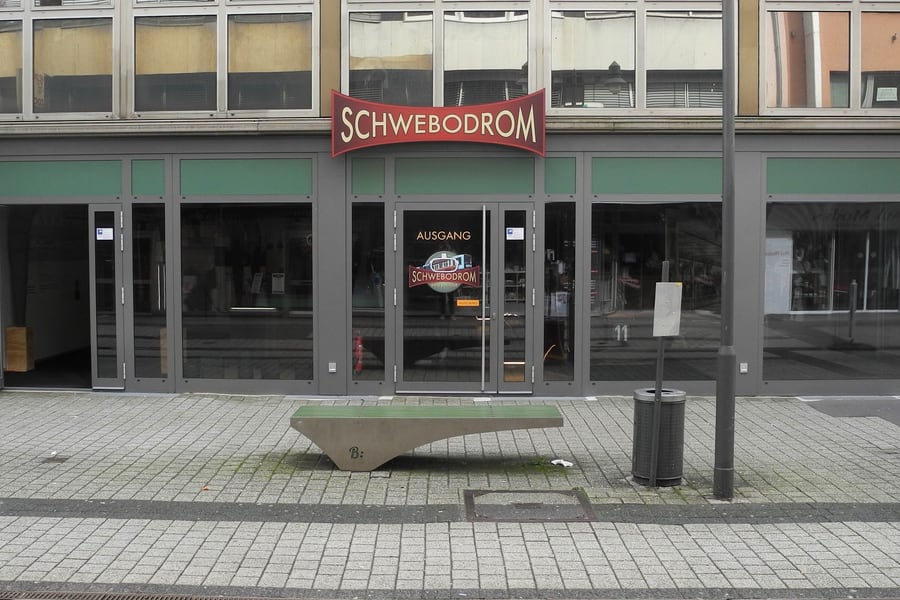 Im Fokus / Wikimedia Commons · CC BY-SA 4.0 · cropped
The Schwebodrom
A small museum at Werth 96, opened in October 2023, built around an original car of 1900 and a virtual-reality ride through the Wuppertal of 1929 — the one place that shows you what the line looked like before everything was renewed. Wednesday to Sunday, 11:00 to 19:00; a visit takes about 75 minutes. The station outside it is worth a look too: it opened in August 2013 as a copy of the art nouveau original, and took 27,905 rivets.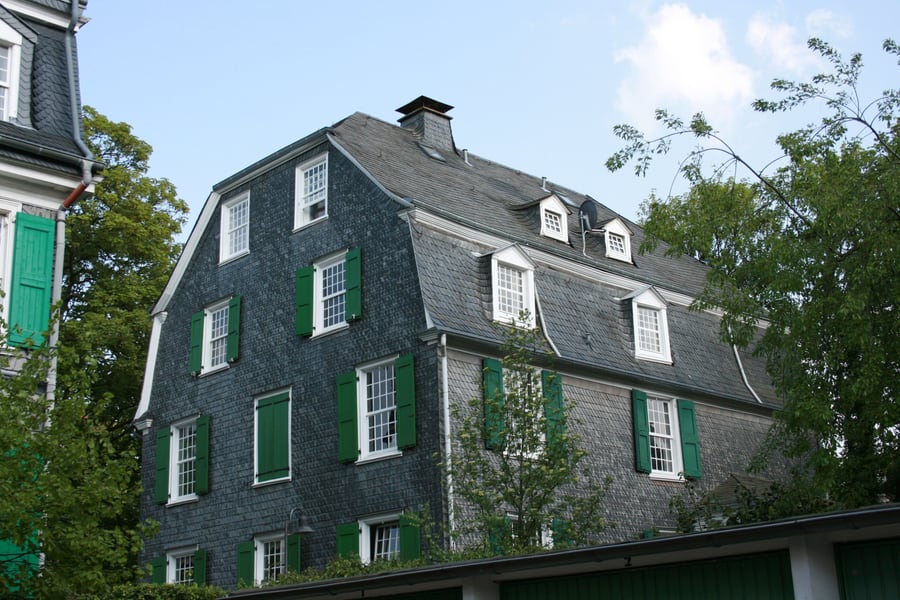 Frank Vincentz / Wikimedia Commons · CC BY-SA 3.0 · cropped
The Engels-Haus
Friedrich Engels was born in Barmen in 1820, into the textile family whose mills were the model for his first book. His birthplace was destroyed in the war, but the family's slate-hung house of 1775 survives a few streets away and is now the museum of his life and work, reopened on 11 September 2021 after five years of restoration. Tuesday to Sunday, 10:00 to 18:00, €4.Where to Sleep
Wuppertal is a working city rather than a resort, and its hotels are correspondingly plain — but the line is thirteen kilometres long and every station has one within a few minutes, so the only question worth asking is which end of the valley you want to wake up in. All three below are independent houses on their own websites; we quote no prices and no star ratings, because we have verified neither.
Where to stay
Hotel Schwaferts
On the street section, at Sonnborn
A small independent house on Sonnborner Straße, in business since 1960, with a restaurant and a beer garden. It stands on the stretch where the railway runs above the road, which means the Schwebebahn passes the front of the building — a few minutes' walk from Sonnborner Straße station and two stops from the Vohwinkel terminus.
Check Availability (opens in a new tab, on hotel-schwaferts.de)via hotel-schwaferts.deHotel Astor
In the middle of Elberfeld, by the shopping streets
A forty-odd room independent hotel on Schloßbleiche, in the pedestrianised centre of Elberfeld, with Ohligsmühle and Wuppertal Hauptbahnhof both a few minutes away on foot and the Von der Heydt-Museum round the corner. The most central bed on the line, and the easiest one to reach off a main-line train.
Check Availability (opens in a new tab, on hotelastor-wuppertal.de)via hotelastor-wuppertal.deFachwerk Hotel Wuppertal
Sixteen rooms in a half-timbered house in Barmen
A family-run hotel in a timber-framed building in the centre of Barmen, next to Vorwerk and a short walk from the Werth pedestrian street, the Schwebodrom and the Alter Markt station — the eastern half of the line, and the quieter half of the city. Reception is staffed on weekday mornings only, so arrange your arrival in advance.
Check Availability (opens in a new tab, on fachwerk-hotel-wuppertal.de)via fachwerk-hotel-wuppertal.deQuestions or corrections
Planning this trip and stuck on something, or spotted a time, fare or detail that has changed? Send us a message about The Wuppertal Schwebebahn. We read every one, and we update this page when something has changed.