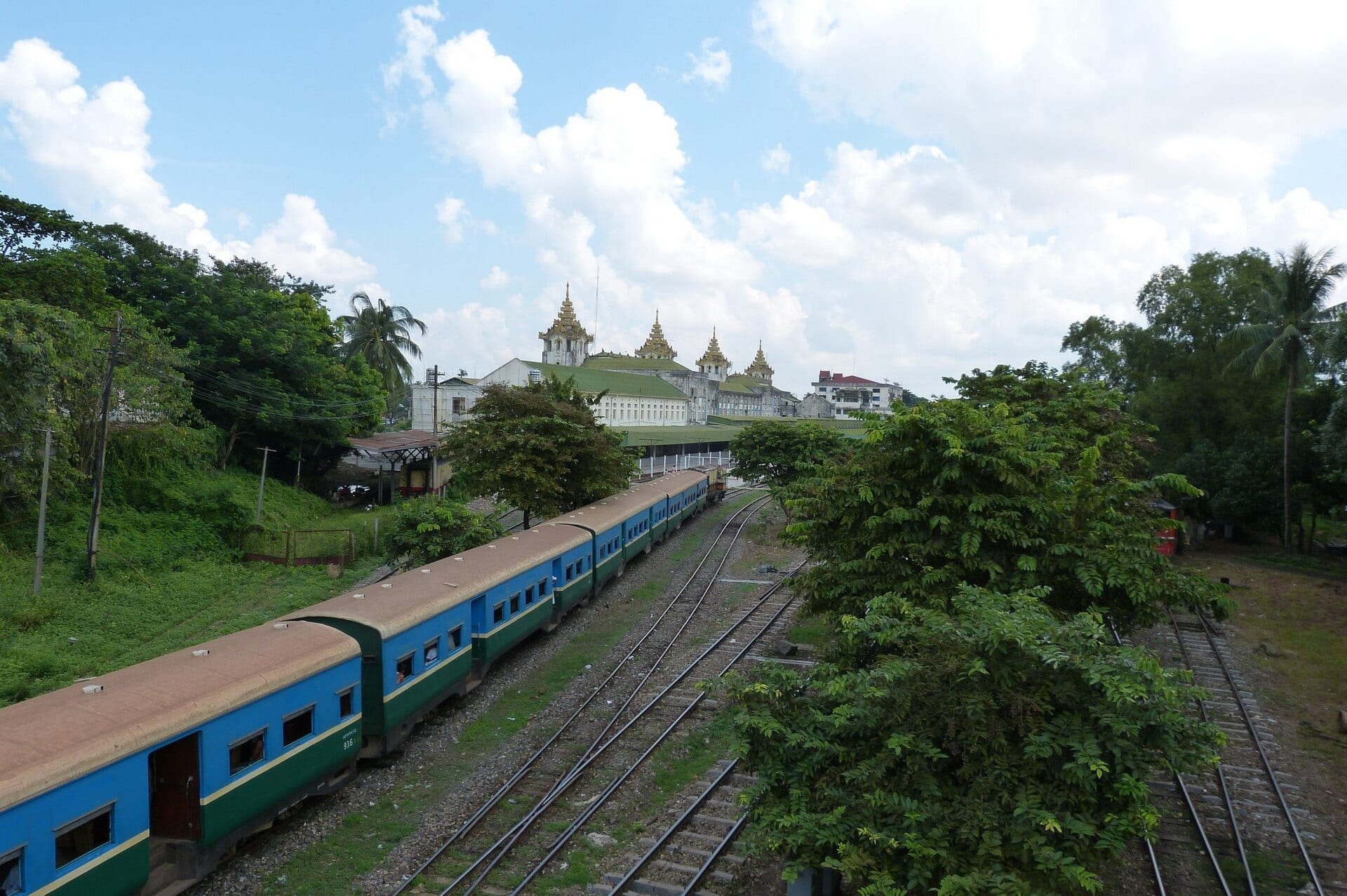
The Yangon Circular Railway
Go-Myanmar / Wikimedia Commons · CC BY-SA 3.0
- DistanceA 45.9 km loop · 39 stations
- DurationFull circuit ~3 hours
- Best seasonNovember to February — dry-season light, cooler mornings
Introduction
Every great city should have a railway like this. For about the price of a cup of tea, Yangon's circle line will show you the whole metropolis in three unhurried hours: 45.9 kilometres of track looping through 39 stations, from the gilded roofs of the downtown terminus out through markets, monasteries, workshops and paddy-green suburbs, and back again. Nothing about it is designed for tourists, which is exactly why travellers have always loved it — this is Yangon riding its own train, and you are simply aboard.
The loop was laid out in the 1930s, in the last decades of British Burma, and completed as a double-tracked circle in 1954. Its rolling stock is one of the railway world's happiest afterlives: when Japan retired its country railcars, Myanmar bought them, and KiHa diesel units still wearing their JR logos, Japanese destination stickers and ceiling fans now trundle through the tropics. Since 2024 they have been joined by brand-new Spanish-built CAF trains, the first fruits of a Japanese-funded modernisation that is slowly rebuilding stations and speeding up the circuit.
The circle line has lived through everything the city has — colonial rule, isolation, the crowds of the 2010s boom, and the hard years since 2021, which have thinned its timetable and its passengers alike. But it runs, daily, from before dawn until late evening, and it remains what it has always been: the cheapest, gentlest, most human way to meet one of Asia's great cities.
The Journey
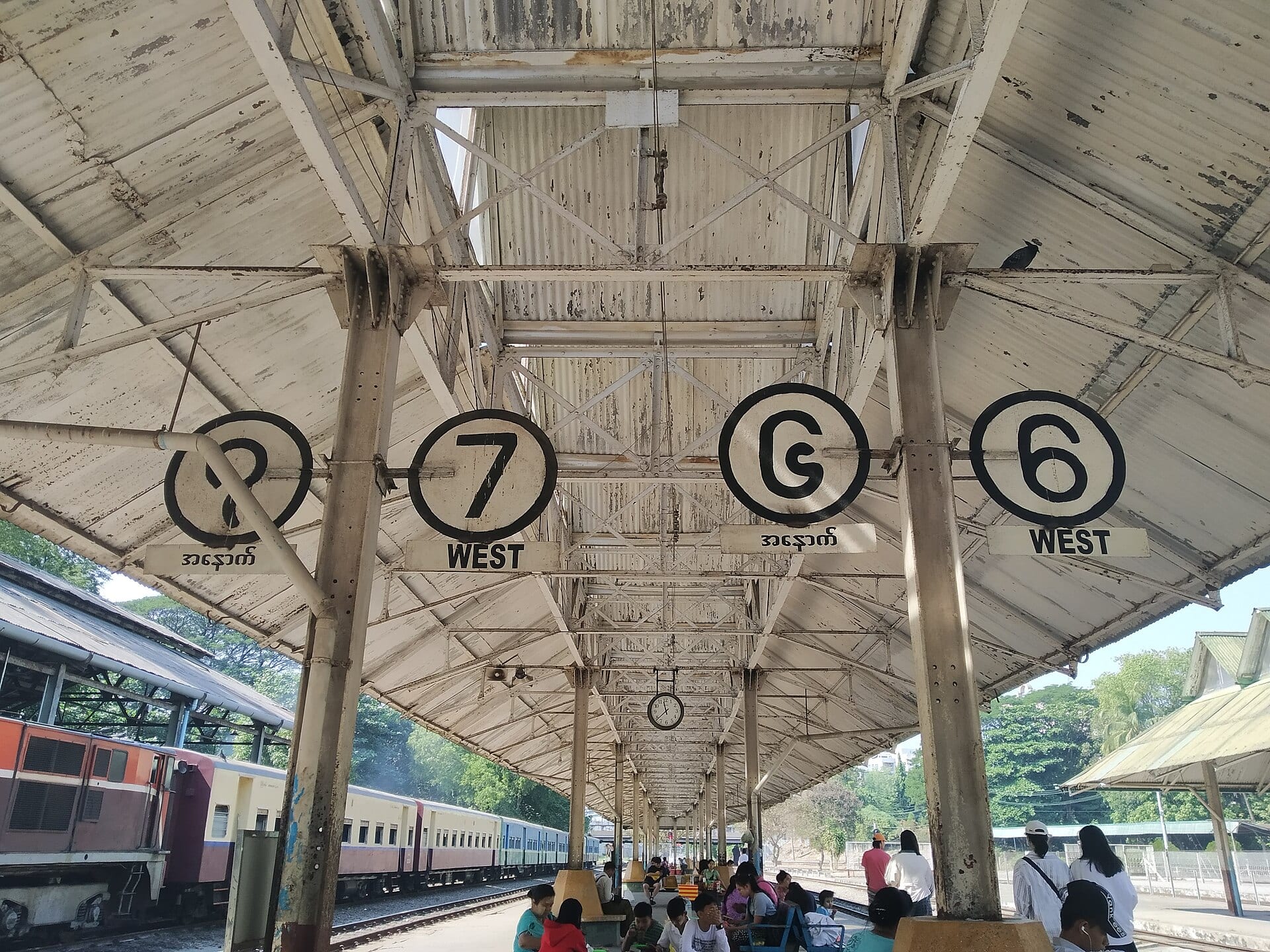
Start at Yangon Central, one of the great railway buildings of Asia — a postwar palace of tiered, gilded Burmese roofs presiding over long, shaded platforms. Circle-line tickets are sold from a platform booth; find the right platform, watch the destination boards in Burmese and English, and board whatever comes: an orange-and-cream veteran from Japan, or one of the sleek new CAF units if your timing is right.
The train pulls out at bicycle speed and never really hurries again. Downtown slides past first — the backs of colonial blocks, laundry lines, gold-spired pagodas appearing and vanishing between buildings. Then the city loosens. At Kamayut the university crowds board; around Insein, on the western side, the loop passes workshops and the sprawl of everyday commerce, with the ex-JR depot cars rusting gently in the yards.
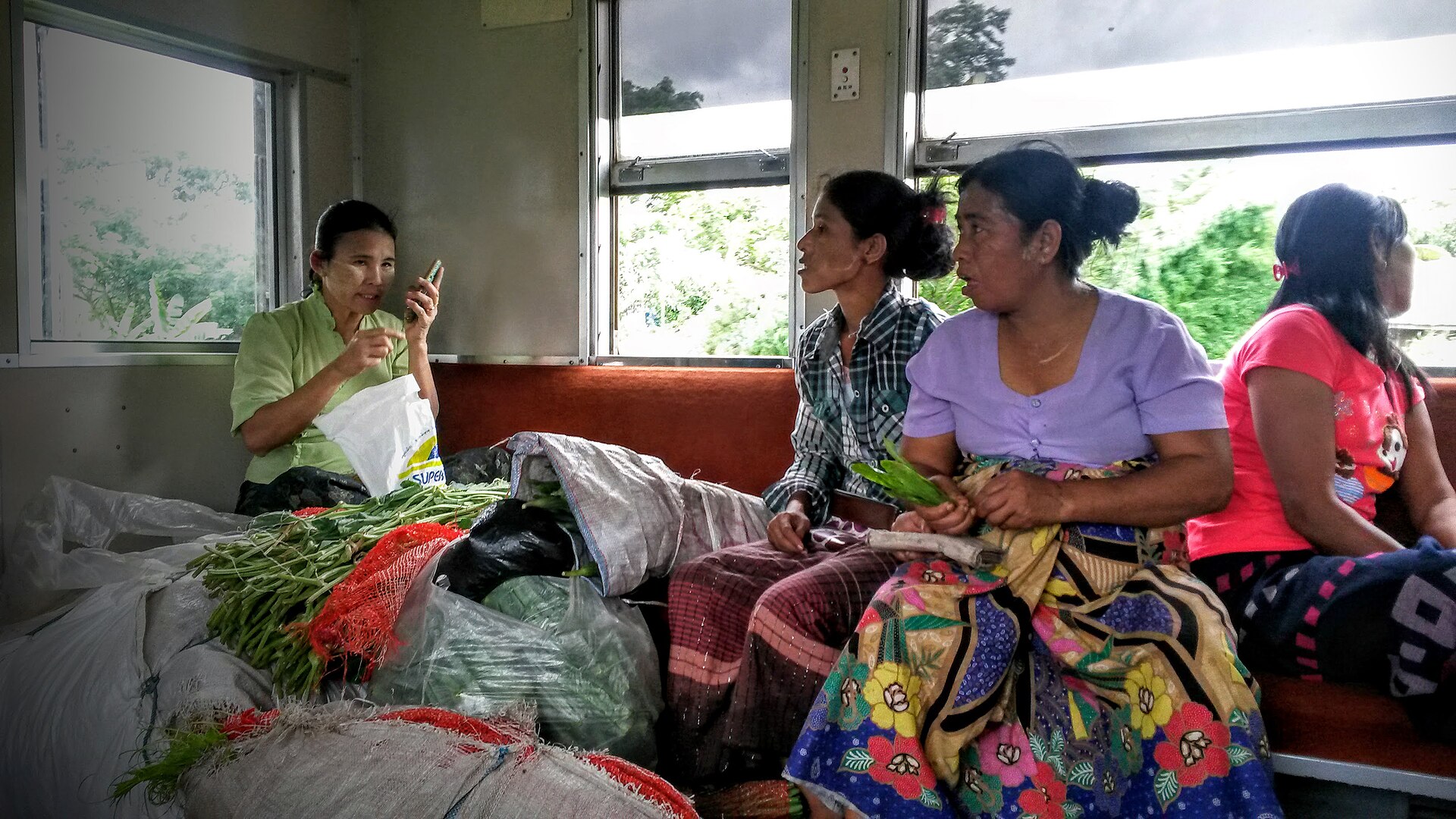
The famous stop is Danyingon, the market station on the northern arc. Here the distinction between platform, market and train dissolves entirely: sacks of greens come through the windows, traders spread produce on the carriage floor and sort it between stations, and for a few stops your railcar is a rolling wholesale market. It is the single best scene on the line, and it happens every morning.
Beyond, the loop swings past Mingaladon on the airport side of the city, through suburbs where the track runs between vegetable gardens, duck ponds and monastery walls, close enough to daily life to smell cooking fires. Passengers doze, monks scroll phones, vendors work the aisle with quail eggs, samosas and sliced mango. There is no commentary and nothing to "see" in the brochure sense — the journey is the sight.
Three hours after leaving, the gilded roofs of Yangon Central rise again above the tracks. You will have spent almost nothing, crossed nothing off a list, and understood the city better than any tour could manage. That is the circle line's quiet magic — and why, through every era of Myanmar's difficult history, it has never stopped turning.
Along the route
Go-Myanmar / Wikimedia Commons · CC BY-SA 3.0Three hours, thirty-nine stations
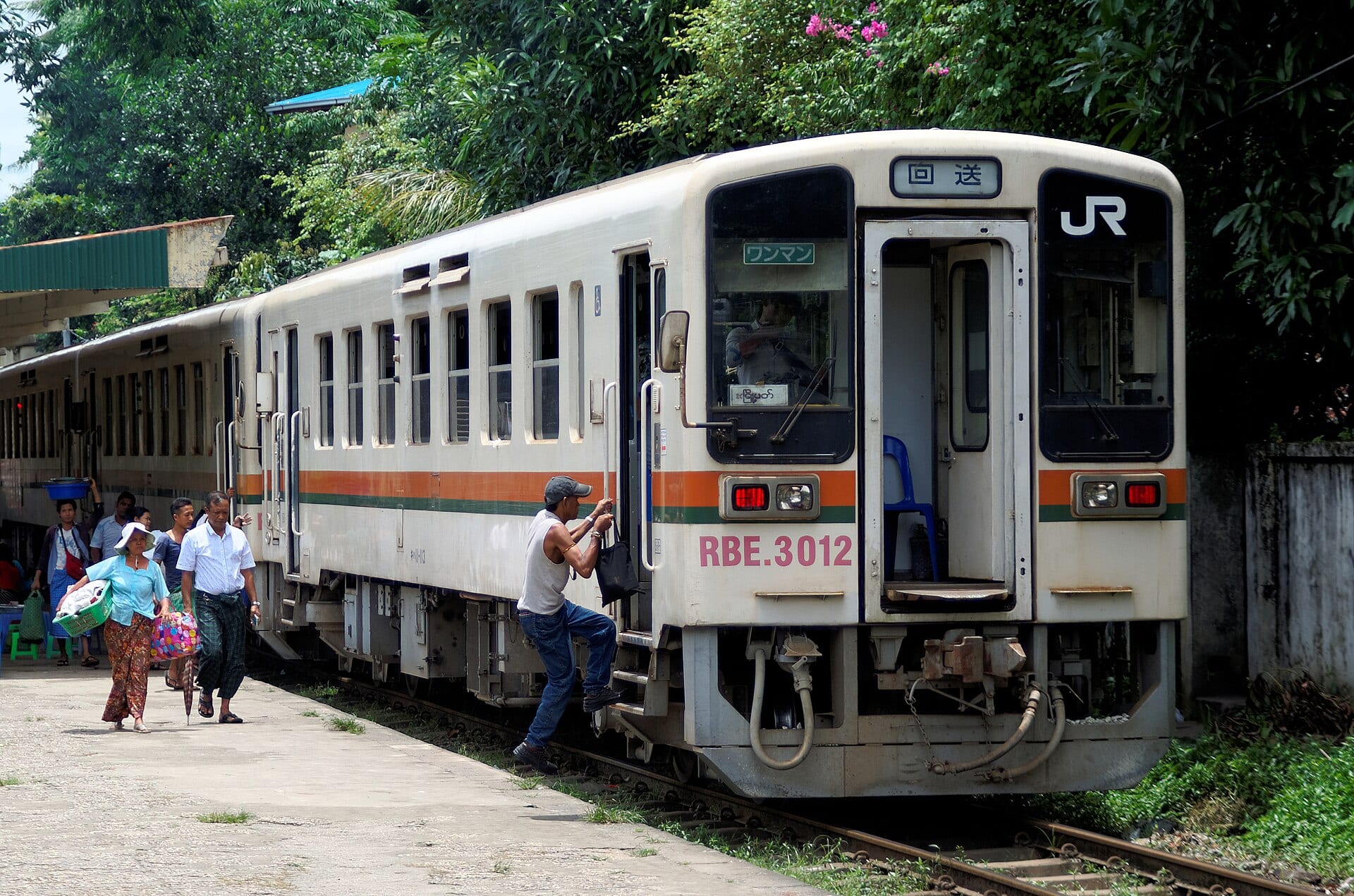
The circle line is Yangon in cross-section: 45.9 kilometres around the city through 39 stations, from downtown platforms to suburbs where the track runs between vegetable plots and monastery walls. The full loop takes about three hours — the best-value city tour in Asia, conducted at a walking-pace amble with the windows open.Jakub Hałun / Wikimedia Commons · CC BY-SA 4.0Japan's railcars, second act
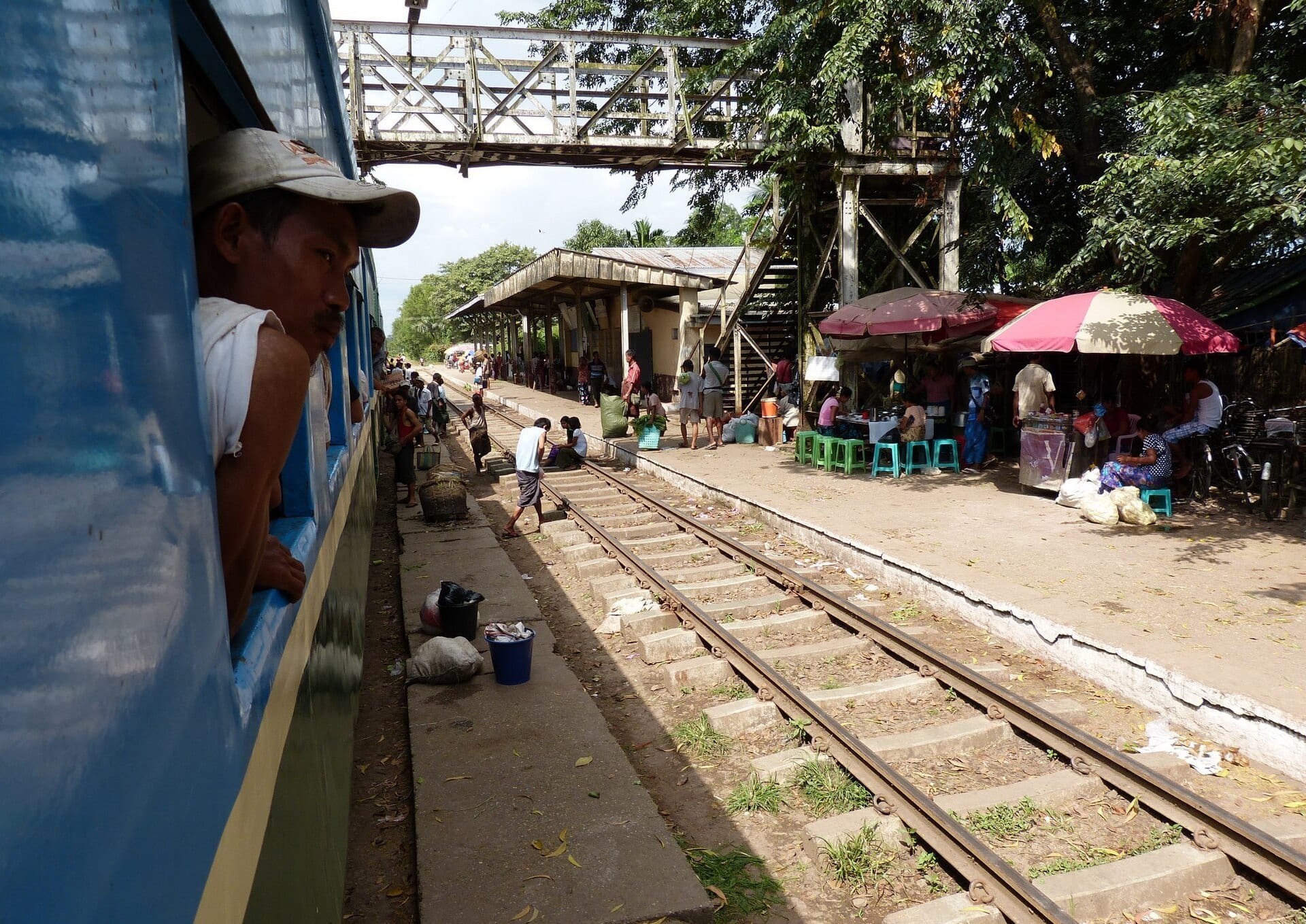
Most trains on the loop are secondhand Japanese railcars — KiHa 40s and their cousins, bought when JR retired them, many still carrying their Japanese route stickers, ceiling fans and even the JR logo. Riding one is a strange double exposure: a Japanese country train, transplanted whole into the tropics.Jakub Hałun / Wikimedia Commons · CC BY 4.0The market on rails
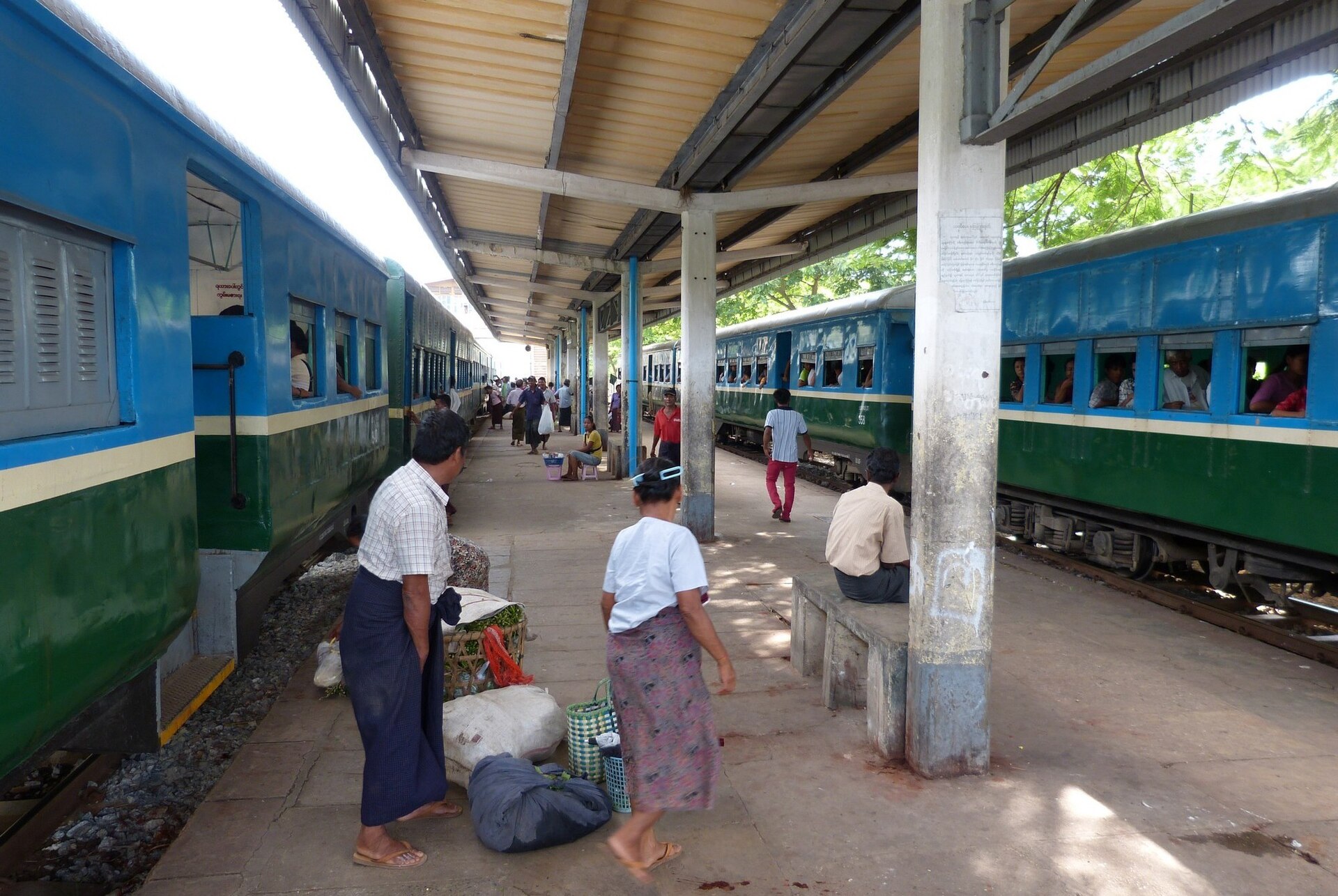
The loop is a working railway in the oldest sense — at Danyingon, the market station, the platform and the train become one continuous bazaar, with produce passed through the windows and traders sorting greens on the floor between stations. Ride in the morning and commerce comes to you.A bit of history
Culture & experiences along the way
calflier001 / Wikimedia Commons · CC BY-SA 2.0Ride it like a local
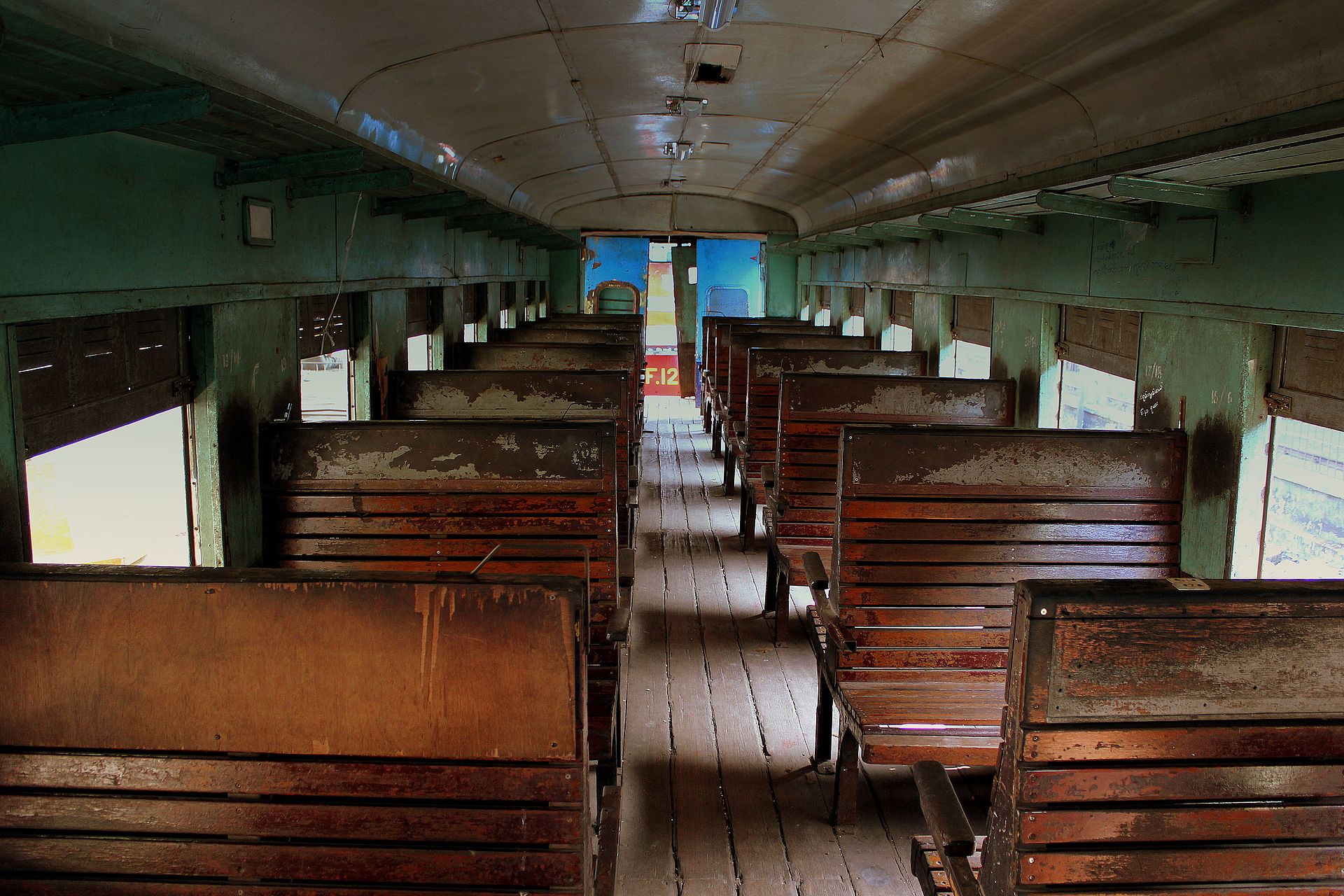
Board at Yangon Central, buy the cheap ticket, and take the older RBE railcar rather than the new train — hard benches, open windows, vendors with trays of quail eggs and cut fruit. You don't have to do the whole loop: hop off wherever looks interesting and catch the next train round. Services run from before dawn until late evening.Shin Khant Maung / Wikimedia Commons · CC BY 4.0Old train or new?
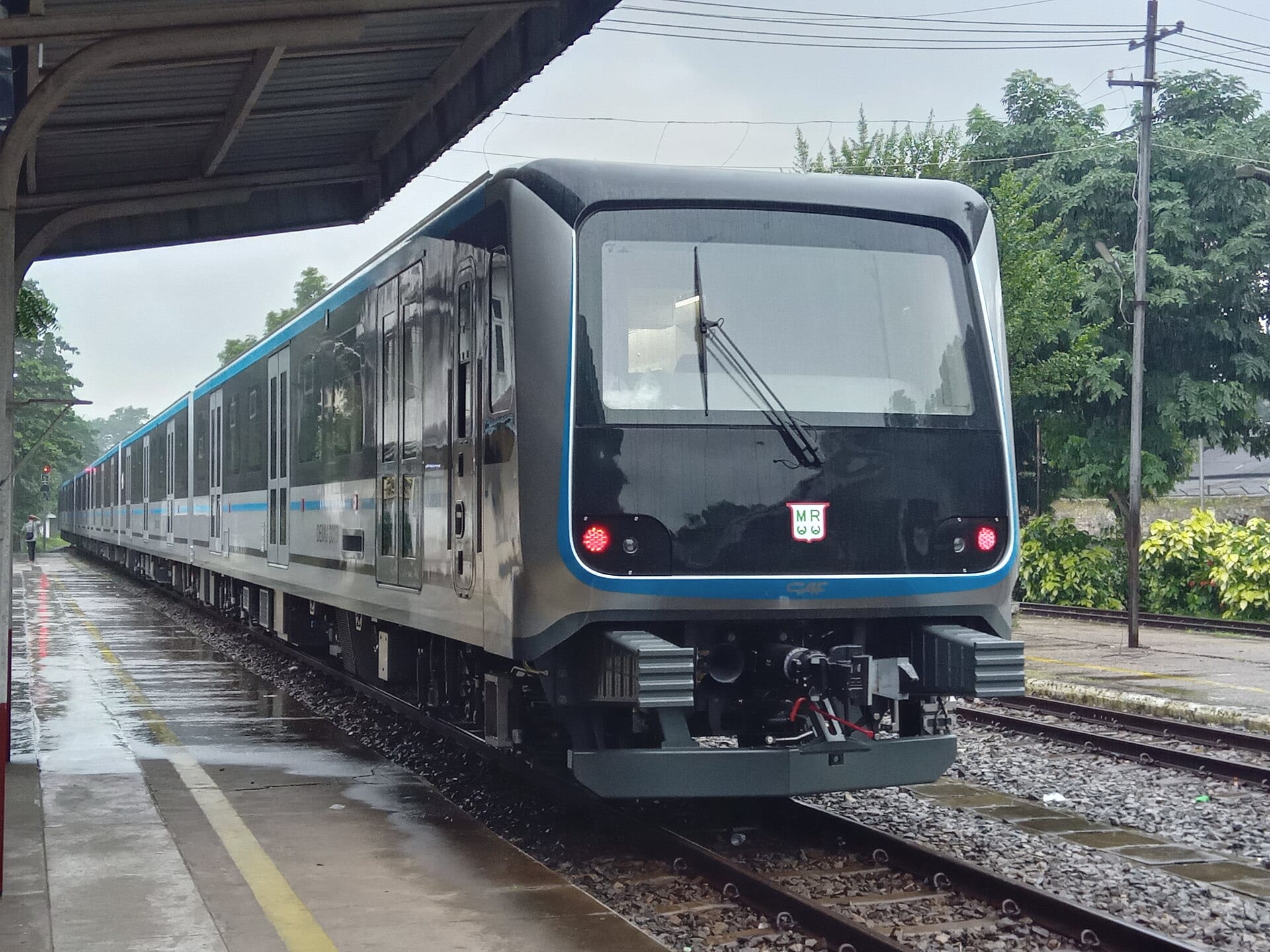
Since 2024 the loop has run brand-new Spanish CAF diesel units on a few diagrams each day — air-conditioned, smooth, about K1,000 a ride against K400 on the veterans. The new trains are the future of the line; the old ones are the experience. Do one lap of each and you will have ridden both eras of the Yangon railway.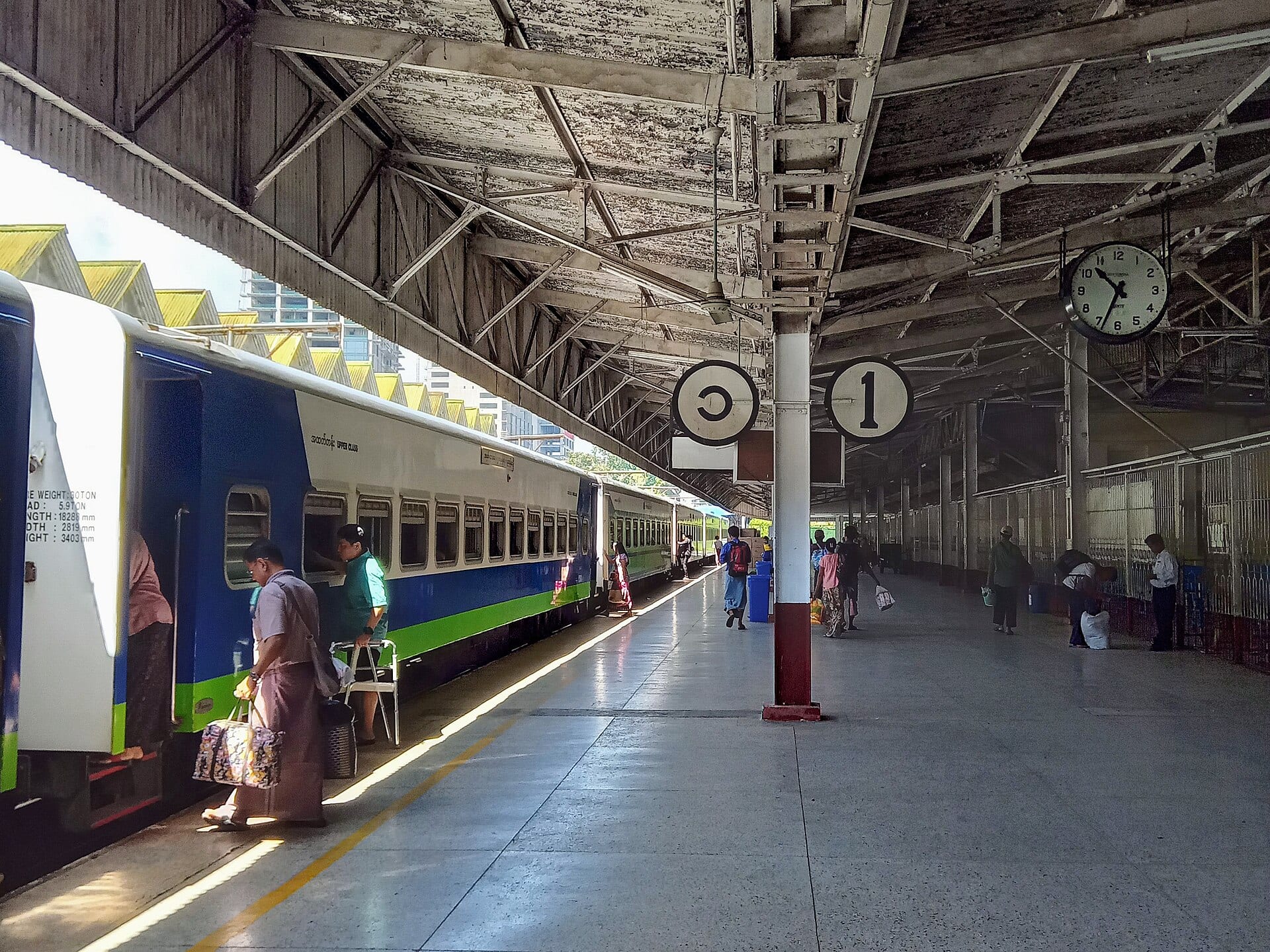 Shin Khant Maung / Wikimedia Commons · CC BY-SA 4.0
Check the situation first
Yangon Region is not on the FCDO's restricted lists at the time of writing, and the circle line runs daily — but Myanmar remains a country in conflict, and conditions can change at short notice. Read your government's current travel advice, carry small kyat notes, and treat photography around stations and officials with sensitivity.Timetables
The circle line is a turn-up-and-go railway — no reservations, no seat numbers, just a ticket from the platform booth and the next train round. Exact departure minutes shift frequently and are posted only at the stations, so the honest way to present the service is by pattern, as reported in state media in August 2025 and current as of early 2026:
| Service | Pattern |
|---|---|
| Operating hours | Daily, roughly 03:45 to 22:15 |
| Circle trains | About 7 trips per day in each direction |
| New CAF DEMUs | 2 departures in the morning + 2 in the afternoon |
| Full circuit | About 3 hours |
Good to know:
- Mornings are best. The market traffic — including the rolling bazaar around Danyingon — happens early; by afternoon the loop is quieter and hotter.
- You can ride any segment. Trains call at all 39 stations; hop off anywhere and rejoin a later working. Ticket prices are trivial either way — about K400 on the older railcars, K1,000 on the new CAF trains, as reported in 2025.
- Service is thinner than it once was. Before 2020 the loop ran far more trains and carried vastly more people; today's seven-per-direction pattern reflects Myanmar's difficult present. The JICA-funded upgrade is slowly rebuilding stations and is intended to cut the full circuit from about 170 to 110 minutes.
- Check locally on the day. With no operator website, the station booth at Yangon Central is the only authoritative timetable in the city.
Pattern as reported in August 2025 and early 2026; subject to change without notice. Always confirm at the station.
Tickets
Ticketing on the circle line is gloriously simple. There is no online booking, and none is needed — Myanma Railways sells tickets from platform booths at Yangon Central and around the loop, in cash, in kyat. As reported in 2025, a ride on the older ex-Japan railcars costs about K400 and the new air-conditioned CAF trains about K1,000 — either way, among the cheapest three hours of travel on earth. Carry small notes; change for large denominations can be a struggle.
Foreign visitors once needed a passport and a dollar-priced tourist ticket for the loop; that system is long gone, and today you pay the same few hundred kyat as everyone else. ⚠️ Myanmar as a whole remains a country in conflict and conditions change quickly, so check your government's current travel advice before you go.
Book your tickets
Circle line ticket
Any station, any distance — about K400
Tickets are sold at platform booths — at Yangon Central and at stations around the loop — for a few hundred kyat, payable in cash. There is no online booking and none is needed; just turn up, buy a ticket and board. The full circuit takes about three hours, or ride as far as you like and hop off.
via Myanma RailwaysThe new CAF trains
Air-conditioned DEMUs · about K1,000
The Spanish-built CAF units run a handful of departures morning and afternoon — air-conditioned, modern and still remarkably cheap. Same platform booths, same simple cash tickets; ask which departures are worked by the new trains.
via Myanma RailwaysRail Passes
No rail pass is needed or worth buying. Interrail and Eurail are European schemes, and Myanmar is not among the 33 countries in Interrail's list of covered railway companies. A ride round the loop is bought at a platform booth for a few hundred kyat.
Checked October 2026 against Interrail's list of railway companies (opens in a new tab).
Places to Visit
Yangon is a walking city with one overwhelming landmark, a great deal of peeling colonial fabric, and a circle line that will take you round the edges of it for the price of a cup of tea.
Two places the cards below don't cover. Yangon Central station deserves ten minutes even if you are not catching a train — its tiered, gilded Burmese roofs make it a monument in its own right, a railway station wearing the architecture of a palace. And the grand old Strand Hotel on the riverfront, opened at the turn of the twentieth century, is still worth walking into for the lobby alone.
The last recommendation is the line itself. Use it as transport rather than as a sightseeing loop — out to Insein's markets or the northern suburbs, where the vegetable sellers board with their baskets at dawn and the train becomes a rolling workplace rather than a ride. Do that, and the journey and the destination become the same thing.
 Marcin Konsek / Wikimedia Commons · CC BY-SA 4.0 · cropped
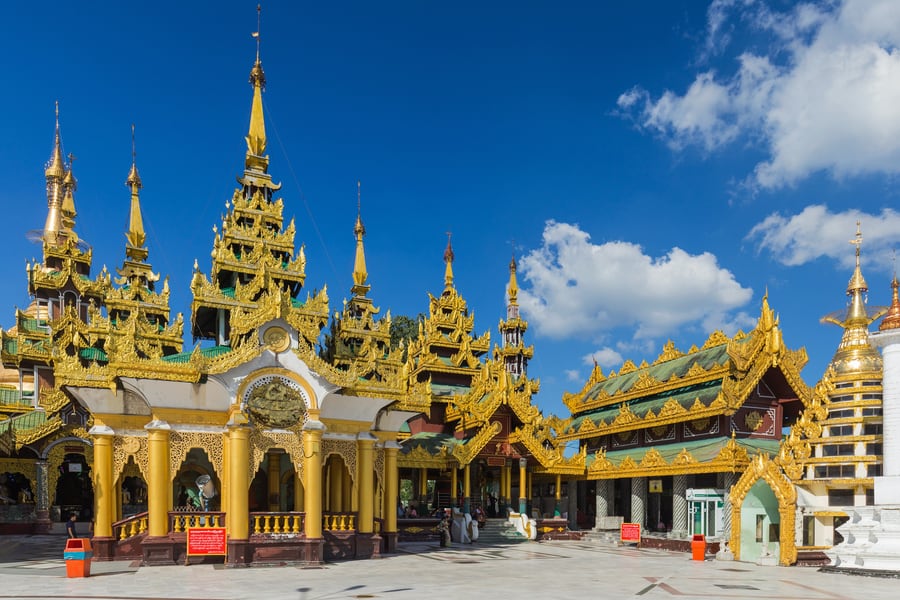
The Shwedagon Pagoda
The stupa stands on Singuttara Hill, 51 metres above the city, and is held to enshrine relics of four Buddhas — among them eight hairs of the Gautama Buddha. It is plated in genuine gold and overwhelming at close range: terrace after terrace of gilded shrines, pavilions and small stupas radiating out from the great spire. Come at dusk, when the platform fills with families, monks and candlelight. Nothing else in Yangon compares.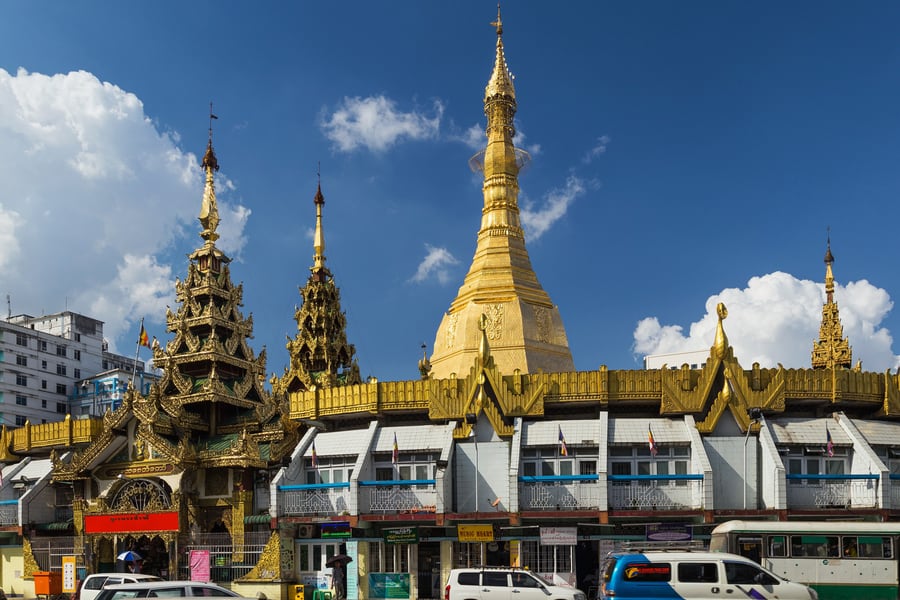 Marcin Konsek / Wikimedia Commons · CC BY-SA 4.0 · cropped
Sule Pagoda
Downtown Yangon was laid out around it, and the golden stupa now sits marooned in a traffic roundabout with shops built into its own base and buses grinding past on every side. Burmese legend makes it older than the Shwedagon. It has also been the pivot of modern Burmese politics: the rallying point of the 1988 uprising and again of the 2007 Saffron Revolution. You will pass it a dozen times without meaning to.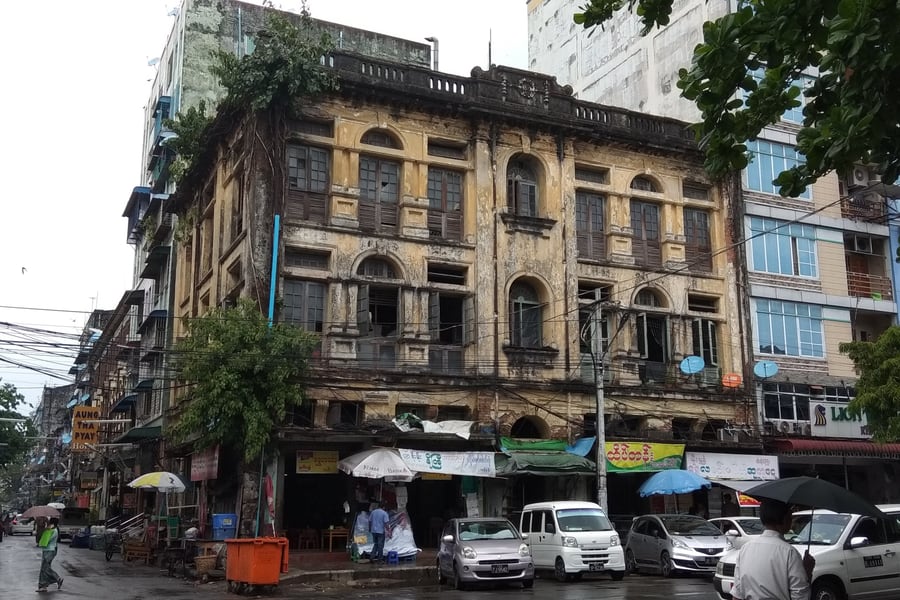 Bjoertvedt / Wikimedia Commons · CC BY-SA 4.0 · cropped
Downtown Yangon
South of the station lies one of the largest surviving ensembles of colonial architecture in Asia — whole blocks of weathered Victorian and Edwardian offices, stucco peeling off in sheets, banyan seedlings in the parapets, and ground floors full of tea shops, book stalls and mohinga vendors. Pansodan Street and Merchant Road are the best of it. No city centre in the region rewards aimless walking more.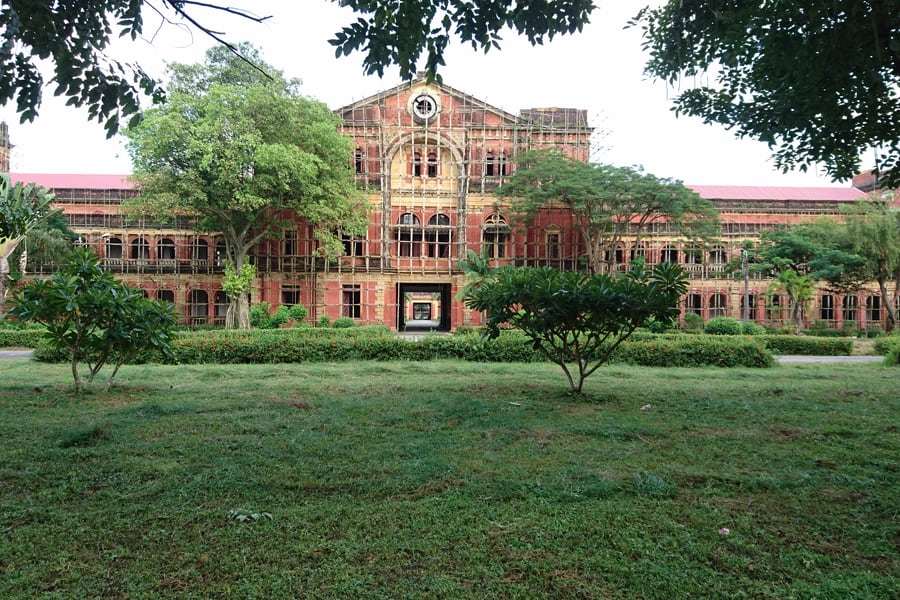 Mejillon095 / Wikimedia Commons · CC BY-SA 3.0 · cropped
The Secretariat
The vast red-brick Ministers' Office was the administrative seat of British Burma, filling an entire city block of 6.5 hectares between Anawrahta, Theinbyu and Maha Bandoola roads. It is also the building in which Aung San and eight cabinet ministers were assassinated — the single most consequential room in modern Burmese history. It stood empty and overgrown for decades; access has been partial and intermittent since.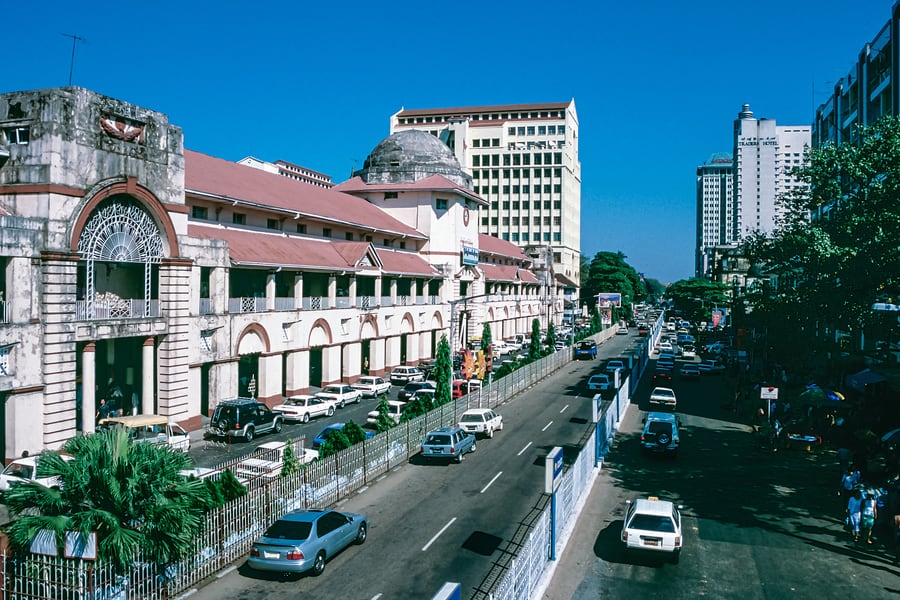 Stefan Fussan / Wikimedia Commons · CC BY-SA 3.0 · cropped
Bogyoke Aung San Market
Built in 1926 as Scott Market and renamed after independence — and, despite the common story, named not for the civil servant who brought football to Burma but for Gavin Scott, the municipal commissioner of the day. Inside are cobbled lanes under a long colonial roof, lined with lacquerware, jade, longyis, antiques and art. It is a tourist market and makes no secret of it. Note that it closes on Mondays.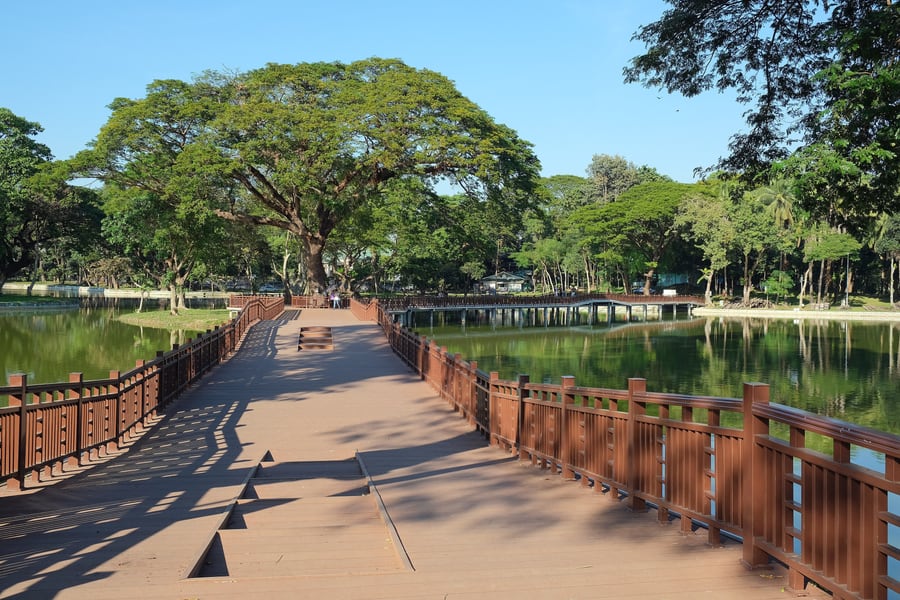 kallerna / Wikimedia Commons · CC BY-SA 4.0 · cropped
Kandawgyi Lake
East of the Shwedagon, and entirely artificial: the British created it as a clean water supply, piping it from Inya Lake, and for all its 4.8 km circumference it is barely a metre deep. A teak boardwalk runs out over the water and around the shore through the surrounding parkland, and at the right moment the gilded pagoda floats above the treeline and is doubled in the lake. The easiest hour in Yangon after a day on the rails.Where to Sleep
Sleep downtown. The blocks between Yangon Central station and the river hold the city's most atmospheric addresses — colonial-era buildings converted into hotels and guesthouses, from budget rooms above tea shops to the grand old riverfront institutions — and put you within walking distance of the circle line's starting point, the markets and the best street food in Myanmar. Booking the famous names directly is wise; the international booking platforms work only patchily for Myanmar, and a direct email is often the only reliable channel.
Mid-range travellers will find comfortable, well-run hotels around Kandawgyi Lake and near the Shwedagon — leafier and quieter than downtown, with the pagoda a stroll away, at the cost of a short taxi to the station.
Two practical notes for the times. First, pay attention to your government's travel advice and to local conditions when choosing where to stay; Yangon is calm compared with much of the country, but the situation is not static. Second, carry cash — cards and ATMs work erratically, and hotels frequently prefer crisp US dollars or kyat. Yangon has hosted travellers through every chapter of its history; a little preparation lets it host you well through this one.
Questions or corrections
Planning this trip and stuck on something, or spotted a time, fare or detail that has changed? Send us a message about The Yangon Circular Railway. We read every one, and we update this page when something has changed.