The Yaoundé to Ngaoundéré Sleeper
Bmnda / Wikimedia Commons · CC0 · 2016/17 · cropped
- Distance620 km, Yaoundé to Ngaoundéré
- Duration13 h 47 northbound · 12 h 43 southbound
- Best seasonNightly, all year · November to March is the dry season on the plateau
Introduction
Cameroon's railway ends at Ngaoundéré. Not at a border and not at a port — at a town on the Adamawa plateau, 620 km north of the capital, with a good half of the country still in front of it. Everything beyond it — Garoua, Maroua, the Chad frontier, N'Djamena — carries on by road from the end of the platform. That is what makes the overnight train out of Yaoundé the most important passenger working in the country. It is the hinge on which the forest south hands the traveller over to the Sahelian north.
Camrail calls it the sleeper and it is one. Train 191 leaves Yaoundé at 19:50 and train 192 leaves Ngaoundéré at 19:15, every day of the week in both directions, with two-berth and four-berth compartments, first and second class seating and a bar-restaurant car. The run takes a little under fourteen hours going north and a little under thirteen coming back, and it calls at seventeen stations, most of them in country where nothing else is scheduled to stop.
The line beneath it was the last piece of the Transcamerounais. Work started north from Yaoundé in 1964 and the rails reached Ngaoundéré ten years later; the station there opened on 10 December 1974 and has been the head of the Cameroonian railway ever since.
The Journey
The train boards at Yaoundé's passenger station in the early evening and pulls out at ten to eight, which means the first two hours are spent watching the capital's hills give way to forest in the dark. Little is lost by that. The scenery on this line is a slow gradient rather than a set of views: equatorial forest at the southern end, then wooded savanna, then the open grass of the Adamawa, which is the barrier between Cameroon's forested south and its savanna north. What a daylight run would show is what the night run tells you anyway, through the windows at Obala and Mbandjock, and again after dawn on the plateau.
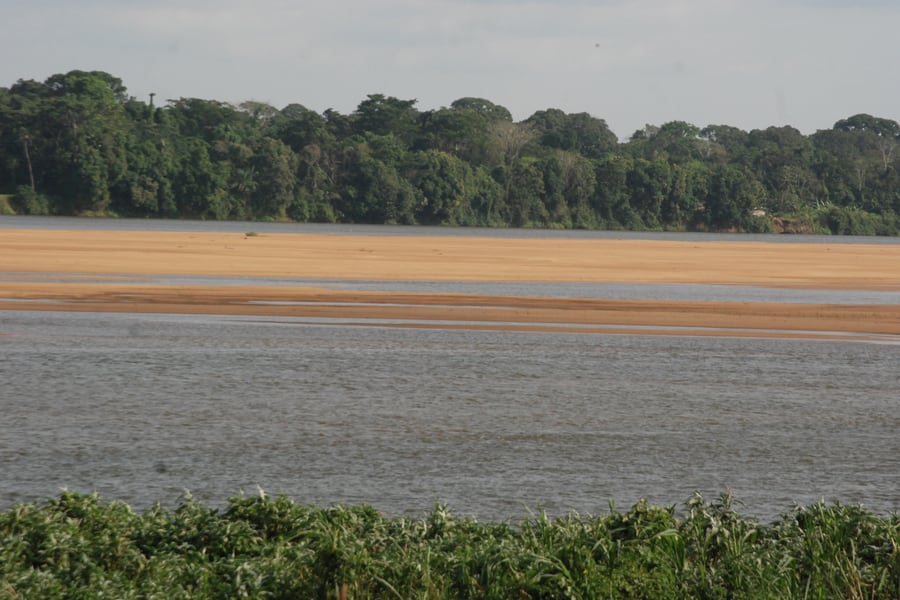
The first half of the run belongs to the Sanaga, the largest river in Cameroon, and the train calls at Nanga Eboko on its bank. Bélabo, roughly the midpoint, is the town the railway made: it stands on the line, it is where the omnibus that works the northern half begins its run, and it is the point at which the climb towards the plateau starts in earnest, on a ruling gradient of 1.6 per cent. Beyond it the railway crosses the Djérem — one of the two rivers whose confluence makes the Sanaga, and a bridge the country thought striking enough to put on a postage stamp when the line opened in 1974. Ngaoundéré itself stands at about 1,270 metres, and its name in Mbum means "navel of the mountain".
What runs, and what pulls it
Camrail's sleeper is a long, conventional, locomotive-hauled train. The operator's own description gives two first-class cars, eight second-class cars, one sleeping car with two-berth compartments, three or four more with four-berth compartments, a bar-restaurant car, a generator van and a luggage van. That formation used to offer between 951 and 983 seats a service; when the Chinese-built cars were taken out of use in 2017 the capacity was roughly halved, to sets of 429 and 438.
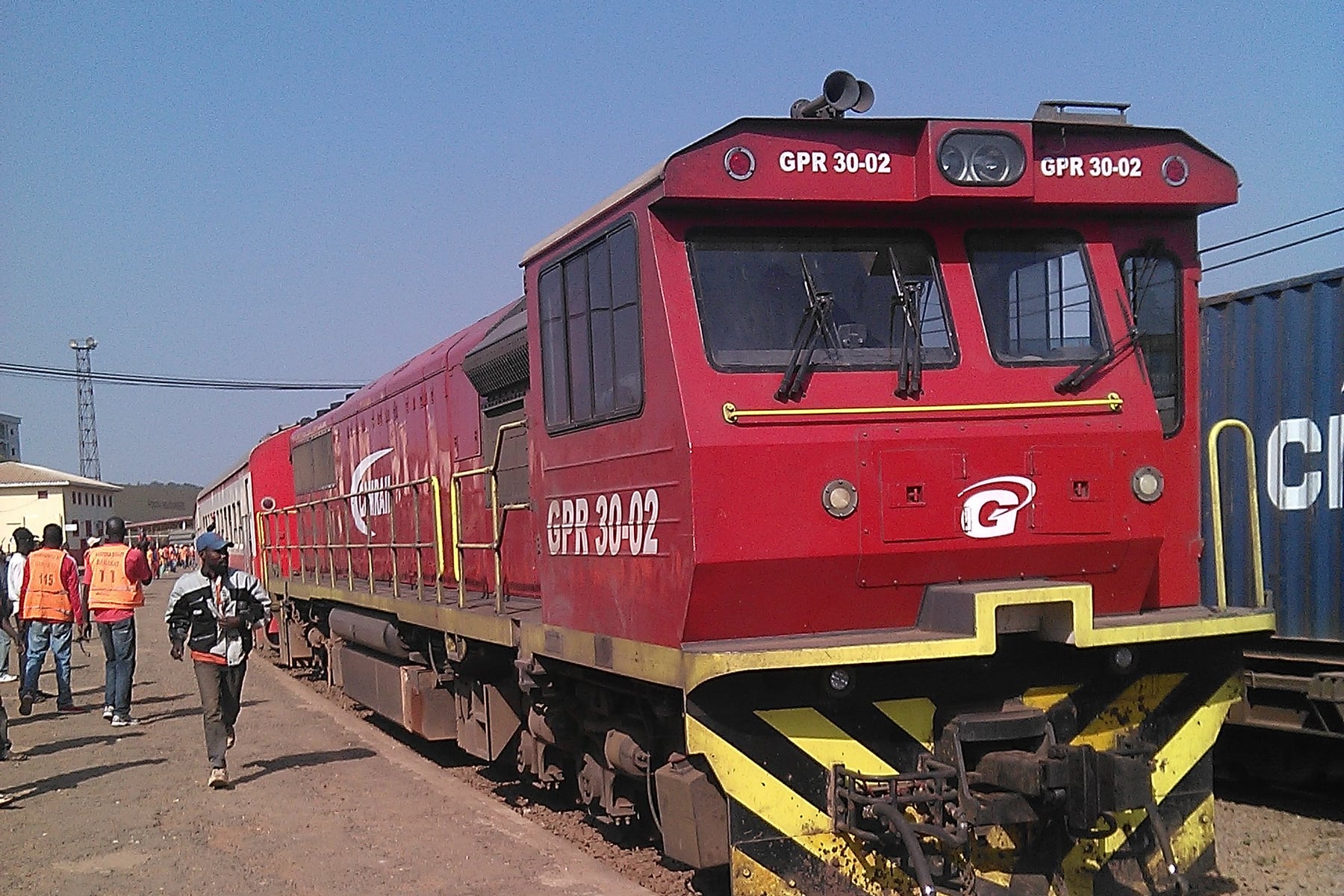
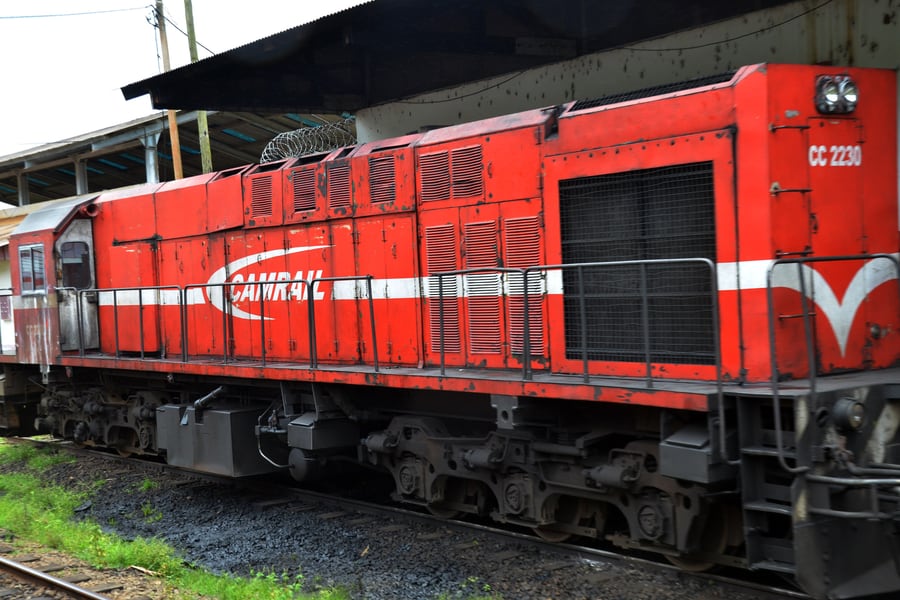
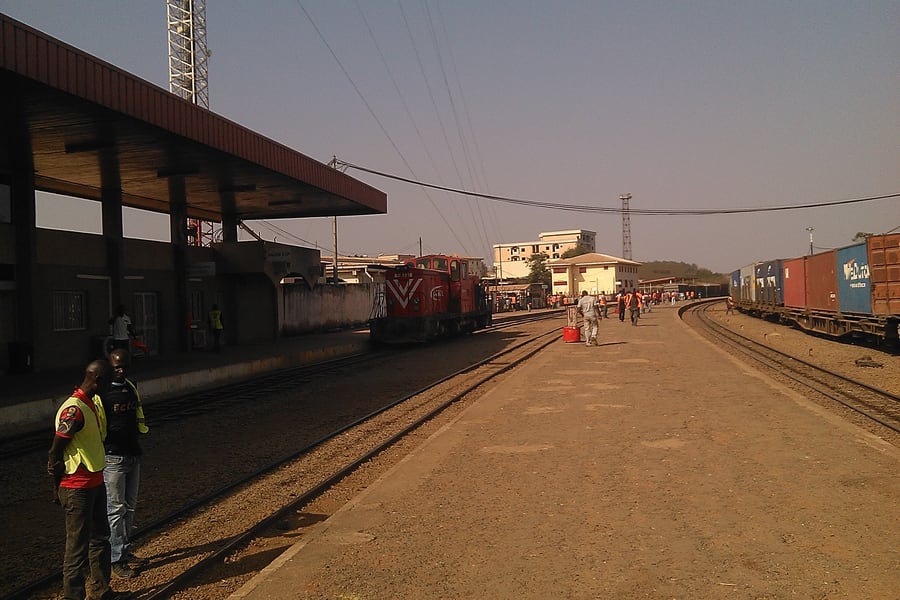
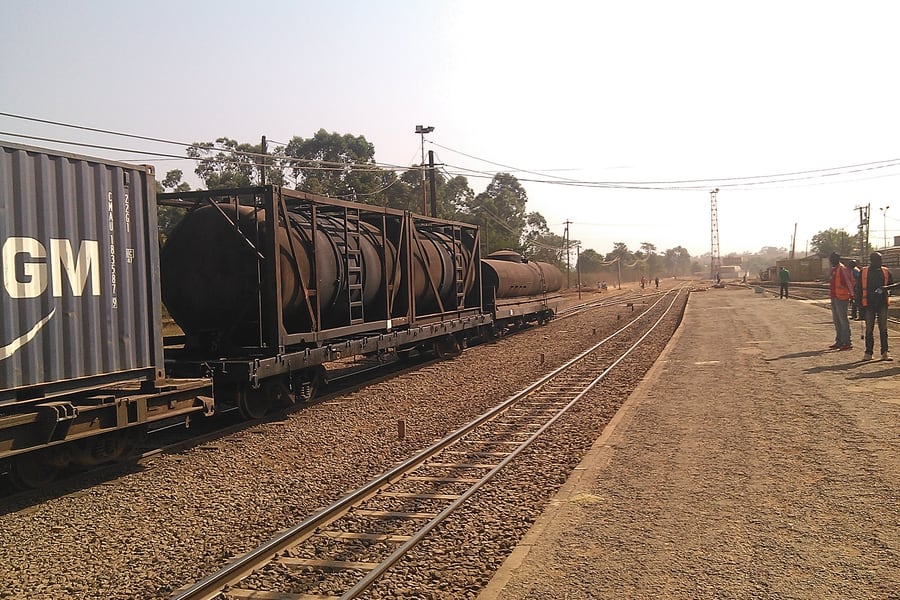
The traction is whatever the depot has. Camrail's passenger and freight fleets are not separate, so the front end may be one of the thirty-two Bombardier-built CC 22 machines of 2,200 hp, or one of the nine GPR 3000 units that the South African builder Grindrod delivered in 2015 — the type in the photograph at the top of this page, GPR 30-02, standing at Ngaoundéré at the head of the train from Yaoundé. Four more locomotives, of Grindrod's GL30 type, were landed at Douala on 6 February 2026, though those were bought for freight.
The bar-restaurant, and the hostesses
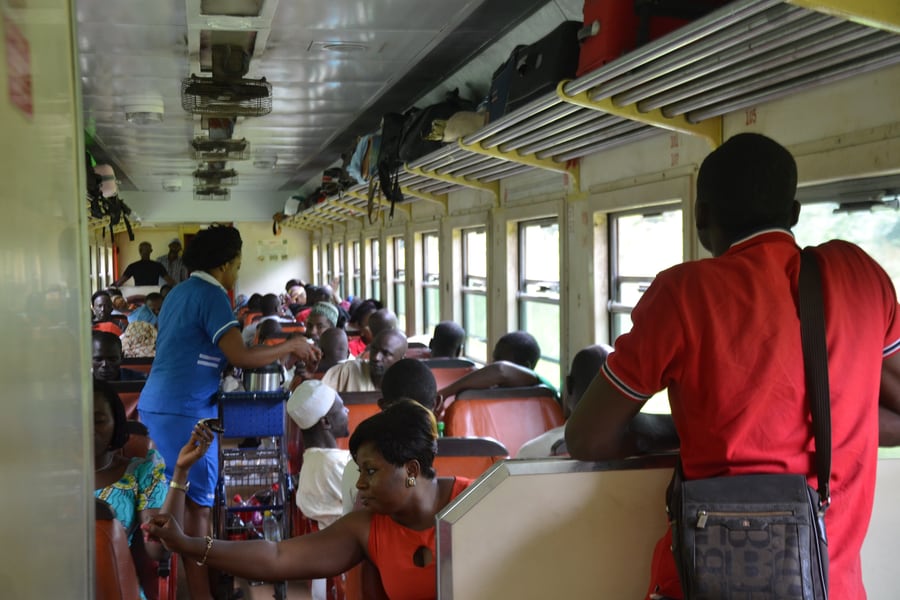
The bar-restaurant car is the part of the train Camrail talks about most. It has a proper menu with hot and cold dishes, a children's menu, an audiovisual system for the evening, and hostesses who work the cars with a trolley as well as serving in the restaurant. Announcements are made in both French and English, which is less of a formality here than it sounds: Cameroon is officially bilingual and the operator publishes in both languages, one of very few in the region that does.
Along the route
The end of the rails
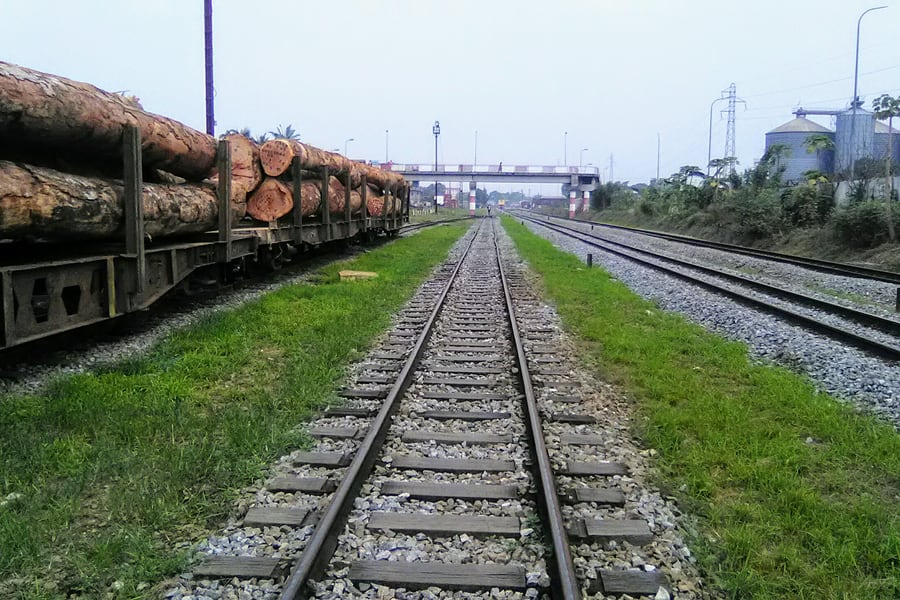
Ngaoundéré is where Cameroon's railway stops. Garoua, Maroua and the road to N'Djamena all begin at the platform end, which is why this train matters far more than its length suggests.Onto the plateau
The climb out of the Sanaga basin is worked at a ruling gradient of 1.6 per cent. It ends on high savanna, with Ngaoundéré itself at about 1,270 metres.The bridge on the stamp
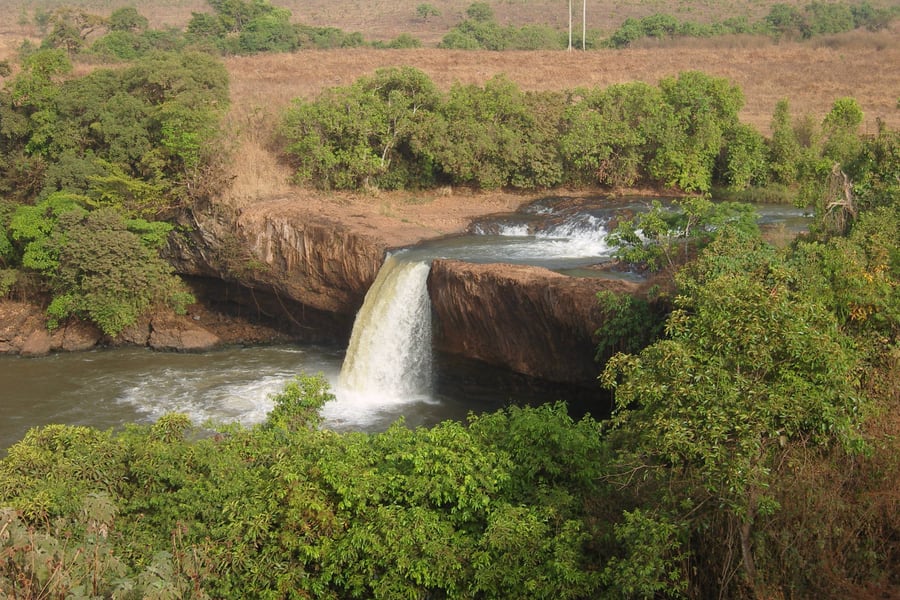
When the line opened in 1974 Cameroon marked it with four postage stamps. One of them was the bridge over the Djérem, which the train crosses north of Bélabo.A bit of history
Culture & experiences along the way
 PRA / Wikimedia Commons · CC BY 3.0 · cropped
Ndolé, which Cameroon will argue about
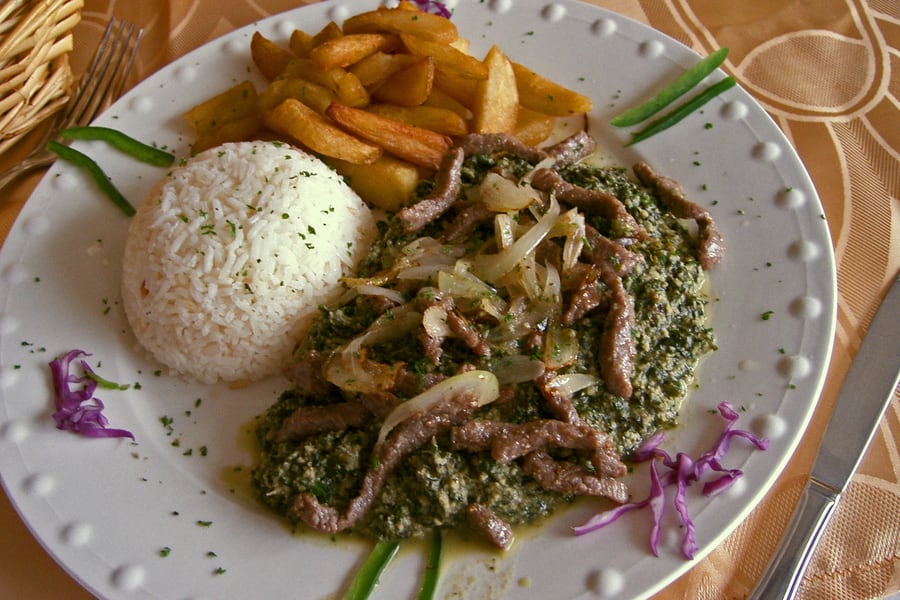
The national dish is bitterleaf — ndolé — boiled hard to draw the bitterness out, then cooked down with ground peanuts, crayfish and beef or smoked fish into something dense and dark green. It comes with fried ripe plantain or boiled cassava, and no two households agree on the balance.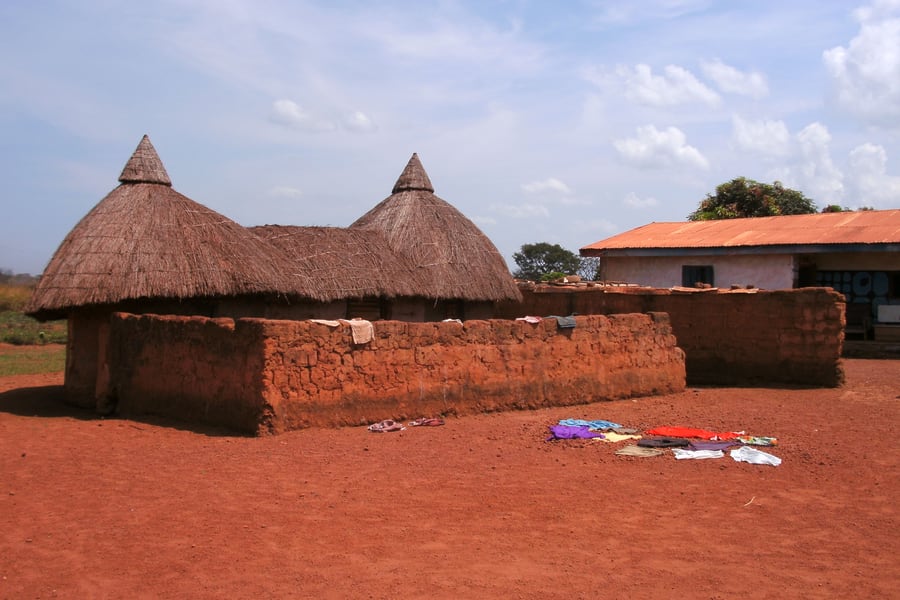 WILLAV-FR / Wikimedia Commons · CC BY-SA 4.0 · cropped
Into the lamidats
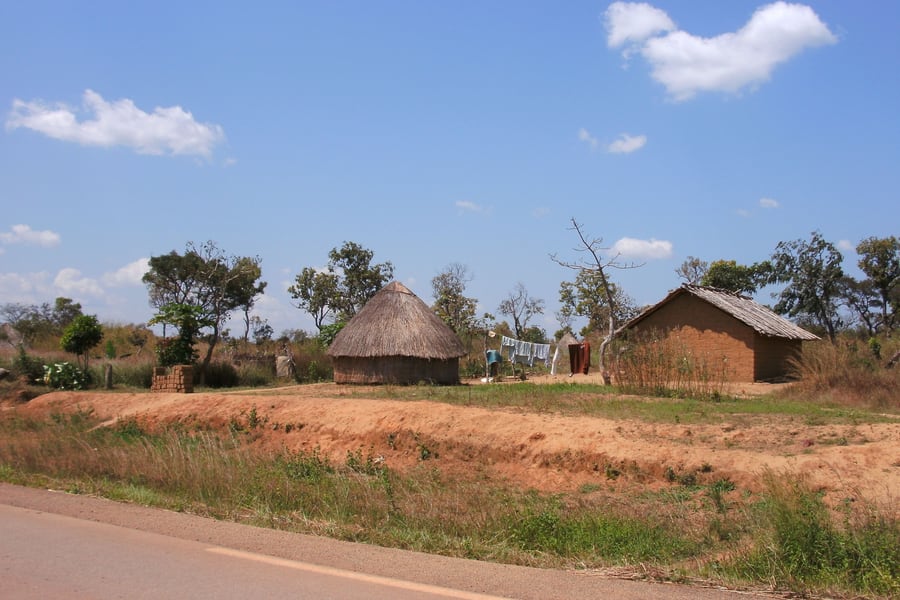
North of Bélabo the forest thins and the train climbs onto the Adamawa, which is Fulani country and has been governed since the nineteenth century through lamidats — chieftaincies under a lamido. The compounds show it: laterite walls, conical thatch, a gated entrance hall where visitors wait. The lamido's palace at Ngaoundéré receives them still.Timetables
One train runs each way, every night, in both directions. The times below have been in force since Monday 3 April 2023, when Camrail rearranged the schedule and took about four hours out of the run.
| Train | Route | Departs | Arrives |
|---|---|---|---|
| 191 | Yaoundé → Ngaoundéré | 19:50 | 09:37 next day |
| 192 | Ngaoundéré → Yaoundé | 19:15 | 07:58 next day |
Seventeen stations are served, in this order out of Yaoundé: Obala, Batschenga, Mbandjock, Nanga Eboko, Ouassa, Mengué Bibey, Zing, Mbargué, Bélabo, Goyoum, Tête d'Éléphant, Mbitom, Pangar, Ngaoundal, Makor, Bawa and Ngaoundéré. A separate omnibus, trains 112 and 113, works the northern half between Bélabo and Ngaoundéré twice a week in each direction and calls at all 21 stops on that stretch.
Most travellers reach Yaoundé from Douala on the day train, and the connection works in one direction only. The Train Express TE185 leaves Douala at 06:30 and arrives at 11:15, which leaves the afternoon free before the sleeper goes north; coming the other way, TE186 leaves Yaoundé at 17:00 and reaches Douala at 21:45, well after 192 has arrived. Both run daily and take 4 h 45.
Camrail's online sales open about a week ahead, so a departure more than eight days away simply does not appear in the booking system yet — and berths in the near-term departures are often gone by the time it does. Watch the operator at camrail.cm (opens in a new tab).
Times as of August 2026.
Tickets
Tickets are sold on Camrail's own platform at mycamrail.cm (opens in a new tab) and at station counters, and nowhere else. The operator issued a public warning in September 2025 about a counterfeit Facebook page and a fake booking form taking payments in its name, and was explicit that official information on tickets and timetables comes only from its two websites and from the guichets. Payment online is by mobile money.
Four fares cover the whole run and none of them moves with demand: the same figures come back from the booking system whichever date is asked for, and they match the tariff Camrail publishes. Shorter journeys are priced by distance — Bélabo, about the midpoint, is roughly half the through fare in either class of seat.
Fares as of August 2026.
Book your tickets
Second class seat
Yaoundé to Ngaoundéré, end to end
The cheapest way over the whole line, in one of the eight second-class cars.
Book Tickets (opens in a new tab, on mycamrail.cm)via mycamrail.cmFirst class seat
Yaoundé to Ngaoundéré, end to end
A seat in one of the two first-class cars, with the bar-restaurant along the train.
Book Tickets (opens in a new tab, on mycamrail.cm)via mycamrail.cmBerth in a four-berth compartment
Priced per berth
A bed in one of the three or four sleeping cars laid out with four-berth rooms.
Book Tickets (opens in a new tab, on mycamrail.cm)via mycamrail.cmBerth in a two-berth compartment
Priced per berth
The most private accommodation on the train, in the single two-berth sleeping car.
Book Tickets (opens in a new tab, on mycamrail.cm)via mycamrail.cmRail Passes
No rail pass covers Cameroon. Interrail and Eurail are European products, sold for a fixed list of European countries, and there is no African scheme that includes Camrail. Nor does Camrail sell a multi-journey ticket of its own: the network is one Y-shaped line of about a thousand kilometres, and a pass would have very little to be spent on.
What the operator does run is a loyalty scheme, and only on the day train between Douala and Yaoundé — ten end-to-end journeys earn an eleventh free. It has no equivalent on the sleeper.
Through ticketing to a neighbouring country does not exist either. The rails stop at Ngaoundéré, so travel on towards Chad or the far north begins with a road journey, bought separately.
Checked August 2026.
Places to Visit
This is a line with two ends and not much of a middle, at least as far as a visitor is concerned. The towns it serves between Yaoundé and Ngaoundéré are working places — a river town, a railway junction, a market — and the train reaches most of them in the dark. What is worth planning around is either end, plus Bélabo if the omnibus on the northern half is of interest.
The Adamawa itself is the barrier between Cameroon's forested south and its savanna north, and almost all of its 64,000 square kilometres is given over to cattle. The Muslim Fulbe are the largest group on the plateau; the Mbum, who named Ngaoundéré, were there before them.
 ADAMBITA / Wikimedia Commons · CC BY-SA 4.0 · cropped
Yaoundé
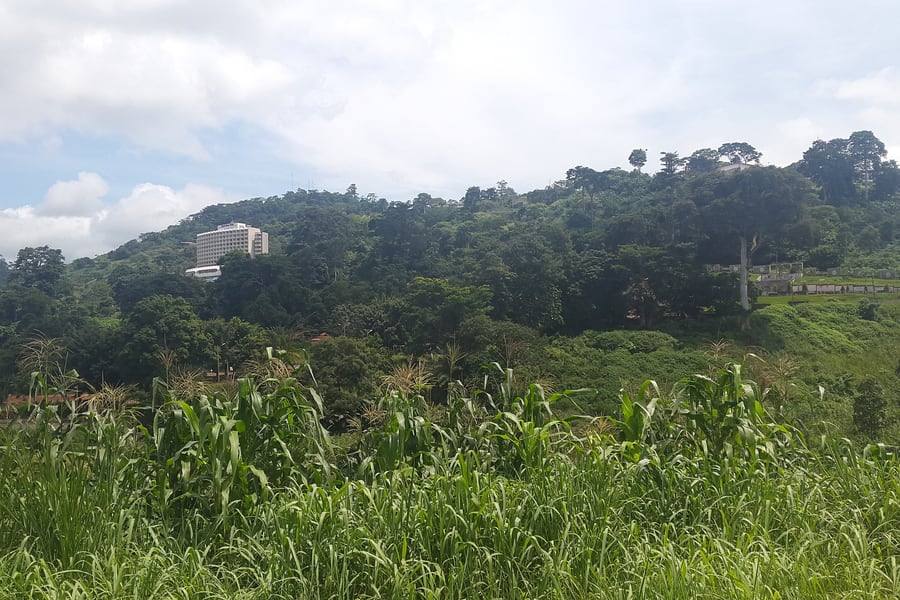
The capital, and the city of seven hills — which is why almost every view of it is from above. Mont Fébé stands over it to the north, wooded to the top, with a Benedictine monastery and a museum part of the way up; the hills around the city run to 1,200 metres and more, and the built-up quarters keep to the high ground while the marshy bottoms are left to gardens. The sleeper's late departure leaves a full day for it.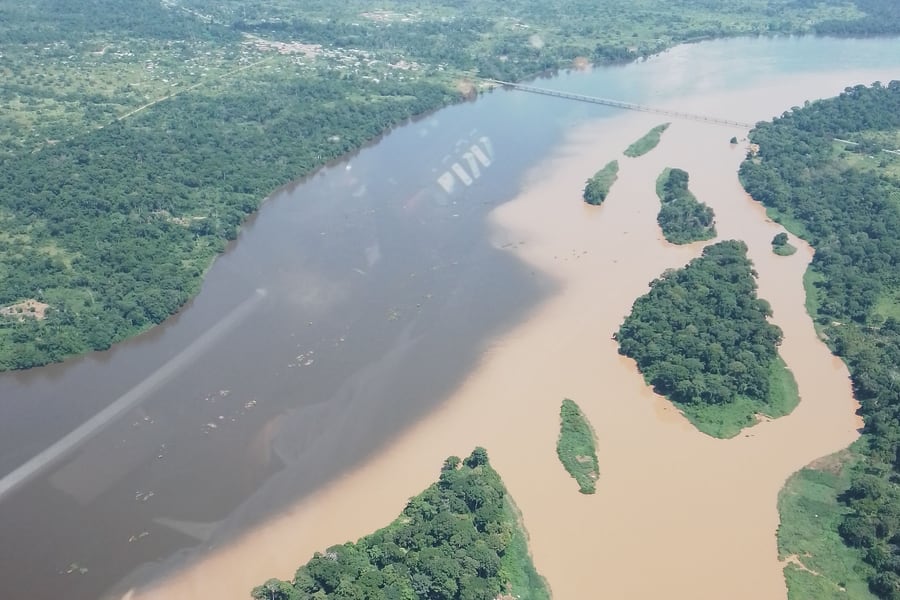 Flycameroon / Wikimedia Commons · CC BY-SA 4.0 · cropped
Nanga Eboko
The capital of the Haute-Sanaga department, on the bank of the river that gives the department its name — the Sanaga is the largest in Cameroon, formed where the Djérem and the Lom meet, and it runs 603 km from there to the Atlantic. The town is small — about eighteen thousand people within it — and it is the fourth stop out of Yaoundé.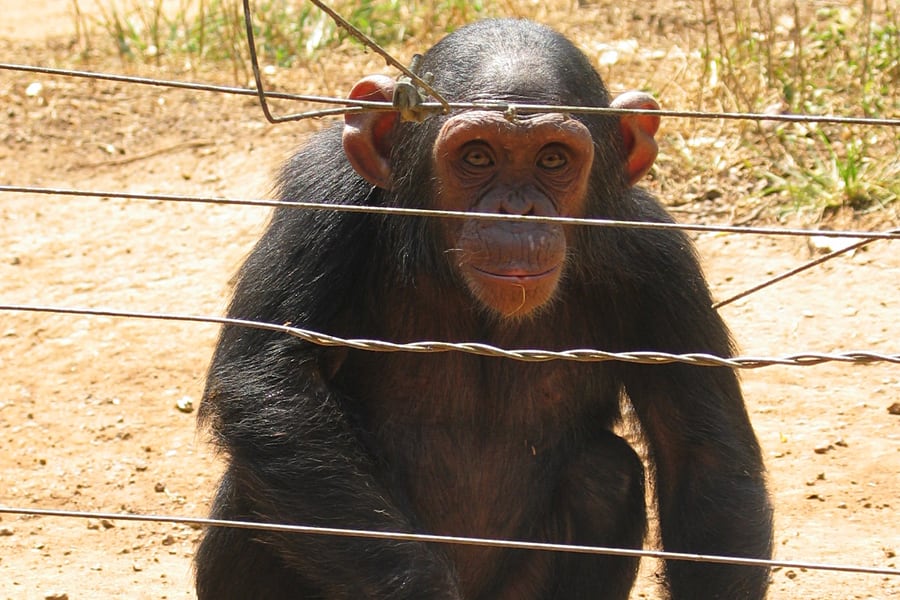 Amcaja / Wikimedia Commons · CC BY-SA 3.0 · 2007 · cropped
Bélabo
Roughly the midpoint, a town of 22,500 on the Sanaga, and a place the railway made — its quarry supplies the ballast and the aggregate for a factory casting the concrete sleepers the line is laid on. Beside it is the Mbargué forest, which the next station up the line is named for, and in it the Sanaga-Yong sanctuary has taken in rescued chimpanzees since 1999: eighty of them across 225 acres, with cabins for visitors.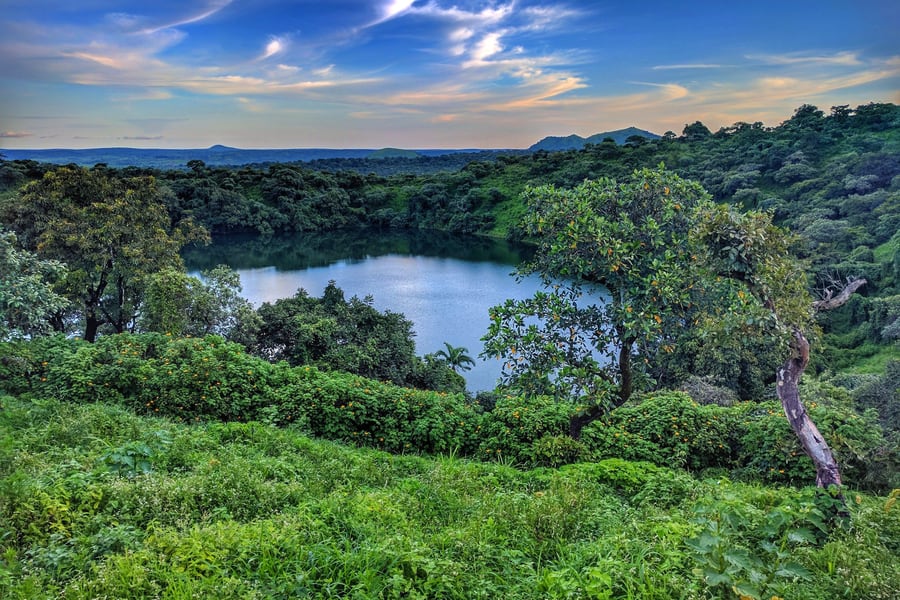 2ddanga / Wikimedia Commons · CC BY-SA 4.0 · 2015 · cropped
Ngaoundéré
The end of the line and the capital of the Adamaoua region, at about 1,270 metres, its name meaning "navel of the mountain" in Mbum. It is the crossroads of the northern trade, the point every lorry between the south and the far north has to pass through. Two things are worth the taxi: Lac Tison, a crater lake in the forest beside the Bertoua road, and the Vina falls, where the river drops off the plateau.Where to Sleep
The sleeper leaves Yaoundé late and arrives at Ngaoundéré in the middle of the morning, so a night at each end is part of the arrangement rather than an extra. Yaoundé has by far the wider choice, and the capital's established hotels sit in the government quarter around the Boulevard du 20 Mai, a short drive from the passenger station.
Ngaoundéré is a different proposition. It is a regional capital of some size and the road head for northern Cameroon, but its town-centre hotels are local businesses that take bookings by telephone and keep no website, so there is no honest link to give for them. The one place near the town that does publish for itself is out on the Meiganga road, half an hour away, and is a lodge rather than a hotel.
Where to stay
Hilton Yaounde
Boulevard du 20 Mai, in the government quarter
A city-centre hotel with five restaurants and bars, an outdoor pool, a fitness centre and sixteen meeting rooms.
Check Availability (opens in a new tab, on hilton.com)via hilton.comCampement Ranch de Ngaoundaba
Half an hour from Ngaoundéré, on the Meiganga road
A former hunters' camp turned lodge, seventy years old, with its own kitchen and chef and a lake below it.
Check Availability (opens in a new tab, on campementranchngaoundaba.com)via campementranchngaoundaba.comPractical information
Cameroon's railway carries an accident in its recent memory, and any honest account of it has to say so. On 21 October 2016 a Camrail train from Yaoundé to Douala derailed near Eséka, on the Douala line rather than this one. Seventy-nine people were killed and about 550 injured. A road bridge on the national highway between the two cities had collapsed a few days before, the train was carrying far more passengers than it was built for, and it had been lengthened from nine carriages to seventeen to take them. The investigation found speed and the condition of the rolling stock at fault. The express service on that route was relaunched in 2021.
The northern line is a different operation — an overnight train with reserved seats and berths rather than an overloaded day train — but the same operator runs both, and Camrail has spent the years since on new locomotives, renewed track and a public safety campaign along the lineside.
For the journey itself: bring what you want to eat as well as using the restaurant car, take a torch, and expect the train to be late rather than early. Announcements are in French and English. Ngaoundéré is the road head for the whole of northern Cameroon, so onward transport out of the station is plentiful, but destinations in the Far North region carry travel advisories and are worth checking with your own government before booking anything.
Questions or corrections
Planning this trip and stuck on something, or spotted a time, fare or detail that has changed? Send us a message about The Yaoundé to Ngaoundéré Sleeper. We read every one, and we update this page when something has changed.