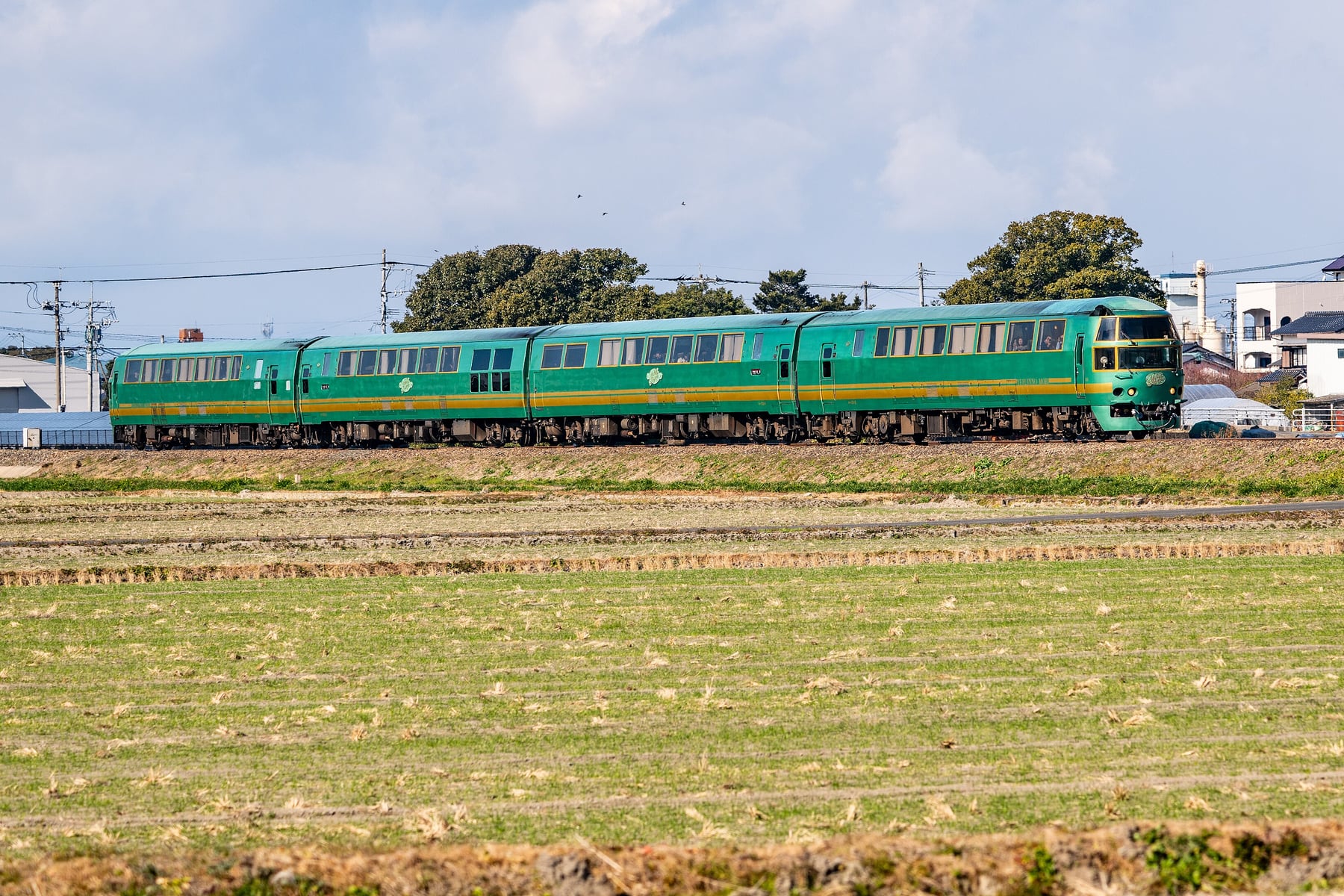
Yufuin no Mori
Takeshi Aida / Wikimedia Commons · CC BY-SA 2.0 · cropped
- Distance134.8 km to Yufuin · 189.3 km to Beppu
- DurationAbout 2¼ hours to Yufuin, 3 hours 20 minutes to Beppu
- Best seasonYear-round · autumn colour in the Kusu valley Oct–Nov, morning mist on Lake Kinrin from autumn into winter
Introduction
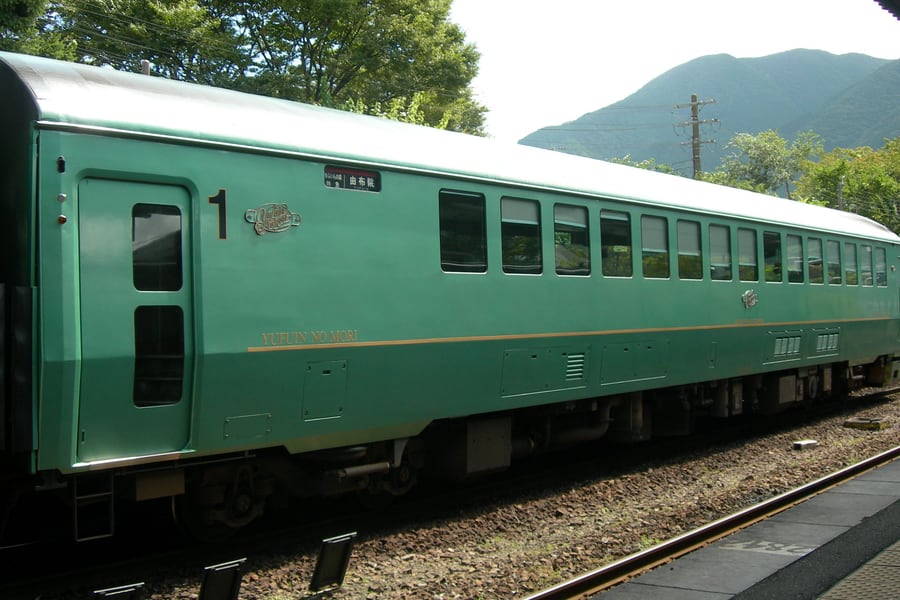
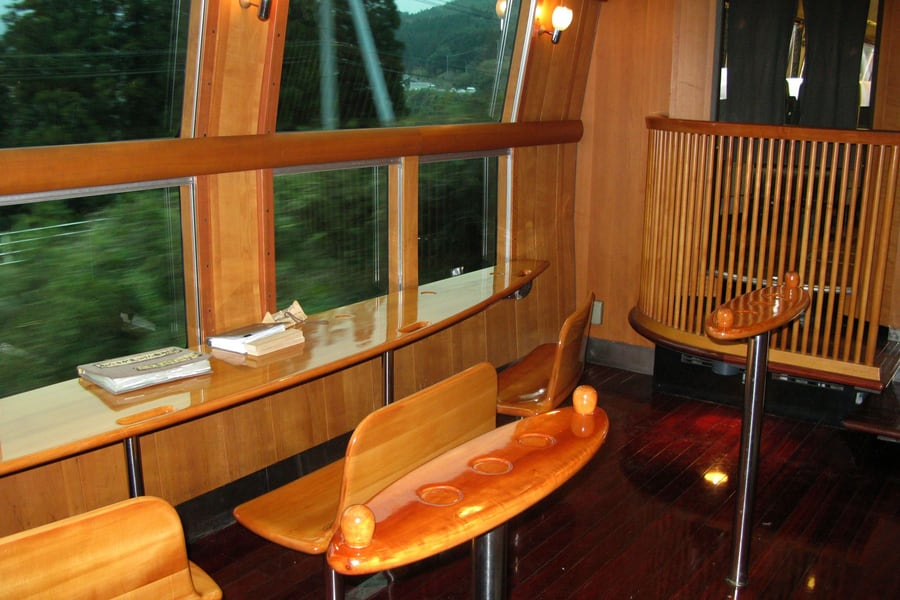
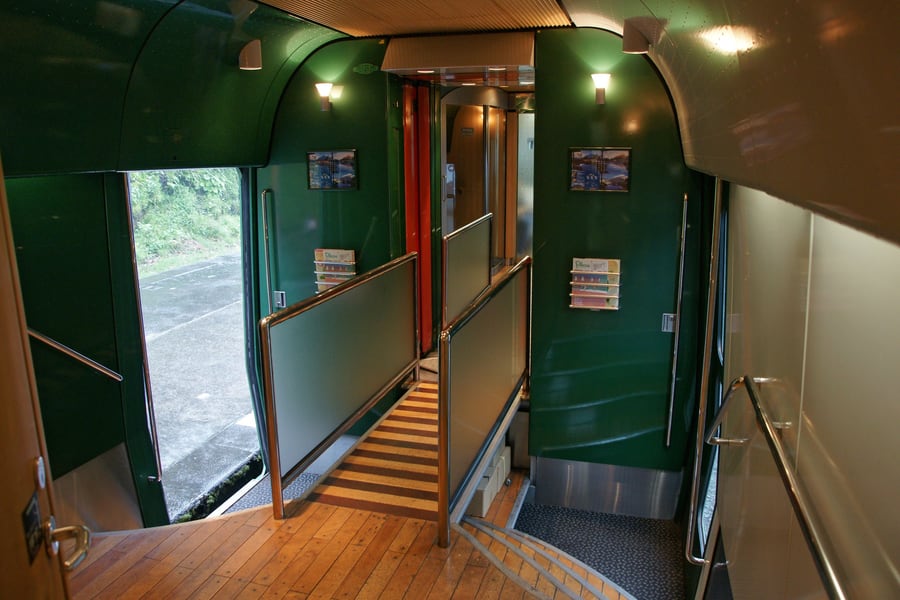
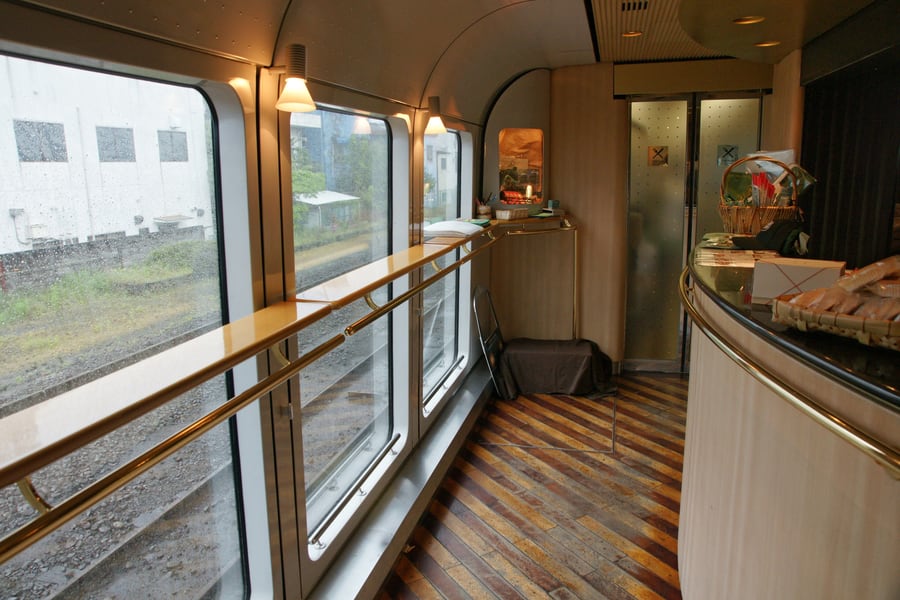
The Yufuin no Mori, "the forest of Yufuin", is JR Kyushu's resort express from Hakata in Fukuoka to Yufuin, the hot-spring town at the foot of Mt Yufu. It was built in 1989 around one idea: that the holiday in Yufuin should begin the moment you step aboard. The cars are metallic green outside and wood inside, the seats sit high above the rails for the view, and a buffet sells local beer, sweets and souvenirs.
It runs across the middle of Kyushu on the Kyūdai Line, a single-track, unelectrified railway that leaves the Chikugo plain, follows the Kusu River up through narrow valleys and hot-spring villages, and crosses a watershed to reach Yufuin in about two and a quarter hours. One round trip a day continues to Beppu, the hot-spring city on the coast.
Three round trips run every day, and every seat is reserved. They sell out day after day, so book as early as the seats go on sale.
The Journey
The train leaves Hakata on the Kagoshima Main Line and runs south across the Fukuoka plain to Tosu and Kurume, where it turns east onto the Kyūdai Line. For the next hour it crosses the flat rice country of the Chikugo River, with the long ridge of the Minō mountains on the right, and passes Tanushimaru, whose station is built in the shape of a kappa, the water sprite of local legend.
Up the Kusu valley
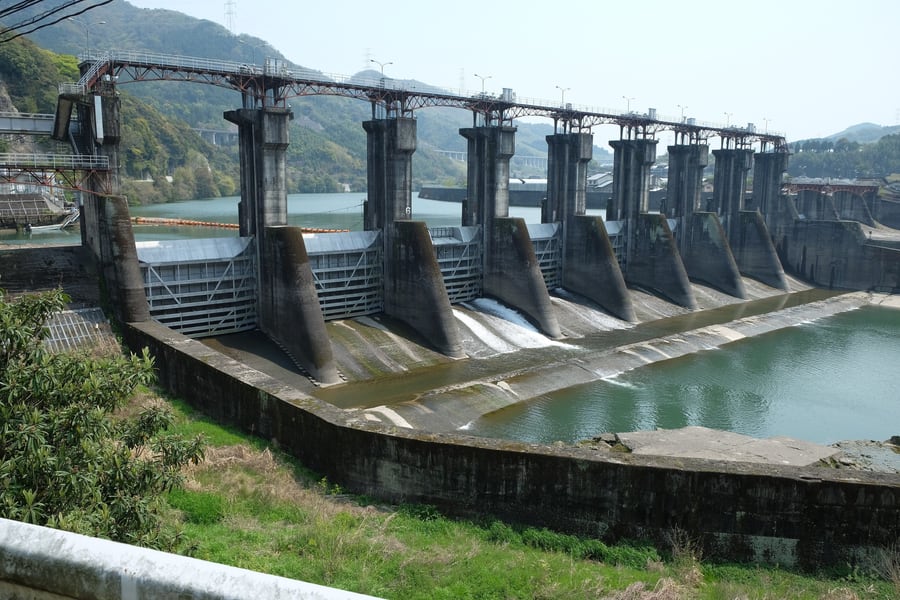
Past Yoake the line follows the green reservoir of the Yoake Dam into Hita, the old merchant town that was ruled directly by the shogunate. Beyond it the valley narrows: the train crosses and recrosses the Kusu River around the riverside hot springs of Amagase, and slows down for the Jion Falls on the right. Before Bungo-Mori the flat-topped Kirikabu-san, the "tree-stump mountain", stands to the right, and just past the station is the roundhouse of the old steam depot.
Over the watershed to Yufuin
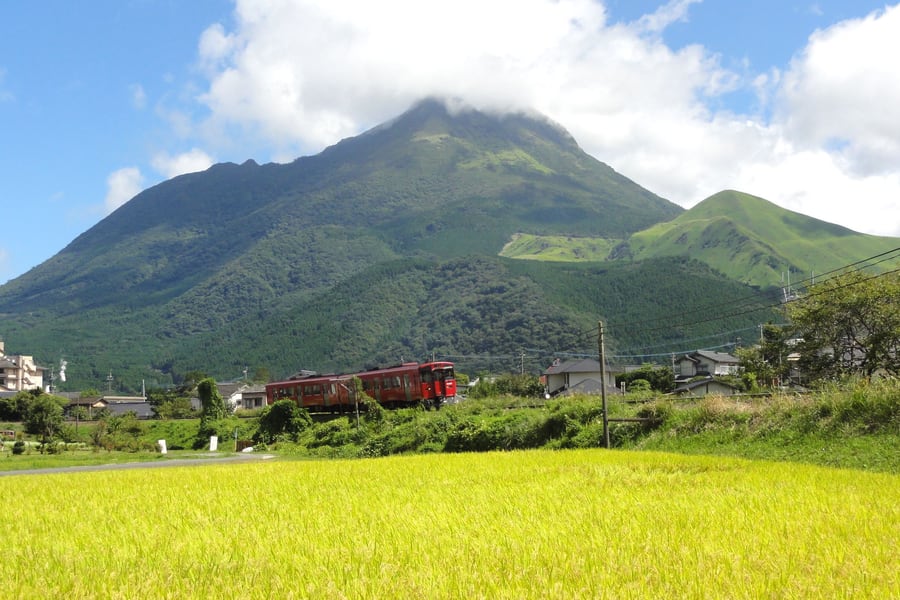
From Bungo-Mori the line climbs through forest and under the watershed in the 1,860-metre Mizuwake tunnel; behind it the water drains to the Chikugo River, ahead of it to the Ōita River. Then the twin peaks of Mt Yufu, called Bungo Fuji, appear ahead and the train runs down into the basin of Yufuin. A cabin attendant comes through with advice on the town shortly before arrival. The Beppu train carries on down the Ōita River to Ōita and along the shore of Beppu Bay, the only stretch of the journey beside the sea.
The trains
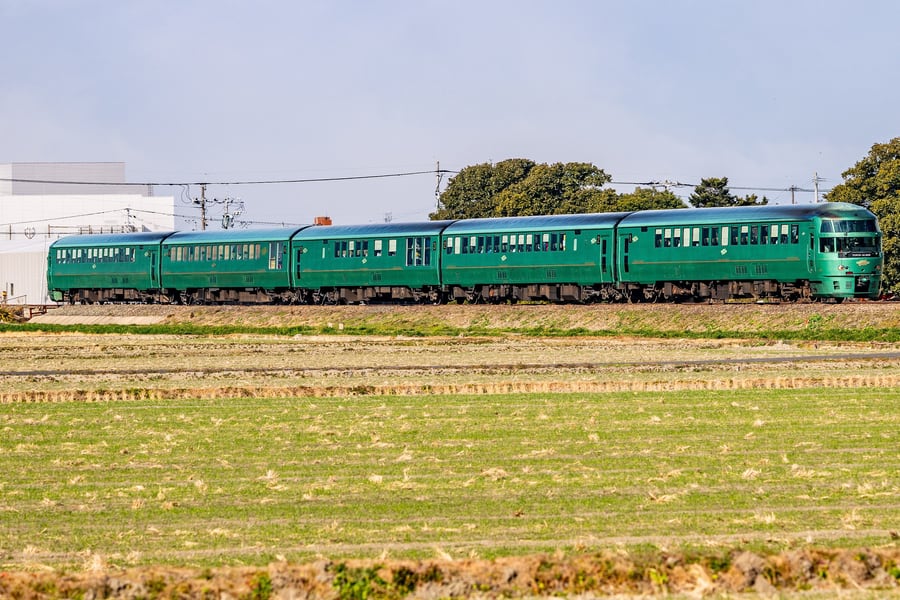
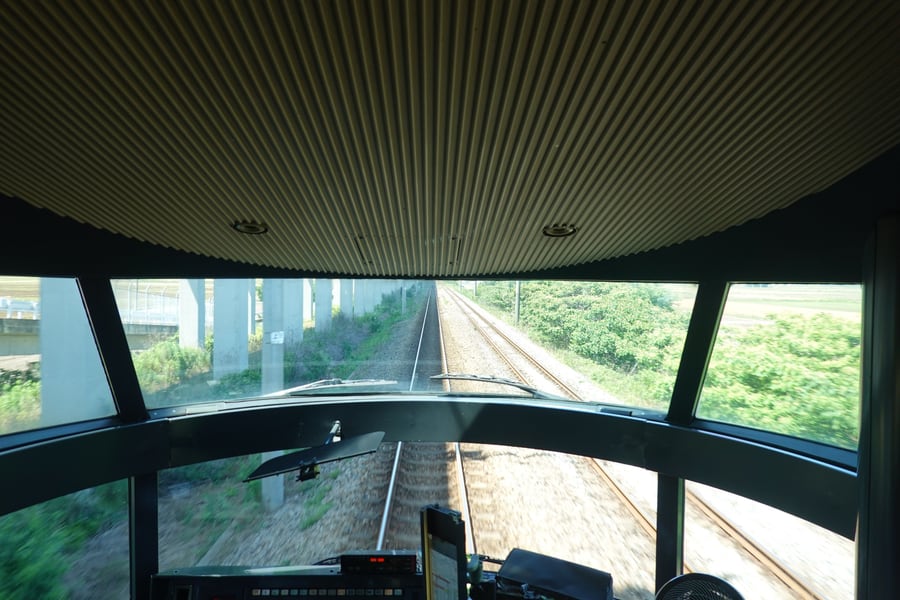
There are two sets. Yufuin no Mori I is the original four-car KiHa 71 of 1989, the first of JR Kyushu's design-and-story trains, and works the Beppu round trip. Yufuin no Mori III, the five-car KiHa 72 of 1999, works the other two. Both are high-deckers, with the passenger floor raised above the running gear, and both have a buffet; the KiHa 72's cars are joined by enclosed walkways like little bridges. The seats at each end look forward over the driver's cab and cost the same as any other. When a set is away for inspection, a plain KiHa 185 runs in its place as the limited express Yufu, on the same times and without the buffet. The line also carries two more of JR Kyushu's sightseeing trains, the Aru Ressha and the Kanpachi/Ichiroku, but both are sold only as tour packages; on some days one stands at Yufuin beside you.
Along the route
 sk01 / Wikimedia Commons · CC BY-SA 3.0
The Yoake Dam
Leaving the Chikugo plain, the line passes Yoake and runs beside the green water of the Yoake Dam into Hita. On Hita's platform stands a geta as tall as a person: the town is one of Japan's three great makers of the wooden clogs.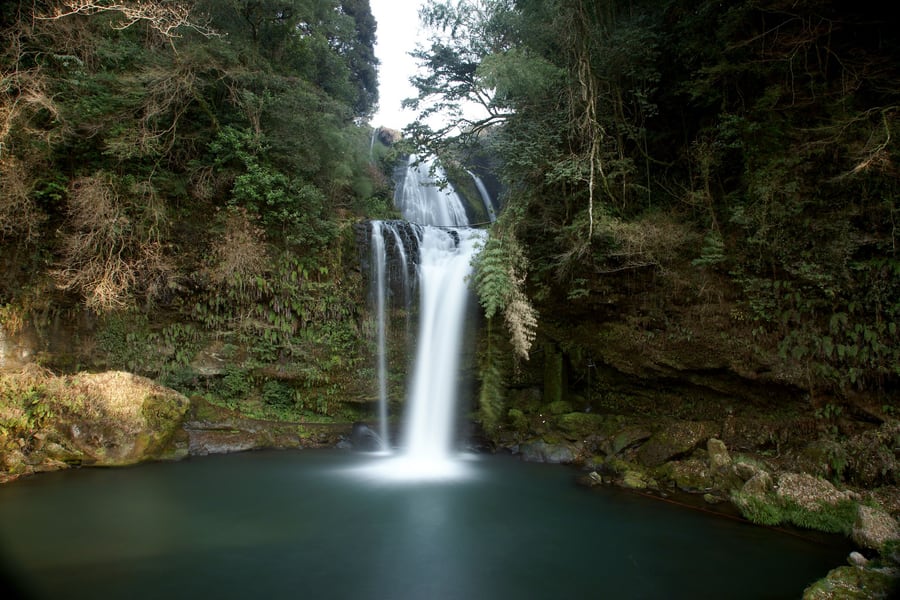 かるちる / Wikimedia Commons · CC0
Jion Falls
Past Amagase the train slows right down for the Jion Falls, on the right going to Yufuin. A cabin attendant walks through with a card bearing their name, and the falls are lit up after dark.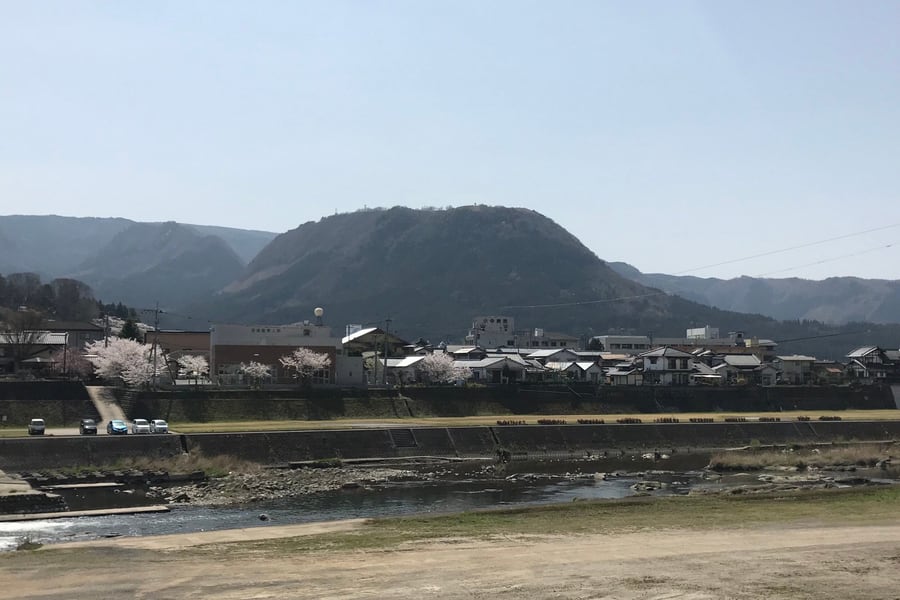 そらみみ / Wikimedia Commons · CC BY-SA 4.0 · cropped
The tree-stump mountain
Before Bungo-Mori, Kirikabu-san rises on the right with a summit so flat it looks sawn off. Just past the station stands the old steam depot's roundhouse, the last fan-shaped engine shed left in Kyushu.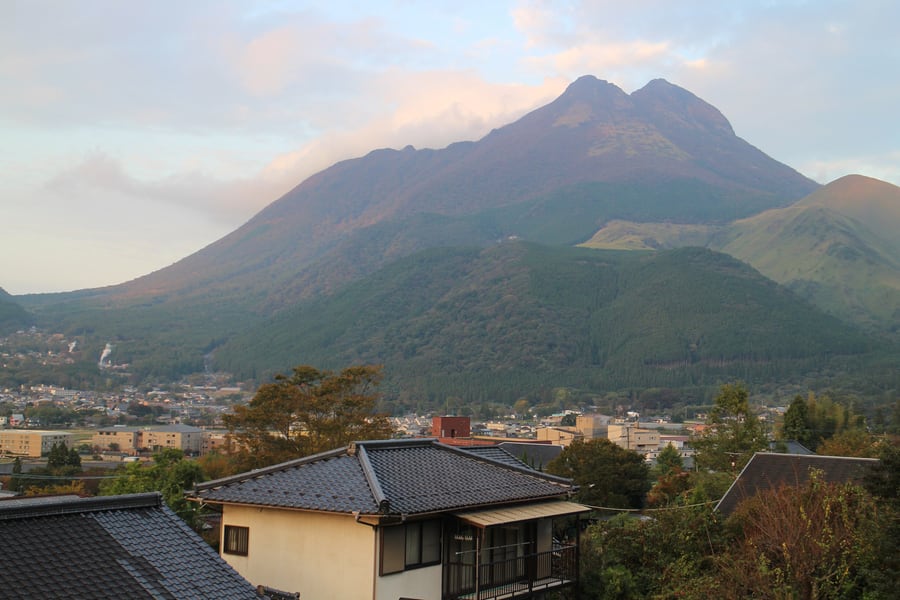 Suicasmo / Wikimedia Commons · CC BY-SA 4.0
Mt Yufu
Over the watershed the forest opens, and the twin peaks of Mt Yufu, called Bungo Fuji, stand straight ahead. The train runs down into the Yufuin basin with the mountain filling the front windows.A bit of history
Culture & experiences along the way
 663highland / Wikimedia Commons · CC BY 2.5
The buffet
Both sets carry a buffet stocked from along the line: Yufuin beer, a warm cheesecake made with Yufuin milk, a yuzu squash from the recipe of a Yufuin inn's tea room, and fruit sandwiches from Ukiha. The original KiHa 71 pours draught beer. Bento boxes come only by reservation, on JR Kyushu's website.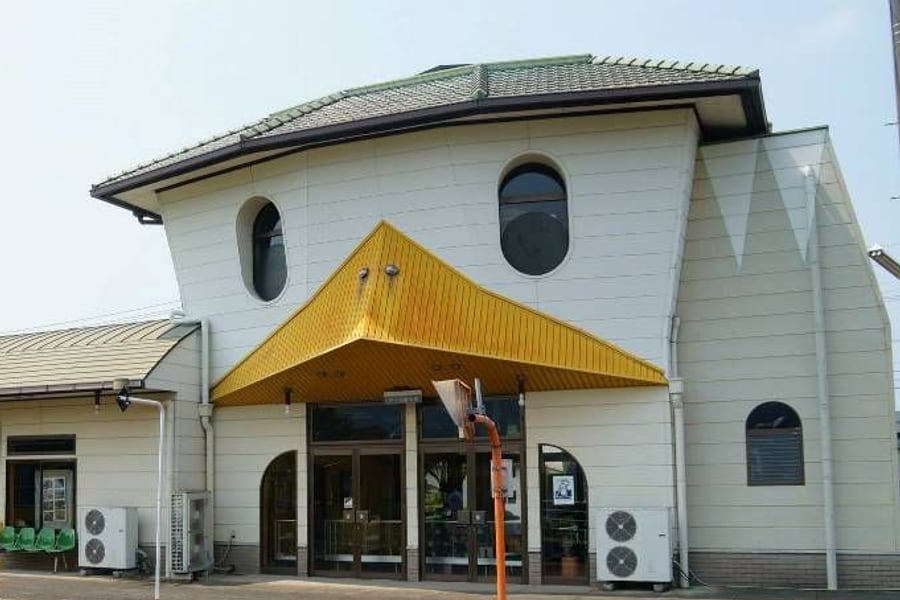 Anilsoi11 / Wikimedia Commons · CC BY-SA 4.0 · cropped
The kappa station
Tanushimaru calls itself the birthplace of the kappa, the water sprite of Japanese folklore, and in 1992 it rebuilt its station in the creature's shape: a white face with round eyes and a golden beak over the door. Look out on the left on the way to Yufuin.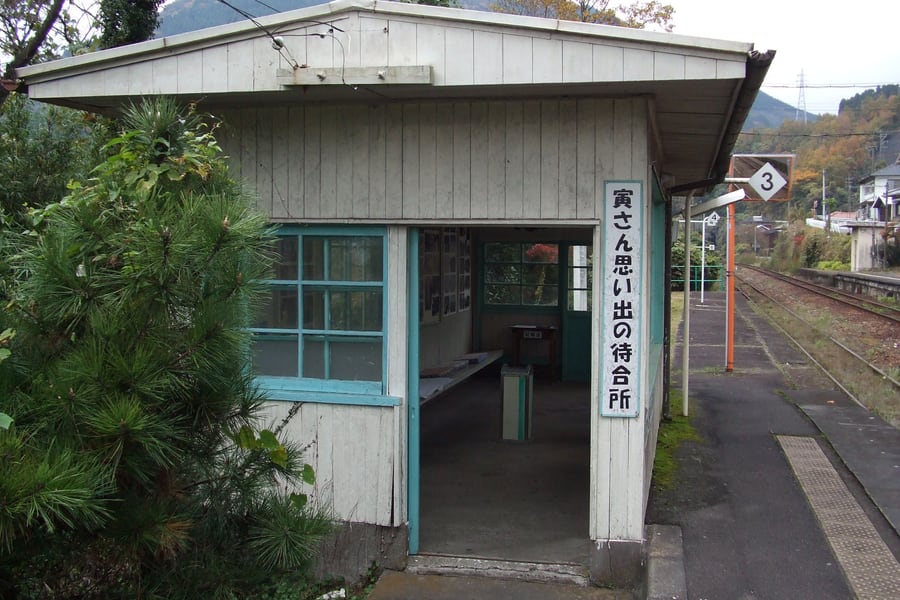 はづき裕一 / Wikimedia Commons · CC BY-SA 3.0 · cropped
Tora-san's waiting room
The hot-spring village of Yunohira, past Yufuin on the Beppu train, was a location for the thirtieth film of Otoko wa Tsurai yo, the comedy series about the wandering pedlar Tora-san. Since 2006 the old wooden shelter on its platform has been "Tora-san's memories waiting room", hung with photographs from the shoot.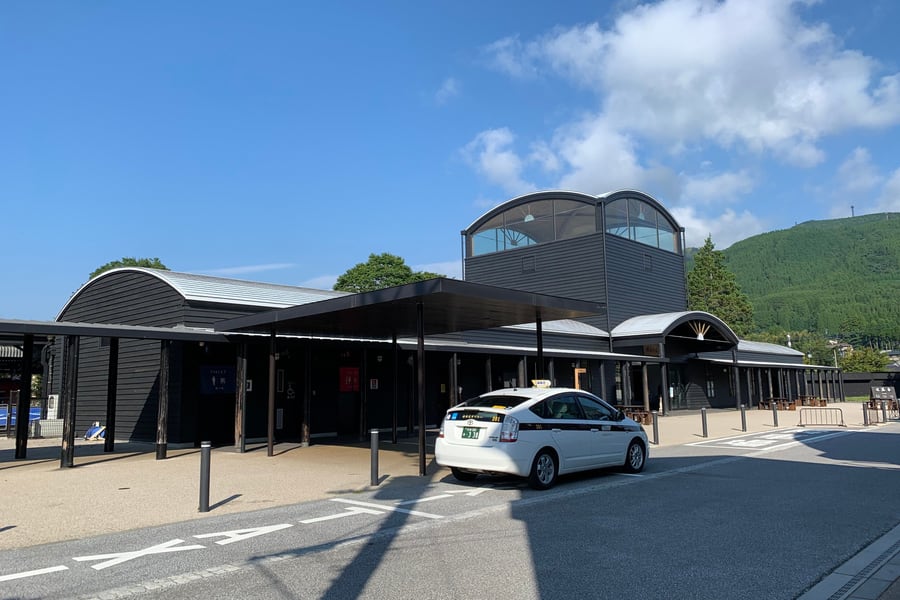 inunami / Wikimedia Commons · CC BY 2.0 · cropped
Isozaki's station
Yufuin station, finished in 1990, is the work of the Ōita-born architect Arata Isozaki: a black timber building with a tall, glazed hall that JR Kyushu likens to a chapel. Its platform footbath is closed for earthquake strengthening until about the end of 2026.Timetables
Three round trips run every day: two between Hakata and Yufuin, and one between Hakata and Beppu by way of Yufuin and Ōita. Every seat is reserved; there is no walk-up car.
Hakata to Yufuin and Beppu
| Train | Hakata | Kurume | Hita | Bungo-Mori | Yufuin | Beppu |
|---|---|---|---|---|---|---|
| No. 1 | 09:17 | 09:51 | 10:37 | 11:04 | 11:31 | — |
| No. 3 | 10:11 | 10:47 | 11:33 | 12:00 | 12:32 | 13:31 |
| No. 5 | 14:38 | 15:12 | 15:56 | 16:24 | 16:50 | — |
Beppu and Yufuin to Hakata
| Train | Beppu | Yufuin | Bungo-Mori | Hita | Kurume | Hakata |
|---|---|---|---|---|---|---|
| No. 2 | — | 12:01 | 12:32 | 13:01 | 13:46 | 14:19 |
| No. 4 | 14:36 | 15:56 | 16:24 | 16:53 | 17:36 | 18:10 |
| No. 6 | — | 17:17 | 17:44 | 18:12 | 18:54 | 19:27 |
Good to know:
- All trains also stop at Tosu and Amagase, and No. 3 and No. 4 at Ōita.
- Which train is which. Nos. 1, 2, 5 and 6 are normally the five-car KiHa 72; Nos. 3 and 4 are the original KiHa 71.
- Inspection days. On 14–16 and 19–23 October and 30 November 2026, Nos. 3 and 4 run as the limited express Yufu on the same times, without the buffet or cabin attendants. JR Kyushu publishes the days from December onwards in mid-October.
Times as of October 2026, from JR Kyushu's timetable of 14 March 2026. Check your date on JR Kyushu's Yufuin no Mori page (opens in a new tab).
Tickets
You need the fare plus a reserved-seat limited express ticket, bought together: ¥6,130 from Hakata to Yufuin and ¥4,160 to Hita for an adult, with the seat fee varying a little by date. JR Kyushu's web-only Kyushu Net ticket brings Hakata–Yufuin down to ¥5,600. Seats go on sale at 10:00 one month before travel, online and at JR ticket offices; the four-seat box seats are sold only at the offices.
The seats sell out day after day, and JR Kyushu itself suggests that anyone heading for Yufuin consider the other way round: the Sonic to Ōita by way of Kokura, then up the Kyūdai Line. Fares checked October 2026 on JR Kyushu's Yufuin no Mori page; Japanese yen.
Book your tickets
Hakata to Yufuin
One way, adult · fare and reserved seat
The whole run to Yufuin with a reserved seat, on sale one month ahead; the seat fee varies a little by date.
Book Tickets (opens in a new tab, on JR Kyushu)via JR KyushuHakata to Hita
One way, adult · fare and reserved seat
As far as the old merchant town of Hita, an hour and twenty minutes from Hakata.
Book Tickets (opens in a new tab, on JR Kyushu)via JR KyushuRail Passes
The Yufuin no Mori is a JR Kyushu limited express, and the JR passes cover it, reserved seat included. The JR Kyushu Rail Pass (Northern Kyushu) costs ¥15,000 for three days or ¥17,000 for five, and the All Kyushu pass ¥22,000 for three days; the Japan Rail Pass covers it too, at ¥50,000 for seven days. Book the seat at a JR Kyushu ticket office or machine, free with the pass; the Northern Kyushu pass allows six such bookings. Booking before you arrive, through JR Kyushu's pass website, costs ¥1,500 a section for a sightseeing train.
For a return trip to Yufuin alone, a pass does not quite pay: two single tickets cost ¥12,260 and the three-day pass ¥15,000. It pays once the trip goes further, on to Beppu and back to Hakata on the Sonic, say, or another day out across northern Kyushu; price those legs as single tickets before buying.
Checked October 2026 against JR Kyushu's Rail Pass (opens in a new tab) page and the Japan Rail Pass prices (opens in a new tab).
Places to Visit
With only three trains a day, a stop on the way out means coming back on a later train, so plan around the timetable: Hita fits between No. 1 and No. 5, and Bungo-Mori or Amagase between a morning train and No. 6 home. Yufuin itself deserves a night.
 Asturio Cantabrio / Wikimedia Commons · CC BY-SA 4.0 · cropped
Hita
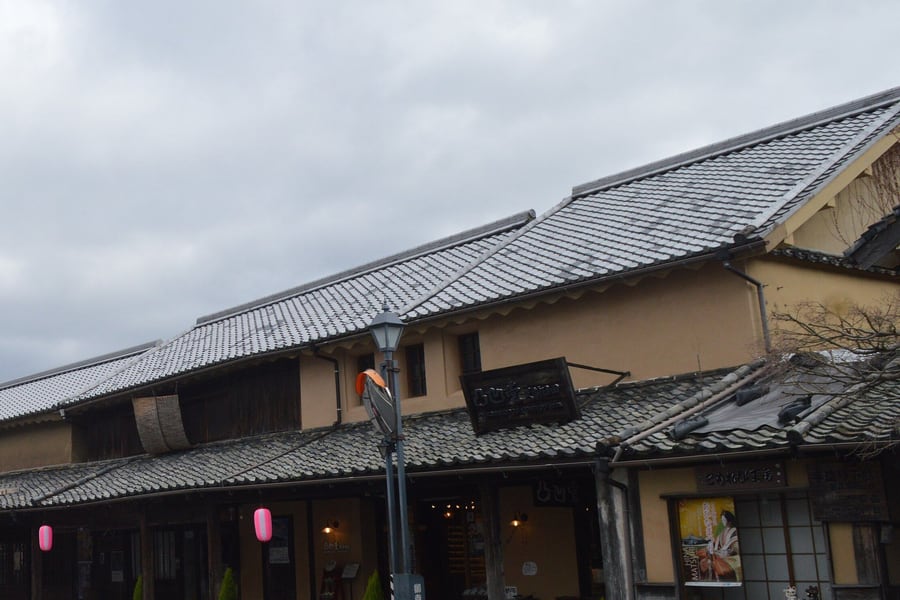
From early in the Edo period Hita was ruled directly by the shogunate, and prospered on trade. North of the station, Mameda-machi keeps its grid of old merchant houses, a preservation district since 2004; inside are a sake brewery with a tasting corner, an old pharmacy and a merchant house famous for its Hina dolls.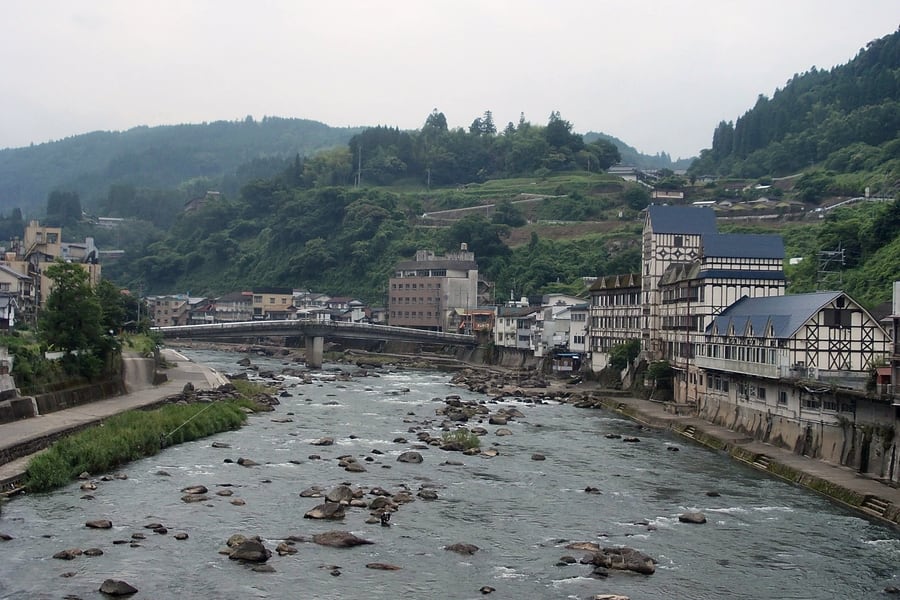 STA3816 / Wikimedia Commons · CC BY-SA 4.0 · cropped
Amagase
Amagase Onsen is counted with Beppu and Yufuin among the three great hot springs of the old province of Bungo. Its inns line the Kusu River, and on the riverbank below them are five communal open-air baths, the nearest about a minute's walk from the station. Bring your own towel.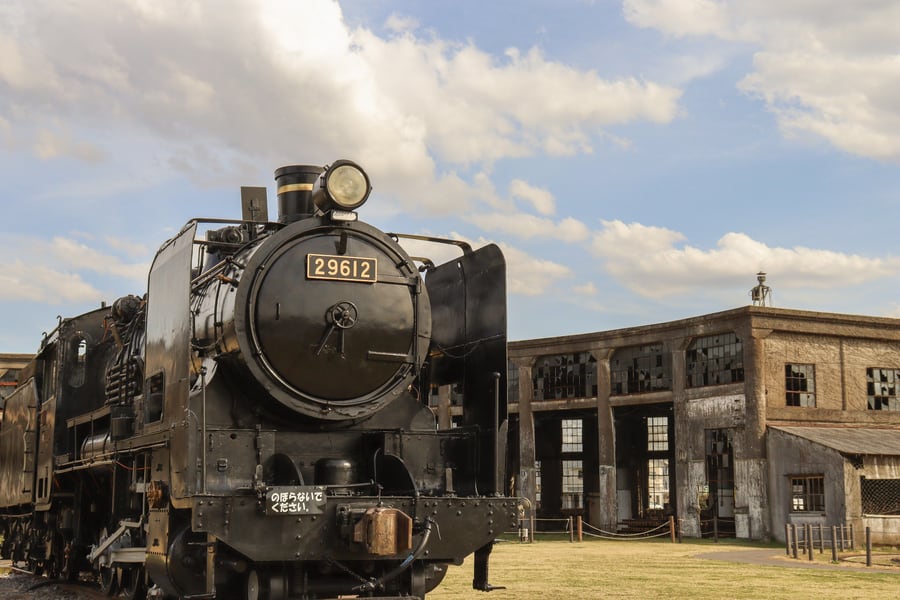 kiki_1313 / Wikimedia Commons · CC BY 4.0
Bungo-Mori
Just east of the station, the Bungo-Mori roundhouse served steam locomotives from 1934 to 1971. It still has its turntable and, on its walls, the bullet marks of an air raid on 4 August 1945. A class 9600 locomotive built in 1919 stands in front, and a small museum tells the depot's story.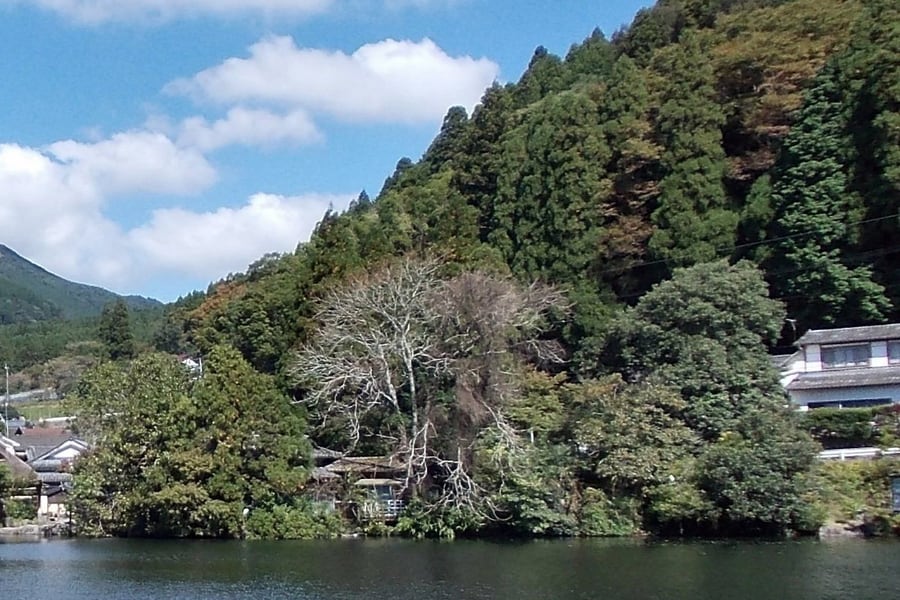 STA3816 / Wikimedia Commons · CC BY-SA 3.0 · cropped
Yufuin
At the foot of Mt Yufu, Lake Kinrin is fed by springs of cold water and hot water rising from its bed. On cold mornings from autumn into winter the warm water steams, and the mist that hangs over the lake is the picture Yufuin is known for. A scholar is said to have named it Kinrin, "golden scales", in 1884, after watching fish glint in the evening sun.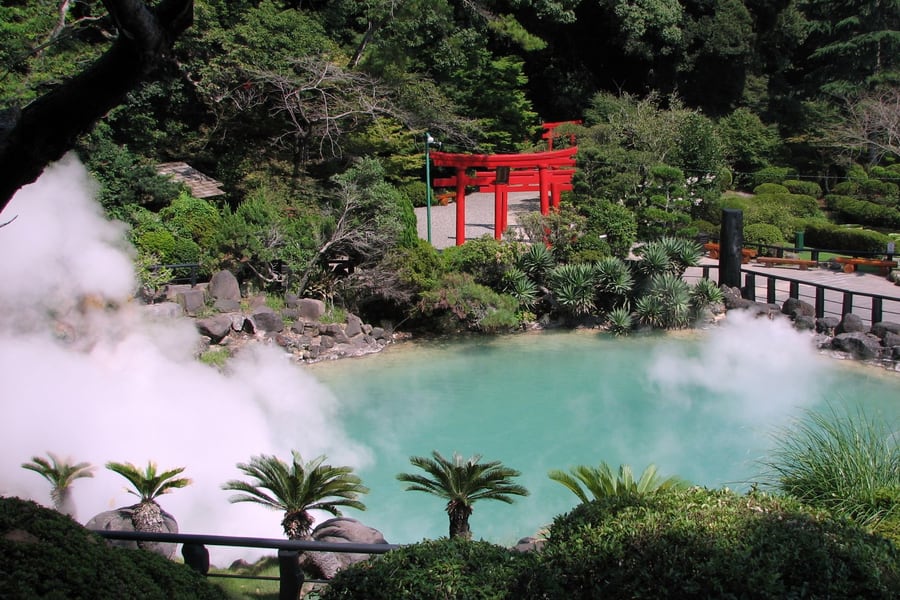 Leyo / Wikimedia Commons · CC BY-SA 2.5 CH · cropped
Beppu
Twenty minutes by bus from Beppu station, the Jigoku Meguri is a circuit of seven "hells", hot springs too hot to bathe in, among them the cobalt-blue Umi Jigoku at 98 °C. Four are national Places of Scenic Beauty. One ¥2,400 ticket covers all seven, for that day and the next; they open 8:00 to 17:00.Where to Sleep
Yufuin is a town of ryokan, the Japanese inns where dinner, breakfast and the hot-spring bath come with the room, and a night there is the point of the trip. A hotel by Hakata station makes the 9:17 departure easy, and Beppu, at the end of the Beppu train, has hot springs of its own.
Where to stay
JR Kyushu Hotel Blossom Hakata Central
Hakata · 2 minutes' walk from the station's Hakata exit
A city hotel run by the railway's own hotel company, beside the station the train leaves from.
Check Availability (opens in a new tab, on jrk-hotels.co.jp)via jrk-hotels.co.jpYufuin Tamanoyu
Yufuin · sixteen rooms in a private wood
Begun in 1953 as a retreat for Zen priests, now an inn of sixteen rooms, most with their own hot-spring bath.
Check Availability (opens in a new tab, on tamanoyu.co.jp)via tamanoyu.co.jpHana Beppu
Beppu · 6 minutes' walk from the station's west exit
A hot-spring inn of JR Kyushu's hotel company, reopened after renovation in March 2026.
Check Availability (opens in a new tab, on hanabeppu.jp)via hanabeppu.jpQuestions or corrections
Planning this trip and stuck on something, or spotted a time, fare or detail that has changed? Send us a message about Yufuin no Mori. We read every one, and we update this page when something has changed.