Yuzhno-Sakhalinsk to Nogliki
Artyom Svetlov / Wikimedia Commons · CC BY 4.0 · cropped
- Distance613 km
- Duration12 h 40 min
- Best seasonYear-round
Introduction
Sakhalin is an island the size of Ireland lying off the Russian Pacific coast, and one railway runs up the middle of it. It starts at Yuzhno-Sakhalinsk, the island capital, and ends 613 kilometres north at Nogliki, a settlement of ten thousand people on the right bank of the Tym. There is one passenger train a day in each direction, it goes overnight, and it takes a little under thirteen hours. Nothing else on the island moves that far on rails.
What makes it worth the night is that this is not an ordinary Russian railway wearing an unusual timetable. The southern half was built by Japan, which held southern Sakhalin as the governorate of Karafuto from 1905 to 1945 and laid its tracks to the Japanese standard of 1,067 millimetres. The Soviet Union inherited the gauge along with the island and kept it for another seventy years, so until very recently Sakhalin ran on rails set narrower than every other railway in Russia, worked by locomotives built for no other line and coaches that could not travel anywhere else. The conversion to the Russian 1,520 mm was finished on 30 August 2019. It took sixteen years.
The result is a railway with two histories showing through at once. The stations south of Poronaysk stand where Japanese ones did and carry Russian names given in 1947; the formation north of Pobedino was pushed through the taiga by Soviet builders in the 1970s and reached Nogliki only in 1979. The island is still not joined to the mainland — freight wagons arrive by ferry — which makes this one of the few railways in Russia you cannot reach by rail.
The Journey
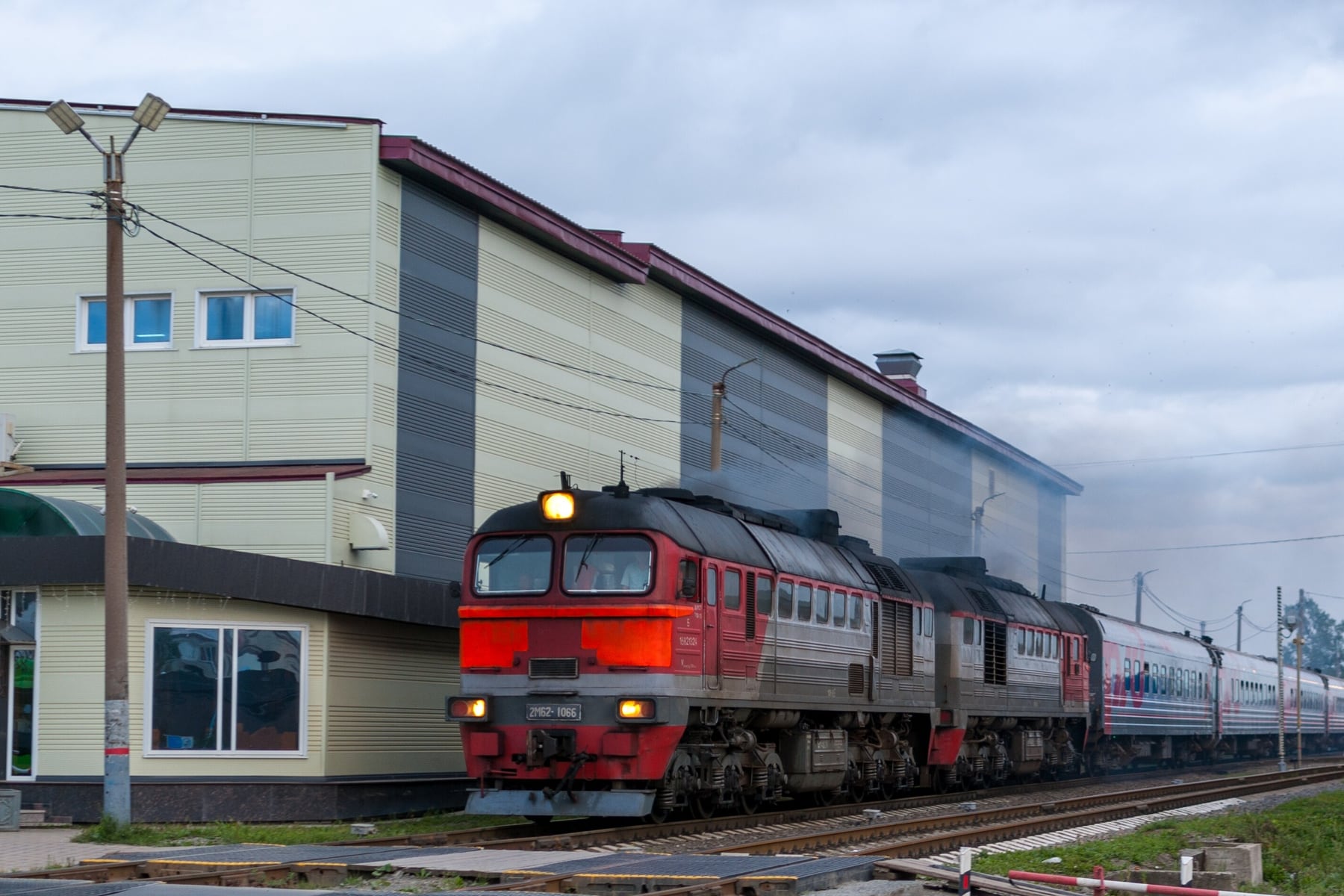
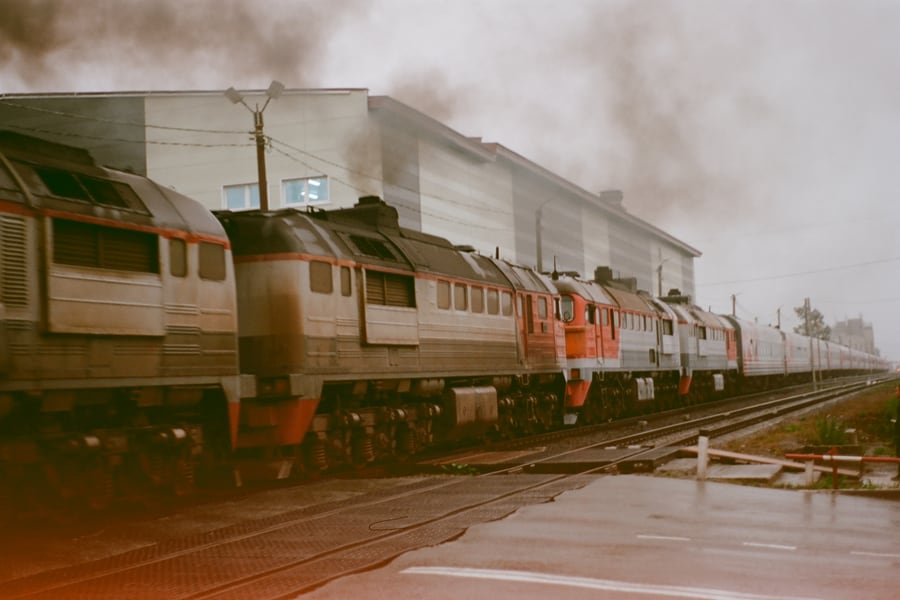
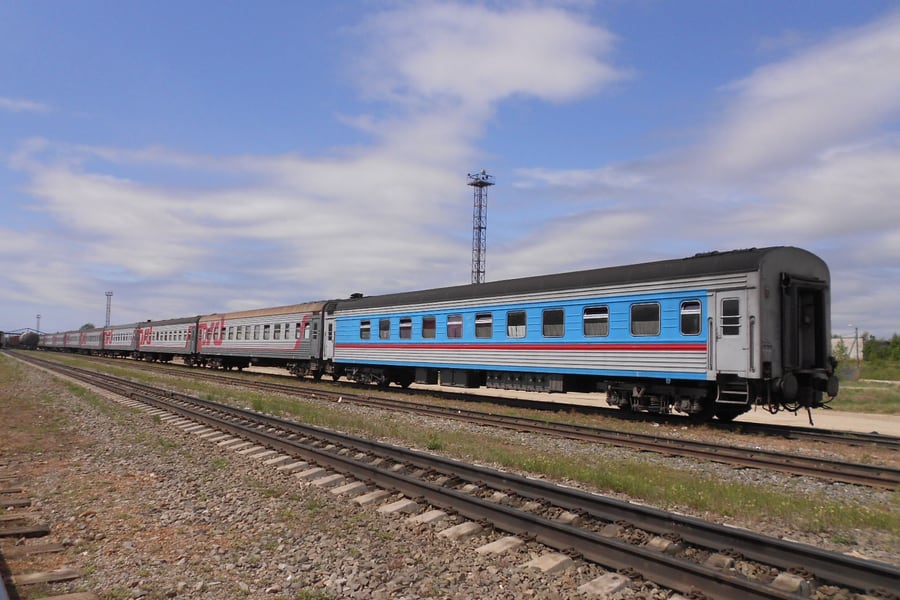
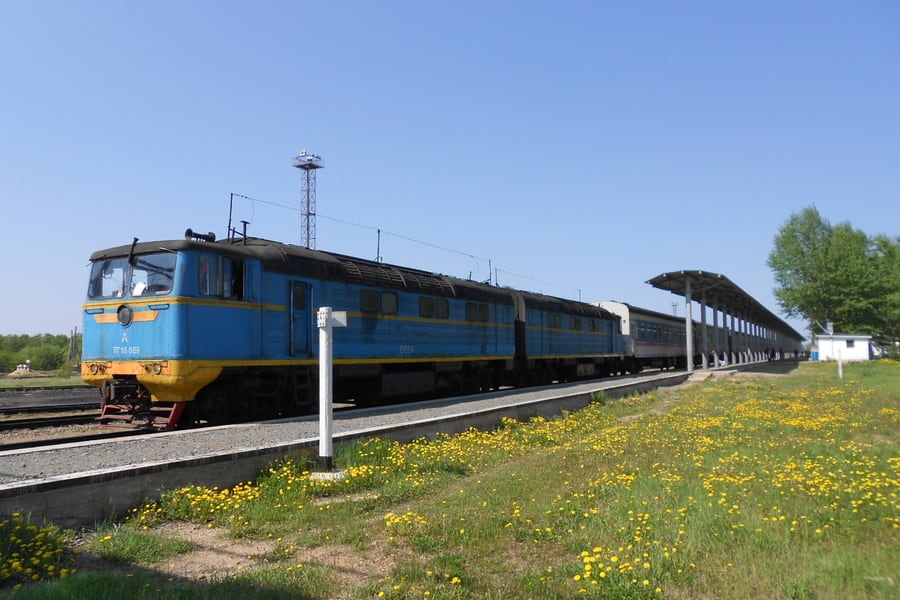
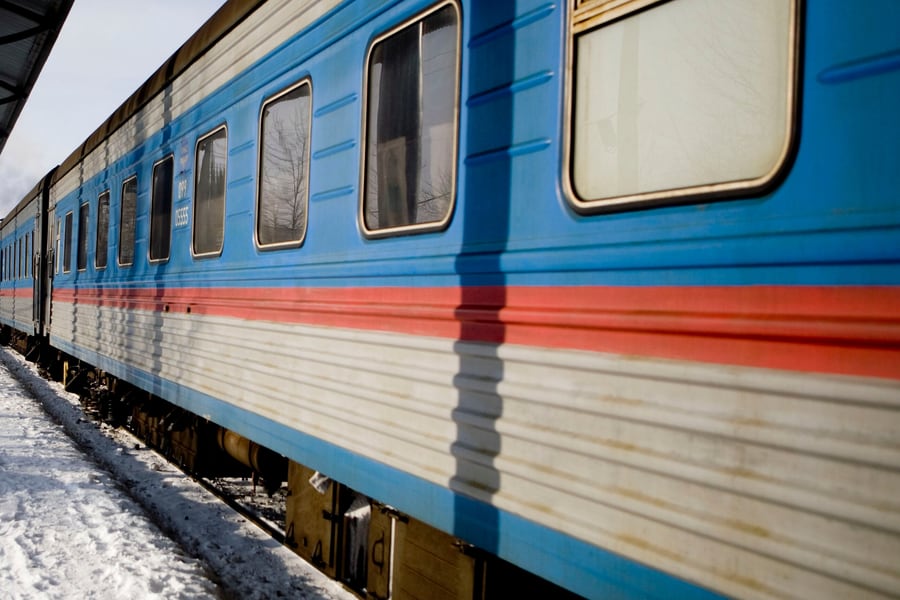
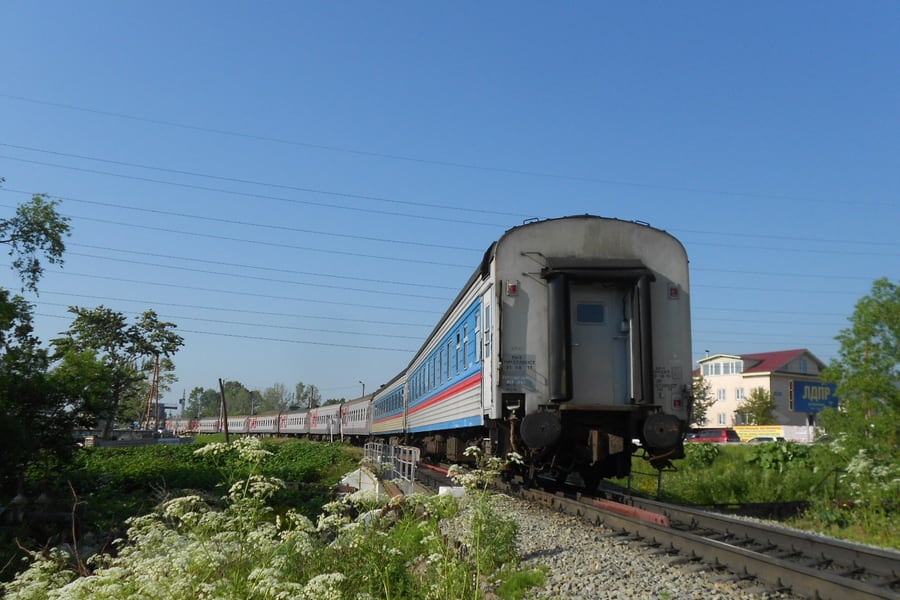
The train leaves Yuzhno-Sakhalinsk at 20:05 and is out of the city inside ten minutes. Two sections of a 2M62 diesel take the front — sometimes four, coupled in pairs — and behind them runs a rake of sleeping cars in the red-and-grey of the Russian operator, with a few older coaches still in the blue and white the island used to paint its own stock. There is no electrification anywhere on Sakhalin and there never has been.
For the first hour the line runs north through Sokol and Dolinsk, and then it meets the Sea of Okhotsk and stays with it. This is the good part, and northbound it happens in the dark — which is the single strongest argument for riding the train the other way instead: on the 18:16 out of Nogliki you are on the coast at first light. For most of the hundred kilometres between Vzmorye and Makarov the formation runs on a shelf a few metres above the beach, with surf on one side and green hills straight up on the other.
Poronaysk, at 02:12 northbound, is the halfway point and the longest stop — twenty minutes, long enough to get off. The town was Shikuka under the Japanese and Post Tikhmenevsky before that, and its name is Ainu: poro nay, big river. The Poronai is the largest river on the island and the train crosses its floodplain on the way in.
Through the taiga to Tymovsk
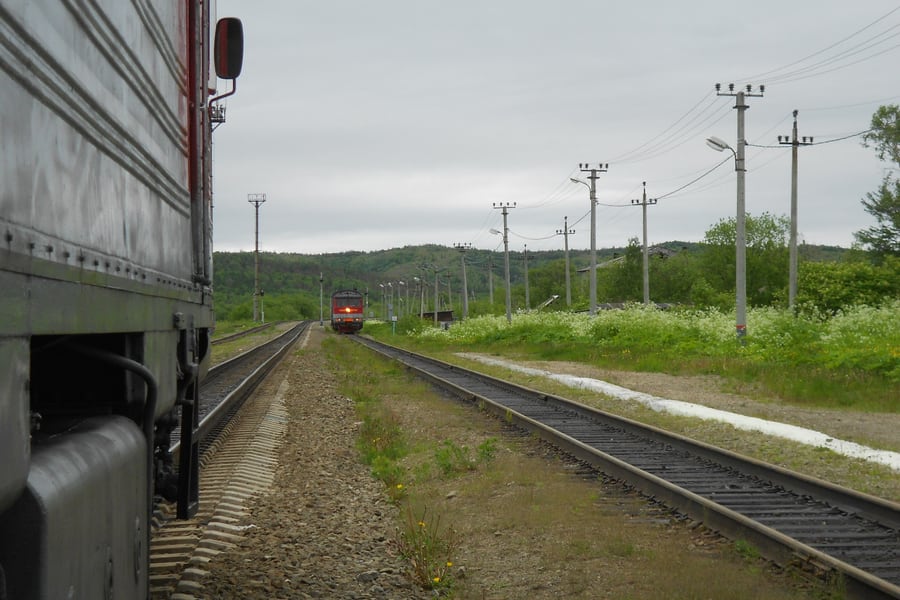
North of Poronaysk the coast is gone and the line turns inland into forest. The stops come with a minute's dwell each: Olen, Zabaykalets, Matrosovo, Buyukly, Smirnykh, Pobedino. Olen is the one that matters historically. It was Furido, and the Japanese railway stopped there in 1941 at the 352nd kilometre, because a few kilometres further north the 50th parallel ran across the island and everything beyond it was the Soviet Union. The track from Olen onward was built after the war, and it feels different: longer straights, wider curves, and forty kilometres at a stretch with nothing beside the line but larch.
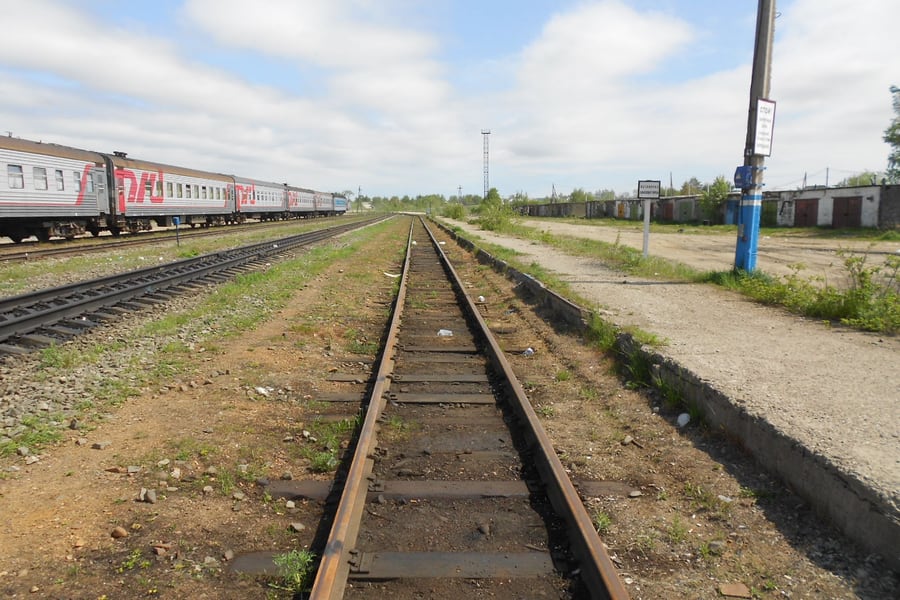
Tymovsk comes at 06:19, with a ten-minute stop and a locomotive depot full of orange shunters. The settlement beside it was founded in 1880 as Derbinskoye, named after a prison warder whom the convicts killed for his cruelty, and renamed after the river in 1949. It is also the place to get off for Aleksandrovsk-Sakhalinsky, sixty kilometres away over the ridge on the Tatar Strait, which is where Chekhov spent most of his three months on the island in 1890.
The last two hours
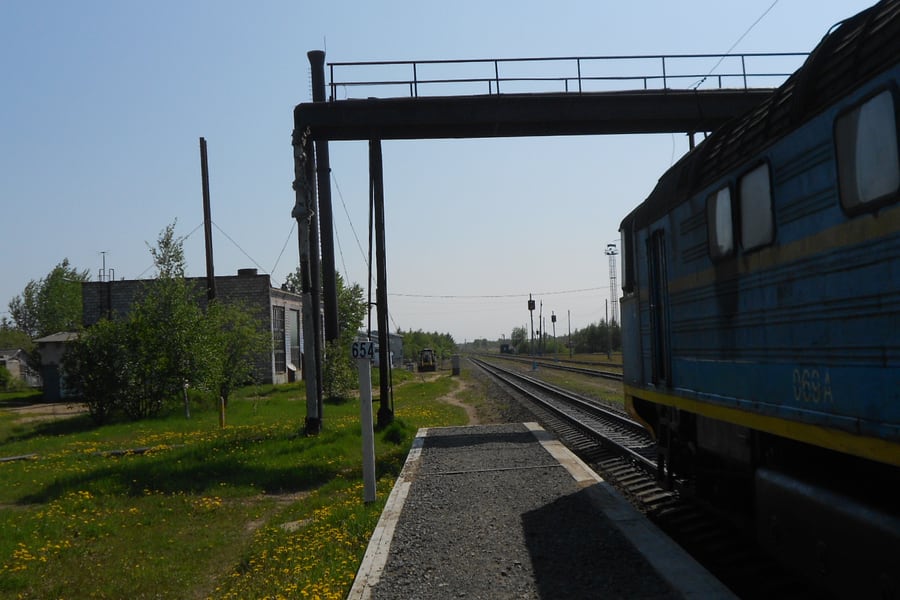
Between Tymovsk and Nogliki the railway crosses the watershed into the Tym basin and follows the river north. Slava, Ado-Tymovo, Alba, Argi-Pagi, Nysh — the last of them is the point where a bridge from the mainland would come ashore, if one is ever built. The train reaches Nogliki at 08:45, runs past a locomotive shed and a line of tank wagons, and stops beside a kilometre post reading 654. That number is measured from Korsakov, forty-one kilometres south of Yuzhno-Sakhalinsk, and it is the end of the railway. Beyond it the rails simply stop.
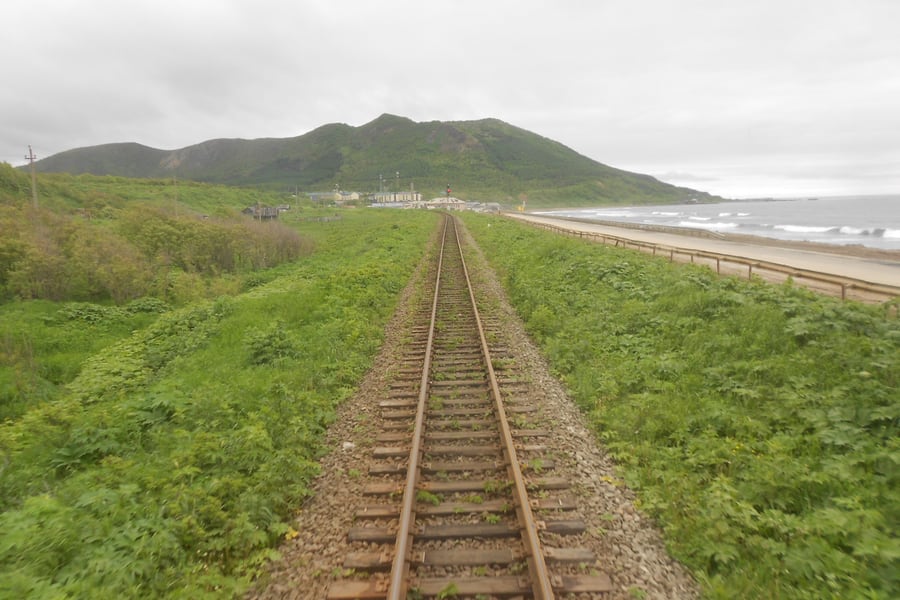
They did not always. A 750 mm narrow-gauge railway ran on from here to Okha, in the oilfields at the top of the island, and it carried passengers until 2006, when the 233 kilometres between Nogliki and Okha were closed and the rails lifted and sold for scrap. The whole system was gone by 2007, and some of its locomotives ended up in the railway museum at Yuzhno-Sakhalinsk. Walk north out of the village and you can still find the formation: bare ballast, a few rotted sleepers, and a steel truss bridge over the Tym that now carries a road.
Along the route
 Artyom Svetlov / Wikimedia Commons · CC BY 4.0 · cropped
Dolinsk, and the first hour
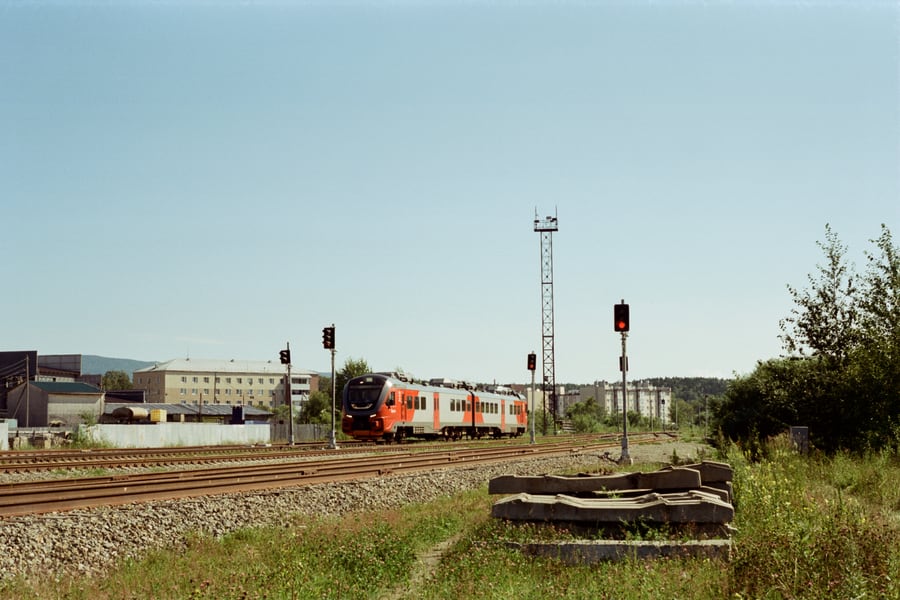
Otiai under the Japanese, and where a private paper company began pushing the east-coast line north in 1926. Fifty minutes out of the capital, it is the last stop before the railway meets the sea, and the RA3 railbuses of the southern end call here too.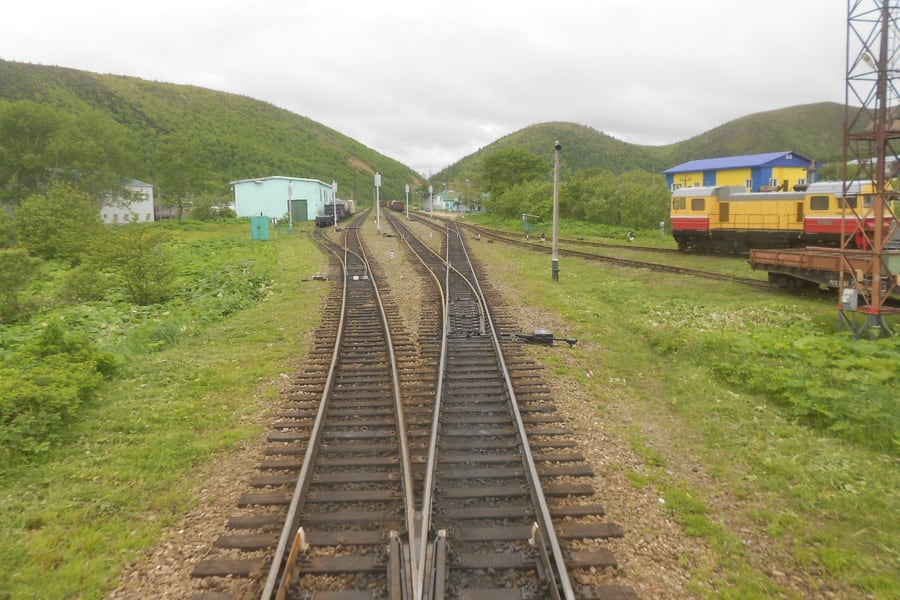 Сергей Болашенко / Wikimedia Commons · CC BY-SA 3.0 · cropped
Vzmorye and the Okhotsk shore
Shiranui until 1947, a village of just over five hundred people, and the middle of the best hour on the line. The track threads between green hills and the beach; a hundred metres up the slope stands a Japanese shrine gate that has been there since 1940.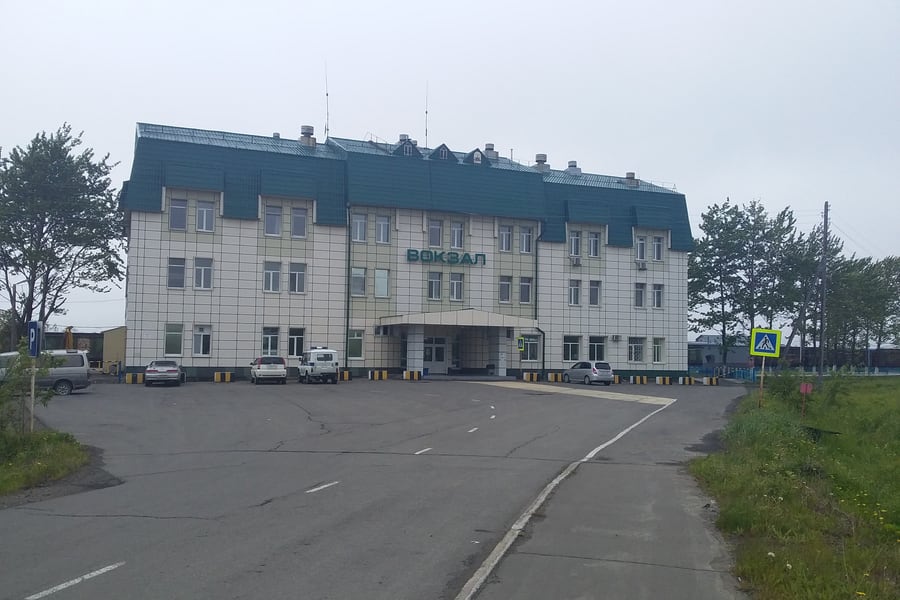 RA-96013 / Wikimedia Commons · CC BY-SA 4.0 · cropped
Poronaysk, twenty minutes at two in the morning
The longest stop and the halfway point, in a town of sixteen thousand at the mouth of the island's biggest river. Ainu named it — poro nay, big river — and it was Japanese Shikuka from 1905 to 1945. One of the line's three locomotive depots is here.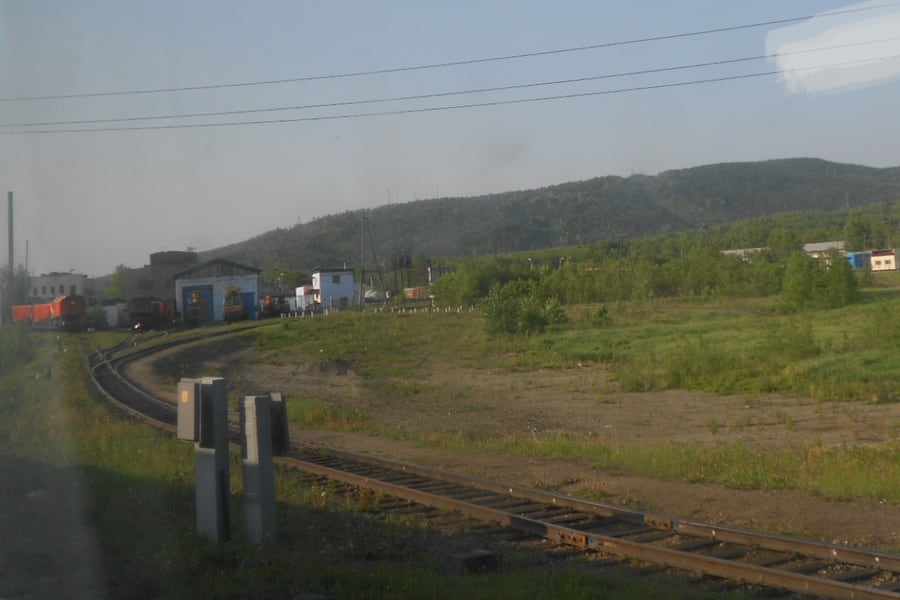 Сергей Болашенко / Wikimedia Commons · CC BY-SA 3.0 · cropped
Tymovsk and the depot
Ten minutes at 06:19, and the railway's northern depot: a shed, a yard and a line of orange shunters under the hills of the Tym valley. This is also the railhead for the far coast — the road to Aleksandrovsk-Sakhalinsky climbs west from here.A bit of history
Culture & experiences along the way
 Сергей Болашенко / Wikimedia Commons · CC BY-SA 3.0 · cropped
The gauge that came from Japan
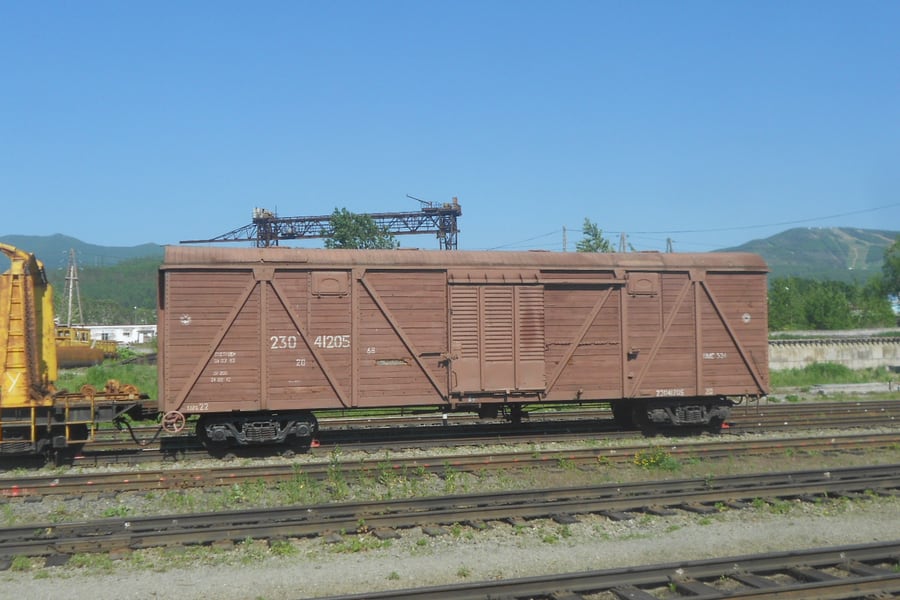
Japan built these railways to 1,067 mm, its own standard, and the USSR kept it for seventy years after 1945. Every wagon arriving from the mainland had to have its bogies swapped; the island's freight cost up to ten times what the same haul cost on the mainland network. The last 1,067 mm rails came up in 2020.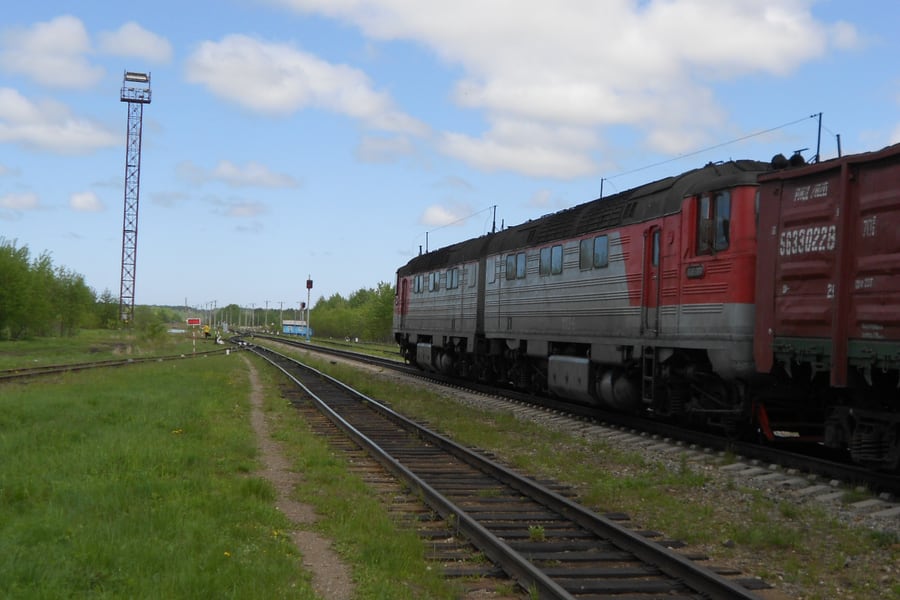 Сергей Болашенко / Wikimedia Commons · CC BY-SA 3.0 · cropped
The TG16, built for one island
Sakhalin's damp maritime air ruled out electric transmission, so the Lyudinovo works built it a locomotive of its own: the TG16, a two-section diesel-hydraulic that ran nowhere else. TG16s were the mainstay from the 1960s until the regauge, and a final batch of TG16Ms was delivered as late as 2014–16.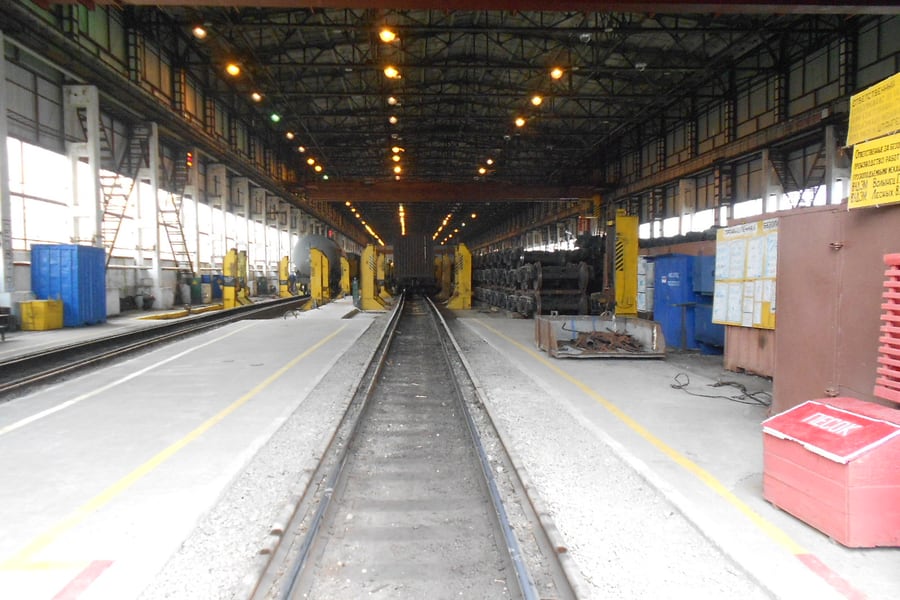 Сергей Болашенко / Wikimedia Commons · CC BY-SA 3.0 · cropped
Every wagon arrives by ship
There is no rail link to the mainland. Wagons cross the Tatar Strait on the train ferry from Vanino to Kholmsk, opened in 1973 and doubled in 1983, and are shunted on and off inside the berth. A tunnel was begun under Stalin in 1950 and abandoned; a bridge has been discussed since 2001 and is not built.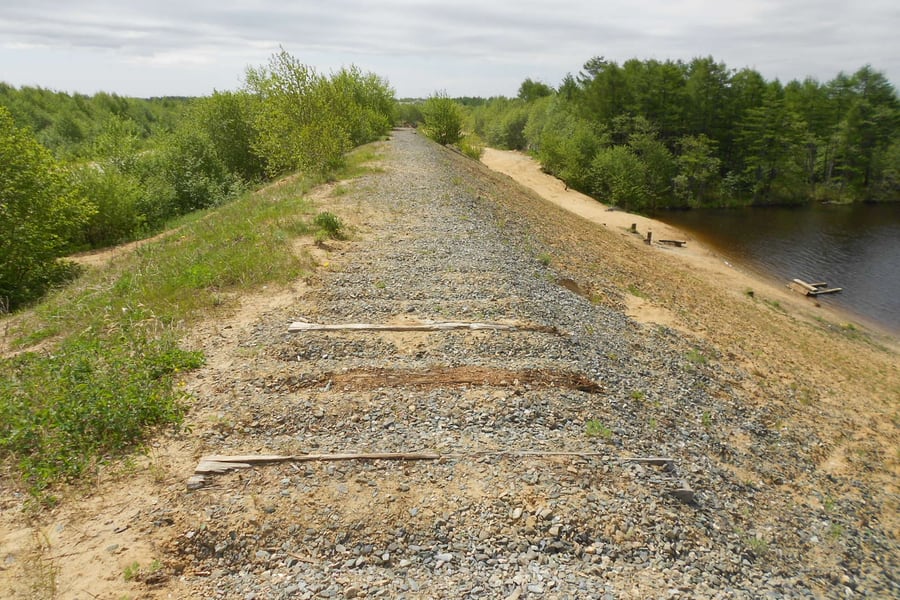 Сергей Болашенко / Wikimedia Commons · CC BY-SA 3.0 · cropped
The railway that used to go further
Nogliki was not always the end. A 750 mm line ran on to the Okha oilfields, and it took passengers until 2006, when its 233 kilometres were closed and sold for scrap. This is what is left of it a few minutes north of the station: ballast, a few sleepers and the shape of an embankment going nowhere.Timetables
One overnight train runs each way, every day, all year. It is numbered 303/304 on most days and 301/302 once a week, and the two are the same service on very slightly different times. Between late spring and the end of September a second train, 505/506, is added twice a week.
All times are Sakhalin time (UTC+11, Moscow +8) and are correct as of September 2026.
Yuzhno-Sakhalinsk → Nogliki
| Train | Departs | Arrives | Journey | Runs |
|---|---|---|---|---|
| 303Э | 20:05 | 08:45 | 12 h 40 | daily, except when 301Э runs |
| 301Э | 20:05 | 09:03 | 12 h 58 | about once a week |
| 505Г | 21:51 | 10:43 | 12 h 52 | Tue and Fri, to 29 September |
Nogliki → Yuzhno-Sakhalinsk
| Train | Departs | Arrives | Journey | Runs |
|---|---|---|---|---|
| 304Э | 18:16 | 06:50 | 12 h 34 | daily, except when 302Э runs |
| 302Э | 18:00 | 06:50 | 12 h 50 | about once a week |
| 506Г | 23:05 | 10:50 | 11 h 45 | Wed and Sat, to 30 September |
Where 303Э and 304Э stop
Twenty-two intermediate calls, most of them one minute. These are the ones worth knowing about; except where a range is shown, the time given is the departure.
| Station | Northbound 303Э | Southbound 304Э |
|---|---|---|
| Yuzhno-Sakhalinsk | 20:05 | 06:50 arr |
| Dolinsk | 21:00 | 06:00 |
| Vzmorye | 22:09 | 04:48 |
| Makarov | 00:25 | 02:35 |
| Vakhrushev | 01:34 | 01:31 |
| Poronaysk | 02:12 – 02:32 | 00:32 – 00:52 |
| Smirnykh | 04:05 | 23:03 |
| Onor | 05:02 | 22:03 |
| Tymovsk | 06:19 – 06:29 | 20:35 – 20:45 |
| Nysh | 08:04 arr | 19:04 |
| Nogliki | 08:45 arr | 18:16 |
Poronaysk and Tymovsk get twenty and ten minutes respectively; everywhere else you stay on board. The 505/506 pair follows the same route and calls at the same places, roughly an hour and a half behind the 303 northbound and three-quarters of an hour behind the 304 going south.
⚠️ These are reserved-berth trains and the season matters. The board was swept for eight consecutive days in September 2026 and again for a date in November, which is what confirms the service runs through the winter; the 505/506 supplement carries an explicit end date and will not be there in October. Check the operator's own booking system for the date you want before you plan around it.
Tickets
Every place on this train is reserved and allocated by the booking system, so buy before you travel rather than turning up at the station. Four classes run in the same rake: an ordinary seated car, platskart — the open sleeping saloon, bunks in bays with no compartment doors — four-berth kupe compartments, and a small number of two-berth SV. For an overnight run of nearly thirteen hours the seated car is a false economy; platskart is the way most of the island travels.
We do not print a fare here. The only figures we could verify come from a foreign railway reselling this train at the inter-state tariff, which is neither the currency nor the price a passenger buys from the Russian operator. Book through the operator's own channels and take the number it gives you on the day.
Rail Passes
No rail pass covers this journey. Interrail and Eurail are a 33-country European scheme and Russia is not in it, so a pass bought in Europe is worth nothing here — and there is no separate Sakhalin or Far East pass to buy instead.
Nor would one help if it existed. There is a single train a day, every berth on it is reserved and allocated individually, and a pass in the Interrail sense — turn up, board, sit down — is not how this railway is sold. The Russian operator runs its own loyalty and multi-journey products, but their current terms cannot be confirmed from outside the country while its websites are unreachable from much of Europe, so we will not describe them here.
Buy a point-to-point ticket for the specific night you want, in the class you want, and buy it early: one train a day across a thirteen-hour island means the compartments fill.
Places to Visit
The line is a night train, so most of what is worth seeing is at one end or the other, or a bus ride off the middle of it. Two things are worth planning around. The first is that the island's best museum is five minutes' walk from the departure station, so give Yuzhno-Sakhalinsk a day before you board. The second is that Tymovsk, ten minutes' stop at half past six in the morning, is the railhead for Aleksandrovsk-Sakhalinsky — the old penal capital on the far coast, and the reason a good many people come to Sakhalin at all.
 FotoAnna / Wikimedia Commons · CC BY-SA 3.0 · cropped
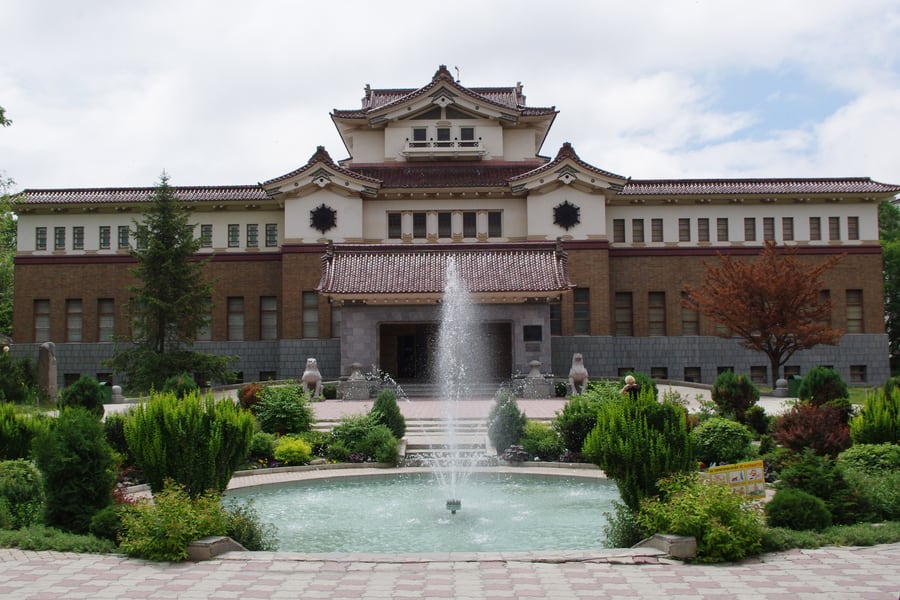
The Sakhalin Regional Museum
The best building on the island and the best reason to arrive a day early. It was put up in 1935–37 by the Karafuto governorate to a design by Yoshio Kaizuka, in the teikan or "imperial crown" style — a Western masonry box under a Japanese tiled roof — and it is the only example of that style anywhere in Russia. The museum inside traces its own line back to a collection started at Aleksandrovsky Post in 1896, and it is five minutes' walk from the station.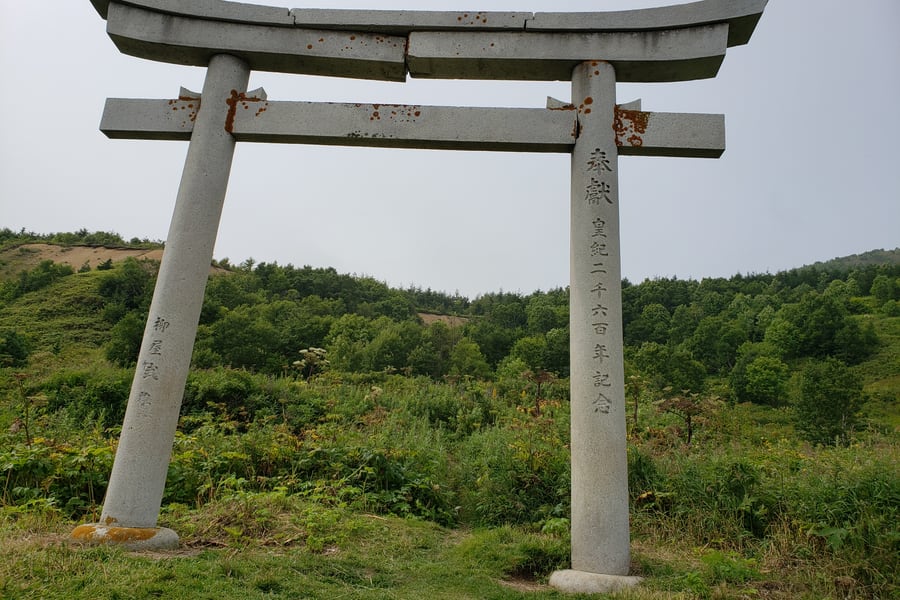 特急東海 / Wikimedia Commons · CC0
The torii above Vzmorye
A concrete shrine gate standing in the scrub on the hillside above the village, all that is left of the Higashi-Shiraura shrine. The inscription dates it to Imperial Year 2600 — 1940 — and carries the name of the man who paid for it, Takeo Yanagiya. Southern Sakhalin is full of these: gateposts, foundations and boundary stones left where Japanese towns stood until 1945.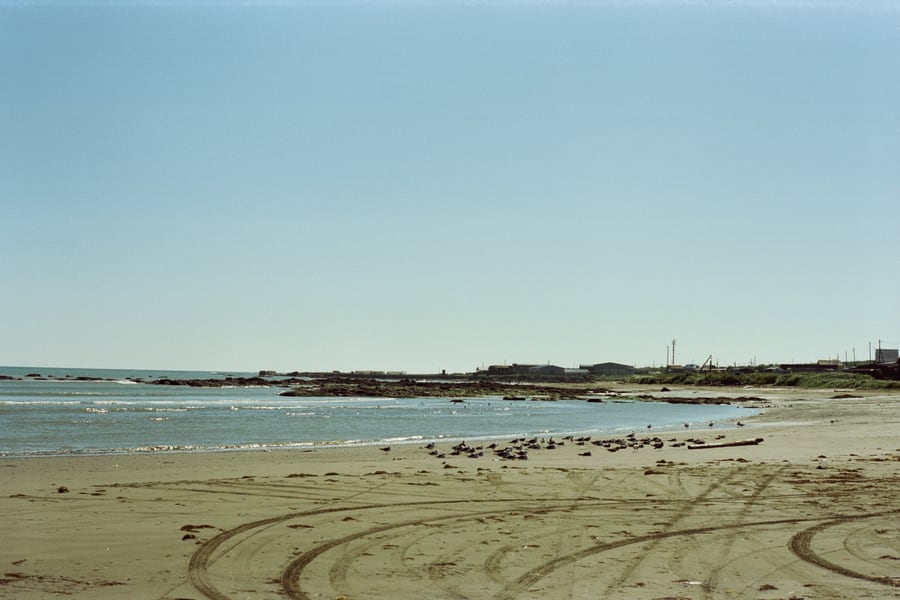 Artyom Svetlov / Wikimedia Commons · CC BY 4.0 · cropped
Sakaehama, where the galactic railway began
This beach was Sakaehama, and its station was once the northernmost in Japan. On 4 August 1923 the poet Kenji Miyazawa reached it, having crossed from Hokkaido looking for the soul of his sister Toshi, dead of tuberculosis at twenty-four — he believed she had gone north. The visit is credited with the Okhotsk Elegy and the beginnings of Night on the Galactic Railroad. The branch from Dolinsk closed in 1993; the shore did not.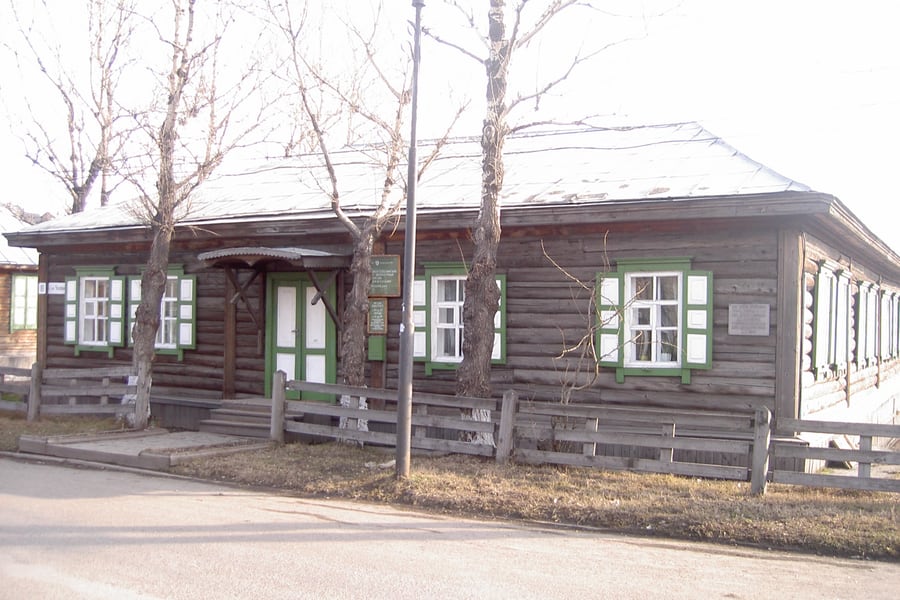 Harveyqs / Wikimedia Commons · CC BY-SA 4.0 · cropped
Chekhov's Sakhalin
Anton Chekhov came here in the summer of 1890, spent three months counting and interviewing convicts, and published «Остров Сахалин» in 1893–95. He called the place the Sakhalin Paris; it was the capital of the island's penal system and has fewer than nine thousand people today. The Chekhov museum on Chekhova Street is the memorial to that journey, and there is a second museum devoted to the book. The road from Tymovsk is gravel.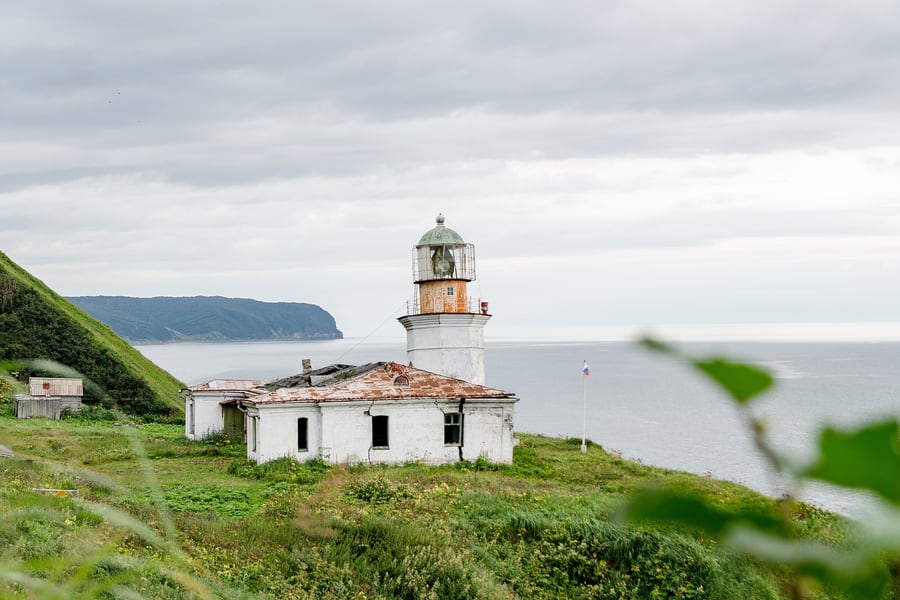 Maxim trukhin / Wikimedia Commons · CC BY-SA 4.0 · cropped
Cape Jonquière, the lighthouse and the crooked tunnel
A lighthouse of 1864 on the headland above the Tatar Strait, long derelict. Convicts cut the way to it by hand — the 87-metre Aleksandrovsky tunnel, named for Alexander II and bent like an integral sign, because nobody at the penal post could survey a straight bore until a transported prisoner turned out to be able to do the sums. Offshore stand the Three Brothers, three rocks that are the emblem of the island.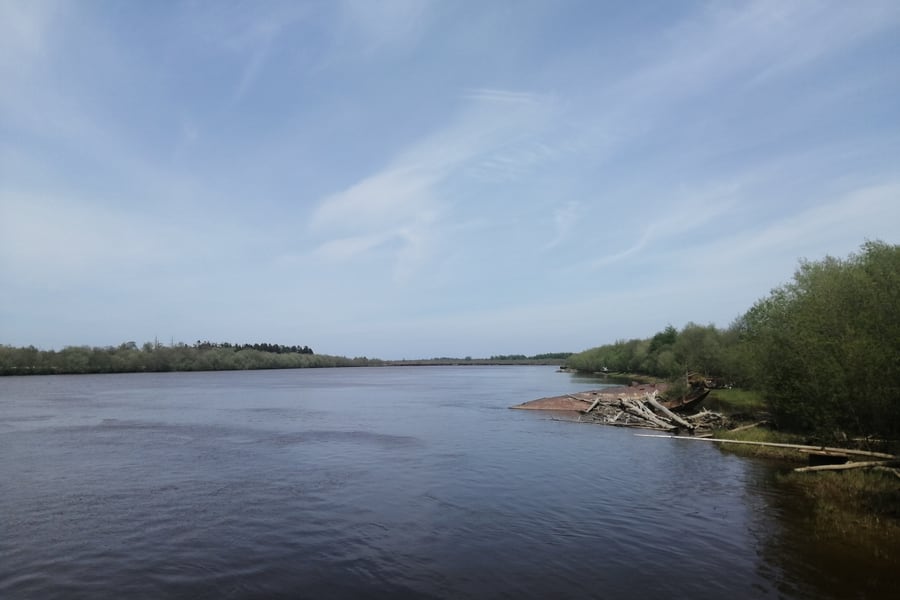 Апатинаити / Wikimedia Commons · CC BY-SA 3.0 · cropped
The Tym at Nogliki
The terminus stands on the right bank of the Tym, nine kilometres above the point where it empties into Nyysky Bay. The village is deliberately low-rise — this is seismic country — and its name is Nivkh: Nogl-vo, from a river called "the smelly one" because oil seeps to the surface in its basin. That oil is why the railway was pushed this far north at all.Where to Sleep
The train itself is the bed for the middle of this journey, so what you need is a night at each end. Yuzhno-Sakhalinsk has the island's only real choice of hotels, all of them within a few minutes of the station. Nogliki has two, both small, both in a settlement of ten thousand people where the train arrives at a quarter to nine in the morning and leaves again at 18:16 — which is either a comfortable day to fill or a reason to stay the night, depending on what you came for.
There is nothing bookable online at Poronaysk or Tymovsk, and the train passes both in the small hours anyway. If you want to break the journey, do it at Tymovsk and go on to Aleksandrovsk-Sakhalinsky, which has beds; arrange that one before you leave the capital.
Where to stay
Mega Palace
Central Yuzhno-Sakhalinsk
The island's largest hotel, with its own restaurants, conference halls, fitness rooms and spa, a few minutes from the station.
Check Availability (opens in a new tab, on megapalacehotel.com)via megapalacehotel.comMira Hotel
Yuzhno-Sakhalinsk
A smaller business hotel in the capital with meeting rooms, a fitness suite and booking direct through its own site.
Check Availability (opens in a new tab, on mirahotelsakhalin.ru)via mirahotelsakhalin.ruGostinitsa Nogliki
Sovetskaya 6, in the centre
A three-storey hotel in the middle of the settlement, with an air and rail ticket office among the shops on its ground floor.
Check Availability (opens in a new tab, on hotel-nogliki.ru)via hotel-nogliki.ruUsadba
Dachnaya 19A, Nogliki
Sixteen rooms from economy to suite, five minutes by road from the station, with free Wi-Fi, a round-the-clock reception and a billiard lounge.
Check Availability (opens in a new tab, on usadba-nogliki.ru)via usadba-nogliki.ruQuestions or corrections
Planning this trip and stuck on something, or spotted a time, fare or detail that has changed? Send us a message about Yuzhno-Sakhalinsk to Nogliki. We read every one, and we update this page when something has changed.