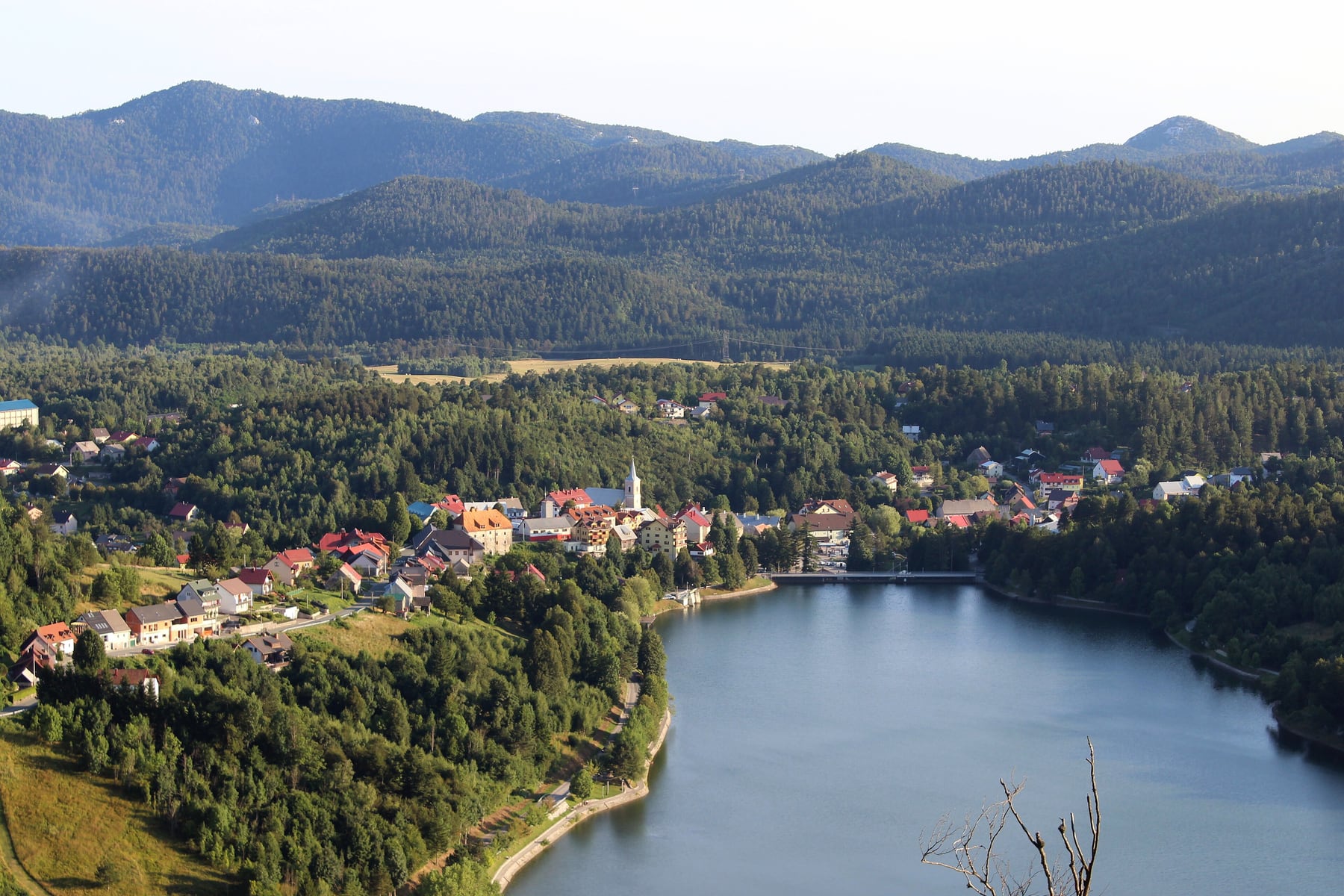
Over Gorski kotar — Zagreb to Rijeka
Lan Glad / Wikimedia Commons · CC BY-SA 4.0 · cropped
- DistanceZagreb–Rijeka · 229 km
- Duration4 h 07 on the fast train, 4 h 53 on the stopper
- Best seasonAll year · four through trains daily, and snow on the mountain from December
Introduction
Between Zagreb and the sea stands Gorski kotar, the wooded upland that Croatians call the green heart of the country: fir and beech forest almost without a break, limestone gorges with rivers falling into them, lakes held behind dams at Lokve and Fužine, and bears, wolves and lynx in the woods above the line. The railway spends the middle of its afternoon in it. It climbs out of the Karlovac plain, crosses the Dobra and the upper Kupa country, calls at Vrbovsko and Skrad and Delnice, tops out at 837 metres above the sea, and then falls off the edge of the mountain towards the Kvarner gulf — the last hour on ledges cut into the karst, with the sea widening below and concrete walls along the embankments to hold the wind off the train.
At the bottom of that descent is Rijeka: a working port with a classical station, a promenade called the Korzo, a castle on the hill at Trsat, and the Adriatic at the end of the street. It is 229 kilometres from Zagreb and it takes between four and five hours, which is slow, and the slowness is the entire point. This is one of the great mountain crossings of southern Europe, done on an ordinary ticket, on trains that run every day of the year.
The sea a landlocked kingdom had to borrow
The line exists because of a piece of nineteenth-century constitutional arithmetic. After the Austro-Hungarian Compromise of 1867 and the Croatian–Hungarian Settlement of 1868, Rijeka — Fiume — was detached from Croatia and administered directly from Budapest. Hungary had no coast of its own. It had just acquired one town on somebody else's, and it wanted a railway to it.
So Hungary built this line, and built it fast: work began in the middle of 1869 and the first train ran from Karlovac to Rijeka on 23 October 1873, three and a half years later, cut through the mountain by some twenty-three thousand men working with pick, shovel and barrow, with black powder in the tunnels until dynamite arrived near the end. Rails came from France, Belgium, Austria and Hungary, hauled up to the line by horse cart from Rijeka and Karlovac along the two old post roads, the Karolina and the Lujzijana. Before it opened, the winter journey between the two towns by those roads could take several days.
What it bought was immediate. Budapest was suddenly joined to the Adriatic; Rijeka took the trade that had gone to Senj and began to compete with Trieste, which Vienna had connected sixteen years earlier. And when Rijeka's station burned down in 1888, the replacement that opened in 1891 was designed by Ferenc Pfaff, chief architect of the Hungarian Royal State Railways. It is still the building the train stops under.
The Journey
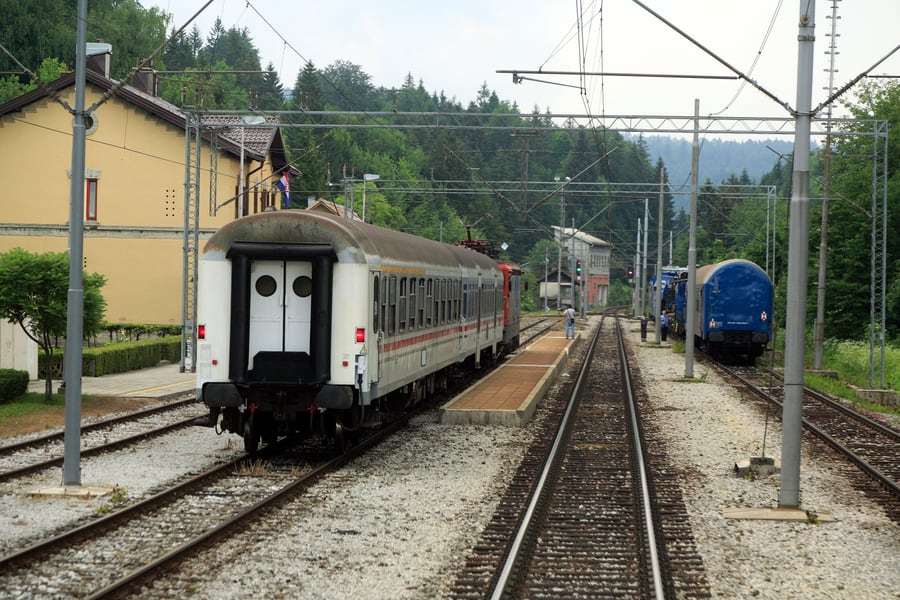
The train leaves Zagreb Glavni kolodvor and spends its first hour on flat ground — Jastrebarsko, the Kupa, and then Karlovac, the six-pointed star fortress the Habsburgs began in 1579 to hold back the Ottomans, now a town of four rivers with a station on the edge of it. Beyond Duga Resa the valley narrows, the Mrežnica and then the Dobra come alongside, and at Ogulin the mountain begins. Ogulin is the operational heart of the line — one of the three big engine sheds and turntables built for this railway, alongside Moravice and Oštarije — and a few minutes further on, at Oštarije, the Lika railway turns south for Split.
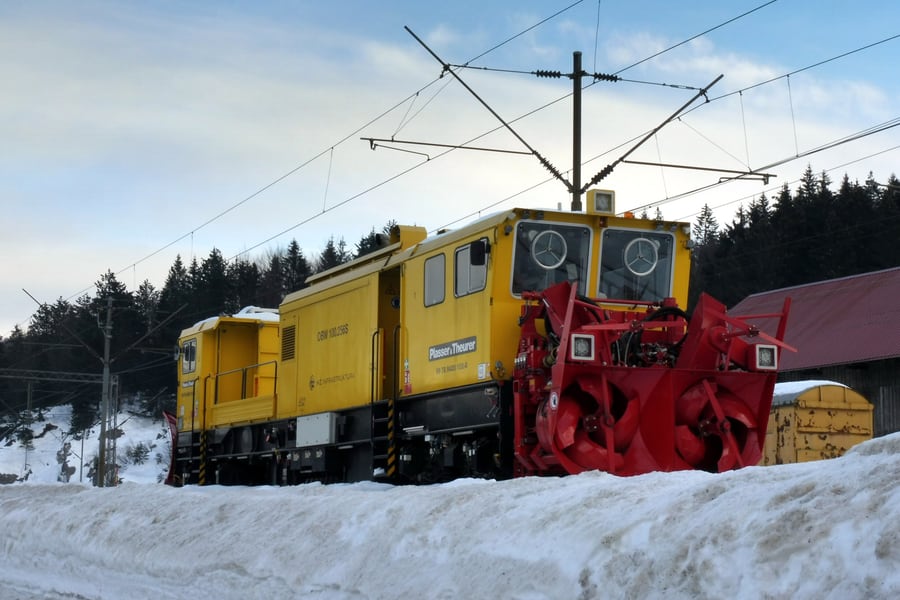
From Ogulin the line climbs steadily for an hour and a half. Vrbovsko, then Moravice, then Brod Moravice, and the country changes completely — spruce and fir, hay meadows in clearings, timber stacked beside the track, and villages of steep-roofed houses built for four months of snow. Skrad sits above one of the finest gorges in the country. Delnice, a little further on, is the main town of Gorski kotar and keeps the railway's rotary snow blower. Past Lokve the line runs through the longest cutting in Croatia — 1,420 metres of rock — and reaches its summit, and then Fužine appears on its promontory above the Bajer reservoir, which is as good as the view from this train gets.
The drop to the Adriatic
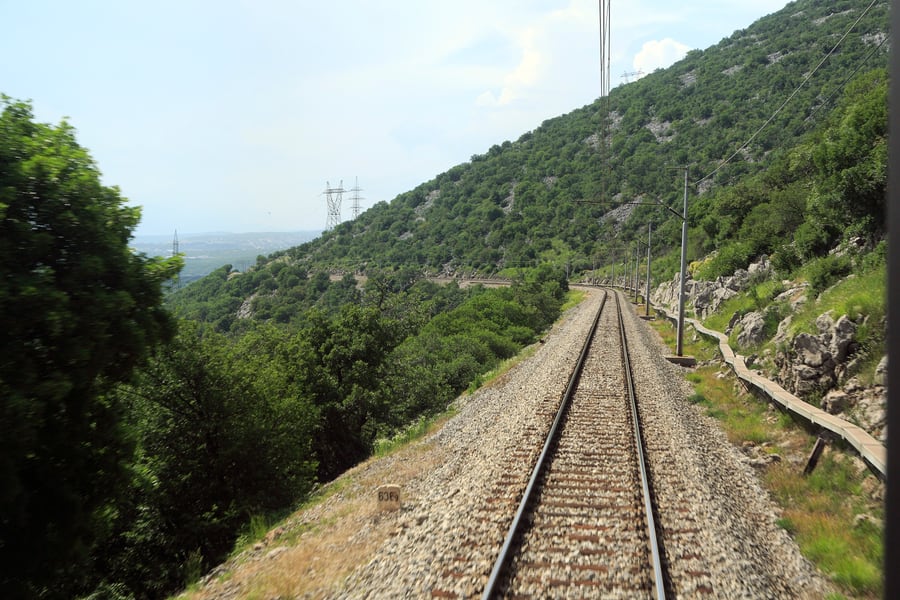
After Fužine the railway has to lose eight hundred metres in about thirty kilometres, and it does it the nineteenth-century way: by going a long way round. Lič, Drivenik, Zlobin, Plase, Meja, Škrljevo — the names come slowly because the line is doubling back on itself along the face of the coastal range, and somewhere in there the Kvarner gulf opens out below, with the islands beyond it.
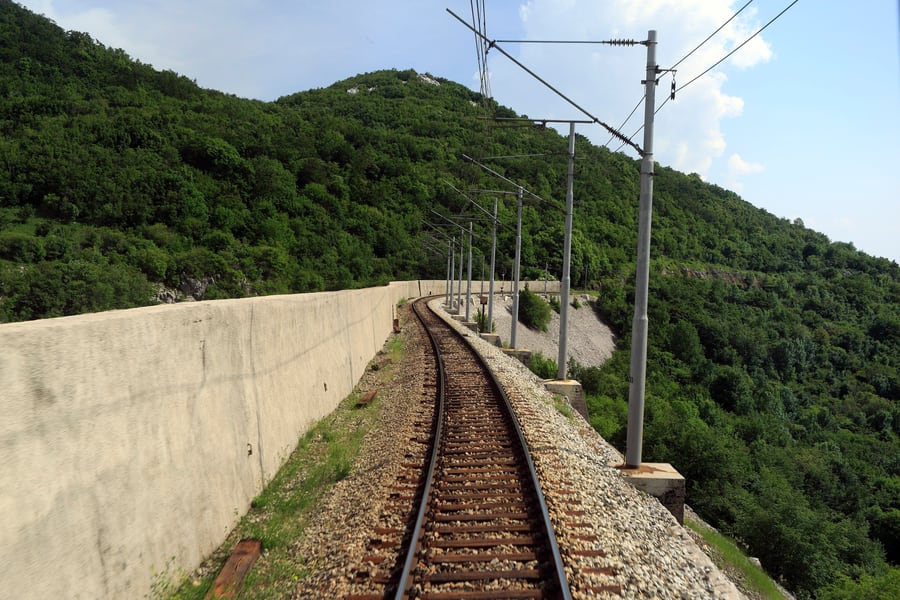
This is also where the bura lives. The cold downslope wind that pours off these mountains onto the Adriatic is violent enough that the embankments on the descent are built with concrete and masonry walls along their seaward side to shelter passing trains, and the exposed edges of Gorski kotar carry snow fences for the other half of the year. Both are original railway furniture and both are still doing their job.
The last few kilometres run through the suburbs of Rijeka above the Rječina, past Sušak-Pećine, and into a station whose platform is 352 metres long and whose canopy is 155 — built for a port that in 1913 was the tenth-busiest in Europe.
Slower than it was in 1982
The first trains took nine and a half hours from Zagreb to Rijeka in 1873. By the 1930s it was five and a half. In 1982 the run was three and a half hours. Today the fastest train on the timetable takes four hours and seven minutes, and the stopping train takes nearly five.
Nothing has gone wrong, exactly. The line is single track for its whole length and it was laid out for the traffic of the 1870s. Croatia's transport ministry puts it plainly: the line "was opened for traffic in 1873, and according to exploitation it is one of the most difficult railway lines in Europe due to the fact that its technical characteristics do not meet the demands of transport". Everything done since — including electrification, which began at Matulji in 1936 with the oldest traction substation in the country and was not fully converted to 25 kV until 2012 — has been done to a track alignment that cannot be straightened.
The answer is a new railway rather than a faster one. The nizinska pruga, the "lowland line", is a double-track route that will eventually replace this one between Zagreb and Rijeka; the ministry's design speed is 160 to 200 km/h, the Zagreb–Karlovac geometry is being set out so that over 250 km/h would be possible later, and the aim is a Rijeka–Zagreb journey of about an hour. It is being built in pieces. The first, Hrvatski Leskovac to Karlovac, is 44 kilometres of reconstruction and second track; eight of its eleven stages are complete, and in April 2026 HŽ Infrastruktura signed the contract for the remaining three, worth €278.8 million before VAT, with thirty-six months to finish. The mountain sections beyond it are still at the design stage.
Which means the ride described on this page has years left in it, and then it becomes a branch line, or a memory. For now the train still goes over the top.
What runs on it
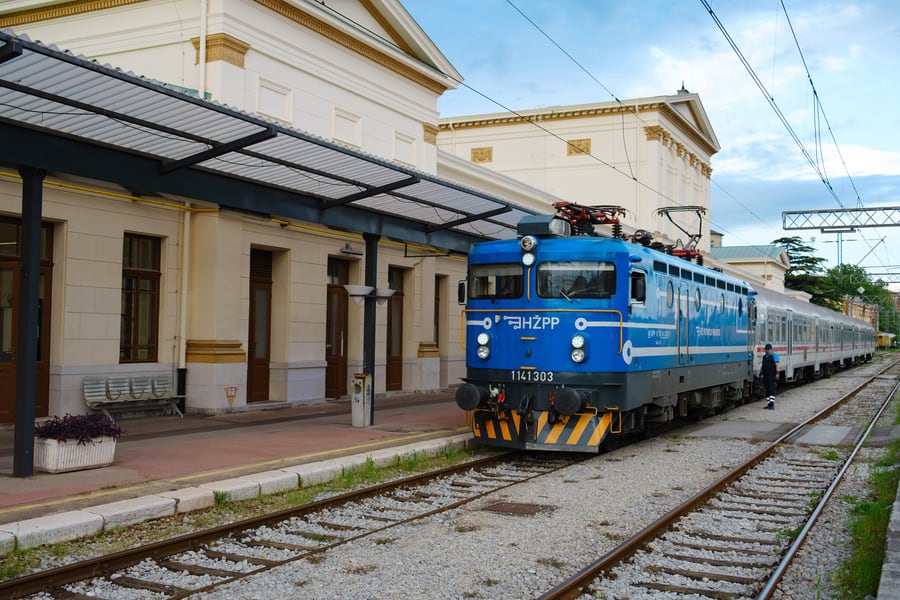
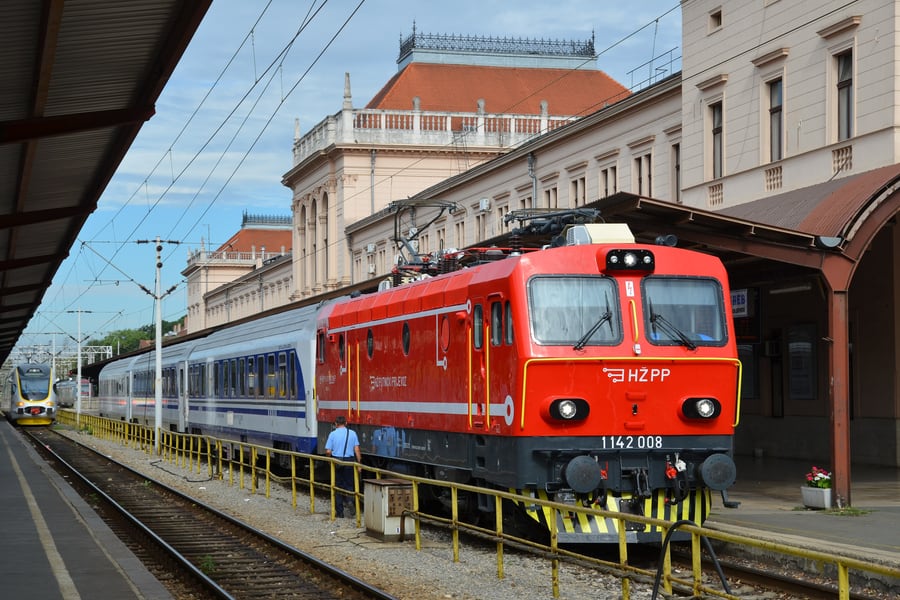
The trains are locomotive-hauled: a blue HŽPP class 1141 electric on the front and ordinary coaches behind. Between Ogulin and Rijeka there are more local trains than through ones, which is the sensible way to read this timetable — the mountain is better served than the journey across it. And Delnice keeps a rotary snow blower on the strength of the winters up here, which is the clearest statement anyone has made about what 837 metres means in this part of Europe.
Along the route
Bvcmz248.5 / Wikimedia Commons · CC0 · croppedA sea that had to be borrowed
After 1868 Rijeka was detached from Croatia and administered from Budapest. Hungary had no coast of its own and now had one town on somebody else's, so it built 175 kilometres of railway across a mountain range to reach it. Even the station at the far end is Hungarian.Falk2 / Wikimedia Commons · CC BY-SA 4.0 · croppedThree and a half years, by hand
Some twenty-three thousand men were on the works at once, with pick, shovel and barrow, and black powder in the tunnels until dynamite arrived near the end. About a hundred metres of railway a day went down, and two field hospitals were run for the men building it.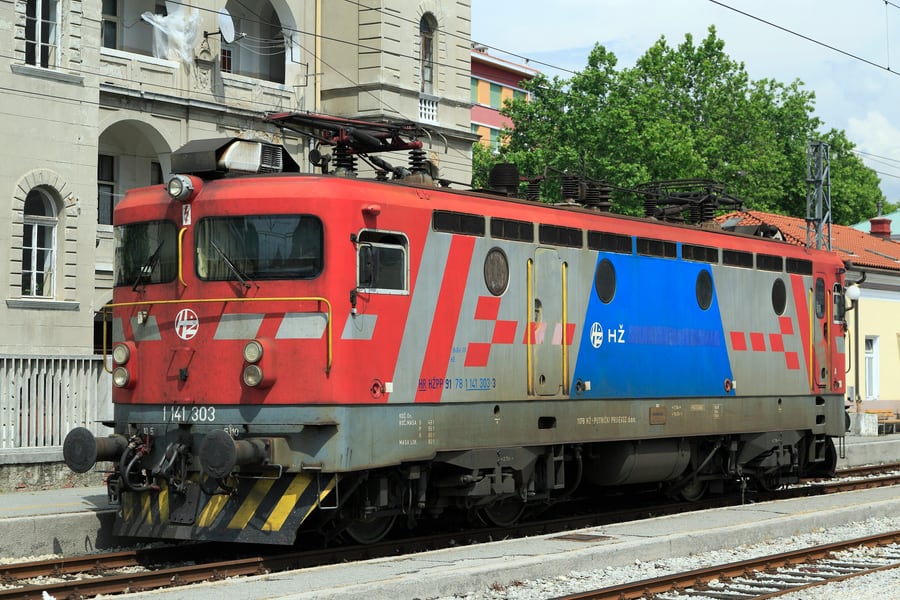 Falk2 / Wikimedia Commons · CC BY-SA 4.0 · cropped
Slower than it was in 1982
The first trains took nine and a half hours. By 1982 it was three and a half; today the fastest takes four hours and seven minutes. The transport ministry calls this one of the most difficult railway lines in Europe to operate.A bit of history
Culture & experiences along the way
 John Mulrine / Wikimedia Commons · CC BY 2.0 · cropped
Which of the two trains to take
702, at 16:12 from Zagreb, is the fast one — four hours seven minutes, fourteen stops, into Rijeka at 20:19. 4000, at 08:30, is the one for the railway: it calls forty-seven times, takes nearly five hours, and crosses the mountain in the middle of the day with the light on it. Coming back, 703 leaves Rijeka at 05:17 and 4001 at 13:40.Lan G. / Wikimedia Commons · CC BY-SA 4.0 · croppedThere is no day return from Zagreb
The morning train reaches Rijeka at 13:23 and the only afternoon train back leaves at 13:40, which is seventeen minutes in the city. Done from Zagreb, this is an overnight journey. Done from Rijeka it works in a day — 703 up at 05:17 and 702 back at 16:12 — and there is a good half-day version either way, out to Delnice on 4000 and home on 4001.Falk2 / Wikimedia Commons · CC BY-SA 4.0 · croppedWalls against the wind
On the descent to the Adriatic the embankments are built with masonry and concrete walls along their seaward side. They are burobrani — bora shields — put there against the cold downslope wind that funnels off these mountains onto the Kvarner, and they are original railway furniture, listed among the heritage structures of the line. The high ground on the inland side carries snow fences for the other half of the year.Kiki273 / Wikimedia Commons · CC BY-SA 3.0 · croppedThe stations are the originals
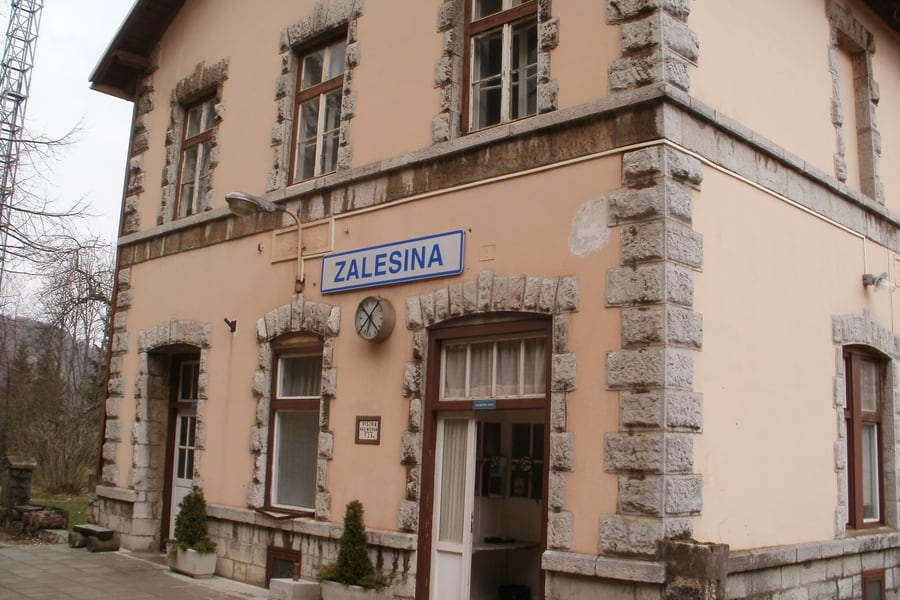
Almost every station between Karlovac and the coast is the building the line opened with: stone quoins, shuttered windows, an enamel nameboard, a bench. Zalesina, Skrad, Vrbovsko and Brod Moravice are worth looking up from a book for. The engine sheds and turntables at Ogulin, Moravice and Oštarije are the working end of the same inheritance.Falk2 / Wikimedia Commons · CC BY-SA 4.0 · croppedExcursion trains through the year
HŽPP runs day trips on this line, and it publishes the list. The Delnice Christmas fairy tale goes up the mountain in December and January; the Rijeka carnival train runs in February or March; Karlek carries the crowds to the Ogulin Fairy Tale Festival in June, met at the platform by brass bands; Cinehill takes a film-festival audience into Gorski kotar in July; and there is a train to Fužine for New Year's Eve at noon.Timetables
Every time below is read from HŽPP's own timetable feed, downloaded on 16 August 2026, and checked against the operator's live traffic notices of the same week. The timetable period runs from 14 December 2025 to 12 December 2026; the third set of amendments to it came into force on 14 June 2026.
There are two through trains a day from Zagreb to Rijeka and two back, plus a Sunday working, and they run all year. HŽPP's own seaside page makes the point without ceremony: for Rijeka and Pula, passengers "can travel in regular trains". There is no summer special on this line, and none is needed.
Zagreb to Rijeka
| Train | Zagreb GK | Karlovac | Ogulin | Moravice | Skrad | Delnice | Fužine | Rijeka | Runs |
|---|---|---|---|---|---|---|---|---|---|
| 4000 | 08:30 | 09:48 | 11:02 | 11:33 | 11:52 | 12:07 | 12:25 | 13:23 | daily |
| 702 | 16:12 | 17:13 | 18:10 | 18:40 | 18:57 | 19:10 | 19:26 | 20:19 | daily |
702 is the one to take if the object is Rijeka — four hours and seven minutes, fourteen stops. 4000 is the one to take if the object is the railway: it calls forty-seven times, takes four hours and fifty-three, and is on the mountain in the middle of the day.
Rijeka to Zagreb
| Train | Rijeka | Fužine | Delnice | Skrad | Moravice | Ogulin | Karlovac | Zagreb GK | Runs |
|---|---|---|---|---|---|---|---|---|---|
| 703 | 05:17 | 06:14 | 06:31 | 06:46 | 07:05 | 07:42 | 08:46 | 09:50 | daily |
| 1701 | 11:24 | 12:22 | 12:44 | 13:00 | 13:19 | 13:51 | 14:53 | 16:04 | Sundays, see below |
| 4001 | 13:40 | 14:37 | 14:55 | 15:10 | 15:28 | 16:00 | 17:10 | 18:30 | daily |
1701 is a Sunday-only train, and it disappears for the summer. In the 2026 timetable it runs on Sundays up to 14 June and again from 27 September, and not on the Sundays in between. On the weekdays of term time the same path exists as train 4605, but it stops at Oštarije at 13:57 and goes no further.
Over the mountain only — Ogulin to Rijeka
The Gorski kotar section has more trains than the through journey does. If the mountain is the point, these are useful, and Zagreb–Ogulin is well served separately.
| Train | Ogulin | Delnice | Fužine | Rijeka | Runs |
|---|---|---|---|---|---|
| 4600 | 04:05 | 05:09 | 05:28 | 06:30 | daily |
| 4602 | 05:45 | 07:02 | 07:21 | 08:19 | Mon–Fri |
| 4604 | 14:18 | 15:26 | 15:45 | 16:47 | Mon–Fri, term time |
| 4606 | 15:44 | 16:52 | 17:11 | 18:09 | daily |
| Train | Rijeka | Fužine | Delnice | Ogulin | Runs |
|---|---|---|---|---|---|
| 4603 | 07:25 | 08:27 | 08:45 | 09:52 | daily |
| 4605 | 11:24 | 12:22 | 12:44 | 13:51 | Mon–Fri, term time |
| 4607 | 15:35 | 16:31 | 16:49 | 17:58 | Mon–Fri |
| 4609 | 19:26 | 20:27 | 20:45 | 21:50 | daily |
Two more journeys, by changing at Ogulin
Both of these run daily, and both put a train over Gorski kotar at a time the through services do not.
- Zagreb 13:08 (train 4054) — Ogulin 15:31; 4606 leaves Ogulin at 15:44 and is in Rijeka at 18:09. Thirteen minutes to change.
- Rijeka 07:25 (train 4603) — Ogulin 09:52; 4059 leaves Ogulin at 10:00 and is in Zagreb at 12:34. Eight minutes to change.
A day on the line
There is no comfortable there-and-back in one day, and it is worth knowing that before booking. 703 out of Rijeka at 05:17 and 702 back from Zagreb at 16:12 is the only same-day pair, and it means a five-in-the-morning start. From Zagreb, the honest shape of this trip is 4000 down at 08:30 and a night in Rijeka, with 703 or 4001 the following day.
A shorter version that does work in a day, every day of the week: Zagreb 08:30 to Delnice at 12:07 on 4000, and 4001 back out of Delnice at 14:55, into Zagreb at 18:30. That is under three hours on the ground, which is enough for the town and lunch, and it puts both crossings of the mountain in daylight.
Track work
At the time of writing the operator's notice board lists no closures on the Zagreb–Rijeka line itself. The engineering blocks currently published are on other routes out of Zagreb — Sesvete and Dugo Selo, Križevci to the Hungarian border — and on the Karlovac–Ozalj–Kamanje branch, which is bus-operated until 12 December 2026 and is a different line that happens to start in the same station.
*Times as of August 2026. HŽPP publishes the timetable, the live traffic notices and the engineering works at hzpp.hr (opens in a new tab), and the notice board is worth a look on the morning of travel.*
Tickets
This is an ordinary domestic journey on an ordinary domestic ticket, with no supplement and no compulsory reservation — the operator names the Split trains as the ones that need a seat booked, and the Rijeka trains are not among them. Buying online is 10 per cent cheaper than at the counter, and ticket machines are thin on the ground: the only one on this journey is at Zagreb Main Station.
Two standing offers apply. The operator's "to the seaside by rail" page takes 40 per cent off tickets bought at its ticket offices and names Rijeka; separately, a prepaid smart card takes a further 50 per cent off second-class fares at weekends. Validity is unusually generous at this distance — a one-way ticket lasts two days and a return six, so a return bought on a Monday is still alive on Saturday. Rules read from HŽPP, 16 August 2026.
Book your tickets
Bvcmz248.5 / Wikimedia Commons · CC0 · croppedA ticket over the mountain
Zagreb to Rijeka, or any part of it
An ordinary domestic fare, 10 per cent cheaper online, valid two days one way and six return.
Book Tickets (opens in a new tab, on hzpp.hr)via hzpp.hrKiki273 / Wikimedia Commons · CC BY-SA 3.0 · croppedThe seaside and weekend offers
40 per cent at the counter · a further 50 at weekends
Two standing discounts that both apply to this route, and stack with nothing else.
Book Tickets (opens in a new tab, on hzpp.hr)via hzpp.hrBicycle ticket
€1.99 one way
Folded, a bicycle rides anything; unfolded, none of the four through trains takes it.
Book Tickets (opens in a new tab, on hzpp.hr)via hzpp.hrRail Passes
A rail pass is not the way to do this journey, and the reasons are worth setting out because they are specific rather than general.
The Croatia One Country Pass
Interrail's Croatia Pass covers HŽPP's whole network, this line included, and there is nothing on these trains that a pass holder has to pay extra for — no supplement, no compulsory reservation, no first-class-only working. A pass holder simply gets on.
The catch is the condition Interrail states itself: a One Country Pass cannot be used to travel into or out of the country it covers. A Croatia pass is for travelling inside Croatia. It cannot carry anyone in from Ljubljana, Vienna or Budapest, and it cannot be bought at all by someone resident in Croatia.
So the arithmetic is simple. This is a single domestic journey of 229 kilometres, sold as one ordinary ticket and 10 per cent cheaper again online. A pass that has to earn its price back over three or four travel days will not do it on one crossing of Gorski kotar, and it will not do it on a return either, because the return ticket is valid six days and covers the same ground.
When a pass does start to make sense
A pass earns its keep on this line only as part of a longer Croatian itinerary — Zagreb to Rijeka, then Zagreb to Split down the Lika railway, then the summer night train to Osijek, over a week or so. Four or five long domestic runs in a fortnight is roughly where the sums turn.
The Global Pass
An Interrail Global Pass is a different proposition, because it does carry its holder across the border, and Croatia is one of its countries. For anyone arriving from Ljubljana, Vienna or Budapest and continuing over the mountain to the Adriatic, it works normally here, and the same absence of supplements applies — the pass is shown, the train is boarded.
Pass conditions read from interrail.com, October 2026. No fare or pass price is quoted on this page — both change, and neither would be worth trusting six months from now.
Places to Visit
Almost everything worth stopping for on this line is within walking distance of a platform, which is a consequence of the railway having arrived before the tourism did. Karlovac's star fortress, Ogulin's chasm, the gorge at Skrad, the deepest show cave in the country at Lokve — all of them are reached from a station the train calls at, and the trail into the Skrad gorge literally begins at the station gate.
The six below run in order from Zagreb. Two of them, Skrad and Lokve, are protected areas in the county's care, opened by concession-holders and worth a telephone call before setting out; the mountain between them is a national park declared in 1949. Rijeka at the end is a working port with a castle above it on the site of an Illyrian and Roman fort, and a promenade at sea level, and it is the only place on the list that wants a full day rather than an afternoon.
 Vojtěch Dočkal / Wikimedia Commons · CC BY-SA 4.0 · cropped
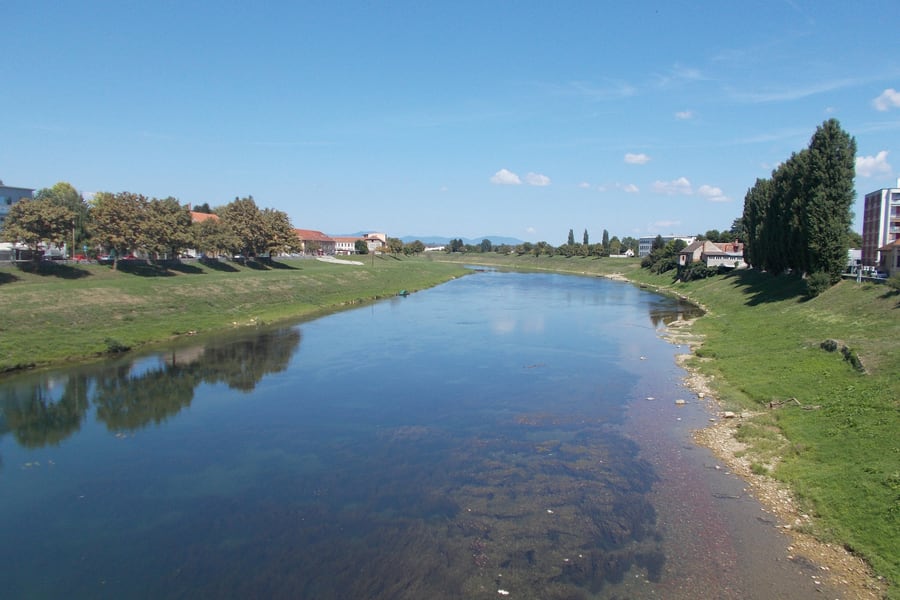
Karlovac, the town inside a star
A fortress laid out as a six-pointed star on empty ground, begun on 13 July 1579 and largely finished by the September of the following year. The Ottomans besieged it seven times, the last in 1672, and never took it; the star is still legible in the street plan. Karlovac calls itself the town on four rivers — the Mrežnica, the Korana and the Kupa run through it, the Dobra just outside — and after the peace of 1699 it turned from a garrison into a market town.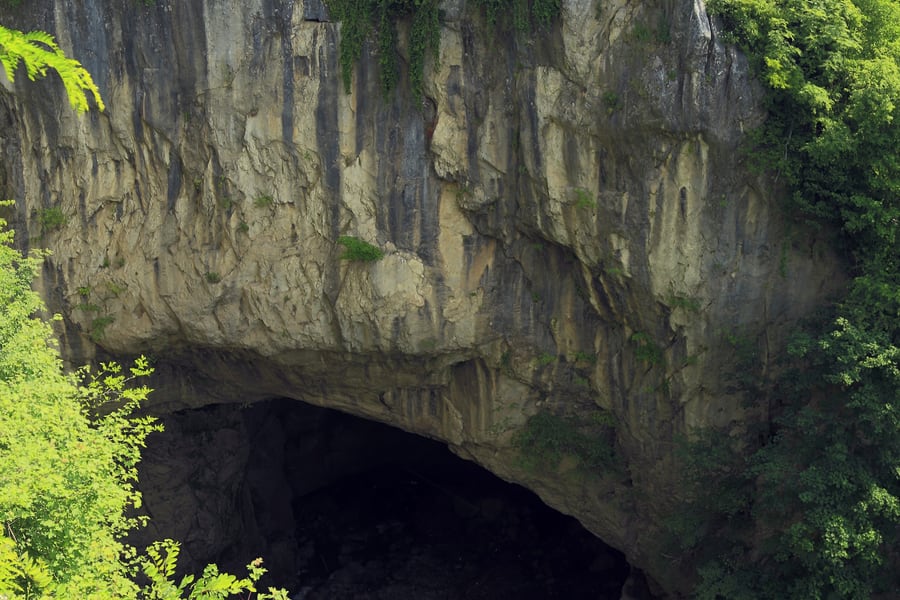 Falk2 / Wikimedia Commons · CC BY-SA 3.0 DE · cropped
Ogulin, and the river that disappears
In the middle of the town the Dobra runs into a cliff and vanishes down Đula's Abyss, which joins the Medvedica cave underground to make the longest cave system in Croatia — 15,701 metres explored so far. Above it stands the castle Bernardin Frankopan founded around 1500, now a museum and Ivana's House of Fairy Tales, for the writer Ivana Brlić-Mažuranić, born here. Behind the town is Klek, whose cliff is where Croatian mountaineering began in 1874.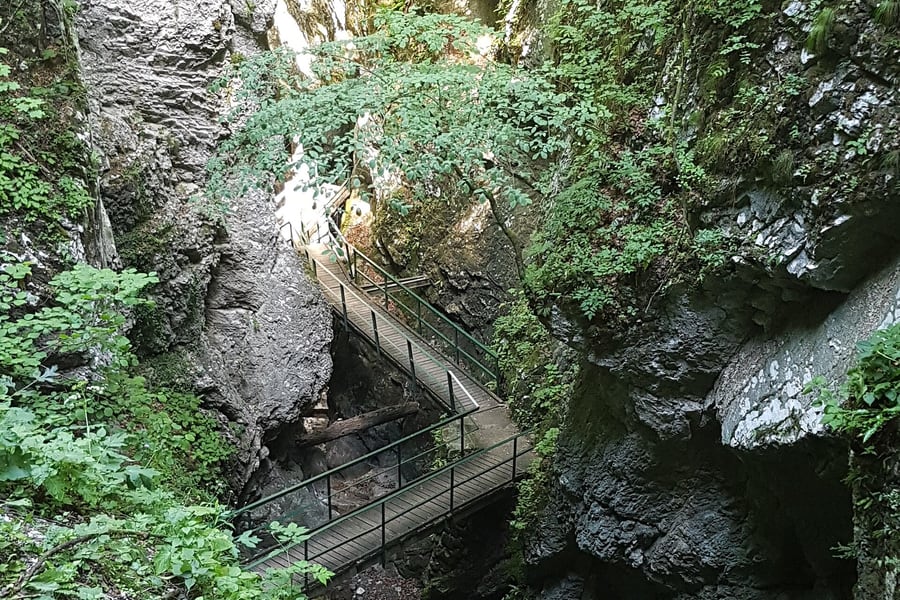 Deapmakeup / Wikimedia Commons · CC BY-SA 4.0 · cropped
The Devil's Passage at Skrad
Vražji prolaz is a canyon about 800 metres long and, in places, two metres wide, cut by the Jasle stream and crossed by walkways bolted into the rock. Round the loop is Zeleni vir, a cave spring under a rock face 70 metres high. All 252 hectares have been protected since 1962, and the circular walk is signposted from the platform at Skrad. It is steep: the county rates it four out of five.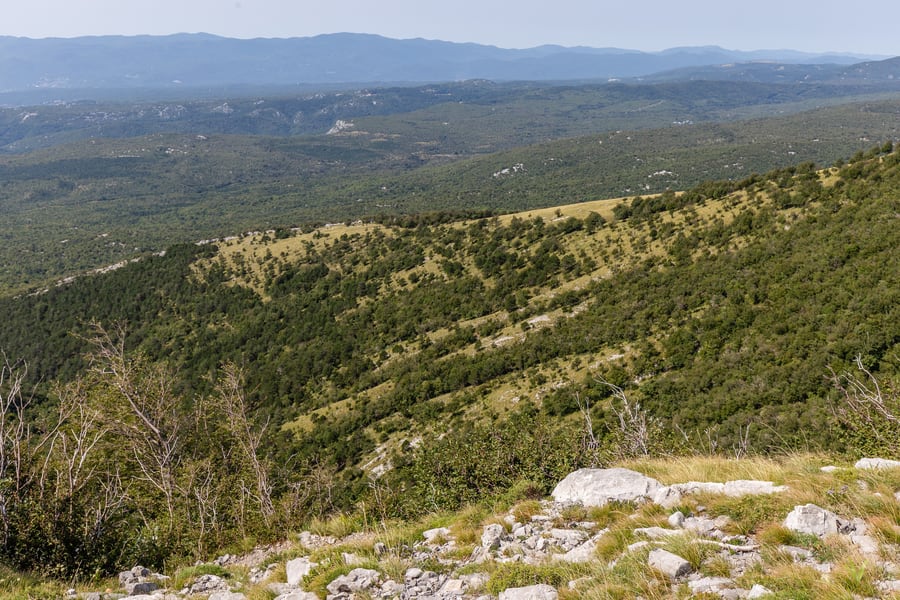 Michal Klajban / Wikimedia Commons · CC BY-SA 4.0 · cropped
Risnjak, and the source of the Kupa
Declared in 1949 and extended in 1997, Risnjak covers 63.5 square kilometres of fir and beech forest and karst grassland, rising to 1,528 metres. It is named for the lynx — ris — wiped out here in the nineteenth century and back after a reintroduction in neighbouring Slovenia; brown bear and wolf are here too. The Kupa rises inside the park, in an oval pool about fifty metres across. The visitor centre is at Crni Lug, reached from Delnice.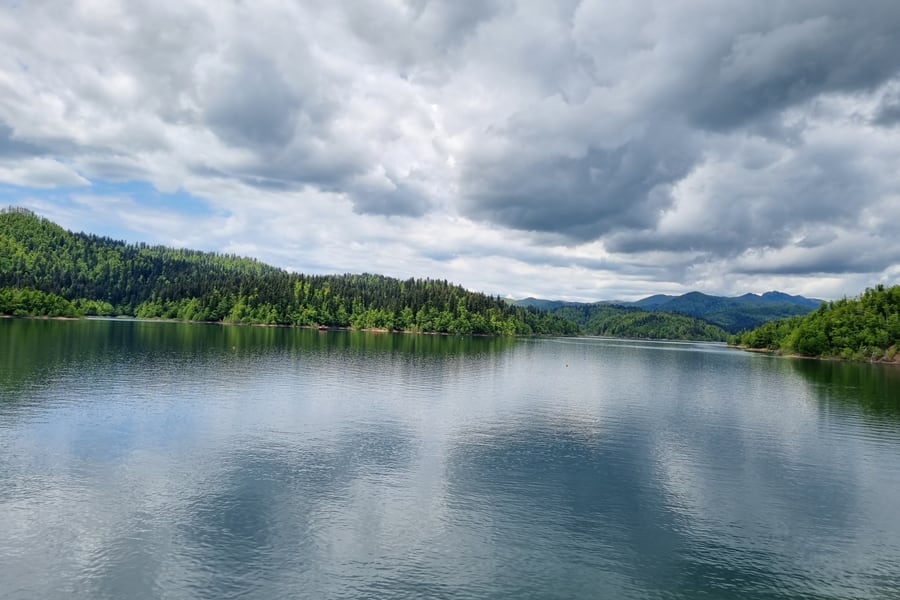 DAlfirevic / Wikimedia Commons · CC BY-SA 4.0 · cropped
Lokve, its lake and the deepest cave in Croatia
Špilja Lokvarka is the deepest show cave in the country. A merchant named Jakov Bolf found it by accident in 1911 while quarrying stone for lime, and the first steps went in a year later. It has six levels; visitors walk the first four, down to 70 metres, and the last two — the lowest 275 metres down — are left to cavers. It holds 1,179 metres of surveyed passage, stays at 8 °C, and is the only place on earth the beetle Croatodirus ozimeci has been found.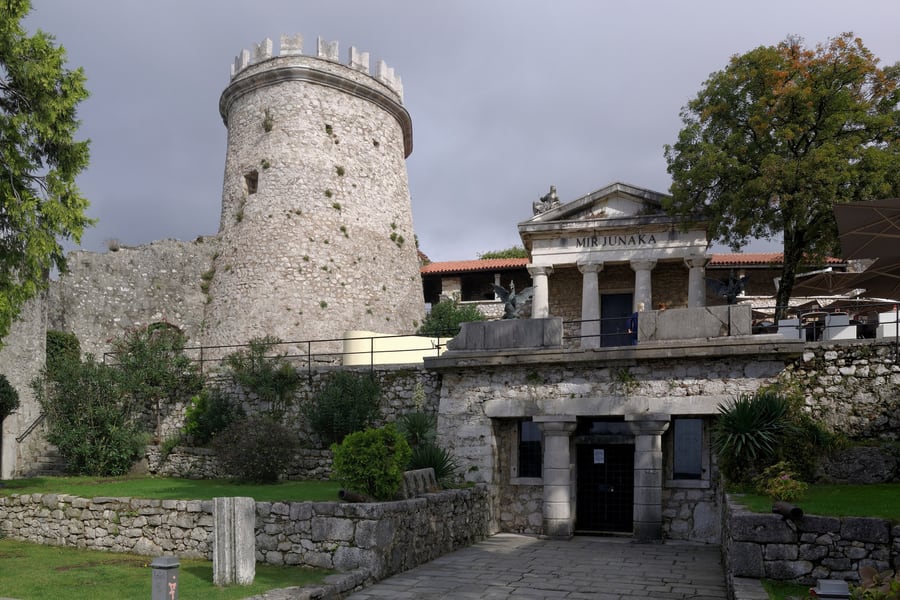 Berthold Werner / Wikimedia Commons · CC BY-SA 3.0 · cropped
Rijeka, at the bottom of the hill
Croatia's third city and its principal port, with 107,964 people at the 2021 census. Charles VI made it a free port in 1719; from 1779 it was a corpus separatum governed from Budapest, and by 1913 it was Europe's tenth-busiest port. Above the town, on the site of an Illyrian and then a Roman fort, stands Trsat castle; below it run the Korzo and the cathedral of St Vitus. Rijeka was European Capital of Culture in 2020, and its carnival is what it is known for.Where to Sleep
The shape of this journey settles the question of where to sleep. There is no comfortable same-day return from Zagreb, so a night at the Rijeka end is not a luxury but the way the timetable works. And because the two through trains sit either side of the middle of the day, a night in Gorski kotar turns one long ride into two good ones — down to Fužine or Delnice on the morning train, out again the next day.
Three below, one at each end and one on the mountain. Each takes bookings directly and each stands in the middle of its own town rather than in a resort complex. No price, rating or star count is given for any of them, because none of that has been verified — what is here is what the hotels say about themselves.
Zagreb's main square is a walk of about ten minutes from Zagreb Glavni kolodvor, up through the chain of park squares laid out in front of the station, and anything on it can be reached with a bag. Fužine is much the smallest of the three towns, and its hotel is also the village restaurant, which in Gorski kotar counts for a good deal. Rijeka's centre lies just behind its station, with the Korzo a few minutes' walk from the platform.
Where to stay
Hotel Dubrovnik
On Zagreb's main square
A city hotel at Ljudevita Gaja 1, standing directly on Ban Jelačić square with a tram stop outside the door and the Upper Town and St Mark's about seven minutes away on foot. It has an American steakhouse and grill, a café on the square and a lobby bar, five conference halls named after Croatian bans, air conditioning throughout and free wifi, and it takes bookings and enquiries directly through its own site.
Check Availability (opens in a new tab, on hotel-dubrovnik.hr)via hotel-dubrovnik.hrHotel Bitoraj
In the middle of Fužine, on the mountain
A family hotel and restaurant in the centre of Fužine, run by the Kauzlarić family, with twenty-five rooms of different shapes — traditional and modern, a two-room apartment, and one redesigned throughout for guests with disabilities, with ramps and a lift to reach it. There is a wellness centre with a sauna facing the forest, and a restaurant that cooks Gorski kotar food, game included. It began in 1933 as Pansion Neda, named for the owner's daughter, who later became the first and so far only woman to be mayor of Rijeka; it took the name of the mountain above the town after the war.
Check Availability (opens in a new tab, on bitoraj.hr)via bitoraj.hrGrand Hotel Bonavia
In the centre of Rijeka
The flagship of Jadran hoteli, the largest hotel group in the Rijeka area, standing in the middle of the city a few minutes from the station and the Korzo. Its rooms run from standard doubles through superior rooms — including one laid out for guests with disabilities — to premium rooms with balconies and suites, and the hotel handles meetings and weddings as well as ordinary stays. Bookings are taken directly on the group's site.
Check Availability (opens in a new tab, on jadran-hoteli.hr)via jadran-hoteli.hrQuestions or corrections
Planning this trip and stuck on something, or spotted a time, fare or detail that has changed? Send us a message about Over Gorski kotar — Zagreb to Rijeka. We read every one, and we update this page when something has changed.