The Zittauer Schmalspurbahn to Oybin and Jonsdorf
Dan Kollmann / Wikimedia Commons · CC BY-SA 4.0
- Distance16.1 km in all — 8.93 km to Bertsdorf, then 3.30 km to Oybin or 3.85 km to Jonsdorf
- Duration48 minutes Zittau to Kurort Oybin; 49 minutes to Kurort Jonsdorf
- Best seasonLate March to early November for the full service — and a Saturday or Sunday for seven double departures rather than four
Introduction
In 1981 the government of East Germany decided when this railway would stop carrying passengers. The date was set for autumn 1990. The Olbersdorf lignite mine, which the line ran straight past, was to be enlarged over the top of it, and a fast tramway would take the passengers instead. Freight was to carry on until 1991, and then there would be no narrow-gauge railway in the Zittau Mountains at all.
What happened instead is that the mine went first. On 1 March 1990 the council of ministers decided to stop taking coal out of Olbersdorf, and on 30 September 1991 the last coal train left the pit. The hole it left behind was filled with water between September 1996 and March 1999, diverted in from two small streams, and it is now the Olbersdorfer See — sixty hectares of it, forty metres deep, with a beach and a campsite and a footpath round the rim. The train still runs past. It passes the lake at Olbersdorf Niederdorf and Olbersdorf Oberdorf, two stops that were named after a village rather than a mine, and it has outlived the thing that was scheduled to bury it by more than thirty years.
What the railway does now
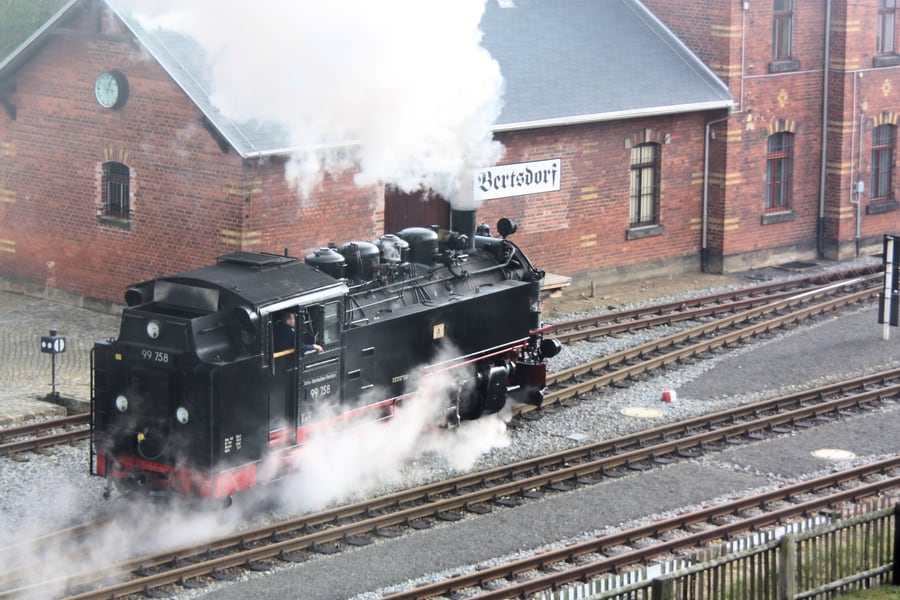
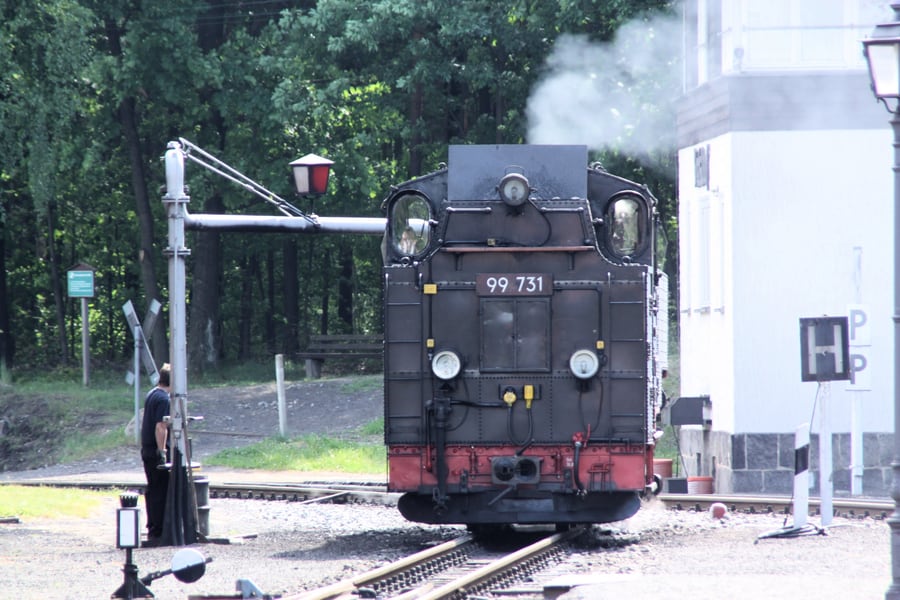
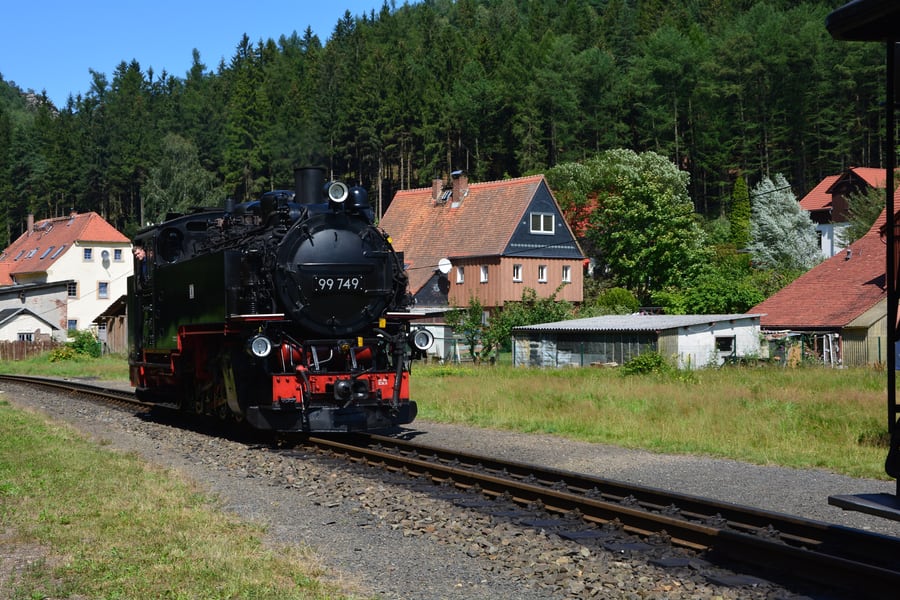
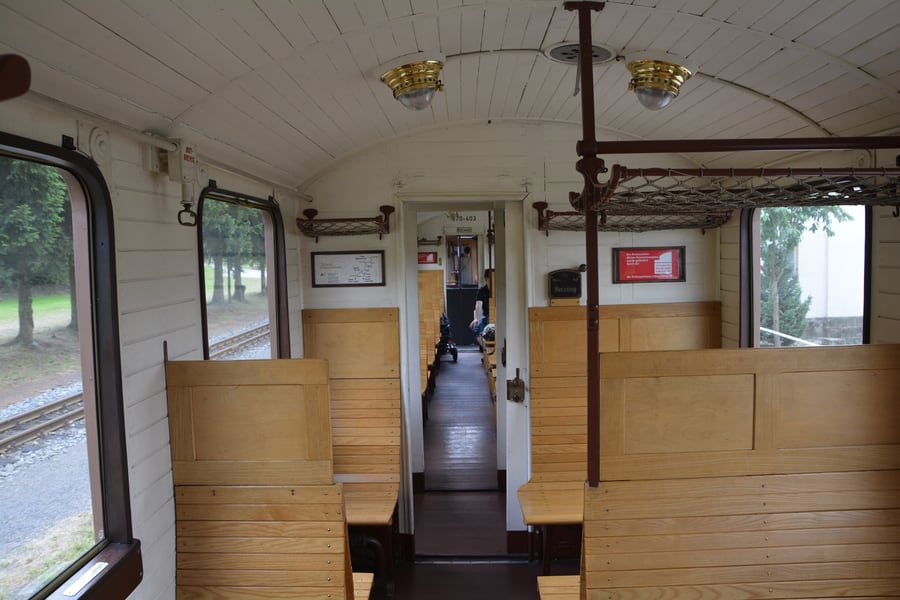
It runs from Zittau, in the far south-east corner of Saxony where Germany, Poland and Czechia meet, sixteen kilometres up into the Zittau Mountains on a track 750 millimetres wide. Steam every day, all season. The stock is genuinely old — the class of locomotive that does most of the work arrived new in 1929 and is still in daily traffic — and the coaches have wooden seats and brass luggage racks.
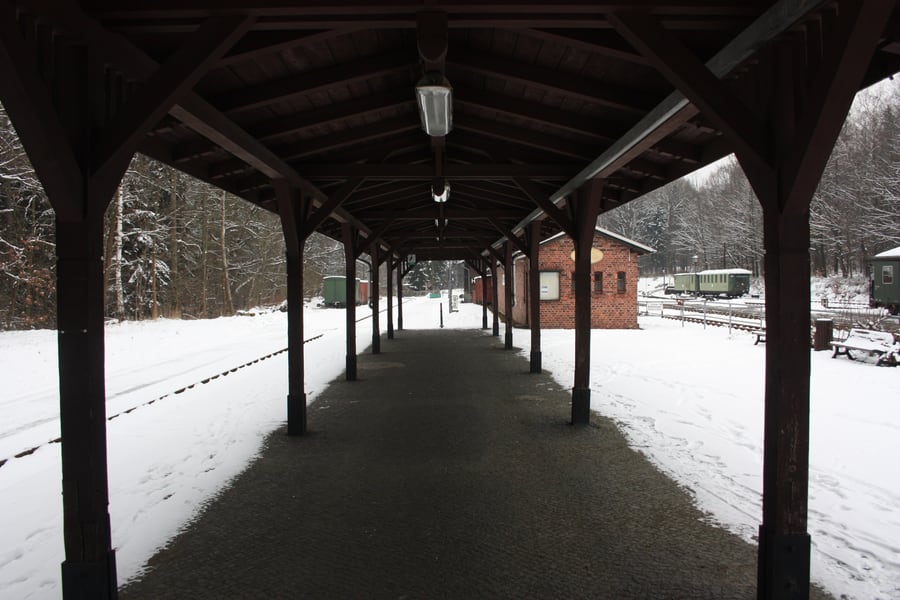
The part worth knowing about in advance is what happens at Bertsdorf, 8.93 kilometres out. The line divides there. One branch climbs 3.30 kilometres to Kurort Oybin, under a sandstone mountain carrying the ruins of a monastery that Charles IV founded in 1369; the other runs 3.85 kilometres to Kurort Jonsdorf, where sandstone was quarried into millstones for three and a half centuries. Bertsdorf has an island platform with the station building standing on it, a roof put over the whole thing in 1914, and a mechanical signal box at the end.
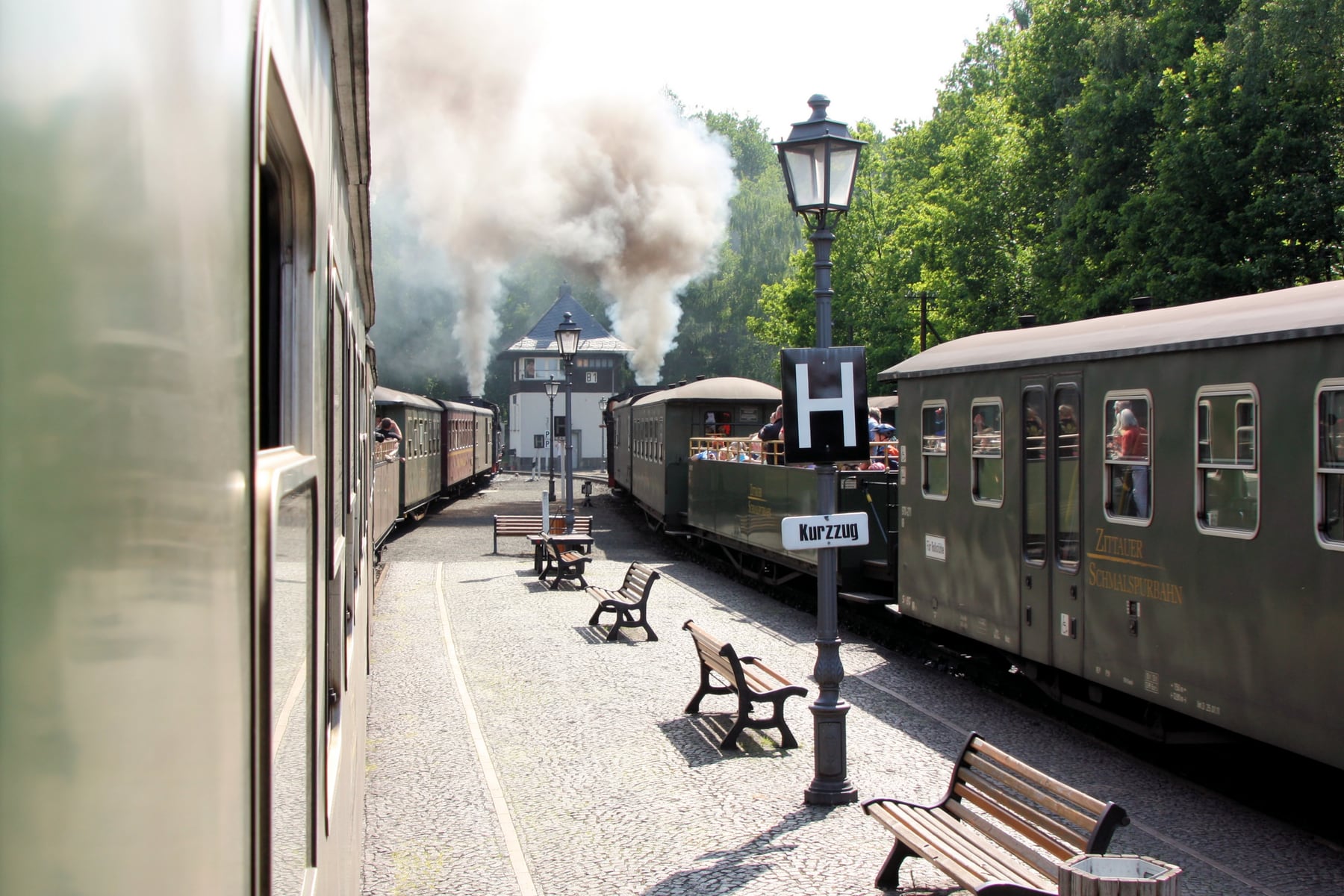
And on the right sort of day, two trains stand on either side of that platform and leave at the same minute — 09:42, 11:42, 13:42, 15:42, and on a Saturday three more besides. Two locomotives, two whistles, two columns of smoke, running side by side for a few hundred metres before the tracks part and one goes left and the other goes right. The railway calls it the Bertsdorfer Doppelausfahrt. It is not a special event and no one sells a ticket for it; it is just what the timetable produces when there are enough trains in traffic to produce it.
The Journey
Trains start from a bay beside the main-line station at Zittau, alongside the platforms used by the regional services to Dresden, Cottbus, Liberec and Varnsdorf. The narrow gauge then works its way out of the town at walking pace through three more stops — Zittau Haltepunkt, Zittau Süd, Zittau Vorstadt — which between them cover about two kilometres. Zittau Süd, at 232 metres, is the lowest point on the whole railway.
Past the lake
After Zittau Vorstadt the line comes out into open country and reaches Olbersdorf. This is the part of the journey that carries the history. The two Olbersdorf stops sit beside what was, until 1991, an opencast lignite mine: pits had been dug here since 1908, a bucket-chain excavator and two steam locomotives arrived to strip the overburden in the early years, bucket-wheel excavators took over in 1968, and 21.5 million tonnes of coal came out before it ended. The railway was part of it. A 2.4-kilometre connecting line was laid from the pit to Olbersdorf Oberdorf station and brought into use in 1949, so for four decades this narrow-gauge tourist line was also a coal railway.
The mine is a lake now, and from the train you see water where the workings were. One of the bucket-wheels stands on the shore as a monument, ten metres across with its cutting teeth still on it.
Bertsdorf, and the moment the train divides
Bertsdorf arrives 31 minutes out of Zittau. It is a small place with a large railway: four platform tracks, two sidings, a locomotive shed that has been there since the line opened, two water cranes from the 1890s, and a station building that was the head office of the Zittau–Oybin–Jonsdorf Railway Company when the line was privately owned. The whole ensemble is a protected monument, and once a month it opens as a museum station.
The Zittau train stops on one side of the island platform. On the other side there is usually already a second train, which has been waiting — the first working of the day comes up from Zittau at 08:43, gets to Bertsdorf at 09:13, and stands there for twenty-nine minutes. Passengers for the other valley cross the platform. Then both trains leave together.
The two valleys
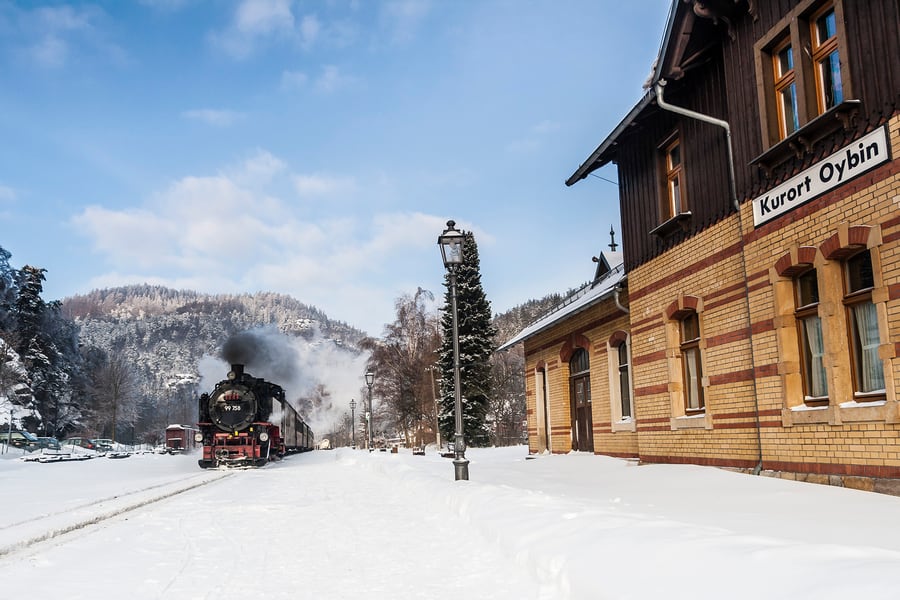
Towards Oybin the line climbs through woods for eleven minutes, calling at Kurort Oybin-Niederdorf and at a halt named Teufelsmühle, and finishes at 389 metres under the Oybin rock itself. The terminus building is a long two-storey house in yellow brick with the station name painted across it, and the mountain with its ruins stands directly behind.
Towards Jonsdorf it is twelve minutes, one intermediate halt, and a terminus whose reception building has been a guesthouse since the early 2000s. The millstone quarries begin a short walk beyond the platform.
The two branches never meet again. What connects them is the shuttle that works back and forth across Bertsdorf all day, alternating valleys — Jonsdorf to Bertsdorf, Bertsdorf to Oybin, Oybin to Bertsdorf, Bertsdorf to Jonsdorf — so that from either terminus you can reach the other with one change, and the change is timed.
The train itself
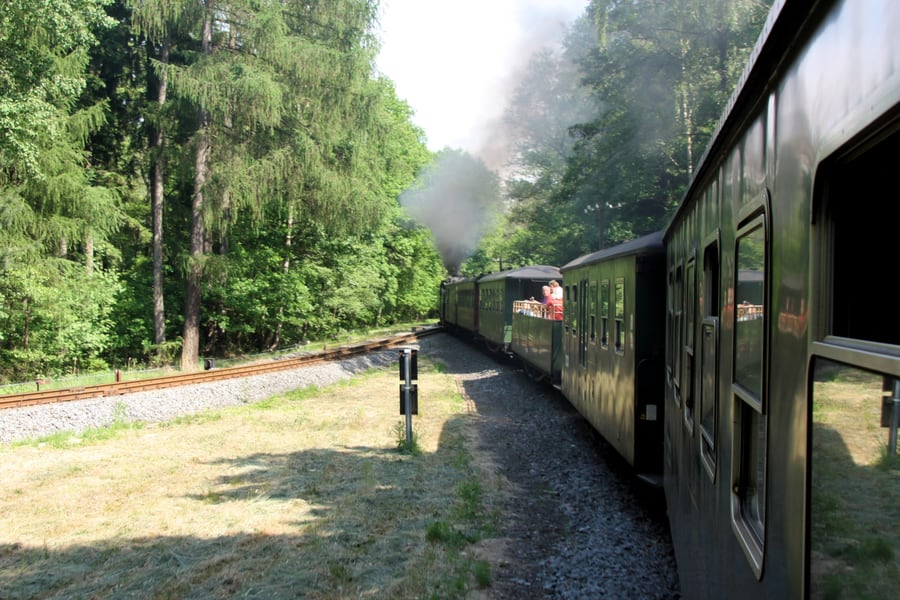
From May to October, in fine weather, every steam train carries an open observation coach with a roof and no sides. Every steam train also carries a wheelchair coach; the operator asks for a day's notice. The historic sets that run at weekends between early April and the start of November — billed as the Reichsbahnzug and the Sachsenzug — are the exception, and have no wheelchair coach. There is a dining car every day in the main season, and Friday to Sunday out of it.
Along the route
Dan Kollmann / Wikimedia Commons · CC BY-SA 4.0Two trains, one platform, the same minute
At Bertsdorf the railway divides, and the timetable is built so the two halves leave together. Passengers cross the island platform, and then both locomotives go at once — four times on a weekday, seven at weekends. It is not staged and there is no charge for it.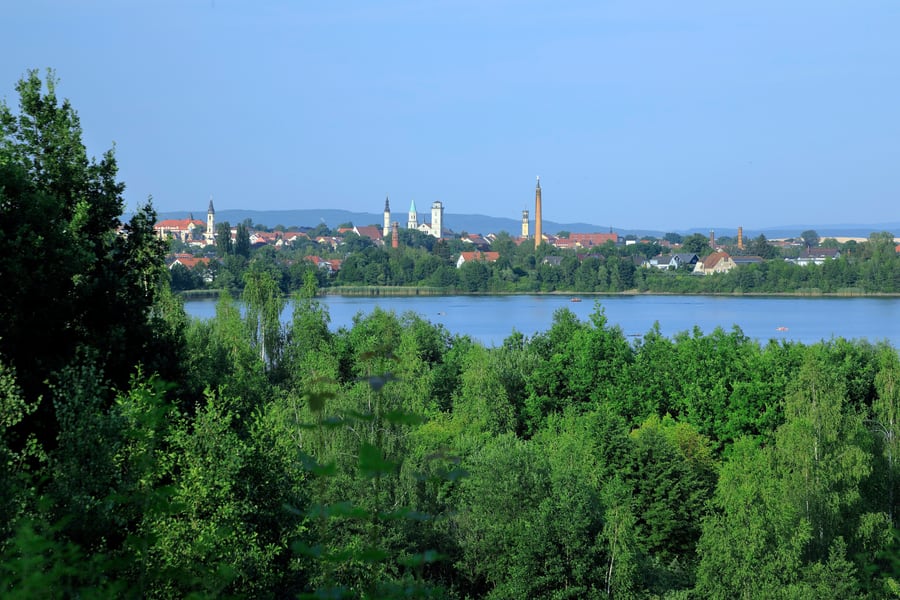 Falk2 / Wikimedia Commons · CC BY-SA 4.0
The mine was going to bury it, and went first
In 1981 the state fixed autumn 1990 as the end of passenger services here, so the Olbersdorf lignite pit could be dug out over the trackbed. The coal was stopped in March 1990 instead, and the hole was filled with water. The railway now runs along its shore.Dan Kollmann / Wikimedia Commons · CC BY-SA 4.0A timetable measured in locomotives
The operator does not publish a frequency. It publishes how many trains are in traffic — three on Sundays, two on main-season weekdays, one in the off season — and colours every day of its calendar to match. That number is the most useful thing to check before picking a date.A bit of history
Culture & experiences along the way
Dan Kollmann / Wikimedia Commons · CC BY-SA 4.0Ride both valleys in one day
The shuttle that works across Bertsdorf all day alternates between the branches, so a single day ticket gets you Zittau to Oybin, back down to the junction, out to Jonsdorf and home again, with the changes already timed. Doing it in that order also means you are standing on the platform for at least two of the double departures rather than sitting in one of the trains that makes them.Bybbisch94, Christian Gebhardt / Wikimedia Commons · CC BY-SA 4.0Sit in the open coach
From May to October, when the weather is good, every steam train carries an open observation coach — a roof, a floor, railings and no sides. On a line whose whole business is smelling of coal smoke and travelling at the speed of a bicycle, it is the seat to have. Every steam train also carries a wheelchair coach, with a day's notice asked for.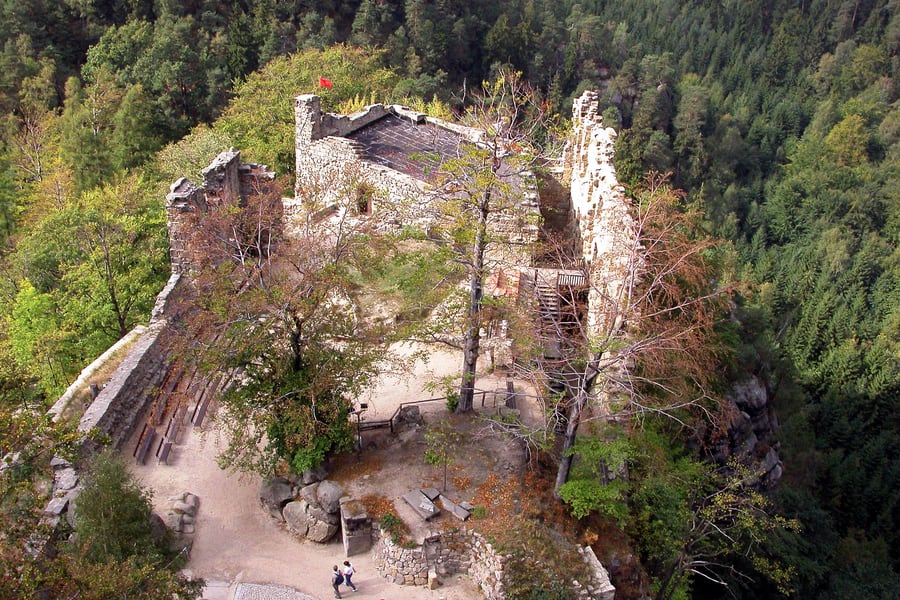 Jörg Blobelt / Wikimedia Commons · CC BY-SA 4.0
Climb the Oybin from the terminus
The station at Kurort Oybin sits directly under the rock, and the path to the castle and monastery ruins on top starts a few minutes from the platform. Charles IV founded the Celestine house here in 1369 and had the mountain rebuilt as somewhere to retire to; lightning and fire ended it in 1577. The walk up is short and steep and the view from the top covers both valleys the railway serves.Timetables
The operator does not describe its service by frequency. It describes it by how many trains are out on the line at once, and the printed calendar colours every day of the year accordingly: three trains on Sundays, public holidays, Saturdays and bridging days; two trains on ordinary main-season weekdays; one train in the off-season. That number is what decides whether you see two locomotives leave Bertsdorf together, so it is worth choosing before you choose a date.
All times below are as of August 2026, taken from the operator's published timetable and calendar for 2026 and checked against live schedule data for specific dates.
Main season — 28 March to 1 November 2026
Two trains (Monday to Friday). From Zittau at 08:43, 09:05, 11:05, 13:05 and 15:05. Every one of them runs to Bertsdorf in 31 minutes; the 08:43 gets there at 09:13 and then waits.
From Bertsdorf the departures to Kurort Oybin are 09:42, 10:49, 11:42, 12:49, 13:42, 14:49, 15:42 and 16:51, arriving 11 minutes later. Departures to Kurort Jonsdorf are 09:42, 11:42, 13:42 and 15:42, arriving 12 minutes later. The four times that appear in both lists are the four double departures of a weekday.
Coming back on a weekday, from Kurort Oybin at 10:02, 11:11, 12:02, 13:11, 14:02, 15:11, 16:02 and 17:24; the last of those reaches Zittau at 18:06. From Kurort Jonsdorf at 10:04, 12:04, 14:04 and 16:04. The 14:04 connects through to Zittau at 16:45. The 16:04 is the last of the day and it involves a long stand at Bertsdorf — it reaches Zittau at 18:06, a little over two hours after leaving Jonsdorf.
Three trains (Saturdays, Sundays and public holidays). Four more departures from Zittau are added, at 10:16, 12:16, 14:16 and 16:16, and the Jonsdorf branch gains a second set. Bertsdorf then sends trains into both valleys at 09:42, 10:49, 11:42, 12:49, 13:42, 14:49 and 15:42 — seven simultaneous departures in a day rather than four. Late afternoon breaks the pattern: 16:49 to Jonsdorf and 16:51 to Oybin leave two minutes apart, and there is a final 17:38 to Oybin. Last trains back are 17:11 from Jonsdorf (Zittau 18:10) and 18:00 from Oybin (Zittau 18:41).
The four weeks with no trains at all
From 2 to 27 November 2026 there is no service on any part of the line, for engineering work. The operator prints this across four rows of its calendar, and a search for a train at Bertsdorf on those dates returns nothing while the main-line station in Zittau carries its usual seventy-odd departures. No replacement bus is advertised.
Off season — 28 November to 18 December 2026
One train works the whole railway, and the double departure does not happen at all. Two round trips from Zittau, at 09:07 and 13:07, reaching Oybin at 09:49 and 13:49.
Between them the single set shuttles across Bertsdorf: to Oybin at 09:38, 11:35, 13:38 and 15:35, back from Oybin at 09:59, 11:56, 13:59 and 15:56; to Jonsdorf at 10:39 and 14:39, back from Jonsdorf at 11:01 and 15:01. Returns to Zittau leave Bertsdorf at 12:08 and 16:08, arriving 12:37 and 16:37.
A new timetable for 2026/27 takes effect on 13 December 2026, and the operator runs Advent trains with coffee and Stollen through December, Father Christmas trains to both termini on 24 December with nothing running after 15:00, and a New Year's Eve train — which for 2026 is already advertised as sold out. Those dates sit outside the two published seasonal timetables, so the operator's own calendar is the thing to check for them.
Connections at Zittau
Zittau is on the regional network, and the narrow-gauge timetable is printed with the main-line arrivals beside it. Trains reach Zittau from Dresden at 07:52, 08:55, 09:52, 10:55, 11:52, 12:55, 13:52, 14:55 and 15:52, from Cottbus at five minutes to each hour, from Liberec in Czechia at two minutes to each hour from 07:58, and from Varnsdorf at 59 minutes past. Going home, departures for Dresden leave at 11:03, 12:05, 13:03, 14:05, 15:03, 16:05, 17:03 and 19:03.
Timetables, the year calendar and the current PDF are published by the operator at zittauer-schmalspurbahn.de (opens in a new tab).
Tickets
Fares are charged by how many stations you pass rather than by kilometre, in four bands, under a tariff that took effect on 28 March 2026. Zittau to either terminus is the top band: €14.00 single, €20.00 return, with reduced rates for 15- to 17-year-olds, apprentices and students. Children up to 14 travel free with a ticket-holding adult. A single is valid all day and you may break the journey as often as you like, which matters here — the interesting places are spread across Olbersdorf, Bertsdorf, Oybin and Jonsdorf rather than gathered at one end.
Anyone meaning to see both valleys is past the price of a return before lunch, so the €26.00 day ticket — valid across the whole ZVON network — is usually the sensible purchase. A Deutschlandticket does not carry you here, but it entitles you to buy the historic-railway supplement at €12.00 for the day, which does the same job for half the money.
Book your tickets
Single and return
€14.00 single · €20.00 return, Zittau to either terminus
Priced by stations passed, with breaks of journey allowed all day.
Book Tickets (opens in a new tab, on Zittauer Schmalspurbahn (SOEG))via Zittauer Schmalspurbahn (SOEG)Day ticket
€26.00, and valid across the whole regional network
The sensible buy for both branches — an existing €20.00 return upgrades for €6.00.
Book Tickets (opens in a new tab, on Zittauer Schmalspurbahn (SOEG))via Zittauer Schmalspurbahn (SOEG)Historic-railway supplement
€12.00 for Deutschlandticket and network-ticket holders
What a Deutschlandticket buys you here, since the ticket itself is not valid.
Book Tickets (opens in a new tab, on Zittauer Schmalspurbahn (SOEG))via Zittauer Schmalspurbahn (SOEG)Rail Passes
No rail pass carries you on the Zittauer Schmalspurbahn by itself. The line is worked by a private company, the Sächsisch-Oberlausitzer Eisenbahngesellschaft, and it charges a historic-railway supplement on top of every network product rather than accepting them outright. Knowing that in advance saves an awkward conversation with a conductor.
Interrail and Eurail
An Interrail or Eurail pass is not valid here, and there is no pass-holder discount. Interrail settles that itself: its coverage table for Germany sends anything it does not name to a closed list of the German companies a pass is valid on, and the Sächsisch-Oberlausitzer Eisenbahngesellschaft is not on it. What a pass does usefully cover is the journey to the start: Zittau has regional trains from Dresden roughly hourly, from Cottbus, and from Liberec across the Czech border, and all of those are ordinary services on which a pass works normally. Arriving on a pass and then buying a €14.00 single or a €26.00 day ticket for the narrow gauge is the straightforward arrangement.
The Deutschlandticket
The €63 monthly Deutschlandticket is the pass most visitors will actually be holding, and it behaves the same way: not valid, but it entitles the holder to the Historik-Zuschlag at €12.00 a day (€8.00 reduced), or €36.00 for a week. Because the day ticket costs €26.00, the supplement is the cheaper route onto the railway for anyone who already has the Deutschlandticket for other reasons — and it also gets you to Zittau from anywhere in Germany on regional trains at no extra cost.
Is a pass worth buying for this journey?
For this railway alone, no. Sixteen kilometres of 750-millimetre track does not repay a rail pass, and the operator's own day ticket is both cheaper and valid across the surrounding ZVON network for the same day.
The case changes if the Zittau line is one stop on a Saxon narrow-gauge trip. Saxony still has an unusual number of these railways in daily steam operation, and several of them — the Weißeritztalbahn, the Lößnitzgrundbahn and the Fichtelbergbahn — belong to a different operator, the SDG, whose own €12.00 supplement covers all three on one day but does not extend to Zittau. Two operators, two supplements, no combined ticket. A Deutschlandticket plus one supplement in each company is the way that works out cheapest, and it is worth planning the days so that each €12.00 buys more than one line.
Conditions here were checked against the operator's published tariff, Interrail's own coverage table for Germany and the Deutschlandticket's published price, in August 2026.
Places to Visit
The railway is sixteen kilometres long and the things worth stopping for are spread along all of it, which is one of the better arguments for a day ticket. Zittau is a proper town with a market square rather than a place you pass through on the way to the mountains. Olbersdorf is where the industrial history is, and it is not hidden — the lake and the machinery beside it are both plainly what they are. Bertsdorf is the railway's own museum. And the two termini are the two halves of the Zittau Mountains: a monastery ruin on a rock at one, three and a half centuries of quarrying at the other.
The cards below follow the order a train from Zittau reaches them.
 Erik-Holm Langhof / Wikimedia Commons · CC BY-SA 4.0 · cropped
Zittau
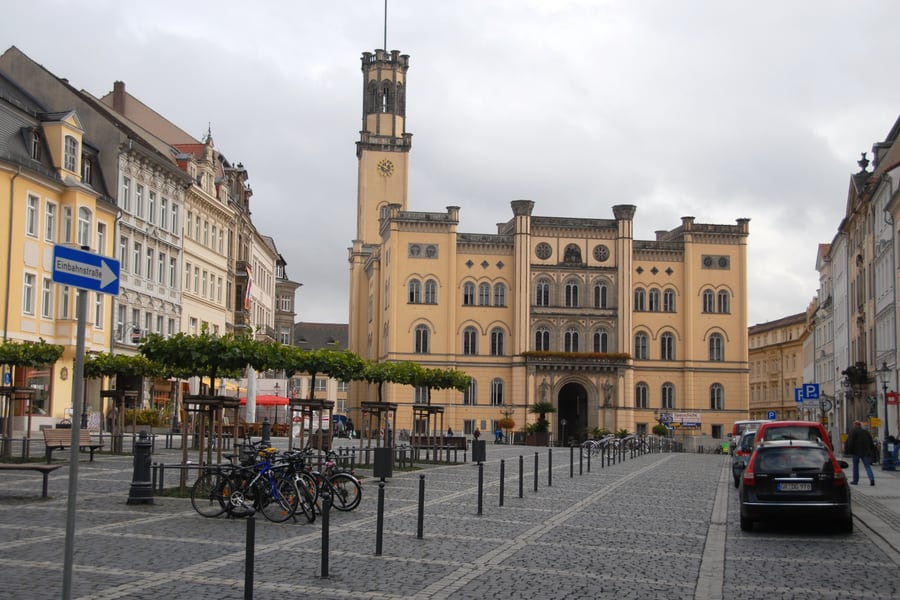
A town of about 25,000 people in the corner where Germany, Poland and Czechia meet, first recorded in 1238, with the Lausitzer Neiße forming the Polish border along its eastern edge. The market square is dominated by a town hall built between 1840 and 1845 by Carl August Schramm, in an Italian Renaissance manner worked up from designs by Karl Friedrich Schinkel, with a tower fifty metres high.Falk2 / Wikimedia Commons · CC BY-SA 4.0 · croppedThe Olbersdorfer See
Sixty hectares of water, forty metres deep, filling the pit of the lignite mine that was to have swallowed this railway. Coal was dug here from 1908, and 21.5 million tonnes came out before the last train left in 1991; the hole was flooded from two diverted streams between September 1996 and March 1999. Saxony held its state garden show here in 1999, and there is now a beach, a campsite and a path round the shore.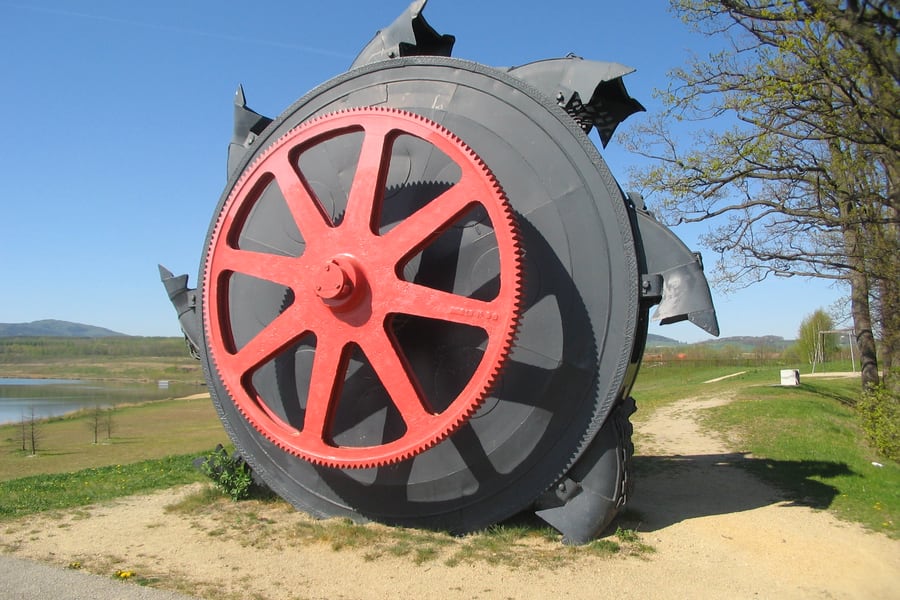 Olzi / Wikimedia Commons · public domain · cropped
The bucket wheel, and the mine railway
One cutting wheel from a bucket-wheel excavator stands on the bank as a monument, teeth still on it, at the scale that removed a landscape. Beside it the volunteers of the Zittau narrow-gauge railway association keep a small mine railway with four diesel and electric locomotives built between 1955 and 1973, and run it on published days through the summer — the season opening, the Day of the Miner in July and their own association festival.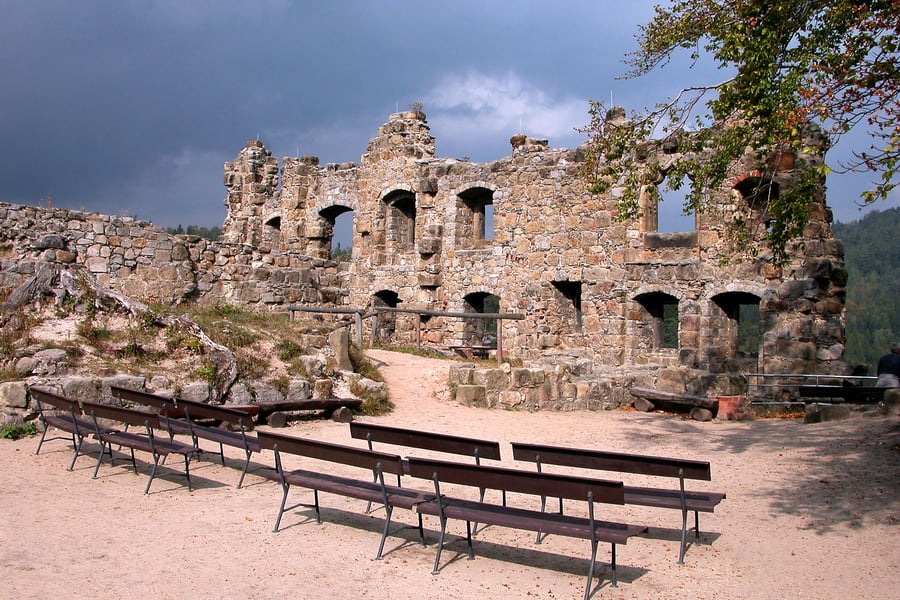 Jörg Blobelt / Wikimedia Commons · CC BY-SA 4.0 · cropped
Burg und Kloster Oybin
A sandstone mountain a little over 500 metres high, carrying a castle and a monastery in ruins. The fortress went up between 1311 and 1316 to guard two trade roads over the pass; Charles IV ordered an imperial residence here in 1364 and founded the Celestine monastery in 1369, its church built 1366–84 with help from the Prague cathedral workshop. Fire destroyed it all in 1577. Caspar David Friedrich painted the ruins in 1810 and Carl Gustav Carus in 1820.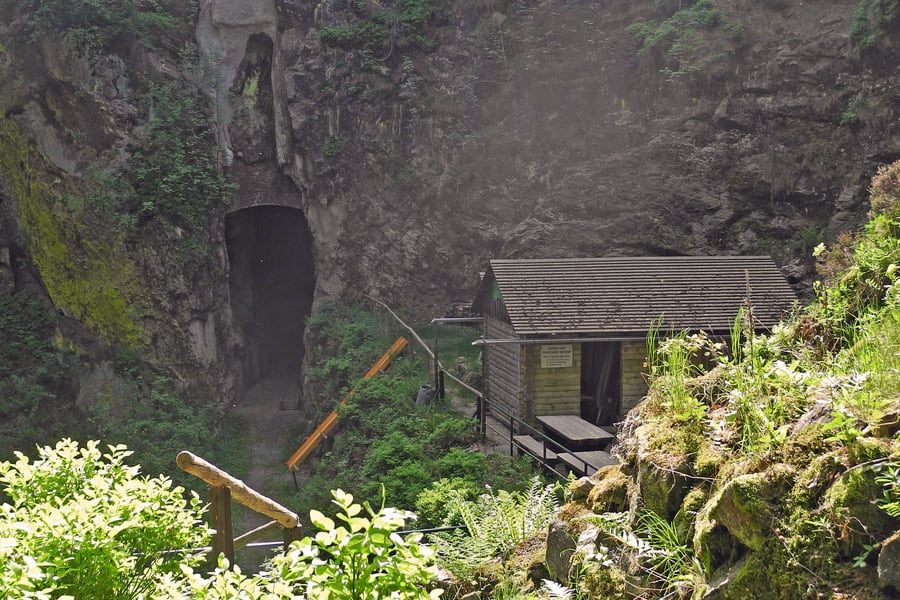 SchiDD / Wikimedia Commons · CC BY-SA 4.0 · cropped
The Jonsdorf millstone quarries
In 1560 the village judge Hieronymus Richter and his two sons worked out that the local sandstone would make millstones; quarrying started in 1580 and went on for more than three and a half centuries. Volcanic intrusions had baked the stone unusually hard, which is what made it worth cutting. Four quarries over some thirty-five hectares are now a nature trail through worked faces and adits, and one of them, the Schwarzes Loch, has been open as a show mine with guided tours since 1998.Where to Sleep
This railway is unusual in running its own accommodation, and in putting it inside the stations. The operator lets a guesthouse in one terminus building, a holiday flat in the other, and two converted passenger coaches that stand on the platform and move between the two termini with the season. All of them look out on the line, which is either the whole point or a reason to choose something else.
One detail is worth knowing before booking: the operator gives a free week ticket for one person with any stay of five nights or more in its own accommodation. Against a €42.00 weekly fare that is a real reduction rather than a gesture.
The alternative is to stay in the village at Oybin and walk to the castle, which is what most visitors do. Prices and availability are on each house's own site — we have not verified either, and neither star ratings nor guest scores appear on the cards below.
Where to stay
Ferienwaggons an der Zittauer Schmalspurbahn
Two converted carriages, standing on the platform
Two passenger coaches rebuilt as holiday flats, each sleeping two, with a separate bedroom, kitchen, shower room and a small terrace looking straight out at the working railway. They stand at Kurort Jonsdorf from Easter until July and at Kurort Oybin from August to October. Free WiFi and parking; no pets. Booked through the operator or the Zittau Mountains accommodation office.
Check Availability (opens in a new tab, on zittauer-schmalspurbahn.de)via zittauer-schmalspurbahn.dePension "Zum Bahnel"
In the terminus building at Kurort Jonsdorf
The reception building at the end of the Jonsdorf branch has been a guesthouse for more than a decade. One single, three double, one triple and one four-bed room, all with shower and WC, television and a view of the narrow gauge, plus a holiday flat for four and a loft apartment for two with a roof terrace. Breakfast is served in the station's former waiting room, which is hung with railway odds and ends. Non-smoking, free WiFi, no pets.
Check Availability (opens in a new tab, on zittauer-schmalspurbahn.de)via zittauer-schmalspurbahn.deHotel garni Am Berg Oybin
In the village, eight minutes' walk from the ruins
A family-run hotel garni in the middle of Kurort Oybin, with fifteen double and four single rooms, all non-smoking and all with shower, WC, satellite television and telephone, and free WiFi throughout. Breakfast is ordered from a list rather than taken from a buffet and brought to the table, and is served until 11.00 on weekdays and noon at weekends. There is a house library for wet afternoons.
Check Availability (opens in a new tab, on hotelambergoybin.de)via hotelambergoybin.deQuestions or corrections
Planning this trip and stuck on something, or spotted a time, fare or detail that has changed? Send us a message about The Zittauer Schmalspurbahn to Oybin and Jonsdorf. We read every one, and we update this page when something has changed.