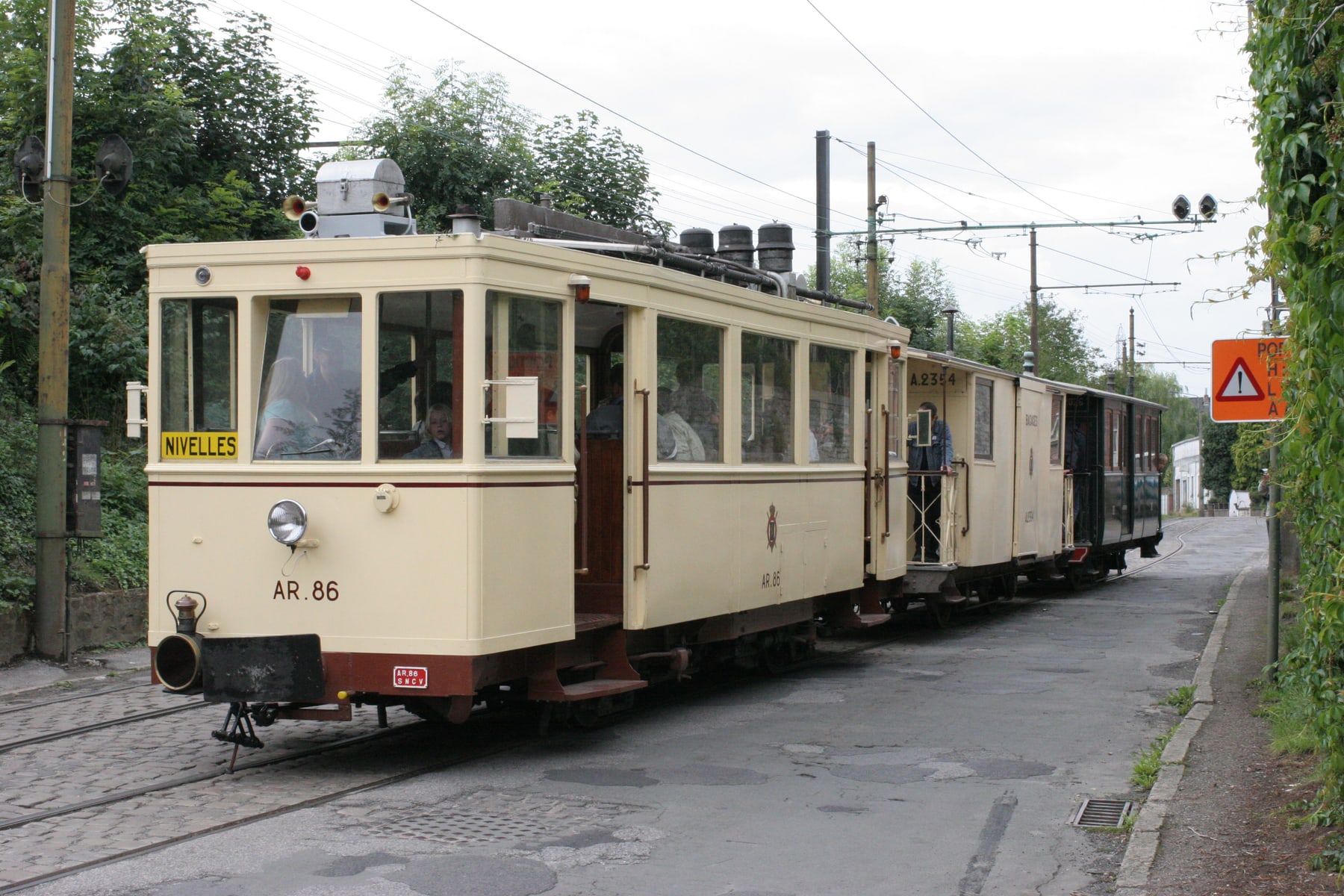
ASVi Vicinal Tramway, Thuin–Lobbes
Peter Rabijns (Flickr BB.12069) / Wikimedia Commons · CC BY 2.0 · cropped
- Distance8 km of metre-gauge line · three branches
- Duration15–37 min per branch, round trip
- Best seasonSundays and public holidays, May–October
Introduction
Belgium built two railway networks, and only remembers one.
The first is the famous one: the line of 1835 that is widely called continental Europe's first public railway, and eventually one of the densest main-line networks in the world. The second was invented because the first was not enough. Its trains were too infrequent and its lines too shy of the hills, and the villages of the Ardennes, the Condroz and the Hainaut coalfield were left off the map entirely — too thinly populated, as the operator's own museum puts it, to guarantee the dividends of a greedy shareholder base.
So in 1885 a law created the Société Nationale des Chemins de Fer Vicinaux — the National Company of Local Railways — and gave it a different brief. Build cheaply. Build along the roads, or along the water, or over the hills. Reach everywhere. Carry everything: schoolchildren, milk churns, sugar beet, coal. The vicinal was a metre-gauge tramway system that behaved like a railway, paid for jointly by the State, the provinces, the communes and even private individuals, and run on the principle that the profitable lines would keep the unprofitable ones alive.
It worked extraordinarily well. By the Universal Exhibition of 1935 the vicinal ran to roughly 5,000 kilometres — considerably more route than the main-line railway had managed in fifty years. Then the car arrived, and tracks running down the middle of busy roads became an expense nobody would pay for. By 1985 about 200 kilometres survived: the coast tramway, the Charleroi network, and the line to the caves at Han. The company was dissolved in 1991.
Of those three, the line at Han closed in January 2026 — the Société des Grottes de Han put the cost of bringing it up to standard at five million euros and stopped running it. The coast tramway is still there, and still ordinary: it is the Kusttram, sixty-seven stops from the French border to the Dutch, on a normal ticket, every ten minutes in August.
What is left, and why it is here
Almost none of it remains as a railway. What does survive at Thuin, eighteen minutes south-west of Charleroi by ordinary train, is eight kilometres of metre-gauge track and a collection of more than forty vehicles, kept running since 1972 by an all-volunteer association called ASVi.
The line matters more than the collection, because of how it was assembled. One part is genuinely original vicinal: a surviving stretch of the old tram routes from Thuin towards Lobbes and Anderlues, which carried fare-paying passengers until the last day of 1983 and which ASVi has operated ever since. The other part is not a tramway at all. It is a section of the SNCB's main-line railway to Chimay, closed, lifted, and then converted to metre gauge in 1993 by leaving the sleepers where they were and moving one rail of each pair inwards.
The result is that three short branches radiate from the museum, and each one runs on a different kind of alignment. One goes down into Thuin in the street. One follows the verge of a main road to Lobbes — one of the last electrified roadside sections left in Belgium. One runs out across open country on its own reserved track, because that track used to belong to a proper railway.
That is the reason to come. Not the museum hall, though it is a good one, and not simply the pleasure of an eighty-year-old tram, though that is real. It is that the vicinal's three characteristic ways of getting about — down the road, beside the road, and away from the road altogether — can all still be ridden here, in an afternoon, on one ticket.
The Journey
Everything starts from the Musée du Tram at Thuin, which is not a museum station invented for the purpose. It is the site of Thuin-Ouest, a real station on the Belgian State Railways' line 109 from Mons to Chimay. Passenger trains stopped calling in 1964; goods trains kept running to the sugar factory at Donstiennes into the 1980s; then the line was abandoned, and in 1992 ASVi ran a farewell railcar over it before the rails came up.
They did not all come up. What happened next is the most quietly remarkable thing about this railway, and it is worth understanding before you ride it.
One rail, moved
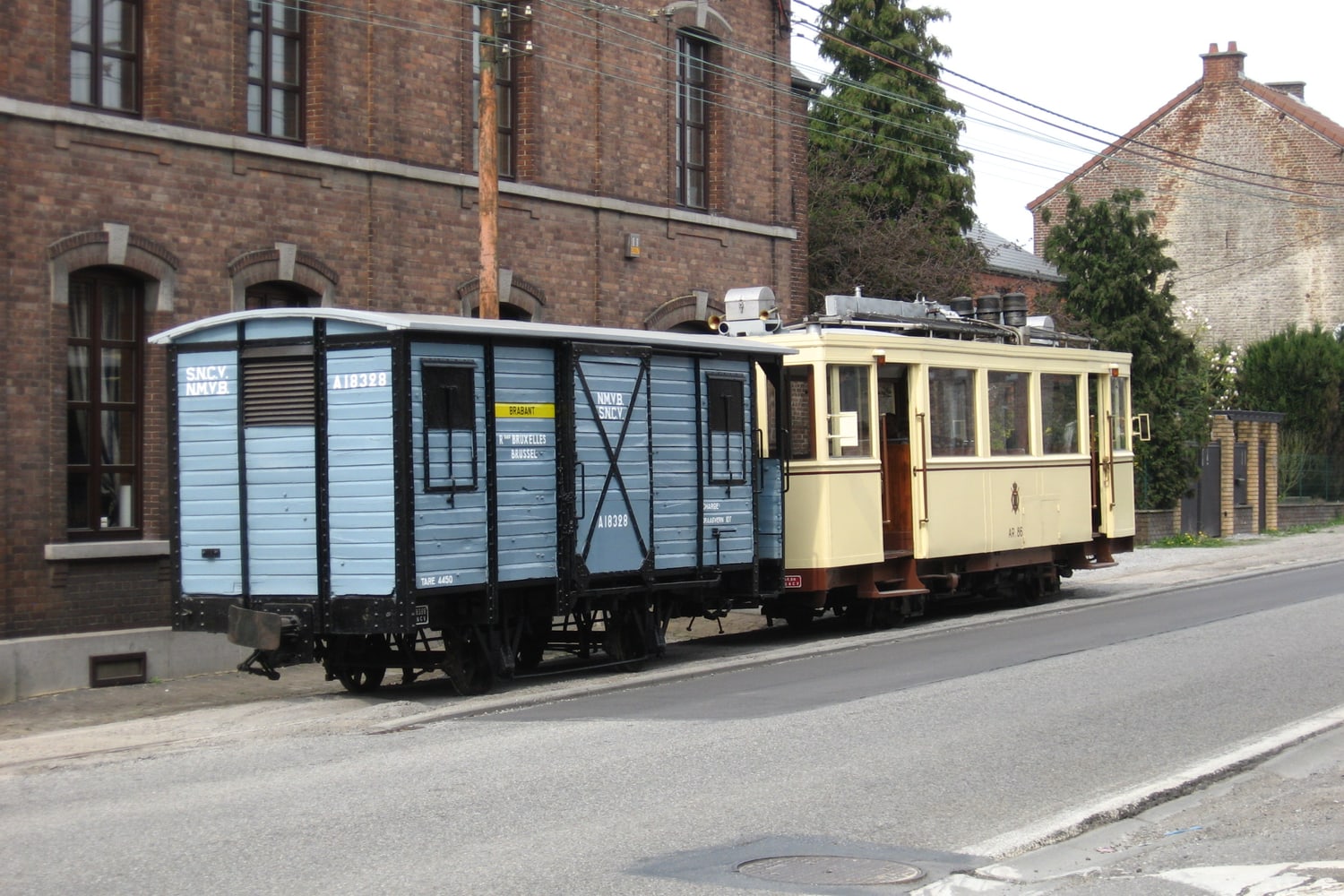
Converting a standard-gauge railway to metre gauge normally means a new formation, new sleepers and new track. ASVi could afford none of that. But line 109 was laid on steel sleepers, and steel sleepers can be re-drilled.
So in February 1993 the volunteers left the sleepers lying exactly where the SNCB had left them, and went along the line unbolting one rail of each pair, moving it inwards, and fixing it down again at 1,000 millimetres. A single switch was put in at the Rue de la Couture and the rails across the level crossing were replaced. The pointwork was scavenged from the wreckage of Belgian tramways: the first turnouts came out of the loop built for the 1958 Brussels World's Fair, the mixed standard-and-metre turnout came from Marcinelle Hauchies, and the rest were salvaged from the scrapped Charleroi and Centre networks.
The electrical supply was assembled the same way. The substation, begun in 2000, runs on a rectifier and two 600-volt circuit breakers rescued from the Binche substation of the SNCV's own line 90. Current first flowed in June 2003.
Three branches, three alignments
From the museum the line divides, and the division is the point. A standard ticket gives unlimited travel on all three, so the sensible plan is simply to ride each one.
To Thuin Ville-Basse — about half a kilometre, five minutes, downhill. The tram leaves the museum, passes Thuin Jonction, crosses beneath the SNCB's line 130A and runs down to the square by the Sambre in the street itself, on rails set into the road surface. This is vicinal running at its most characteristic and, for a modern passenger, its most startling: there is no reservation, no fence, no platform. There is a tram coming down the road.
To Lobbes Entreville — just under three kilometres, thirteen minutes. The tram turns the other way at the Jonction, runs past Thuin cemetery, crosses the Sambre on a bridge that had to be completely rebuilt between 2003 and 2005, and descends along the valley to Lobbes Pont du Nord. Beyond the Hôtel de Ville stop it swings back to the main road and runs along its western verge — not in the road and not away from it, but on the shoulder beside the traffic. This is described as one of the last electrified roadside sections surviving in Belgium, and it is the alignment on which most of those 5,000 kilometres were built.
The tracks continue past the present terminus to the old passing loop at Quatre-Bras and, beyond that, towards Lobbes-Bonniers, where they stop. The section onwards to Anderlues was lifted in 2005, which severed this line from the Charleroi network for good and left it an island. Restoring the run to Bonniers is ASVi's stated ambition.
To Biesme-sous-Thuin — three and a bit kilometres, fifteen minutes. This is the old main line, and it feels like one. The tram runs out past Le Haut-Marteau on its own reserved formation through fields, with a RAVeL cycle path laid alongside it on the rest of the trackbed, to the former SNCB station at Biesme. The extension opened on 14 August 2010. It is worked by diesel railcars — and, on a handful of Sundays a year, by steam.
What you will ride
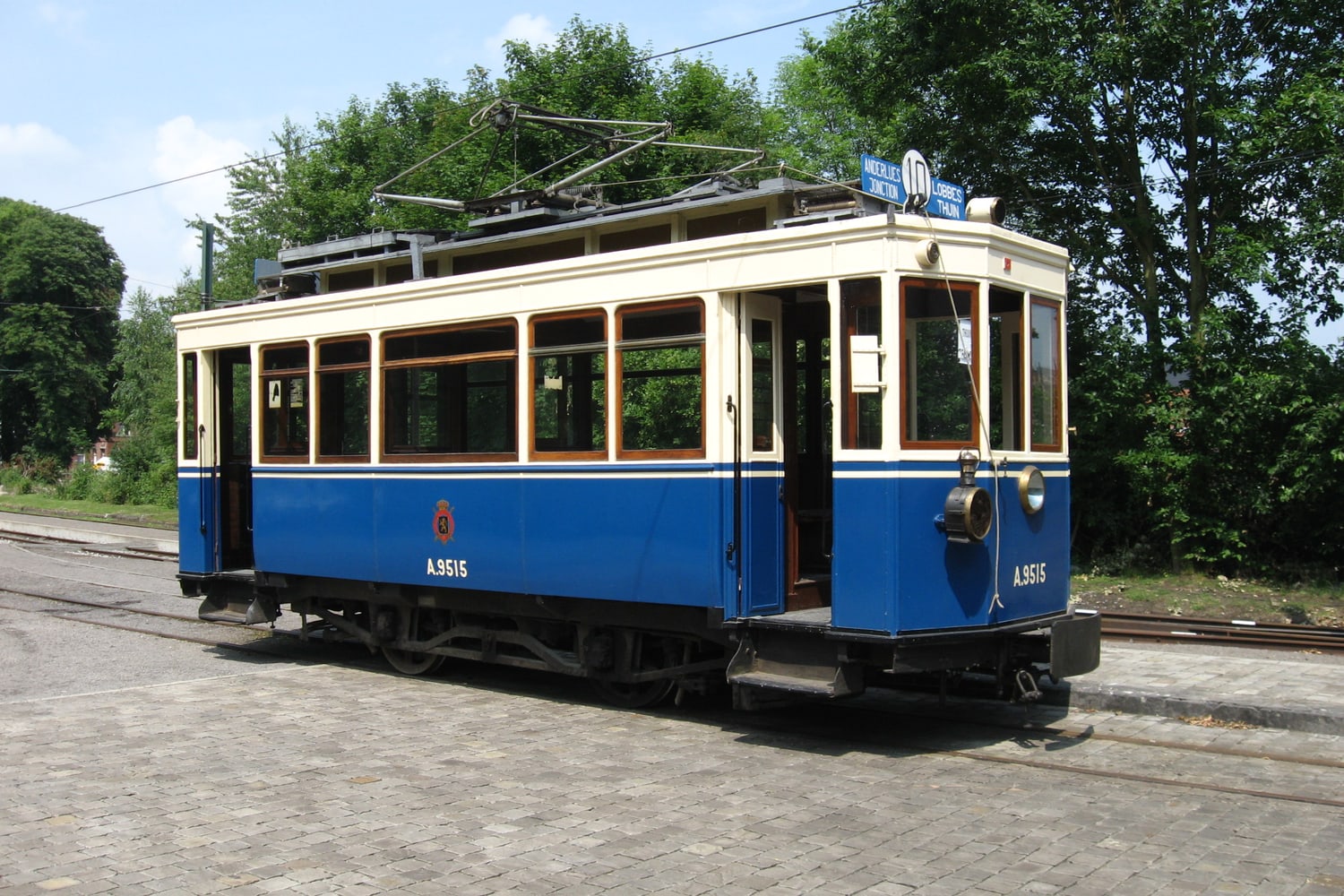
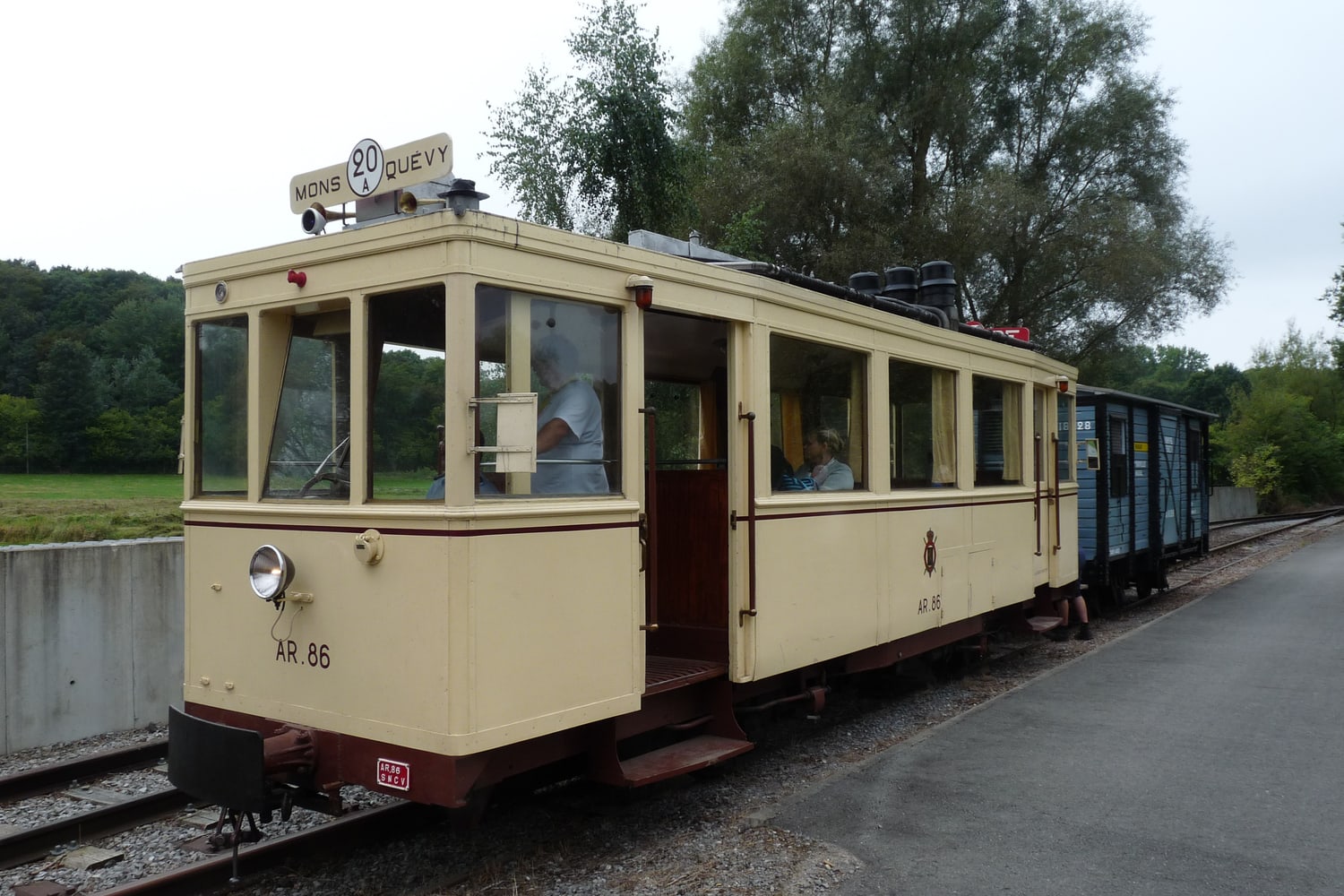
Not one thing, which is the pleasure of it. The workhorses are two diesel railcars: AR.86, built by the SNCV's own Brabant works at Cureghem in 1934, and ART.300, built at Andenne in 1937. The electric cars are older and stranger — A.9073 of 1901, built in Charleroi by Électricité et Hydraulique, the firm that became ACEC; A.9288 from Manage, 1909; A.9515 from Le Rœulx, 1918; and the more comfortable two-axle cars 9888 and 9924 of 1930 and 1931.
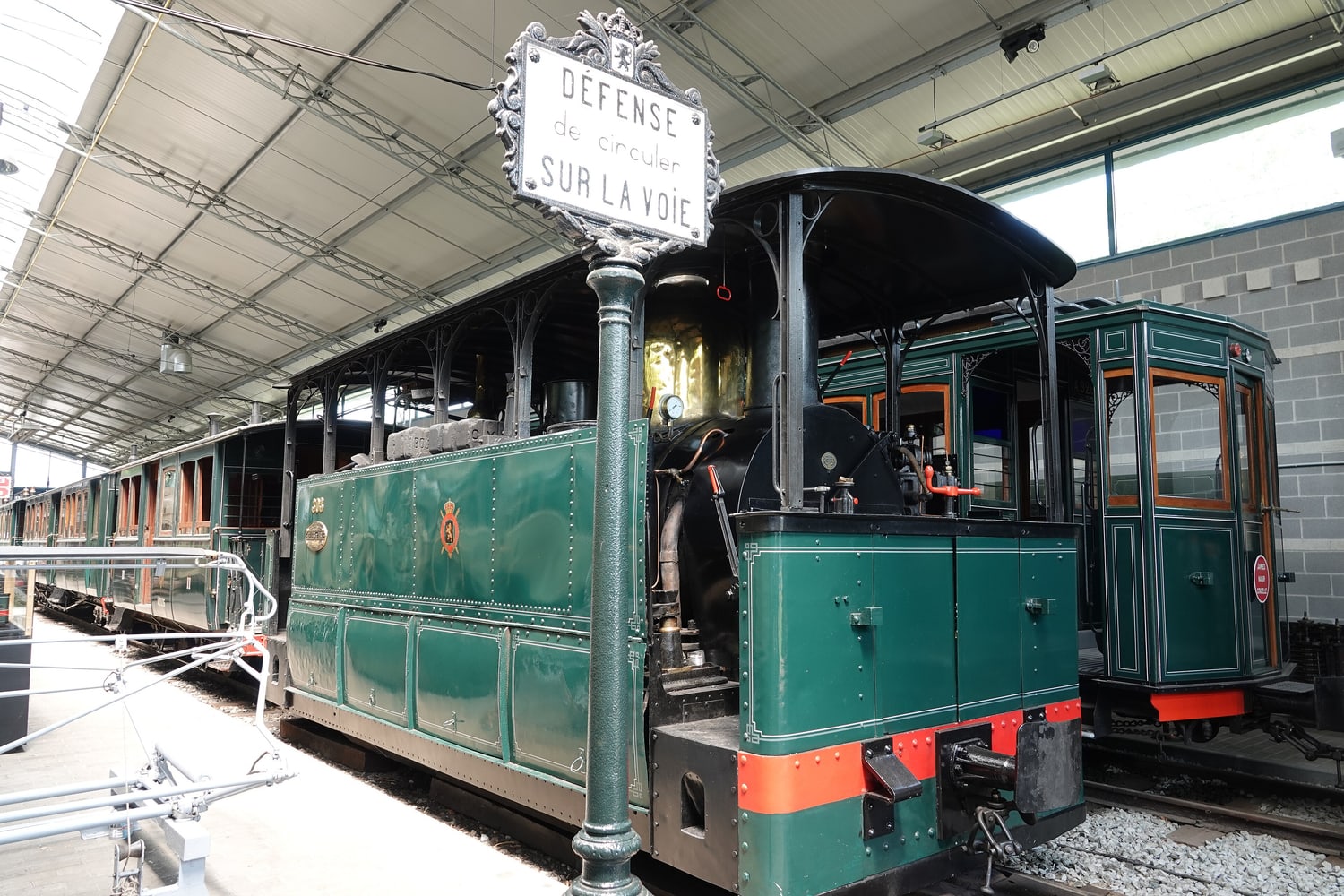
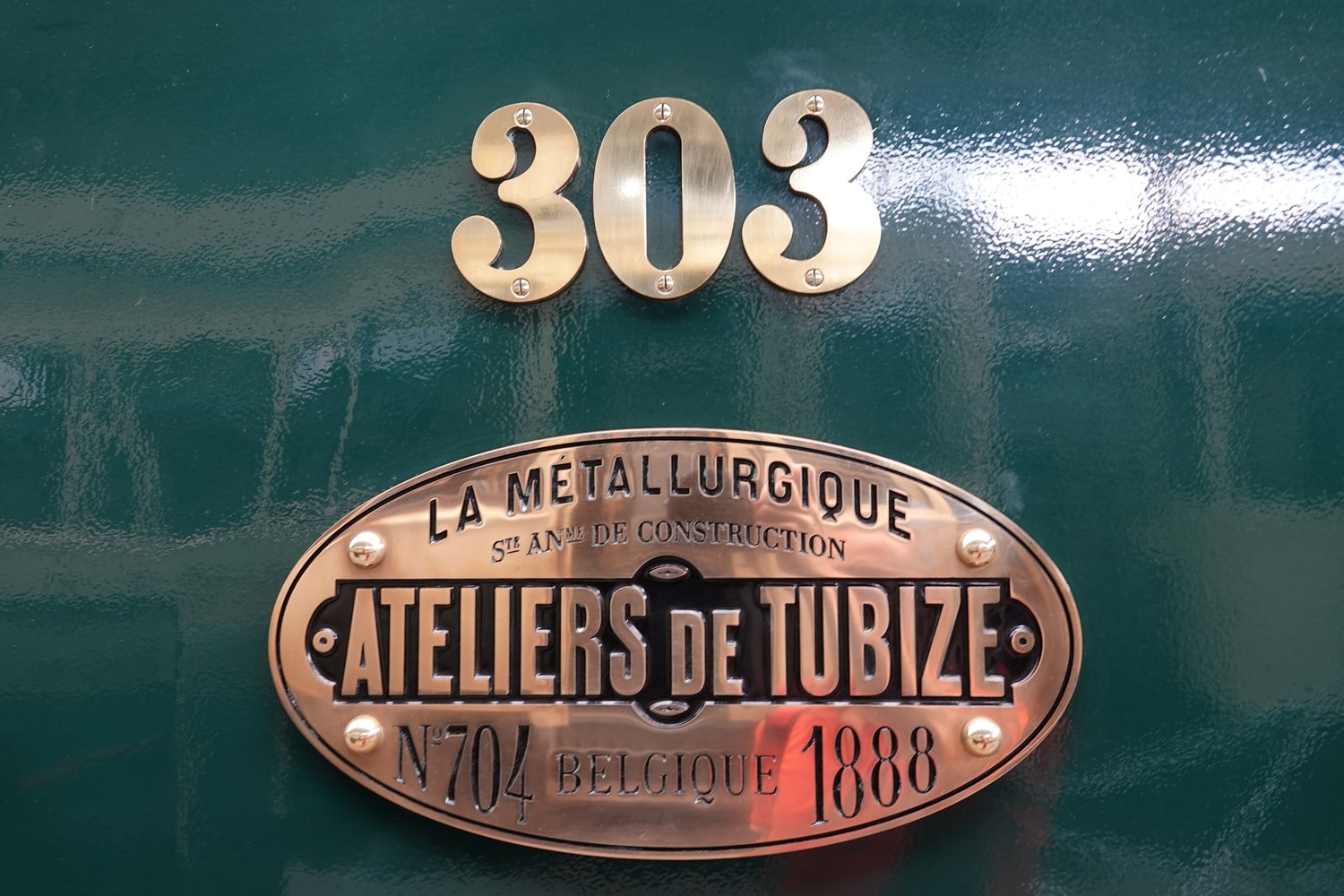
And on steam days there is HL.303, an 0-6-0 tank of 1888 from the Ateliers Métallurgiques de Tubize: seven metres long, twenty-four tonnes, a top speed of 30 km/h, and a builder's plate on the tank side that reads N° 704 · Belgique · 1888. It was bought for preservation in 1965, stripped in June 2015, rebuilt over three years by the CITEV workshops in France, and returned to steam at the Tram Festival in August 2018.
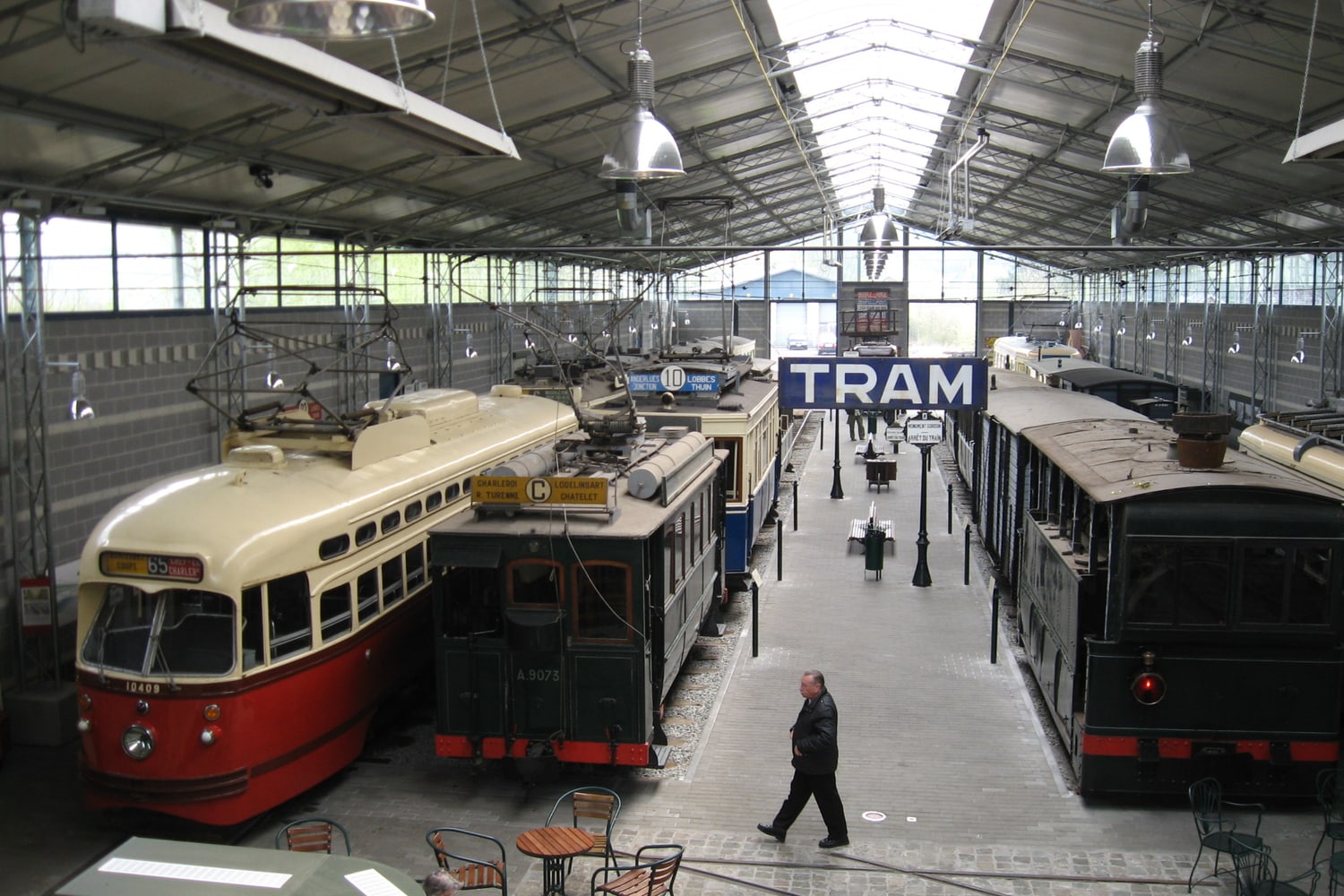
The museum hall itself — the Centre de Découverte du Vicinal, built with a €1.1 million European grant that ASVi had to top up with €110,000 of its own money — holds the rest: standard bogie trams of the sort built four hundred times over between 1932 and 1947, goods wagons, an overhead-line tower wagon, and a PCC car with an odd history. It came from a batch of twenty-four built for Belgium in 1950, was sold on to Belgrade in 1960, and was brought home in 1986.
Allow two to three hours, which is the operator's own estimate, and more if you intend to ride all three branches.
Along the route
Smiley.toerist / Wikimedia Commons · CC BY-SA 4.0 · croppedA main line regauged by moving one rail
The museum stands on an abandoned SNCB line. In 1993 the volunteers regauged it in the cheapest way physically possible: the metal sleepers were left exactly where they lay, and one rail of each pair was unbolted, moved inwards and refixed. The points were scavenged too.Smiley.toerist / Wikimedia Commons · CC BY-SA 4.0 · croppedThree branches, three kinds of vicinal
The three lines are not variations on one ride. One runs in the street, one along the verge of a main road, one on its own right of way through fields. Street, verge and reserved track — the whole vicinal idea in one afternoon, on one ticket.Nenea hartia / Wikimedia Commons · CC BY-SA 4.0 · croppedAn 1888 locomotive, back in steam
HL.303 is a metre-gauge 0-6-0 tank engine built at Tubize in 1888 — seven metres long, 24 tonnes. Stripped down in 2015 and rebuilt over three years, it returned to steam in 2018 and works the Biesme line on a handful of Sundays a year.A bit of history
Culture & experiences along the way
 Jean-Pol Grandmont / Wikimedia Commons · CC BY 2.5 · cropped
The Marche Saint-Roch
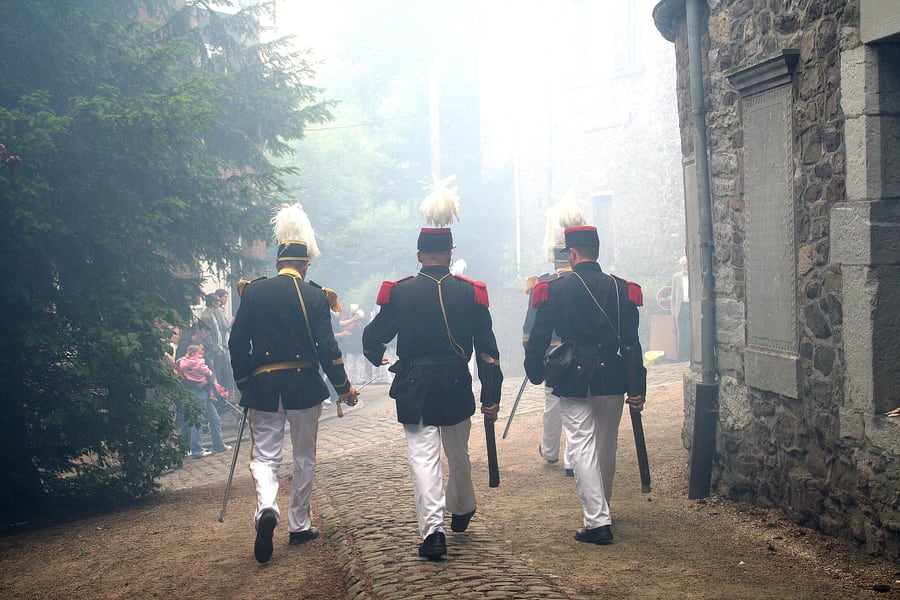
On the third Sunday of May about 2,000 men march through Thuin in Napoleonic uniform behind fife and drum, firing black-powder volleys down the streets until the town disappears into smoke. It is the first of the Entre-Sambre-et-Meuse marches, and UNESCO put fifteen of them on its heritage list in 2012.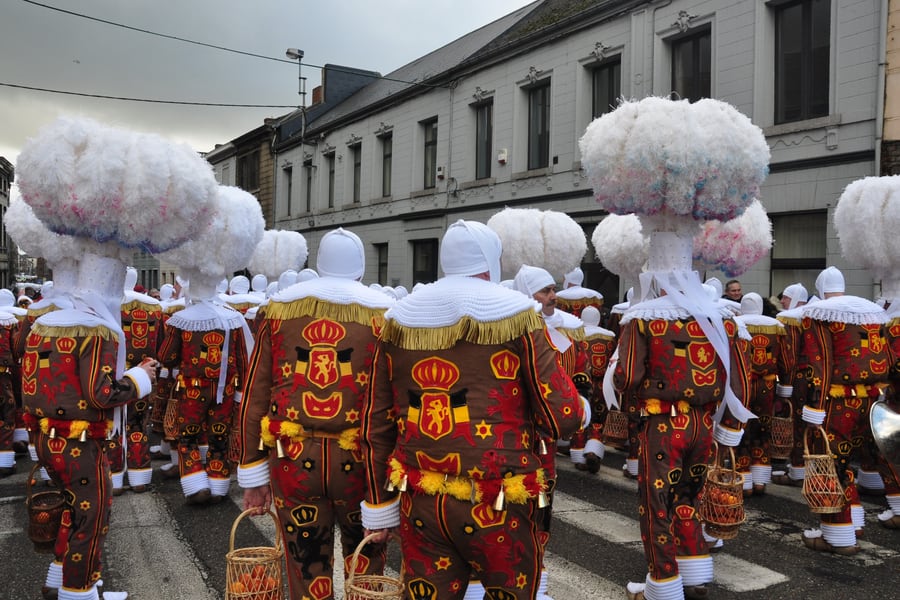 Cyfray / Wikimedia Commons · CC BY-SA 4.0 · cropped
The Gilles of Binche
Twenty kilometres away, on Shrove Tuesday, Binche's Gilles are up at four in the morning in wax masks, and by afternoon they are wearing hats of some 300 ostrich feathers weighing three kilos and throwing blood oranges at the crowd. UNESCO named it a Masterpiece of intangible heritage in 2003.Timetables
All times and dates below were read from the operator's own calendar and timetable sheets on 12 August 2026, and the 2026 season is the whole of what has been published — every date in 2027 still shows as closed.
The 2026 operating calendar
The museum and the trams do not keep the same hours, and this catches people out.
| Day | Museum | Trams |
|---|---|---|
| Sundays | 12:30–18:00 | Yes |
| Most public holidays | 12:30–18:00 | Yes |
| Wednesdays | 13:00–17:00 | No |
| Saturdays | 13:00–17:00 | No |
| Mondays, Tuesdays, Thursdays, Fridays | Closed | — |
Tram days in 2026, exactly as the operator's calendar gives them:
- May — 1 (Friday, Labour Day), 3, 10 (steam), 24, 25 (Whit Monday), 31
- June — 7, 14 (steam), 21, 28
- July — 5, 12 (steam), 19, 21 (Tuesday, National Day), 26
- August — 2, 9, 15–16 (Tram Festival, steam), 23, 30
- September — 6, 12–13 (Heritage weekend, no steam), 20, 27
- October — 4, 11 (steam), 18, 25
- November — 1 (Nocturne, steam)
- December — 19–20, Santa's Tram, 13:00–20:00
Two things are worth pulling out of that list. The steam Sundays are the second Sunday of the month — 10 May, 14 June, 12 July and 11 October — with steam also running on the August festival weekend and at the November Nocturne. And Sunday 17 May was closed, so the pattern is most Sundays, not every one. Check the date you want rather than assuming.
⚠️ One thing to confirm before travelling on a Saturday. The operator's fares page defines its standard "classic days" as Sundays and public holidays from April to October, plus Saturdays in July and August — and it says so in both French and English. But the 2026 calendar marks every Saturday in July and August as museum-only, 13:00–17:00, with no trams. The last general timetable the museum published, for 2025, did include a Saturday service between 5 July and 6 September, and that sheet has since been hidden on the site. The likeliest reading is that Saturday running has been dropped and the fares footnote is out of date — but the two pages genuinely disagree, so if a Saturday is your only option, ask the museum first.
Departures on an ordinary Sunday
The museum has not published a general 2026 departure sheet — only the calendar above and a grid for the August festival. The pattern below is from its last published general timetable, for the 2025 season, so treat the clock-face as indicative and the operating hours above as authoritative.
Each of the three branches ran hourly, staggered so that one follows another out of the museum:
| Branch | Departs the museum | Arrives back |
|---|---|---|
| Thuin Ville-Basse | :20 past each hour | :35 |
| Biesme-sous-Thuin | :30 past each hour | :07 past the next |
| Lobbes Entreville | :50 past each hour | :19 past the next |
In 2025 that gave departures at 13:20, 14:20, 15:20, 16:20 and 17:20 for Ville-Basse; 13:30 to 17:30 for Biesme; and 13:50 to 17:50 for Lobbes. A Ville-Basse round trip took a quarter of an hour, Lobbes about twenty-nine minutes and Biesme about thirty-seven, so riding all three in an afternoon is comfortable rather than rushed.
Departures on the August festival weekend
For 15–16 August 2026 the museum published a full grid, and it runs longer and to a different stagger — do not use the Sunday pattern above for these two days.
| Branch | Out of the museum | Return workings |
|---|---|---|
| Biesme-sous-Thuin | 11:00 → 19:00, hourly on the hour | 11:30 → 19:30 |
| Lobbes Entreville | 11:10 → 19:10, hourly | 11:40 → 19:40 |
| Thuin Ville-Basse | 11:20 → 18:20, hourly | 11:50 → 18:50 |
Steam works the Biesme line on those days, taking the 12:00, 14:00, 16:00 and 18:00 departures; the other Biesme trips are diesel railcars, and both Lobbes and Ville-Basse are worked by electric trams. The last departure on each branch is marked facultatif — run only if required.
Getting there by train, and the catch
Thuin has its own SNCB station on line 130A, Charleroi to Erquelinnes and on into France. From the station the museum is about a ten-minute walk, and the walk is a good one: cross the footbridge over the Sambre, come out on the Ville-Basse square — which is the tramway's own terminus — and follow the tram rails uphill along the Rue t'Sertevens. Past the level crossing the museum is on your left. You can ride the tram back down to where you started.
The catch is that the S63 is at its thinnest on precisely the days the trams run. Sampled on 12 August 2026:
| Day | Charleroi-Central → Thuin | Frequency |
|---|---|---|
| Sundays | 08:24, 10:24, 12:24, 14:24, 16:24, 18:24 | Two-hourly |
| Saturdays | 12:24, 14:24, 16:24 … | Two-hourly |
| Weekdays | 07:24, 08:48, 09:24, 10:24, 11:24, 12:37, 13:24, 14:24, 15:26 … | Roughly hourly |
The run takes 18 minutes. Coming back on a Sunday, trains leave Thuin for Charleroi at 10:20, 12:20, 14:20, 16:19, 18:20 and 20:19.
That makes the clean Sunday plan obvious: the 12:24 from Charleroi arrives at 12:42, which puts you at the museum for opening, and the 18:20 back leaves as the museum closes. Miss it and the next is at 20:19.
Buses run too: TEC line 91, Anderlues–Thuin, stops at Thuin Ouest SNCB, fifty metres from the door.
For the current calendar and any late changes, see the museum's own fares and calendar page (opens in a new tab).
Tickets
Tickets are bought at the museum, on the operator's published 2026 prices read on 12 August 2026. For most visitors on most days the answer is the standard ticket at €13, because unlimited travel is what makes this railway worth the trip: three branches, three completely different alignments, and no penalty for riding each of them twice. Children under six travel free, and the reduced rate is for groups of more than ten and for ASVi members rather than for age.
The steam ticket is a different product, not an upgrade. It buys one return trip to Biesme-sous-Thuin behind the 1888 locomotive and museum admission, but not unlimited travel on the electric and diesel cars. On a steam Sunday the combined ticket at €20 is the one that does both, and its €7 premium is the real price of the steam run. The August, September and autumn special days are priced higher throughout.
Book your tickets
Standard ticket
€13 adult · €11 reduced · €8 child 6–12
Unlimited travel on all three lines, with the museum included.
Book Tickets (opens in a new tab, on museedutramvicinal.be)via museedutramvicinal.beCombined ticket
€20 adult · €18 reduced · €16 child 6–12
Unlimited travel plus the steam return to Biesme-sous-Thuin, on steam Sundays.
Book Tickets (opens in a new tab, on museedutramvicinal.be)via museedutramvicinal.beSteam ticket
€15, all ages · first class adds €2
One return behind the 1888 locomotive and the museum — not the rest of the network.
Book Tickets (opens in a new tab, on museedutramvicinal.be)via museedutramvicinal.beMuseum admission only
€5, all ages
For the Wednesdays and Saturdays when the museum opens and no trams run.
Book Tickets (opens in a new tab, on museedutramvicinal.be)via museedutramvicinal.beRail Passes
The short answer: no rail pass is worth buying for this journey, and the reason is worth spelling out because it applies to every heritage line in Belgium.
On the tramway itself, nothing applies
ASVi is a private non-profit association running its own metre-gauge line. It is not part of the national network, and it never was in the modern sense — the vicinal was always a separate company from the SNCB. No Interrail pass, no Eurail pass, no Benelux or SNCB product of any kind is valid on the tram, and there is no discount for holding one. The €13 standard ticket is the fare, and you buy it at the museum.
On the train to Thuin, an ordinary ticket is almost certainly enough
Getting to Thuin is a different matter, and here a pass can be valid — Thuin is a normal SNCB station on line 130A, served by the S63 from Charleroi-Central. An Interrail or Eurail pass covers that leg, and no reservation is needed or possible on a Belgian local service.
But it will rarely be worth using a travel day on it. The journey is 18 minutes, and Belgian domestic fares are distance-based and low. If you are coming from elsewhere in Belgium for the day, buy an ordinary SNCB ticket to Thuin and back.
What SNCB actually sells, read from its own site in August 2026, is not the older named passes some guidebooks still list. Fares are banded by age — Child under 12, Youth under 26, Adult 26–64, Senior 65+ — with Train+, a few euros a month, cutting off-peak and weekend fares and capping the price per journey, and season tickets in Standard, Unlimited, Flex and Student flavours for commuters. There are also group fares, and one of them is genuinely useful here: SNCB's mini-group rate starts at four people, whereas ASVi's own reduced tramway fare needs a party of more than ten. A family of four gets the cheaper rate on the train and pays full price on the tram.
The one exception worth knowing
If you are already travelling in Belgium on a pass and want to build a day out of it, the useful combination is not a pass product at all but the geography: Thuin is on the line that continues to Erquelinnes and over the border to Maubeuge in France. A pass valid in both countries makes Thuin a plausible stop on the way through rather than a there-and-back excursion from Charleroi — which, given that the Sunday service is only two-hourly, is a genuinely more comfortable way to fit the museum in.
One caution if you try it: the tram's own last departures are in the late afternoon and the museum shuts at 18:00, so a southbound onward train has to be an evening one.
Places to Visit
The tramway is short, and that is an advantage: it leaves most of a day for the two small towns it connects, both of which are older and stranger than a visitor expects.
Thuin sits on a spur where the Biesmelle runs into the Sambre, which is why it is built on two levels. The ville basse along the river is where the barges and the tram terminus are; the ville haute on the ridge above is the old fortified town, and between them the slope is stacked with terraced gardens. The tram connects the two in five minutes, running down the middle of the road. Walking back up through the gardens is the better way round.
Lobbes, a mile and a half across the Sambre, was one of the great monastic centres of the early medieval Low Countries. Its abbey is gone, but the church the monks built outside their own walls is still standing, and still in use, twelve hundred years later.
The two are connected by more than the tramway. Lobbes abbey was founded in the seventh century by Saint Landelin; his companion and first successor was Saint Ursmer. Landelin went on to found a second house downstream at Aulne, which Ursmer also took over — and both men's stone coffins are in the crypt at Lobbes today. The tram runs, more or less, between their two foundations.
 Trougnouf (Benoit Brummer) / Wikimedia Commons · CC BY 4.0 · cropped
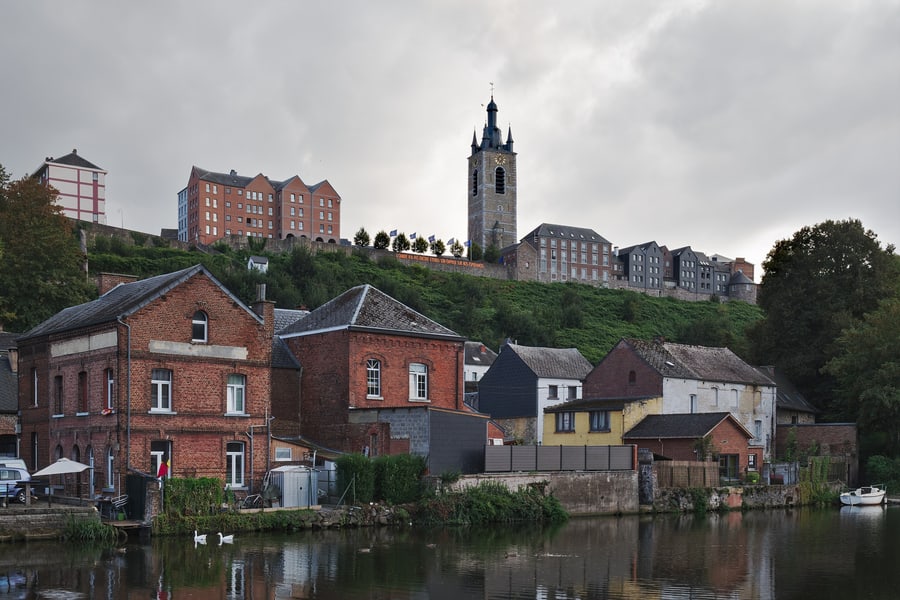
The belfry of Thuin
The tower on the skyline above the tram is one of the 56 belfries of Belgium and France inscribed by UNESCO in 1999, and the only belfry the Prince-Bishopric of Liège ever had. Sixty metres tall, built between about 1153 and 1164 on bare schist without foundations, it began as the bell tower of the collegiate church of Saint-Théodard. The church itself is gone: the town pulled the nave down in 1811 to clear a space for dancing, and kept the tower.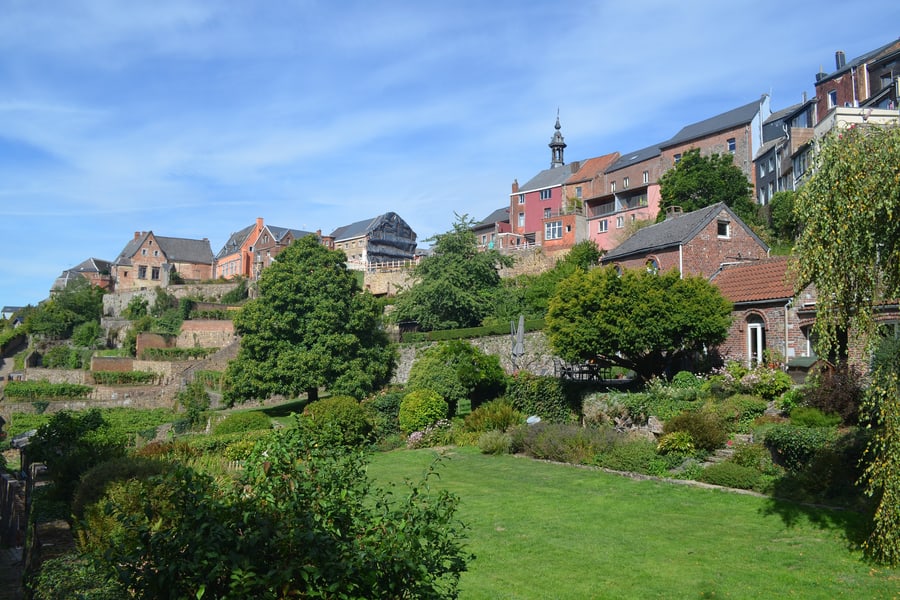 Jmh2o / Wikimedia Commons · CC BY 4.0 · cropped
The hanging gardens
Thuin stands on a spur above the Sambre and the Biesmelle, and its medieval defences came in tiers down the south-facing slope. Over the centuries the townspeople planted the ledges between those sandstone ramparts as family vegetable plots — about 210 gardens on stacked levels, threaded by paved alleys with names like the Posty Arlequin. Restored in the 2000s, listed as exceptional Walloon heritage, and free to walk at any time. Vines were replanted in 2001.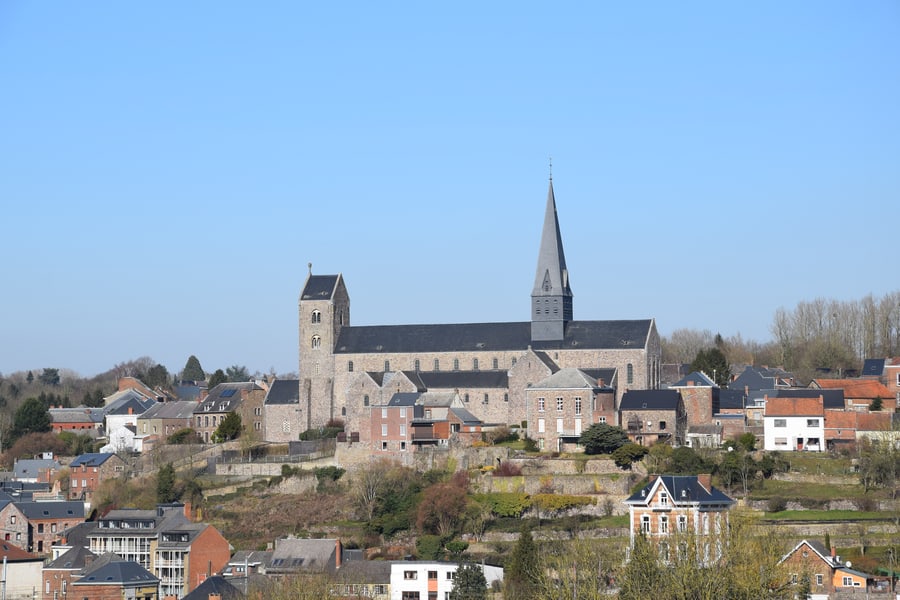 Chatsam / Wikimedia Commons · CC BY-SA 3.0 · cropped
The collegiate church of Saint-Ursmer, Lobbes
A short walk from the Lobbes tram stops stands one of the oldest churches in Belgium, rebuilt in stone by abbot Fulrad between 819 and 823 and still Carolingian in nave and west end, with Mosan work in the tower, choir and crypt. Go down into that crypt: it holds the abbots' grave slabs and the primitive sarcophagi of Saint Ursmer, died 713, and Saint Ermin, died 737. Hungarian raiders sacked the place in 954.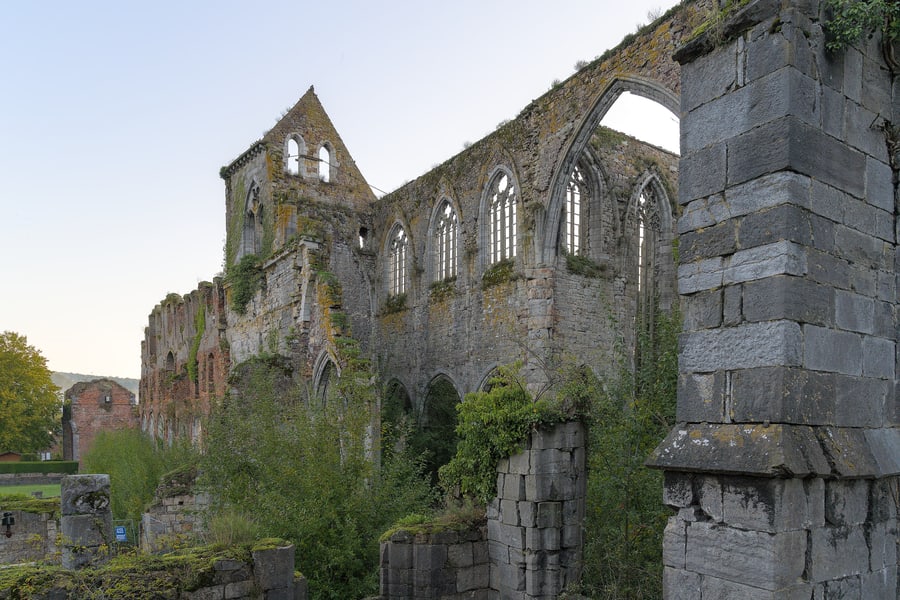 Trougnouf (Benoit Brummer) / Wikimedia Commons · CC BY 4.0 · cropped
Aulne Abbey
About five kilometres downstream, in the Gozée section of Thuin, stands the roofless shell of a great Cistercian abbey — an enormous Gothic church open to the sky. It began in 657 as the hermitage of Landelin, the monk who had founded Lobbes, and passed to Saint Ursmer, his companion and successor there; it joined the Cistercians in 1147 and was suppressed in 1794. A brewery was built among the ruins in 1998, on the site of the abbey stables.Where to Sleep
Thuin is a day trip for most people — it is eighteen minutes from Charleroi and about an hour from Brussels, and the tram day ends at six in the evening. But the area rewards a night if you want the abbey as well as the tramway, and there are two places with real character rather than a chain box by a motorway junction.
Bear in mind that this is a small town in the Hainaut, not a resort. The choice is genuinely narrow: until recently the only hotels in the area were the two below, everything else being guest houses and bed and breakfasts.
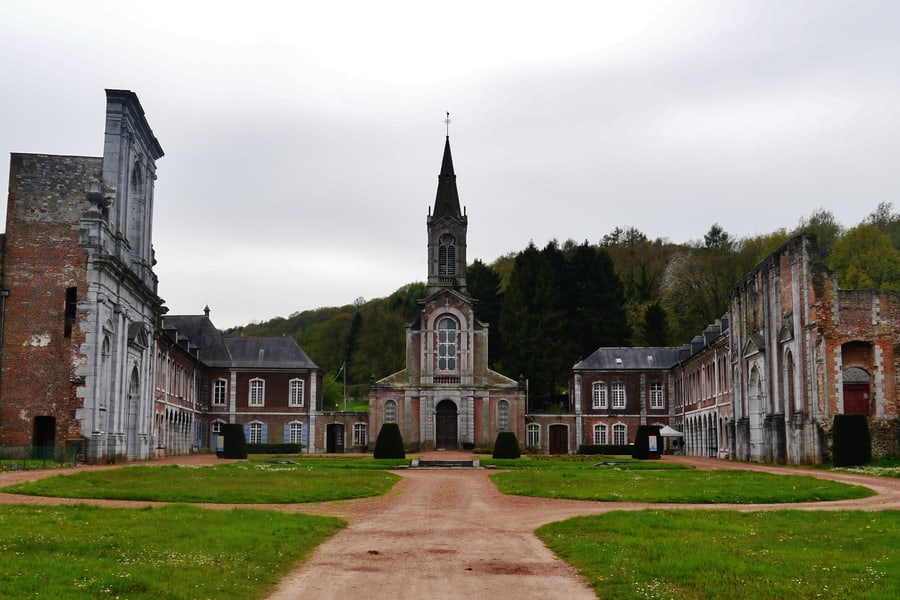
If you have a car, or do not mind a taxi, stay at the Auberge de l'Abbaye d'Aulne — it stands on the abbey site itself, and all six of its rooms look out at the ruins. There is nowhere else in the region where the view out of the window is the reason for the trip.
If you are travelling by train, the Relais de la Haute Sambre at Lobbes is the more practical choice, at the far end of the tramway rather than out at the abbey.
Neither is in the upper town of Thuin, so if being able to walk to the belfry and the gardens matters more than either of the above, look at the guest houses in the ville haute instead.
A note on both: no prices, star ratings or review scores appear on the cards below, because we have verified none of them. Both hotels' own websites were opened and read in August 2026, which is the one thing we can vouch for — they are trading, and they take direct bookings.
Where to stay
 Zairon / Wikimedia Commons · CC BY-SA 4.0 · cropped
Auberge de l'Abbaye d'Aulne
Six rooms, in among the abbey ruins
A small hotel on the site of Aulne Abbey — its own description puts it "in the heart of the ruins" — with six double rooms that every one of them looks out at the abbey, and a tavern downstairs. It is the one place in the area where the view from the window is the reason to come, and it is a short drive or a long walk from the tram at Thuin.
Check Availability (opens in a new tab, on aubergedelabbaye.be)via aubergedelabbaye.beLe Relais de la Haute Sambre
Fifteen rooms at the Lobbes end of the line
A hotel of fifteen rooms in wooded grounds at Lobbes, the far terminus of the tramway, with a restaurant and buffet breakfast. It is also something more unusual: the whole business is an entreprise de travail adapté — a social-economy company that has employed mainly workers with disabilities since 1976, across the hotel, the kitchen and its grounds-maintenance trades.
Check Availability (opens in a new tab, on rhs.be)via rhs.beQuestions or corrections
Planning this trip and stuck on something, or spotted a time, fare or detail that has changed? Send us a message about ASVi Vicinal Tramway, Thuin–Lobbes. We read every one, and we update this page when something has changed.