Kusttram
- DistanceAbout 67 km · 67 stops · metre gauge
- DurationAbout 2 h 25 end to end
- Best seasonAll year · every 10 minutes in high summer
Introduction
De Lijn keeps a page for the Kusttram that is not a timetable and not a tourist brochure. It is a list of building sites, with dates against them, and it runs to 2028. Knokke was rebuilt between September 2025 and April 2026. Oostende's Northlaan was done in two stages through the first half of 2026. De Panne is being taken apart in four: two stretches finished by June, a third from September to December 2026, a fourth from January to April 2027, and the Esplanade left until spring 2028.
And at the bottom of that page, in De Lijn's own words, is the sentence that decides what an autumn visit actually looks like: the last trips of the day between De Panne and Oostende are being run by bus on certain weekdays this autumn.
This is not a heritage line having a bad year. It is a working piece of public transport — 67 stops over about sixty-seven kilometres, from the French border to the Dutch — being rebuilt underneath its own passengers, a few hundred metres at a time, while running every ten minutes. The two numbers really are the same; it is a coincidence, and a useful one for remembering the shape of the thing.
The last long tramway
The Kusttram is what is left of the vicinal: the metre-gauge network that once ran to roughly five thousand kilometres of Belgium, built to reach the places the main-line railway would not. Our page on the preserved line at Thuin tells that story properly, and records where it ended — by 1985 about two hundred kilometres survived, in three pieces: the coast tramway, the Charleroi network, and the little line to the caves at Han.
Of those three, the Han tramway shut in January 2026. The Société des Grottes de Han put the cost of bringing it up to standard at five million euros and, with visitor numbers falling, stopped running it; a heritage-listing procedure was opened on 28 January to try to prevent its disappearance. So the coast is now the piece of the vicinal that still does the job it was built for — an ordinary ticket, no season, no special product, a tram every ten minutes in August and every fifteen in September.
What the ride is
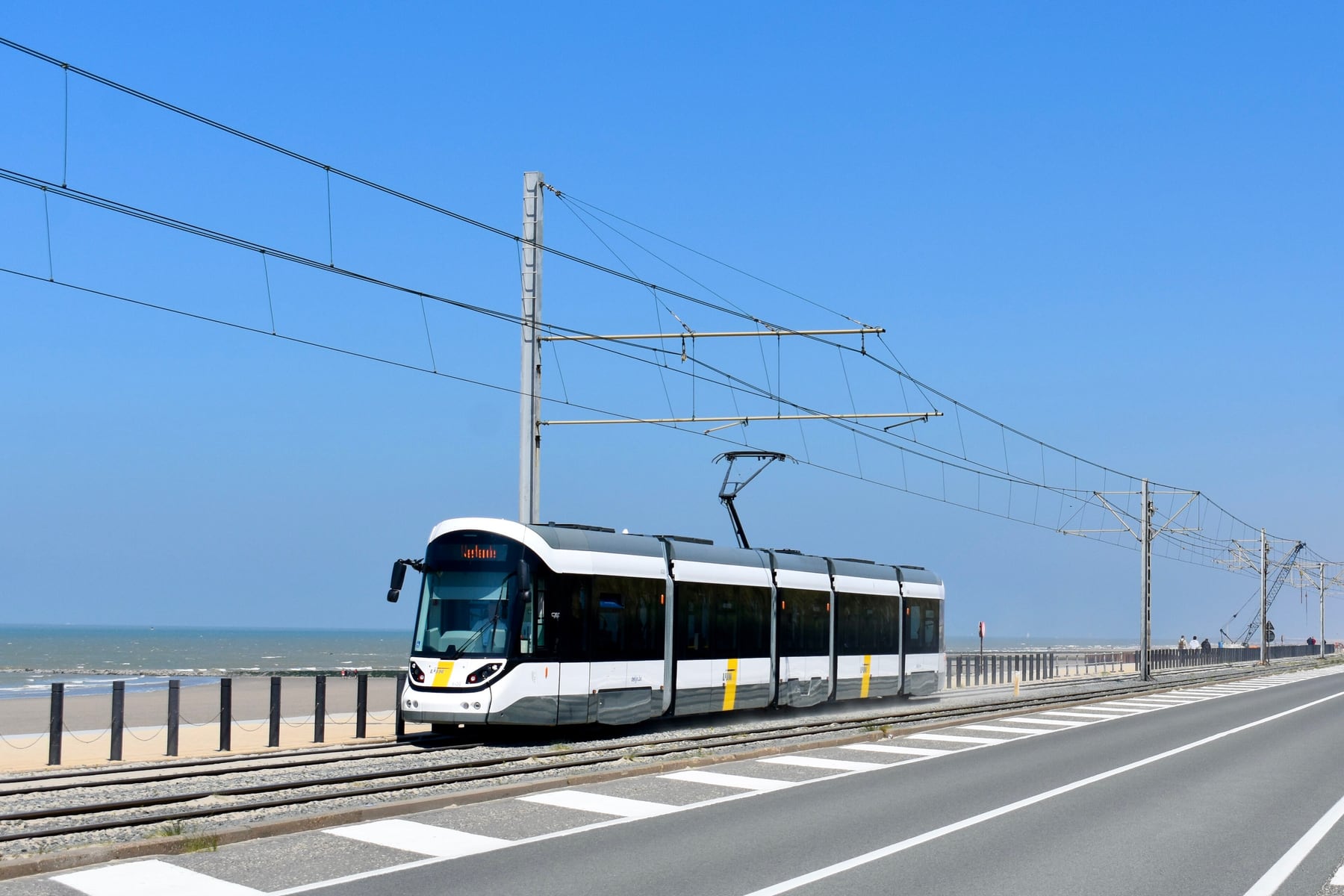
It runs from De Panne, within sight of the French frontier, to Knokke near the Dutch one, along the whole Belgian coast. It is not a scenic railway pretending to be transport; it is transport that happens to spend an afternoon beside the North Sea. For long stretches it runs on its own reservation through the dunes with the sea on one side and nothing much on the other. Then it turns inland along a seafront boulevard and becomes a street tramway, with apartment blocks on one side and beach cabins on the other, before going back into the dunes.
End to end takes about two hours and twenty-five minutes, and almost nobody does it in one sitting. The timetable divides at Oostende, roughly halfway: 38 stops to the west, 30 to the east, and every tram is booked as one leg or the other. In practice about nine out of ten carry straight on across the city after a three-minute stand at the same platform, so through passengers mostly stay where they are.
The other thing worth knowing before choosing an end to start from is that the two termini are not equally easy to reach. Oostende, Blankenberge and Knokke all have a direct hourly train from Brussels. De Panne does not — it is a change at Ghent on a weekday and two changes on a Sunday, and over two hours either way. The far west end of the line is the hard end, which is worth knowing before planning a day around it.
The Journey
The line was not planned as a coastal tramway. It arrived in pieces, over forty-one years, and the shape it has now is the residue of that.
The first section opened in 1885, between Oostende and Nieuwpoort-Stad — De Lijn dates the Kusttram's 125th anniversary to January 2010, which puts the count from there. A year later, on 18 July 1886, it reached Veurne by way of Koksijde. The seafront route from Oostende to Middelkerke-Bad followed on 19 July 1897. The last link of the present alignment was not put in until 11 August 1926, and the tram only reached the national railway station at De Panne — which is actually at Adinkerke, a few kilometres inland — on 1 July 1998.
Behind it all was the Nationale Maatschappij van Buurtspoorwegen, created by a railway law of 28 May 1884 to build what the main-line companies would not. By 1939 it ran 4,756 kilometres. The occupation of 1914–18 took much of it: of 4,096 kilometres, 1,865 were left standing by November 1918. The rest went to the car. What is now De Lijn was formed on 31 December 1990 out of the Antwerp and Ghent city operators and the Flemish half of the old vicinal company, and began work on 1 January 1991.
Oostende, where the timetable folds
The ride divides in the middle, and it is worth understanding why before setting out.
Every scheduled journey on the line is booked as one of two legs: De Panne to Oostende Station, 38 stops and about 78 minutes; or Oostende Station to Knokke, 30 stops and about 64 minutes. Nothing in the published timetable runs the whole way as a single journey. Oostende is where the numbering changes and where the crews turn round.
What actually happens on the ground is gentler than that sounds. On a high-summer weekday, 166 of the 183 trams arriving at Oostende — about nine in ten — carry straight on across the city on the same vehicle, standing three minutes at the same platform before setting off again. So a through passenger usually stays in their seat and simply notices the pause. It is the one in ten that makes the difference: if the tram terminates, the next one is ten or fifteen minutes behind it, and the three-minute stand becomes a wait on a platform in the middle of Oostende.
Counting the stand, De Panne to Knokke is about 2 hours 25 minutes.
What passes the window
Westward from Oostende the tram spends much of its time on its own reservation, running through the dune belt on grassed or ballasted track with the sea over the low ridge to the right and polder behind. Around Middelkerke and Westende it comes out beside the apartment blocks, then goes back into the sand. Nieuwpoort is the one place it turns properly inland, to cross the Yser at the town rather than the mouth.
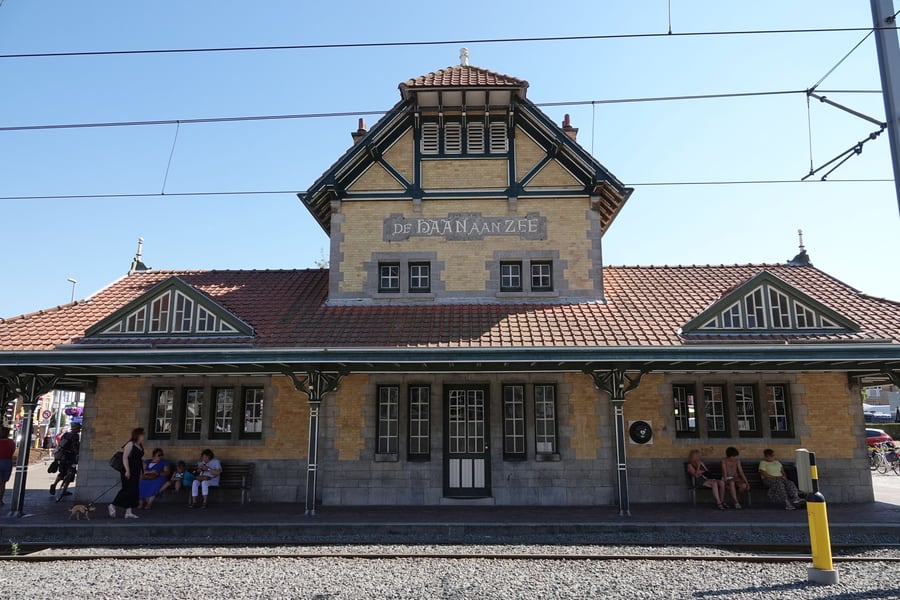
Eastward the character changes. De Haan aan Zee is the set piece: a villa quarter laid out around a small yellow-brick station of 1902, by the Brussels architect Georges Dhaeyer, which replaced an earlier shed known as the Blekken Statie — the tin station. It is still the stop. Blankenberge puts the tram down a street with its pier at the end of it. Past Zeebrugge the line threads the edge of a working deep-sea port, which is the least pretty stretch and the most surprising. Knokke is the last stop, with the Zwin behind it.
The trams themselves
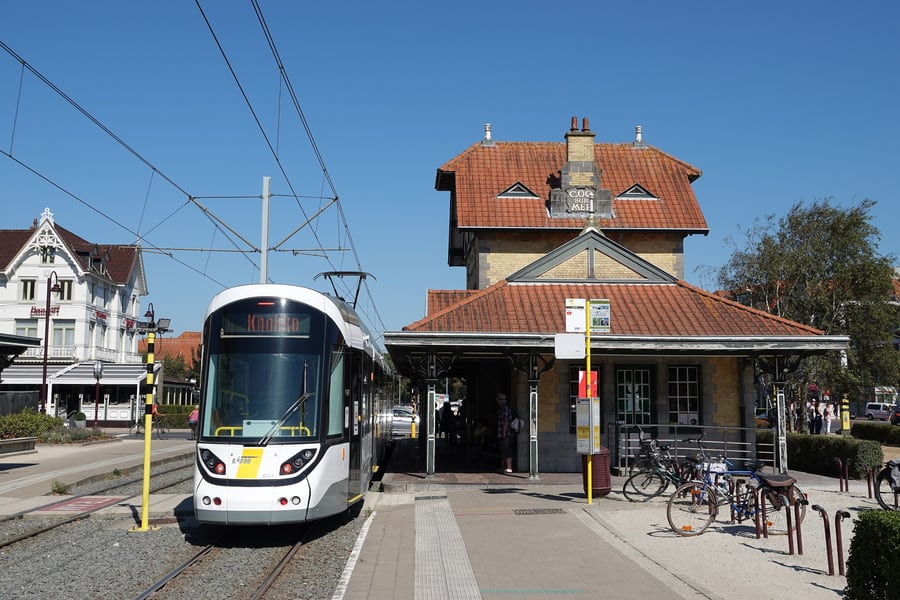
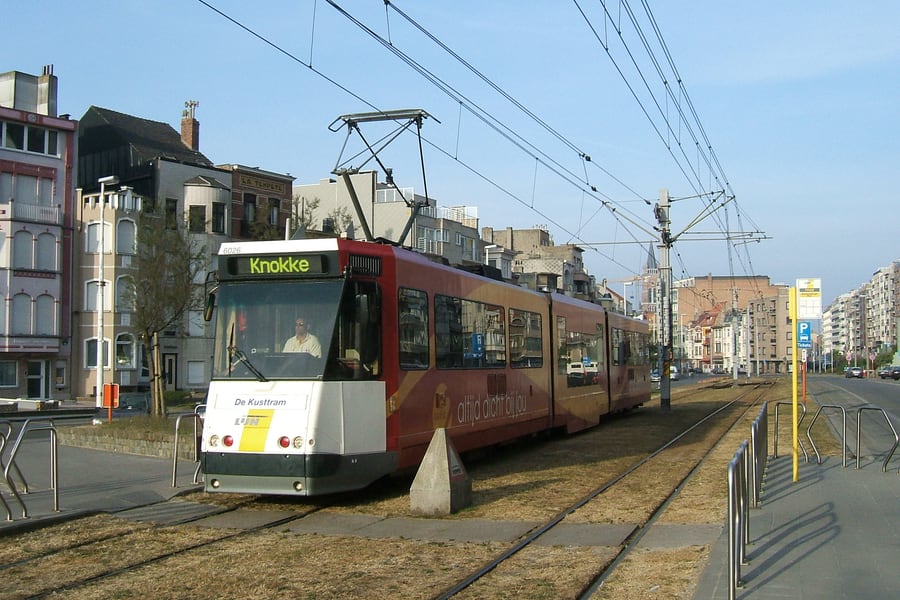
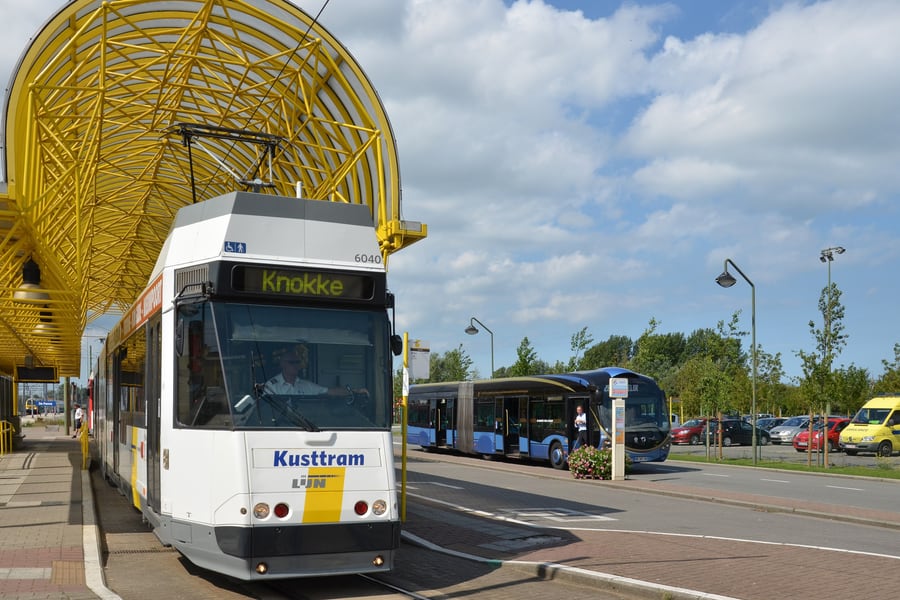
Two generations work the line. The older BN articulated cars, in the yellow and white De Lijn carried for decades, have been joined since the early 2020s by low-floor CAF trams in white and grey, which is what most of the photographs on this page show. The rebuilding programme and the new fleet are the same project seen from two ends: better and safer tracks, in De Lijn's phrase, and stops that a low-floor tram can actually serve level.
Along the route
Jannis Raabe / Wikimedia Commons · CC BY 4.0 · croppedA tramway rebuilt underneath its passengers
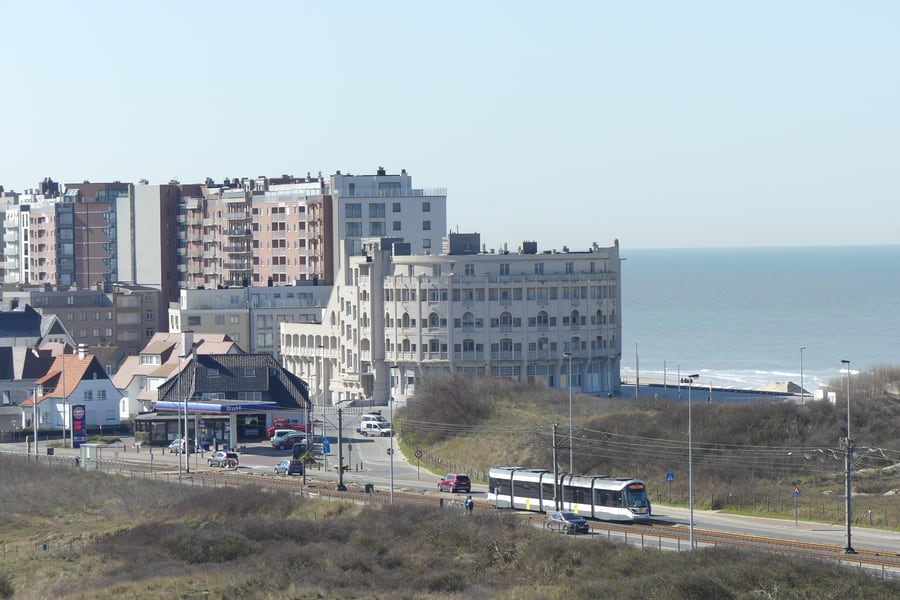
De Lijn publishes a works programme for this line that reads like a demolition schedule and runs to spring 2028. De Panne alone is being taken apart in four phases. In the operator's own words, the last trips of the day between De Panne and Oostende are running by bus on certain weekdays this autumn.Flanierer / Wikimedia Commons · CC BY-SA 4.0 · croppedThree minutes at Oostende
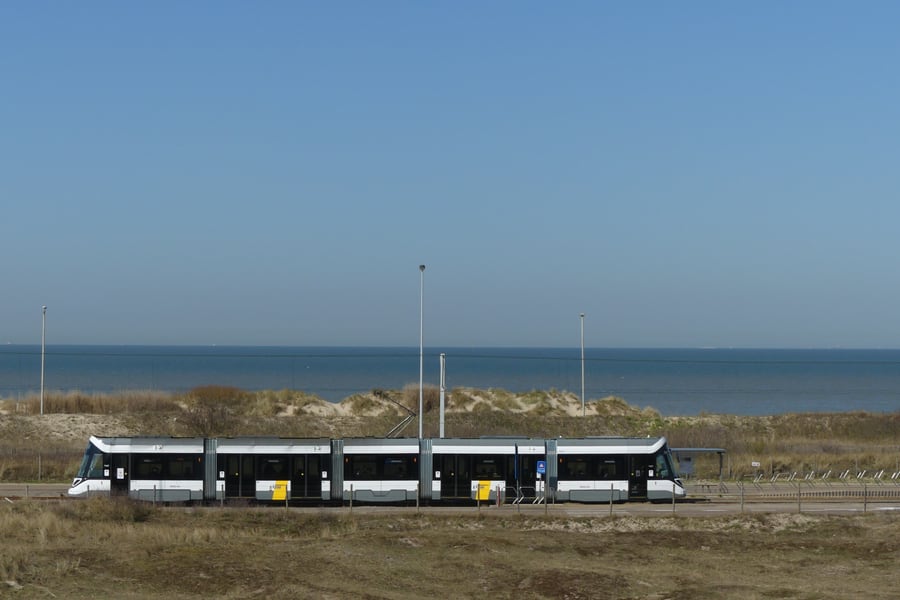
Nothing in the timetable runs the whole line as one journey. What happens on the ground is gentler: on a high-summer weekday 166 of 183 arrivals at Oostende carry straight on across the city on the same vehicle, after a booked three-minute stand.Florian Fèvre / Wikimedia Commons · CC BY-SA 4.0 · croppedWhat is left of the vicinal
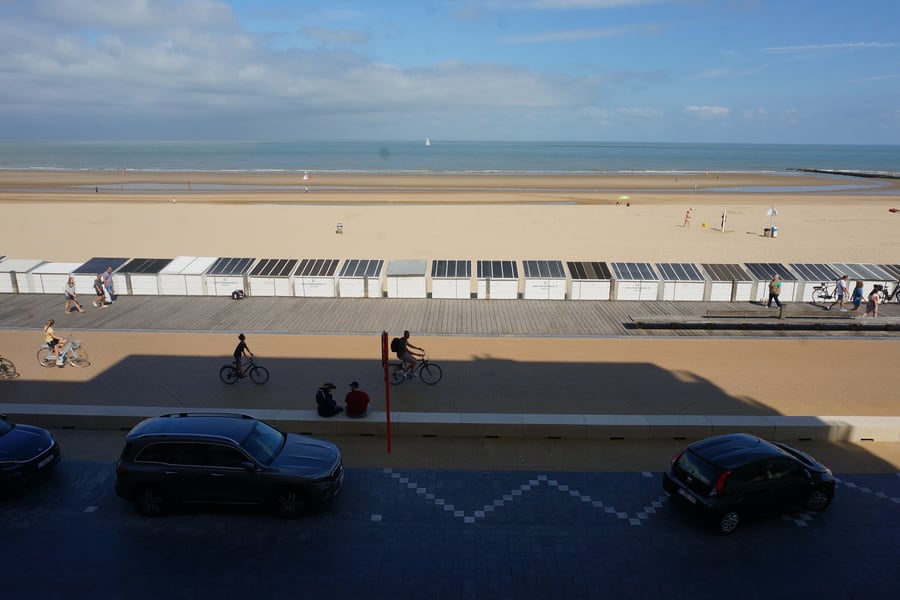
The vicinal was a metre-gauge network built to reach what the railway would not, and at its height it ran to some five thousand kilometres. Three pieces survived to 1985; the coast is the one still doing the job it was built for, on an ordinary ticket.A bit of history
Culture & experiences along the way
 Paul Hermans / Wikimedia Commons · CC BY-SA 4.0 · cropped
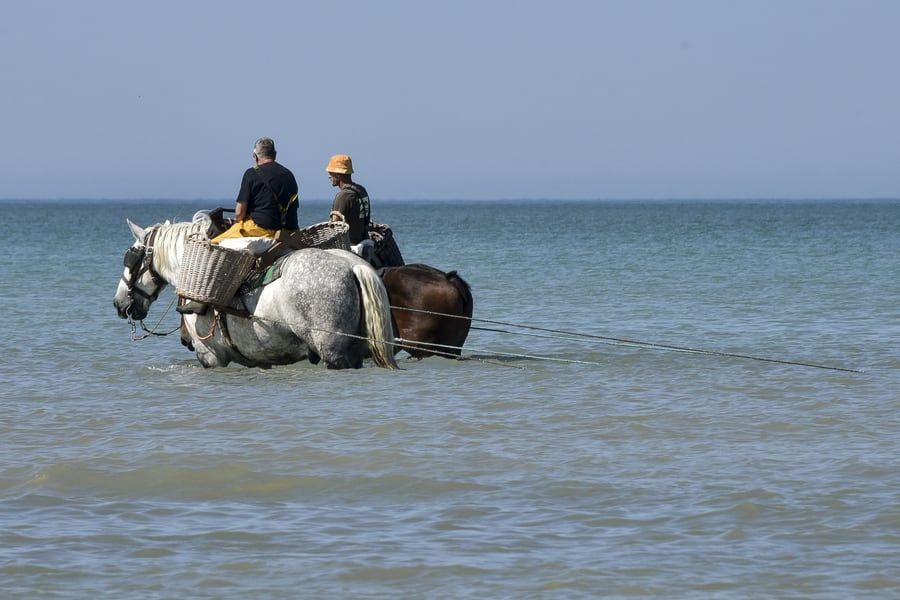
Fishing for shrimp on horseback
At Oostduinkerke, a stop on this line, twelve households still ride Brabant draught horses breast-deep into the surf to drag funnel nets for brown shrimp — the last place on earth where it is done. UNESCO listed it in 2013. They fish in public through spring and autumn, and most days in high summer.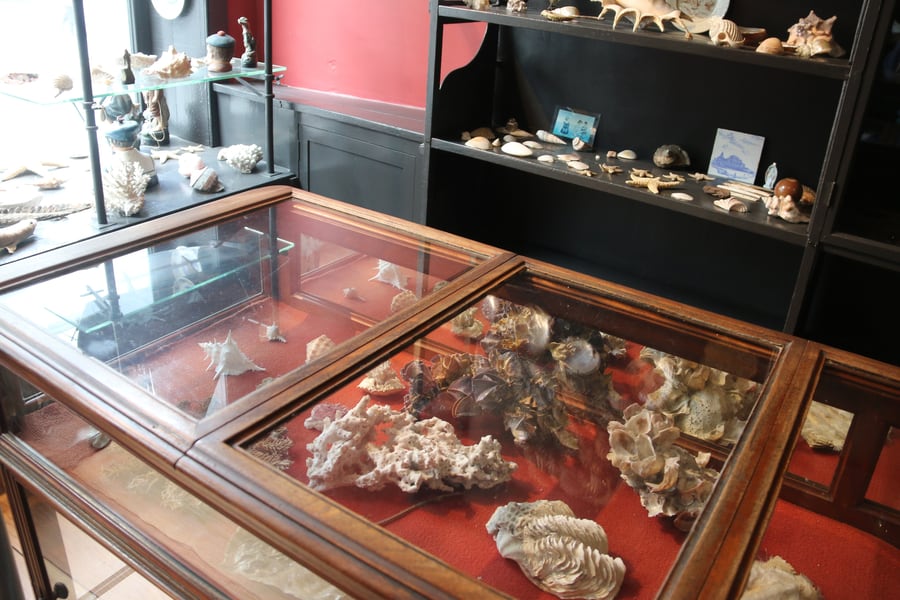 FrDr / Wikimedia Commons · CC BY-SA 4.0 · cropped
James Ensor's shell shop
Ostend's strangest painter lived above his aunt's souvenir shop on the Vlaanderenstraat, among the shells, masks and chinoiserie that walk straight out of the shop cabinets into his pictures. The house is a museum and the shop has been put back exactly as it was.Timetables
Everything below was read on 13 August 2026 from De Lijn's own line pages and from De Lijn's own published timetable data, which at the time of reading covered 15 June to 30 September 2026.
How often it runs
De Lijn's summary is that the tram runs "every 10, 15 or 20 minutes during the day, depending on the period", and every 30 minutes in the evening. The published timetable puts numbers on that:
| Day sampled | Midday interval, 10:00–17:00 | Journeys per direction, each leg |
|---|---|---|
| Thursday 13 August — high summer | every 10 minutes | about 92 |
| Sunday 16 August — high summer | every 10 minutes | about 90 |
| Tuesday 1 September | every 15 minutes | about 59 |
| Sunday 6 September | every 15 minutes | about 53 |
| Thursday 24 September | every 15 minutes | about 59 |
The step down from ten minutes to fifteen happens at the end of August, and it applies to Sundays as much as to weekdays — the high-summer Sunday service is as frequent as the weekday one. From about 19:00 the interval opens out to 30 minutes.
First and last
| From De Panne | From Knokke | |
|---|---|---|
| First tram, weekday | 04:14 | 04:20 |
| First tram, Sunday | 06:14 | 05:50 |
| Last tram | 00:22 | 00:21 |
Weekday mornings start remarkably early for a seaside line — this is a commuter tramway as well as a holiday one. Sundays begin an hour and a half to two hours later, and end at the same time.
Journey times
| Leg | Stops | Typical run |
|---|---|---|
| De Panne → Oostende Station | 38 | 78 minutes |
| Oostende Station → Knokke | 30 | 64 minutes |
| Stand at Oostende | — | 3 minutes |
| De Panne → Knokke | 67 | about 2 h 25 |
Every journey is booked as one of the two legs. On a high-summer weekday about nine in ten trams carry on across Oostende on the same vehicle after the three-minute stand, so most through passengers never leave their seat. The remaining one in ten terminates, and the connection is then whatever the next tram is — ten minutes in August, fifteen in September.
⚠️ The works, and the autumn replacement buses
This is the part of the Kusttram that a timetable alone will not tell you. De Lijn is renewing track and stops in phases along the whole line, and the programme published on its works page runs to 2028:
| Where | When |
|---|---|
| Knokke, Elizabethlaan – Knokke Station | September 2025 – April 2026 (completed) |
| De Panne, Fazantenlaan – Adinkerkelaan | January – April 2026 (completed) |
| Oostende, Northlaan | January – June 2026 (completed) |
| De Panne, Adinkerkelaan – Moeder Lambik | April – June 2026 (completed) |
| De Panne, Moeder Lambik – Adinkerkelaan | September – December 2026 |
| De Panne, Moeder Lambik – Adinkerke Station | January – April 2027 |
| De Panne, Esplanade – Golfstraat | Spring 2028 |
De Lijn's own words on the same page: the last trips of the day between De Panne and Oostende are being operated by bus on certain weekdays this autumn, following most of the tram route and calling at or near the stops. It also notes that during diversions, drivers may only pick up and set down at the temporary stops agreed with the local authority — passengers boarding elsewhere would not be covered by its insurance.
⚠️ The link De Lijn gives for the detail of those replacement buses is broken on the English version of its site, resolving to an empty page. The works page itself is the reliable one: delijn.be/nl/nieuws/kusttram-werken (opens in a new tab).
The practical consequence is small but real: an autumn evening at the western end of the line may finish on a bus rather than a tram, and the last stretch into De Panne is the part being dug up.
Getting to the line by train
Three of the four places where the tram meets the national railway have a direct hourly train from Brussels. The fourth does not. Sampled from iRail across several windows for Sunday 16 August 2026:
| Interchange | From Brussels-South | Journey |
|---|---|---|
| Oostende | direct, hourly at :03 | 72 minutes |
| Blankenberge | direct, hourly at :28 | 73 minutes |
| Knokke | direct, hourly at :51 | 84 minutes |
| De Panne (Adinkerke) | no direct train — two changes on a Sunday | 125 minutes |
On a weekday De Panne improves only to one change, at Ghent-Sint-Pieters, and 121 minutes. The tram's western terminus is a good two hours from Brussels however it is approached, which is worth weighing before deciding which end to start from. Oostende, in the middle of the line and 72 minutes from Brussels, is the easiest place to join.
The heritage trams at De Panne
Separately from De Lijn, the volunteer association T.T.O.-Noordzee keeps about thirty historic coast trams in the old depot at Loskaai 15 in De Panne, and runs them on a short line to Adinkerke station. From its own site, read on 13 August 2026: rides run in July and August, departing at 11:30, 14:00, 15:00 and 16:00, taking about 40 minutes, at €5 a head. The exhibition of tram sets that worked the coast between 1908 and 1985 is free. Tickets are sold at the depot, cash or card, and the stop to alight at is De Panne Esplanade.
⚠️ The commune's own tourism page for the depot currently says both a different price and that the historic trams are not running. The association's site is the more specific and more recent of the two, and it is the one quoted above.
Tickets
There is no Kusttram fare. The coast tram is an ordinary De Lijn service on ordinary De Lijn tickets, the same ones that work on a city bus in Antwerp. ⚠️ The single ticket does not cover a leg of this line. A €3 single buys sixty minutes; Oostende to Knokke takes 64, De Panne to Oostende 78, and end to end about two hours twenty-five. A single bought in the app expires flat at sixty minutes, while one bought contactlessly or at a machine lets you complete the ride.
The day ticket at €9 costs three singles and removes the question, which makes it the sensible buy for anyone going more than a few stops. In July and August children under twelve pay for a ride with a strandbloem — a beach flower — instead of a fare. Bicycles need their own €2.40 ticket, are carried only if there is room, and are the passenger's own job to load. Read from De Lijn on 13 August 2026.
Book your tickets
Day ticket
€9 for 24 hours · €4.50 for ages 6–11
The sensible ticket for this line, because a single expires before either leg ends.
Book Tickets (opens in a new tab, on delijn.be)via delijn.beThree-day ticket
€18 for 72 hours · €9 for ages 6–11
Two days of coast for the price of the first, if the trip is longer than an afternoon.
Book Tickets (opens in a new tab, on delijn.be)via delijn.beSingle
€3 for 60 minutes
Enough for a few stops only — buy it on the vehicle or at a machine, not in the app.
Book Tickets (opens in a new tab, on delijn.be)via delijn.beBicycle ticket
€2.40, valid twelve months from purchase
The Kusttram is the only De Lijn service that carries bicycles, and only if there is room.
Book Tickets (opens in a new tab, on delijn.be)via delijn.beRail Passes
No rail pass covers the Kusttram, and buying one for this journey would be a mistake.
An Interrail or Eurail pass is valid on the trains of SNCB/NMBS, the Belgian national railway. The coast tram is not an SNCB train — it belongs to De Lijn, the Flemish regional operator, and takes De Lijn's own tickets and nothing else. A pass will carry you to Oostende, Blankenberge or Knokke and stop at the station door.
That is not an argument against holding a pass. It is an argument for understanding what it does here: the pass is for getting to the coast, and a De Lijn day ticket is for travelling along it. Those are two separate purchases, and together they are the whole cost of the day.
If you already hold a pass
- Belgian domestic IC and S trains take no reservation, so a pass day can be used on the day it is decided. Oostende is 72 minutes from Brussels-South on a direct hourly train.
- One travel day covers the return trip to the coast and back.
- Add a De Lijn day ticket at €9 for the tram itself. Nothing about holding a rail pass changes that price.
If you do not
For a single day out from Brussels there is no pass worth buying. An ordinary SNCB return plus a De Lijn day ticket is cheaper than any pass product, and SNCB's own weekend pricing usually does better still — read on 13 August 2026:
- Adults aged 26–64 get 30% off on Saturdays, Sundays and public holidays.
- Travellers under 26 and 65 and over pay 40% less than the standard fare at all times, on any day and in either class.
- Holders of Train+ get a further 40% off the weekend fare.
- ⚠️ Since 15 May 2026, bridge days are charged at the weekday rate; the weekend reduction does not apply to them.
⚠️ Third-party fare listings for this line are out of date
Several travel sites currently quote the Kusttram at €2.50 a single and €7.50 for a day pass, and SNCB's weekend reduction at 50%. On the operators' own pages, read on 13 August 2026, De Lijn charges €3 and €9, and SNCB's weekend discount for a 26–64 adult is 30%. The operators' own sites are the ones to trust.
Places to Visit
The whole point of a tram every ten minutes is that getting off costs nothing. There is no reservation to lose and no next departure to worry about — in August the next one is ten minutes away, in September fifteen. That makes the Kusttram unusual among the journeys on this site: the line is worth riding, but it is at its best used as a way of stringing together a coast rather than as a ride in itself.
Four of the five places below are at a tram stop, or a short walk from one. The fifth is the exception that needs planning, and it is worth stating plainly.
⚠️ The Zwin is not a stop-off
Zwin Nature Park sits behind Knokke, at the far eastern end of the line, and it is not on the tram. The park runs its own shuttle bus from Knokke Station — which is where the tram terminates — but only from 1 April to 18 October, and only twice each way per day: out at 10:30 and 11:30, back at 16:15 and 17:00. There are 75 seats a ride, sold in advance, at €3 return.
Two departures a day is a very different thing from a tram every ten minutes. Riding the line from De Panne takes about two hours twenty-five, so catching the 11:30 shuttle means leaving the western terminus at around 09:00. The Zwin is a day built around the Zwin, not an afternoon added to a tram ride — and the last bus back leaves the park at 17:00, well before the tram stops running at half past midnight.
The rest is easier
Raversijde has its own stop, Raversijde Provinciedomein, between Middelkerke and Oostende. De Haan aan Zee is a stop where the station building is the attraction. Blankenberge's pier stands at the seaward end of the street the tram runs down. De Westhoek begins where De Panne ends, a walk from the western terminus and from the depot where the historic trams are kept.
One practical note that applies to all of them: a De Lijn day ticket at €9 costs three singles and makes the hopping on and off free at the point of use. On a line where a single is valid for sixty minutes and the shorter leg takes sixty-four, it is the only ticket that really fits this way of travelling.
 Nenea hartia / Wikimedia Commons · CC BY-SA 4.0 · cropped
The tram station at De Haan aan Zee
Built in 1902 to a design by the Brussels architect Georges Dhaeyer, replacing an earlier shed the locals called the Blekken Statie — the tin station. It was to be demolished in 1977; the commune bought it instead, it became a protected monument on 24 June 1981, and it was restored in 2002 for its centenary. Yellow brick with blue hardstone, in a Belle Époque villa quarter. Trams still call at it, which makes it the only old station on the line still doing its job.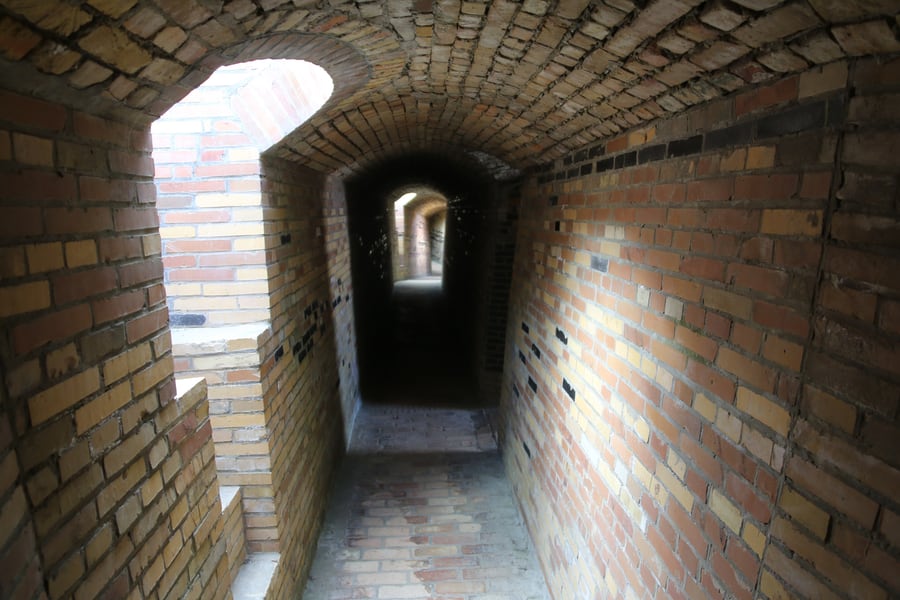 FrDr / Wikimedia Commons · CC BY-SA 4.0 · cropped
Atlantikwall Raversyde
The tram has its own stop for this one, Raversijde Provinciedomein. More than sixty bunkers, observation posts and gun positions survive here, linked by open and underground corridors — a stretch of the German Atlantic Wall of the Second World War. Beside it, in the dunes overlooking the sea, is the Aachen Battery: the only preserved German coastal battery of the First World War anywhere, and winner of a European Heritage Award in 2022. The surrounding park is open all year.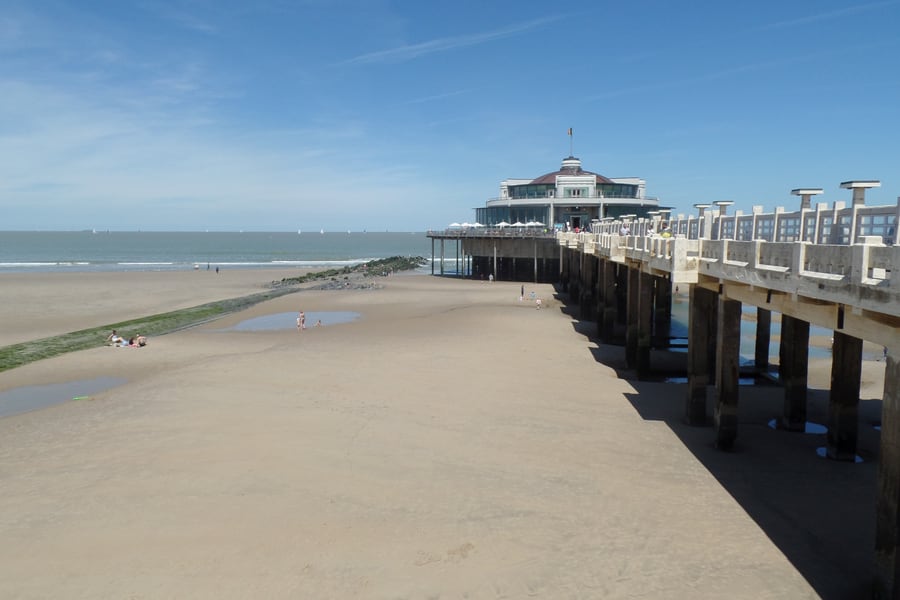 Gordito1869 / Wikimedia Commons · CC BY-SA 4.0 · cropped
The pier at Blankenberge
The first pier here was cast iron and art nouveau, opened on 12 August 1894, and the German occupier burned it down on 15 October 1914. Its replacement is concrete and art deco, designed by Jules Soete and inaugurated on 9 July 1933 — 350 metres out into the North Sea. It survived the next war because a German sergeant declined to dynamite it. Protected as a monument in 2004, with its walkway rebuilt between 2021 and 2023. The tram runs down the street that ends at it.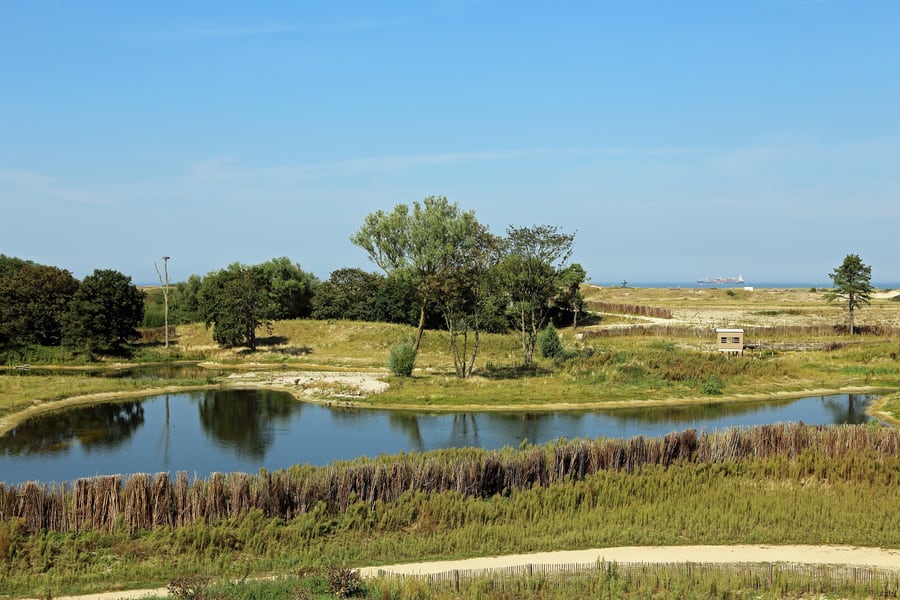 Marc Ryckaert / Wikimedia Commons · CC BY-SA 4.0 · cropped
Zwin Nature Park
The park calls itself the international bird airport, and it sits on the old tidal channel that once carried seagoing ships to Bruges before it silted up. ⚠️ It is not on the tram. Its own shuttle runs from Knokke Station, where the tramway ends, but only from 1 April to 18 October and only twice each way a day — out at 10:30 and 11:30, back at 16:15 and 17:00, 75 seats a ride, €3 return, booked ahead. Two departures a day makes this a whole day out, not a stop-off.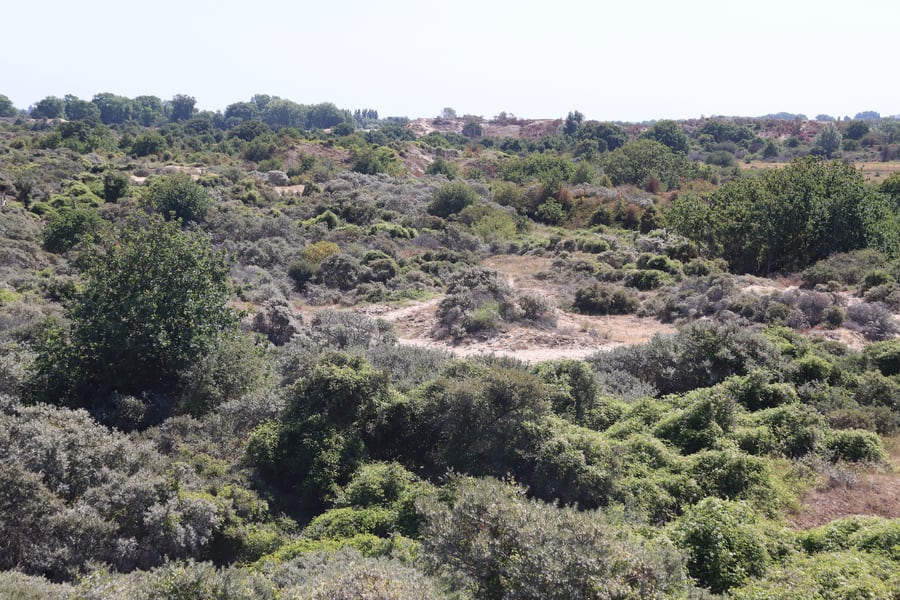 FrDr / Wikimedia Commons · CC BY-SA 4.0 · cropped
De Westhoek, at the end of the line
Roughly 340 hectares of dune between De Panne and the French border, and the best preserved dune landscape on the Flemish coast. It has been a state nature reserve since 1957 — with the Hautes Fagnes, the oldest of its kind in the country — and had landscape protection from 1935. At its centre is a bare, moving dune of more than 100 hectares that the south-westerlies push eastwards by five to ten metres a year. It begins where the town, and the tramway, run out.Where to Sleep
The Kusttram makes the usual question — which town to stay in — much less important than it normally is. Everything on the coast is on one line, the line runs until half past midnight, and a day ticket costs €9. A bed anywhere between De Panne and Knokke is a bed on the tram.
What the choice really comes down to is which end of the line you want to be near, and how easy it is to arrive by train.
- Oostende is the practical answer. It is the middle of the line, the point where every through journey pauses, and the only coastal town 72 minutes from Brussels on a direct hourly train. From here both halves of the tramway are an hour or so away.
- De Haan is the pretty one, and the one with the tram station worth looking at.
- De Panne puts you at the western terminus, next to the dunes and the historic tram depot. It is also the hardest end to reach by train, and the end being rebuilt — the section between Moeder Lambik and Adinkerkelaan is closed for works from September to December 2026, and some late evening journeys towards Oostende are running by bus this autumn.
⚠️ Nothing below carries a price or a rating, because we have checked neither. Each hotel's own website was opened and read on 13 August 2026; the descriptions repeat only what those sites say about themselves and what can be checked independently, such as position on the line.
Where to stay
 Johan Bakker / Wikimedia Commons · CC BY-SA 3.0 · cropped
Thermae Palace
On the sand at Oostende, in the middle of the line
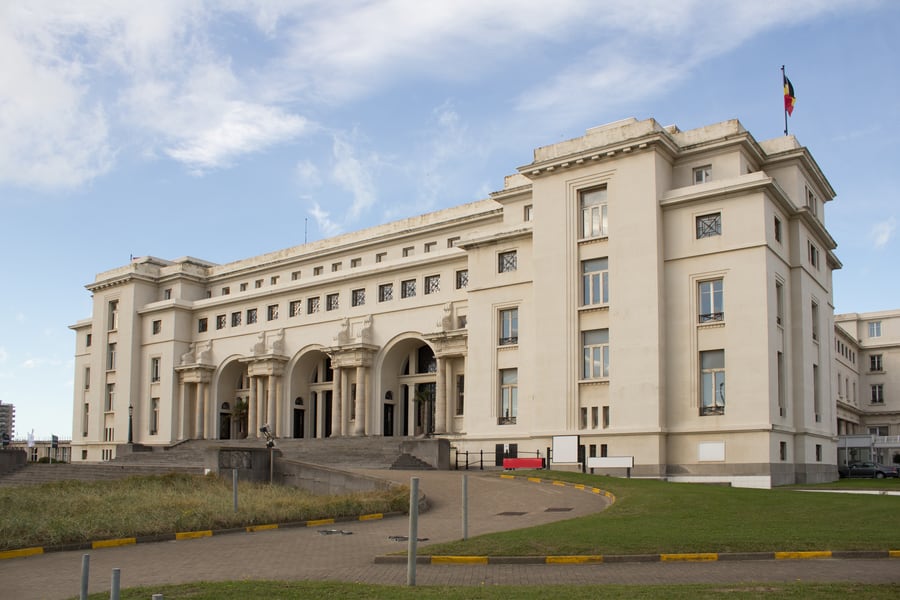
An art deco building opened in 1933 on the beach at Oostende, listed as a protected monument in 2002. Its own site describes 130 rooms, a position 500 metres from the city centre, and an entrance reached along Leopold II's covered gallery. Oostende is the hinge of the tramway and the one coastal town with a direct hourly train from Brussels, which makes this the most practical base on the coast.
Check Availability (opens in a new tab, on thermaepalace.be)via thermaepalace.beHotel Les Dunes
In the Concession at De Haan
A hotel in the middle of De Haan's Concession — the protected quarter of Belle Époque villas laid out on fifty hectares of dune granted by Leopold II in 1889 — a few steps from the beach and the village centre. The protected tram station of 1902 is a short walk away, and the stop is the same one.
Check Availability (opens in a new tab, on hotellesdunes.be)via hotellesdunes.beHotel Villa Select
On the seafront at the western terminus
On the sea dyke at De Panne, a three-minute walk from the De Panne Centrum tram stop, with a pool, sauna and Turkish bath free to guests and a restaurant looking out over the beach. This is the end of the line for the dunes of De Westhoek and the historic tram depot — and the end being rebuilt, with works between Moeder Lambik and Adinkerkelaan from September to December 2026.
Check Availability (opens in a new tab, on hotelvillaselect.be)via hotelvillaselect.beQuestions or corrections
Planning this trip and stuck on something, or spotted a time, fare or detail that has changed? Send us a message about Kusttram. We read every one, and we update this page when something has changed.