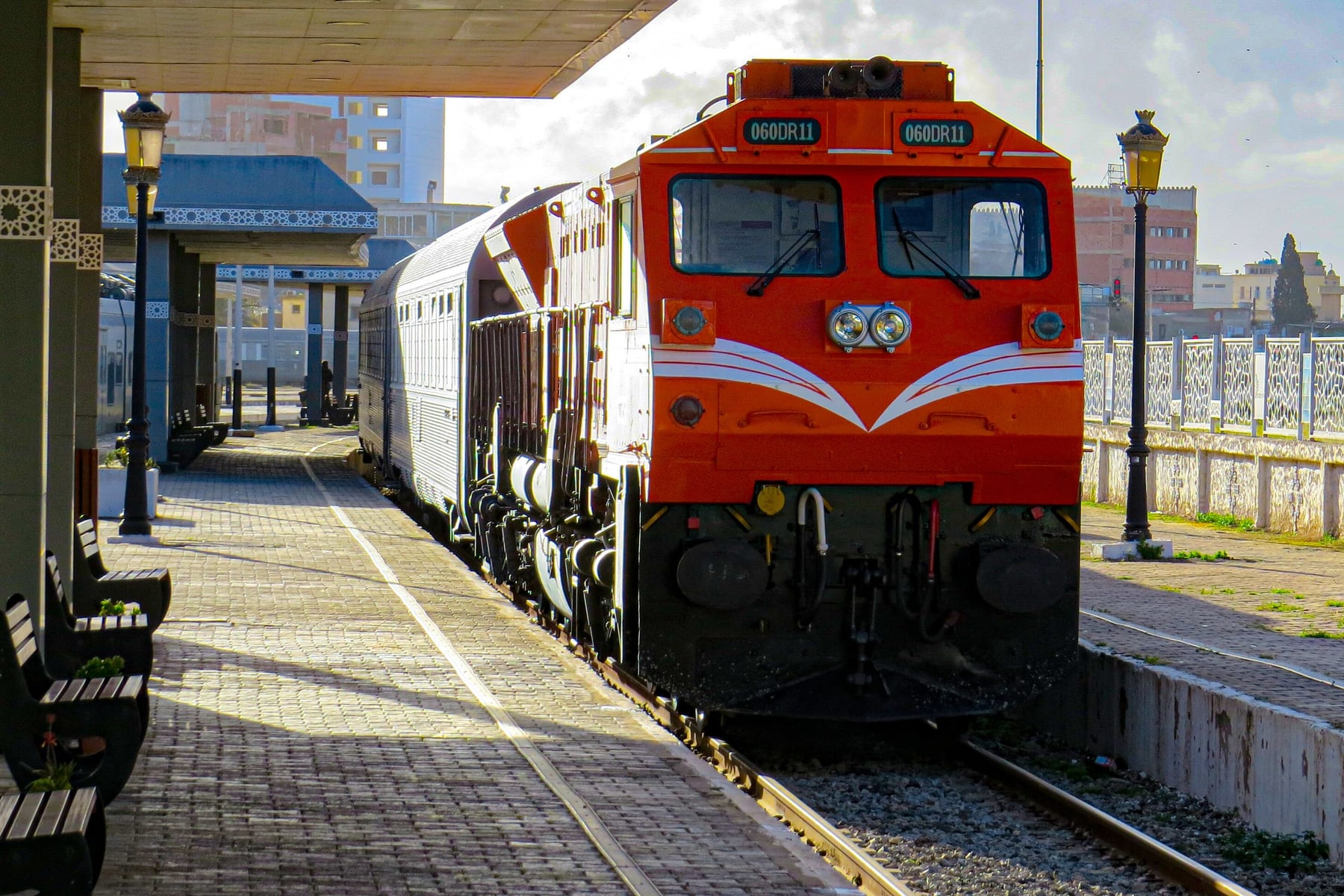
Béchar to Tindouf
Alfred Alreness / Wikimedia Commons · CC BY 2.0 · 2024 · cropped
- DistanceAbout 810 km, Béchar to Tindouf; the whole line runs 950 km to Gara Djebilet
- Duration11 hours 20 minutes, daily in each direction
- Best seasonOctober to April · the train runs all year, but the hamada in summer is punishing
Introduction
On 1 February 2026 Algeria opened a railway 950 kilometres long across the western Sahara, and the next morning it began carrying passengers. The line runs from Béchar, at the foot of the Saharan Atlas, to the iron-ore deposit at Gara Djebilet in the far south-west corner of the country, and the passenger train works the 810 kilometres of it between Béchar and Tindouf. It leaves at eight in the morning and arrives at twenty past seven in the evening: eleven hours and twenty minutes, one train each way, every day, across hamada and erg with six stops in between and almost nothing else.
Everything about it is new. The track was laid in twenty-four months by Chinese and Algerian contractors, to a 32.5-tonne axle load and a design speed of 160 km/h, over 1,431 engineering structures including a viaduct 4,111 metres long across the bed of the Oued Daoura. The train that uses it is ordinary by comparison — first and second class, a dining car, and a fare of 1,490 dinars — but it is the only way to ride the newest long-distance railway in Africa, and it turns Tindouf from a two-day drive into a day out of Béchar. Beneath it runs the reason the line exists at all: ore trains from Gara Djebilet to the steelworks near Oran, eventually two kilometres long.
The Journey
Béchar is the end of the old railway and the beginning of the new one. The line up from Oued Tlelat, outside Oran, reached here in 1906 and was rebuilt in 2010; until 2025 it stopped, and the hundred kilometres south to Abadla were a branch. Now the rails carry on, and the eight o'clock departure runs off the edge of every map the town grew up with.
The first stretch is the greenest the train will see. Abadla sits in an irrigated plain fed by the Oued Guir and the Djorf Torba dam, a place of date palms and cereal fields, and its station is ninety-eight and a half kilometres out. Forty kilometres further is Hammaguir, a name that means something to anyone who followed the space race: the French army's rocket range stood here, with four launch pads called Bacchus, Blandine, Béatrice and Brigitte, and from Brigitte in November 1965 France put its first satellite, Astérix, into orbit. More than 271 rockets went up from this ground before the French left in July 1967.
The long middle
After Hammaguir the country empties. The railway runs out onto the hamada — the stony desert plateau that covers most of this quarter of Algeria — and stays high and level for hundreds of kilometres: 565 metres at Tabelbala, kilometre 308; 550 at Hassi Khebi, kilometre 440; 537 at Oum El Assel, kilometre 640. Tabelbala is the one real surprise on the run, a palm grove strung out over twelve kilometres between two ergs, whose people speak Korandje — a language related to nothing else nearby and carried here from the Niger bend by the salt trade.
Oum El Assel is the last stop, and by then the train has been running for the better part of a working day. From there the line drops towards the bed of the Oued Daoura, crosses it on the long viaduct, and comes into Tindouf at 399 metres and kilometre 810. Gara Djebilet, the mine that pays for all of this, is another hour and twenty minutes beyond.
What is pulling it
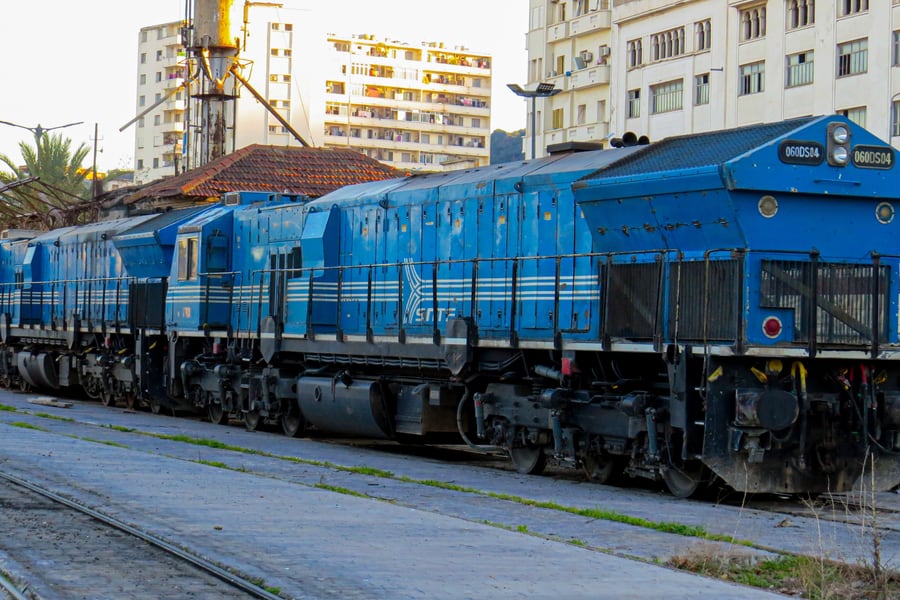
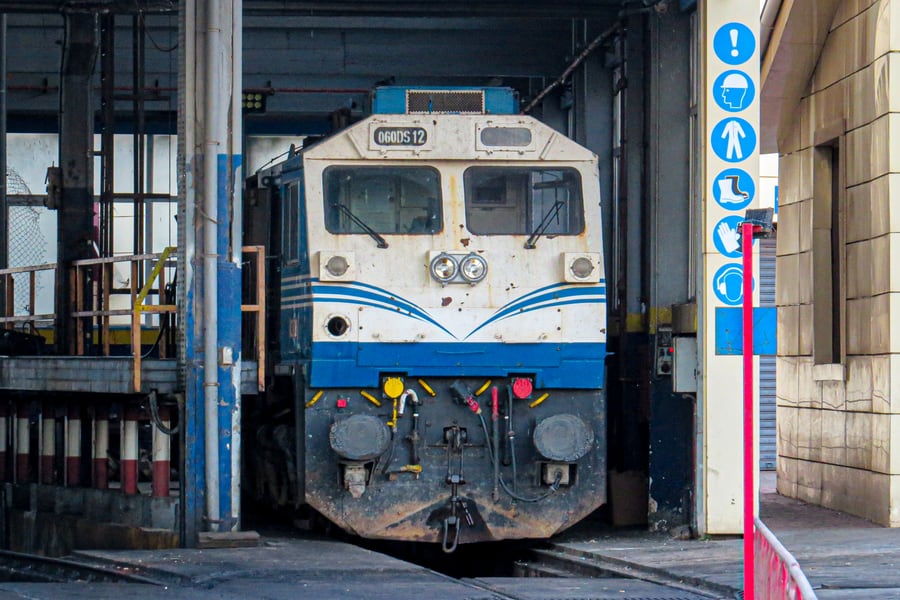
SNTF has not said which class of locomotive works the passenger train. What the railway did say at the launch is that it has first and second class, berths and a dining car, and that it runs at about 80 km/h for now, with a plan to lift that to 120 and bring the journey down to eight hours. The freight is the heavy work: 34 wagons and roughly 2,000 tonnes at first, 500,000 tonnes of ore in 2026, and from 2028 trains of 170 wagons stretching 2.2 kilometres.
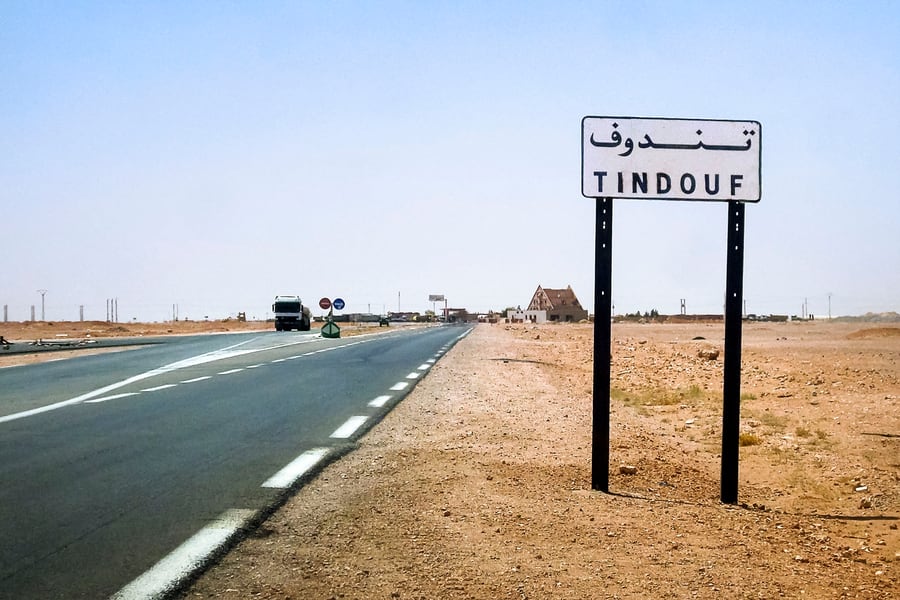
Along the route
 Habib Kaki / Wikimedia Commons · public domain · 2017 · cropped
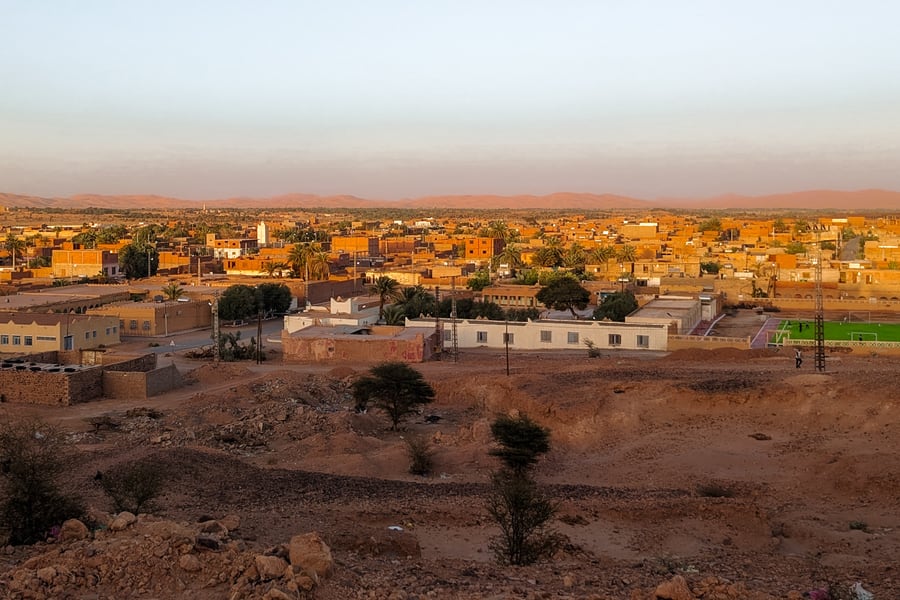
Abadla, where the green stops
Ninety-eight kilometres out, an irrigated plain of date palms and cereal fed by the Oued Guir and the Djorf Torba dam. It is the last cultivated ground the train sees.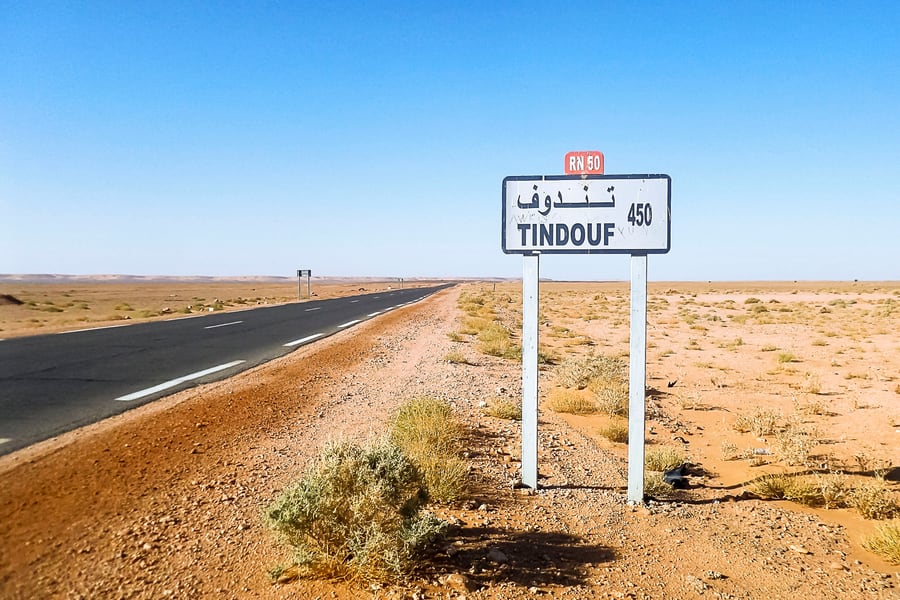 Habib Kaki / Wikimedia Commons · CC0 · 2017 · cropped
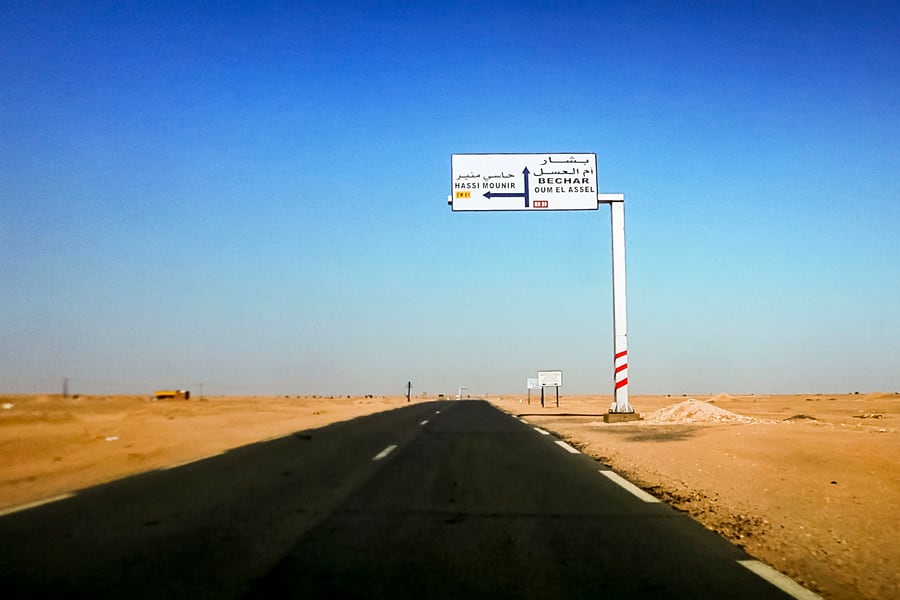
Four hundred and fifty kilometres to go
The RN 50 shadows the railway for much of the way south, and its distance boards are the only measure of progress out here. The train covers the same ground in a single day.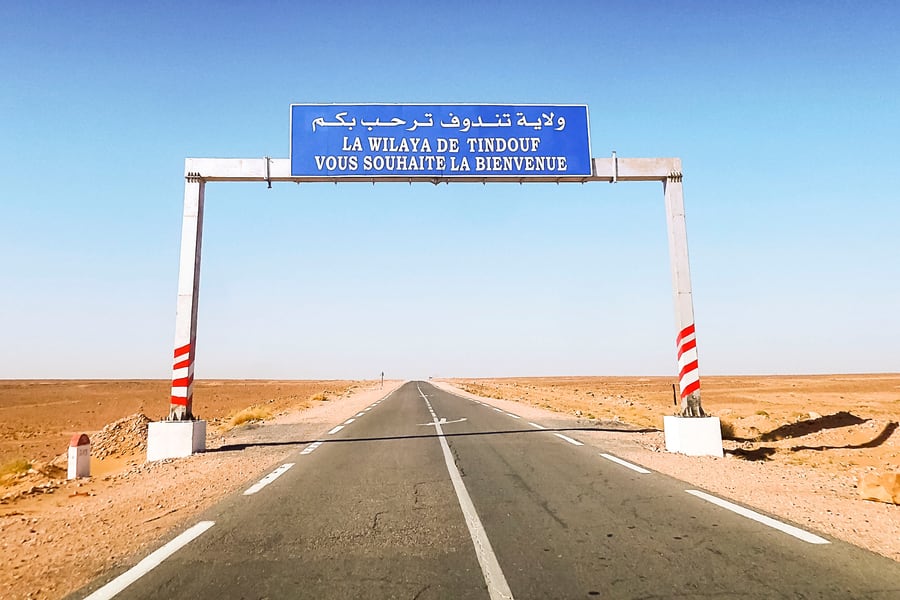 Habib Kaki / Wikimedia Commons · CC0 · 2017 · cropped
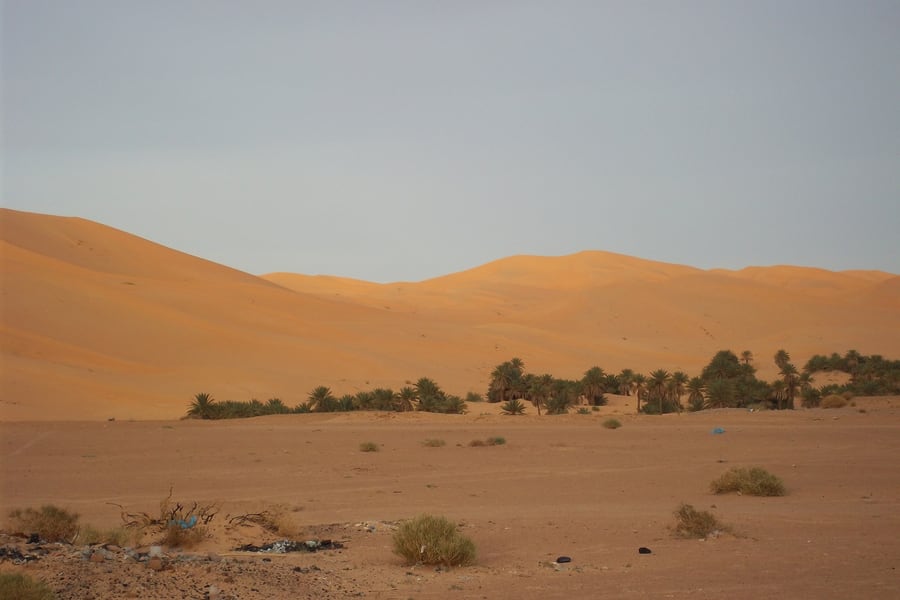
Into the wilaya of Tindouf
Algeria's far south-western corner, bordering Western Sahara, Mauritania and Morocco. Its province had no railway at all until 31 January 2026, when the station opened.A bit of history
Culture & experiences along the way
 Anis Hercule / Wikimedia Commons · CC BY-SA 4.0 · 2019 · cropped
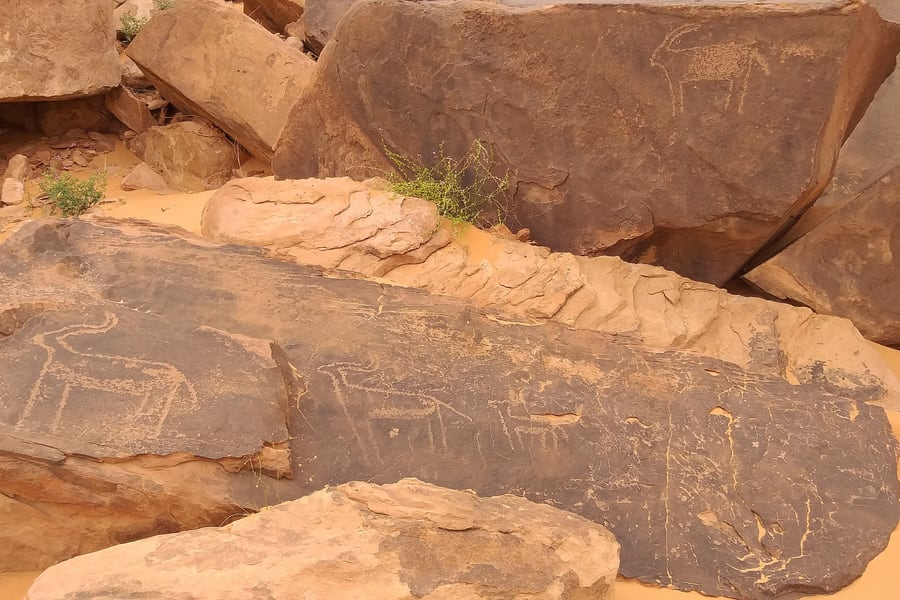
The engraved rocks above Taghit
On the sandstone south of Taghit, people of the Neolithic pecked out elephants, lions, ostriches, giraffes, cattle and antelope — the animals of a Sahara that was wooded savanna when the carving was done. The best of the sites, El Hajra by the Zaouia Tahtania, was put on Algeria's national heritage register in July 2024 and now has a road, a fence and wardens.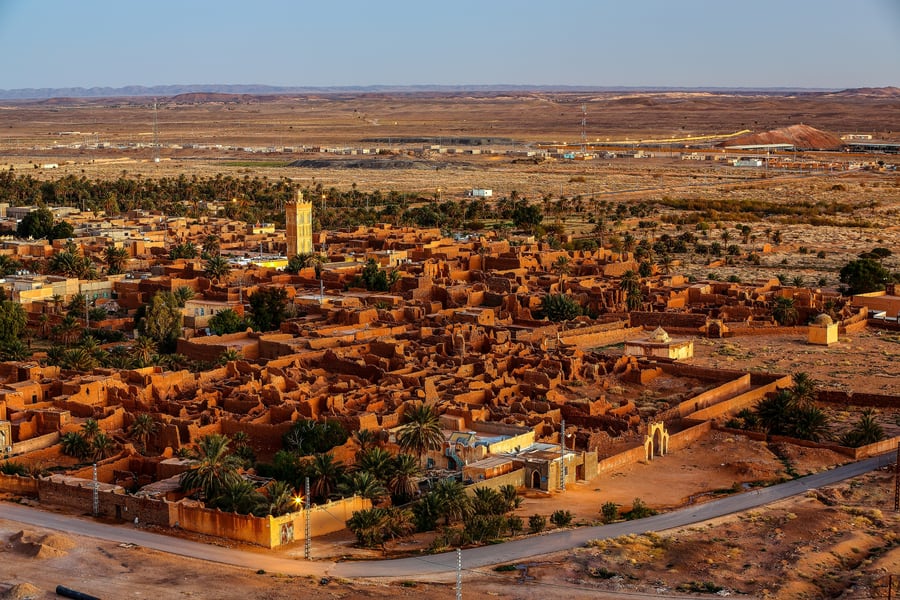 Chettouh Nabil / Wikimedia Commons · CC BY-SA 4.0 · 2013 · cropped
Kenadsa, the ksar and its zaouia
Twenty-two kilometres west of Béchar stands a village of packed earth built around a zaouia — a Sufi lodge and school — founded in the eighteenth century by Sidi M'hammed Ben Bouziane, a scholar from Taghit. The ksar around it is protected as a living historic centre, which is the point: people still live in it.Timetables
One train runs in each direction every day. The two sets leave at much the same time and pass somewhere out on the hamada.
| Direction | Station | Departs | Arrives |
|---|---|---|---|
| Southbound | Béchar | 08:00 | Tindouf 19:20 |
| Northbound | Tindouf | 09:00 | Béchar 20:23 |
The run is eleven hours and twenty minutes. Stops, in order from Béchar: Abadla · Hammaguir · Tabelbala · Hassi Khebi · Oum El Assel.
Getting to Béchar, and on from it
Béchar has an overnight train to and from Oran, which is what makes the Saharan line reachable from the coast without flying.
| Direction | Station | Departs | Arrives |
|---|---|---|---|
| Northbound | Béchar | 21:00 | Oran 07:11 |
| Southbound | Oran | 20:30 | Béchar 06:45 |
From Oran there are four trains a day to Algiers: 1002 at 06:00, MA at 08:00, 1004 at 14:00 and 1006 at 17:00, taking between four and five and a half hours. Arriving at Béchar at 06:45 leaves just over an hour before the Tindouf train goes, which is tight but is plainly how the timetable was built.
As of September 2026. These are the times SNTF announced when the line opened on 1 February 2026,
and the ones it restated in April. SNTF's own site is sntf.dz, and it advertises online
reservation for this route; the site could not be reached from outside Algeria while this page was
written, so the times here come from the Algerian press quoting the company, and the ticket counter
at Béchar or Tindouf remains the reliable way to confirm them. The line is seven months old and its
timetable may still move.
Tickets
Tickets go on sale at the station counters from 08:00 each day. SNTF says reservations can also be made through its website; that was not working on the day the line opened, and the site is not reachable from outside Algeria, so plan on buying at the station.
Fares are set by SNTF and quoted in Algerian dinars: 1,490 in first class and 1,175 in second, Béchar to Tindouf. Both were given by the company's director of management control on the opening day, and no fare has been published for the intermediate stops. There is a dining car on the train.
Book your tickets
First class
Béchar to Tindouf · 1,490 dinars
The fare SNTF announced on the opening day, for the full eleven-hour run.
via sntf.dzSecond class
Béchar to Tindouf · 1,175 dinars
Three hundred and fifteen dinars less, over the same 810 kilometres.
via sntf.dzRail Passes
No rail pass covers Algeria. Interrail and Eurail sell One Country Passes for 33 European destinations, and the network stops at the northern shore of the Mediterranean — no North African railway is in it. SNTF has no domestic pass or multi-journey product either, so every leg is bought as an ordinary ticket.
Nothing is lost by that here. First class from Béchar to Tindouf is 1,490 dinars for eleven hours and twenty minutes of travelling, which is among the cheapest long-distance rail fares anywhere on this site, and the northern connections are priced in the same way. What is worth planning is the sequence rather than the spend: Algiers to Oran, Oran to Béchar overnight, then the desert train the following morning.
As of September 2026, from Eurail's own Global Pass page.
Places to Visit
Five of the six stops are settlements the railway has just put back within reach of one another, and the sixth — Hammaguir — is a former military range with nothing to visit. What follows runs south in the order the train calls, beginning with the excursion everybody makes from Béchar before they board.
 Chettouh Nabil / Wikimedia Commons · CC BY-SA 4.0 · 2013 · cropped
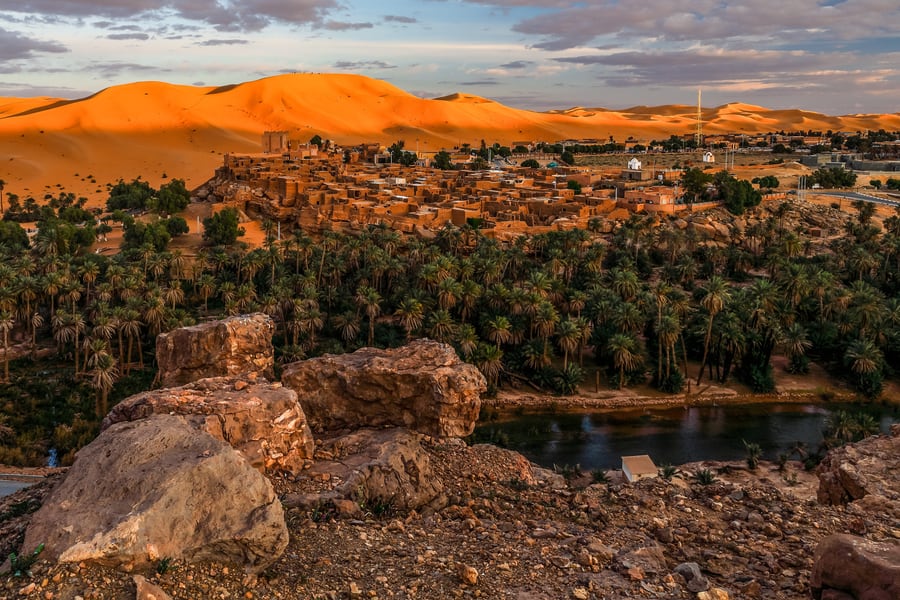
Taghit, from Béchar
Ninety kilometres south of Béchar, and the reason most Algerians come to this corner of the country at all: a ksar of packed earth built nine centuries ago and listed as a national monument in 1999, a palm grove twenty kilometres long below it, and the Grand Erg Occidental piled up behind. The dunes come right to the edge of the houses, and the oasis is an easy day or overnight trip before the train south.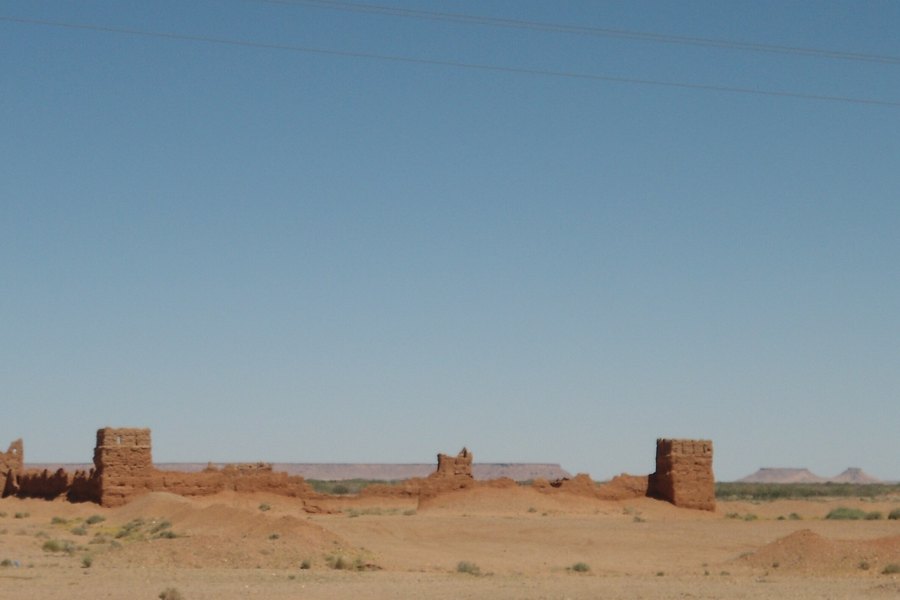 Benzita / Wikimedia Commons · CC BY-SA 4.0 · 2015 · cropped
Abadla
The first stop, and the last green one. The Djorf Torba dam on the Oued Guir waters a plain of date palms and cereal that has been farmed for centuries, and a second, smaller barrage of 1974 sits at the head of it. Out on the flat beyond the irrigation stand the mud-brick walls of an abandoned ksar, roofless and half-dissolved, with the hamada starting immediately behind.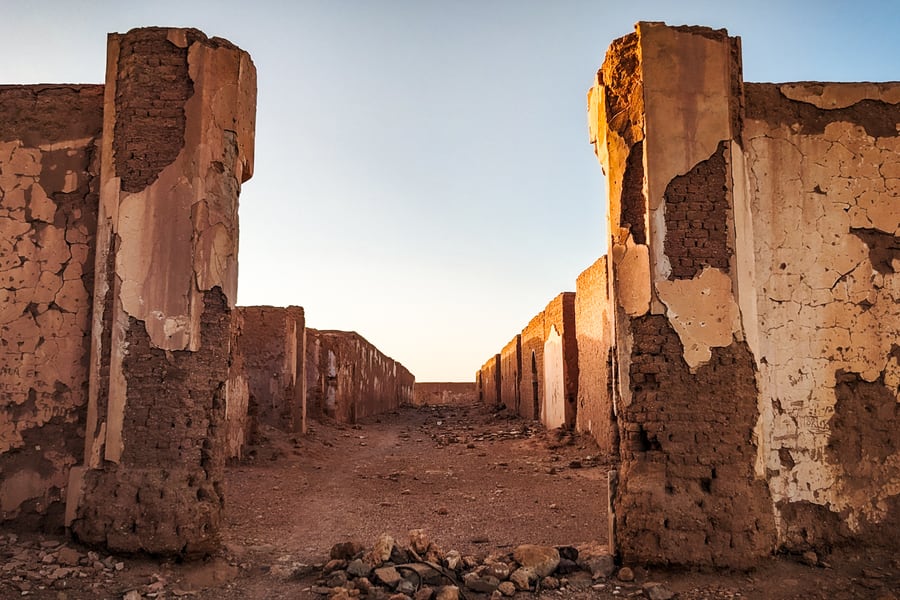 Muhammed Amine Benloulou / Wikimedia Commons · CC BY-SA 4.0 · 2025 · cropped
Tabelbala
A palm grove twelve kilometres long between the Erg er Raoui and the Djebel Lakhal, and one of the strangest places in Algeria: its people speak Korandje, a Songhay language from the Niger bend that arrived with the salt caravans and has been spoken here ever since. On the edge of the oasis stand the roofless earthen walls of the Qalaat el Biro.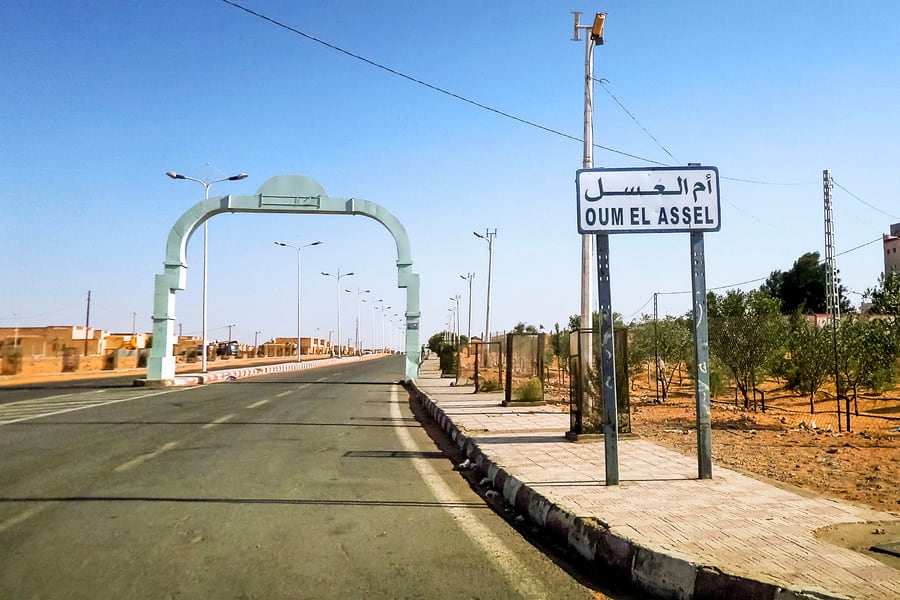 Habib Kaki / Wikimedia Commons · CC0 · 2017 · cropped
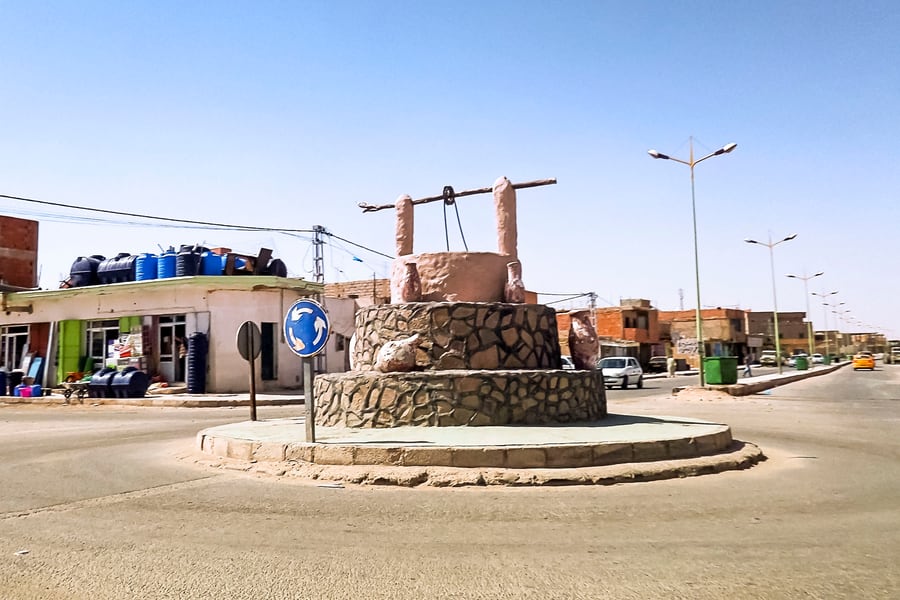
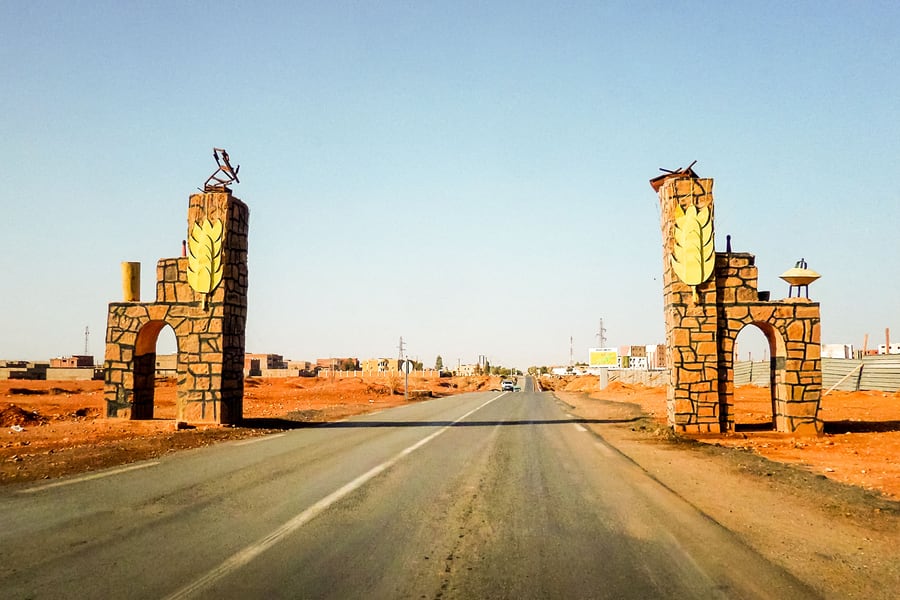
Oum El Assel
The last stop before Tindouf, at kilometre 640, and a settlement built around water in country that has almost none — the name means mother of honey. Its arch across the road is the first built thing in several hours of driving, and for a train passenger it is the signal that the run is nearly over.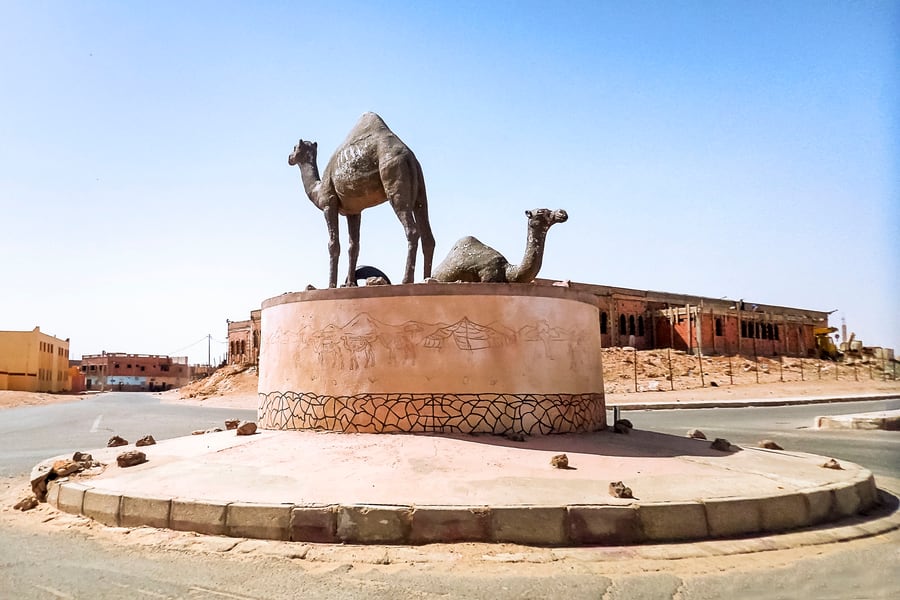 Habib Kaki / Wikimedia Commons · CC0 · 2017 · cropped
Tindouf
The end of the line, roughly 1,450 kilometres from Algiers. Refounded in 1852 on the site of a sixteenth-century ksar, it grew rich on the trans-Saharan caravan trade and was ruined when that trade moved to the Atlantic ports. The Casbah of Belaâmach was given heritage protection in 1999, and every May the mouggar, the region's great traditional fair, fills the town.Where to Sleep
Both ends of the line have hotels, and neither end sells a room online. Béchar is a provincial capital and the base most travellers use, partly because it is also the jumping-off point for Taghit ninety kilometres south. Tindouf's tourism directorate lists seven establishments in the town — the Jbeilat, the Sugi, the Qir, the two Al Khaimah houses, Awlad Gedo and a furnished tourist house — and publishes a telephone number and an email address for each, which is how rooms are taken.
The timetable does much of the work for you. Arriving at 19:20 you need a bed in Tindouf; leaving at 09:00 the following morning you need only one. Coming the other way, the 06:45 arrival from Oran gives an hour at Béchar station and no night at all, and if you would rather not run that connection, a night in Béchar makes the whole thing comfortable.
Practical information
Buy at the counter. Ticket windows at Béchar and Tindouf open at 08:00. The southbound train leaves at the same hour, so buy the day before if you can.
Allow for the connection. Oran to Béchar is an overnight run arriving at 06:45; the Tindouf train goes at 08:00. It works, and there is no second departure if it does not.
The train runs all year, and the desert does not care. The line crosses open hamada for most of its length, at between 500 and 570 metres, with the stops hours apart. Tindouf sees over 45°C in summer and about 27 millimetres of rain in a year; autumn to spring is the sensible window. There is a dining car, but nothing between stations.
Gara Djebilet is not a destination. The line continues an hour and twenty minutes past Tindouf to the mine, which is an industrial site and the reason the railway was built, not a place to visit.
Questions or corrections
Planning this trip and stuck on something, or spotted a time, fare or detail that has changed? Send us a message about Béchar to Tindouf. We read every one, and we update this page when something has changed.