The Döllnitz Railway
Hugh Llewelyn / Flickr · CC BY-SA 2.0
- Distance11.4 km, Oschatz to Mügeln · 20 km to Glossen and Kemmlitz
- DurationAbout 35 minutes by diesel, 40 by steam
- Best seasonSchool days for the diesel trains · steam on set weekends, Easter, Whitsun and New Year
Introduction
The last passenger train between Oschatz and Mügeln ran on 28 September 1975. The line stayed open for kaolin, the white clay dug at Kemmlitz, and by German reunification in 1990 it carried nothing but freight. Its rescue began that same year, and it came from an unexpected quarter: at the end of 1990 the Berlin branch of Pro Bahn, an association of railway passengers, took the line on as a sponsorship, and on 1 September 1991 the agreement was signed in Oschatz. In December 1993 the newly founded Döllnitzbahn GmbH took over from the Reichsbahn, the first railway in Saxony outside federal ownership, with the passengers' association at first its only shareholder.
The first trains back were excursions on a few days a year. The scheduled passengers came back in 1995, and they were going to school: pupils' trains between Altmügeln and Oschatz were the first timetabled service in twenty years, and they are still the heart of the timetable: on Saxon school days, diesel trains run between Oschatz and Mügeln, 11 kilometres of 750 mm track along the Döllnitz and across the farmland of northern Saxony, and some go on to Glossen. Anyone may ride them on an ordinary local ticket.
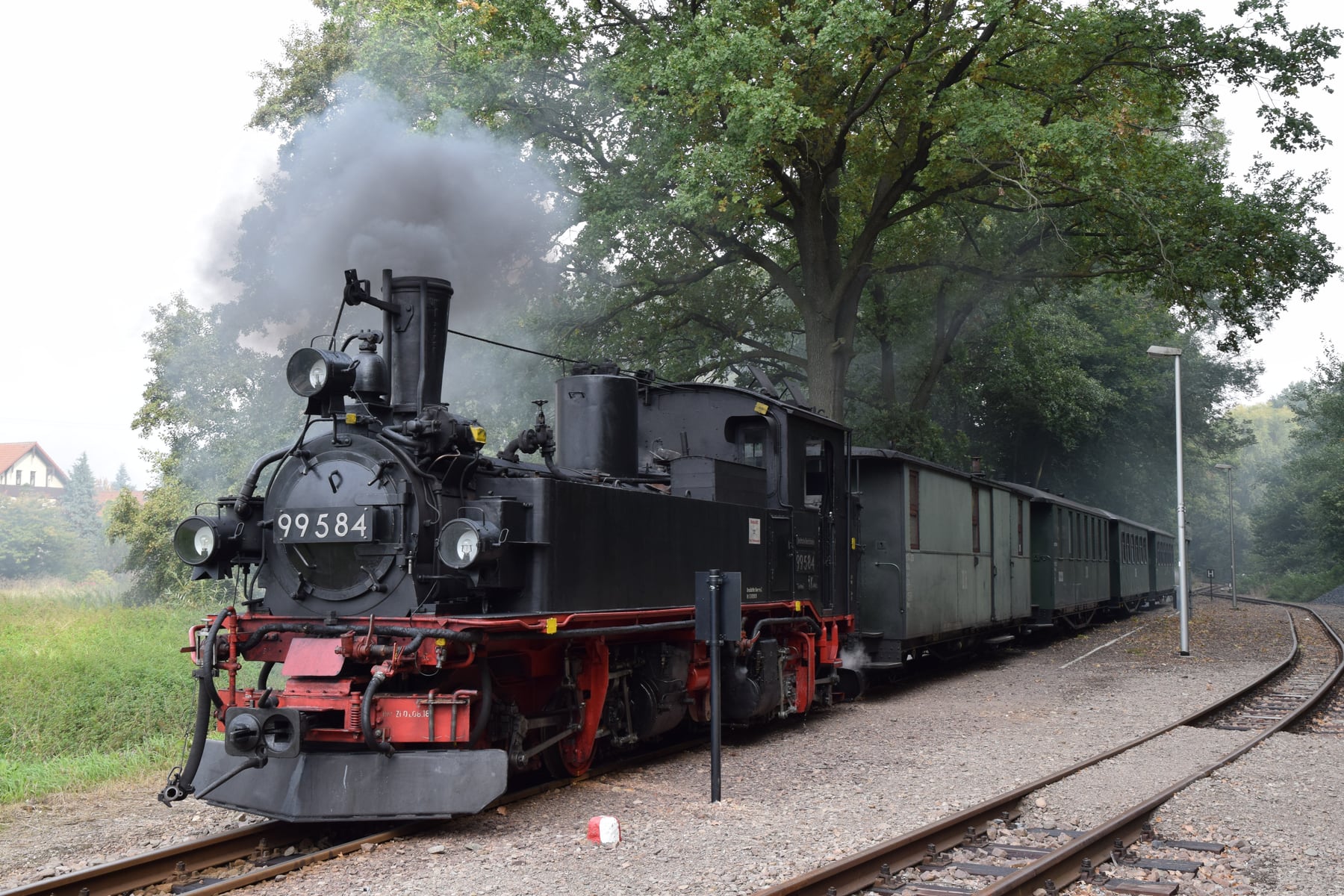
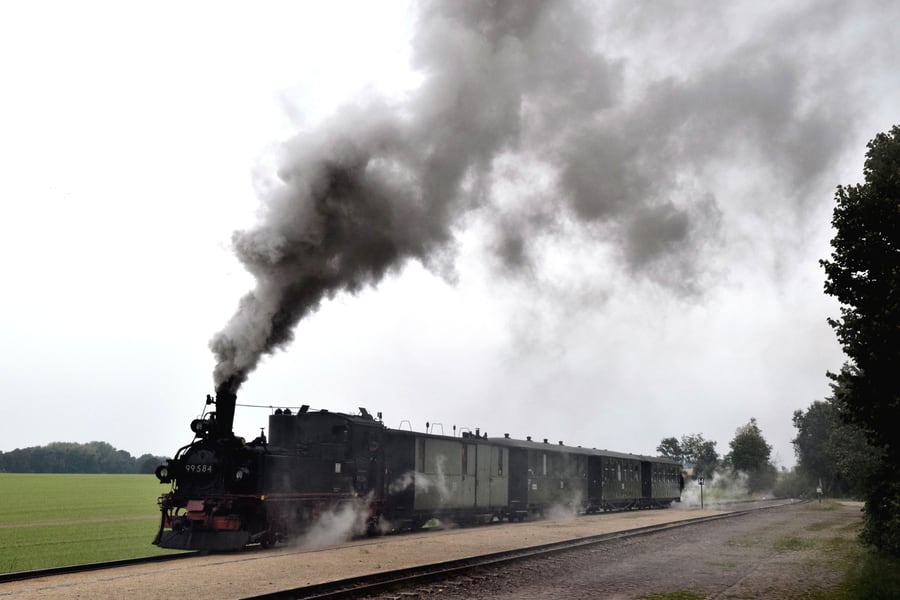
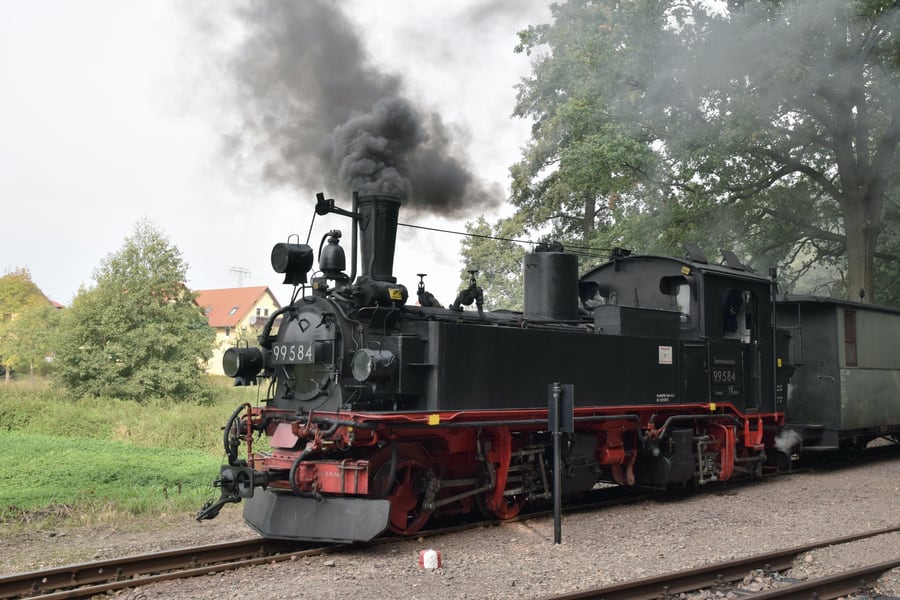
On chosen weekends, Saxon IV K tank engines take over, and the steam trains run through to Glossen and Kemmlitz as well. The line is called the Wilder Robert, and a trip from Oschatz to Mügeln takes about 35 minutes by diesel and 40 by steam.
The Journey
The Döllnitzbahn is what is left of the Mügeln network, a web of Saxon narrow-gauge lines built from 1884 to carry the produce of the farmland between Leipzig and Dresden. The stretch from Oschatz to Mügeln opened on 7 January 1885, and it became one of the most important narrow-gauge lines in Saxony. Mügeln was its hub: after an expansion between 1918 and 1927 the station stretched over 654 metres, with 38 tracks, 67 sets of points and an engine shed for nine locomotives, and the railway still calls it the former largest narrow-gauge station in Germany. In 1959 the station and the depot employed 320 people, the biggest employer in town, and 20 passenger trains a day ran.
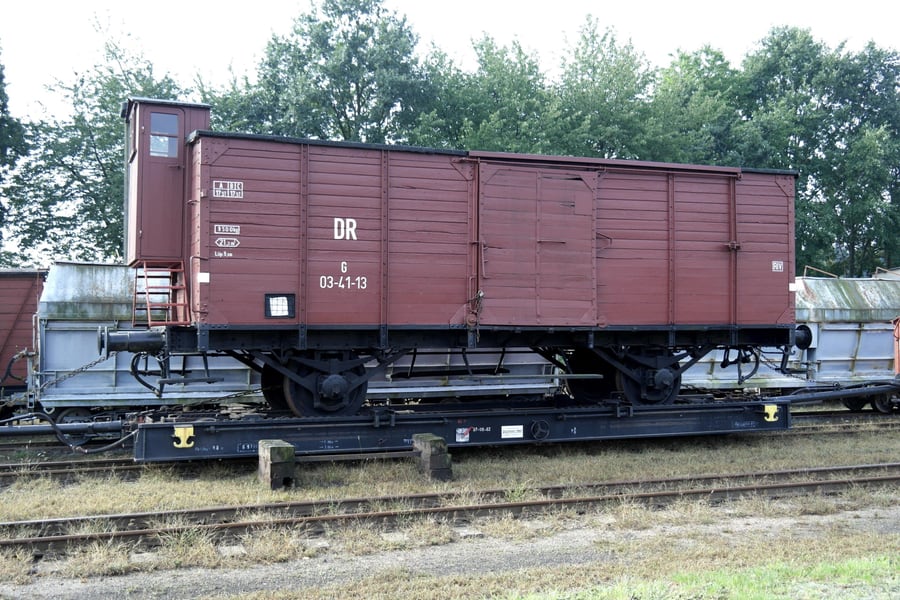
The rest of the network closed around it. The line on to Döbeln went in the 1960s, the line to Wermsdorf in 1972, and in 1975 Oschatz to Mügeln lost its passenger trains too. What kept it open was kaolin. After 1975 almost every load travelled as a standard-gauge wagon riding the narrow gauge on a transporter wagon, the track was renewed in 1981–82 so that freight could run for another 25 years, and it lasted until 2001, the last public narrow-gauge freight in Saxony.
The journey
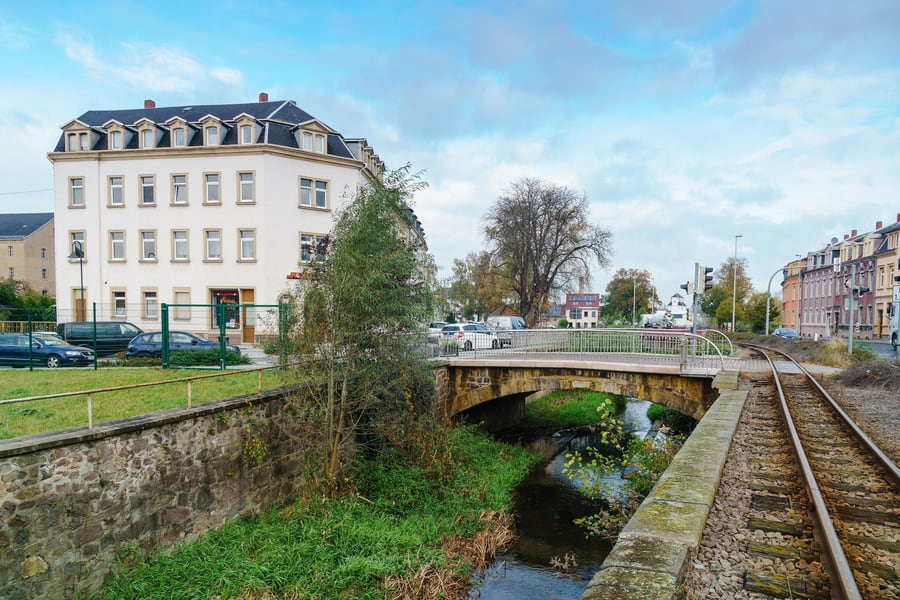
Trains leave Oschatz Hauptbahnhof, on the main line between Leipzig and Dresden, and wind through the town on a 500-metre retaining wall above the little river Döllnitz, crossing it twice before Oschatz Süd and once more beyond. That was the most important intermediate station on the line, and its station building, clad in wood on the upper floor, now holds a museum of railway postcards. Beyond Thalheim and Naundorf the line runs out across open fields, climbing gently towards Schweta and Mügeln; most halts are request stops, so tell the guard where you want to get off.
From Mügeln the steam trains, and some school trains, go on along a stretch of the old Wermsdorf line to Glossen, rebuilt and reopened in 2006, and on some trips to Kemmlitz, the highest point of the line at 178 metres, which trains reached again in 2018. The whole line is 20 kilometres long and climbs about 50 metres, at no more than 30 km/h.
The locomotives
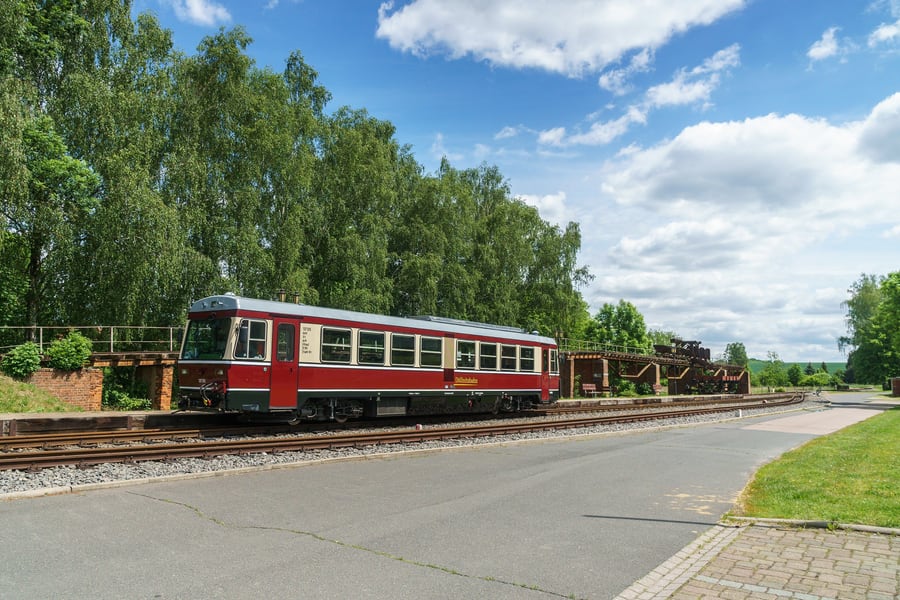
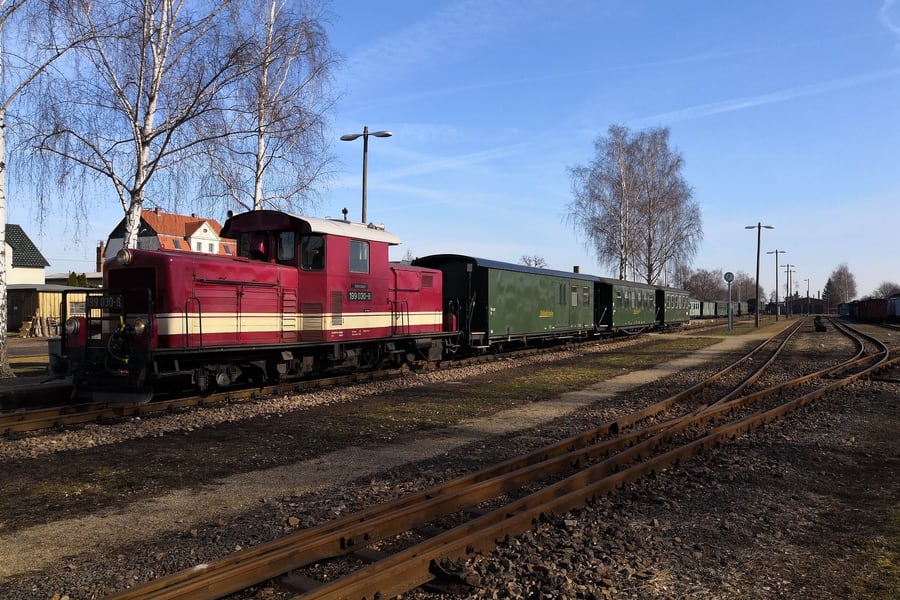
Three Saxon IV K tank engines stayed at Mügeln: 99 561 of 1909 and 99 574 and 99 584 of 1912, all rebuilt at Görlitz in the 1960s. The class ran to 96 engines, the largest series built for Germany's narrow gauge, and from about 1900 until the early 1990s it worked all the traffic here. 99 584 is the one currently in steam. The school trains are usually worked by railcar VT 137 515, built by Jenbacher in 1995 for Austria's NÖVOG and on the line since December 2018, and the two centre-cab diesels 199 030 and 199 031 were built in Vienna in 1940 for Austria's narrow gauge.
Along the route
 Radler59 / Wikimedia Commons · CC BY-SA 4.0
Oschatz and the Döllnitz wall
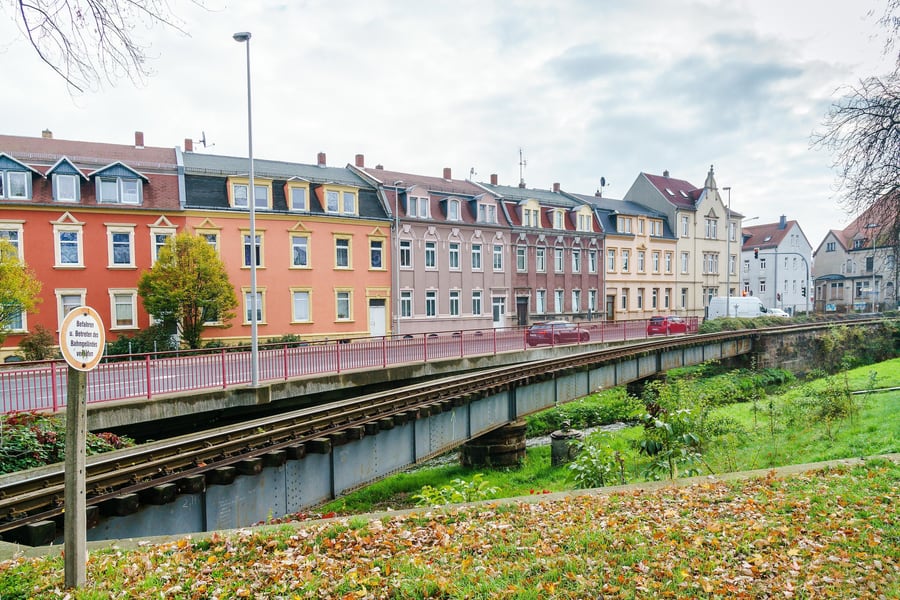
From Oschatz Hauptbahnhof the line winds through town on a 500-metre retaining wall above the little river Döllnitz. The wall is being repaired, so until December 2026 trains are expected to start at Oschatz Süd.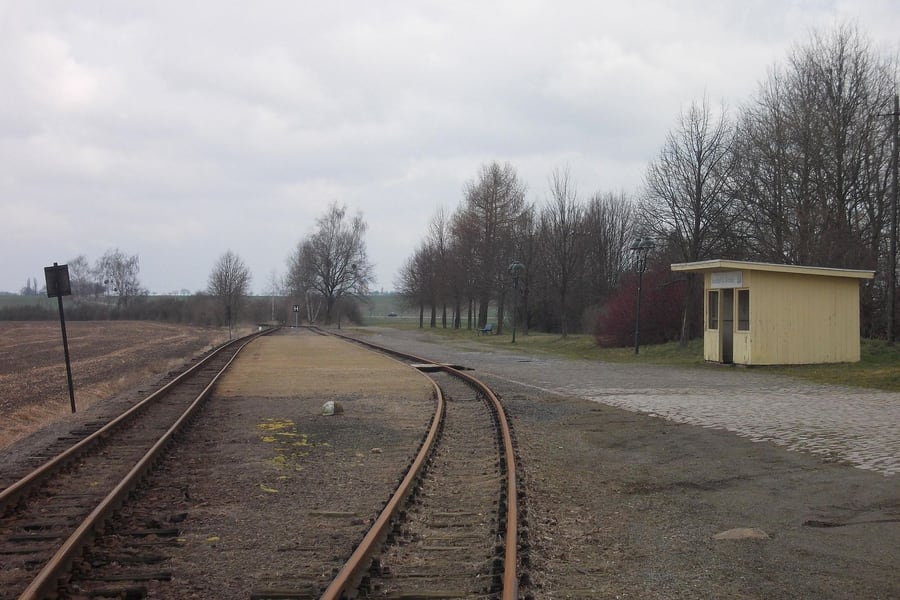 Jwaller / Wikimedia Commons · CC BY-SA 3.0 · cropped
Across the fields to Naundorf
Beyond Thalheim the line runs out into open farmland. Naundorf has a passing loop and a wooden shelter; most of the other halts are request stops, so tell the guard where you want to get off.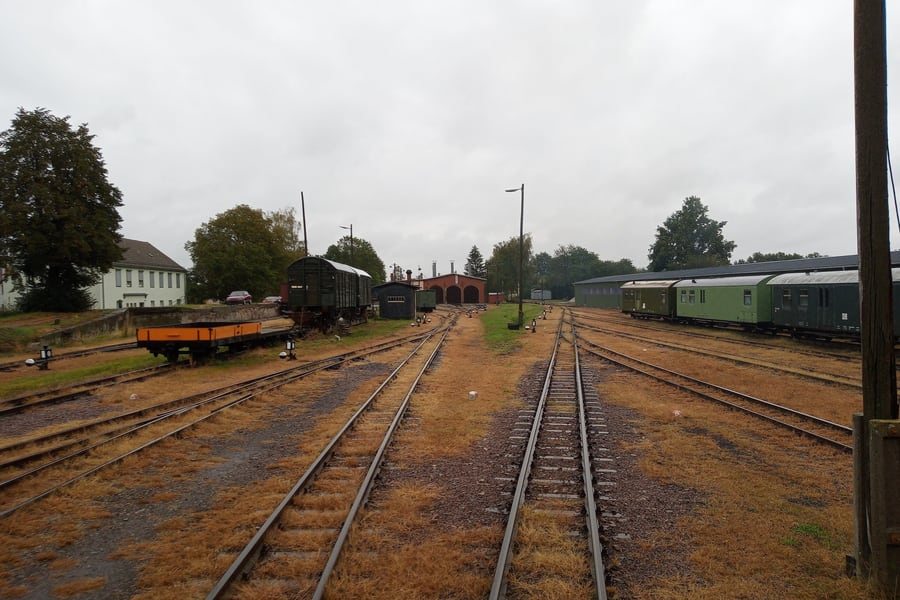 Don-kun / Wikimedia Commons · CC BY-SA 4.0 · cropped
Mügeln, the old hub
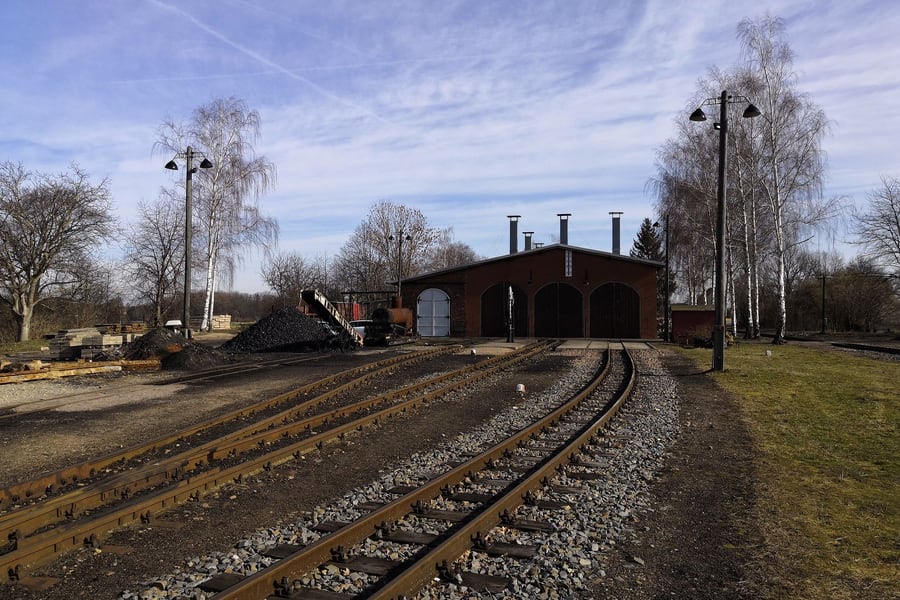
After an expansion between 1918 and 1927, Mügeln station stretched over 654 metres with 38 tracks and 67 sets of points. Much has gone, but the yard, the engine shed and the station buildings are still the heart of the line.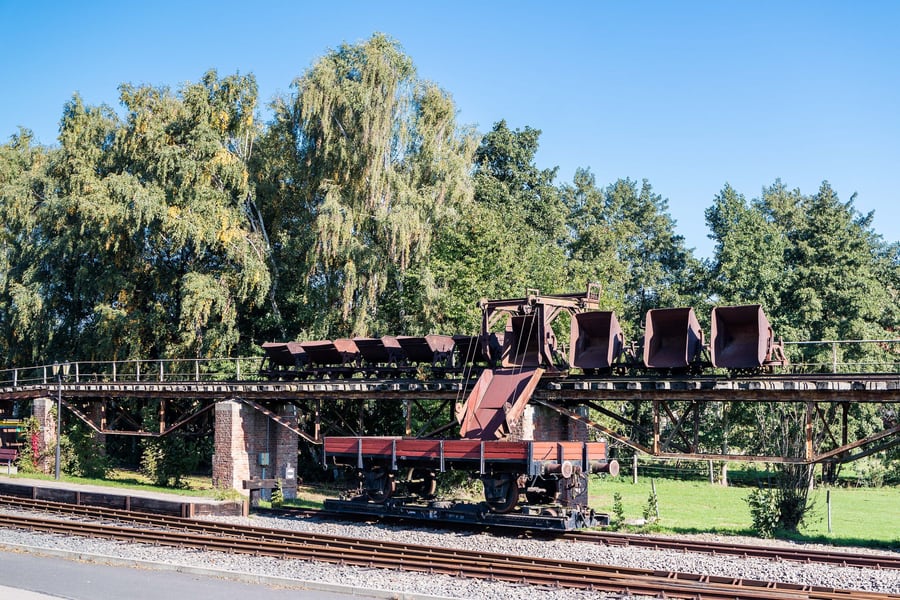 Radler59 / Wikimedia Commons · CC BY-SA 4.0
Glossen and the field railway
Glossen, on a stretch of the old Wermsdorf line rebuilt in 2006, has a display of field railway beside the station, with tipper wagons standing on an old loading bridge. Steam trains turn back here or carry on to Kemmlitz.A bit of history
Culture & experiences along the way
 Radler59 / Wikimedia Commons · CC BY-SA 4.0 · cropped
The kaolin exhibition at Mügeln
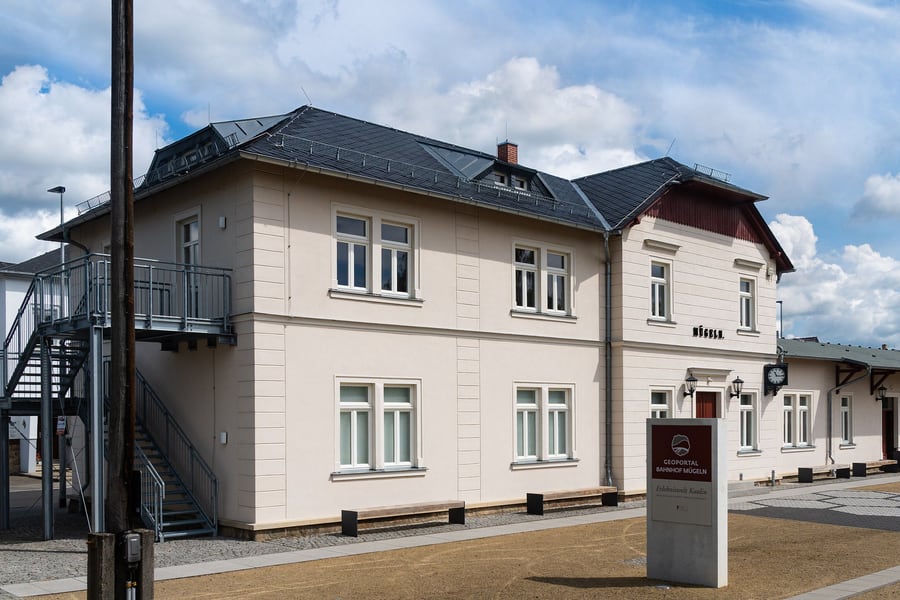
Kaolin, the white clay that is the main raw material of porcelain, kept this line open through the twenty years it had no passengers. The Geoportal in Mügeln station tells its story, from the geology to the mines and the narrow-gauge network. It opens Thursday and Friday 10:00 to 17:00 and on steam days.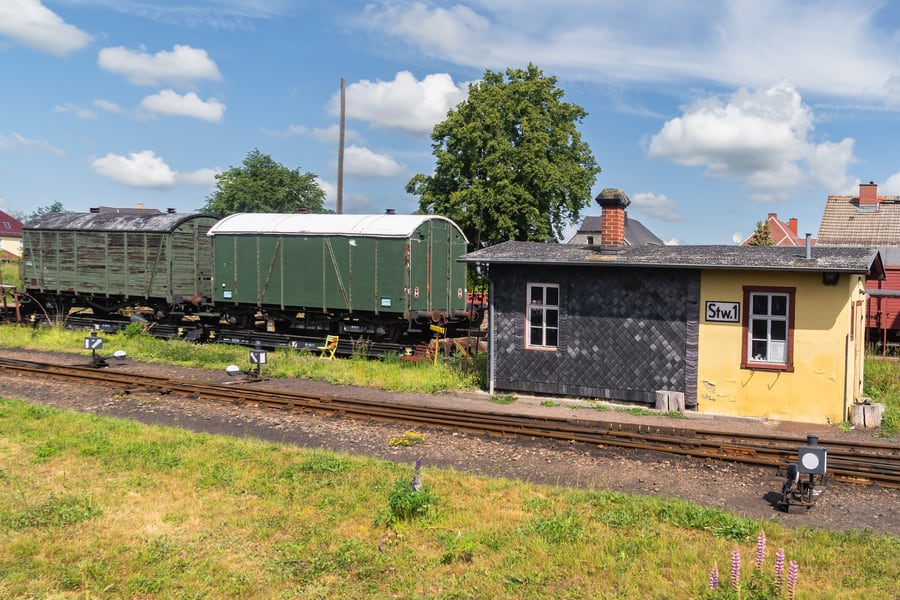 Radler59 / Wikimedia Commons · CC BY-SA 4.0 · cropped
A Reichsbahn signal box
The volunteers of the Förderverein Wilder Robert have restored signal box No. 1 at Mügeln and furnished it as it was in Reichsbahn days. Next door, the old goods shed holds an exhibition on the history of the line.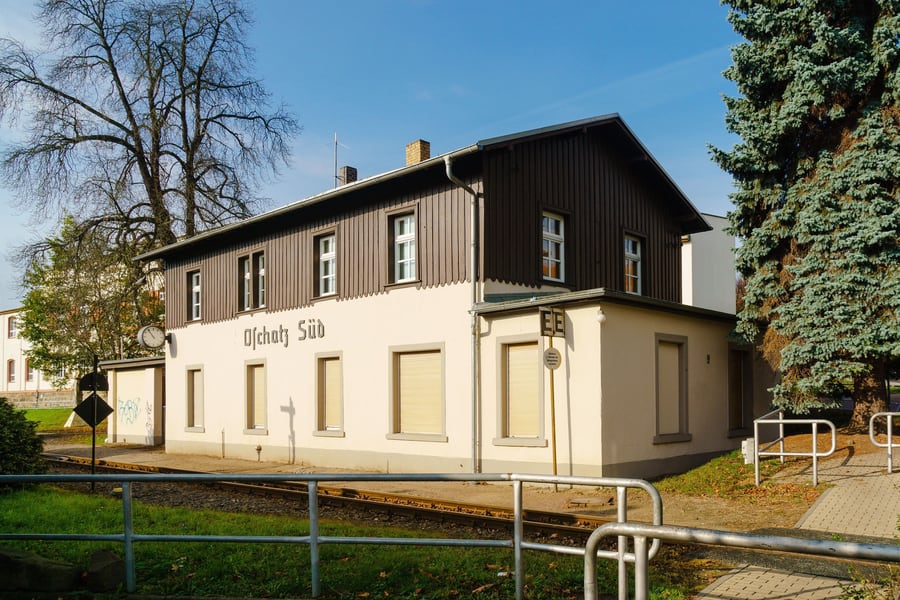 Radler59 / Wikimedia Commons · CC BY-SA 4.0 · cropped
The railway postcard museum
Opened in Oschatz Süd station in December 2019, the 150th year of the postcard, the museum shows picture postcards of stations, locomotives, bridges and railway disasters from Günther Hunger's collection of more than 3,000. It opens on Sundays, 10:00 to 12:00 and 13:00 to 17:00.Timetables
The line has two timetables. Diesel trains run Monday to Friday on Saxon school days, and only then: there are no ordinary trains at weekends, on public holidays or in the school holidays. Steam trains run on set weekends and holidays through the year. Seats are not reserved, and most halts are request stops.
Times below are from the Döllnitzbahn's school-day timetable valid from 17 August 2026, its 2026 steam timetable and its 2026 and 2027 calendars, read in November 2026. Check the calendar at doellnitzbahn.de (opens in a new tab).
⚠️ Until December 2026, by the operator's estimate, works on the retaining wall in Oschatz close the line between Oschatz Süd and Oschatz Hauptbahnhof. Trains start and end at Oschatz Süd, and on weekdays a replacement bus runs to the main station to the train times.
School days, Monday to Friday
| Mügeln | 07:03 | 10:20 | 12:23 | 14:28 |
|---|---|---|---|---|
| Oschatz Süd | 07:29 | 10:46 | 12:50 | 14:54 |
| Oschatz Hbf | 07:39 | 10:57 | 13:00 | 15:05 |
| Oschatz Hbf | 08:20 | 11:20 | 13:06 | 15:20 |
|---|---|---|---|---|
| Oschatz Süd | 08:30 | 11:30 | 13:15 | 15:30 |
| Mügeln | 08:55 | 11:55 | 13:40 | 15:55 |
The 07:03 starts at Glossen at 06:48 and the 14:28 at 14:08, and the 13:06 from Oschatz runs on to Glossen, arriving at 13:59. In the 2026 summer holidays, from 4 July to 16 August, no ordinary train ran.
Steam days
| Mügeln | 09:25 | 12:31 | 16:30 |
|---|---|---|---|
| Oschatz Hbf | 10:03 | 13:09 | 17:08 |
| Oschatz Hbf | 10:43 | 13:45 | 17:44 |
|---|---|---|---|
| Mügeln | 11:22 | 14:24 | 18:19 |
From Mügeln the 11:36 runs on to Glossen (11:51) and the 15:00 to Kemmlitz (15:22), returning from Glossen at 11:59 and from Kemmlitz at 15:45. Special events have their own timetables: on 5–6 December 2026, for the Christmas market in Oschatz, the railcar runs six round trips between Mügeln and Oschatz Süd, and from 26 to 31 December 2026 and on 2–3 January 2027 the steam trains run four round trips between Oschatz Süd and Mügeln, three of them running on to Kemmlitz, hauled by a guest engine, 99 4011 from the Rasender Roland on Rügen.
Event dates announced for 2027: 2–3 January, 24 January, Easter 27–29 March, 17–18 April, 1–2 May and Whitsun 15–17 May.
Getting there
Oschatz is on the main line between Leipzig and Dresden. The RE 50 runs hourly: from Leipzig Hbf at :00, reaching Oschatz in 35 minutes, and from Dresden Hbf at :12, in an hour.
Tickets
The Döllnitzbahn is part of the Mitteldeutscher Verkehrsverbund (MDV), so the school-day trains take ordinary local tickets, bought on the train or at the travel agency in Oschatz station. From 1 August 2026, Oschatz to Mügeln or Glossen crosses two fare zones and costs €5.00, or €3.00 reduced; children under 6 travel free. The Deutschland-Ticket, the Sachsen-Ticket and MDV day and network tickets are all valid.
On steam trains, a single costs €10.00 from Oschatz to Mügeln, Glossen or Kemmlitz, or €8.00 for children aged 6 to 14. Holders of an MDV ticket or the Deutschland-Ticket pay a €5.00 steam supplement each way instead. Tickets are sold on the train and cannot be reserved; special events have their own fares.
Book your tickets
School-day train
Oschatz to Mügeln or Glossen
An ordinary MDV single over two fare zones, sold on the train; the Deutschland-Ticket is valid.
Book Tickets (opens in a new tab, on doellnitzbahn.de)via doellnitzbahn.deSteam train
Oschatz to Mügeln, Glossen or Kemmlitz
A single on a steam train; holders of an MDV ticket or the Deutschland-Ticket pay a €5 supplement instead.
Book Tickets (opens in a new tab, on doellnitzbahn.de)via doellnitzbahn.de24-hour ticket
Two fare zones, one person
Unlimited rides for 24 hours across the line's two MDV fare zones, with a steam supplement on steam trains.
Book Tickets (opens in a new tab, on doellnitzbahn.de)via doellnitzbahn.deRail Passes
Interrail and Eurail passes cover the train to Oschatz, but count on paying for the Döllnitzbahn. Interrail's table of German operators includes regional trains (RB and RE) run by DB "and all other Regional carriers", so the RE 50 from Leipzig or Dresden is covered. The Döllnitzbahn is not named in the table, and its steam trains are special trains with their own fares.
The Deutschland-Ticket is the pass that works here. It is valid on the school-day trains as it stands, and on steam trains with the €5.00 supplement each way. For this journey an Interrail pass is not worth buying.
Pass conditions checked against Interrail's railway-companies page, last updated 21 October 2026, and the Döllnitzbahn's fares page, read in November 2026. The pass issuer's page is the one that binds.
Places to Visit
The line is a morning or an afternoon on its own. Oschatz, where it starts, has an old town around two market squares. Mügeln's castle stands beside the line on the way to Glossen, and the hunting palace of the Saxon kings is at Wermsdorf, where the old line from Glossen once ran on.
 Jörg Blobelt / Wikimedia Commons · CC BY-SA 4.0 · cropped
Oschatz and its market squares
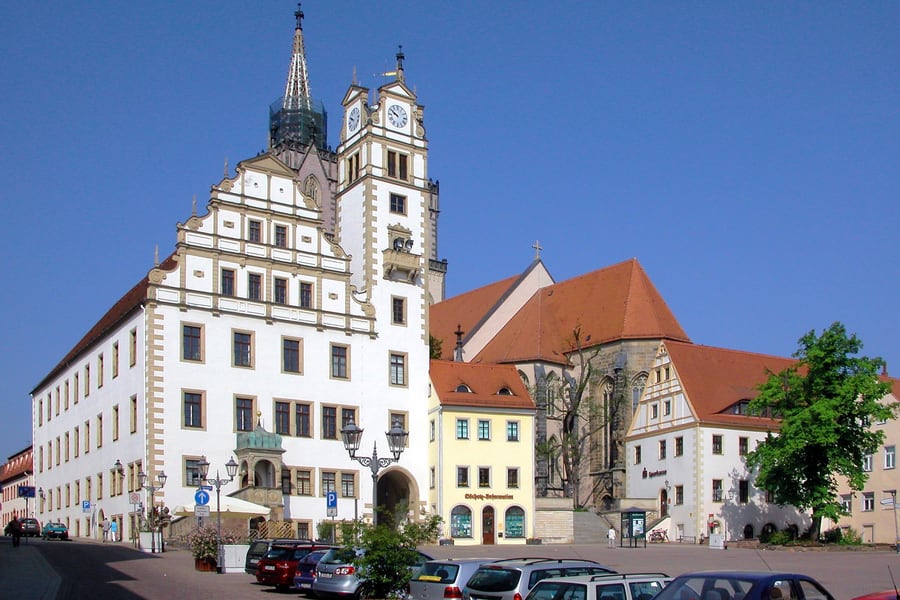
The town hall on the Neumarkt was built from 1538 to 1546, and after the fire of 1842 its tower was raised to plans by Gottfried Semper. Behind it rise the two 75-metre towers of St. Aegidien, rebuilt in Gothic Revival style in 1846–49; the tower keeper's flat, lived in until 1970, is open as a museum. The town museum includes a museum of scales and a watchtower of 1377.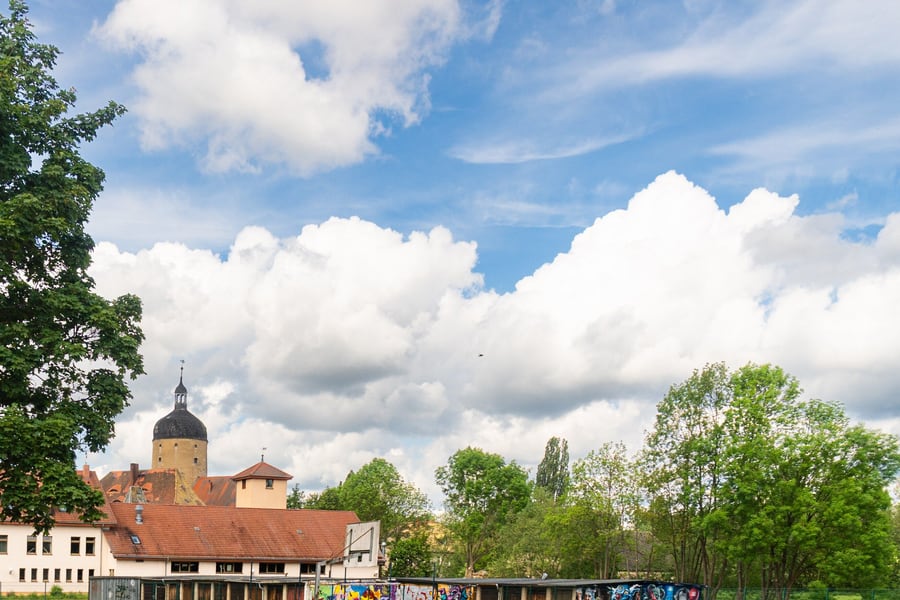 Radler59 / Wikimedia Commons · CC BY-SA 4.0 · cropped
Schloss Ruhethal, Mügeln
The castle by the line in Mügeln goes back to 1150 and was a seat of the bishops of Meissen, in the Döllnitz valley. Its 40-metre tower dates from 1380, and Bishop Johann von Haugwitz gave it its present form in 1572 and retired here. It belongs to the Free State of Saxony, and a local association looks after it.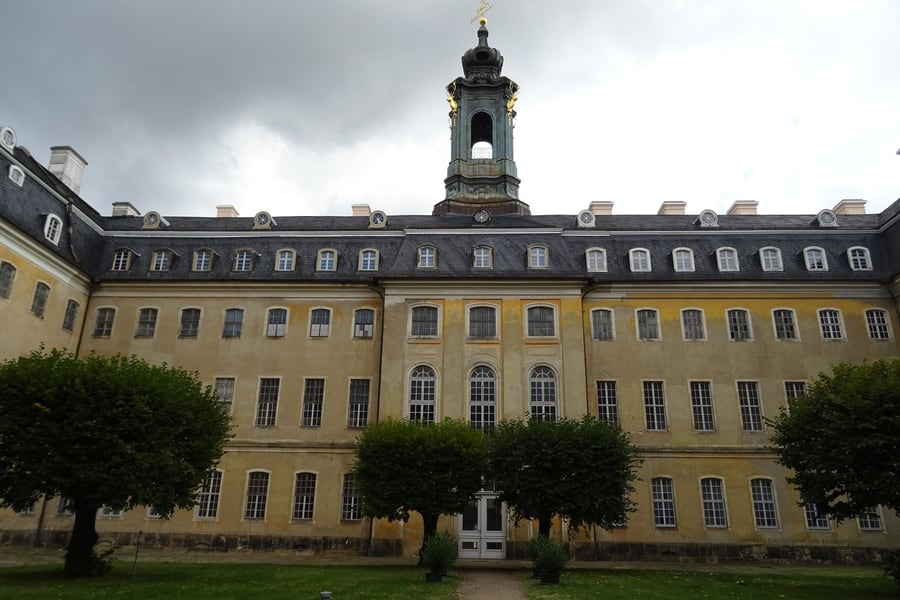 Christian Gebhardt (Bybbisch94) / Wikimedia Commons · CC BY-SA 4.0 · cropped
Hubertusburg
August the Strong began this hunting palace in 1721, and from 1733 it was rebuilt on a far grander scale. On 15 February 1763 the treaties signed here between Prussia, Austria and Saxony ended the Seven Years' War in the Empire; tables and chairs for the talks had to be borrowed from nearby inns, because the palace had been plundered. A friends' association runs public tours.Where to Sleep
The line is an easy day out from Leipzig or Dresden, both about an hour or less away by train. Staying in Oschatz puts you at the start of the line and in the middle of its old town.
The place below keeps its own website and takes direct bookings.
Where to stay
Hotel Gasthaus zum Schwan
On the Neumarkt in Oschatz
An old inn in the centre of Oschatz with 43 rooms and a restaurant, overlooking the Neumarkt.
Check Availability (opens in a new tab, on travdo-hotels.de)via travdo-hotels.deQuestions or corrections
Planning this trip and stuck on something, or spotted a time, fare or detail that has changed? Send us a message about The Döllnitz Railway. We read every one, and we update this page when something has changed.