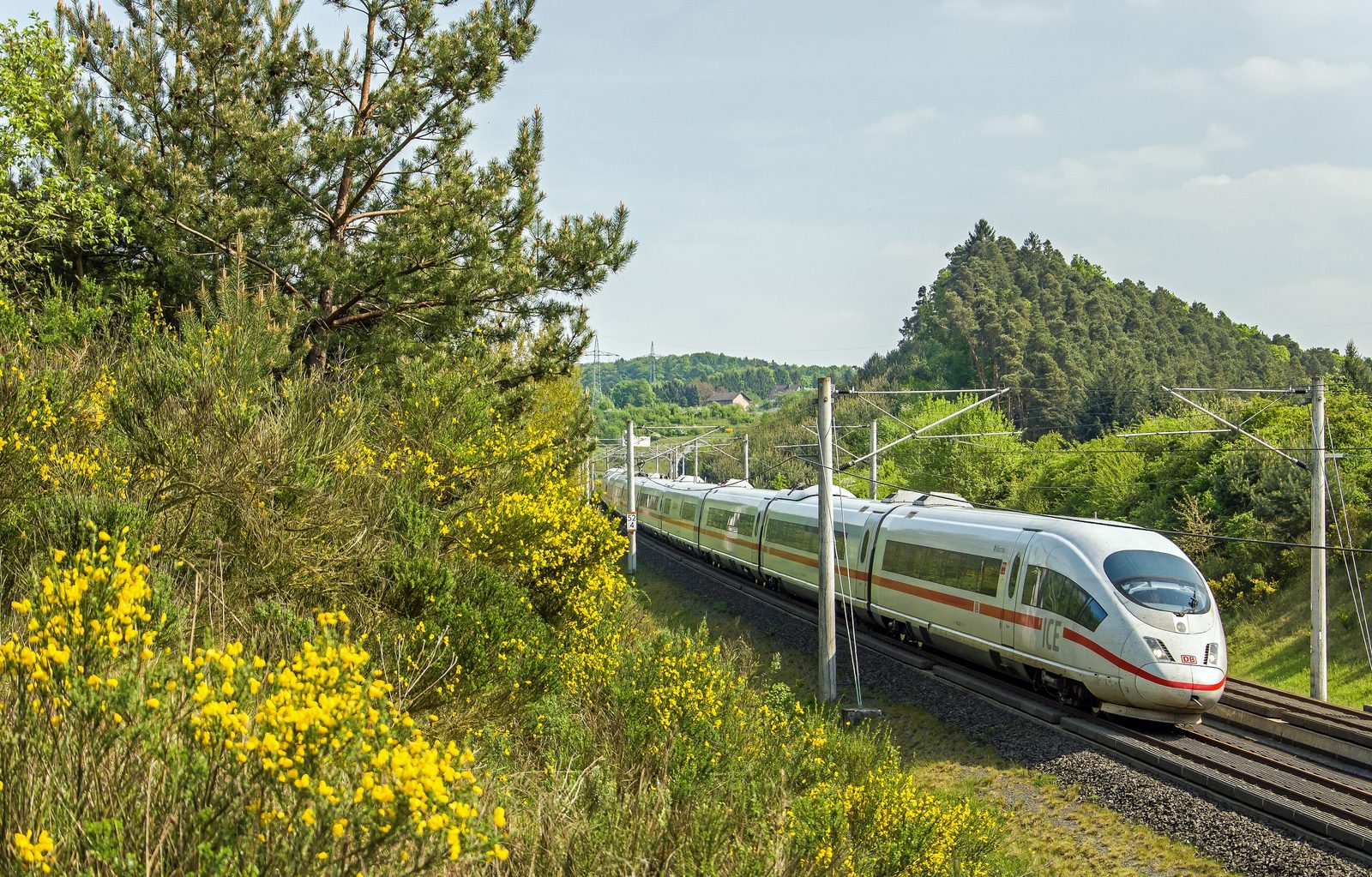
The ICE from Cologne to Frankfurt
Rob Dammers / Wikimedia Commons · CC BY 2.0
- Distance180 km (Köln Hbf–Frankfurt Hbf)
- Duration68 minutes non-stop · 80 with all stops
- Best seasonYear-round
Introduction
Germany's fastest railway runs from Cologne to Frankfurt in sixty-eight minutes. It covers 180 kilometres, touches 300 km/h for most of the way, and replaced a journey that used to take well over two hours. On the numbers it is one of the most impressive pieces of railway in Europe.
It is also, for most of its length, a view of a motorway.
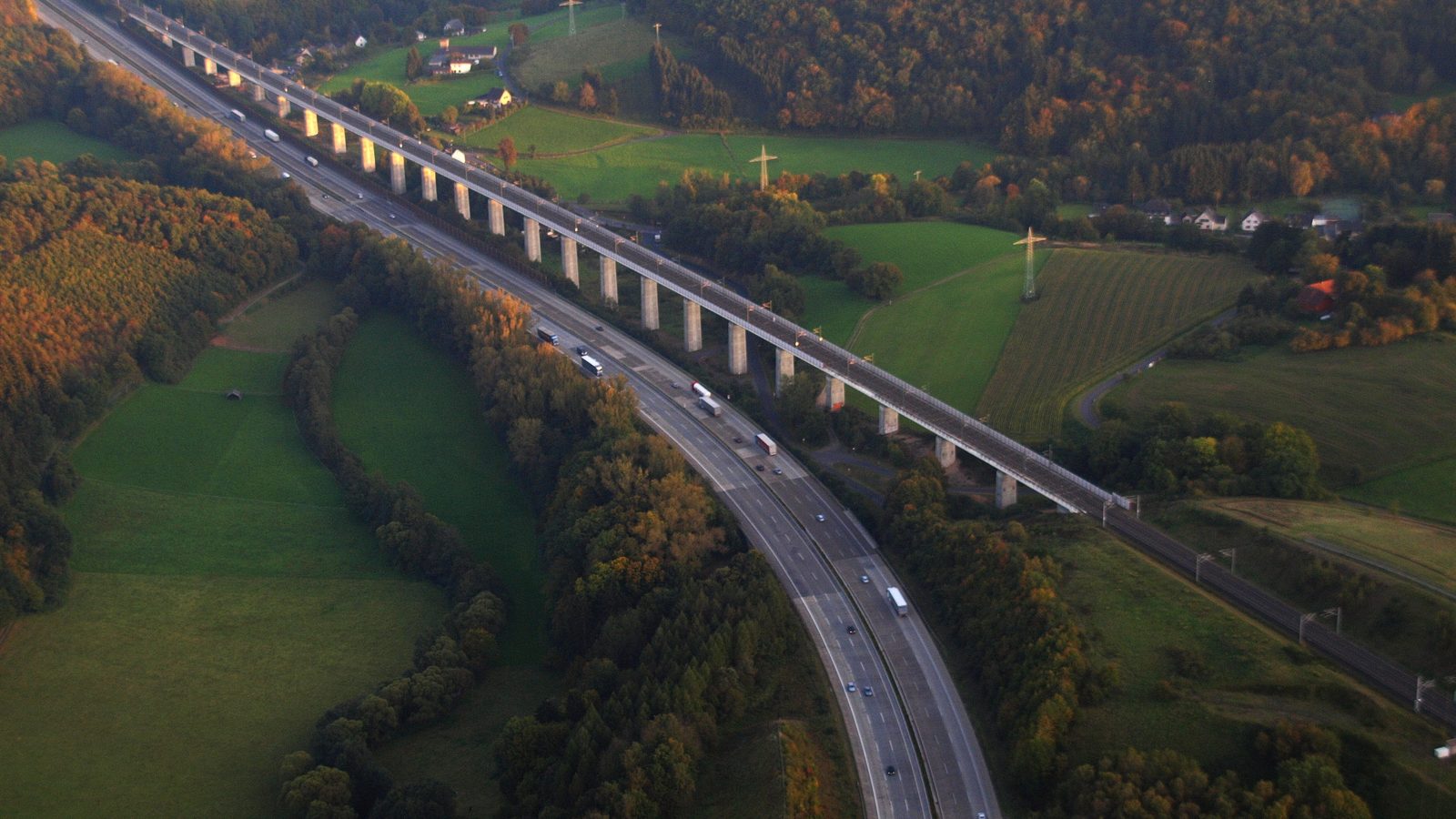
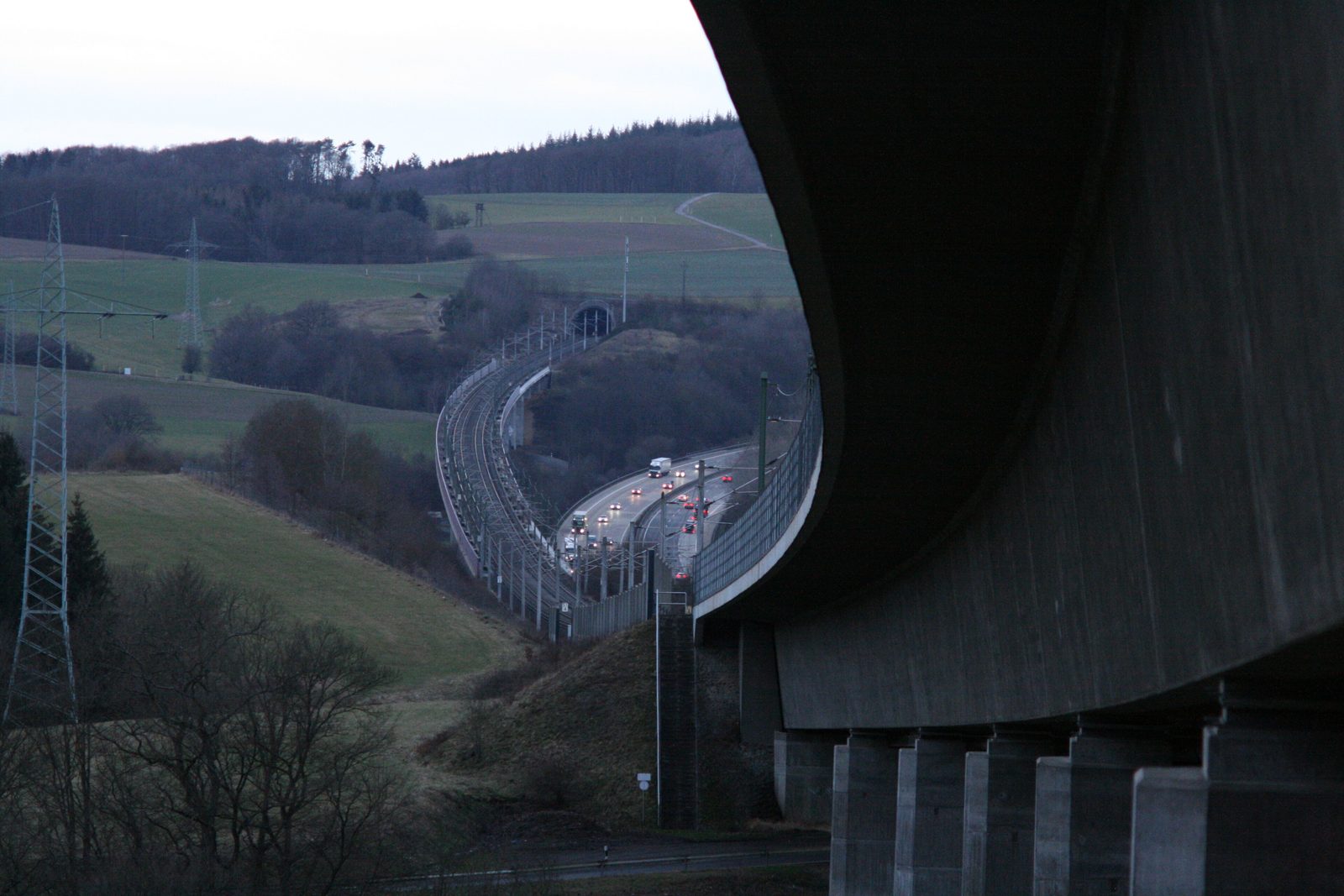
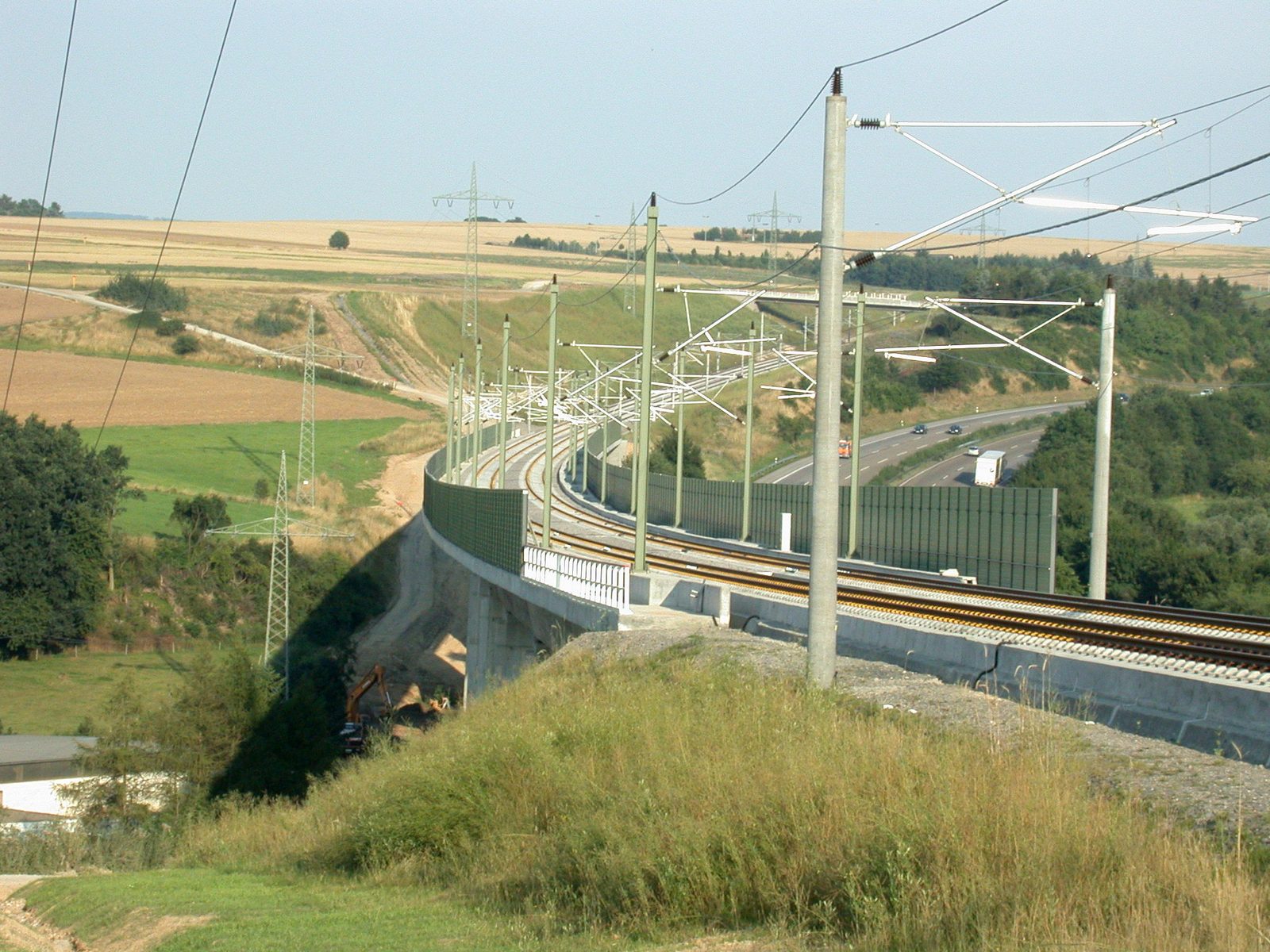
That is not a criticism so much as the design. When the line was planned in the 1980s the decision was taken to build it for passenger trains only, and to lay it alongside the A3 autobahn — the two running as a single corridor through the hills between the Rhineland and the Rhine-Main plain. Freeing the railway from freight meant it could climb far more steeply than a normal main line, so instead of following the river valleys it goes straight over the Westerwald and the Taunus on gradients of one in twenty-five. Where the hills refused, it went through them: thirty tunnels, some forty-seven kilometres of the route underground.
The result is a railway that is genuinely thrilling for about ninety seconds at a time and otherwise shows you noise walls, cuttings, tunnel mouths and, whenever the trees part, six lanes of German traffic keeping pace outside the window. If what you want from a train between these two cities is scenery, you should not take this one.
The honest version
The line was sold on a number it has never hit. When the federal government settled the route in 1989, the head of the railway told the country the journey would fall from 135 minutes to fifty-eight. A Frankfurt newspaper marked the last rails going down with the headline "a decade for fifty-eight minutes". In the timetable for August 2026, the fastest booked train in either direction is sixty-five minutes southbound and sixty-eight northbound, and most trains take eighty. The promised number is still quoted in places. It has never been run.
None of which makes the line a failure. It carries more than forty thousand people a day, it killed the Cologne–Frankfurt air route outright — Lufthansa withdrew the flights entirely in 2007 — and sixty-eight minutes between two cities two hundred kilometres apart remains a remarkable thing to be able to buy for the price of a train ticket. It is just worth knowing what you are buying.
And the alternative
Here is the part the timetable does not advertise. Deutsche Bahn runs ICE trains between Cologne and Frankfurt by two completely different routes, and they cost the same.
The fast ones go the way this page describes. The others — roughly hourly, in the middle of each hour — go the old way, down the left bank of the Rhine through Bonn and Koblenz, past the castles and the vineyards and the Loreley, and take two hours and twenty minutes. That extra seventy minutes buys you what is probably the most beautiful stretch of railway in Germany, which we cover separately as the Middle Rhine.
So the useful thing this page can tell you is not "ride the fast train". It is that the choice exists, that it is the same ticket, and that it is worth making deliberately. The high-speed line is the one for when the point is to arrive — and it is worth riding once for what it is: a railway built to a standard no other line in the country meets, doing something no other train in Germany can.
The Journey
Trains leave Cologne from the Hauptbahnhof, in the shadow of the cathedral, and spend the first quarter of an hour not going fast at all. The high-speed line does not actually begin until Köln-Porz, nine kilometres out, and the approach through the city is shared with everything else — across the Hohenzollern Bridge over the Rhine at a crawl, then out through the eastern suburbs on tracks that carry S-Bahn, regional and freight trains too. Between Porz and Troisdorf there are six parallel tracks, and the limit is 200 km/h.
The railway proper starts at Siegburg/Bonn, twenty-four kilometres out. Immediately beyond the platforms the line dives into the Siegauen tunnel, passes under the river Sieg, comes out heading south-east — and meets the A3. From here to the outskirts of Frankfurt the two are rarely more than a few hundred metres apart, and often close enough that you can read the lorries' number plates.
Up the Westerwald
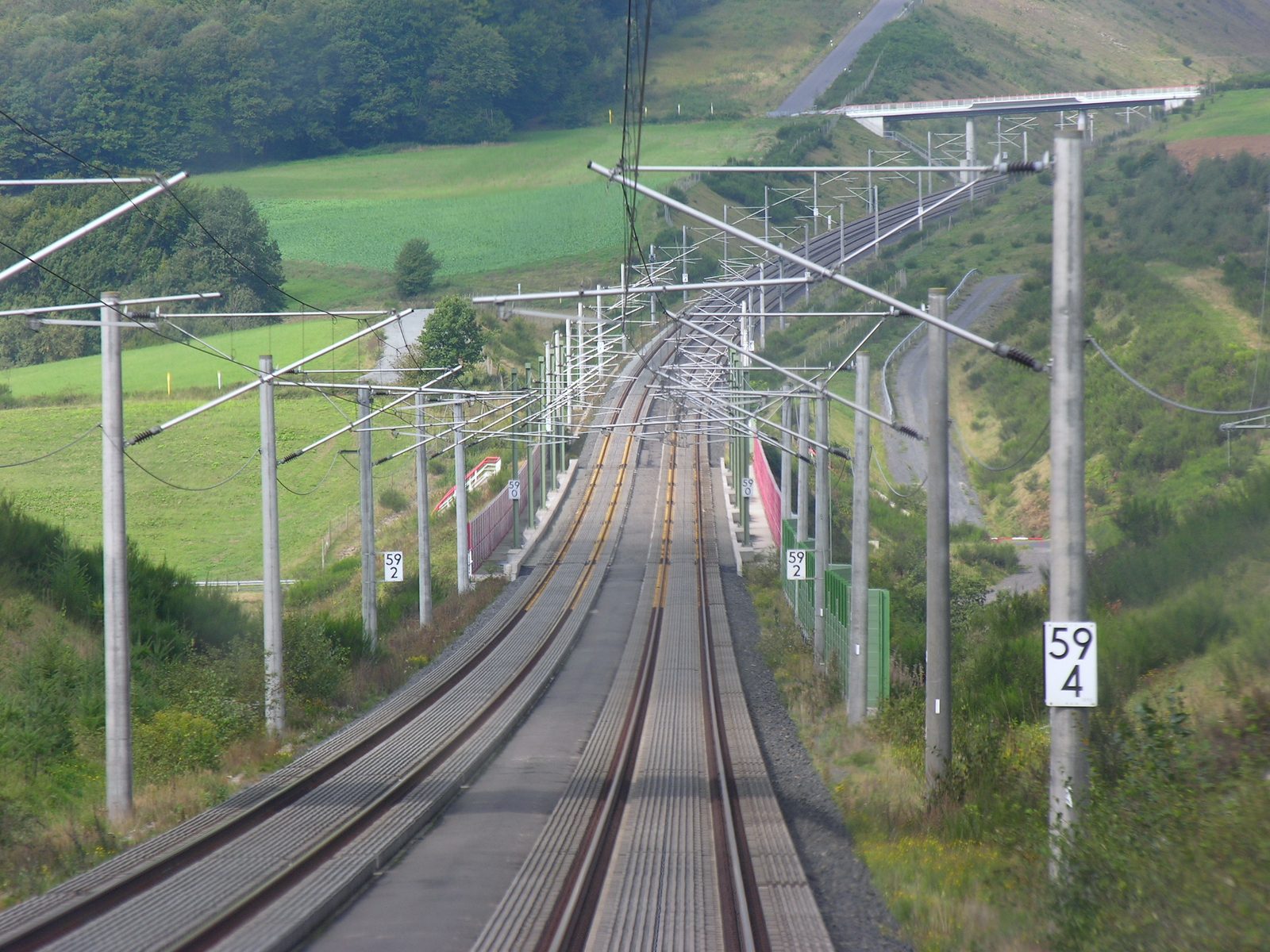
What follows is the part that makes this line unusual. Over the next fifteen kilometres the railway climbs into the Siebengebirge on gradients of forty per mille — four per cent, one in twenty-five — which is roughly four times what a conventional main line is built for and steeper than any other high-speed railway in Germany. It reaches about 300 metres at the Rottbitze tunnel, drops into the Wied valley on the Hallerbach viaduct, and climbs straight back out again at the same four per cent. The summit, around 370 metres, comes near Willroth in the Westerwald.
This is why the line was passenger-only from the start, and why for its first fifteen years only one kind of train was allowed on it. Trains here need power to climb and, far more importantly, brakes to come down: the rule was an eddy-current brake, and until December 2017 the only stock that qualified was the ICE 3. Other trains use it now, but the ICE 4 is held to 250 km/h, and a train running with its eddy-current brake switched off is capped lower still.
The middle: two stations almost nobody asked for
Montabaur arrives at kilometre 88, about halfway. It is a small Westerwald town that got a high-speed station largely because Rhineland-Palatinate wanted one, and trains that do not stop go through the middle of it at 300 km/h on dedicated through tracks while the platforms sit to either side. Twenty-one kilometres later comes Limburg Süd, which is the only station in Germany where nothing but ICE trains call — no regional service reaches it at all. It was built south of Limburg on cost grounds, which is why it does not connect to the Lahn valley line and why the cathedral town it is named after is a bus ride away.
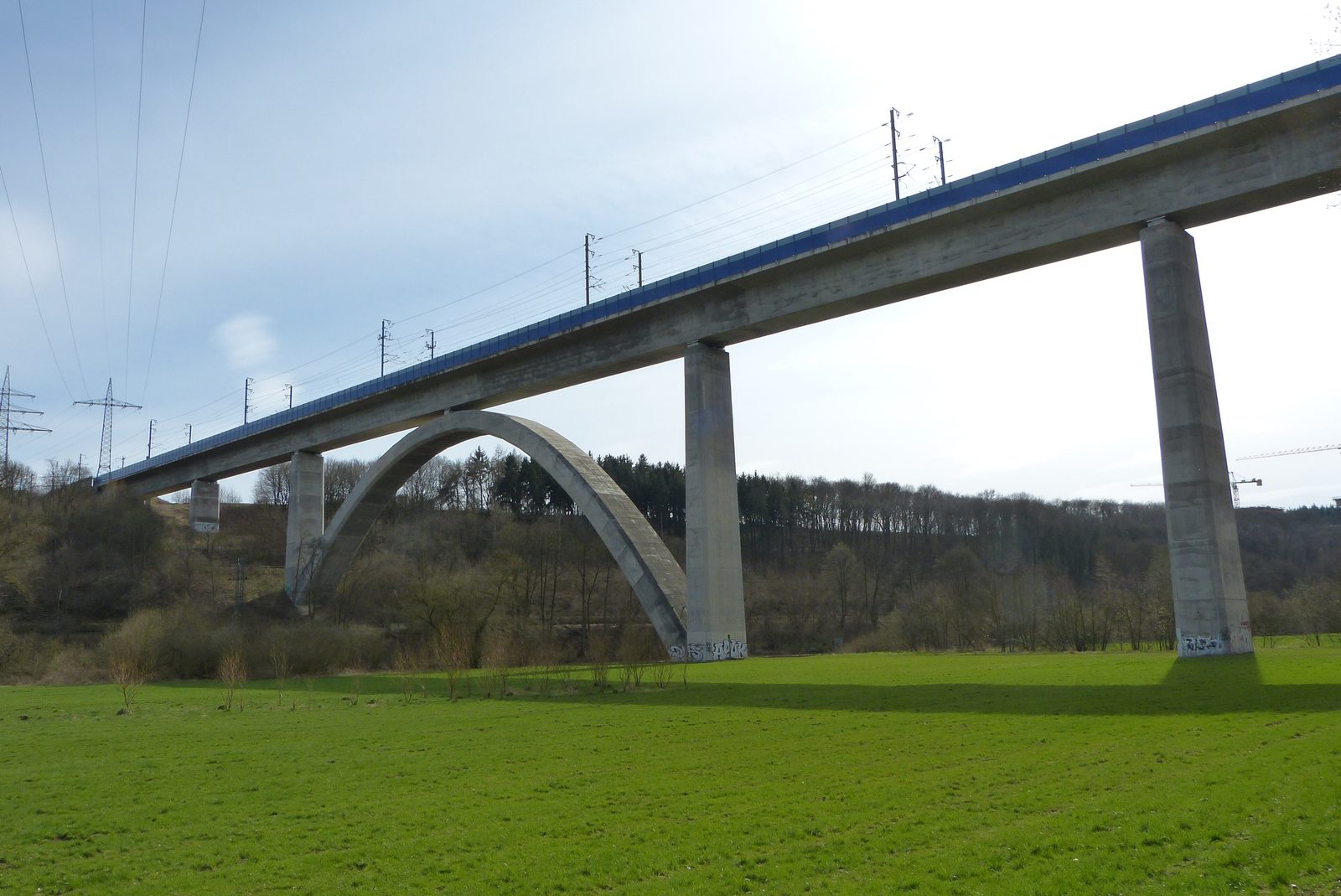
Between them the railway is at its best: the Lahn viaduct, a pale arch over the river north of Limburg, and a run of tunnels through the Taunus including the Schulwald, at 4,500 metres the longest on the line.
Down to the Main
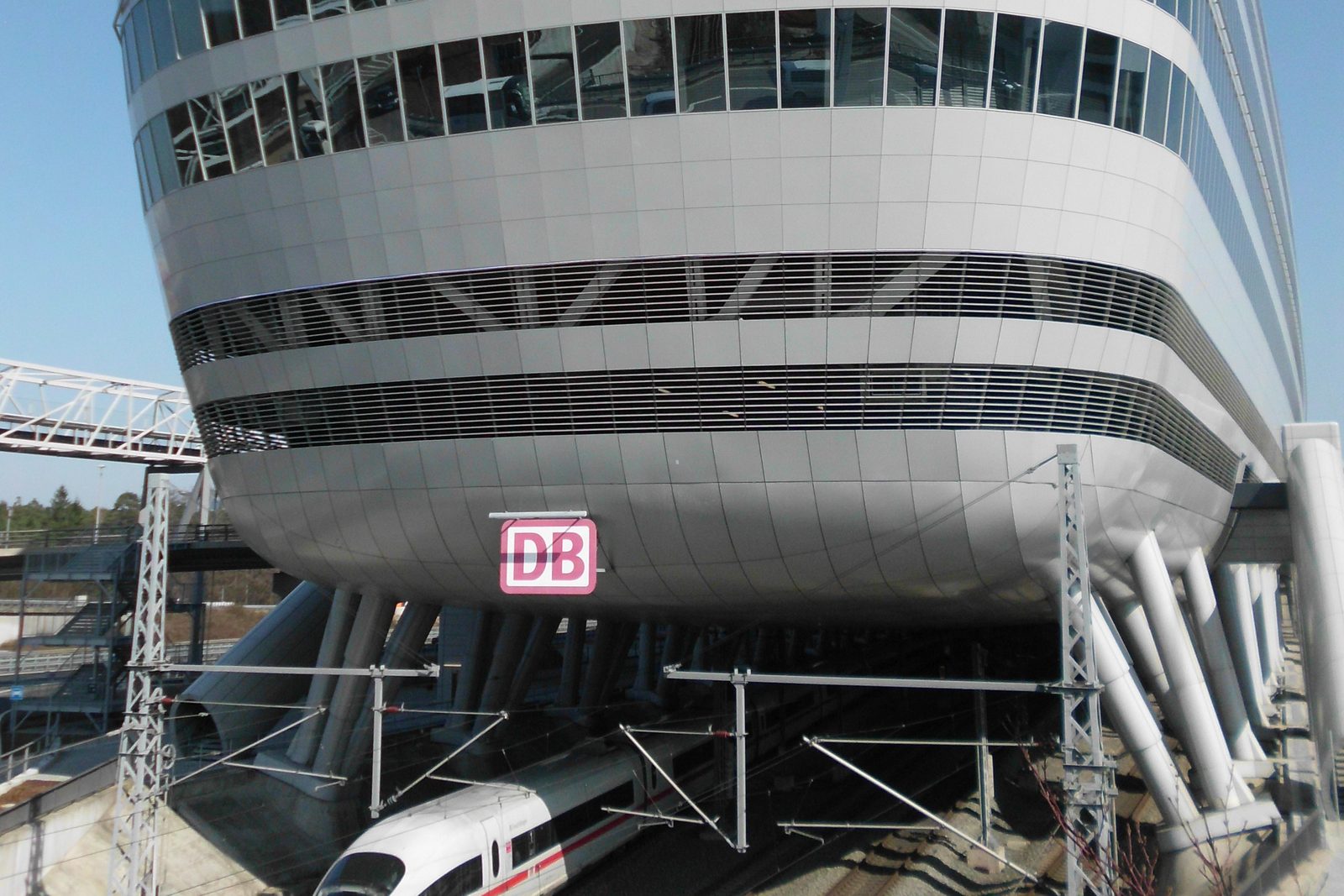
After Idstein and Niedernhausen the line falls through the Hellenberg and Schulwald tunnels, throws off a branch to Wiesbaden at Breckenheim, and comes down to the plain. It crosses the Main at Eddersheim, slows through a 220 and then a 200 km/h section, and runs in under The Squaire — the long curved building straddling the tracks — to Frankfurt Airport's long-distance station, opened in 1999 and the first part of the whole project to be finished.
From there it is a last few minutes over the Riedbahn into Frankfurt Hauptbahnhof, and the fast part is over. Total time, if your train has not stopped: sixty-eight minutes.
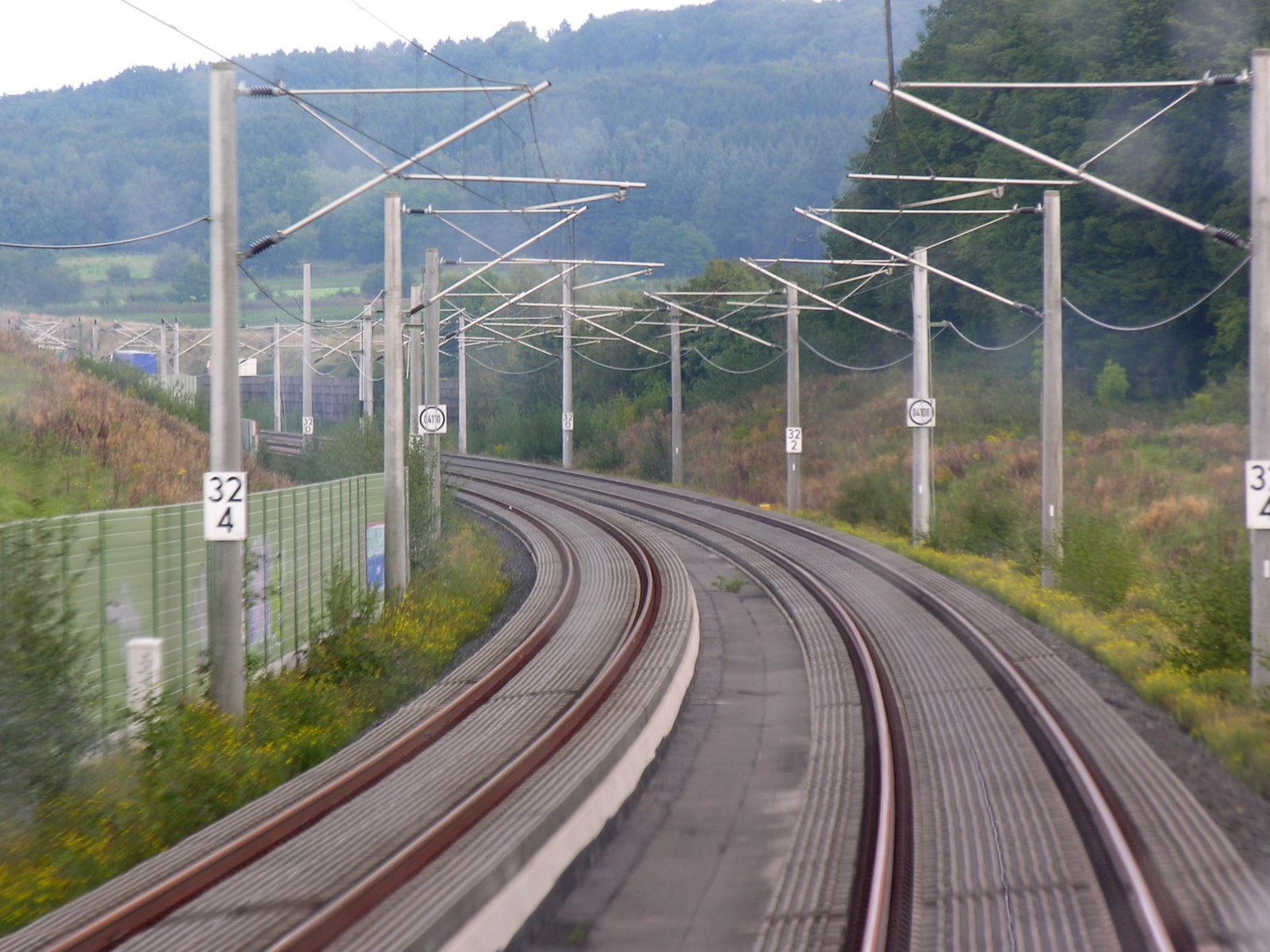
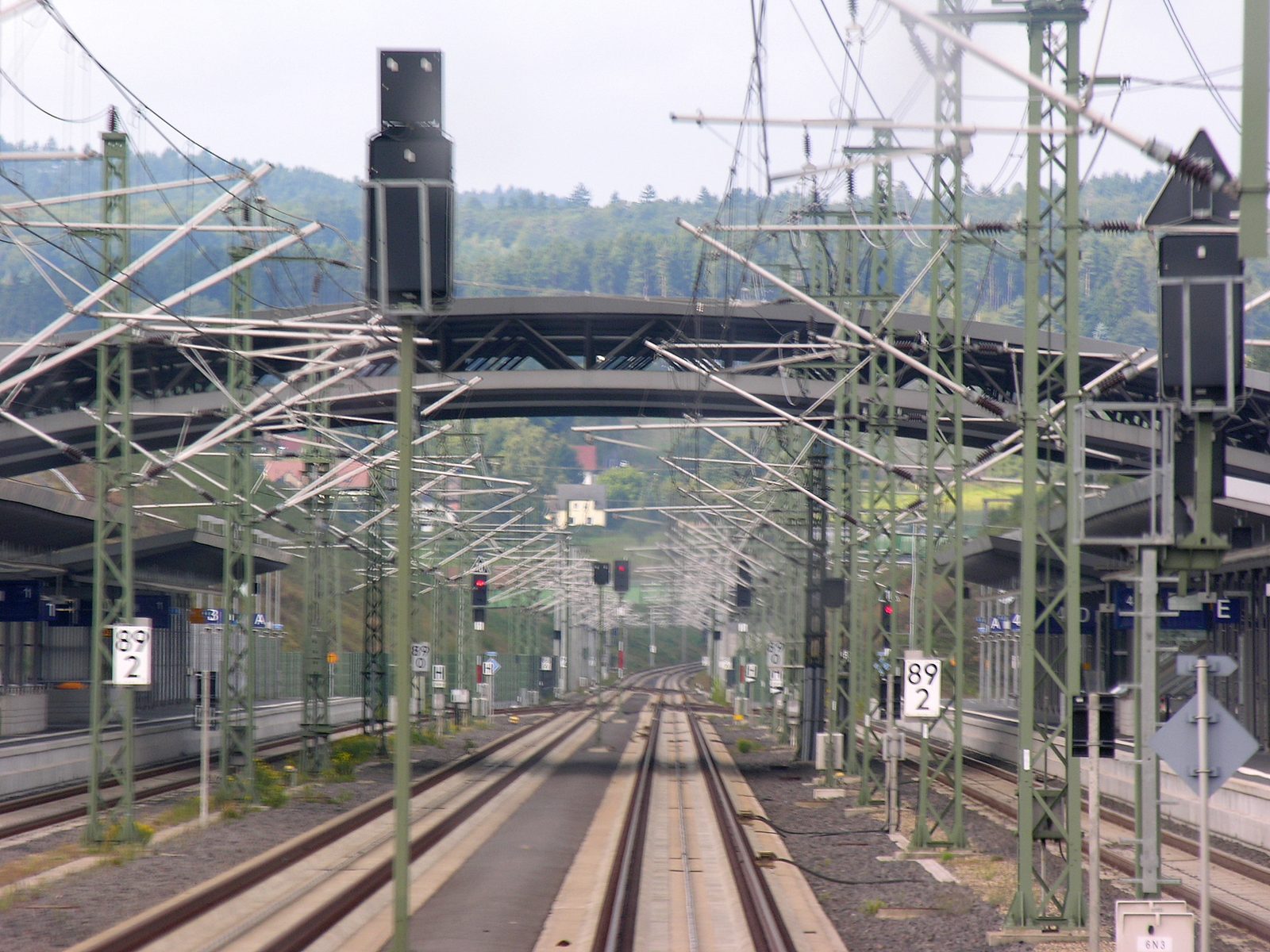
Along the route
Hansueli Krapf / Wikimedia Commons · CC BY-SA 3.0Sold on fifty-eight minutes, running in sixty-eight
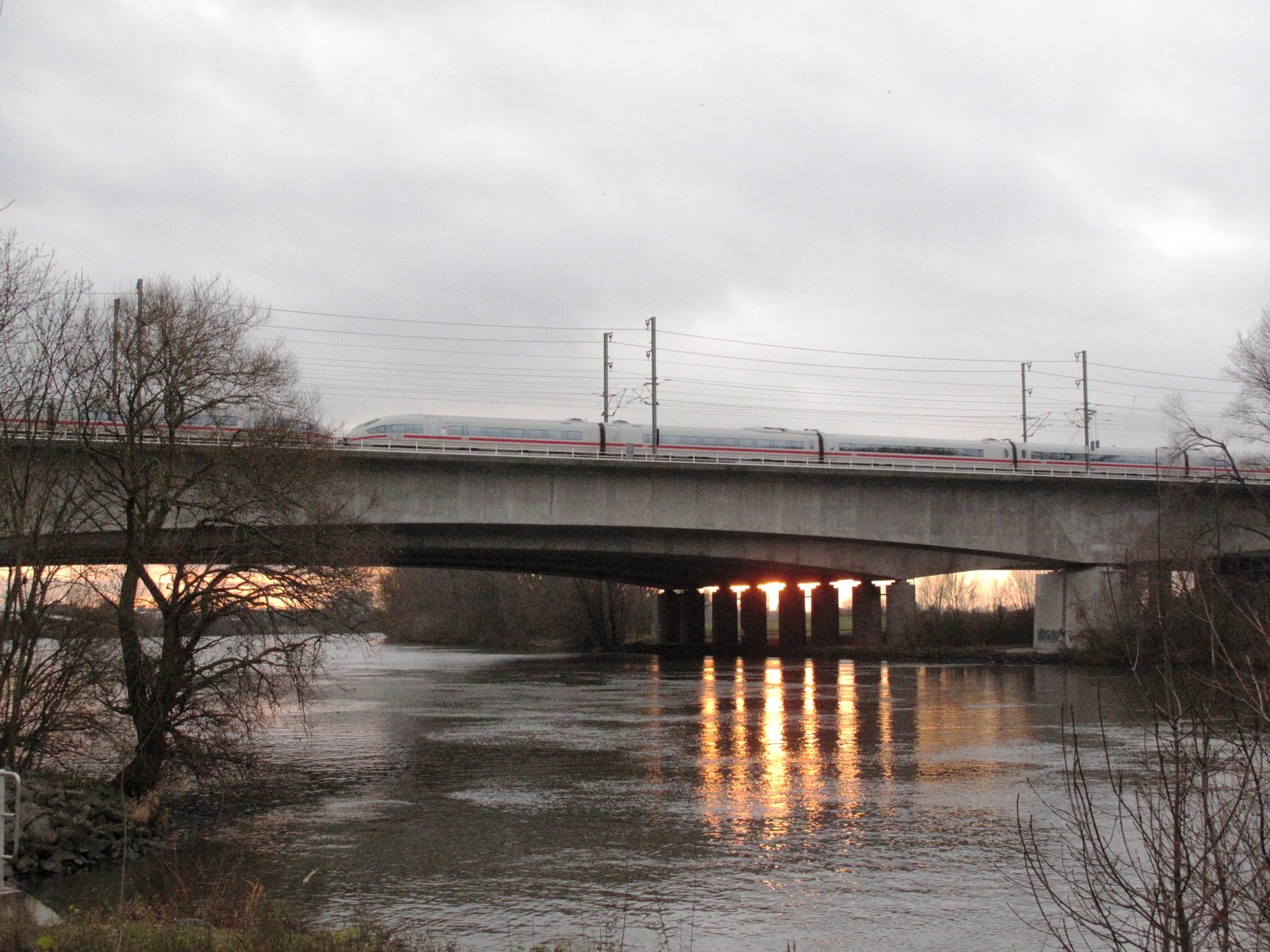
When the route was settled in 1989 the head of the railway told the country the journey would fall to fifty-eight minutes. In the August 2026 timetable the fastest booked train is sixty-five minutes one way and sixty-eight the other; most take eighty.Wolkenkratzer / Wikimedia Commons · CC BY-SA 3.0A railway built along a motorway
Freed from freight, the line could climb at four per cent — the steepest high-speed railway in Germany — so it went straight over the hills beside the A3 instead of following the valleys. The engineering is extraordinary and the view, for long stretches, is six lanes of traffic.Muns / Wikimedia Commons · CC BY-SA 3.0The same ticket buys the beautiful way instead
DB runs ICE trains between these two cities by two entirely different routes for the same fare. The other one goes down the left bank of the Rhine past the castles and the Loreley in two hours twenty. Seventy extra minutes for the finest stretch of railway in Germany is not obviously the wrong trade.A bit of history
Culture & experiences along the way
Hansueli Krapf / Wikimedia Commons · CC BY-SA 3.0Sit at the very front
The ICE 3 family carries its driver in a glass-walled cab with passenger seats directly behind it, so from the first row you look straight down the line over the driver's shoulder. On a railway with this little lineside scenery it is the single best reason to be aboard — three hundred kilometres an hour into a tunnel mouth is a different proposition seen head-on. Those seats are the first to go; reserve, and ask for the end of the train.Echtner / Wikimedia Commons · CC BY 3.0Go down and come back up the Rhine
The best use of this line is as half of a round trip. Take the non-stop south in the morning, spend the day in Frankfurt, and come back in the evening on the xx:53 by way of Mainz, Koblenz and Bonn. It costs the same, it takes seventy minutes longer, and you get both of the things this corridor is famous for in one day instead of choosing.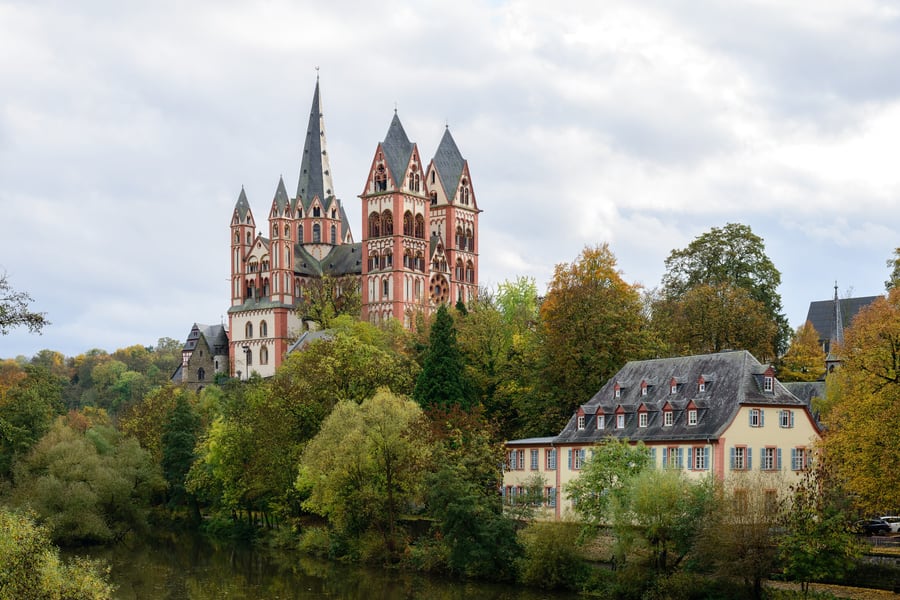 Norbert Nagel / Wikimedia Commons · CC BY-SA 3.0
Get off at Limburg Süd
The only station in Germany where nothing but ICE trains call — no regional service reaches it at all. It stands in open country south of a cathedral town with one of the best-preserved medieval centres in the country, and the contrast between the concrete island and what is a short bus ride away is genuinely startling. Roughly one train an hour stops. Check yours does before you plan on it.Timetables
There is no timetable to memorise here. Something leaves for the other end roughly every twenty minutes through the middle of the day, and the only decision that matters is which kind of train you take — because three different services run between these two cities and they take between sixty-five minutes and two and a half hours.
All times below were checked against Deutsche Bahn's schedule for August 2026. Book and check live times at bahn.de (opens in a new tab).
The three services
The non-stop ICE — 65 to 68 minutes. Cologne to Frankfurt with one call at Frankfurt Airport and nothing else. Southbound these leave Köln Hbf at about xx:18, every two hours through the day — 08:19, 10:19, 12:18, 14:18, 16:18, 18:18, 20:18 — and take 1h08. Northbound from Frankfurt Hbf at about xx:34 — 06:34, 08:33, 10:34, 12:34, 14:34, 18:33 — and these are the fastest trains on the line at 1h05.
The high-speed ICE with stops — 1h09 to 1h25. In the hours between the non-stops, a train leaves Köln at about xx:18 calling at Siegburg/Bonn only (1h09). Roughly every two hours there is also an all-stations run at about xx:29 — Siegburg/Bonn, Montabaur, Limburg Süd, Frankfurt Airport — which takes 1h20. These are the trains to take if you actually want to get off somewhere in the middle.
The Rhine ICE — 2h20. Leaving Köln at about xx:53, roughly hourly, these ignore the high-speed line completely and run down the left bank through Bonn, Koblenz, Bingen and Mainz. Same operator, same ICE trains, same ticket, seventy minutes longer, and incomparably better to look at. This is the route we cover as the Middle Rhine.
First and last
Checked for Wednesday 19 August 2026, both directions:
| Köln → Frankfurt | Frankfurt → Köln | |
|---|---|---|
| First train of the day | 05:53 (arr 08:13, via the Rhine) | 04:46 (arr 06:04) |
| First over the high-speed line | 06:27 (arr 07:49) | 04:46 (arr 06:04) |
| First non-stop | 08:19 (arr 09:27) | 06:34 (arr 07:40) |
| Last over the high-speed line | 23:54 (arr 01:01) | 20:14 (arr 21:39) |
| Last train of the day | 23:54 (arr 01:01) | 21:42 (arr 01:00, via the Rhine) |
Two things worth noticing. The last northbound departure from Frankfurt over the high-speed line is 20:14 — surprisingly early — and after that your only option is the Rhine route at 21:42, which does not reach Cologne until one in the morning. And late-evening trains are slower than the same train earlier in the day: the 23:54 out of Cologne is booked at two hours for a journey the 08:19 does in sixty-eight minutes.
Weekends and stops
The pattern barely changes at weekends. Checked for Sunday 16 August 2026, Köln to Frankfurt ran the same two-hourly non-stops at xx:18, the same all-stations trains at xx:29 and the same Rhine service at xx:53 — thirty-one direct ICE departures across the day, against thirty-two on the Thursday.
The intermediate stations are served selectively, so check before you plan around them. Siegburg/Bonn gets most trains; Montabaur and Limburg Süd get roughly one an hour, on the all-stations runs only. A non-stop ICE will pass through Montabaur at 300 km/h without slowing.
Tickets
One ticket covers Cologne to Frankfurt whichever way your train goes. Deutsche Bahn does not charge more for the high-speed line and does not charge less for the two-and-a-half-hour run down the Rhine, so the scenic route is in effect free. What it costs depends entirely on when you buy: the Sparpreis is cheap, released months ahead and tied to one train; the Flexpreis costs substantially more and lets you take the next departure, which here is rarely more than twenty minutes away.
⚠️ The Deutschlandticket does not work on any train on this page — it is valid on regional services only. It will get you from Cologne to Frankfurt in about three and a quarter hours with a change at Koblenz, past the same Rhine scenery, which is useful if you already hold one and not worth buying for a single journey. Seat reservations are optional but worth the few euros.
Book your tickets
Sparpreis
The saver fare, tied to one train
Cheapest booked early and steeply dearer towards the day; not valid on the next departure.
Book Tickets (opens in a new tab, on Deutsche Bahn)via Deutsche BahnFlexpreis
Full fare, any train, no commitment
Turn up and take whatever leaves next, by either route — worth it if your day is uncertain.
Book Tickets (opens in a new tab, on Deutsche Bahn)via Deutsche BahnInterrail and Eurail
Valid, no supplement, no compulsory reservation
Both routes cost a pass-holder the same, so the Rhine run is free scenery.
Compare Passes (opens in a new tab, on Interrail)via InterrailRail Passes
A rail pass works on this line, with no supplement and no compulsory reservation — which makes it one of the easier high-speed routes in Europe to use a pass on. Compare that with France or Spain, where every high-speed train needs a paid reservation booked in advance, and Germany starts to look generous.
Which pass
Both the Interrail Global Pass (for European residents) and the Eurail Global Pass (for everyone else) cover ICE trains in Germany, as does the one-country pass for Germany. Show the pass, board the train, sit down. There is no ICE supplement of the kind that TGVs and Frecciarossas charge.
The one thing to plan is a seat. Interrail's own guidance for Germany lists ICE reservations as optional, but recommended during busy periods (opens in a new tab) — and it separately names the ICE line through this corridor, Dortmund–Cologne–Frankfurt–Nürnberg–Vienna, among the busiest routes in Europe (opens in a new tab). A reservation costs a few euros. On a Friday afternoon it is the difference between a seat and the vestibule.
Mandatory reservations do exist on German ICEs, but only on specific international workings — the Paris, Brussels and Amsterdam trains among them. Nothing running Cologne to Frankfurt domestically requires one.
Is a pass worth buying for this journey?
For this journey alone, no — and it is worth saying plainly. A pass only earns its money if you are making several long-distance trips. Cologne to Frankfurt booked a few weeks ahead as a Sparpreis is one of the cheaper long journeys in Germany, and a day of pass validity spent on sixty-eight minutes of travel is a day wasted.
Where a pass does pay here is as part of a wider trip — and this route is unusually good value on a pass for a specific reason. Because the fast line and the Rhine line cost a pass-holder exactly the same (nothing), you can take the high-speed train south in the morning and come back up the Rhine in the evening, on the same day's travel, and pay no more for the scenic route than for the fast one. Very few pass journeys in Europe give you that choice.
What a pass does not cover
The Deutschlandticket is not a rail pass and is not valid on any ICE — see the ticket section above. And a pass does not cover the S-Bahn ride out to Cologne/Bonn Airport if your ICE does not call there, nor the Stadtbahn from Siegburg into Bonn, both of which are local services on separate tariffs.
Pass conditions checked against Interrail's own Germany page and its list of busy routes on 20 August 2026. Interrail and Eurail change their terms annually — the issuer's page is the one that binds.
Places to Visit
This is a line you get off, rather than a line you look out of. The stops are few and far apart — four between the two cities — but three of them open up places most visitors to Germany never reach, and the two ends are among the best city stops in the country.
The trick is knowing which trains call where. Only the all-stations ICEs, roughly one an hour, serve Montabaur and Limburg Süd; the fast trains go through both at full speed. Check before you plan a day around either.
 Martin Falbisoner / Wikimedia Commons · CC BY-SA 3.0 · cropped
Cologne Cathedral
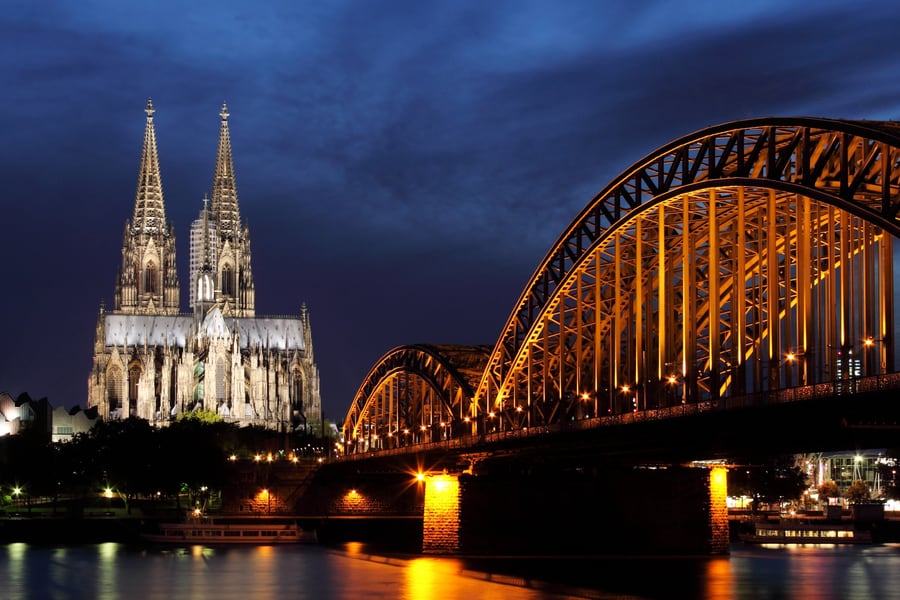
No station in Europe delivers you closer to a great building. Walk out of the Hauptbahnhof and the cathedral is directly in front of you: begun in 1248, abandoned half-built for three centuries, and not completed until 1880. At 157 metres it is the second-tallest church in Germany. Five hundred and thirty-three steps up the south tower reach a platform at about 97 metres, looking over the Rhine and the Hohenzollern Bridge your train crossed on the way out.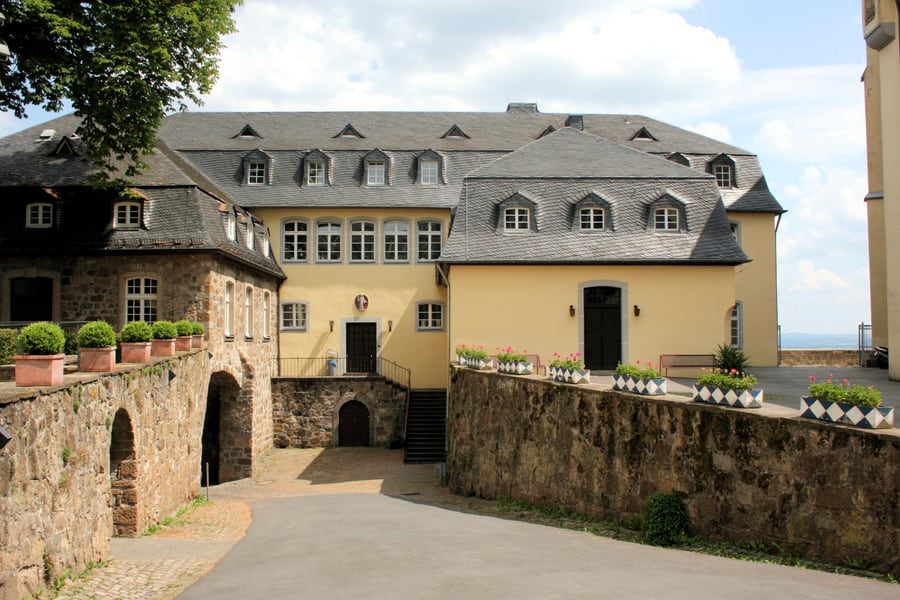 Olbertz / Wikimedia Commons · CC BY-SA 3.0 · cropped
The Michaelsberg, Siegburg
The first stop on the high-speed line proper sits below an abrupt little hill with an abbey on top, founded in 1064 by Anno II, Archbishop of Cologne, and a Benedictine house from then until the monks finally left in 2011. The buildings stand about forty metres above the town and hold the Archdiocese's Catholic Social Institute and a small Carmelite community today. The climb is short and the view over the Rhine plain is a better use of an hour between trains than anything else on the line.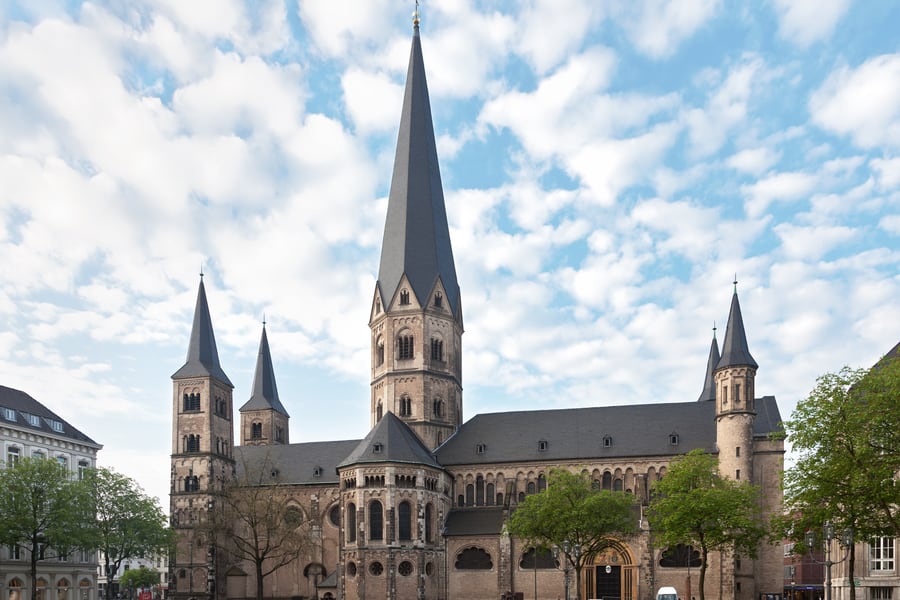 Thomas Wolf, www.foto-tw.de / Wikimedia Commons · CC BY-SA 3.0 DE · cropped
Bonn, twenty-five minutes away
The station is called Siegburg/Bonn for a reason: the Stadtbahn 66 runs from outside it to Bonn Hauptbahnhof in twenty-five minutes, which is how the former capital is attached to the high-speed network. Bonn gives you Beethoven's birthplace, a first-rate run of museums along the Museumsmeile, and the Münster — an eleventh-century Romanesque collegiate church whose cloister is reckoned the most completely preserved Romanesque cloister north of the Alps.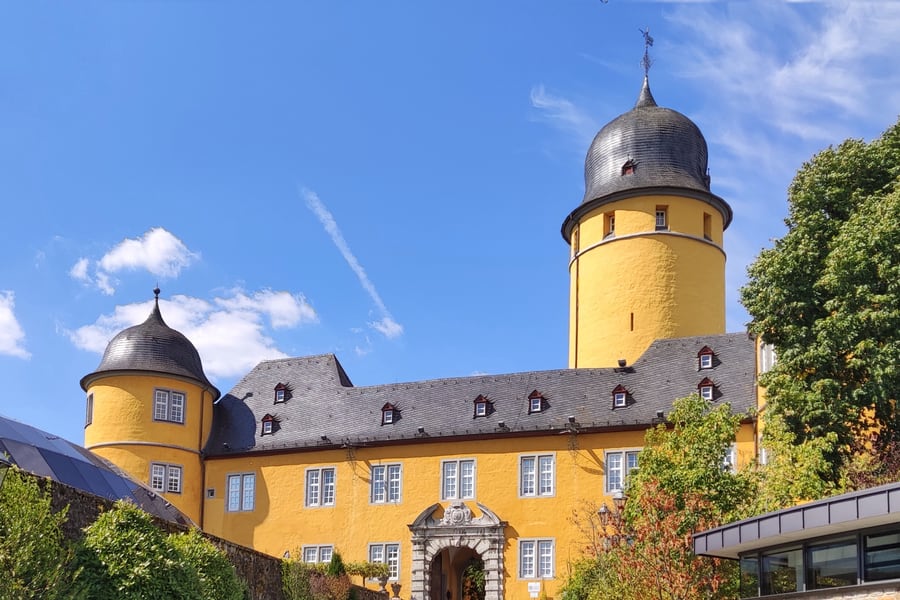 LoKiLeCh / Wikimedia Commons · CC BY-SA 4.0 · cropped
Schloss Montabaur
Impossible to miss and startlingly yellow, the castle stands on the Schlossberg at 321 metres, directly above the town, with a medieval keep 33 metres high behind its ochre walls. A stronghold is recorded here as early as 959; the building you see got its shape in a baroque remodelling between 1687 and 1709. It is a training and conference centre today rather than a museum, so the interior is not generally open — the walk up through the old town is the reason to break the journey here.Norbert Nagel / Wikimedia Commons · CC BY-SA 3.0 · croppedLimburg an der Lahn
The cathedral stands on a limestone rock straight above the river and has seven towers — more than any other church in Germany — which is why you can see it from most of the valley. It was consecrated in 1235. Below it is one of the best-preserved medieval old towns in the country: rebuilt after a fire in May 1289, and still full of half-timbered houses from the thirteenth century onwards, one of them dated 1309. The ICE station is out in open country south of the town; take the bus in.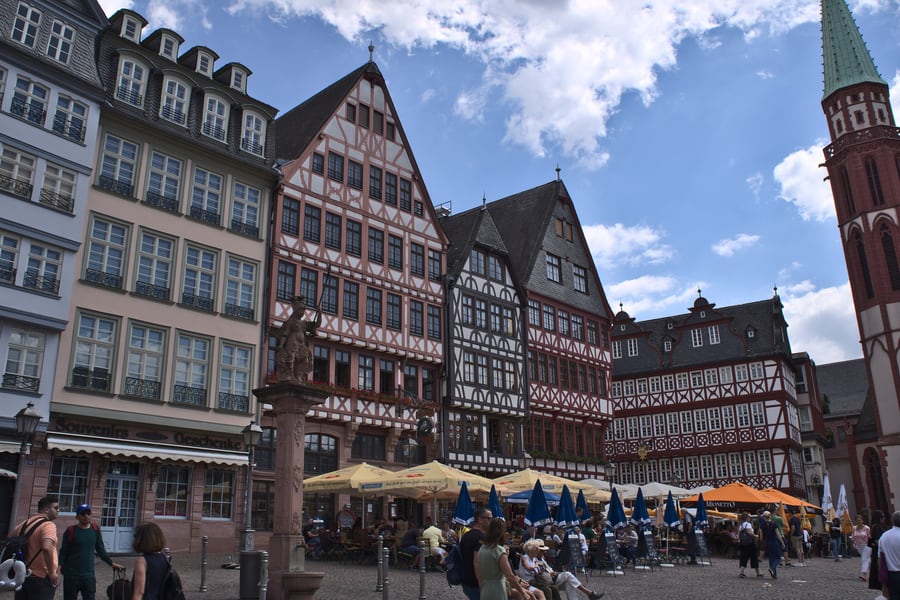 Robert von Oliva (naruciakk) / Wikimedia Commons · CC0 · cropped
The Römerberg, Frankfurt
Frankfurt is a city of towers with a small, dense, entirely rebuilt medieval heart at the middle of it. The city bought the two houses that became the Römer in March 1405 and has run the city from them ever since; the row of gabled houses opposite was reconstructed after the war, and the quarter behind them — the Neue Altstadt, rebuilt between 2012 and 2018 — opened to the public in May 2018. From the Hauptbahnhof it is a walk, or a couple of stops on the S-Bahn to Dom/Römer.Where to Sleep
Sixty-eight minutes is not a journey you break. Nobody rides this line and stops overnight halfway — the point of it is that you do not have to — so the beds that matter are at the two ends, and both cities put them within a few minutes' walk of the platforms.
Cologne is the easier of the two. The Hauptbahnhof sits directly beside the cathedral, and the hotels on Trankgasse and the streets behind it are close enough that you can leave breakfast ten minutes before your train. Frankfurt's Hauptbahnhof opens onto the Bahnhofsviertel, a quarter with a reputation and a genuine renaissance going on in it: the blocks immediately around the station hold some of the more interesting small hotels in the city alongside some of its rougher corners, and it repays looking at a map before booking.
Two houses are listed below rather than the usual three. Several plausible candidates in the middle of the line either could not be reached at all or turned out not to be trading — one Limburg hotel answers with a single page announcing that it closed at the end of July 2026 — and a hotel we cannot stand behind gets no card.
Where to stay
Excelsior Hotel Ernst
Directly opposite the cathedral, beside Köln Hbf
A grand hotel since 1863, on Trankgasse across the square from the cathedral and a two-minute walk from the platforms — close enough that the Dom fills the window of a good many of its 133 rooms and suites. It has a French restaurant and an East-Asian one, and it is the address in Cologne for anyone who wants to step off a train and be there.
Check Availability (opens in a new tab, on excelsiorhotelernst.com)via excelsiorhotelernst.comHotel Nizza
In the Bahnhofsviertel, minutes from Frankfurt Hbf
An independent house a few streets from Frankfurt Hauptbahnhof that has made something deliberately theatrical of itself — Belle Époque and Art Deco rooms, a breakfast room under high ceilings, and a reception staffed by an actual person around the clock. Note that its roof terrace is currently closed for construction work.
Check Availability (opens in a new tab, on hotelnizza.de)via hotelnizza.deQuestions or corrections
Planning this trip and stuck on something, or spotted a time, fare or detail that has changed? Send us a message about The ICE from Cologne to Frankfurt. We read every one, and we update this page when something has changed.