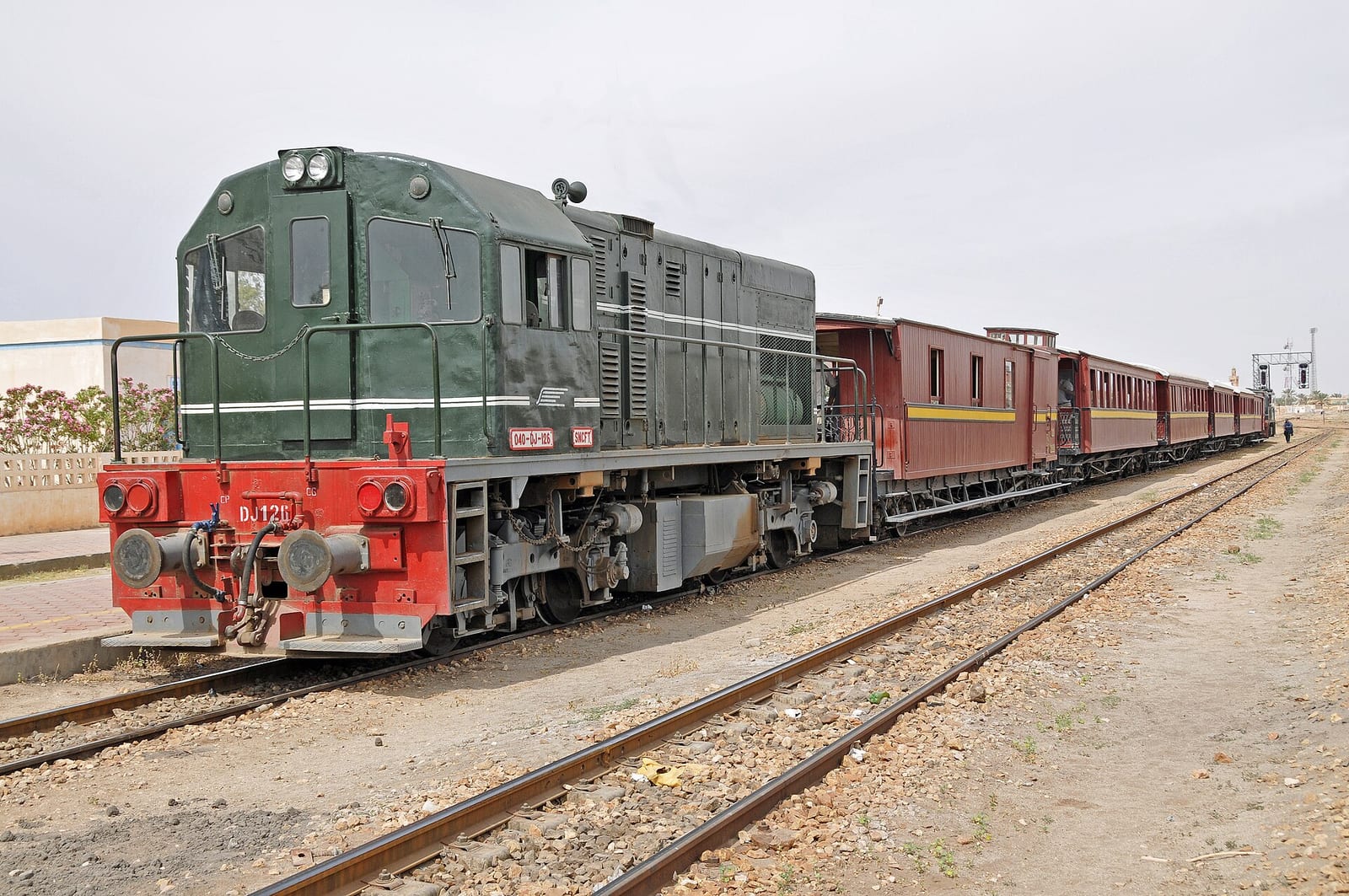
The Lézard Rouge
Dennis G. Jarvis / Wikimedia Commons · CC BY-SA 2.0
- DistanceMétlaoui–Redeyef line · about 43 km there and back
- DurationAbout 1 hour 45 minutes
- Best seasonOctober–April · the Tunisian south is brutally hot in high summer
Introduction
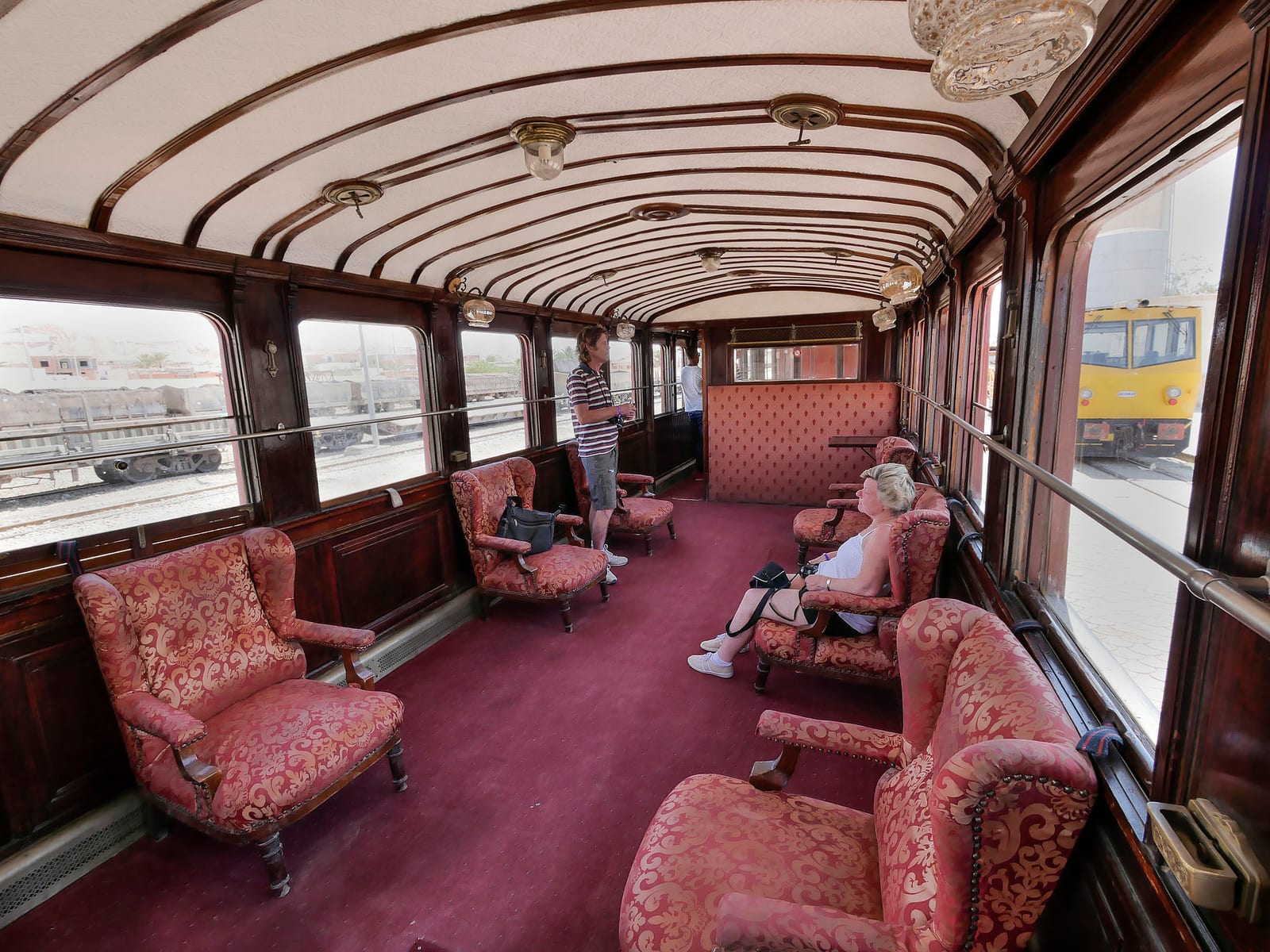
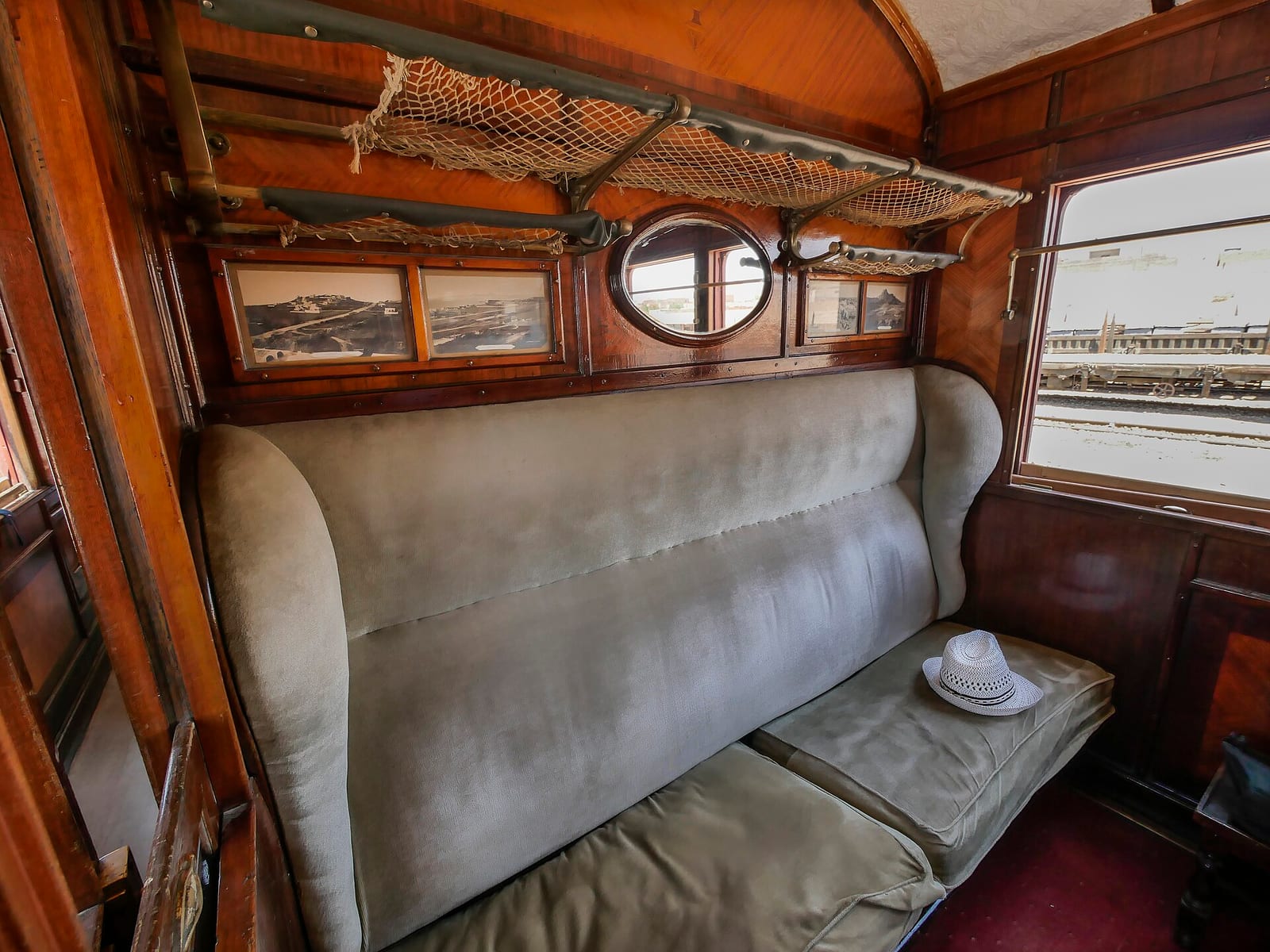
In 1910, in a carriage works at Louvain in Belgium, the French firm of Dyle et Bacalan built a private train for the Bey of Tunis. There was a saloon for the ruler, a second carriage for his court, a dining car and two vans for the luggage. Inside it was marquetry, garnet velvet, polished copper and dark wood — the vocabulary of the Orient-Express and the Train Bleu, which were being fitted out in the same years for the same sort of passenger.
Today that carriage runs into a desert canyon in south-western Tunisia, at the head of a rake painted royal red, and anybody can buy a seat on it.
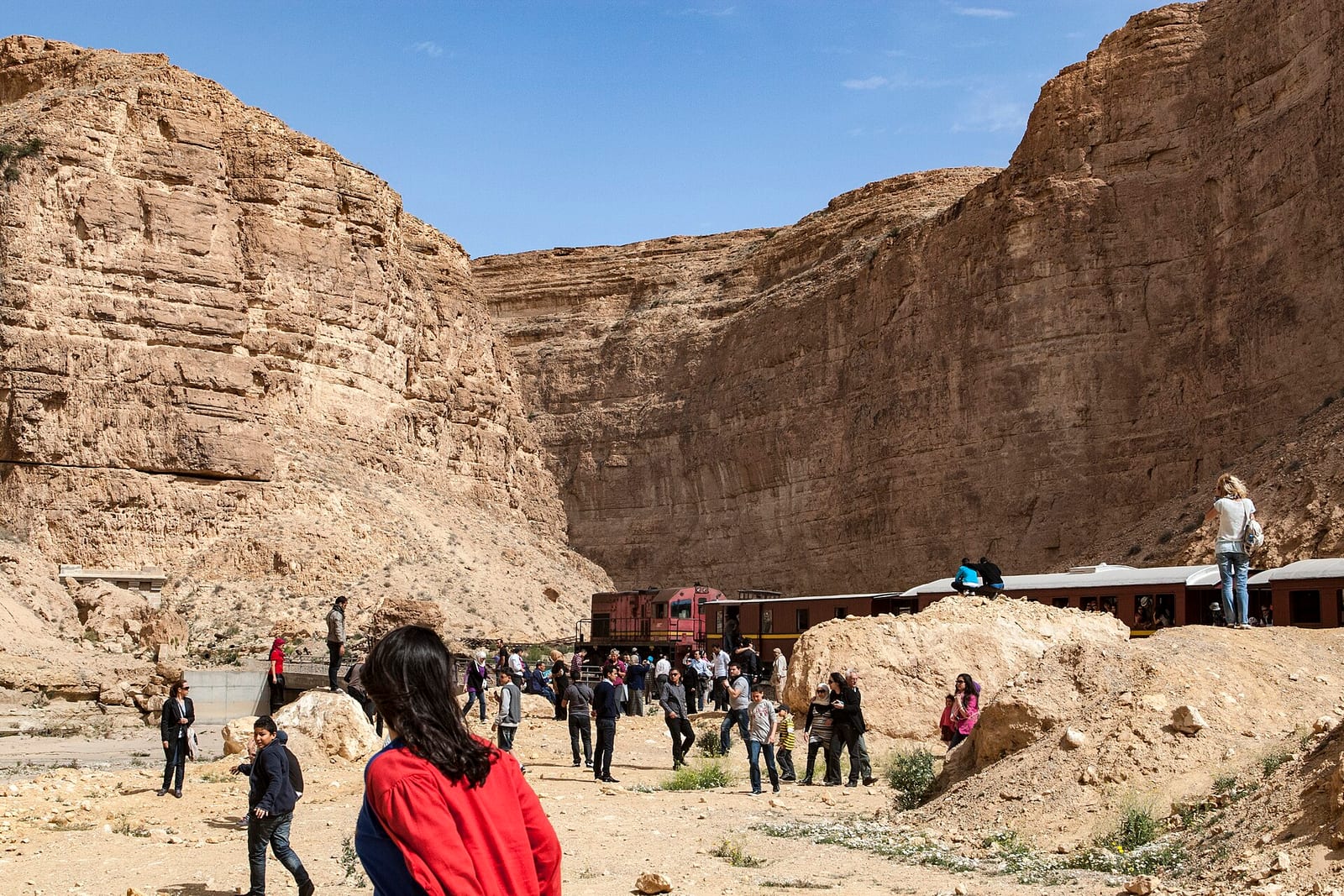
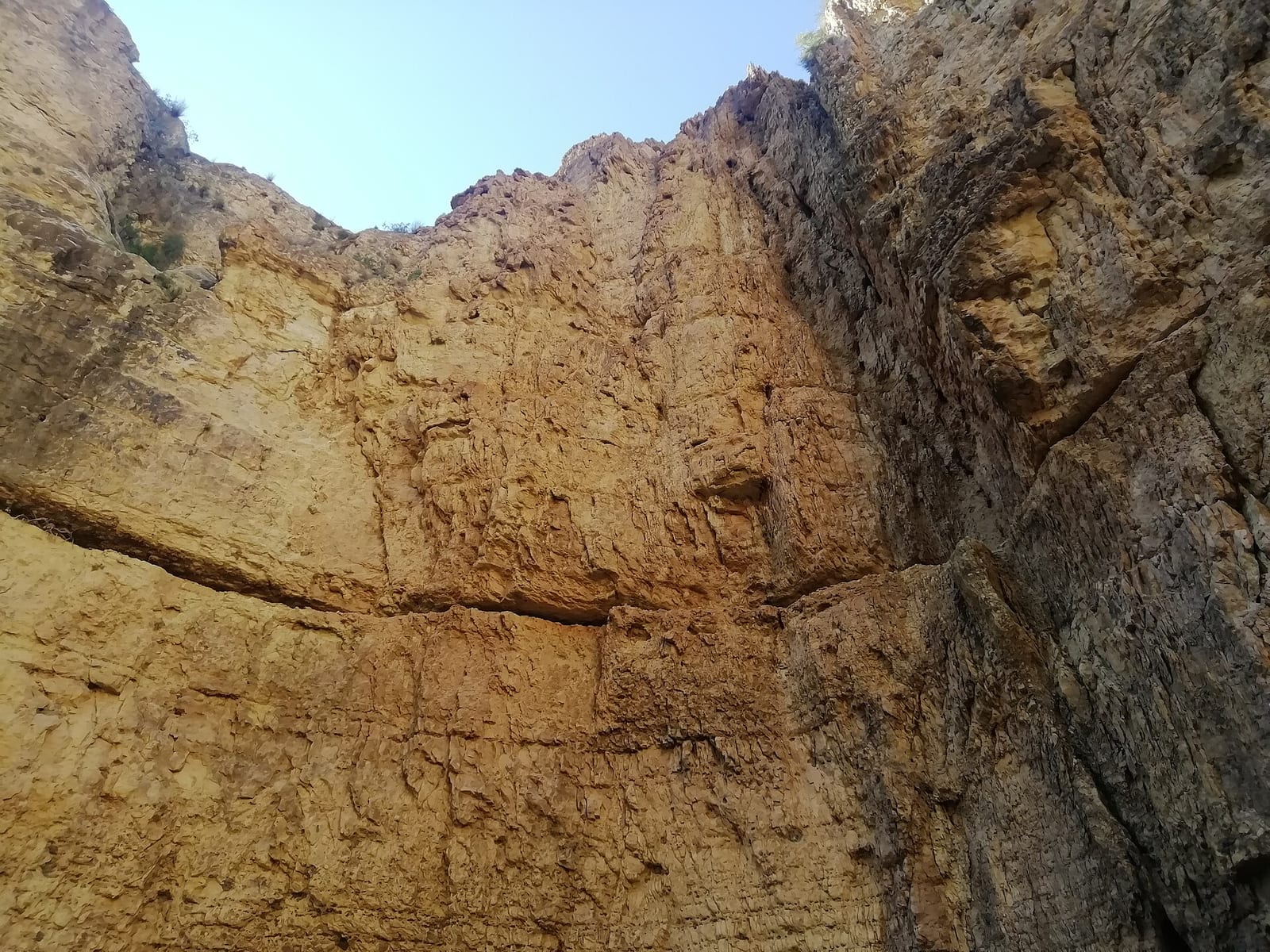
The Lézard Rouge — the Red Lizard — leaves Métlaoui, a phosphate town between Gafsa and Tozeur, and spends about an hour and three quarters running up the Selja Gorge and back. The gorge is the reason to go. It is a deep, crooked slot cut by a seasonal river through bare rock, with palms growing on the floor where the water reaches and nothing at all on the tops. There is no road through it. The railway is the only way in, and it goes through on ledges and short tunnels with the cliffs close enough to touch.
At the widest bend the train stops, and everybody gets off.
Why the railway is there at all
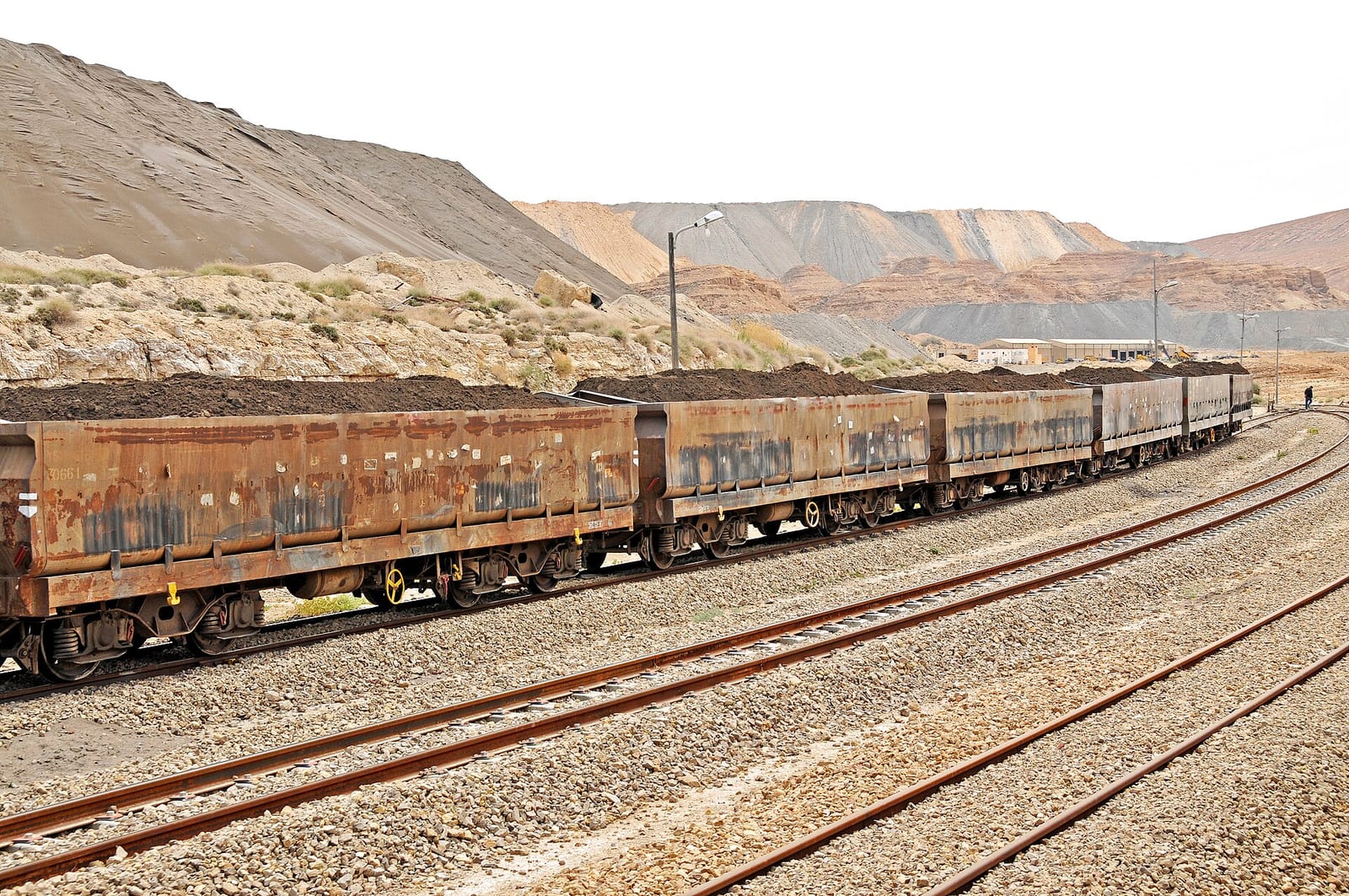
Not for this. In 1885 a French amateur geologist called Philippe Thomas identified enormous beds of calcium phosphate in the hills around Métlaoui. Twelve years later the Compagnie des phosphates et des chemins de fer de Gafsa was granted the deposits in the Selja valley on one condition: that it link them by railway to the port of Sfax, two hundred and fifty kilometres away on the Mediterranean. Rails went through the gorge from 1896. The stretch the tourist train uses, on up to Redeyef, was laid in 1906 and 1907.
Mines opened at Métlaoui in 1899, at Redeyef in 1903, at Moulares in 1904. Tunisia became one of the largest phosphate producers on earth and has stayed there. Loaded ore trains still grind down this line to Sfax. The red train is a visitor on a working railway, and that — rather than any attempt at luxury — is what makes the ride interesting.
And the train has not always been running
This is the part the brochures skip. The beylical carriage was regauged to Tunisia's metre gauge in 1922, carried the last three Husseinite sovereigns, and was then parked on a siding for decades once heads of state discovered the motor car. It was renamed the Lézard rouge and put back to work in April 1974, first on a Tunis–Tozeur circuit, and moved to the Métlaoui gorge run in 1984.
Since then it has stopped more than once. It came off the rails for the best part of a year after the 2011 revolution. Torrential rain stranded it at Métlaoui in 2017. In 2019 Tunisian civil society launched a campaign to have it restored and recognised. It went into the national railway's workshops — and it was still sitting there in November 2024, out of service for want of spare parts, more than eight years after it last carried a paying passenger with any regularity.
Then, on 16 May 2025, it came back.
That is recent enough that you should treat it as news rather than as a fixture. Confirm with SNCFT before you commit to the journey down to Métlaoui. And if the answer is no — as it has been for much of the last decade — there is a second answer, which almost nobody knows about, and which is in the timetable section below: an ordinary scheduled service train runs the same branch, and one of its stations is in the bottom of the gorge.
The Journey
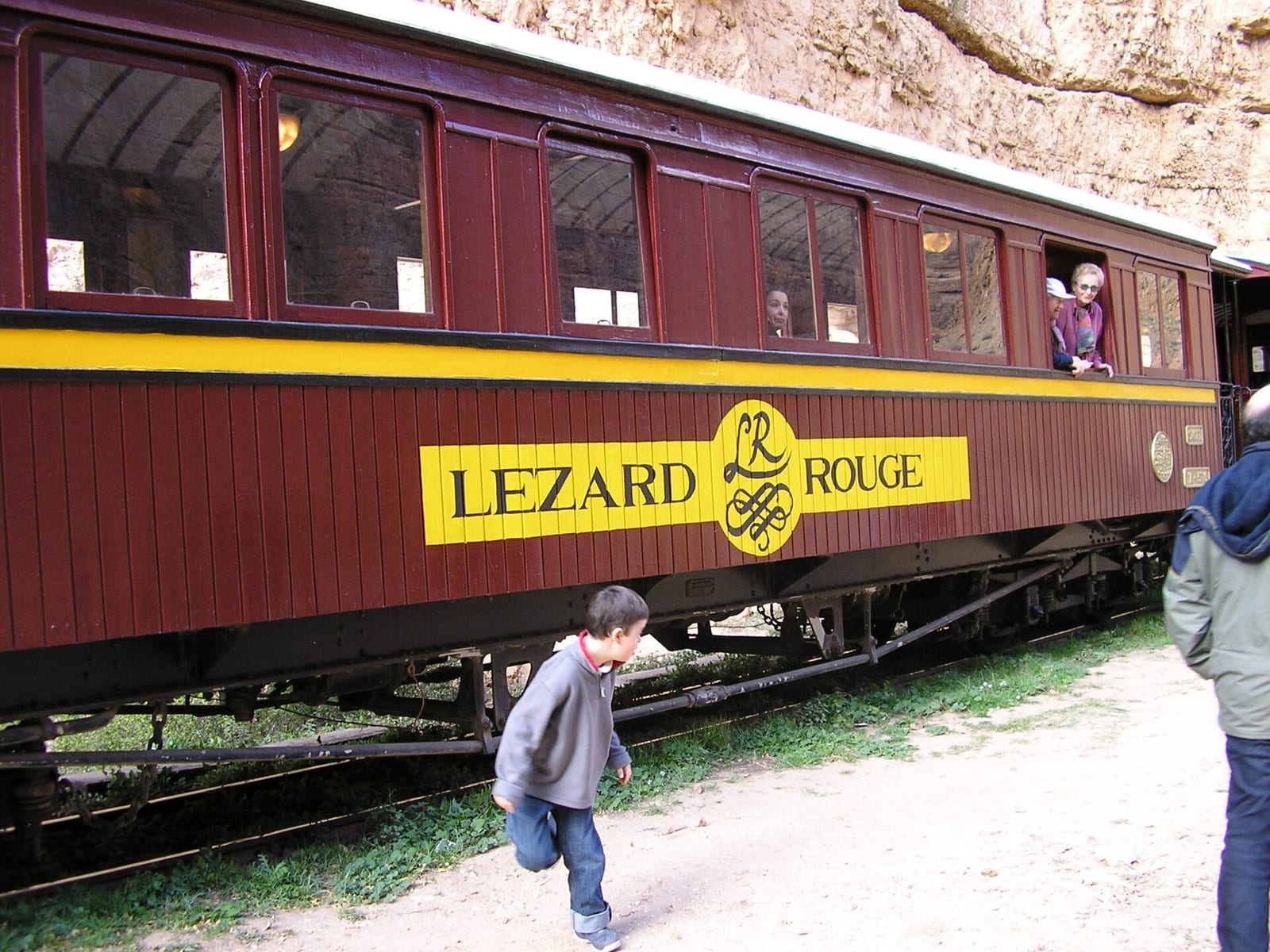
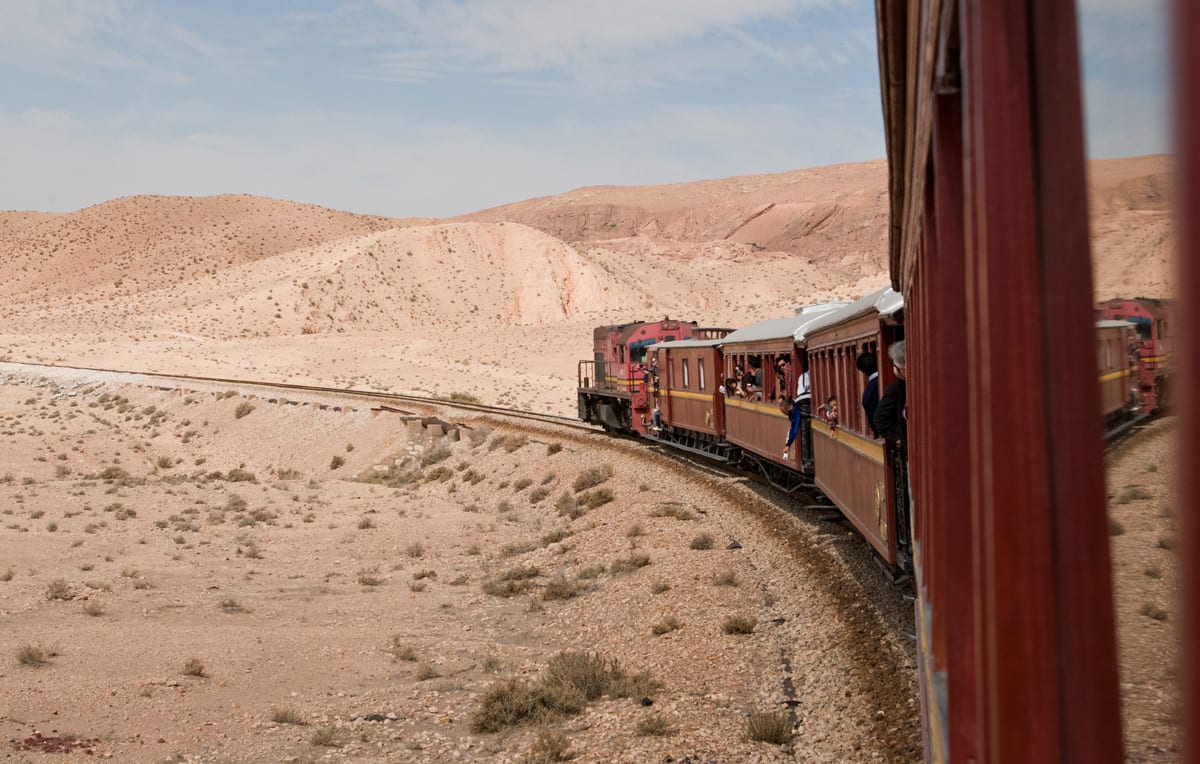
The Lézard Rouge is six vehicles: a salon car, a bar car and four seated carriages, two of them first class, 116 seats between them. A diesel locomotive pulls it — there is no steam on this line and there never has been on this train. The rake is painted a deep royal red with a gold-yellow band lined in black running the length of the flanks, the words Lézard rouge and train touristique lettered on both sides in Arabic and French, and the railway's emblem set into a bronze plate.
Out of Métlaoui
You start in a phosphate town. Métlaoui is not pretty and does not try to be: it is a working place of low buildings, washing plants and ore sidings, sitting in a fold of dry hills with the Sahara not far south. The station is a small one, and the red train standing at the platform is the most colourful object for many kilometres in any direction.
The line heads west and north-west, climbing gently, and for the first quarter of an hour there is nothing much but stone and scrub and the odd cluster of palms. Then the ground begins to rise on both sides.
Into the Selja
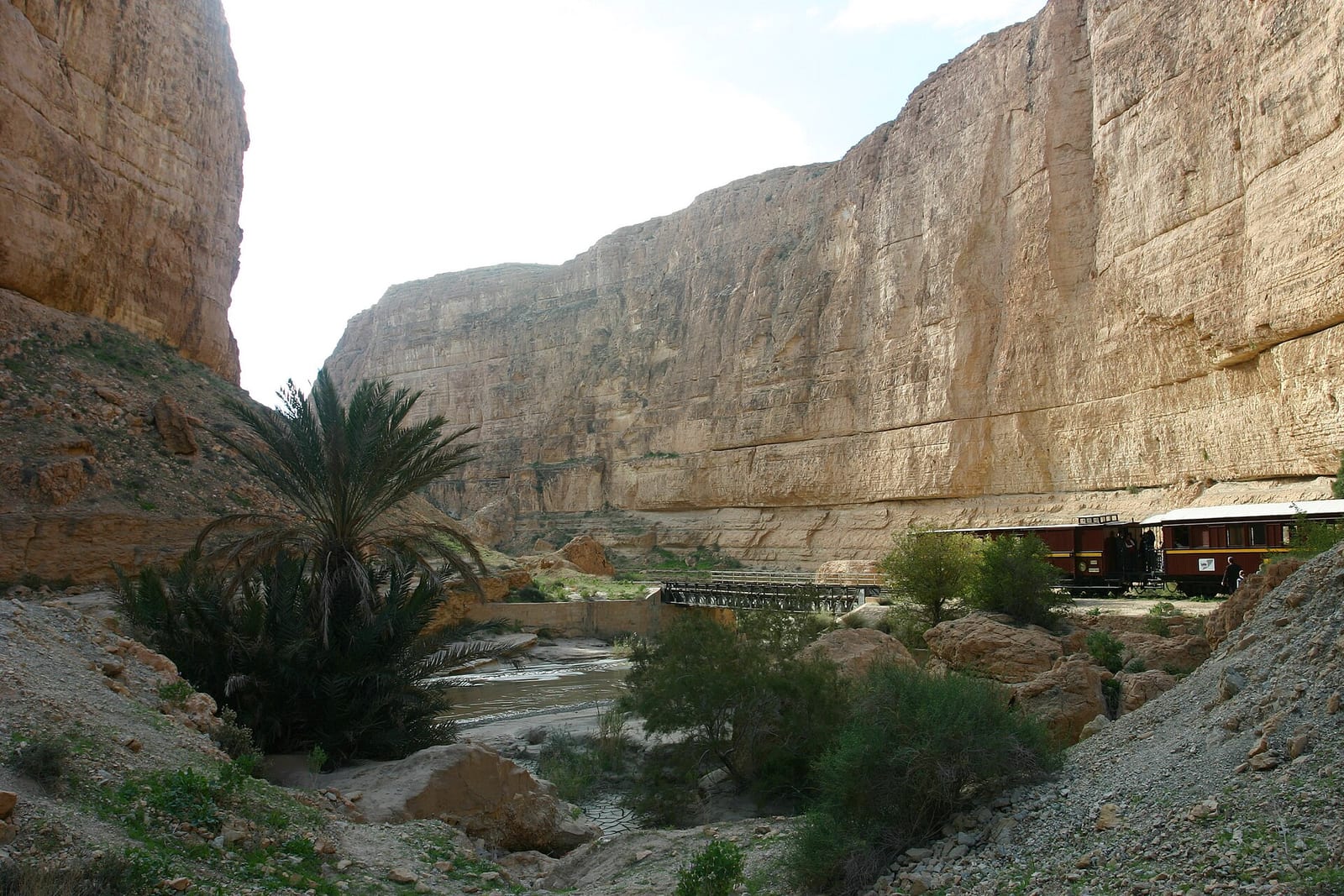
The gorge announces itself gradually and then all at once. Walls of pale, layered rock close in until the sky is a strip; the floor of the canyon carries the Oued Selja, dry for most of the year, green with date palms and oleander wherever the water lingers. The railway runs along a ledge above the bed, crosses it, changes sides, and disappears into short tunnels driven straight through the buttresses where there was no room to go round.
None of this was designed to be looked at. Every cutting and every tunnel here was made to get ore wagons from the mines at Redeyef and Moulares down to the sea, and the engineering has the plain, hard-used quality of industrial work. That is exactly why it is worth seeing. There is no viewing platform, no glass roof, no piped commentary — just open windows, a rock face a few metres away and the noise of the train coming back off it.
The gorges have been a protected nature reserve since 2009 and a Ramsar wetland — listed as the Gorges de Thelja — since February 2012, covering some 675 hectares. Away from the train they are silent.
The halt
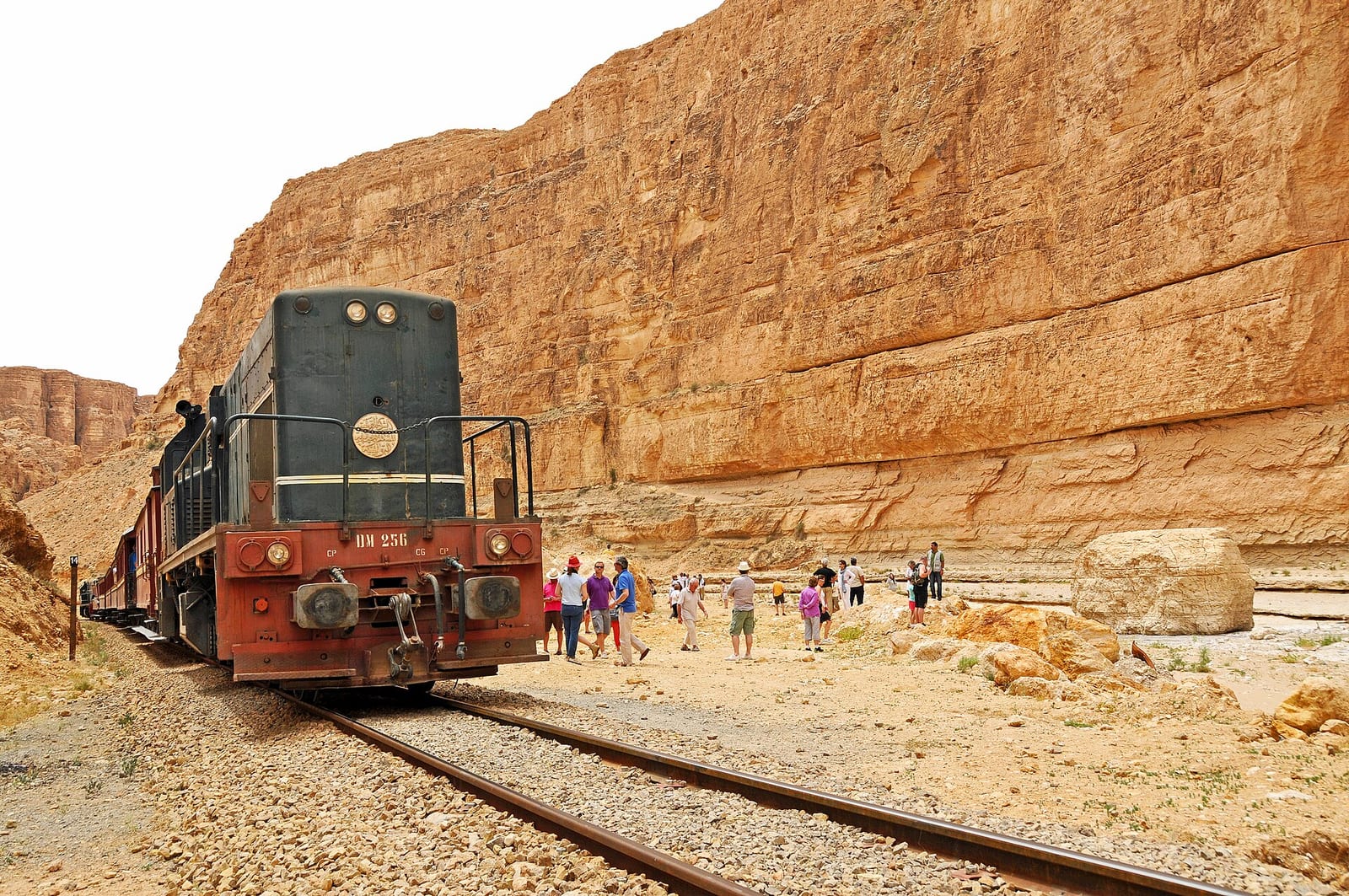
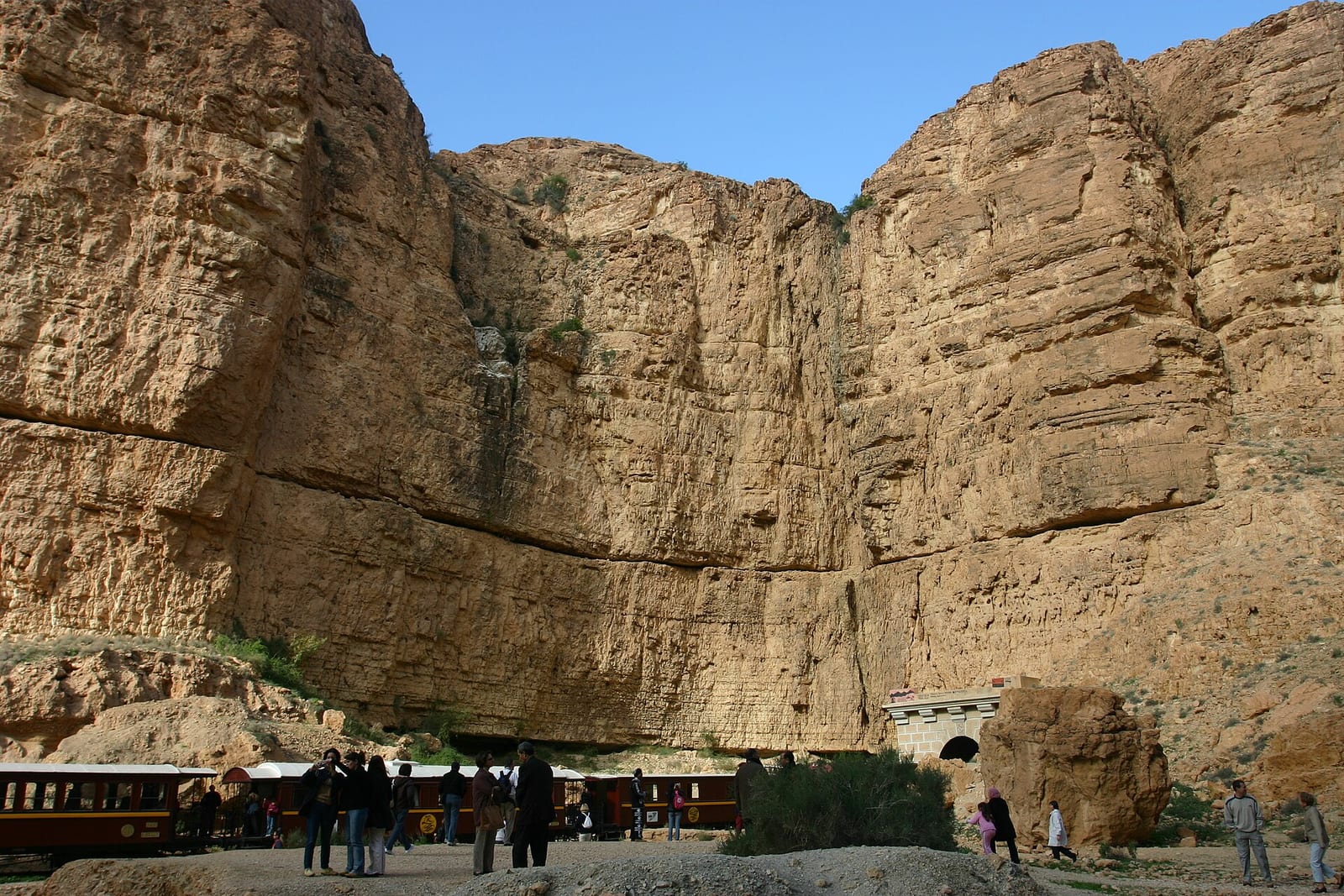
At the widest point the train stops. This is scheduled, not improvised. The doors open, everybody climbs down onto the ballast, and the passengers spread out along the canyon floor for twenty minutes or so — Tunisian families, school groups, a handful of foreign visitors, and children going straight for the rocks.
It is a genuinely strange place to be standing. The walls rise on both sides, the river bed is dry gravel, and there is no road, no path in and no building anywhere. The only way out is the train sitting on the single track behind you, engine idling. When the horn goes, everyone walks back.
Turning round
The tourist working returns to Métlaoui rather than carrying on to Redeyef, which makes the whole excursion about an hour and three quarters. The full branch continues north-west past El Ayoun and Moulares to Redeyef, in the heart of the mining basin — and if you want to see that, an ordinary passenger service goes there, twice a day, on the timetable below.
One thing to know about where you are
The Gafsa mining basin is not a resort. It is one of the poorest and most politically charged parts of Tunisia: unemployment has run around 29 per cent, the phosphate company's workforce has been cut and re-expanded in waves, and in 2008 protests over rigged recruitment at the mines ended in deaths. Unemployed people have more than once blockaded the ore railway, which is both a livelihood and a symbol here.
Visitors are welcome and the region is used to them. But it is worth knowing that the beautiful canyon you have come to photograph sits in the middle of a hard-worked industrial landscape whose people have had a difficult two decades — and that the train you are riding is, to them, first and foremost the thing that carries the rock.
Along the route
stuart Burns / Wikimedia Commons · CC BY 2.0A carriage built for a Bey
The heart of this train was built in 1910 in Belgium for the Bey of Tunis, fitted with marquetry, garnet velvet and polished copper. In 1922 it was cut down to metre gauge, which is how a European state coach ends up on a desert mining line.Houss 2020 / Wikimedia Commons · CC BY-SA 4.0The gorge with no road
The Selja Gorge is a deep, twisting cut west of Métlaoui, and there is no road through it: the only way is the railway, on ledges and short tunnels blasted into the rock. The train stops at the widest point and lets everyone walk.Dennis G. Jarvis / Wikimedia Commons · CC BY-SA 2.0Built for phosphate, not for tourists
The company granted the phosphate beds here in 1897 got them on condition that it built a railway to the port of Sfax. Track went through the gorges from 1896, and loaded ore trains still run on it. The tourist train is the guest.A bit of history
Culture & experiences along the way
Jerzy Strzelecki / Wikimedia Commons · CC BY-SA 3.0Get off at the amphitheatre
The scheduled halt in the middle of the gorge is not a photo stop tacked on the end — it is the point of the trip. The train stands still on the single track at the widest bend, everybody climbs down onto the ballast, and for twenty minutes or so you are standing on the floor of a canyon with cliffs on both sides, no road, no village and no way out except the train you arrived on. Wear something you don't mind getting dusty.stuart Burns / Wikimedia Commons · CC BY 2.0Sit in the bar car
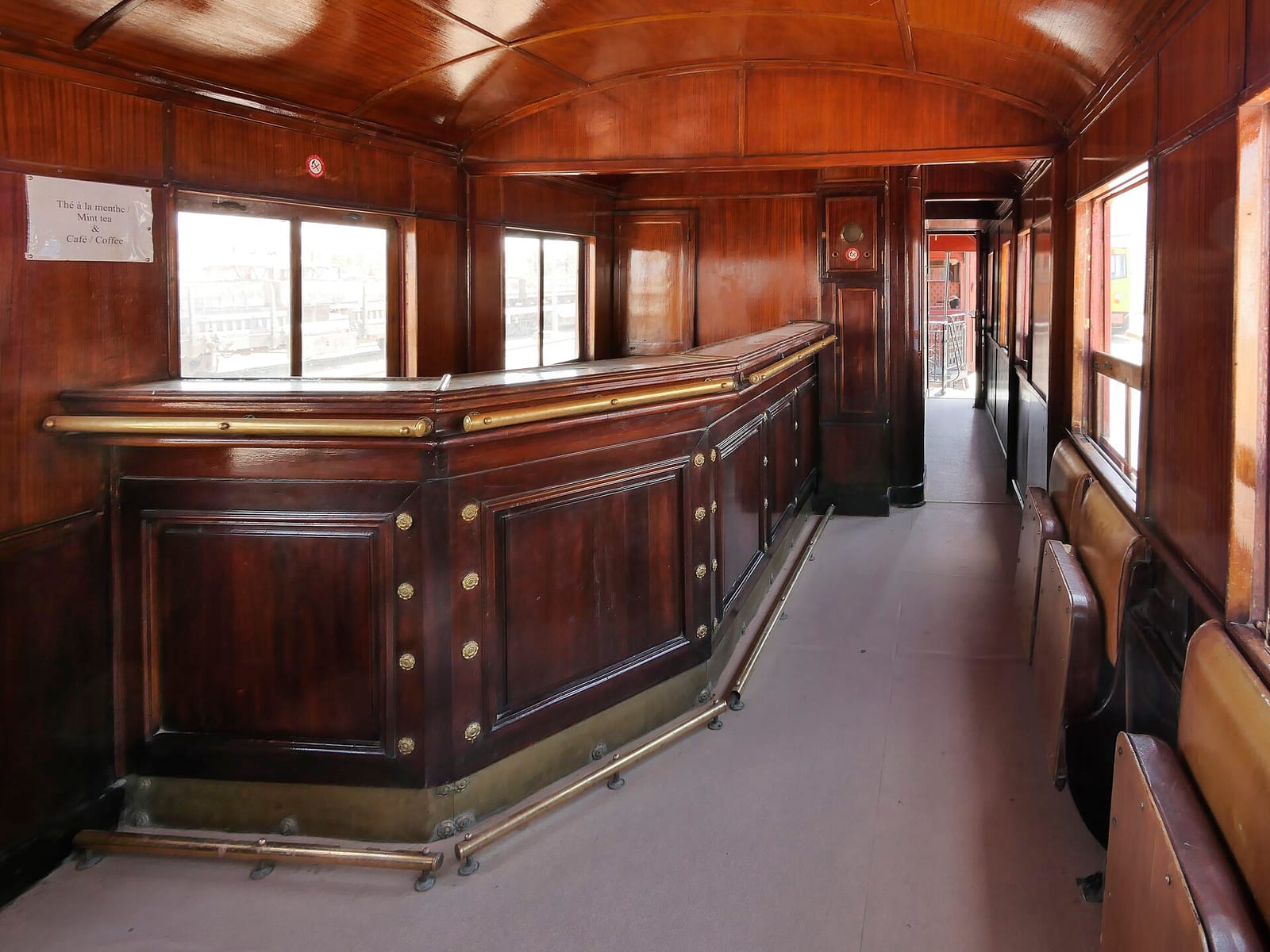
Six vehicles make up the rake — a salon, a bar car and four seated carriages, two of them first class, 116 seats in all. The bar is the one worth finding: dark polished wood, a proper counter, and windows onto a desert gorge. It is not the Orient-Express and it does not pretend to be, but the woodwork is real and it is over a century old.Elcèd77 / Wikimedia Commons · CC BY-SA 3.0Ride the gorge on the ordinary train
Very few people know this. SNCFT's own summer timetable shows a scheduled service train on the same branch — Métlaoui to Redeyef and back — and one of its stops is a station called Selja, in the gorge itself. It is a workaday train for the mining towns, not a tourist product, and the northbound working leaves Redeyef at half past four in the morning. But it means the canyon is reachable even when the red train is in the workshops.Timetables
There are two quite different ways to ride the Selja Gorge, and only one of them is the red train. Read both before you plan.
1. The Lézard Rouge excursion
Confirm before you travel. This train has spent much of the last decade out of service and only returned on 16 May 2025. SNCFT does not publish its timetable on the same pages as the ordinary services.
The pattern reported for the excursion is:
| Season | Roughly May to September |
| Days | Daily except Saturdays |
| Departure | 10:00 on Sundays, Tuesdays and Thursdays · 10:30 on Mondays, Wednesdays and Fridays |
| From | Métlaoui station |
| Duration | About 1 hour 45 minutes, there and back, including the halt in the gorge |
Treat these times as indicative and check them with SNCFT directly — this is a tourist working whose days and season have changed repeatedly, and no fare is published online.
2. The ordinary service train — Métlaoui to Redeyef
This is the useful discovery, and it comes straight off SNCFT's own long-distance timetable poster for summer 2026 (valid 1 July to 31 August 2026). A scheduled passenger train runs the mining branch in each direction, and one of its stations is Selja, in the bottom of the gorge.
Train 15/77 — Métlaoui → Redeyef
| Station | |
|---|---|
| Métlaoui | 17:10 |
| Magroun | 17:20 |
| Selja | 18:01 |
| El Ayoun | 18:06 |
| Moulares | 18:14 |
| Tabeddit (1st stop) | 18:35 |
| Tabeddit (2nd stop) | 19:00 |
| Redeyef | 19:27 |
Train 16/60 — Redeyef → Métlaoui
| Station | |
|---|---|
| Redeyef | 04:30 |
| Tabeddit (1st stop) | 05:05 |
| Tabeddit (2nd stop) | 05:30 |
| Moulares | 05:47 |
| El Ayoun | 05:52 |
| Selja | 05:58 |
| Magroun | 06:36 |
| Métlaoui | 06:46 |
Two things to note. The timetable really does show two separate calls at Tabeddit, twenty-five minutes apart, in both directions — that is how SNCFT prints it, and no source we could find explains why. And the two trains are timed to connect at Métlaoui with the long-distance services: 15/77 meets train 5-13/57 for Tozeur, and 16/60 meets train 13-5/72 for Tunis.
The practical catch is daylight. Southbound through the gorge you pass Selja at 18:01, which in autumn or spring is a good hour to be there. Northbound you pass at 05:58, which is before dawn for much of the year.
Getting to Métlaoui in the first place
Métlaoui sits on the main line to Tozeur, and there is one through train each way per day (summer 2026):
| Southbound (train 5-13/57) | Northbound (train 13-5/72) | ||
|---|---|---|---|
| Tunis Ville | 07:25 | Tozeur | 06:00 |
| Sousse | 09:56 | Métlaoui | 07:20 |
| Sfax | 12:31 | Gafsa | 08:00 |
| Gafsa | 16:30 | Sfax | 11:05 |
| Métlaoui | 17:35 | Sousse | 13:45 |
| Tozeur | 18:30 | Tunis Ville | 16:31 |
Note what this means for a day trip: the train from Tunis does not reach Métlaoui until the evening, so the Lézard Rouge's morning departure requires an overnight stay in Métlaoui, Tozeur or Gafsa. Most visitors arrive by road from Tozeur, which is about an hour away.
Operator: SNCFT — timetables at sncft.com.tn (opens in a new tab), tourist trains at sncft.com.tn/voyageurs/produits-touristiques (opens in a new tab). Times above are taken from SNCFT's published summer 2026 timetable, as of July 2026.
Tickets
Tickets are sold by SNCFT, though in practice most visitors book through a hotel or agency in Tozeur rather than turning up at Métlaoui and hoping. SNCFT does not publish a fare for this train online, and figures on travel sites are undated and unreliable — some predate the train's eight-year absence from service. Ask when you confirm.
Three things to do before you go. Confirm it is running, which is not a formality: the train was out of service from around 2017 until 16 May 2025 and has stopped repeatedly before. Ask which day, because the days and the start times have changed over the years. And ask about the class, because two of the four seated carriages are first and the panelled saloon is a different thing again. Carry cash: card acceptance in Métlaoui is limited.
Book your tickets
The Lézard Rouge excursion
Métlaoui into the Selja Gorge and back
The tourist working from Métlaoui station, about an hour and three quarters there and back, with the halt in the gorge included. SNCFT does not publish a fare online and the train has a history of long lay-offs, so confirm both the price and that it is running before you travel to Métlaoui.
Book Tickets (opens in a new tab, on SNCFT)via SNCFTService train · Métlaoui to Redeyef
The everyday train through the same gorge
An ordinary SNCFT passenger service along the mining branch, calling at Selja in the bottom of the gorge and connecting at Métlaoui with the long-distance trains to Tozeur and Tunis. No frills, no commentary, ordinary fares — and it runs when the tourist train does not.
Book Tickets (opens in a new tab, on SNCFT)via SNCFTRail Passes
No rail pass covers the Lézard Rouge. Interrail and Eurail are European schemes, and Tunisia is not among the 33 countries in Interrail's list of covered railway companies (opens in a new tab). SNCFT sells its seats, usually through a hotel or agency in Tozeur.
Checked October 2026 against Interrail's list of covered railway companies (opens in a new tab).
Places to Visit
Métlaoui is a base rather than a destination. Almost everyone who rides the Lézard Rouge is staying an hour west, in the oases of the Djerid, and the gorge is one day of a longer trip through the Tunisian south.
Nothing below is more than about ninety minutes from Tozeur by road, and only Gafsa is reachable by train. Hire a car or a driver for a couple of days and you can take in the salt pan, the mountain oases and the canyons in one loop — which, together with the gorge, is the whole of southern Tunisia in about three days.
 Skander zarrad / Wikimedia Commons · CC BY-SA 4.0 · cropped
Tozeur
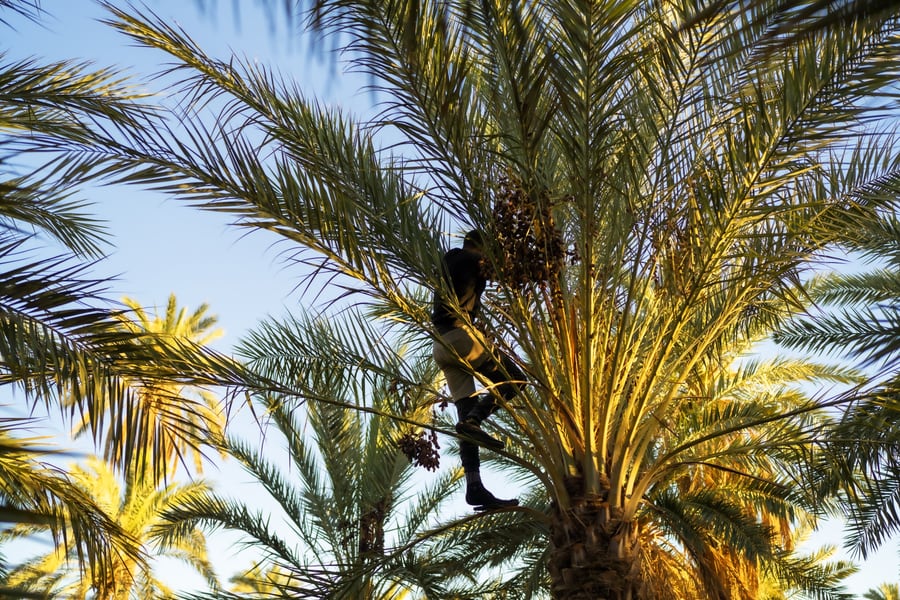
The largest of the Djerid oases and the natural base for this journey, an hour west of Métlaoui. Beyond the town the palm groves run for kilometres, watered by a channel system in use since the fourteenth century and startlingly cool and green after the drive in. The old quarter, Ouled el Hadef, is built of yellow brick laid in raised geometric relief — a style found almost nowhere else in Tunisia.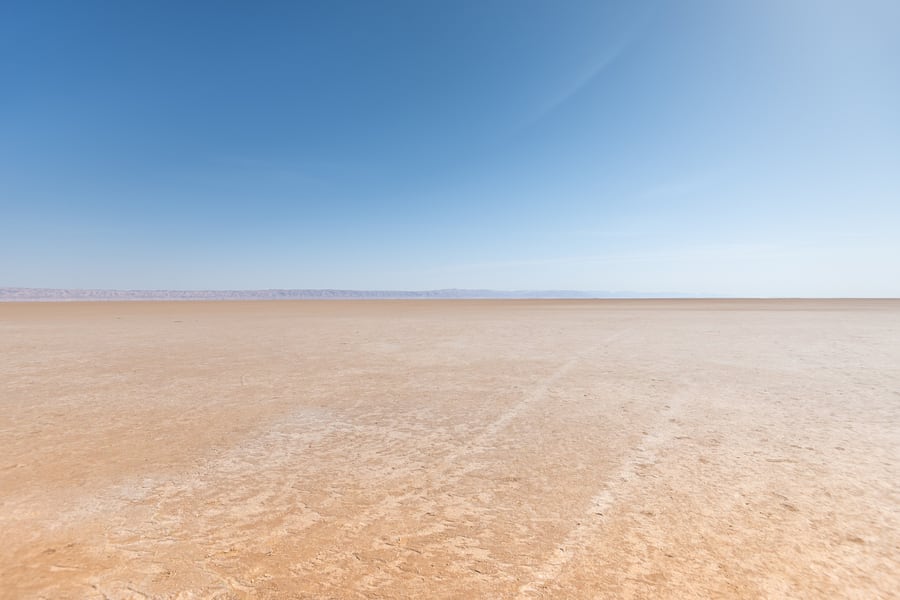 Benmahjoub mohamed / Wikimedia Commons · CC BY-SA 4.0 · cropped
Chott el Djerid
The largest salt pan in the Sahara — sources put it between 5,000 and 7,000 square kilometres — lies half an hour south of Tozeur, almost entirely dry by summer, when ground temperatures reach 50°C and the fata morgana mirages start. Salt-crystal stalls and stranded boats sit along the road across it. ⚠️ Do not walk or drive out onto the open crust: it is not always firm, and people have gone through it.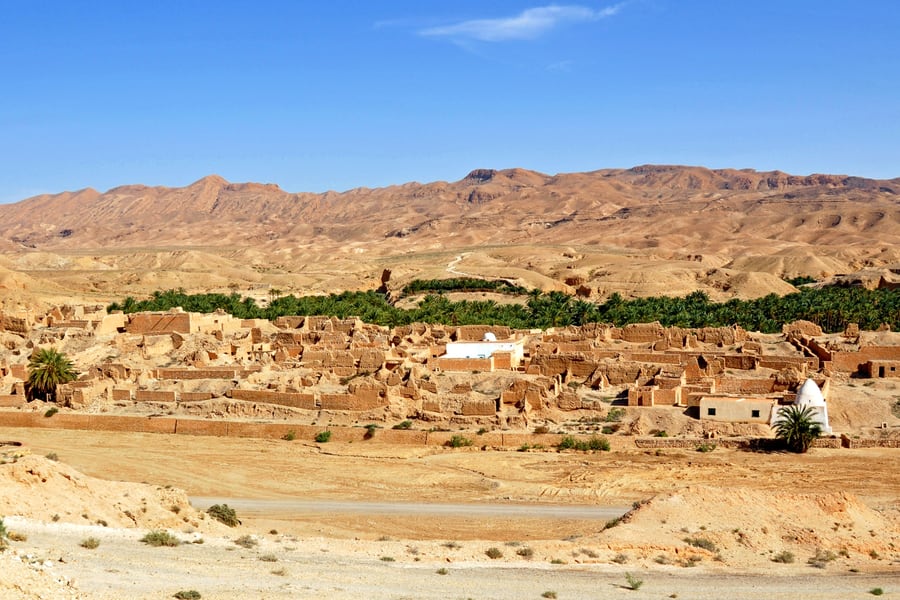 Dennis G. Jarvis / Wikimedia Commons · CC BY-SA 2.0 · cropped
Tamerza and Chebika
Tamerza is the largest mountain oasis in Tunisia, the Roman Ad Turres, seventy kilometres north-west of Tozeur against the Algerian border. The old village is a ruin because the river flooded for twenty-two days in 1969 and everyone moved out; the new town sits alongside it. Chebika is the same story on a smaller scale — a spring in a cleft of bare rock, a waterfall and a palm grove below abandoned walls.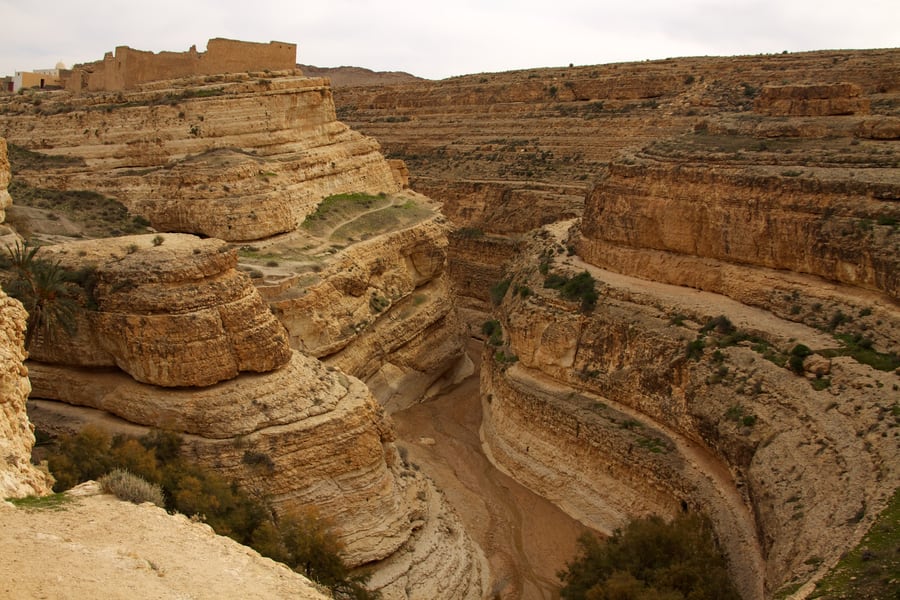 McKay Savage / Wikimedia Commons · CC BY 2.0 · cropped
Mides
Six kilometres from Tamerza, and the reason to keep going. Mides sits on the very lip of its own gorge, a tight meander cut into banded rock with the abandoned village hanging over the drop and the Algerian frontier just beyond. It is a smaller and considerably more vertiginous cousin of the Selja, and unlike the Selja you can stand at the top of it and look straight down.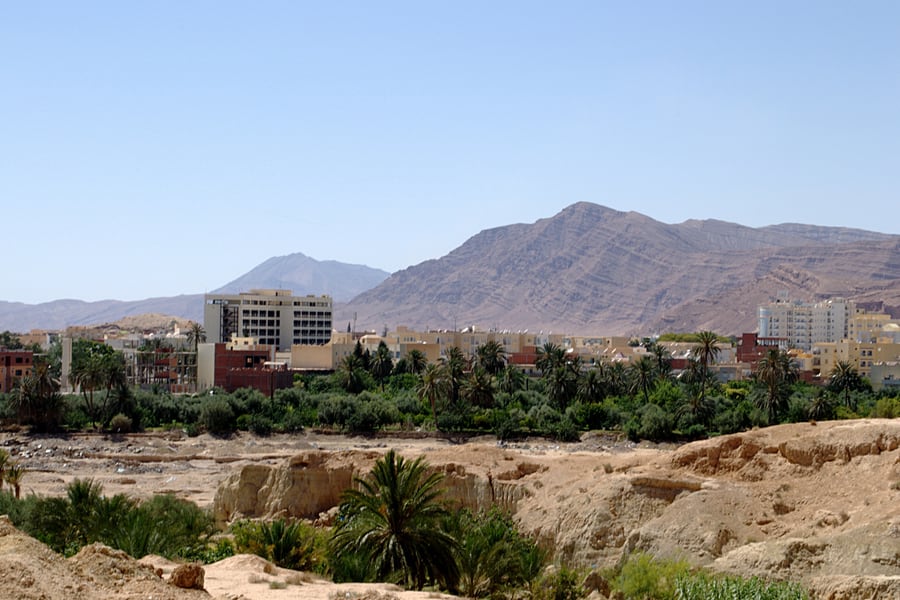 Habib M'henni / Wikimedia Commons · CC BY-SA 3.0 · cropped
Gafsa
The regional capital, ninety minutes east of Métlaoui and on the same railway — the Tunis–Tozeur train calls here. Gafsa is the Roman Capsa, which gave its name to the Capsian culture of prehistoric North Africa, and it became a municipium under Trajan. The town sits between bare mountain and a working oasis, with a good archaeological museum and an old quarter of painted doors.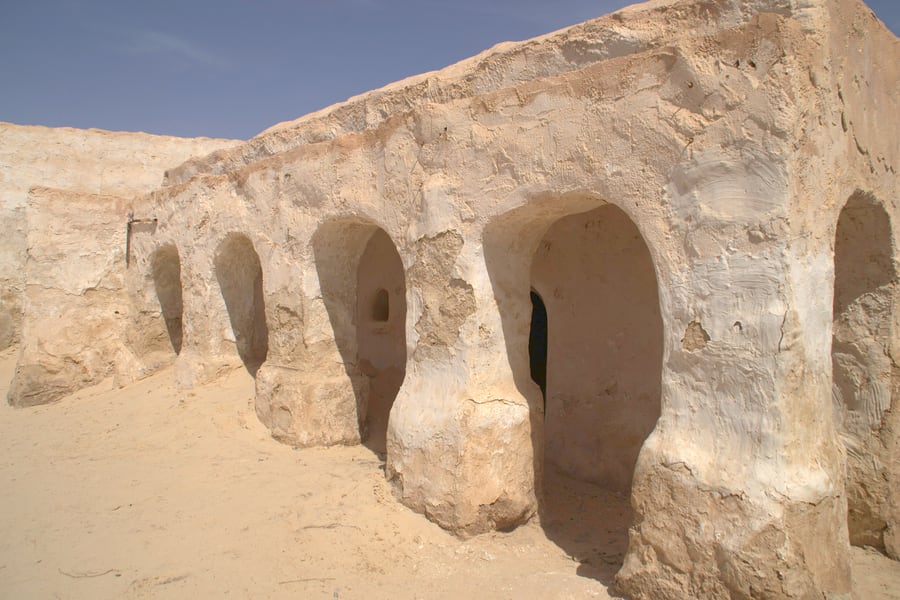 Habib M'henni / Wikimedia Commons · CC BY-SA 4.0 · cropped
Mos Espa
Some twenty buildings put up at Ong Jmel in 1997 for The Phantom Menace and simply left there. It is pure film tourism and heavily visited, but it is genuinely out in the sand — and it is being eaten. Planetary scientists tracking barchan dune migration by satellite watched one close from about 140 metres away to roughly ten between 2002 and 2009, moving some fifteen metres a year. Go before it arrives.Where to Sleep
Almost nobody sleeps in Métlaoui. It is a mining town with very limited accommodation, and the usual pattern is to base yourself in Tozeur, about an hour to the west by road, and come over for the morning departure.
Tozeur
The Djerid's tourist capital has by far the widest choice in the region. There is a strip of larger hotels in the zone touristique on the edge of town, most of them low-rise and built in the local patterned brick, with pools and gardens that matter a great deal in this climate. In the old town and around the palm grove there are smaller guesthouses and restored courtyard houses — quieter, more atmospheric, and close enough to walk into Ouled el Hadef in the evening.
Book ahead in spring and autumn, which are the high seasons here. Midsummer is very hot and much emptier; midwinter nights in the desert are genuinely cold.
Nefta
Half an hour further west, smaller and much less developed than Tozeur, with its own large oasis in a natural basin called the Corbeille. A handful of hotels and guesthouses. A good choice if you want the palm groves without the tour buses.
Gafsa
The practical alternative if you are arriving or leaving by train, since it is on the main line and has more services than Métlaoui. Accommodation is modest and business-oriented rather than scenic, but the town is real, the Roman pools are in the centre, and it puts you ninety minutes from the gorge.
Tamerza
There are a couple of hotels up in the mountain oases near the Algerian border, dramatically sited above the canyons. They are remote — you will need a car or a driver — but the setting is extraordinary and the light at either end of the day is worth the trip on its own.
A note on getting around
There is no useful way to combine the Lézard Rouge with the long-distance train in a single day: the service from Tunis does not reach Métlaoui until the evening. Plan on arriving in the Djerid the day before, by road from Tozeur or on the overnight-ish run from Tunis, and treat the gorge as its own morning.
Questions or corrections
Planning this trip and stuck on something, or spotted a time, fare or detail that has changed? Send us a message about The Lézard Rouge. We read every one, and we update this page when something has changed.