The Lößnitzgrundbahn to Moritzburg and Radeburg
Jörg Blobelt / Wikimedia Commons · CC BY-SA 4.0
- Distance16.5 km (Radebeul Ost–Radeburg)
- Duration55 minutes end to end; 29 minutes to Moritzburg
- Best seasonYear-round — and busiest in midwinter, for the castle's Cinderella exhibition
Introduction
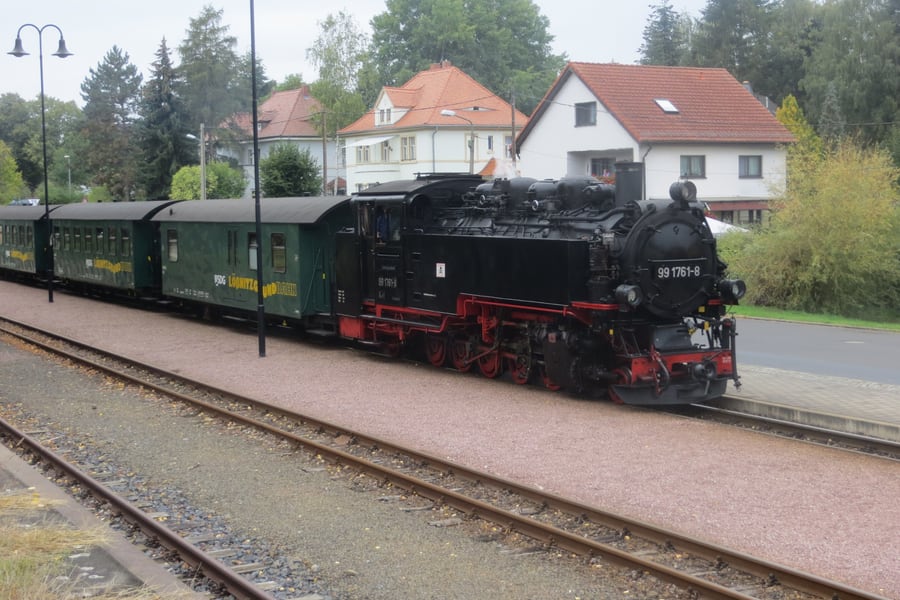
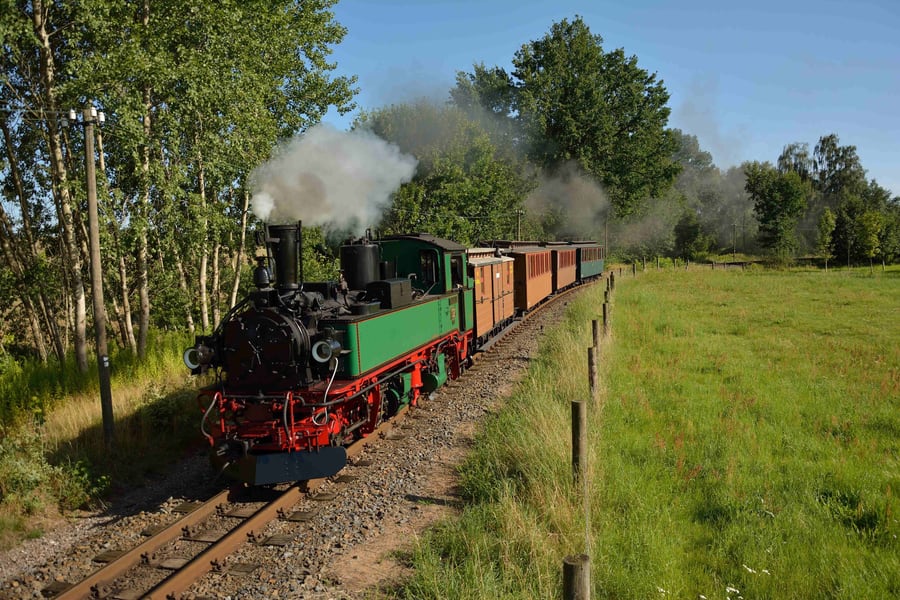
The Lößnitzgrundbahn runs sixteen and a half kilometres of 750-millimetre track from Radebeul Ost, twelve minutes out of Dresden on the S1, through a wooded valley and a chain of ponds to the small town of Radeburg. It opened on 16 September 1884, it is worked by steam every day of the year, and the whole journey takes fifty-five minutes.
The timetable, though, says something the publicity does not: half of its trains do not go to Radeburg at all. Four services leave Radebeul Ost on a weekday and two of them turn round at Moritzburg, twenty-nine minutes up the line. The railway's own operating plan treats the last four and a half kilometres as optional.
The castle is the reason
Moritzburg is a baroque hunting lodge standing on an artificial island in an artificial lake, rebuilt for Augustus the Strong between 1722 and 1730 by the architect of the Dresden Zwinger. The railway has passed within a walk of it since 1884.
That relationship shows up in the only number that matters to a small railway. The Lößnitzgrundbahn carried 176,056 passengers in 2007 and about 275,000 in 2019 — it has been getting busier, steadily, for a decade and a half. Its sister line the Weißeritztalbahn, the same gauge and the same operator, forty kilometres away on the other side of Dresden, went the other way over the same period: 185,000 in 2009, 131,484 in 2021.
The two railways are near enough identical as railways. One of them goes to a castle.
What that makes it
Not a museum piece, and not quite an ordinary branch line either. The Lößnitzgrundbahn is a working steam railway whose main traffic is people going somewhere specific, which is a rarer thing than it sounds — most preserved lines in Europe are the destination themselves.
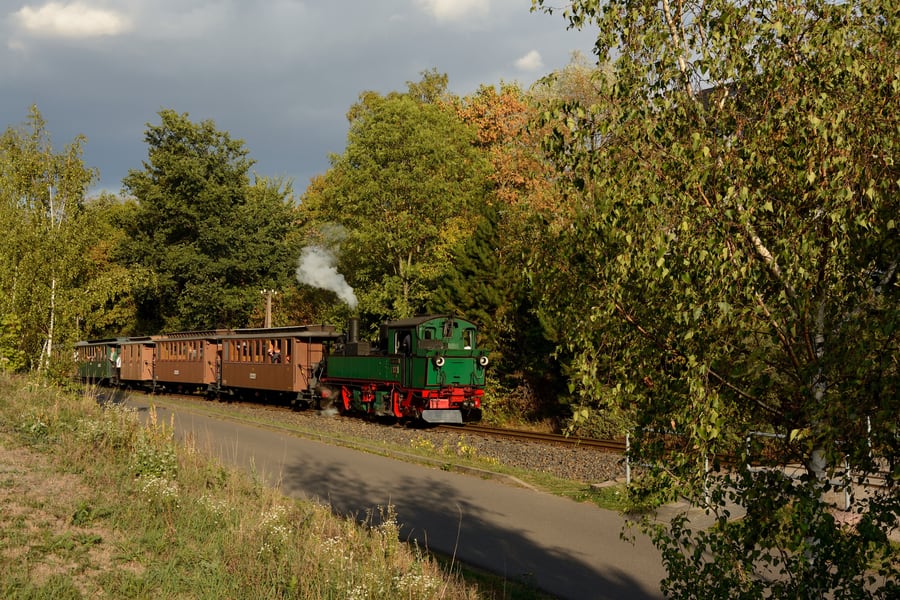
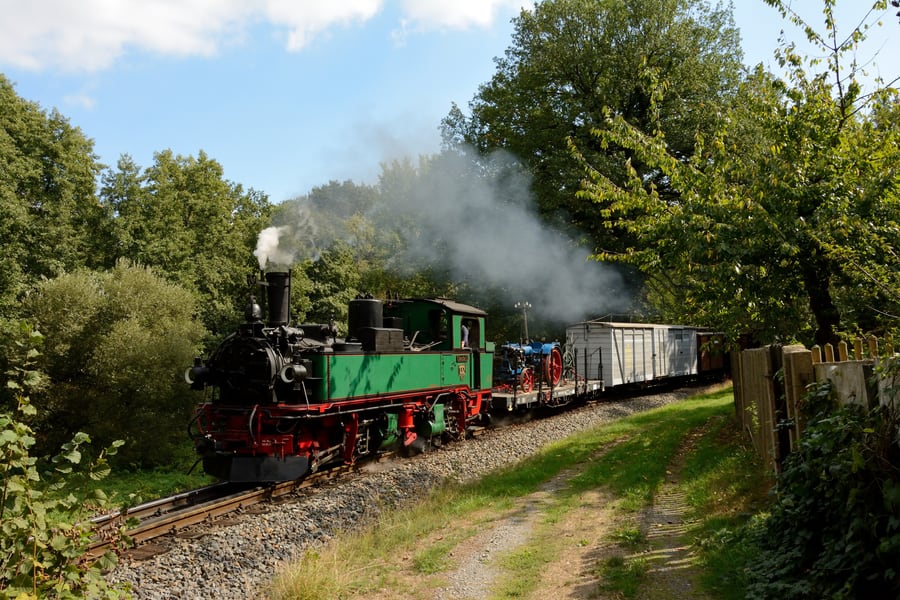
It also carries a second, older railway inside it. The Traditionsbahn Radebeul has been running historic trains over these metals since 10 August 1974, which made it the first regular museum train service anywhere in East Germany, and it is still going: two Saxon IV K locomotives from the 1890s and thirteen coaches built between 1894 and 1930, operating on their own published calendar alongside the everyday service.
The small things
The line is gentle — a maximum gradient of 16.6 per mille and a highest point of 179 metres at Friedewald Bad, where it crosses the Dippelsdorfer Teich on three short bridges. It is nicknamed the Lößnitzdackel, the dachshund, for the way it wriggles along the valley.
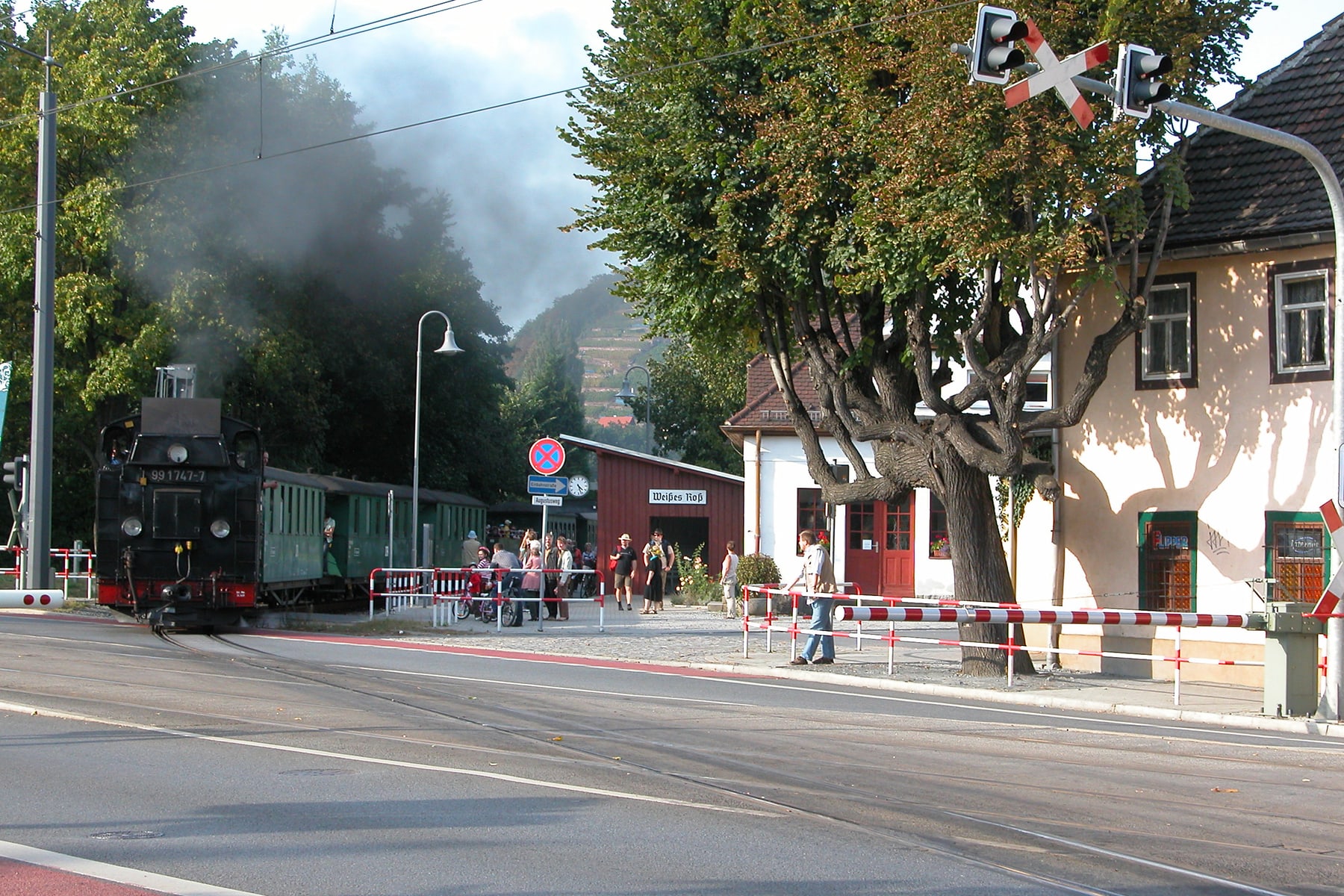
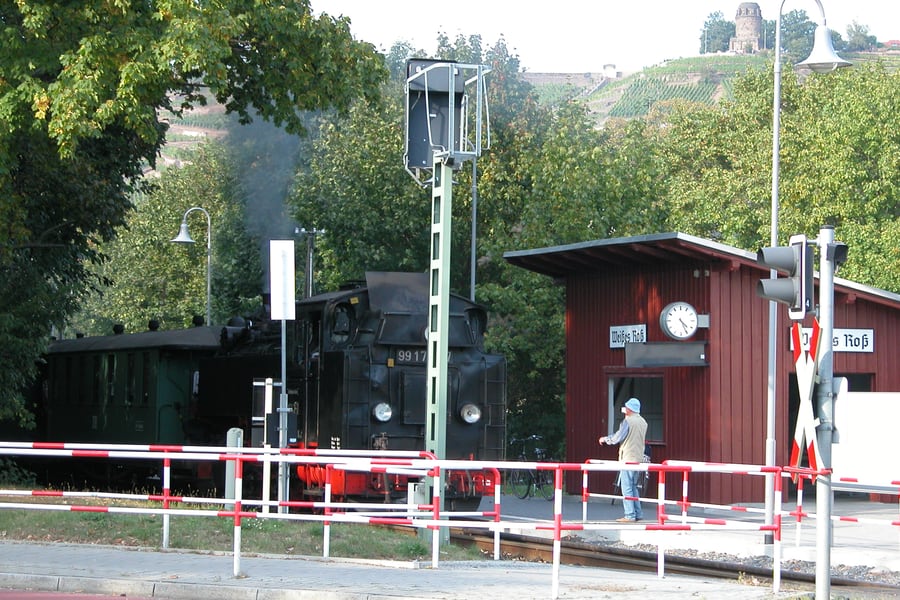
And at Weißes Roß, the second stop, a 750-millimetre steam railway crosses a Dresden city tramway on the level, barriers down, in the middle of a suburb, with the vineyard terraces of the Lößnitz on the hill behind. It is an unglamorous piece of infrastructure and one of the odder things a European railway does on an ordinary Tuesday.
The Journey
The narrow gauge starts in a bay at Radebeul Ost (112 m), across the platform from the S1 to Dresden and Meißen. Radebeul is wine country — the terraced Lößnitz vineyards climb the hill immediately north of the station — and the town's other draw is a short walk away: Karl May lived and died at the Villa Shatterhand on Karl-May-Straße, and the museum there is why the railway runs a special timetable for the Karl-May-Festtage each May.
Weißes Roß, and the tram
For the first kilometre the train runs along the side of the street. At Weißes Roß (117 m) it crosses the tracks of Dresden tram route 4 on the level, with barriers, and then a main road as well. On a Saturday there is usually a small crowd at the barriers, because a steam locomotive going about its business through a suburb is a thing people stop for.
Beyond the crossing the line enters the Lößnitzgrund itself, the wooded valley the railway is named after, and follows it uphill past Lößnitzgrund halt (143 m) among the mills and inns that were Dresden's Sunday walking country long before the railway came.
The ponds
Friedewald (Dresden) Hp (160 m) and Friedewald Bad (179 m) sit in pine forest. Friedewald Bad is the summit of the line — the whole railway climbs just sixty-seven metres from end to end, on a maximum gradient of 16.6 per mille — and immediately beyond it the track crosses the Dippelsdorfer Teich on three short bridges, with water on both sides.
This is the beginning of the Moritzburg pond landscape: a chain of artificial lakes dug and dammed over centuries for fish, and then rearranged in the eighteenth century for the view. The line threads between them for the next four kilometres.
Moritzburg
Moritzburg (177 m) is twenty-nine minutes from Radebeul Ost and is, in practice, the line's centre of gravity. It is the only station where trains cross, the only one where every service calls with two minutes in hand, and the place where half of them terminate and run round. The castle is about a kilometre from the platform.
It is worth understanding what that means for a day out. Four trains a day leave Radebeul Ost; two continue to Radeburg. If you are going to Moritzburg you have a proper service. If you are going beyond it you have two trains, four and a half hours apart.
The quiet end
Past Moritzburg the country flattens and empties. Cunnertswalde and Bärnsdorf (both 167 m) are small; from Bärnsdorf it is a walk to the Großteich and the miniature lighthouse that Augustus the Strong's descendants put up beside it. Berbisdorf (158 m) and Berbisdorf Anbau (149 m) are halts in the fields.
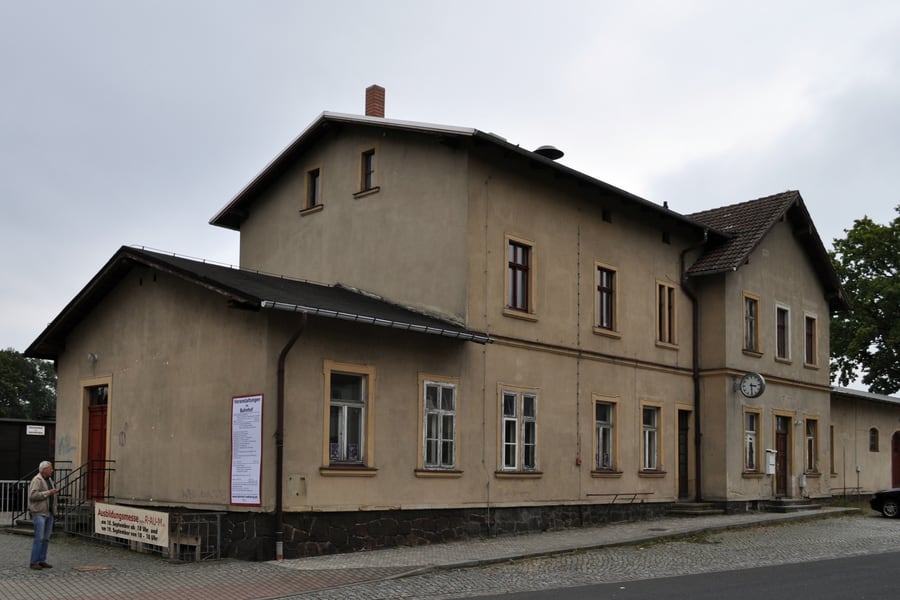
Radeburg (148 m) is a town of about seven and a half thousand people that has been there since 1248 and got its railway in 1884. Its station building is a plain, four-square thing at the end of a long straight, and the town's own claim on the world is Heinrich Zille, the Berlin illustrator, who was born here on 10 January 1858.
The two trains a day that come this far are the ones worth catching.
Along the route
Manfred Schröter, Berga / Wikimedia Commons · CC BY-SA 4.0Half the trains stop short, and that is the story
Four services leave Radebeul Ost on an ordinary day and two turn round at Moritzburg, leaving the last four and a half kilometres to Radeburg with two trains and four and a half hours between them. Nothing in the publicity says the castle is the destination. The operating plan says it clearly enough.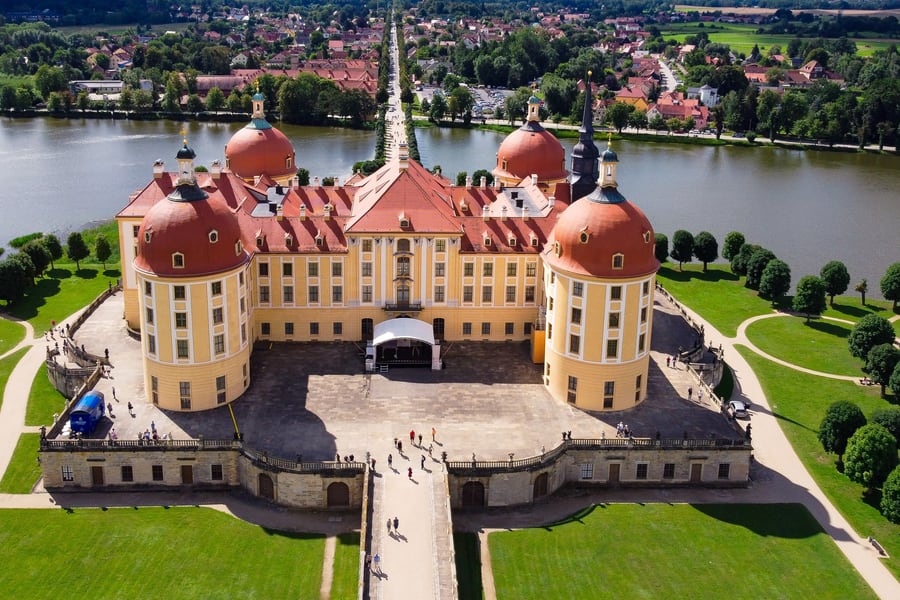 ftrc / Wikimedia Commons · CC BY-SA 2.0
The narrow-gauge line that is getting busier
This railway carried 176,056 passengers in 2007 and about 275,000 in 2019. Its sister the Weißeritztalbahn — same gauge, same operator, forty kilometres away — fell over the same period. One of them ends at a baroque hunting lodge on an island, and that is the whole difference.Jörg Blobelt / Wikimedia Commons · CC BY-SA 4.0A steam railway that crosses a city tram
At Weißes Roß, one stop out of Radebeul Ost, the 750-millimetre line crosses Dresden tram route 4 on the level, with barriers, and then a main road as well. On a Saturday there is usually a small crowd at the gates to watch it happen.A bit of history
Culture & experiences along the way
Traditionsbahn Radebeul / Wikimedia Commons · CC BY-SA 4.0Catch the Traditionsbahn, on its own dates
Historic trains have run on this line since 10 August 1974, which made the Traditionsbahn Radebeul the first regular museum train service anywhere in East Germany. It is still going: two Saxon IV K locomotives from the 1890s, thirteen coaches built between 1894 and 1930, and nine freight wagons from the 1910s and 1920s. It runs to a separate annual calendar published alongside the ordinary timetable, so it is a matter of picking the date.Michael Gäbler / Wikimedia Commons · CC BY-SA 3.0Go in the Cinderella weeks
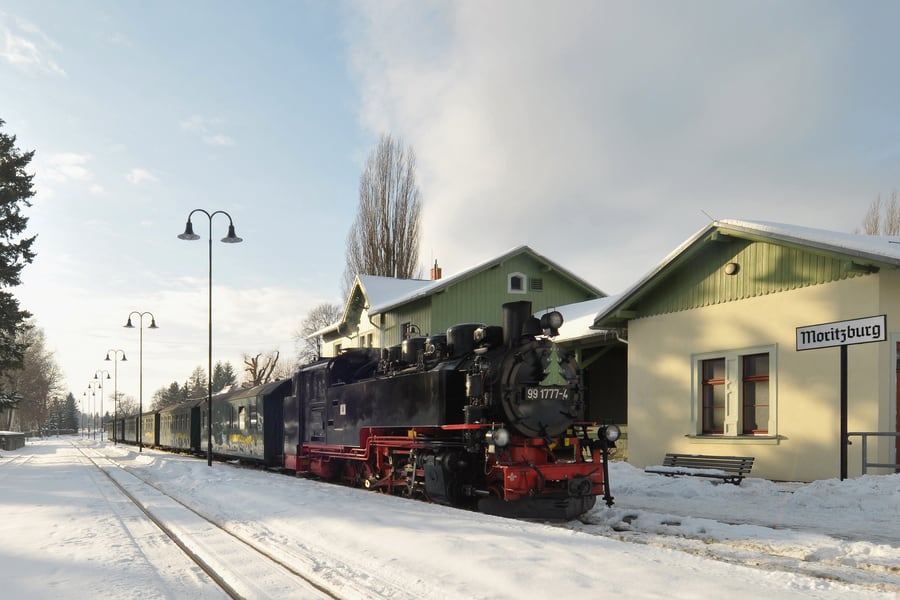
From mid-November to the end of February the castle gives its rooms over to an exhibition about Drei Haselnüsse für Aschenbrödel, the 1973 fairy-tale film shot partly at Moritzburg and still watched every Christmas across central Europe. The lake freezes, the steam shows properly in cold air, and the train runs to the same times it keeps in August. It is the one season when this quiet line is genuinely busy.Traditionsbahn Radebeul / Wikimedia Commons · CC BY-SA 4.0Ride both of the operator's Dresden lines in a day
A Deutschlandticket buys the €12.00 historic-railway supplement, and that supplement is good on all three of the operator's narrow-gauge railways on the same day. Two of them are within half an hour of Dresden on opposite sides — this one at Radebeul and the Weißeritztalbahn at Freital — and both run steam every day of the year. It is the cheapest twelve euros in Saxon railway travel.Timetables
Four trains a day each way between Radebeul Ost and Moritzburg; two of them go on to Radeburg. The times are the same every day of the year, and a fifth pair runs on weekends through the season.
Checked against Deutsche Bahn's schedule data and the operator's own timetable sheet for the year running 14 December 2025 to 12 December 2026, sampled across weekdays, weekends and December 2026.
Up the line — Radebeul Ost northwards
| Train | Radebeul Ost | Weißes Roß | Friedewald Bad | Moritzburg | Radeburg |
|---|---|---|---|---|---|
| P 3000 | 08:56 | 09:03 | 09:19 | 09:25 | — |
| P 3002 | 10:26 | 10:33 | 10:49 | 10:55 / 10:57 | 11:21 |
| P 3004 | 13:26 | 13:33 | 13:49 | 13:55 | — |
| P 3006 | 14:56 | 15:03 | 15:19 | 15:25 / 15:27 | 15:51 |
| P 3008 ✱ | 17:56 | 18:03 | 18:19 | 18:25 | — |
Down the line — southwards to Radebeul Ost
| Train | Radeburg | Moritzburg | Friedewald Bad | Weißes Roß | Radebeul Ost |
|---|---|---|---|---|---|
| P 3001 | — | 09:33 | 09:40 | 09:55 | 10:00 |
| P 3003 | 11:36 | 12:01 / 12:03 | 12:10 | 12:25 | 12:30 |
| P 3005 | — | 14:03 | 14:10 | 14:25 | 14:30 |
| P 3007 | 16:06 | 16:31 / 16:33 | 16:40 | 16:55 | 17:00 |
| P 3009 ✱ | — | 18:33 | 18:40 | 18:55 | 19:00 |
End to end takes 55 minutes northbound and 54 southbound; Moritzburg is 29 minutes from Radebeul Ost. Where two times are shown the train stands there for two minutes.
✱ P 3008 and P 3009 run on some days only, and only between Radebeul Ost and Moritzburg. Between 28 March and 1 November 2026 they run on Saturdays, Sundays and Saxon public holidays, and also on 15 May; between 26 November and 12 December 2026 they run on Thursdays, Fridays and Saturdays.
Getting to Radebeul Ost
The S1 from Dresden Hauptbahnhof takes about twelve minutes and runs several times an hour, continuing to Meißen. Dresden tram route 4 also serves Weißes Roß, one stop up the narrow-gauge line, which is a useful alternative if the S1 timing is awkward. The operator notes that the printed S1 connection times are given without guarantee.
Two closures a year, with no replacement
The line shuts completely for maintenance on 9–27 March and 2–20 November 2026 — the same weeks as the operator's other two narrow-gauge railways. The trains are cancelled and there is no replacement bus; a journey planner queried inside the November window returns no departures at all.
Special timetables
A different timetable applies on 14 May and 24–25 May 2026. Separately published, extended timetables run on 15 February, for the Karl-May-Festtage on 16–17 May, and for the Schmalspurbahn-Festival on 19–20 September 2026. Reservations are not possible on those days.
The open coach, and the historic train
Between 1 May and 30 September 2026 certain trains carry an open observation coach, marked in the printed timetable.
The Traditionsbahn Radebeul runs its historic train on its own separate annual calendar, published as a distinct timetable rather than as part of the regular service — so seeing the 1890s locomotives and the pre-war coaches is a matter of picking the right date, not the right train.
Timetables and current notices at the operator: loessnitzgrundbahn.de (opens in a new tab).
Tickets
The railway sells its own tickets on a tariff in force since 1 January 2026. Four price stages by distance; Radebeul Ost to Radeburg is stage 4, at €9.90 one way and €19.80 return for an adult. Radebeul Ost to Moritzburg, which is what most passengers actually buy, falls in a lower stage. A day ticket over the whole line is €22.10. There are offices at Radebeul Ost and Moritzburg, and at the halts the train crew sell tickets on board with no surcharge.
A Deutschlandticket does not carry you on this railway. It entitles you to buy the €12.00 historic-railway supplement, which works as a day ticket and covers all three of the operator's narrow-gauge lines. Here the arithmetic is closer than on its sisters: €12.00 saves ten euros against the day ticket if you travel alone, and nothing at all if you only want a return to Moritzburg.
Book your tickets
Single and return
€9.90 single · €19.80 return, end to end
Four price stages by distance, and Moritzburg falls in a cheaper one.
Book Tickets (opens in a new tab, on Lößnitzgrundbahn (SDG))via Lößnitzgrundbahn (SDG)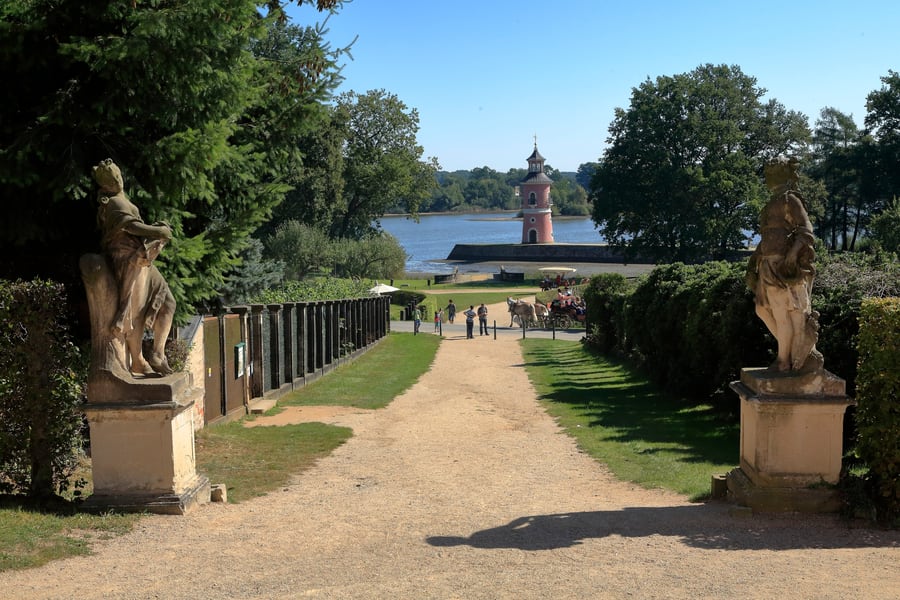
Day ticket
€22.10, and it pays on the second stop
The castle, the ponds and the lighthouse are at three different stations.
Book Tickets (opens in a new tab, on Lößnitzgrundbahn (SDG))via Lößnitzgrundbahn (SDG)Deutschlandticket supplement
€12, good on three railways at once
A day ticket for one person, bought on the day with the Deutschlandticket shown.
Book Tickets (opens in a new tab, on Lößnitzgrundbahn (SDG))via Lößnitzgrundbahn (SDG)Rail Passes
No rail pass is valid on the Lößnitzgrundbahn. Interrail, Eurail, a German Rail Pass, a BahnCard 100 — none of them carries you between Radebeul Ost and Radeburg. The line is privately operated, outside the national network, and accepts its own tickets and VVO season tickets only.
The Interrail half of that is worth being exact about, because it is decided by a single omission. Interrail's coverage table for Germany covers DB and the regional carriers and then defers everything else to a closed roster of companies inside the national tariff. The Sächsische Dampfeisenbahngesellschaft is absent from it — which is why all three of the SDG's Saxon steam lines fail the same test at once, and why the Deutschlandticket supplement below is the only national product that reaches any of them.
A pass does get you to the foot of it. Dresden to Radebeul Ost on the S1 is ordinary regional travel and is covered in the usual way; the narrow gauge across the platform is not.
The one national ticket that helps
The Deutschlandticket is the exception, and only indirectly. It does not carry you here either, but it entitles the holder to buy the operator's SDG-Historik-Zuschlag for €12.00, which then works as a day ticket — and covers the operator's other two Saxon narrow-gauge lines, the Weißeritztalbahn at Freital and the Fichtelbergbahn at Cranzahl, on the same day.
Of the three lines, this is the one where that supplement is worth the least on its own, because the day ticket here is only €22.10 to begin with. It becomes worth a great deal if you combine it with the Weißeritztalbahn: both lines are within half an hour of Dresden on opposite sides, both run steam every day, and twelve euros covers both.
Is a pass worth buying for this trip?
For this journey alone, no. A return over the whole line is €19.80 and a day ticket €22.10, and no pass reduces either. If you already hold a Deutschlandticket, the €12.00 supplement is the cheapest way to ride — and the argument for it gets stronger the more of the operator's network you use in the day.
If you are only going to Moritzburg and back, a return in the lower price stage is the simplest answer, and nothing else is needed.
Pass conditions and the operator's tariff were checked on 20 August 2026 against loessnitzgrundbahn.de (opens in a new tab) and Interrail's published list of railway companies.
Places to Visit
This is an easy line to break a journey on, at least as far as Moritzburg: four trains a day in each direction between Radebeul Ost and the castle means a stop of two hours or of four, whichever suits. Beyond Moritzburg there are two trains, and the choice is between four and a half hours at Radeburg or not going.
The cards below run in the order a train from Radebeul Ost reaches them.
Two things worth knowing that do not have cards of their own. At Radebeul, a walk from the terminus, is the Karl-May-Museum in the Villa Shatterhand, the house the adventure novelist lived in — the railway runs an extended timetable for the Karl-May-Festtage each May, which is as clear a statement of the connection as you could want. And in the Wildgehege Moritzburg, a wildlife enclosure in the forest a walk from Moritzburg station, red and fallow deer and wild boar live in the woods the castle was built to hunt over.
The castle itself is worth timing. Between mid-November and the end of February it gives over its rooms to an exhibition about Drei Haselnüsse für Aschenbrödel, the 1973 Czech-East German Cinderella film shot partly at Moritzburg, which remains something close to a Christmas institution across central Europe. In those weeks the castle is busier in the middle of winter than most Saxon country houses manage in August, and so, consequently, is the train.
 Jörg Blobelt / Wikimedia Commons · CC BY-SA 4.0 · cropped
The Lößnitz vineyards
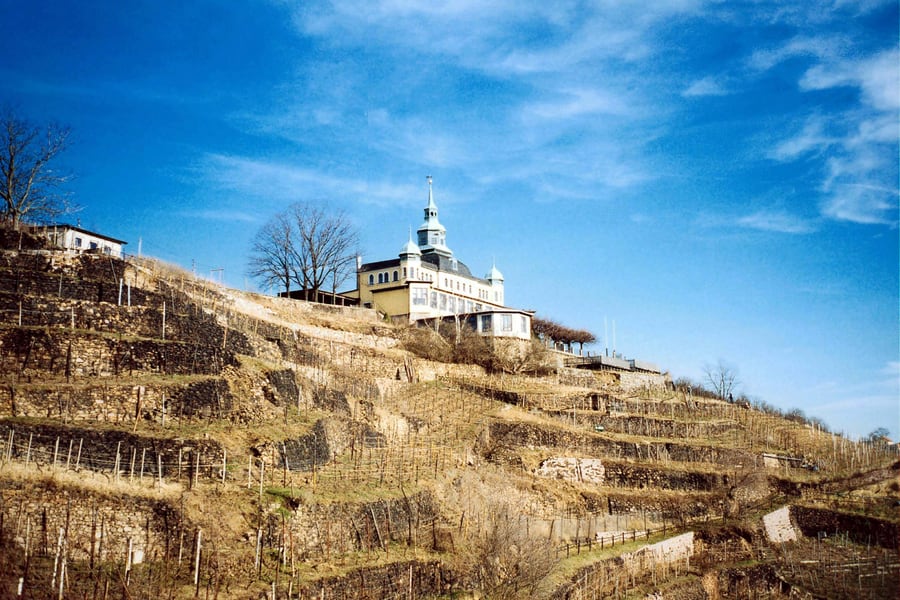
The railway begins in Saxon wine country. Terraces cut into the hillside above Radebeul carry the vines down towards the narrow-gauge track, with the Spitzhaus standing white at the top of them and a long flight of steps climbing to it. The train crosses a tram line and then a main road with all of this on the skyline behind it.ftrc / Wikimedia Commons · CC BY-SA 2.0 · croppedSchloss Moritzburg
A Renaissance hunting lodge of 1542–46, rebuilt between 1722 and 1730 for Augustus the Strong by Matthäus Daniel Pöppelmann, who also built the Zwinger — and set on an artificial island made from four existing ponds. Inside are gilded leather wall hangings in eleven rooms, a bed worked with something like a million feathers that took nineteen years to restore, and seventy-one red-deer trophies including the heaviest known antlers, at 19.8 kilograms.Falk2 / Wikimedia Commons · CC BY-SA 4.0 · croppedThe lighthouse on the Großteich
Saxony is four hundred kilometres from the sea and has a lighthouse anyway. It stands with a little harbour on the Niederer Großteich at Bärnsdorf, part of the eighteenth-century landscape laid out around the Fasanenschlösschen, the pheasant lodge a couple of kilometres east of the castle on a deliberate sightline from it. The whole thing was built for pleasure, and it still works. X-Weinzar / Wikimedia Commons · CC BY-SA 2.5 · cropped
Radeburg
A town of some seven and a half thousand people, first recorded in 1248 and holding town rights under Magdeburg law by 1288. Its claim on the wider world is Heinrich Zille, the illustrator of working-class Berlin, born here on 10 January 1858; the house went in a fire the following year, and the local museum keeps a room of his original drawings and awards a caricature prize in his name.Where to Sleep
Most people ride the Lößnitzgrundbahn from Dresden, which is twelve minutes from Radebeul Ost on the S1 and has beds at every price. With four trains a day to Moritzburg and back, a castle, a lake and a steam railway fit comfortably into a day trip, and that is what the timetable is shaped for.
Staying at Moritzburg changes the visit rather than extending it. The castle grounds, the ponds, the Fasanenschlösschen and the little harbour with its lighthouse are all within a walk of each other, and they are quiet after the last train has gone back down the valley — which on most days is soon after six. In the Aschenbrödel weeks between mid-November and February, when the castle is at its busiest, a bed in the village is the difference between queueing and not.
Both houses below are in Moritzburg itself and a few minutes apart: one in the village centre by the church, the other out among the oaks between the castle and the Fasanenschlösschen.
Where to stay
Hotel Landhaus Moritzburg
In the village centre, by the church
A family house on the Schlossallee run by the Rose family, a few minutes' walk from the castle and about the same from the station. Single, double, triple and four-bed rooms plus apartments, all non-smoking, with shower, television, WiFi and a minibar, and some with a balcony. Breakfast every morning.
Check Availability (opens in a new tab, on landhaus-moritzburg.de)via landhaus-moritzburg.deChurfürstliche Waldschänke
Among the oaks between the castle and the Fasanenschlösschen
A listed group of buildings on the Große Fasanenstraße, out in the Friedewald between the two lodges, with thirty-three individually furnished rooms — some with a terrace — and seven historic rooms given over to the restaurant, which cooks game from the local shoot and fish from the Moritzburg ponds. It is a walk from the station through the woods rather than a street away.
Check Availability (opens in a new tab, on waldschaenke-moritzburg.de)via waldschaenke-moritzburg.deQuestions or corrections
Planning this trip and stuck on something, or spotted a time, fare or detail that has changed? Send us a message about The Lößnitzgrundbahn to Moritzburg and Radeburg. We read every one, and we update this page when something has changed.