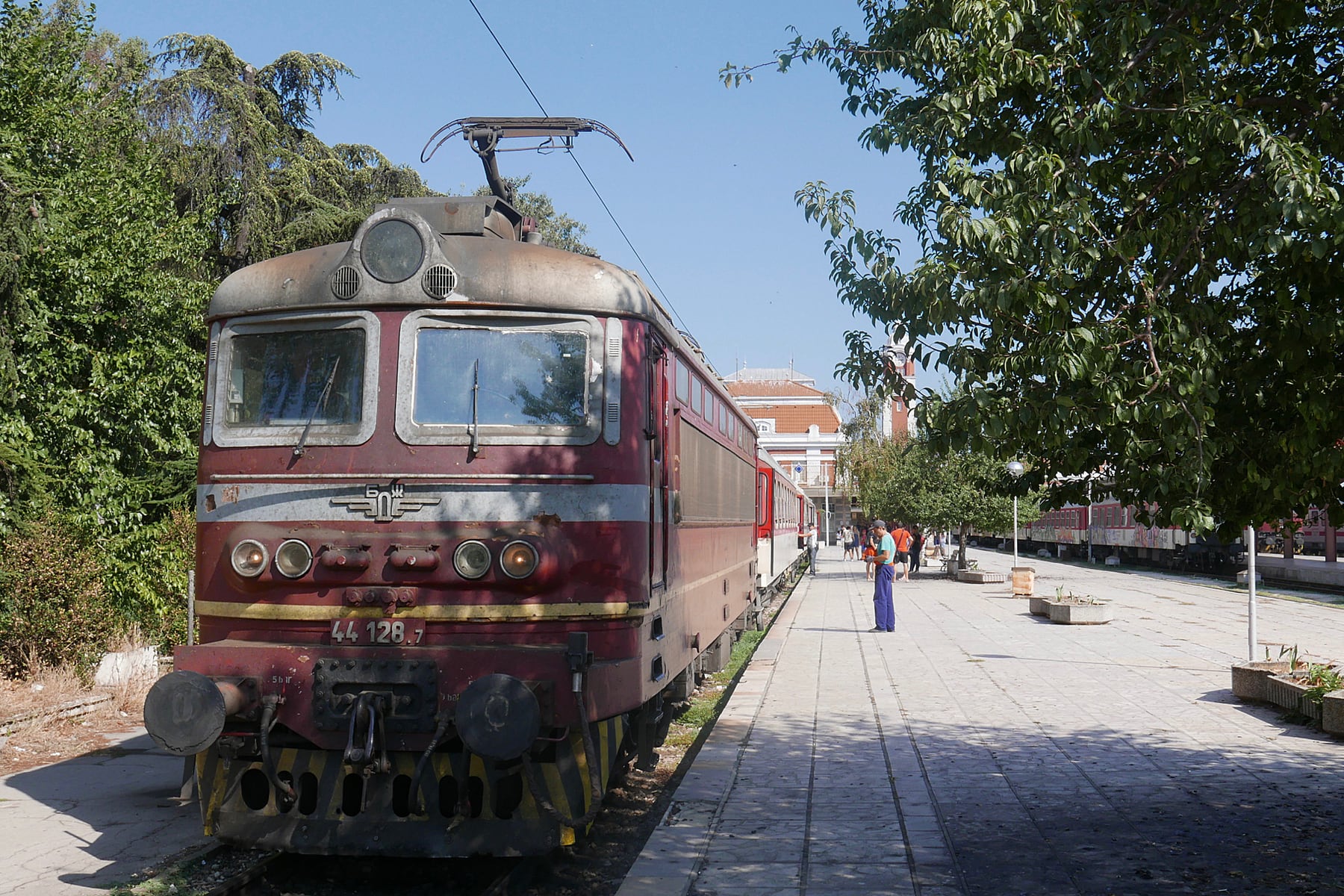
The Ruse–Varna Railway — Bulgaria's First Line
NAC / Wikimedia Commons · CC BY-SA 4.0
- DistanceRuse–Varna · 226 km
- Duration3 h 47 to 4 h 06, depending on the season
- Best seasonAll year · the summer timetable runs to 31 August
Introduction
On 7 November 1866 Midhat Pasha, governor of the Danube Vilayet, boarded a train at Ruse on the bank of the Danube and got off it at Varna on the Black Sea without having changed once. He then declared the railway open. It was the first line ever built in the Bulgarian lands, and at that point there was no Bulgaria — the country would not exist for another twelve years, and its future capital would not see a train for another twenty-two.
The line was not built for Bulgarians, and it was not built by them. An English company formed specially for the purpose by the brothers Henry and Trevor Barkley took a ninety-nine-year concession from the Ottoman government in October 1863, cut the first sod at Ruse on 21 May 1864, and imported every tool and machine it needed from England. It was the second of three schemes that British money pushed through the lower Danube after the Crimean War: Cernavodă to Constanța had opened in 1860 and Bucharest to Giurgiu would follow in 1869. All three did the same thing — shortened the water route by cutting across a neck of land — and this one was aimed squarely at the grain of the quadrilateral between Ruse, Shumen, Varna and Silistra.
What the shareholders wanted, the map still shows
Three years was not long, so the engineers drew the cheapest line they could and built it from both ends towards the middle. Minimum curve radius 335 metres, steepest gradient 25 in a thousand, iron rails weighing 32 kilogrammes to the metre in lengths of six or seven, and as little cut and fill as the plateau would allow. Shumen, the garrison town and the only place of consequence in between, sat where the earthworks would have been expensive. It was left twenty kilometres off the route, with an offer of a branch from Kaspichan by way of consolation. The trains still go past it.
That parsimony has had an odd afterlife. Because the line runs more or less straight, it is still the short way between the Danube and the sea: BDŽ's own fare panel puts the direct journey at 226 kilometres, while every other Ruse–Varna itinerary loops south-west through Gorna Oryahovitsa and covers 360. Two trains a day in each direction take the short way. Everything else takes the long one, and takes between an hour and a half and five hours longer to do it.
The bill
The company kept the line until 1873, handed the working of it to Baron Hirsch's Chemins de fer Orientaux, and presented the Ottoman government with a claim for two million pounds. When Bulgaria became a principality in 1878, article 10 of the Treaty of Berlin quietly transferred the whole obligation to the new state, and the argument over what it was worth went on for another eight years. A law of 24 August 1886 settled the buy-out at 44,500,000 gold leva — a figure the Bulgarian side put at nearly three times the railway's real value, and rather more than the 42 million the state collected in revenue that entire year. Bulgaria raised its first-ever state loan to pay it. The line changed hands on 10 August 1888, by which time interest had taken the total to 52,307,000 gold leva.
So Bulgaria's first railway was also its first national debt. It is a plain, useful, unglamorous line today — a diesel railcar at dawn, two compartment carriages in the afternoon, eleven stops with Cyrillic nameboards and a fare of seven and a half euros for the whole length of it — and it is worth riding for what it cost as much as for where it goes.
The Journey
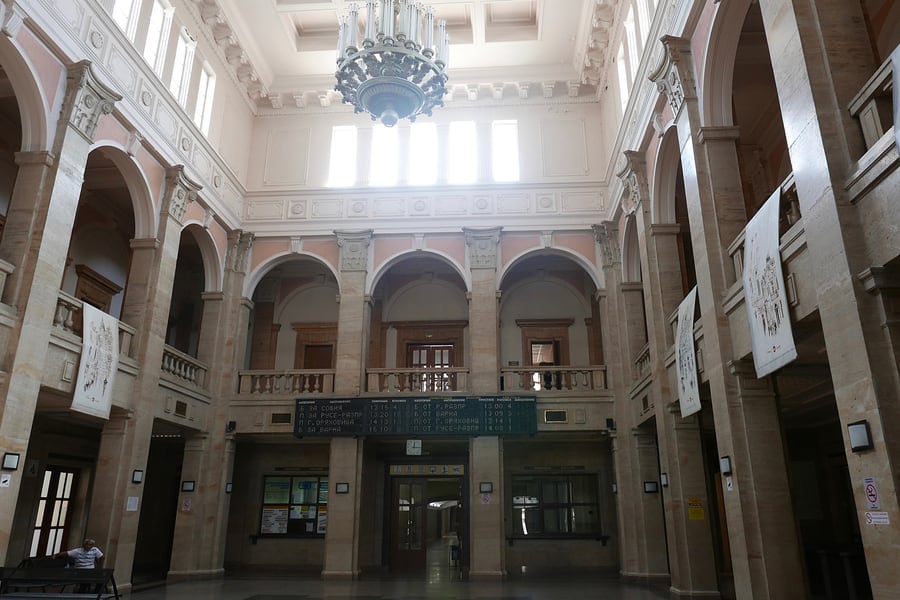
The train leaves from Ruse Central, which is not the station the railway started from. That one is a kilometre away on the bank of the Danube, and it is a museum. Ruse Central opened in late 1955, once the Danube bridge had made the town a frontier crossing as well as a terminus, and it was briefly the largest station on the Balkan peninsula: a Stalinist booking hall with arcades, a chandelier and far more room than the four daily trains to Varna now require.
For the first few minutes the train picks its way out through Ruse-Tovarna and Ruse-Razpredelitelna, the freight yards, sharing tracks with whatever is heading for the bridge and Giurgiu. Then it turns south-east, climbs out of the Danube valley, and settles onto the plateau it will follow for the next two hours.
Across the Ludogorie
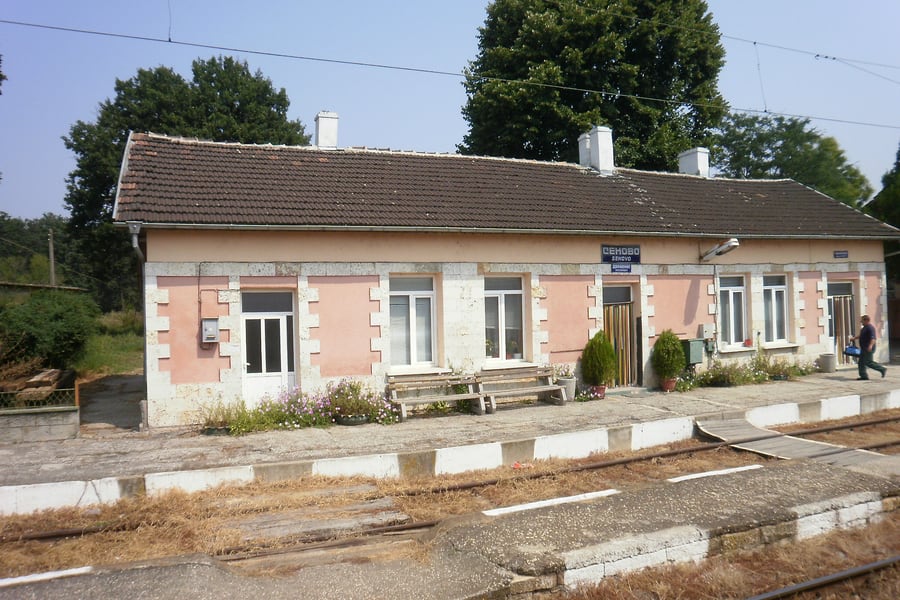
This is the Ludogorie — the Deliorman, the "wild forest" of the Ottoman name — a limestone plateau of wheat and sunflowers with almost no relief to it. The railway crosses it in long straights, and the effect from a carriage window is of a line that has decided where it is going and declines to be diverted. Yastrebovo, Vetovo, Senovo, Prostorno: small stations, some of them among the eleven the line opened with, spaced anywhere from seventeen to thirty-three kilometres apart because the builders put them where they expected traffic rather than where people happened to live.
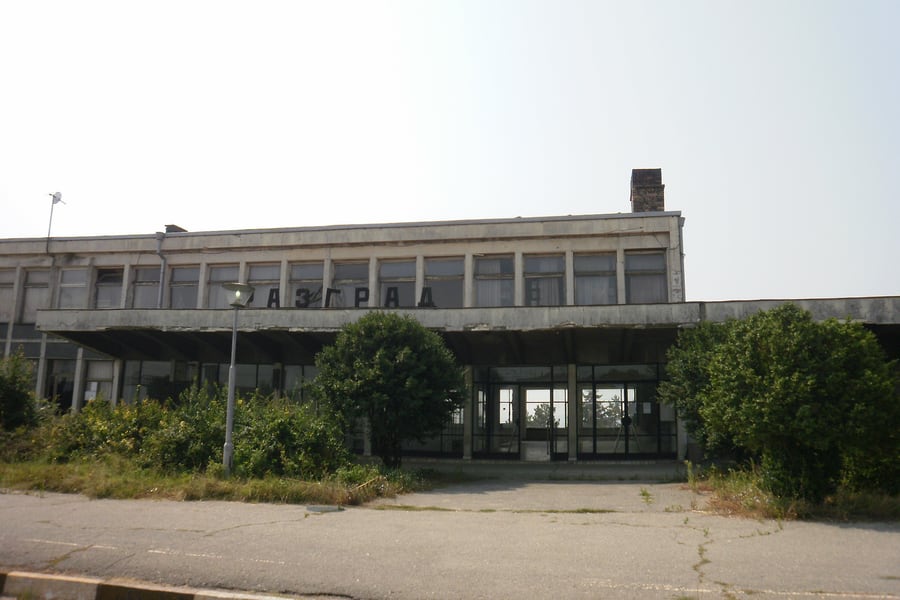
Razgrad, an hour and twenty out of Ruse, is the largest town on the line and its most substantial stop. A Roman city lies a kilometre to the east of it. The station that serves it now is a long concrete building of the socialist period, weathered and half-empty, which is a fair picture of what this railway carries today compared with what it was built to carry.
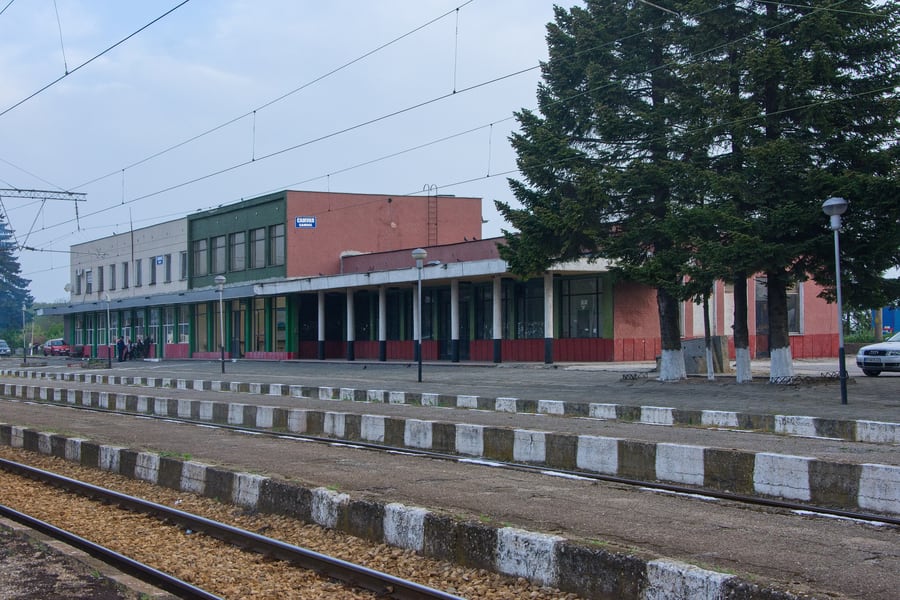
At Samuil the branch to Silistra goes off to the north-east, and three trains a day run up it to Isperih for the Thracian tomb at Sveshtari. Every direct Ruse–Varna service calls at Samuil, which makes the change a practical one rather than a theoretical one.
Pliska, and the turn to the sea
Past Visoka Polyana and Hitrino the country begins to fold. The train calls at Pliska — a two-minute stop at a village station — and this is the point at which the line's indifference to Bulgarian geography becomes almost funny, because three kilometres north lie the ramparts of the first capital of the Bulgarian Empire, and the English company that laid these rails was not thinking about it at all.
At Kaspichan the 1866 railway ends. The line was built as far as here and Varna beyond, but modern main line 9 is reckoned as Ruse–Kaspichan, 142 kilometres, and from Kaspichan the train runs onto main line 2, the long route down from Sofia. Shumen is twenty kilometres away to the west, and the train does not go there. Between 1982 and the 1990s there was a chord from a post called Asparuh that let Ruse trains reach Shumen directly without entering Kaspichan; traffic fell, and the link was lifted.
The last hour
From Kaspichan the line drops through Provadiya, where a gorge cuts between plateaus, then Dobrina, Sindel, Povelyanovo and Beloslav. The final stretch runs along the Varna lakes, past the chemical works at Devnya, between water on one side and industry on the other. It is not the prettiest approach to a seaside city in Europe. Then the tracks simply stop, a few streets behind the harbour, under the trees on Varna's long platform.
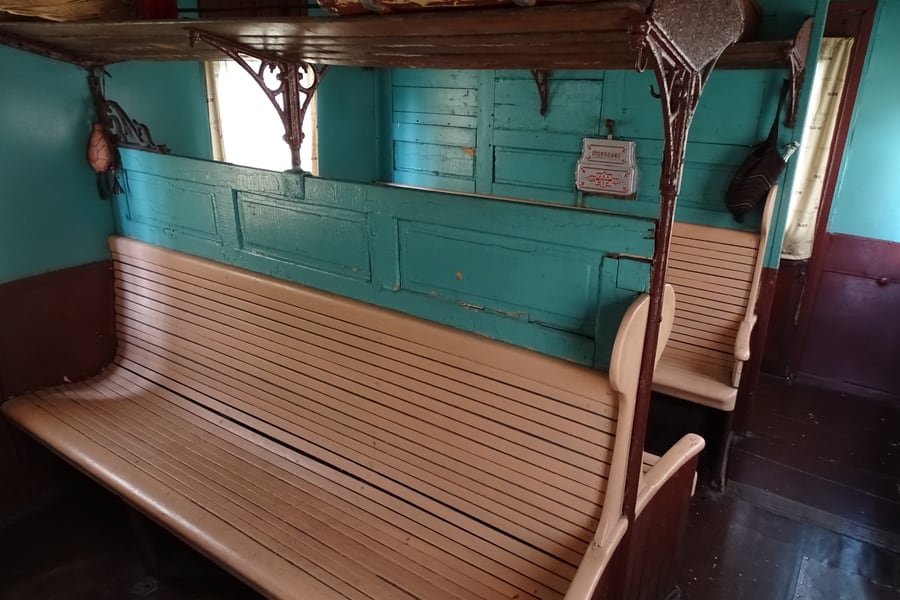
The whole thing takes between three hours forty-seven and four hours six, depending which train and which half of the year. In 1866 it took about eight hours, in carriages a traveller of the 1870s described as having benches narrow as a fence and hard as rock, with first class here reckoned worse than second class anywhere further west. The seats are better now.
Along the route
Timothy Titus / Wikimedia Commons · CC BY-SA 4.0A railway that cost more than the country earned in a year
The Treaty of Berlin moved the railway's debts onto the new principality, and a law of 1886 settled the buy-out at 44,500,000 gold leva — close to three times what the line was worth, and more than the whole of Bulgarian state revenue that year. Interest took the bill past 52 million before the handover.Спасимир / Wikimedia Commons · CC BY 3.0Drawn straight, and Shumen left off it
The builders had three years to finish, and answered by laying the line as straight as the ground allowed. That meant leaving Shumen — the garrison town and the one place in between that mattered — some twenty kilometres off the route. The trains still run past it.Adam Jones from Kelowna, BC, Canada / Wikimedia Commons · CC BY-SA 2.0The engines Manchester built for Bulgaria
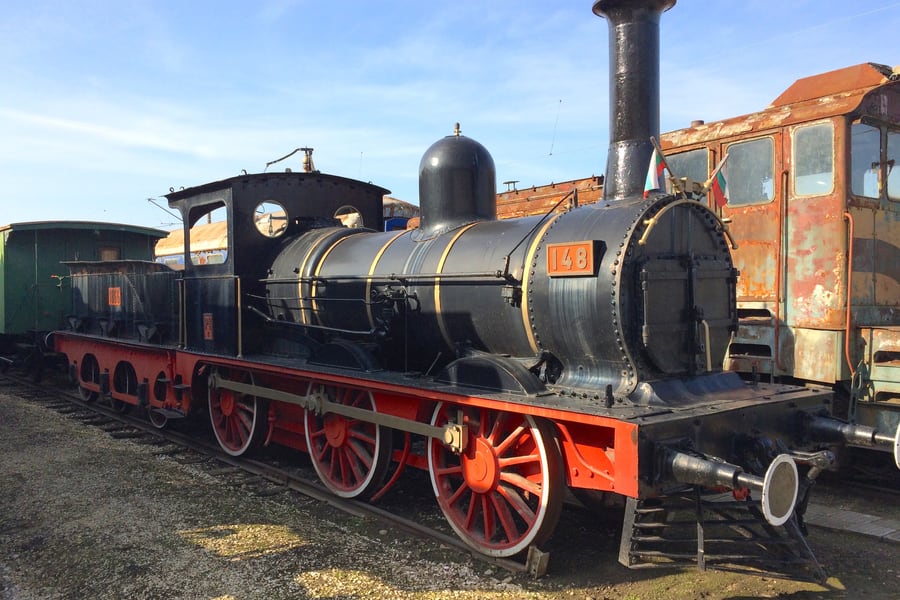
Once the line was open its owners ordered ten more locomotives from England, delivered in 1868 and 1869. They remain the only locomotives ever built in Britain specifically for service in Bulgaria, and number 148 survives, at Ruse.A bit of history
Culture & experiences along the way
Petr Štefek / Wikimedia Commons · CC BY-SA 3.0 czThe short way, and hardly anyone takes it
BDŽ's own fare panel puts the direct run at 226 kilometres. Every other Ruse–Varna itinerary on the board goes round by Gorna Oryahovitsa instead — 360 kilometres, a hundred and thirty-four further, taking between 5 h 42 and 8 h 51 and needing at least one change. Two trains a day in each direction use the line the way it was drawn, and they are the only ones that run through.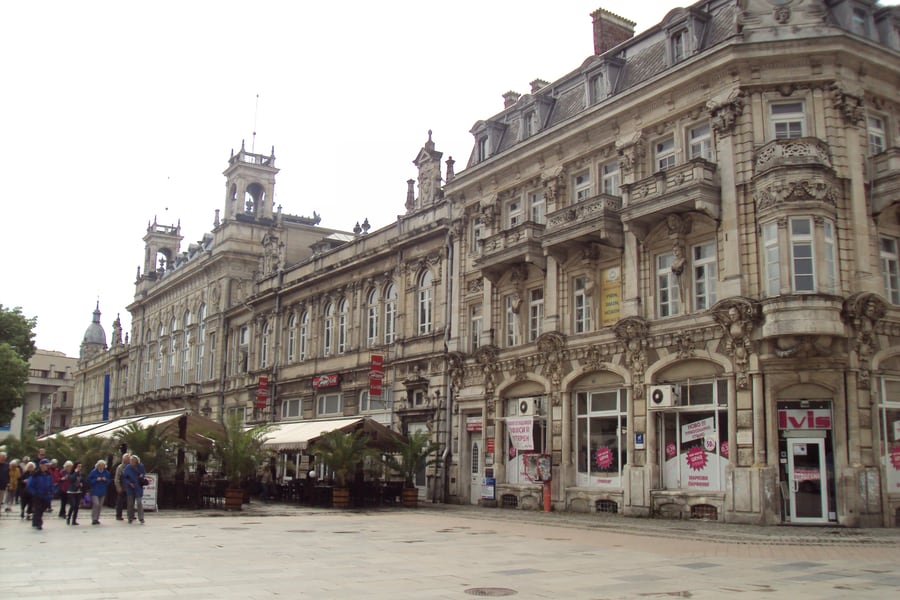 Vislupus / Wikimedia Commons · CC BY-SA 4.0 · cropped
The town that decided to look like Vienna
Ruse got rich on Danube trade and spent it on architecture, hiring Austrian and Italian builders until the centre came out neo-baroque and neo-rococo — balconies, caryatids and the great Dohodno Zdanie, the Profit-Yielding Building of 1902, which paid for the theatre inside it by letting the shops on its ground floor. Walk it before the train.Phil Richards from London, UK / Wikimedia Commons · CC BY-SA 2.0Eight hours in 1866, under four today
When Midhat Pasha, governor of the Danube Vilayet, rode from Ruse to Varna on 7 November 1866 and declared the railway open, the journey took about eight hours. Passengers of the following decade found first class here poorer than second class in western Europe, and the benches, as one account had it, narrow and hard. The same distance now takes 3 hours 47 minutes on the fastest train.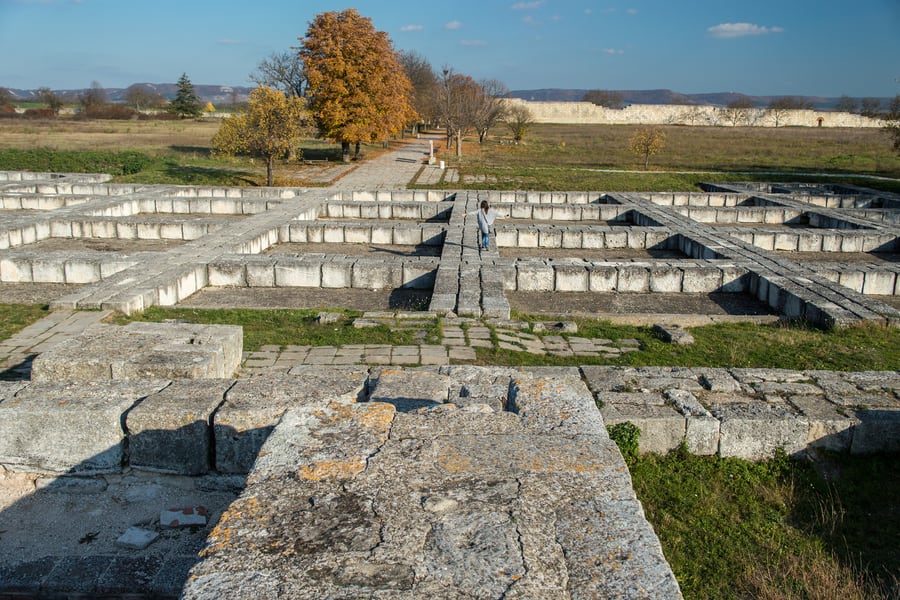 www.bdmundo.com / Wikimedia Commons · CC BY-SA 2.0
The first capital, with a station on the line
Between Hitrino and Kaspichan the train calls at Pliska, and every one of the four direct services stops there. The village gave its name to the first capital of the Bulgarian Empire, whose earthworks and basilica lie a few kilometres north — so the railway that predates the modern Bulgarian state by twelve years happens to pause at the place where the medieval one began.Timetables
Four trains a day use the 1866 line end to end — two each way. Everything else on the Ruse–Varna board goes round by Gorna Oryahovitsa with at least one change. All times below were read from BDŽ's own timetable (opens in a new tab) on 14 August 2026, and each departure was checked against every day of the week between 14 and 24 August. All four ran on all seven days.
Until 31 August 2026
| Train | Ruse | Razgrad | Pliska | Kaspichan | Varna | Time |
|---|---|---|---|---|---|---|
| ICF 9621 | 05:55 | 07:16 | 08:18 | 08:27 | 09:52 | 3 h 57 |
| ICF 9623 | 15:50 | 17:15 | 18:23 | 18:33 | 19:56 | 4 h 06 |
| Train | Varna | Kaspichan | Pliska | Razgrad | Ruse | Time |
|---|---|---|---|---|---|---|
| ICF 9620 | 09:50 | 11:10 | 11:19 | 12:23 | 13:49 | 3 h 59 |
| ICF 9622 | 18:15 | 19:34 | 19:44 | 20:48 | 22:12 | 3 h 57 |
From 1 September 2026
The timetable changes on 1 September, and the autumn workings are quicker because they drop stops — Yastrebovo comes out of all four, and Ezerovo off the morning train from Varna. 31 August still shows the summer times; 1 September shows these.
| Train | Ruse | Razgrad | Pliska | Kaspichan | Varna | Time |
|---|---|---|---|---|---|---|
| ICF 9621 | 05:55 | 07:09 | 08:11 | 08:20 | 09:42 | 3 h 47 |
| ICF 9623 | 16:00 | 17:14 | 18:15 | 18:24 | 19:47 | 3 h 47 |
| Train | Varna | Kaspichan | Pliska | Razgrad | Ruse | Time |
|---|---|---|---|---|---|---|
| ICF 9620 | 09:30 | 10:48 | 10:57 | 11:59 | 13:08 | 3 h 38 |
| ICF 9622 | 18:15 | 19:34 | 19:43 | 20:45 | 22:05 | 3 h 50 |
What the trains are made of
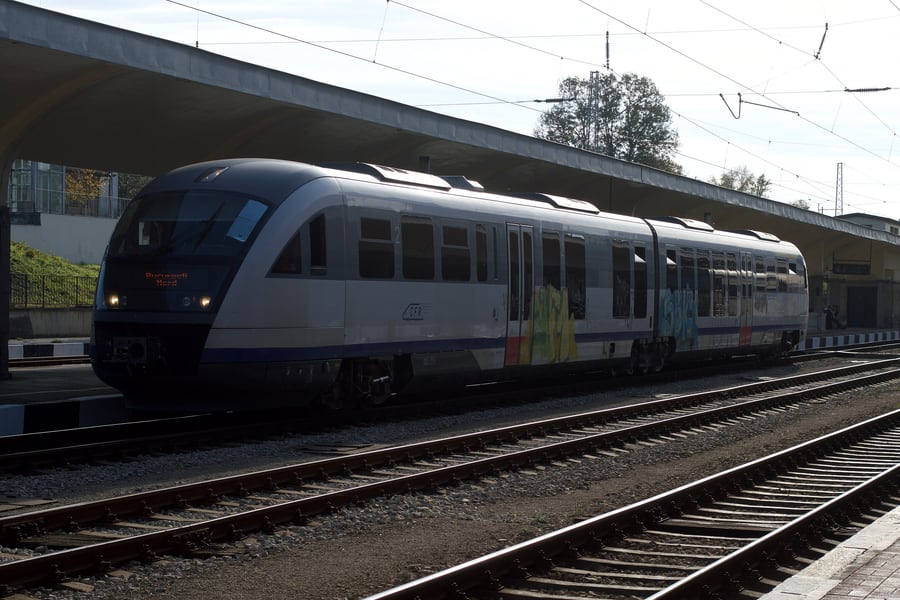
BDŽ publishes the carriage composition on each train's own page, and it is worth a look before booking. Through the summer the 05:55 from Ruse was listed on every date checked as "Дизелов мотрисен влак" — a diesel railcar — while the other three ran as two second-class compartment carriages behind a locomotive. From 1 September the morning train becomes compartment carriages as well. None of the four offers first class, and none carries a sleeping car or anything to eat.
The long way round
For completeness: the other nine daily Ruse–Varna itineraries route via Gorna Oryahovitsa and cover 360 kilometres instead of 226. They take between 5 h 42 and 8 h 51, and all of them involve changing trains. Two carry sleeping cars — the 23:11 out of Ruse and the 21:55 out of Varna — so an overnight crossing is possible, but not on the 1866 line.
Two things about the planner
BDŽ's board answers for roughly four weeks ahead and then stops: it returned full results for every date up to 11 September 2026 and nothing at all from 13 September on. An empty board that far out is the horizon rather than a cancellation.
The site also carries a standing notice that engineering work may alter schedules, and advises checking the day's timetable for any ticket bought in advance. Times on this page are stamped to the reading described above.
Tickets
Second class from Ruse to Varna over the direct line was €7.57 on the day this page was written — 226 kilometres and just under four hours. That is the whole of it: neither direct train offers first class and neither requires a reservation, so there is nothing to add to the fare. A return was €12.12, a child of 7 to 10 €3.79, and a group of three to six €6.44 each.
⚠️ BDŽ does not work to a fixed published tariff, and its own panel warns that prices vary by day and by how the ticket is bought. These are one reading, from 14 August 2026. The direct trains are short — a single railcar, or two carriages — so a summer Saturday can fill them even without a compulsory reservation, and the booking horizon is about four weeks. Bulgaria has used the euro since 1 January 2026.
Book your tickets
Ruse – Varna, the whole 1866 line
226 km, second class, no first class offered
The through fare on the two direct trains was €7.57 in second class when this page was written, with a return at €12.12, children aged 7 to 10 at €3.79 and a group rate of €6.44 each for parties of three to six. Neither train carries first class, and neither needs a reservation. BDŽ's live board shows the day's departures and opens a fare panel for each.
Book Tickets (opens in a new tab, on Bulgarian State Railways (BDŽ))via Bulgarian State Railways (BDŽ)Booking online with BDŽ
The operator's own ticketing site
Tickets for this line are sold at station counters and through BDŽ's own booking system. Because the direct trains are short — a railcar or a pair of carriages — seats are finite on summer weekends even without a compulsory reservation, and the planner will only answer about four weeks ahead of the day of travel.
Book Tickets (opens in a new tab, on Bulgarian State Railways (BDŽ))via Bulgarian State Railways (BDŽ)Rail Passes
For this particular journey, a rail pass is not worth buying, and the arithmetic is not close.
The Interrail Bulgaria One Country Pass is the relevant product. Driven on interrail.com (opens in a new tab) on 20 August 2026, the adult second-class prices were:
| Travel days, within one month | Adult, 2nd class |
|---|---|
| 3 days | €67 |
| 4 days | €84 |
| 5 days | €100 |
| 6 days | €118 |
| 8 days | €150 |
Against a through fare of €7.57, the cheapest pass costs as much as almost nine Ruse–Varna journeys. Even a return trip on consecutive days comes to €15.14 bought as tickets, against €67 for the three-day pass. Bulgarian rail fares are low enough that a pass has to work very hard here, and on this line it does not.
Where a pass might still earn its keep
A Bulgaria pass makes more sense for a trip that strings several long days together — Sofia to Varna on the main line is 543 kilometres, the Sub-Balkan route to Burgas is 418, and the Rhodope narrow-gauge line runs 125 kilometres over the mountains. A traveller doing three or four of those inside a month, rather than one short cross-country hop, is in a different calculation.
Two conditions worth knowing before buying
⚠️ The price widget defaults to a Youth traveller, aged 12 to 27. The headline figure shown on first landing was €50 for three days, which is the youth price; the adult figure only appears once an adult is added and the youth removed. A senior rate (60 and over) exists as well.
⚠️ A One Country Pass cannot be used to enter or leave the country it covers, and cannot be bought by a resident of that country. For anyone planning to carry on over the Danube to Romania, that crossing is not covered by a Bulgaria pass.
Neither direct train on this line requires a reservation, so a pass holder would board without any supplement — which removes one of the usual arguments against passes, and still leaves the fare cheaper.
Places to Visit
The 1866 railway runs through a part of Bulgaria that most visitors never reach, and it happens to connect an unusual density of very old things. Within a few kilometres of the line there is a Roman city, a Thracian tomb, the first capital of the Bulgarian Empire, a UNESCO rock monastery and, at the far end, the oldest worked gold anyone has dug up.
Two of the six below are reached from stations the direct trains actually call at — Pliska has its own halt, and Samuil is the junction for the branch to Isperih and Sveshtari. Ivanovo and the transport museum belong to the Ruse end, Abritus is on the edge of Razgrad, and the Varna gold is in the city where the line stops.
Two notes on what is not here. Madara, the Ovech fortress above Provadiya and the Roman baths of Odessos all sit on the stretch this journey shares with the Sofia–Varna express, and they are described on that page rather than repeated on this one. And a great deal of what the line passes — the villages of the Ludogorie, the plateau itself — is simply farmland, which is the honest reason this is a railway to ride rather than a corridor to stop along.
 Adam Jones from Kelowna, BC, Canada / Wikimedia Commons · CC BY-SA 2.0
The National Transport Museum, in the first station
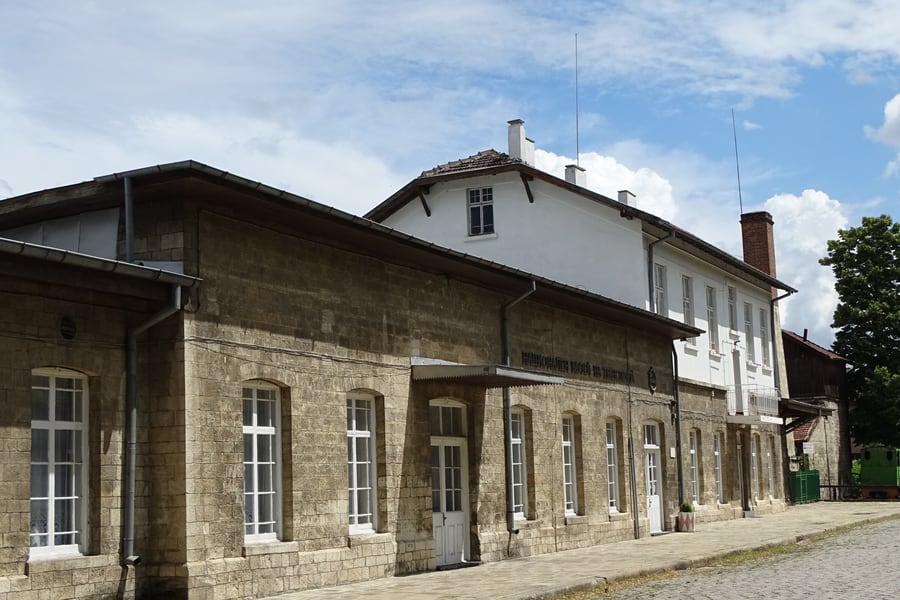
The building the line started from, finished in 1866 and the only one of its eleven original stations with a second storey. It stopped handling trains when a classification yard opened in June 1954 and has been the country's transport museum since, founded in 1966 for the railway's centenary. Locomotive 148 stands in the yard, along with royal saloons and a carriage built for the sultan. It opens 09:00 to 17:00.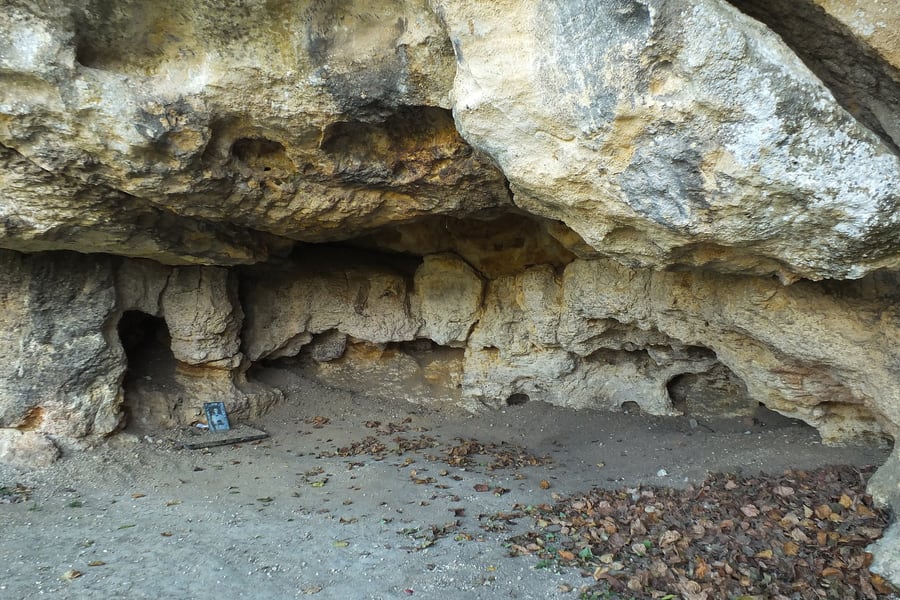 Delysia v / Wikimedia Commons · CC BY-SA 4.0
The rock-hewn churches of Ivanovo
Churches, chapels and cells cut into a limestone wall 32 metres above the Rusenski Lom, begun in the 1220s by the future patriarch Joachim and worked on into the seventeenth century. At its height the complex held some 40 churches and around 300 other rooms. Five churches keep their thirteenth- and fourteenth-century frescoes, and the whole site has been on the UNESCO list since 1979.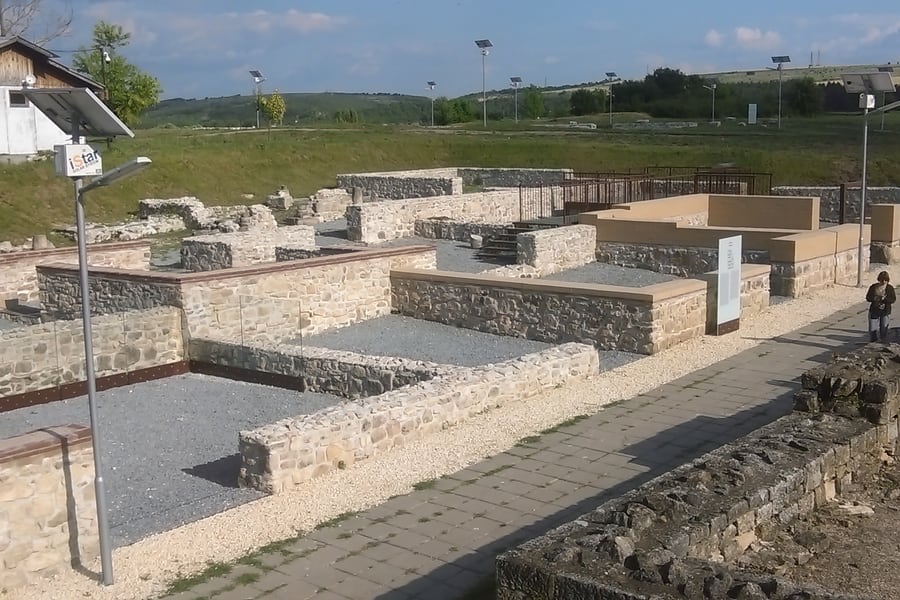 Litev / Wikimedia Commons · CC BY-SA 4.0
Abritus, under Razgrad
A Roman city about a kilometre east of the modern town, excavated from 1969 and laid out so the street plan of its residential quarter can be walked. It gave its name to one of Rome's worst days — the battle of Abritus, in the summer of 251, in which the emperor Decius and his son Herennius Etruscus were both killed by a Gothic coalition under Cniva. Ammianus Marcellinus rated that defeat alongside the Teutoburg Forest and Adrianople.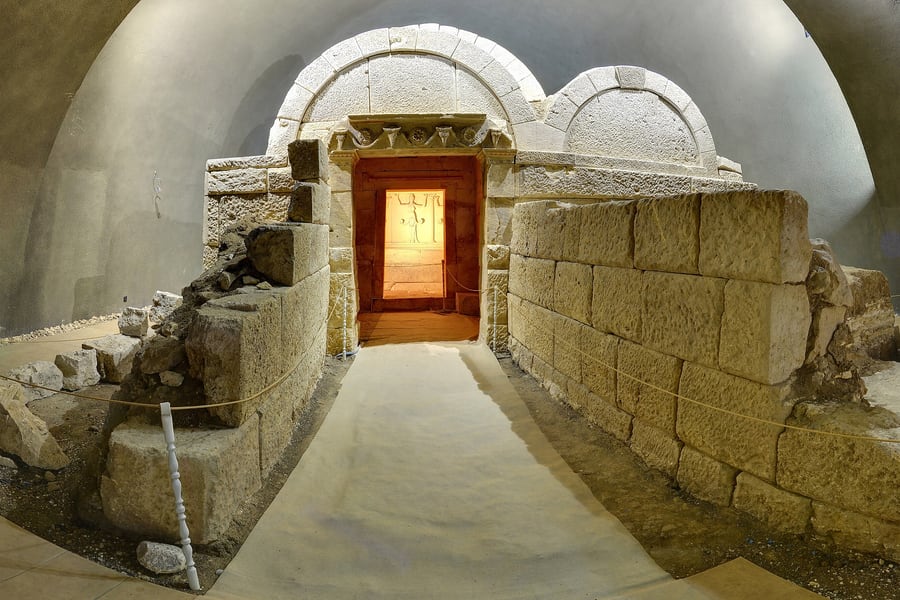 Interact-Bulgaria / Wikimedia Commons · CC BY-SA 4.0
The Thracian tomb of Sveshtari
A tomb of the first quarter of the third century BC, found in 1982 under a burial mound and now sheltered inside a vault a visitor walks into. Ten female figures carved half human and half plant stand in high relief around the central chamber, and nothing else like them has been found in the Thracian lands. It has been a UNESCO site since 1985. Three trains a day run from Samuil to Isperih, about half an hour up the branch.www.bdmundo.com / Wikimedia Commons · CC BY-SA 2.0Pliska, the first capital
The seat of the Bulgarian rulers from the late seventh century until the court moved to Preslav in 893. An earth rampart faced in stone ran 21 kilometres around some 2,300 hectares, with a walled inner town of palaces and, from about 875, the Great Basilica. Byzantine troops under Nikephoros I burned the place in 811 and Omurtag rebuilt it in ashlar. The ruins lie 3 kilometres north of the modern village.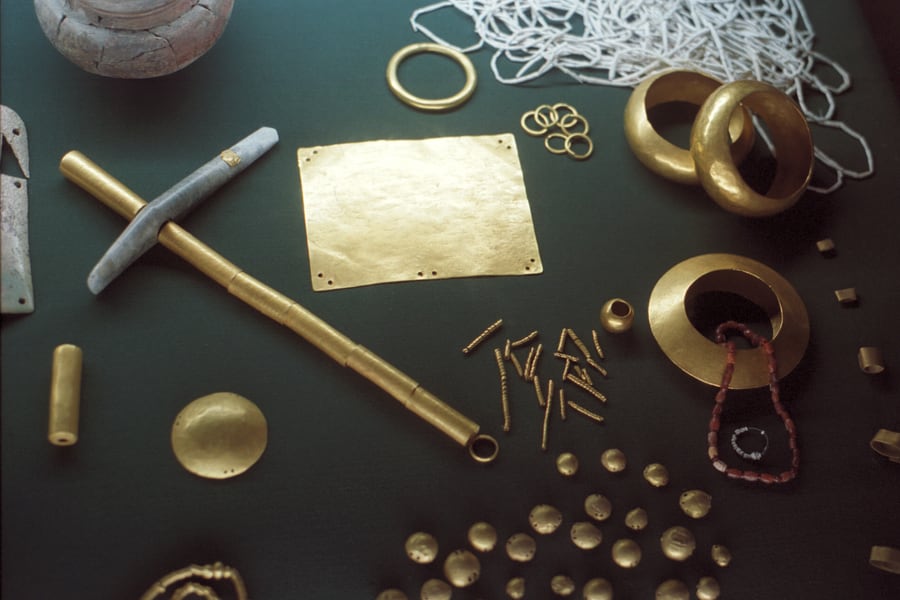 Zde / Wikimedia Commons · CC BY-SA 4.0
The Varna gold
A cemetery on the western edge of Varna, found by accident in October 1972 by an excavator driver, Raycho Marinov. Its 294 graves held gold worked between about 4600 and 4200 BC — bracelets, beads, sheet plaques and a sceptre — usually called the oldest gold treasure in the world, being the largest and most varied of several Bulgarian finds of that age. Radiocarbon work in 2006 dated the graves to 4569–4340 BC. The gold is shown in the city's Archaeological Museum.Where to Sleep
The journey is under four hours, so most people will not need a bed in the middle of it. The two ends are the interesting question: Ruse is a Danube port with a nineteenth-century centre built when the town was the richest in the Ottoman Balkans, and Varna is a Black Sea resort city with a correspondingly wide choice.
The early train out of Ruse leaves at 05:55, which makes a room within walking distance of the station worth more than usual. The four below all have their own websites and take direct bookings; each was opened and read on 14 August 2026.
None of these cards carries a price, a star rating or a review score. Some of the hotels publish their own; those are the hotel's claims about itself rather than anything verified here, so they are not repeated. What the cards describe instead is what is checkable — when the building went up, how many rooms it has, what it stands next to.
Photographs are the other gap. Bulgaria has no commercial freedom of panorama, which means a photograph of a modern building cannot be published here even when a free licence exists, and Wikimedia Commons has no picture of any of these four in any case. The cards therefore ship without images rather than with something that is not the hotel.
Where to stay
Anna Palace
Ruse, for the 05:55
A house on Knyazheska Street built in 1888 for the grain merchants Dina and Ziso Bebis, who had the architect Valsamaki design it and brought in two painters to fresco the interior. Ten years later part of it was given over to the company building the Ruse–Gorna Oryahovitsa railway. It is a hotel now, completely renovated in 2023, with a restaurant and lobby bar.
Check Availability (opens in a new tab, on annapalace.com)via annapalace.comGrand Hotel Riga
Ruse, on the Danube bank
Set directly on the river about 400 metres from Ruse's main square, with four places to eat between them — a summer garden restaurant, a panorama restaurant at the top, a main restaurant and a tavern doing traditional dishes. Direct booking carries free parking and the choice of a room with or without meals.
Check Availability (opens in a new tab, on hotel-riga.com)via hotel-riga.comHotel Central
Razgrad, halfway along the line
In the middle of Razgrad, the largest town the 1866 railway serves, with renovated single, double, triple and four-bed rooms and apartments. Every room has its own bathroom, cable television, air conditioning and free internet; the apartments add a kitchenette. There are three conference rooms taking between thirty and a hundred and fifty people.
Check Availability (opens in a new tab, on hotelrazgrad.com)via hotelrazgrad.comGrand Hotel London
Varna, at the end of the line
Varna's first grand hotel, begun in 1906 to a design by the architect Dabko Dabkov and opened on 25 May 1912, when the local paper called it a thoroughly European hotel and noted that its prices were no higher than anywhere else in town. The building has kept its appearance; inside there are 24 rooms, a lobby bar with a garden and a restaurant.
Check Availability (opens in a new tab, on londonhotel.bg)via londonhotel.bgQuestions or corrections
Planning this trip and stuck on something, or spotted a time, fare or detail that has changed? Send us a message about The Ruse–Varna Railway — Bulgaria's First Line. We read every one, and we update this page when something has changed.