The Sofia–Varna Express — Bulgaria's Longest Railway
TrainSimFan / Wikimedia Commons · CC BY 4.0
- DistanceSofia–Varna · 543 km
- DurationAbout 7½ hours by day · 7 h 43 overnight
- Best seasonJune to September for the coast · the line runs all year
Introduction
Five hundred and forty-three kilometres separate Sofia from Varna by rail, which makes this the longest railway line in Bulgaria. It crosses the whole country, from the capital under Vitosha to the Black Sea, and the fast trains take a little under eight hours over it. The route is worth riding for the Iskar Gorge alone. But the more unusual thing about this journey is what you sit in.
In March 2024 Bulgarian State Railways signed a contract with Deutsche Bahn for 76 second-hand carriages: sixty open second-class saloons, six fitted for wheelchairs and bicycles, and ten buffet cars. The whole deal, delivery included, came to 30.5 million leva — 391,166 leva a carriage. They had last been through a heavy overhaul between 2018 and 2022, and they were still earning their living on the German network in December 2023. Nineteen reached Bulgaria that April and the remaining fifty-seven by the beginning of June, renewing something over a fifth of BDŽ's passenger fleet in one purchase. They went to the three busiest runs in the country: Sofia to Varna, Sofia to Burgas, Sofia to Ruse.
So the daytime expresses to the Black Sea are made of carriages Germany had finished with. BDŽ's own composition list for train 2611, the 07:15 to Varna, shows three of them and nothing else — three air-conditioned second-class saloons, running the length of the country on a €14.67 ticket.
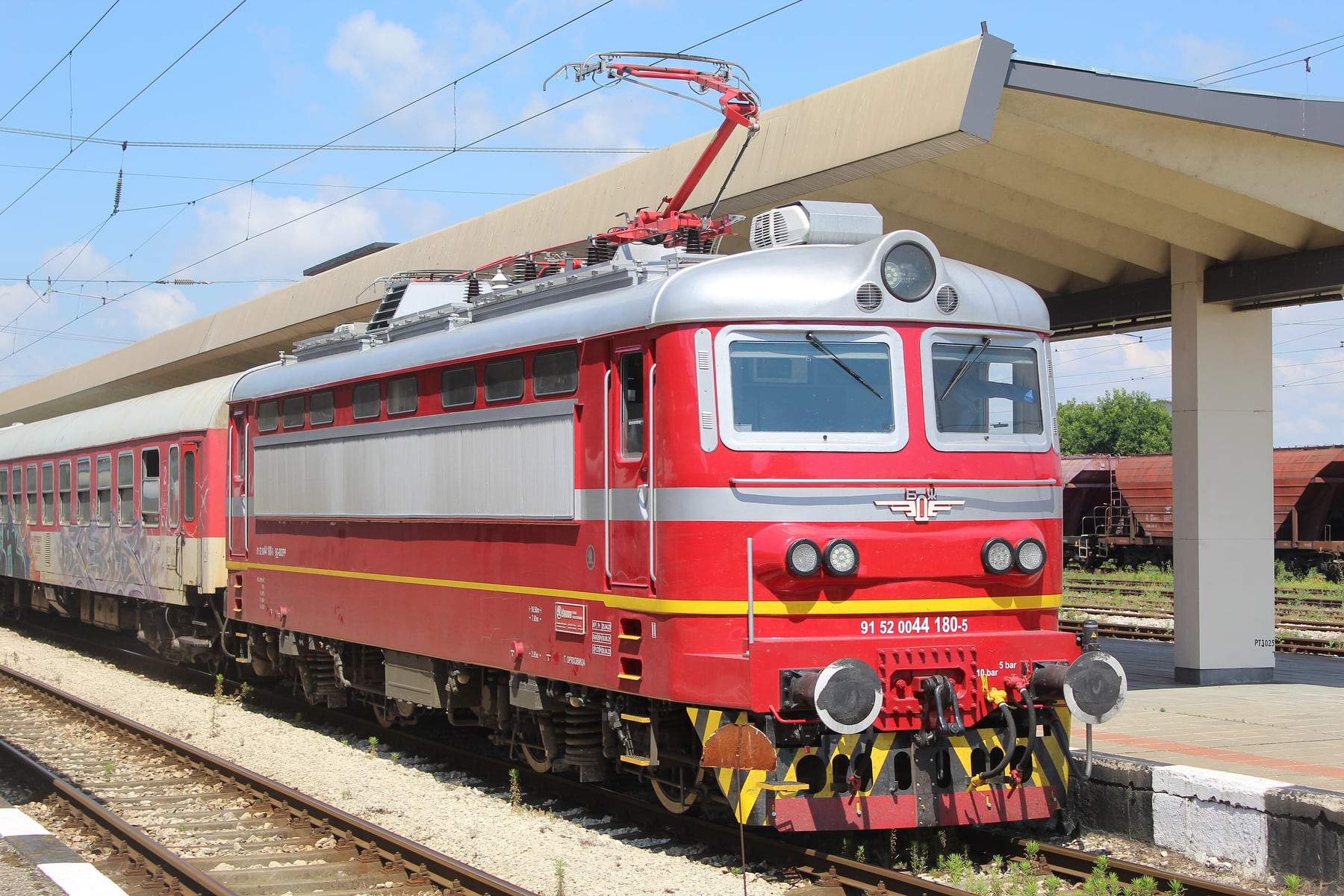
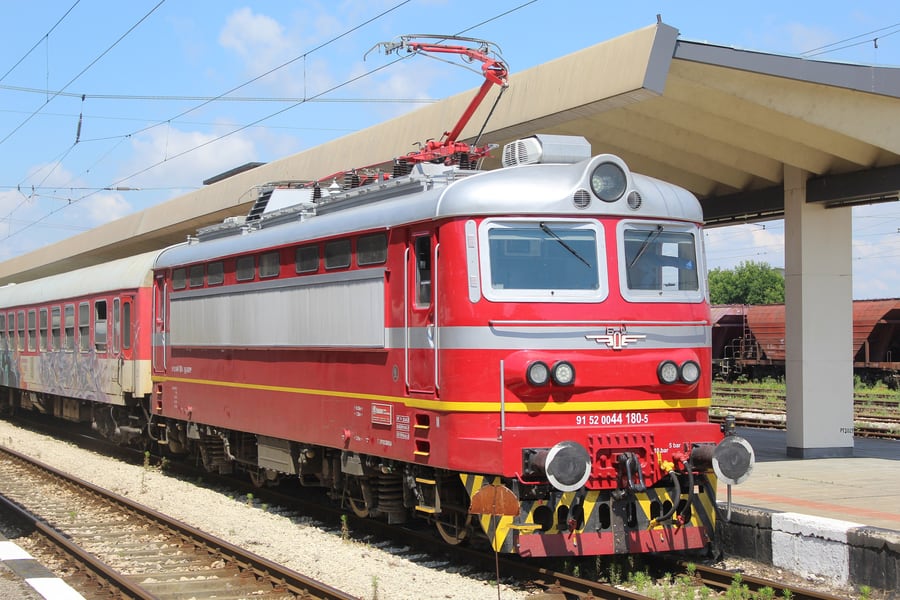
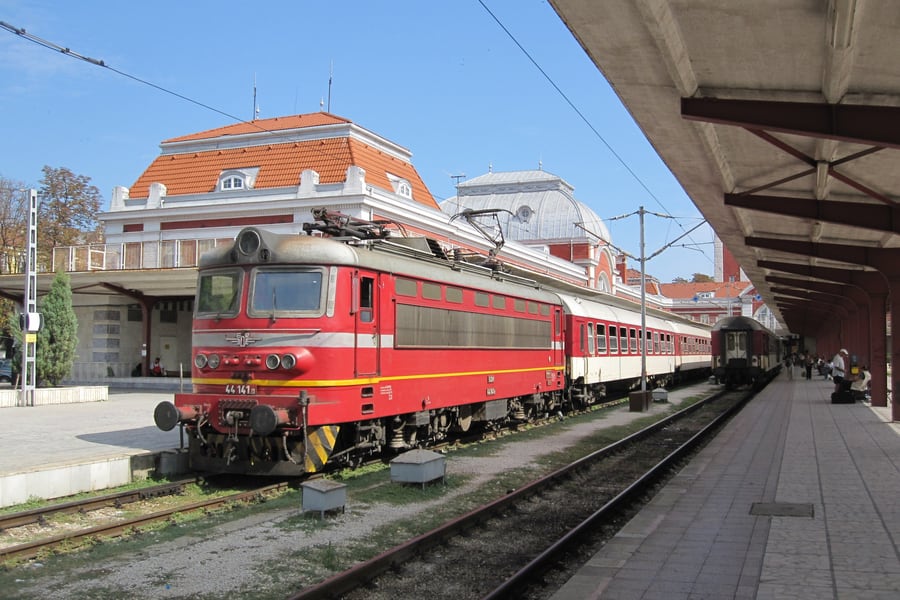
The locomotive on the front has usually had a second life too. The machine photographed entering Gorna Oryahovitsa on the front of this page was built by Škoda at Plzeň in 1983, renumbered in 1988, badly damaged by fire at Vidbol on 30 July 2017, rebuilt and re-geared in the Czech Republic in 2022, and renumbered again — from 45 180 to 44 180 — to record that it could now do 130 kilometres an hour instead of 110. Very little on this railway is new. Almost all of it has been given another go.
The line
Officially it is Bulgarian main line 2, Sofia–Gorna Oryahovitsa–Varna, 543.563 kilometres of standard gauge electrified at 27.5 kV, 50 Hz. It is double track for all but the Resen–Gorna Oryahovitsa section, carries 22 tunnels totalling about 4,000 metres and roughly 187 bridges, and is worked at between 60 and 130 kilometres an hour. The ruling gradients tell you the shape of the country it crosses: 10.7 in a thousand out of Sofia to Mezdra, 18 across the Danubian plain to Gorna Oryahovitsa, 25 over the eastern hills to Kaspichan, and 10.2 down to the sea.
It was finished in pieces from both ends. Shumen to Kaspichan opened on 20 June 1895; Sofia to Roman, the hard part through the Iskar Gorge, on 20 February 1897; Roman to Pleven on 18 June 1899; and Pleven to Shumen on 8 November 1899, which closed the gap and gave the capital a railway to the sea.
The end of the line came first
Varna already had one. The Ruse–Varna railway, about 223 kilometres from the Danube to the Black Sea, was built for the Ottoman government by an English company associated with William Gladstone and the Barkley brothers. Work began in 1864 and the line opened in 1866 — the first railway on what is now Bulgarian soil, twelve years before there was a Bulgarian state to own it. Bulgaria bought it in 1888. The line from Sofia arrived thirty-three years after the trains did.
The Journey
The journey falls into four parts, and only the first of them is mountain railway.
Sofia to Mezdra — the gorge
For the first hour and a half the train is in the Iskar Gorge, the defile where the river cuts clean through the Balkan Mountains — the only river that crosses the whole range. The line was driven through it between 1894 and 1897 and it shows: more than twenty tunnels, bridge after bridge over the Iskar, and limestone walls that rise a few hundred metres above the track. The white Lakatnik rocks stand over the station of the same name, and the fast trains to Varna call there, which is unusual enough to be worth knowing. Below Zverino the walls fall back, and at Mezdra — a junction created when the line opened on 20 February 1897 — the train turns east and the mountains are done.
This first stretch has a journey of its own on this site; anyone who only wants the scenery can ride it as a ninety-minute trip out of Sofia and come straight back.
Mezdra to Gorna Oryahovitsa — the plain
East of Roman the railway drops onto the Danubian plain and spends the next three hours crossing it. This is farmland, wide and open, with the Balkan range a blue line away to the south. Cherven Bryag is a junction; a few kilometres before it the line runs past Karlukovo, where the Iskar has cut a second, smaller gorge and the Prohodna cave stands open at both ends. Pleven, at about the halfway mark, is the largest town on the route and the one most travellers have heard of, for the siege of 1877 that decided the Russo-Turkish war.
Then Levski, Pavlikeni and Gorna Oryahovitsa, where every train stops for ten to twenty minutes. It is a railway town rather than a destination, but it is the junction for Veliko Tarnovo, the medieval capital, which is twenty minutes away by local train or bus.
Gorna Oryahovitsa to Kaspichan — the eastern hills
The steepest gradients on the line are in this section, 25 in a thousand, as the railway works its way through Strazhitsa, Popovo and Targovishte and over the shoulder of the eastern Stara Planina. Shumen is the last big town, with its fortress on the hill above and — a few minutes further on, near Kaspichan — the Madara Rider, the eighth-century relief carved 23 metres up a vertical cliff, on the UNESCO list since 1979. Seven trains a day cover the eleven to sixteen minutes from Shumen to Madara station.
Kaspichan to Varna — the lakes
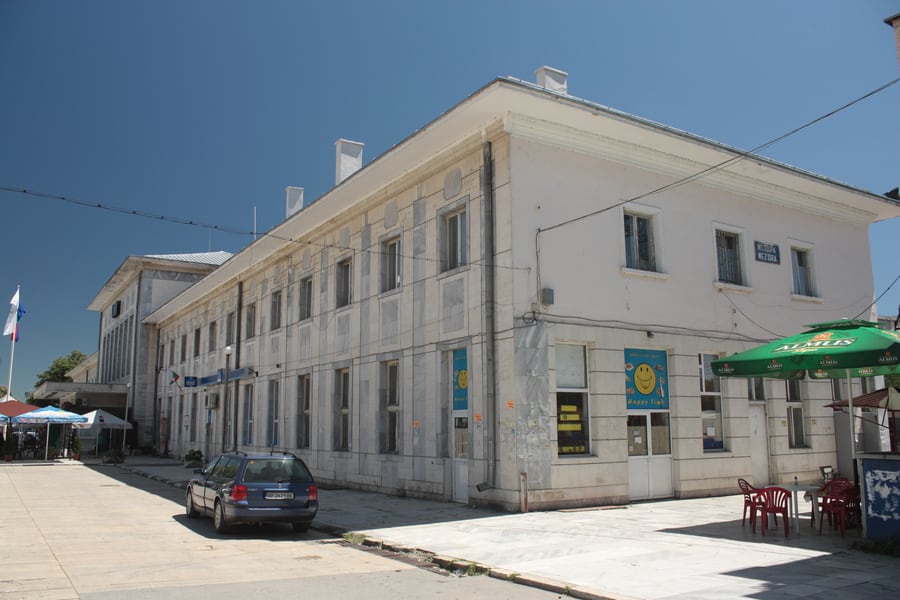
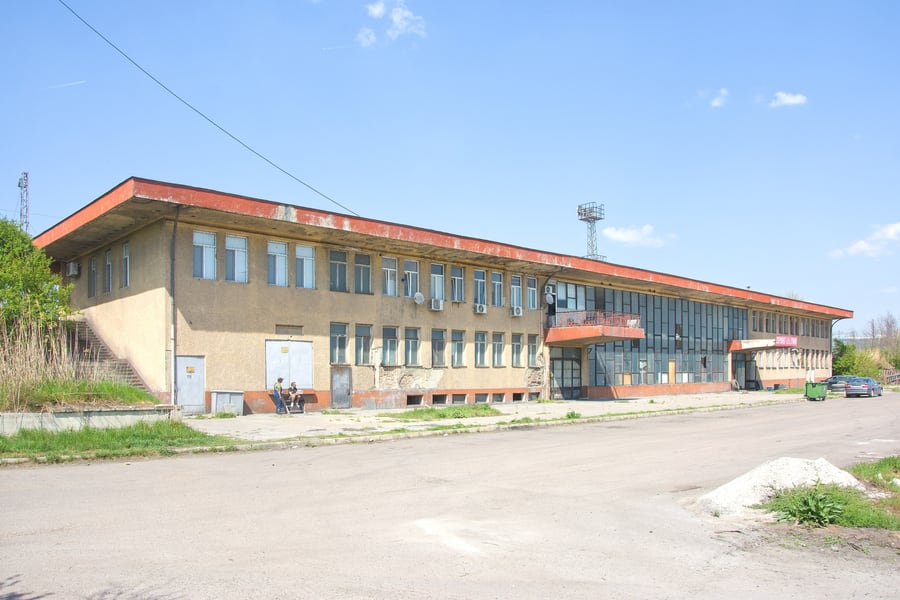
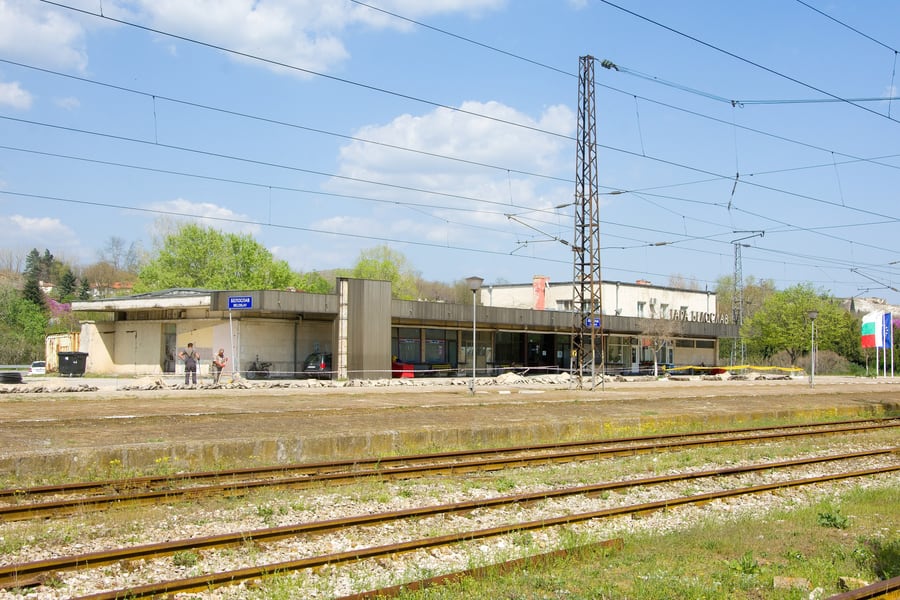
The last hour is the best of the second half. At Provadiya the line threads a karst gorge with the ruins of the Ovech fortress on the flat-topped rock above it, then runs down the Provadiya valley to Sindel, where it meets the line from Karnobat, and out along the Varna lakes — Beloslav and Varna, joined to each other by a canal and to the sea beyond. Beloslav sits on both banks of that canal, and a vehicle and passenger ferry still connects the two halves of the town; a road bridge to replace it is planned. Behind it are the chemical works at Devnya and the shipyard east of the town. It is an industrial landscape rather than a pretty one, and it is the honest approach to a port city.
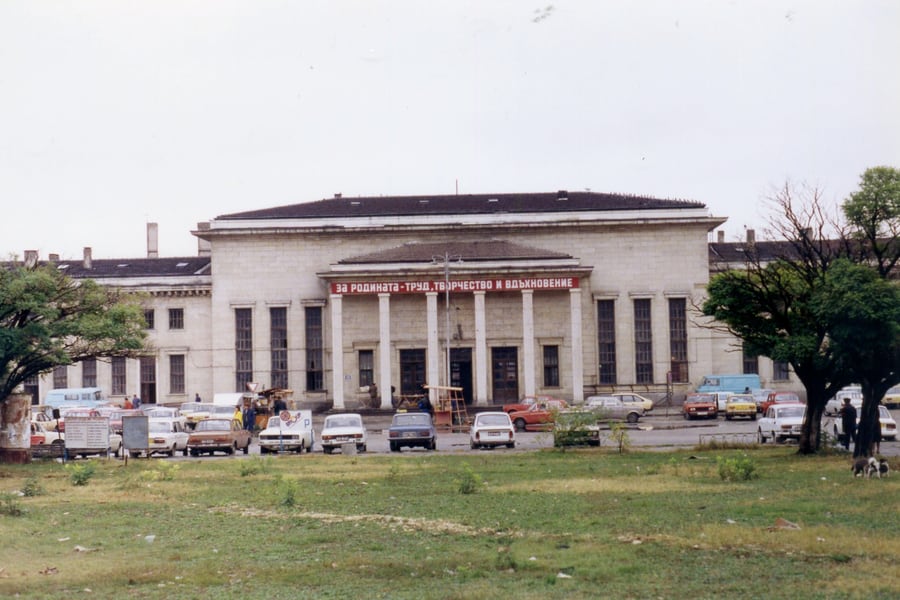
Varna station stands at the end of the tracks by the harbour, nineteen kilometres east of Beloslav and a short walk from the Sea Garden and the sea front. Its clock tower is the part of the building that shows above everything else.
What it is not
This is a scheduled inter-city train, not a heritage or tourist operation. There is no observation car, no commentary, and — on the composition BDŽ published for these trains on the day this page was written — no buffet car either, although the seasonal expresses to the coast have carried one in past summers. What there is, is a very long, very cheap ride across an entire country, in carriages better than most people expect.
Along the route
TrainSimFan / Wikimedia Commons · CC BY 4.0Seventy-six carriages Germany had finished with
BDŽ bought sixty second-class saloons and ten buffet cars from Deutsche Bahn in March 2024, for 30.5 million leva. They were still running in Germany that December. All had arrived by June, renewing more than a fifth of the passenger fleet in one purchase.Phil Richards from London, UK / Wikimedia Commons · CC BY-SA 2.0A locomotive that was given a second number
The machine on the front of this page was built by Škoda in 1983, badly damaged by fire in 2017, and rebuilt and re-geared in the Czech Republic in 2022. It came back as a different class number, because the rebuild raised its top speed to 130 km/h.Edal Anton Lefterov / Wikimedia Commons · CC BY-SA 3.0Finished from both ends, in 1899
The line was built in pieces — Shumen to Kaspichan in 1895, Sofia to Roman through the Iskar Gorge in 1897 — and the gap closed on 8 November 1899. Only then did the capital have a railway to the sea, thirty-three years after Varna's first trains.A bit of history
Culture & experiences along the way
Mark Ahsmann / Wikimedia Commons · CC BY-SA 4.0The train does not start at the main station
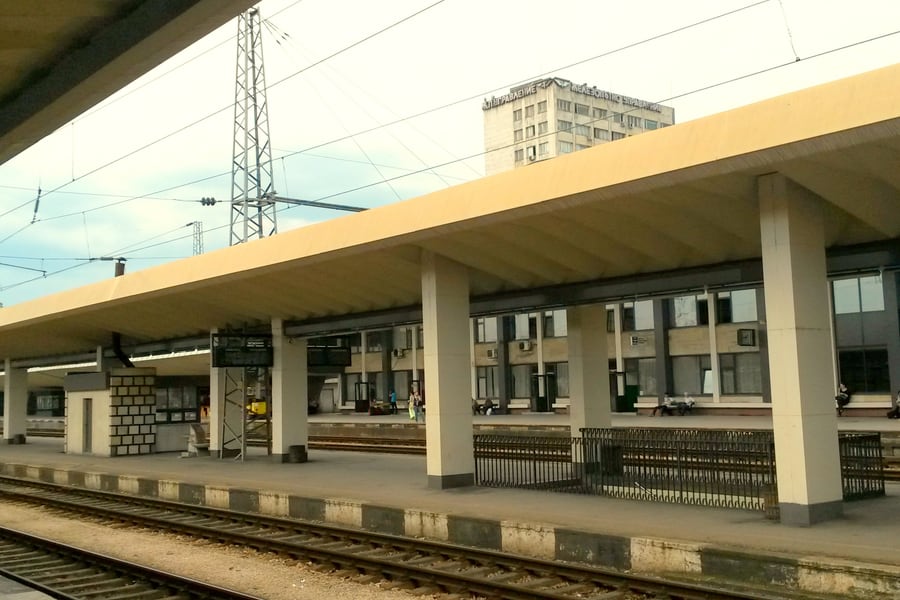
Sofia Central has been under reconstruction since 7 May 2024. The work was due to finish in August 2025; by May 2025 the transport ministry was giving June 2026, and it was still in force on the board read for this page. Passengers for Varna, Pleven, Mezdra, Ruse, Vidin and Lom change at Sofia North, five minutes up the line. BDŽ's planner builds the shuttle in, and both night trains still run through from Sofia Central.Phil Richards / Wikimedia Commons · CC BY-SA 4.0Three railways to the same sea
Sofia is joined to Varna by three separate routes, and they are within thirty kilometres of one another in length. The main line through the Iskar Gorge is 543 km; the Sub-Balkan line through Karlovo and Sliven, used by the 3637 overnight, is the shortest at 514 km; and the southern route through Plovdiv and Stara Zagora is the longest at 546 km. On the day this page was written the main line was the quickest by about an hour.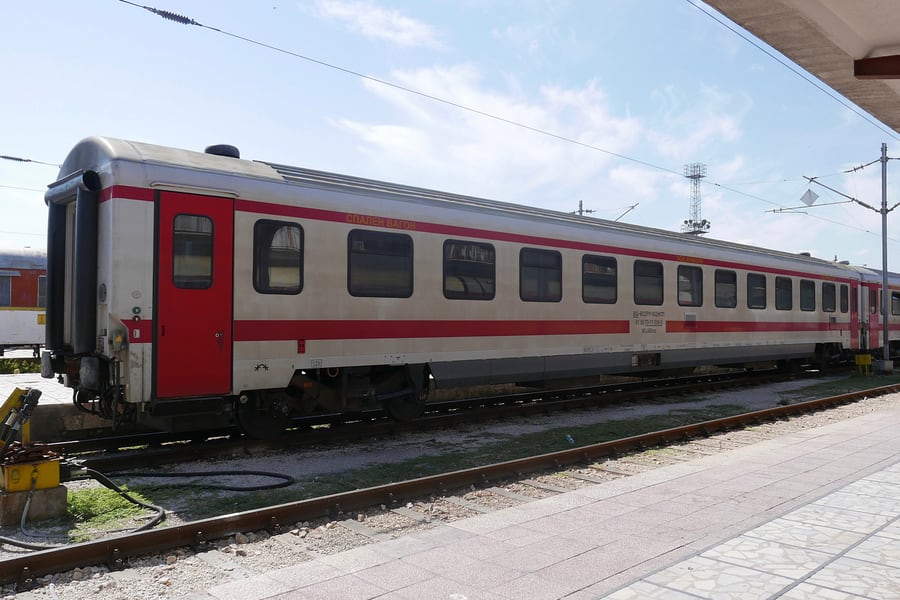 NAC / Wikimedia Commons · CC BY-SA 4.0 · cropped
A night crossing with a berth
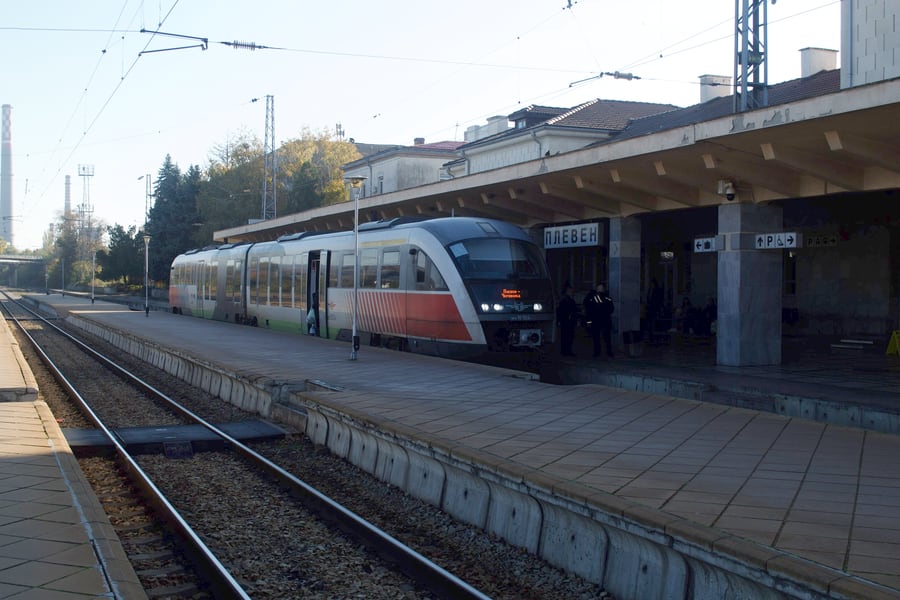
Trains 2627 out of Sofia at 23:00 and 2626 out of Varna at 21:55 each carry three sleeping cars, first and second class, alongside ordinary compartments. They run through from Sofia Central without the shuttle, take the Iskar Gorge in the dark, and arrive at 06:43 and 05:45 respectively. The berth supplement is €7.67 in second class and €10.23 in first.Petr Štefek / Wikimedia Commons · CC BY-SA 3.0 czWhat arrives at the far end
The last hour runs along the Varna lakes, past the chemical works at Devnya, to Beloslav — a town on both banks of the canal joining the two lakes, where a vehicle and passenger ferry still connects the two halves. It is an industrial approach rather than a scenic one, and then the tracks simply stop, beside the harbour in Varna.Timetables
Every time below was read directly from BDŽ's live board for Friday 14 August 2026, and from the operator's own per-train pages, which is what BDŽ was showing on the day this page was written. The planner returns results only for the current date, so this is one day's service read in full rather than a year-round pattern. The operator is the place to confirm the day you intend to travel.
First, where the train leaves from
Sofia Central station is being rebuilt, and most northbound trains do not start there. Track renewal began on 7 May 2024, was due to finish in August 2025, and by May 2025 the transport ministry was giving June 2026 as the new date. It was still in force on 14 August 2026: passengers for Svoge, Lakatnik, Mezdra, Pleven, Ruse, Vidin, Lom and Varna change at Sofia North (София Север), five minutes up the line, and BDŽ's planner builds the shuttle into the itinerary automatically. A handful of trains — including both night services — still run through from Sofia Central.
Daytime, Sofia to Varna
| Train | Sofia Central | Sofia North | Pleven | Gorna Oryahovitsa | Shumen | Varna |
|---|---|---|---|---|---|---|
| ICF 2611 | 07:00 (shuttle) | 07:15 | 09:59 | 11:10 | 13:05 | 14:53 |
| ICF 2613 | 10:10 (shuttle) | 10:21 | 13:00 | 14:08 | 16:06 | 17:52 |
ICF 2613 is marked as the fastest trip of the day — 7 hours 42 minutes door to door from Sofia Central, or 7 hours 31 from Sofia North. Both trains are formed of three of the ex-German second-class saloon carriages, both carry a compulsory reservation, and both call at around twenty intermediate stations including Svoge, Lakatnik, Mezdra, Roman, Cherven Bryag, Levski, Pavlikeni, Strazhitsa, Popovo, Targovishte, Kaspichan, Provadiya, Sindel and Beloslav.
Daytime, Varna to Sofia
| Train | Varna | Shumen | Gorna Oryahovitsa | Pleven | Sofia North | Sofia Central |
|---|---|---|---|---|---|---|
| ICF 2612 | 07:50 | 09:32 | 11:19 | 12:32 | 15:15 | 15:25 (shuttle) |
| ICF 2614 | 10:45 | 12:24 | 14:13 | 15:23 | 18:10 | 18:20 (shuttle) |
| ICF 2616 | 13:50 | 15:29 | 17:13 | 18:36 | 21:35 | 21:40 |
ICF 2616 runs through to Sofia Central without a change, which the other two do not, and it is also the only daytime train that calls at Karlukovo for the Prohodna cave. It is formed of compartment stock rather than the German saloons.
Overnight
| Train | Depart | Arrive | Route |
|---|---|---|---|
| ICF 2627 | Sofia 23:00 | Varna 06:43 | Main line, via Pleven — 7 h 43 |
| ICF 2626 | Varna 21:55 | Sofia 05:45 | Main line, via Pleven — 7 h 50 |
| ICF 3637 | Sofia 23:30 | Varna 07:25 | Sub-Balkan, via Karlovo and Sliven — 7 h 55 |
| ICF 3636 | Varna 21:40 | Sofia 06:07 | Sub-Balkan, via Karlovo and Sliven — 8 h 27 |
Both 2626 and 2627 run through from Sofia Central, take the Iskar Gorge in the dark, and carry three sleeping cars apiece alongside first- and second-class compartments. They are the fastest way between the two cities on the main line, and the only ones that do not involve the shuttle to Sofia North.
The other two ways round
Varna can be reached from Sofia by three separate routes, and the distances are closer than the journey times suggest. The main line north through the Iskar Gorge is 543 km. The Sub-Balkan line through Karlovo, Kazanlak and Sliven, used by the 3637 and 3636 overnight, is the shortest at 514 km. The southern route through Plovdiv and Stara Zagora is the longest at 546 km, and carries ICF 8651 (Sofia 10:15, Varna 18:55) and the overnight ICF 8657 (21:00–05:50). The main line is the one this page is about, and on 14 August 2026 it was the quickest of the three by about an hour.
Getting off along the way
Almost every stop on the fast trains is a place with something to see, but two need a connection. Veliko Tarnovo is reached from Gorna Oryahovitsa, and Madara, for the rock relief, has seven trains a day from Shumen taking eleven to sixteen minutes.
Tickets
Crossing the entire country by train remains startlingly cheap. BDŽ's fare panel for the 543-kilometre run gave €14.67 in second class and €18.36 in first on 14 August 2026, with a return at €22.04 — roughly one and a half singles rather than two — and a sleeping-car berth about twenty-three euros all in. Bulgaria adopted the euro on 1 January 2026 and it has been sole legal tender since 1 February.
⚠️ BDŽ does not price to a fixed tariff. Its own panel warns that prices vary by day and by booking conditions, and the same Sofia–Burgas fare has moved by more than two euros overnight. All the fast trains on this line carry a compulsory reservation at €0.51, which means a specific train and a specific seat — and that summer weekends sell out. Sleeper berths open thirty days ahead, ordinary reservations five. There is no buffet car.
Book your tickets
Sofia – Varna, the whole line
€14.67 second class · €18.36 first · €22.04 return
543 km across the country, with a compulsory reservation at €0.51 on every fast train.
Book Tickets (opens in a new tab, on Bulgarian State Railways (BDŽ))via Bulgarian State Railways (BDŽ)Booking online with BDŽ
The operator's own ticketing site
Seats on this line are finite and they go on summer weekends.
Book Tickets (opens in a new tab, on Bulgarian State Railways (BDŽ))via Bulgarian State Railways (BDŽ)Rail Passes
For this journey, a rail pass does not pay. The arithmetic is not close.
The Interrail Bulgaria Pass
Interrail sells a one-country pass for Bulgaria. Prices read from its own booking widget on 14 August 2026, for an adult travelling second class:
| Pass | Price |
|---|---|
| 3 days within 1 month | €67 |
| 4 days within 1 month | €84 |
| 5 days within 1 month | €100 |
| 6 days within 1 month | €118 |
| 8 days within 1 month | €150 |
Youth prices, for travellers aged 12 to 27, start at €50 for three days. Eurail sells the equivalent pass to travellers who live outside Europe.
⚠️ Interrail's own widget opens on the youth price. The prices it shows first are the ones for travellers aged 12 to 27, and the adult figures only appear once the traveller type is changed — so the number on the page at first glance is not the number most people will pay.
Against a €14.67 ticket
The cheapest adult pass costs €67 and buys three days of travel. A single Sofia to Varna is €14.67, and the return €22.04. Even the whole of Bulgaria's longest railway line, ridden there and back, uses barely a third of the cheapest pass. To break even on three days an adult would need to cover something like 1,600 kilometres of Bulgarian railway, which is more than the country comfortably offers in that time.
The same is true for a first-class seat at €18.36, and it stays true if the trip is extended to Burgas or Ruse. Bulgarian fares are simply too low for a pass to make sense on their own.
What a pass does not cover here
Even where a pass is held — most often as part of a Global Pass already bought for a longer European trip — it does not remove the two costs that matter on this line:
- The compulsory reservation, €0.51, is payable on every fast train to Varna regardless of pass.
- The sleeping-car supplement, €7.67 in second class and €10.23 in first, is payable on the overnight services.
Interrail's own conditions note that most night trains and reserved services need a booking at extra cost, and that a one-country pass cannot be used to enter or leave the country it covers.
When it might be worth it
The case for a pass on this route is a Global Pass held for a wider journey — arriving from Serbia or Romania, riding to the coast, and going on to Istanbul — where the Bulgarian legs are incidental rather than the reason for buying. For a trip that is only Sofia to Varna and back, buying the ticket at the counter is both cheaper and simpler.
Places to Visit
Seven stops, seven places worth breaking the journey for. Because every fast train on this line carries a compulsory reservation, breaking the journey means booking two tickets rather than one — but at fourteen euros for the whole run, splitting it is not an expensive decision.
The cards below run in the order the train meets them, from the gorge an hour out of Sofia to the Roman baths ten minutes from Varna station.
 Randona.bg / Wikimedia Commons · CC BY-SA 4.0
The Lakatnik Rocks
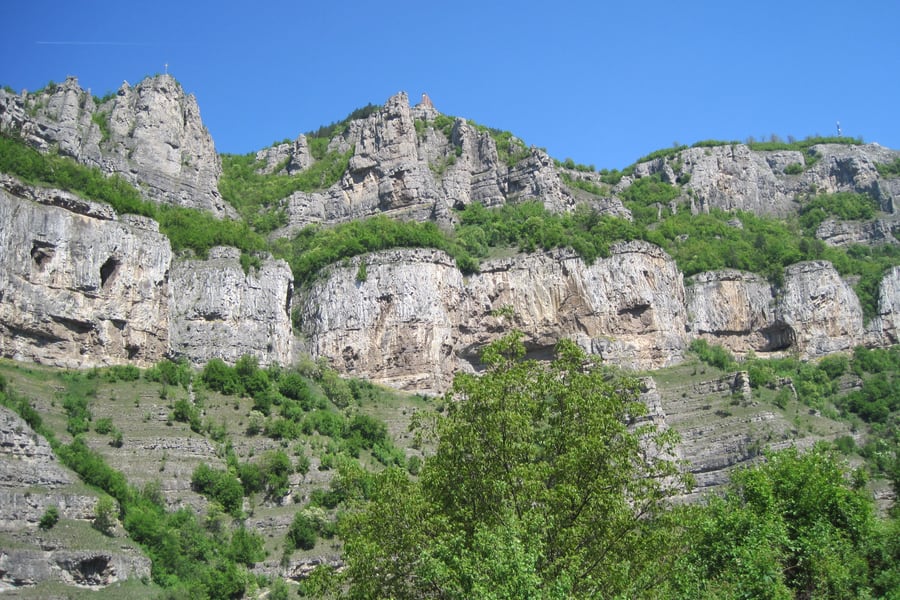
Red sandstone and limestone standing more than 250 metres above the Iskar, on the left wall of the gorge, and the birthplace of Bulgarian rock climbing. The Eagle's Nest hut of 1938 is the small building visible high on the face; a climbers' cross first raised in 1939 was destroyed and put back in 2001. Below run the caves — Temna Dupka alone has four levels and more than nine kilometres of galleries. Protected since 9 February 1966.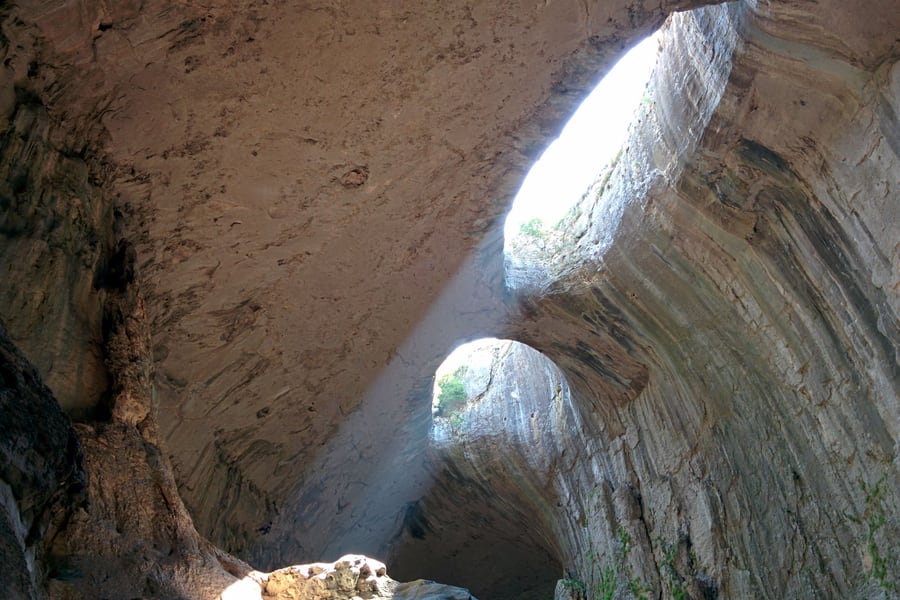 Камен Ханджиев / Wikimedia Commons · CC BY-SA 4.0
Prohodna, and the Eyes of God
Two eye-shaped holes in the roof of a cave, eroded through the limestone and pouring daylight onto the floor. Prohodna is 262 metres long — the longest cave passage in Bulgaria — and open at both ends, one entrance 35 metres high and the other more than 42. It stands about 2 kilometres from Karlukovo, where the Iskar has cut a second gorge north of the Balkan range.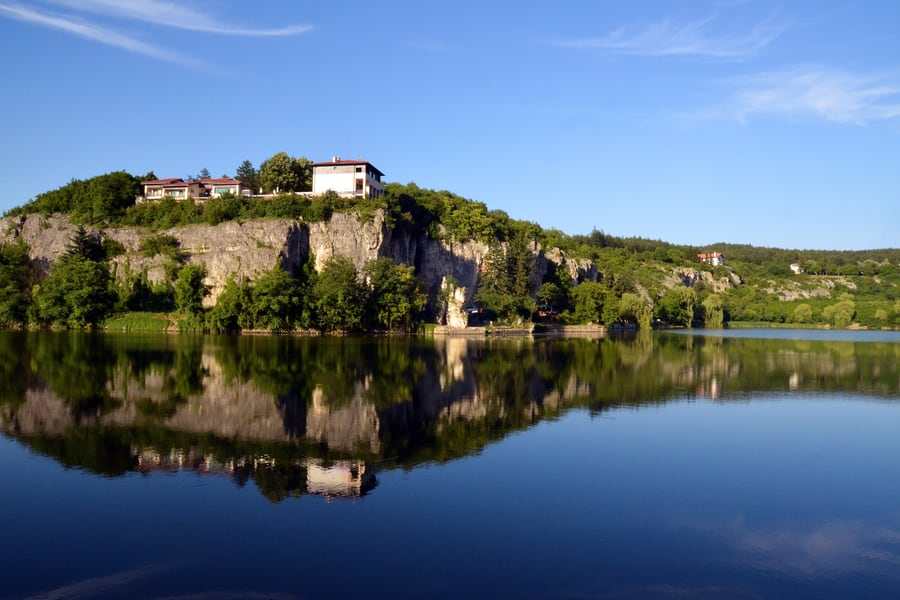 Yani Yakov Photography / Wikimedia Commons · CC BY-SA 4.0
Kaylaka, above Pleven
Ten square kilometres of karst valley south of the town, where the Tuchenitsa river has cut a canyon between parallel cliffs 20 to 30 metres high and a hundred-odd metres apart. The park was laid out from 1946 and planted with something like 10,000 cedars, among them Himalayan pines rare elsewhere in Bulgaria. The ruins of the Roman fortress of Storgosia stand inside it, and there are two reservoirs with boats.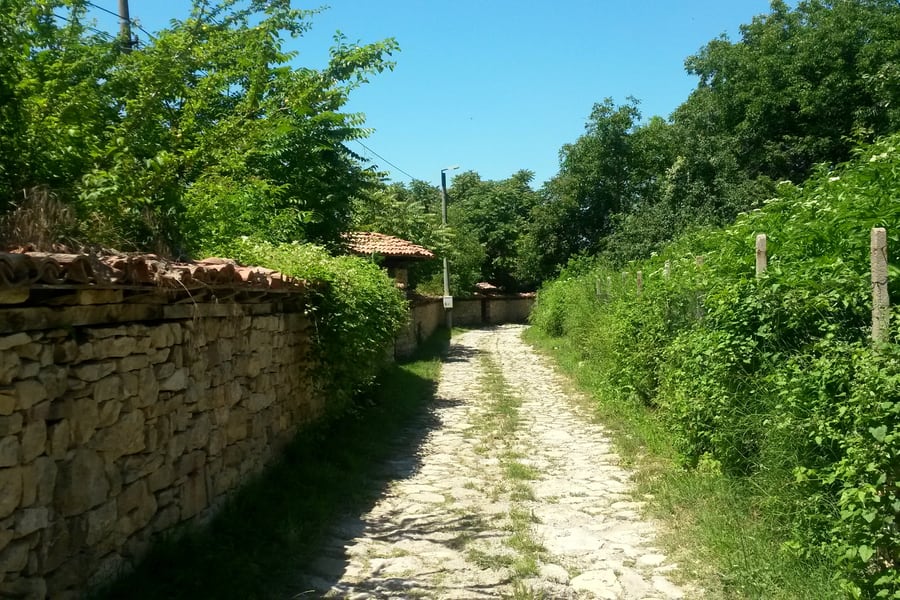 Mark Ahsmann / Wikimedia Commons · CC BY-SA 4.0
Arbanasi
A village of 144 fortified stone houses on the plateau between Veliko Tarnovo and Gorna Oryahovitsa, at 400 metres, first recorded in a register of 1540–41 and made into a grand vizier's private estate around 1556. Its merchants grew rich on silk and livestock in the seventeenth and eighteenth centuries and built like it. Five church museums survive; the Nativity Church carries an inscription of 1638 naming the couple who paid for it.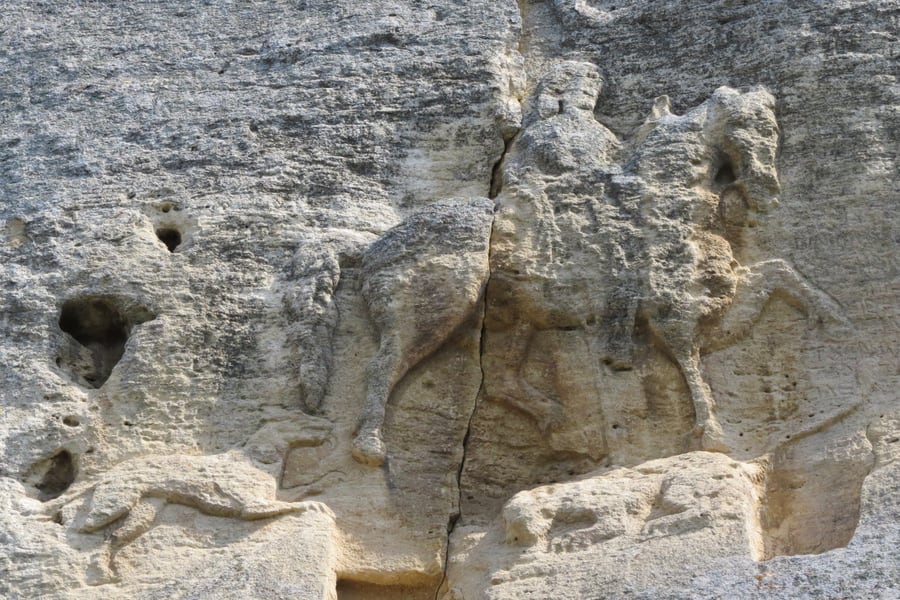 Octopus at Slovenian Wikipedia / Wikimedia Commons · CC BY-SA 3.0
The Madara Rider
A horseman spearing a lion, a dog running beside him, carved 23 metres up a vertical cliff at the very end of the seventh century or the beginning of the eighth, in the reign of Khan Tervel. It is the only rock relief of its kind in Europe and has been on the UNESCO list since 1979. Seven trains a day run the short hop from Shumen to Madara station.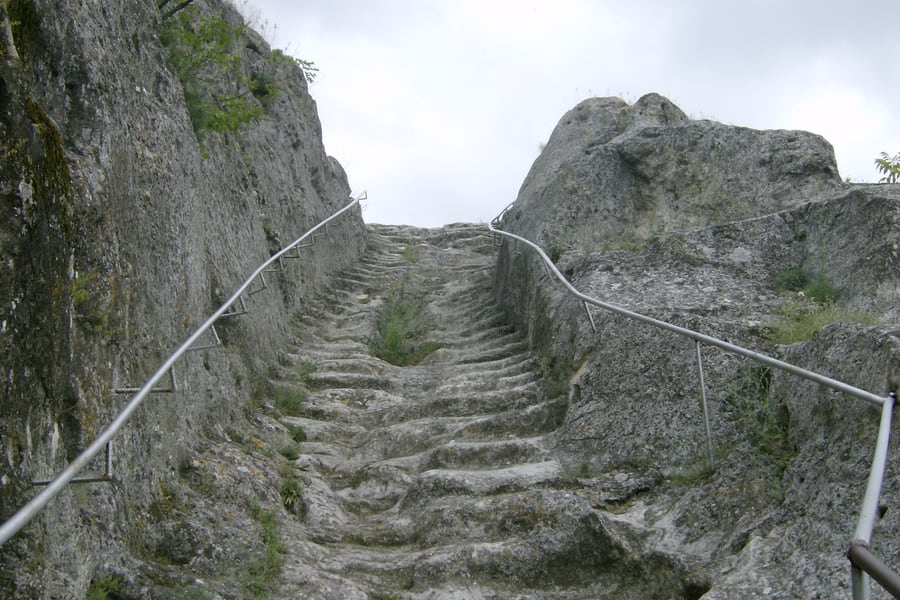 Izvora / Wikimedia Commons · CC BY-SA 4.0
The Ovech fortress
A fortress on a flat-topped plateau ringed by 20-metre cliffs, directly above the gorge the railway threads. Archaeology puts it in use from the third century to the early seventh, and again from the tenth or eleventh until the end of the seventeenth. Three ways up survive: stairs cut into the rock on the east, a spiral stair of 111 steps on the west, and a 150-metre bridge to the next plateau.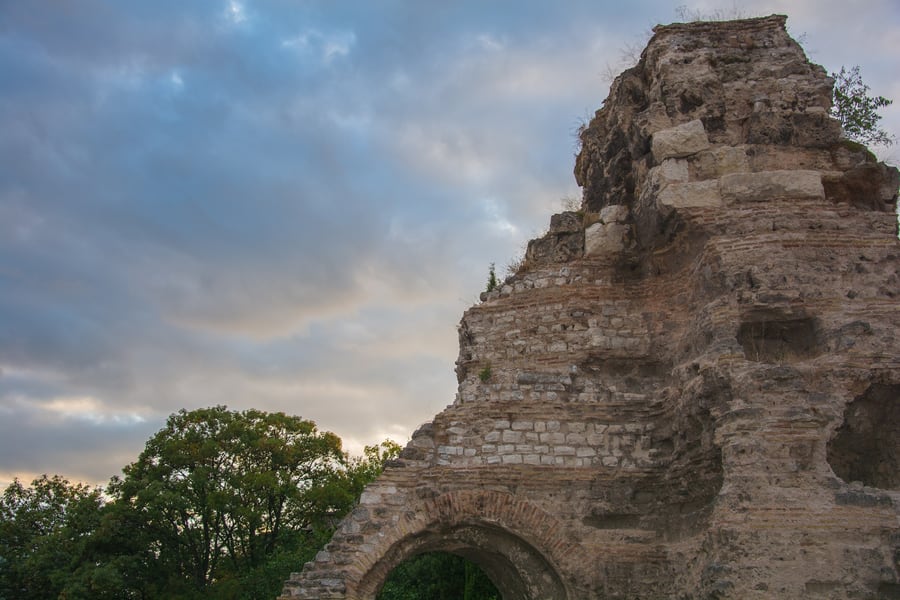 Nikolina Ivanova / Wikimedia Commons · CC BY-SA 4.0
The Roman baths of Odessos
Seven thousand square metres of Roman bathhouse, built in the late second century and in use for only about a hundred years. Vaults survive to 20–22 metres, along with the changing room, the cold, warm and hot pools, the exercise yard and the underfloor heating. They are the fourth-largest Roman baths still standing in Europe and the largest in the Balkans, in the streets behind the harbour.Where to Sleep
The whole line can be ridden in a day in either direction, and the two night trains remove the need for a bed altogether. But the halfway towns are cheap, and Veliko Tarnovo in particular deserves more than the twenty minutes the timetable gives it.
Four properties are listed below: one in Sofia for an early start, two along the route, and one in Varna. Every link was opened and read in a browser on 14 August 2026. None carries a price or a rating on this page, because we have verified neither — each description says only what the hotel itself says about its rooms, its position and its history.
⚠️ All four cards ship without a photograph, and deliberately. Bulgaria has no commercial freedom of panorama, so a photograph of a modern hotel building cannot be used here, and Wikimedia Commons holds no image of any of these four. A card with no picture is better than a picture of the wrong building.
For an overnight crossing instead of a hotel, trains 2626 and 2627 carry three sleeping cars each, at a supplement of €7.67 in second class and €10.23 in first.
Where to stay
Hotel Rila
Central Sofia, for an early departure
In downtown Sofia between Vitosha Boulevard, the Presidency and the Ivan Vazov National Theatre, a few minutes from the Archaeological Museum and Alexander Nevsky. Convenient for the 07:00 shuttle to Sofia North and the 07:15 to Varna, which is the first train of the day over the whole line.
Check Availability (opens in a new tab, on hotelrila.bg)via hotelrila.bgHotel Rostov
Pleven, at the halfway mark
In the centre of Pleven, with 101 rooms and 160 beds, free parking, a restaurant seating up to 330 and two conference halls. The building itself is part of the town's history: it went up in 1968 to a design by the architect Kiril Ruskov, and its own account says it was the first in Bulgaria built using French slip-form construction.
Check Availability (opens in a new tab, on rostov.bg)via rostov.bgGrand Hotel Yantra
Veliko Tarnovo, from Gorna Oryahovitsa
In the heart of the old town, with rooms and suites looking out over the Tsarevets fortress, the Trapezitsa hill and the Arbanasi plateau. There is a relaxation and wellness centre and a small indoor pool. Veliko Tarnovo is twenty minutes from Gorna Oryahovitsa, where every train on this line pauses.
Check Availability (opens in a new tab, on yantrabg.com)via yantrabg.comGraffit Gallery Hotel
Varna, at the end of the line
A design hotel in Varna whose four guest floors were each given to a different Bulgarian architect, so the interiors change as you go up. It has its own restaurant and direct booking benefits including discounts at the underground garage and at several restaurants and spas around the city.
Check Availability (opens in a new tab, on graffithotel.com)via graffithotel.comQuestions or corrections
Planning this trip and stuck on something, or spotted a time, fare or detail that has changed? Send us a message about The Sofia–Varna Express — Bulgaria's Longest Railway. We read every one, and we update this page when something has changed.