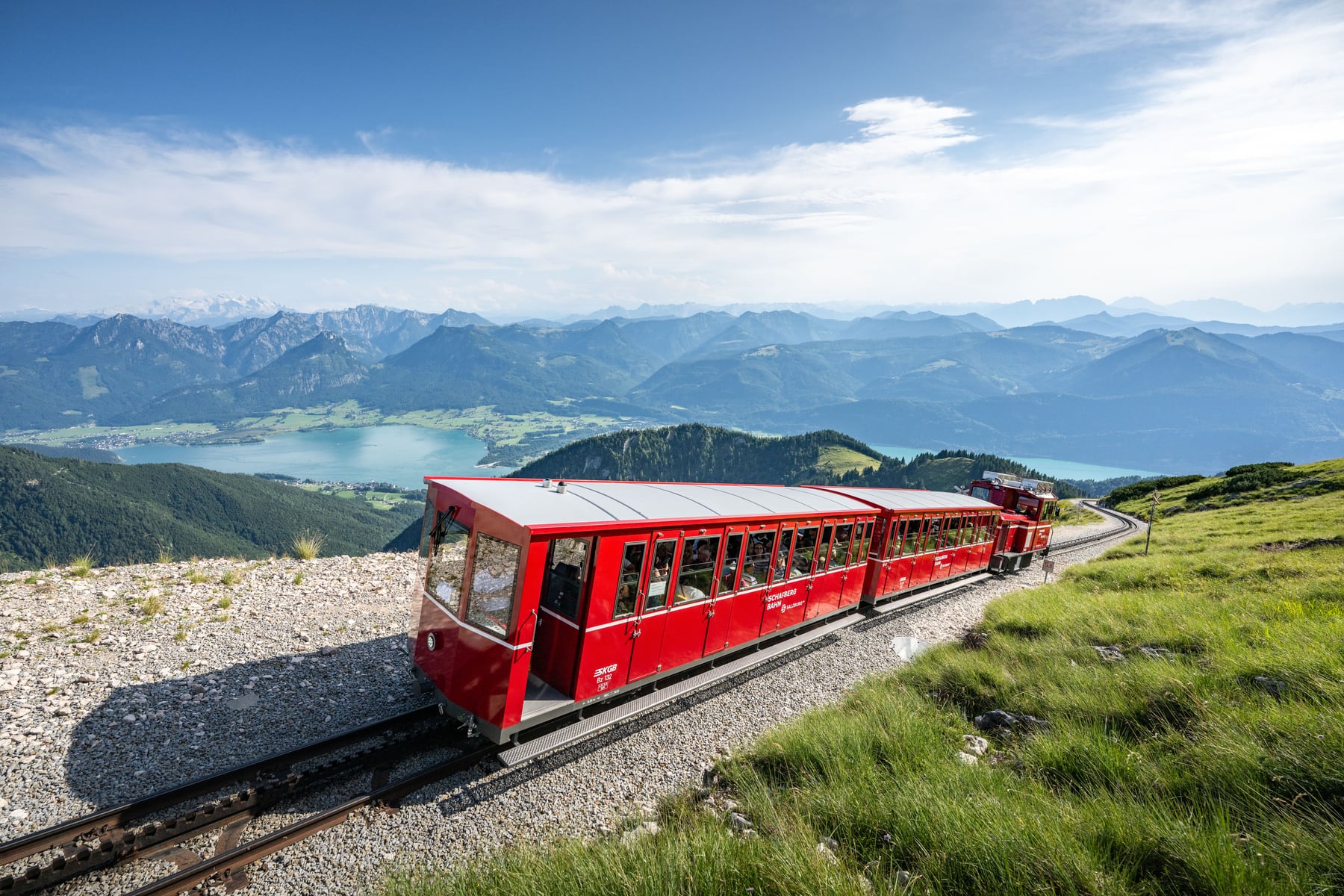
Schafbergbahn
© Salzburg AG Tourismus GmbH / Georg Kukuvec
- Distance5.85 km
- Duration35 minutes up, 40 down
- Best season25 April – 1 November 2026, daily; up to every 20 minutes in fine weather
Introduction
Before there was a railway up the Schafberg, St. Wolfgang carried its visitors to the top.
Early in the nineteenth century the grandest families from Vienna and the leading citizens of St. Wolfgang had themselves carried up the mountain in chairs, and the town grew a trade to do it: the Sesselträger, the chair-carriers, a guild with fixed fares, fixed ranks to wait on and strict rules for the safety of the people they carried. There was somewhere to carry them to. The hotel on the summit was finished in 1864, three decades before the first train, and the operator calls it Austria's oldest mountain hotel. Since 1 August 1893 the climb has been the railway's.
It is, in the operator's words, the steepest rack railway in Austria: 5.85 kilometres from the shore of the Wolfgangsee to a summit station at 1,732 metres, climbing 1,190 metres on gradients of up to 26 per cent, in about 35 minutes. An Abt rack runs the whole length of the line, because the engines drive only through their cogwheels. Stern & Hafferl built it from April 1892 with 350 workers, most of them Italian, and some 6,000 mule loads carried the materials and the food up the mountain.
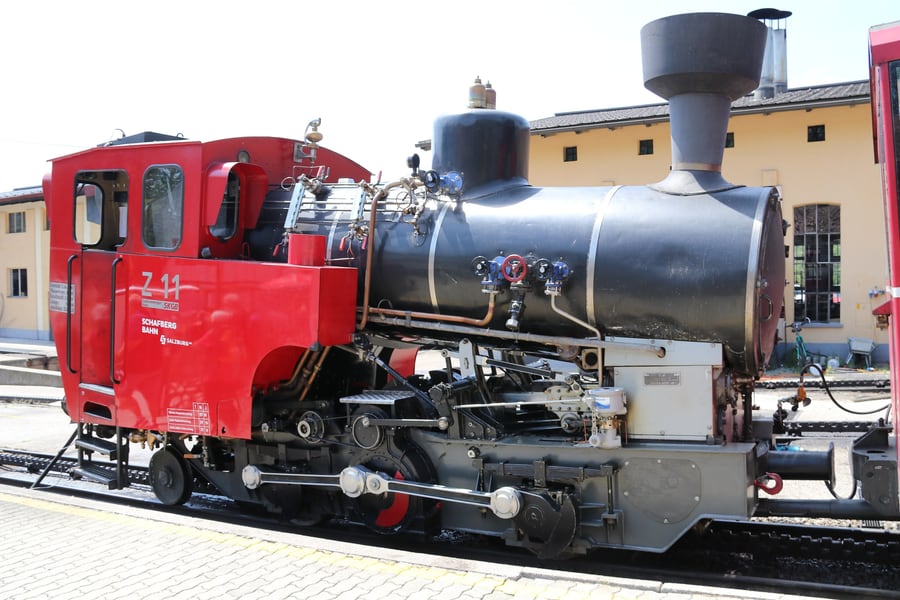
Three generations of engine work it today. Four diesel-electric locomotives, delivered between 2010 and 2020, haul most of the trains. Four oil-fired steam engines, built new at Winterthur in 1992 and 1995–96, run alongside them. And the original coal-fired engines of 1893 and 1894, which the operator counts among the oldest working rack steam locomotives in the world, come out only for a handful of summer evening trains.
The Journey
The Schafbergbahn starts from its valley station on the lakeshore in St. Wolfgang, the ErlebnisQuartier, opened in April 2023 in place of the old one: a large, light-filled hall where the trains are boarded under cover, with a ticket office, a shop, a café and restaurant upstairs, and a small museum whose centrepiece is a historic locomotive. A train is a single engine and one or two coaches, and the engine is always at the downhill end, pushing.
The climb
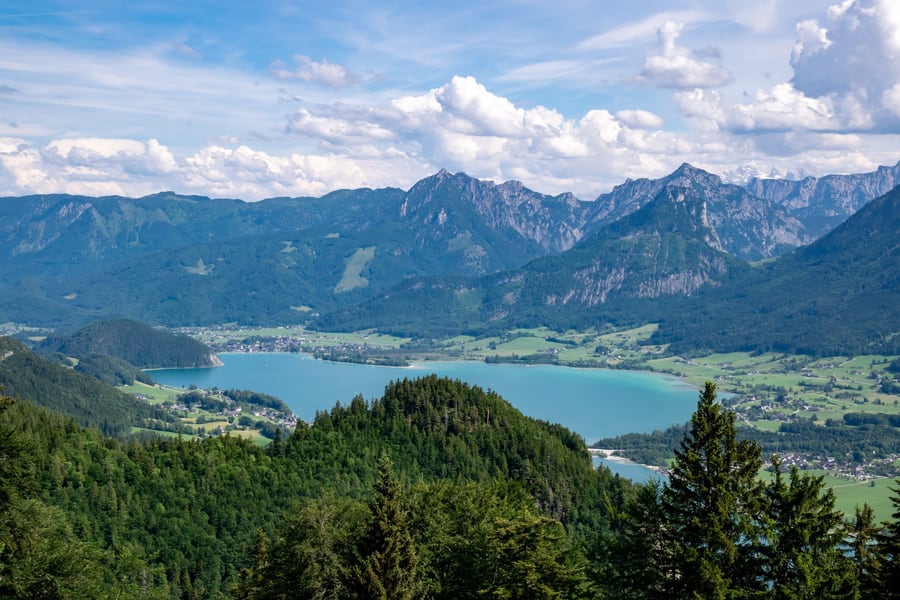
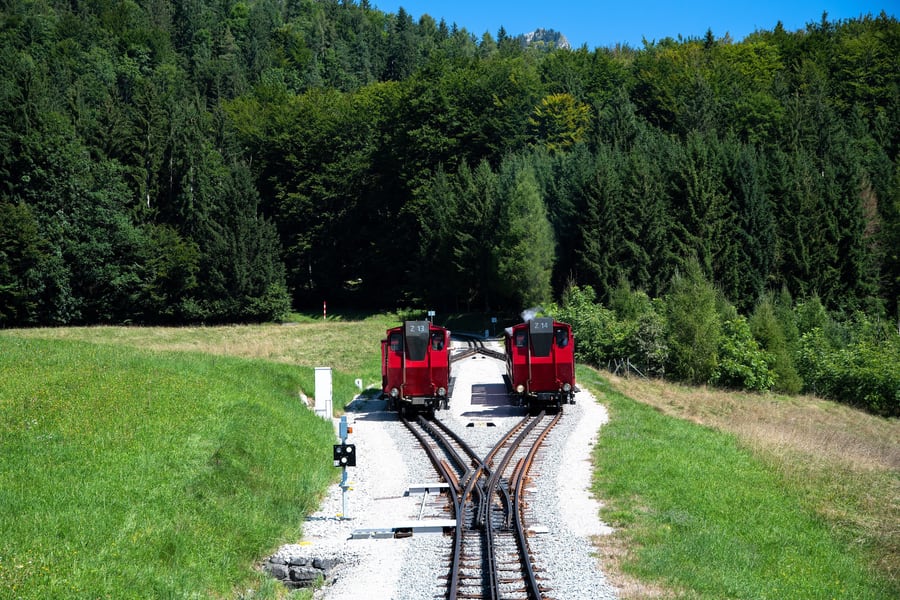
The line is single track. About 472 metres out it crosses the Dittelbach, the stream that divides Upper Austria from the state of Salzburg, and the rest of the journey is in Salzburg. Through the forest the train passes the Aschinger loop, 65 metres long and added in 2011 so that trains could run every twenty minutes, and after 2.7 kilometres reaches the Dorneralm loop at 1,015 metres, where trains cross and the Wolfgangsee opens out below in full.
The rack is the Abt system, two toothed bars laid side by side between the rails, and because the engines have no drive to their wheels it is laid even where the line is nearly level. The gradient reaches 26 per cent. Until the track was renewed between 2018 and 2023, much of the line still ran on the rails laid in 1893, rolled at Zeltweg and stamped BST.
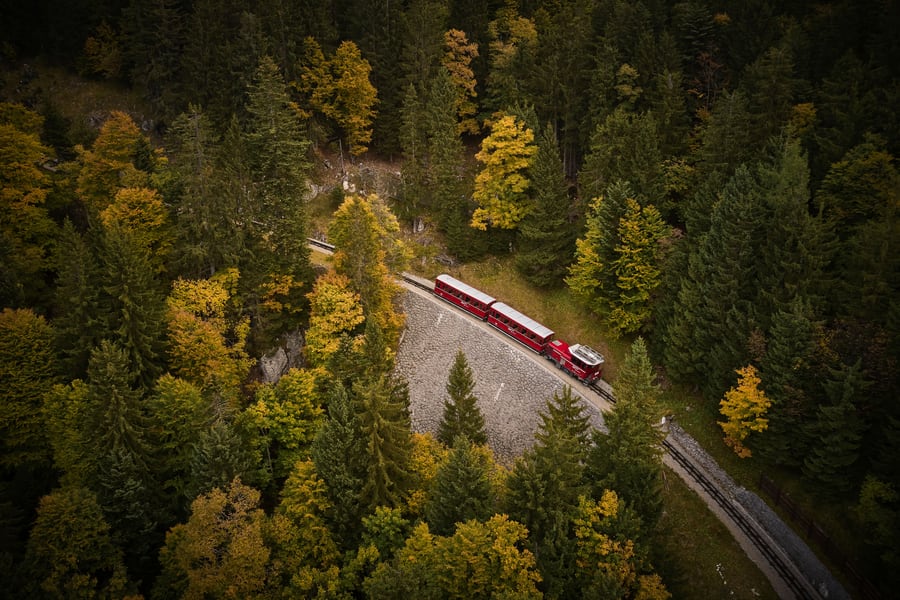
After about thirty minutes and 4.2 kilometres the train stops at Schafbergalm, 1,364 metres up. This is the treeline, and from here on the view opens over the valley and the Wolfgangsee. The last ten minutes are the most dramatic: the line runs close under rock walls and through two tunnels, 87 and 26 metres long, before reaching the summit station at 1,732 metres.
At the top
From the station a path climbs another 50 metres to the Hotel Schafbergspitze and the summit at 1,783 metres. To the north the mountain falls away sheer for about 300 metres, and at the Himmelspforte, a narrow gap in the rock, stands the summit cross. The operator counts eleven lakes from here on a clear day; the three big ones are the Wolfgangsee to the south, and the Mondsee and the Attersee below the north face.
The time of your train down is fixed when you buy the ticket. It can be changed at the summit station, the hotel or the Himmelspforte; trains down from Schafbergalm take passengers as space allows. The descent takes about forty minutes.
The engines
The first engine, the Z1, arrived at Ischl in pieces early in 1893 and was taken to St. Wolfgang by sledge, where Krauss assembled it. The first train reached the summit on 31 July and the line opened the next day. The original Krauss engines from Linz, of 1893 and 1894, burn coal and are kept for the nostalgia trains; because fewer and fewer firms have the knowledge, almost all their repairs are done in the railway's own workshop in St. Wolfgang. In 1992 and 1995–96 the Swiss Locomotive and Machine Works at Winterthur built four new steam engines for the line, Z 11 to Z 14, fired with light oil. The diesel-electric locomotives from Stadler, Vz 31 to Vz 34, came in 2010, 2016 and 2020 and now do most of the work.
Who has owned it
A concession of 1890 covered both a narrow-gauge local railway from Ischl to Salzburg and a rack railway up the Schafberg from St. Wolfgang, and the Salzkammergut-Lokalbahn company was founded to build them. The rack railway was sold to the Österreichisches Verkehrsbüro in 1932, passed to the Deutsche Reichsbahn in 1938 and to the Austrian Federal Railways after the war. Since the 2006 season it has belonged, with the Wolfgangsee boats, to a subsidiary of Salzburg AG.
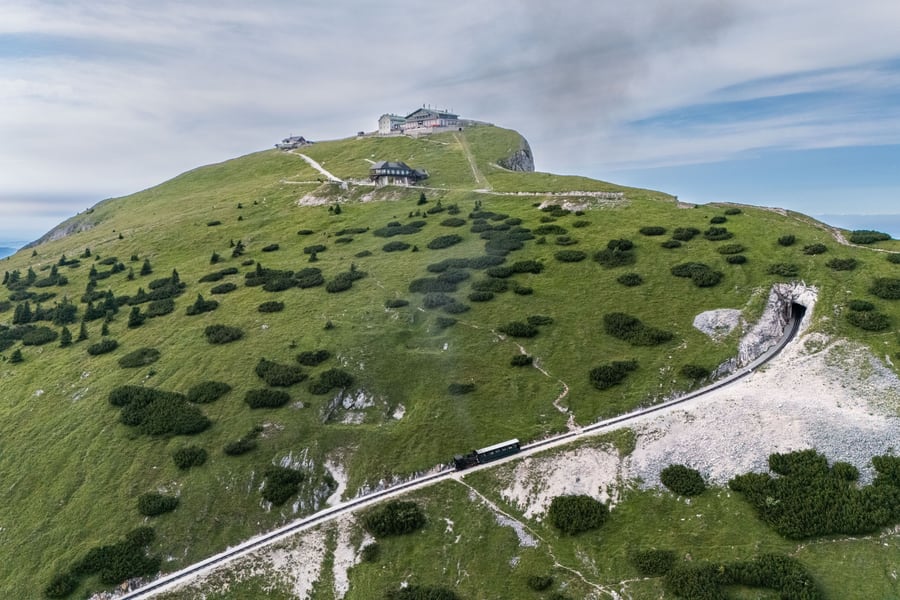
Along the route
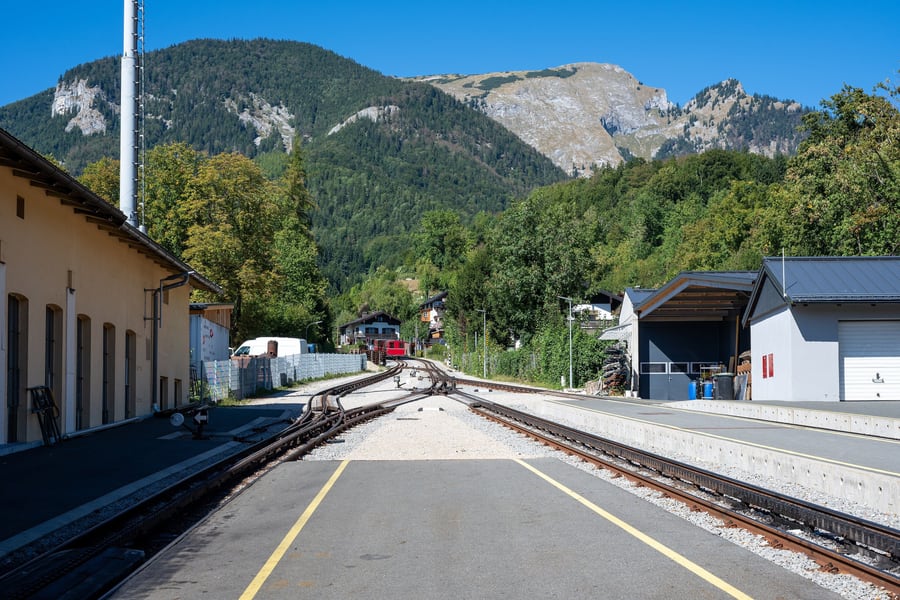 Linie29 / Wikimedia Commons · CC BY 4.0
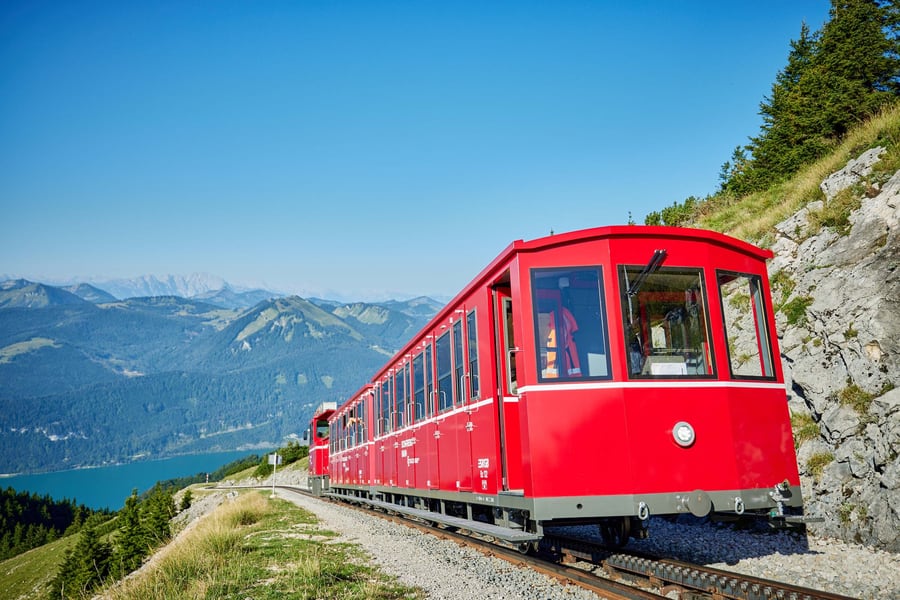
Into another state
The valley station is in St. Wolfgang, in Upper Austria. About 472 metres out, the line crosses the Dittelbach, the stream that marks the border, and climbs the rest of the way in the state of Salzburg.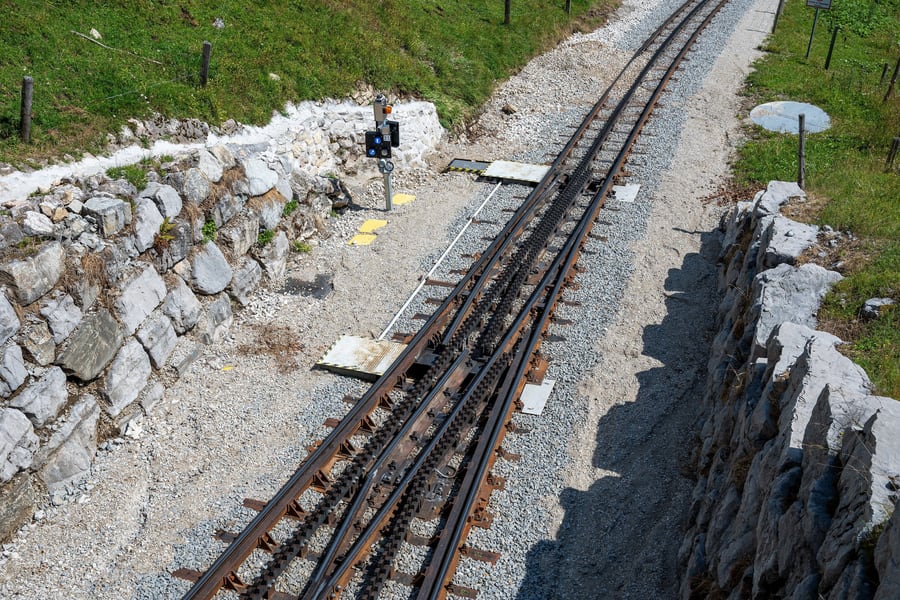 Linie29 / Wikimedia Commons · CC BY 4.0
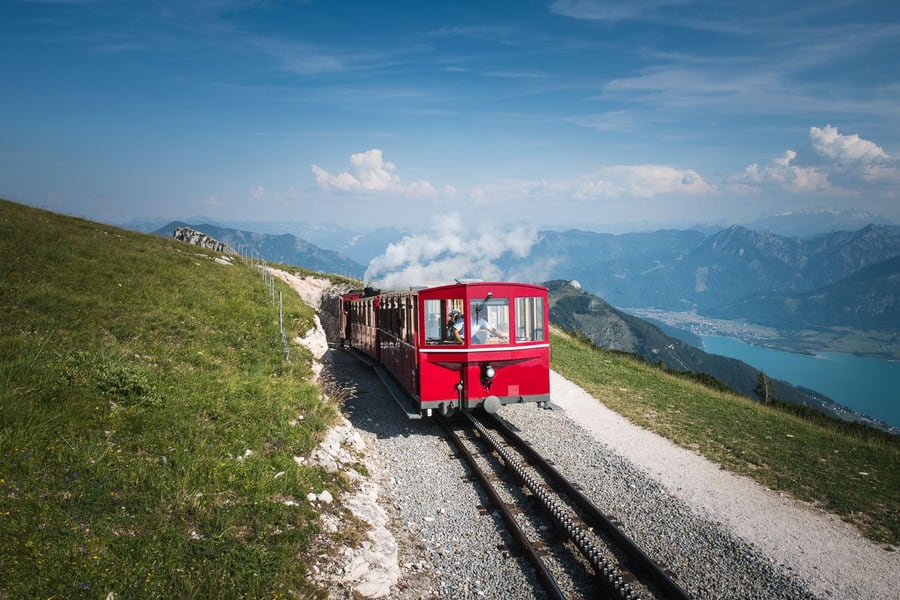
Rack all the way
The engines drive only through their cogwheels, so an Abt rack, two toothed bars side by side, runs the whole length of the line, even where the track is almost level. Points like these at Schafbergalm carry the rack across too.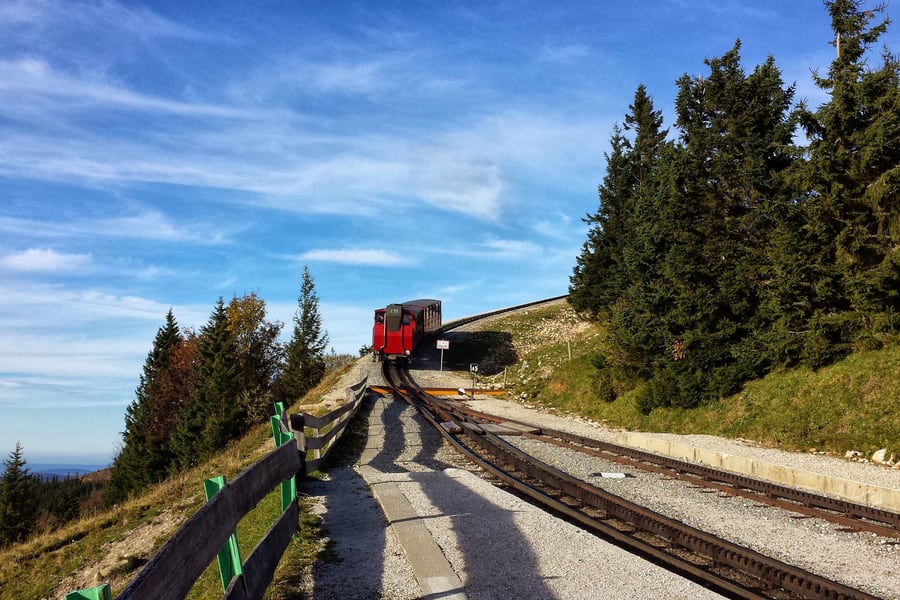 josef lahmer / Wikimedia Commons · CC BY-SA 3.0 · cropped
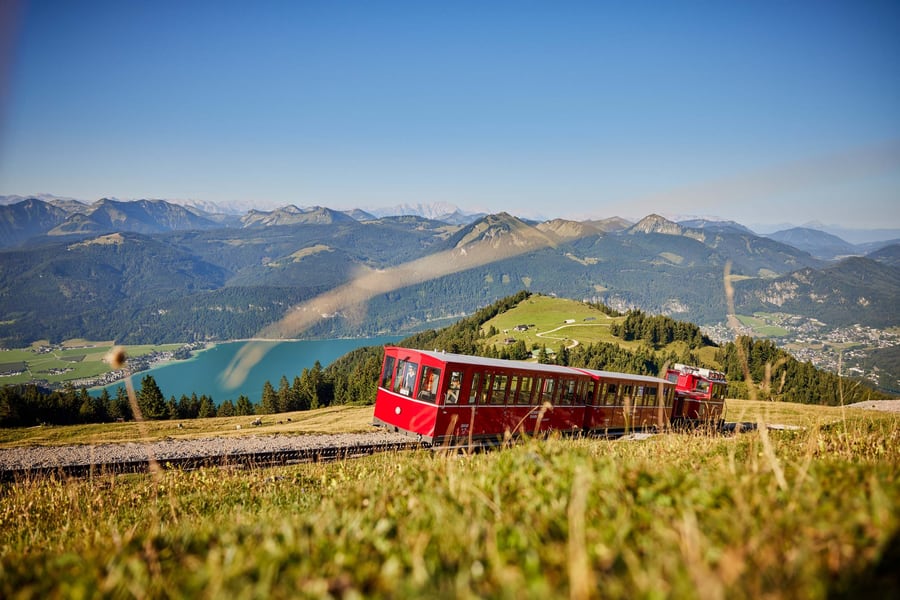
Schafbergalm, the treeline
After about thirty minutes and 4.2 kilometres the train stops at Schafbergalm, 1,364 metres up, where the forest gives out. Walkers can get off here and climb the rest of the way to the summit.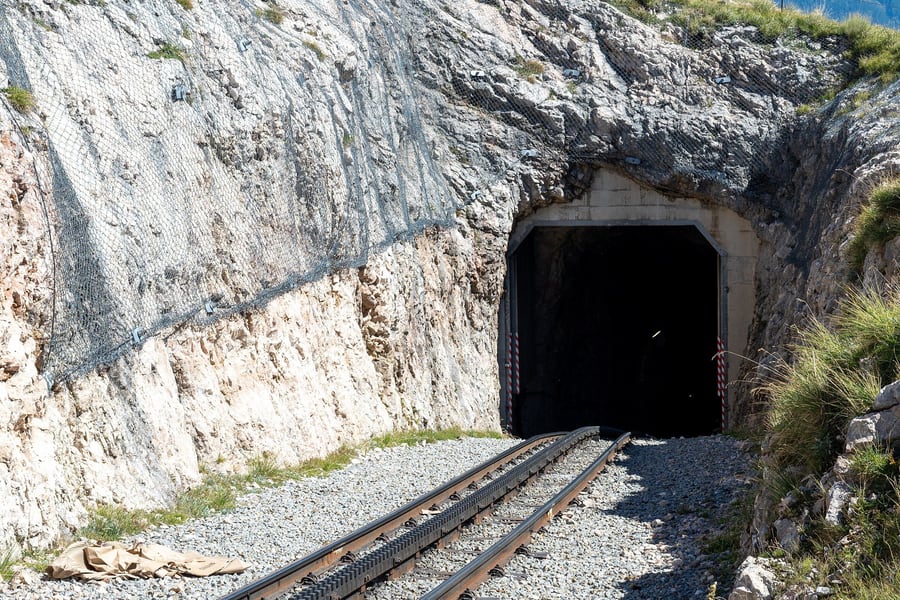 Linie29 / Wikimedia Commons · CC BY 4.0 · cropped
Two tunnels to the top
The last stretch runs close under rock walls and through two short tunnels, 87 and 26 metres long, before the summit station at 1,732 metres. The hotel and the summit itself are a 50-metre climb on foot.A bit of history
Culture & experiences along the way
 Fiver, der Hellseher / Wikimedia Commons · CC BY-SA 4.0 · cropped
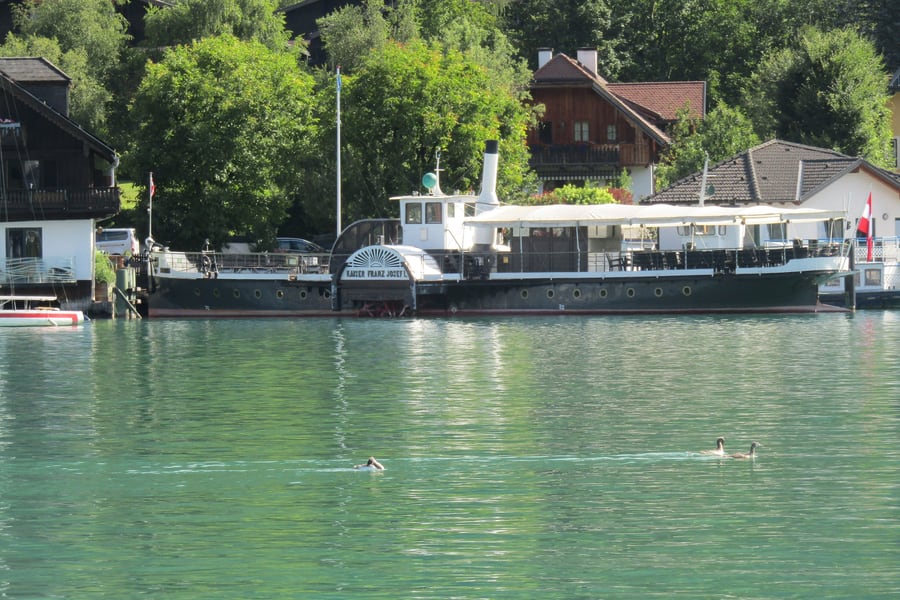
The Kaiser Franz Josef I
The first steamer on the Wolfgangsee, launched in 1873 and owned by the same company as the railway. She lost her steam engine for a diesel in 1954 and was restored in 2008 to look as she did around 1908. The operator runs her on nostalgia cruises.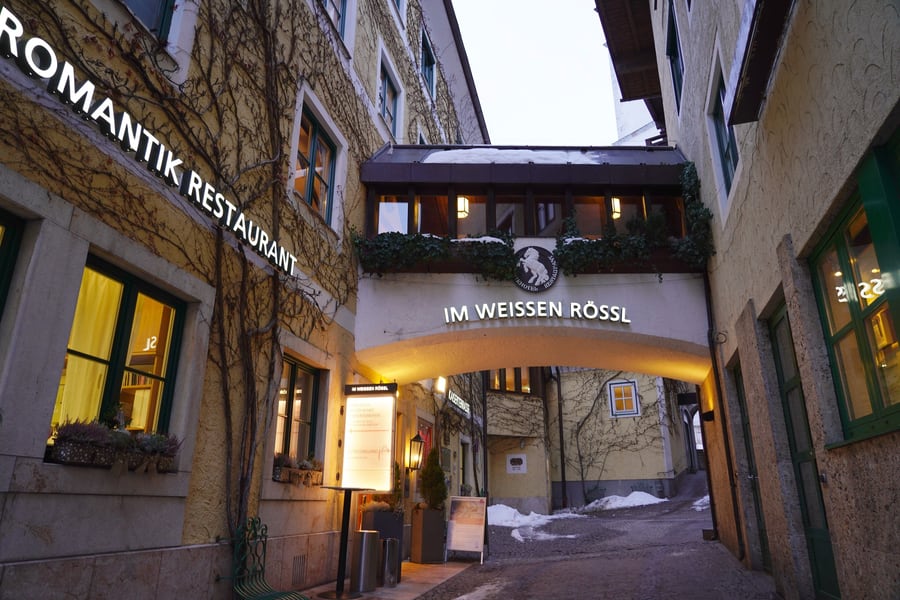 Ray Swi-hymn / Wikimedia Commons · CC BY-SA 2.0 · cropped
Im weißen Rößl
Ralph Benatzky's musical comedy of 1930, from an 1897 Berlin farce, is set at the White Horse Inn in St. Wolfgang: a head waiter in love with the landlady, a Berlin manufacturer who wishes he had gone to Ahlbeck instead, and the Emperor arriving in Act Two.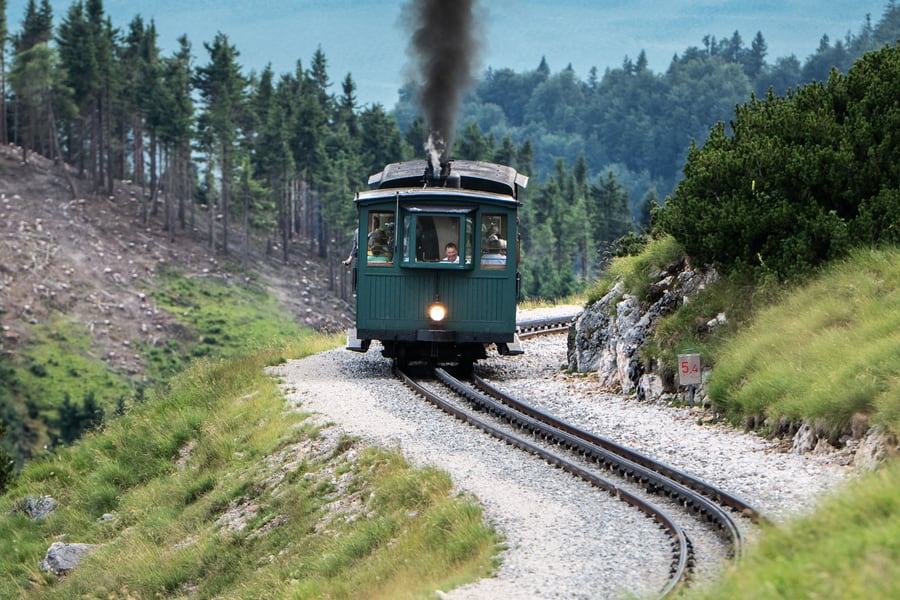 © Salzburg AG Tourismus GmbH / Georg Kukuvec · cropped
The 1893 engines, by evening
The original Krauss engines run only on a few summer evenings: up at 17:20, dinner at the Himmelspforte, down at 20:45. One round trip burns 500 kilograms of coal and 3,000 litres of water, and the engine takes four hours to prepare.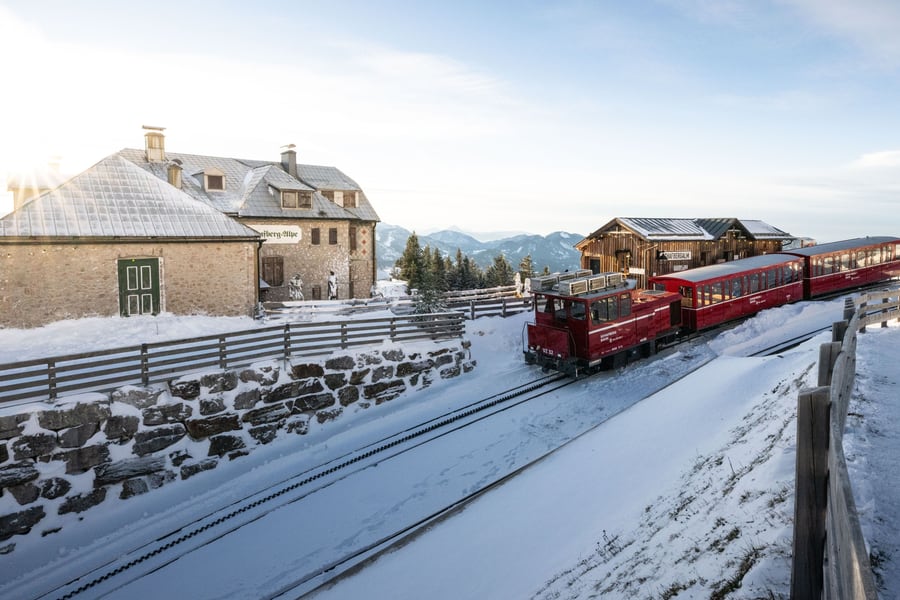 © Salzburg AG Tourismus GmbH · cropped
Advent at Schafbergalm
From 20 November to 20 December, Wednesday to Sunday, and daily over Christmas and New Year, a train strung with lights climbs to Schafbergalm for the Wolfgangseer Advent. Advent weekends bring live music at the station, the Schafberg-Alpe inn opens its parlour, and a special postbox collects letters to the Christkind.Timetables
The main season in 2026 runs daily from 25 April to 1 November, all the way to the summit. The timetable is built around a fixed core of trains, with more added as the crowds demand: on busy, fine days the operator runs trains every twenty minutes, and in bad weather or with few passengers some are cancelled.
Main season — 25 April to 1 November 2026
Up to the summit:
| St. Wolfgang | Schafbergalm | Schafbergspitze |
|---|---|---|
| 08:50 ◆ | 09:15 | 09:25 |
| 09:15 ● | 09:40 | 09:50 |
| 10:10 | 10:35 | 10:45 |
| 11:10 ● | 11:35 | 11:45 |
| 11:50 | 12:15 | 12:25 |
| 12:50 | 13:15 | 13:25 |
| 13:30 | 13:55 | 14:05 |
| 14:50 | 15:15 | 15:25 |
| 15:30 | 15:55 | 16:05 |
| 16:30 ▲ | 16:55 | 17:05 |
Down to St. Wolfgang:
| Schafbergspitze | Schafbergalm | St. Wolfgang |
|---|---|---|
| 10:00 ● | 10:10 | 10:40 |
| 11:05 | 11:15 | 11:40 |
| 12:05 ● | 12:15 | 12:40 |
| 12:45 | 12:55 | 13:20 |
| 14:05 | 14:15 | 14:40 |
| 14:45 | 14:55 | 15:20 |
| 15:45 | 15:55 | 16:20 |
| 16:25 | 16:35 | 17:00 |
| 17:05 ▲ | 17:15 | 17:40 |
● runs every day of the season. ◆ runs 27 June to 6 September on sunny days. ▲ runs for guests of the Hotel Schafbergspitze, booked in advance. Every other train runs as shown on the departure boards at the stations, so check the board on the day.
The last ordinary train down leaves the summit at 16:25. No reservation is needed for the journey up, but the time of the journey down is fixed when you buy the ticket, and can be changed at the terminals at the summit station, the hotel or the Himmelspforte. The operator publishes the day's live departures and free seats on its website.
Nostalgia steam evenings
On five Saturdays in summer 2026 — 27 June, 11 and 25 July, 8 and 22 August — an original 1893 engine leaves St. Wolfgang at 17:20, reaches the summit at 18:10, and comes down at 20:45, back at 21:35.
Out of season
In spring and in Advent trains run only as far as Schafbergalm. In 2026 the Advent trains run 20 November to 20 December, Wednesday to Sunday, and daily again from 26 December to 3 January. The spring trains of 2026 ran at weekends from 7 March to 12 April, and daily over Easter and from 18 to 24 April.
Getting to St. Wolfgang
St. Wolfgang is reached by bus or by boat. From Salzburg, the operator's route is bus 150 to Strobl and bus 546 to the Schafbergbahnhof stop, or bus 150 to St. Gilgen and the lake boat across. From Vienna or Linz, take the train to Attnang-Puchheim, a regional train to Bad Ischl on the Salzkammergut line, and bus 546 from there.
Times as of October 2026, from the SchafbergBahn's own 2026 timetable (opens in a new tab).
Tickets
Tickets are sold in the operator's online shop, at its ticket offices in St. Wolfgang and St. Gilgen and on board the Wolfgangsee boats. There are no classes, and one price list covers the 2026 season. Children under four ride free if they sit on a lap; from four to fourteen they pay the child fare. On Fridays from 13:30, until 31 October, children ride free with an adult, and on Mondays from 13:30 there is a cheaper fare for anyone over sixty.
Dogs need a ticket, €7.50 for the day, and must be leashed and muzzled; prams and bicycles are not carried. Holders of the Salzkammergut Erlebnis-Card pay €58.20 return instead of €61, and a return ticket takes €4 off the parking at P7, beside the valley station. Read from the operator in October 2026.
Book your tickets
St. Wolfgang – Schafbergspitze return
€61 adult · €18.40 child 4–14 · €43 one way
Up and down the whole line, with the time of the descent fixed when you buy.
Book Tickets (opens in a new tab, on SchafbergBahn)via SchafbergBahnMountain and lake, one day
€78.70 from St. Gilgen · €61 from Gschwendt
The railway return plus the boat to St. Wolfgang and back from a landing stage of your choice.
Book Tickets (opens in a new tab, on SchafbergBahn)via SchafbergBahnNostalgia steam evening
€98 adult · €43.90 child, dinner included
The 1893 engine up and down, a welcome drink and a roast at the Himmelspforte.
Book Tickets (opens in a new tab, on SchafbergBahn)via SchafbergBahnTo Schafbergalm, spring and Advent
€50 return · €30 one way
The out-of-season trains, which turn at the halfway station.
Book Tickets (opens in a new tab, on SchafbergBahn)via SchafbergBahnRail Passes
No rail pass covers the Schafbergbahn. The operator states that neither the KlimaTicket, Austria's annual all-network ticket, nor the ÖBB Vorteilscard is valid on it, and it appears nowhere among the Austrian railway companies whose trains Interrail covers. Everyone pays the operator's fare.
A pass still gets you most of the way. ÖBB's trains to Salzburg, Attnang-Puchheim and Bad Ischl are covered by an Interrail Austria Pass or a Global Pass, and regional trains need no reservation. The last stretch to St. Wolfgang is a bus or a boat, and the rack railway is a separate ticket, so for this trip alone a pass is not worth buying; it pays only when the Salzkammergut is one stop on a longer journey through Austria. The Salzkammergut Erlebnis-Card takes a few euros off the fare.
Checked October 2026 against Interrail's table of railway companies (opens in a new tab) and the SchafbergBahn's prices page (opens in a new tab).
Places to Visit
The Schafberg stands between three lakes, and a day here is as much about them as the mountain. These six are the town at the foot of the line, the summit itself, the cliff and the village across the Wolfgangsee, the Emperor's summer house at Bad Ischl, and the lake below the north face.
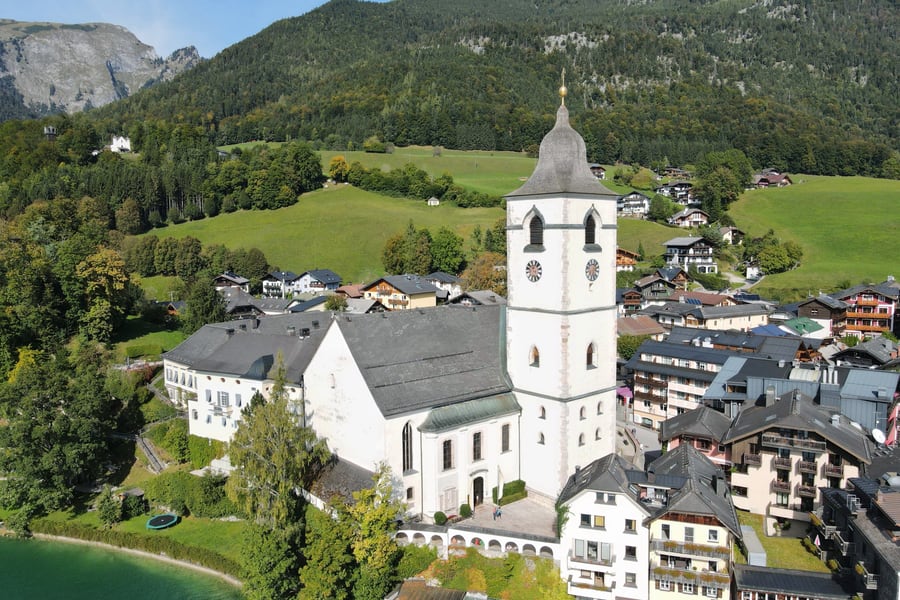 Foto: C.Stadler/Bwag / Wikimedia Commons · CC BY-SA 4.0
St. Wolfgang and the Pacher altar
The pilgrimage church stands on a rock above the lake, in the middle of the town. Inside is Michael Pacher's winged altar, made between 1471 and 1481 and the only one of his altars to survive complete. In the Baroque age Thomas Schwanthaler was asked to replace it, and is said to have persuaded the abbot to build his new altar elsewhere instead.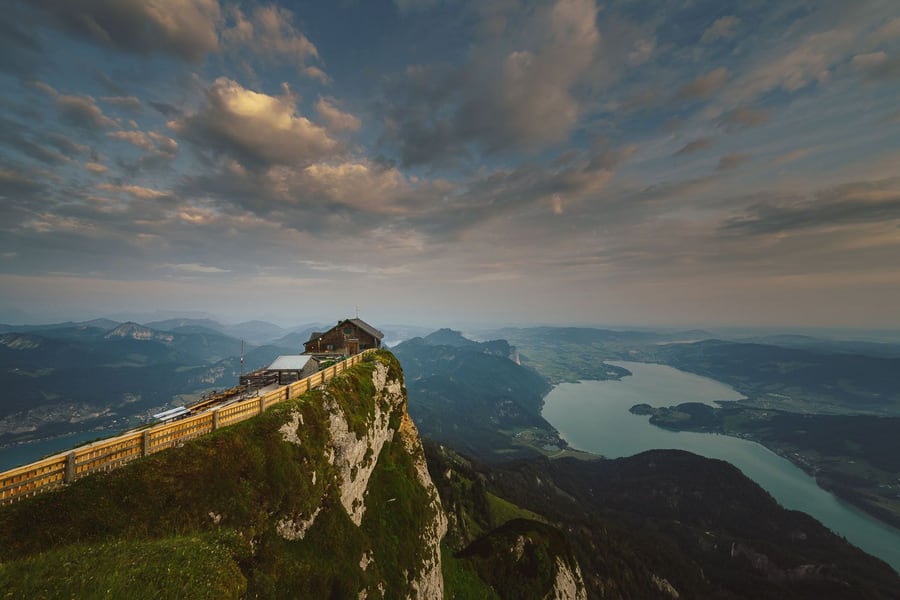 © Salzburg AG Tourismus GmbH
The summit and the Himmelspforte
From the summit station a path climbs 50 metres to the hotel and the top at 1,783 metres. On the north side the mountain drops sheer for about 300 metres, and at the Himmelspforte, a narrow gap in the rock, stands the summit cross. The operator counts eleven lakes from here on a clear day.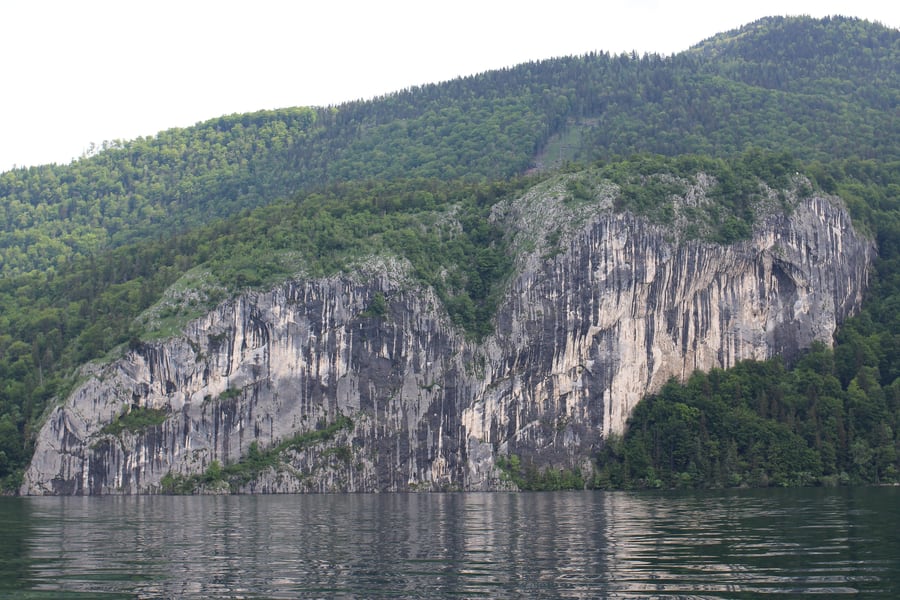 HagenF01 / Wikimedia Commons · CC BY-SA 4.0
The Falkenstein
A cliff that drops straight into the lake. The shore below is so steep that only a footpath links St. Wolfgang and Ried with St. Gilgen. Legend has Saint Wolfgang living up here as a hermit and throwing an axe into the valley, vowing to build his church wherever it landed.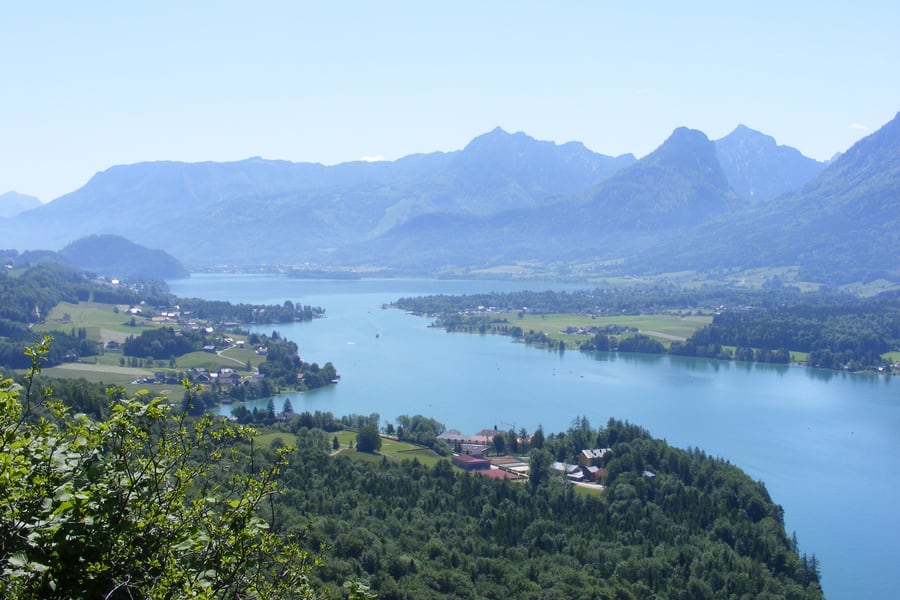 Eweht / Wikimedia Commons · CC BY-SA 4.0
St. Gilgen
The village at the western end of the lake, where Mozart's mother, Anna Maria Pertl, was born in 1720 and where his sister Nannerl moved when she married. Mozart himself never came. The lake boats to St. Wolfgang and the railway leave from its quay.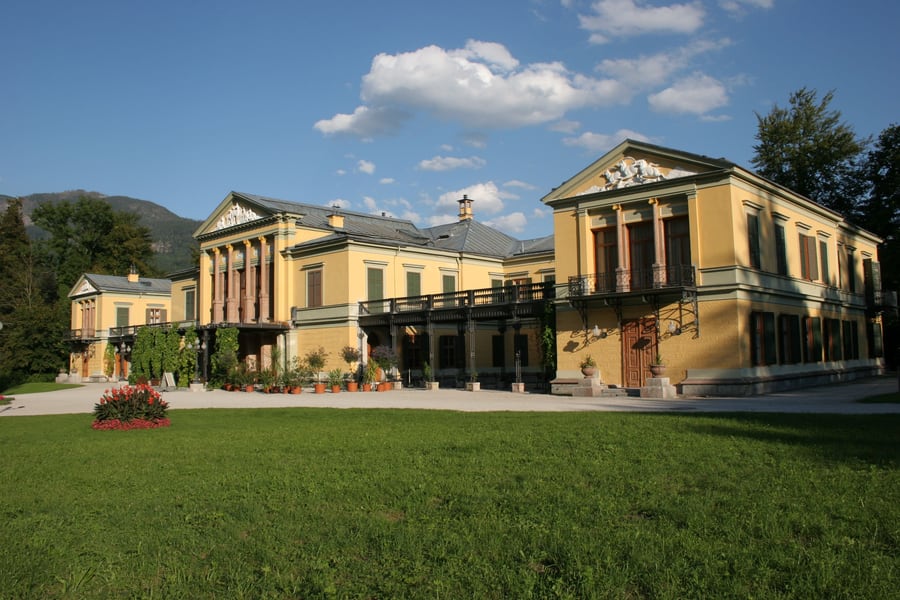 Sigmunds / Wikimedia Commons · CC BY-SA 3.0
The Kaiservilla, Bad Ischl
A Biedermeier villa that Sophie, the Emperor's mother, bought after his engagement in 1853 as a wedding present for Franz Joseph and Elisabeth. Enlarged in the Neoclassical style by 1860, it became their summer residence. Their great-grandson still lives there, and the house and its English park are open for tours.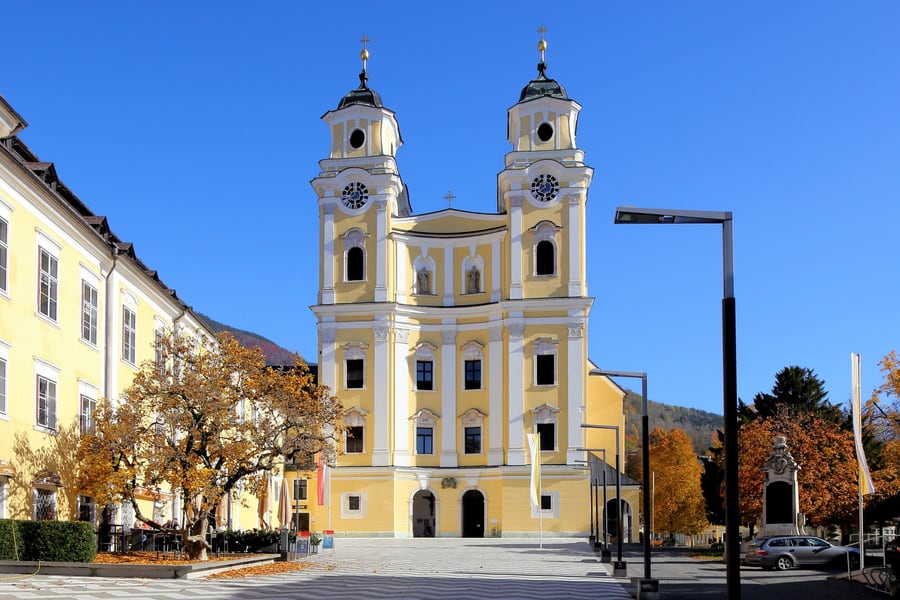 Foto: C.Stadler/Bwag / Wikimedia Commons · CC BY-SA 4.0
Mondsee
The lake under the north face. In the town of Mondsee on its shore, a Benedictine abbey was founded in 748, and its monks made, around 810, the oldest known translation of any part of the Bible into Old High German. The abbey church became a basilica in 2005, and the wedding in The Sound of Music was filmed there.Where to Sleep
There are two places worth staying: down in St. Wolfgang, where the trains start and the lake boats call, or at the very top, in the hotel that was there before the railway.
Where to stay
 Tsungam / Wikimedia Commons · CC BY-SA 4.0
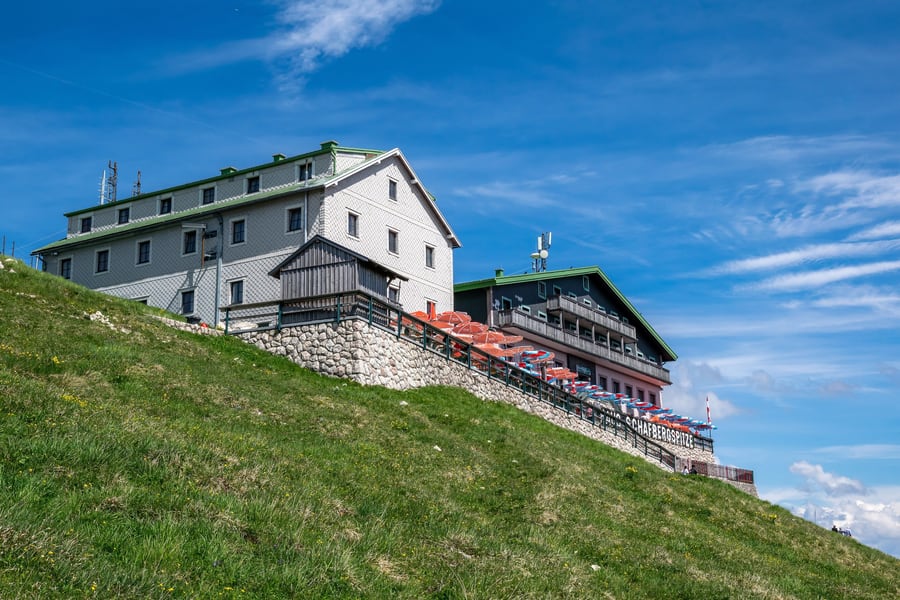
Hotel Schafbergspitze
On the summit, open May to mid-October
Built in 1864, three decades before the railway, and run by the Pasch family since 1966. After the last train down, guests have the summit to themselves and can go out at any hour.
Check Availability (opens in a new tab, on schafberg.net)via schafberg.net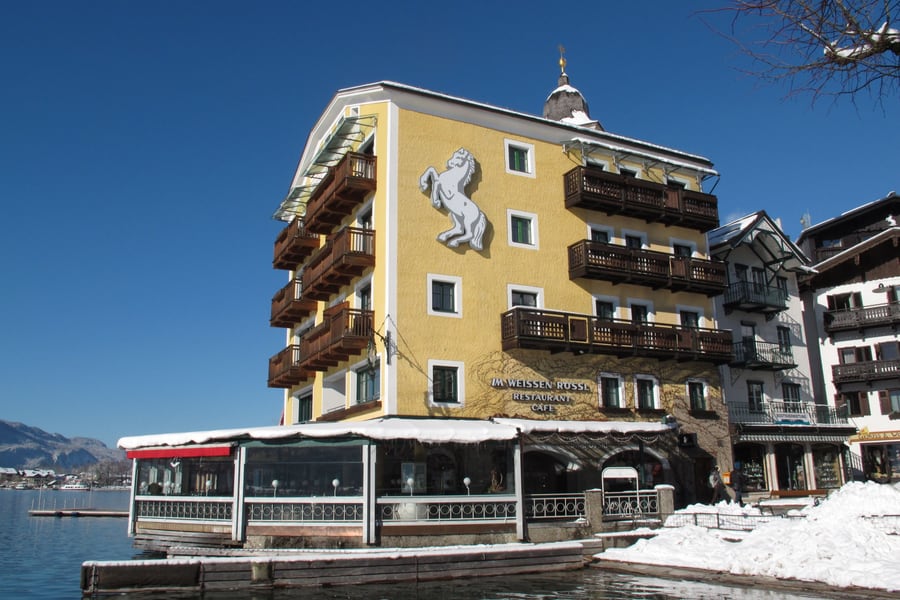 Bohao Zhao / Wikimedia Commons · CC BY 3.0
Im Weissen Rössl
On the lakefront in St. Wolfgang
The inn of the operetta, a hotel since 1878 and run by the Peter family, with its own heated bath in the lake and a lakeside restaurant, beside the pilgrimage church.
Check Availability (opens in a new tab, on weissesroessl.at)via weissesroessl.atQuestions or corrections
Planning this trip and stuck on something, or spotted a time, fare or detail that has changed? Send us a message about Schafbergbahn. We read every one, and we update this page when something has changed.