The TGM · Tunis to Carthage
M.Rais / Wikimedia Commons · CC BY-SA 3.0
- DistanceTunis Marine–Marsa Plage · 19 km
- DurationAbout 45 minutes end to end
- Best seasonMarch–May and September–November · summer is hot and the beaches are full
Introduction
Somewhere on this nineteen-kilometre suburban railway, a commuter with a newspaper gets off at a station called Hannibal, walks two hundred metres, and passes the largest Roman baths ever built in Africa on the way to their front door.
That is the TGM. It is not a heritage railway, not a tourist product and not remotely grand. It is the everyday electric line from the edge of the Tunis medina out to the beaches at La Marsa, running every ten to twenty minutes, carrying schoolchildren and office workers and people with shopping. It just happens to run straight through Carthage.
Older than the protectorate
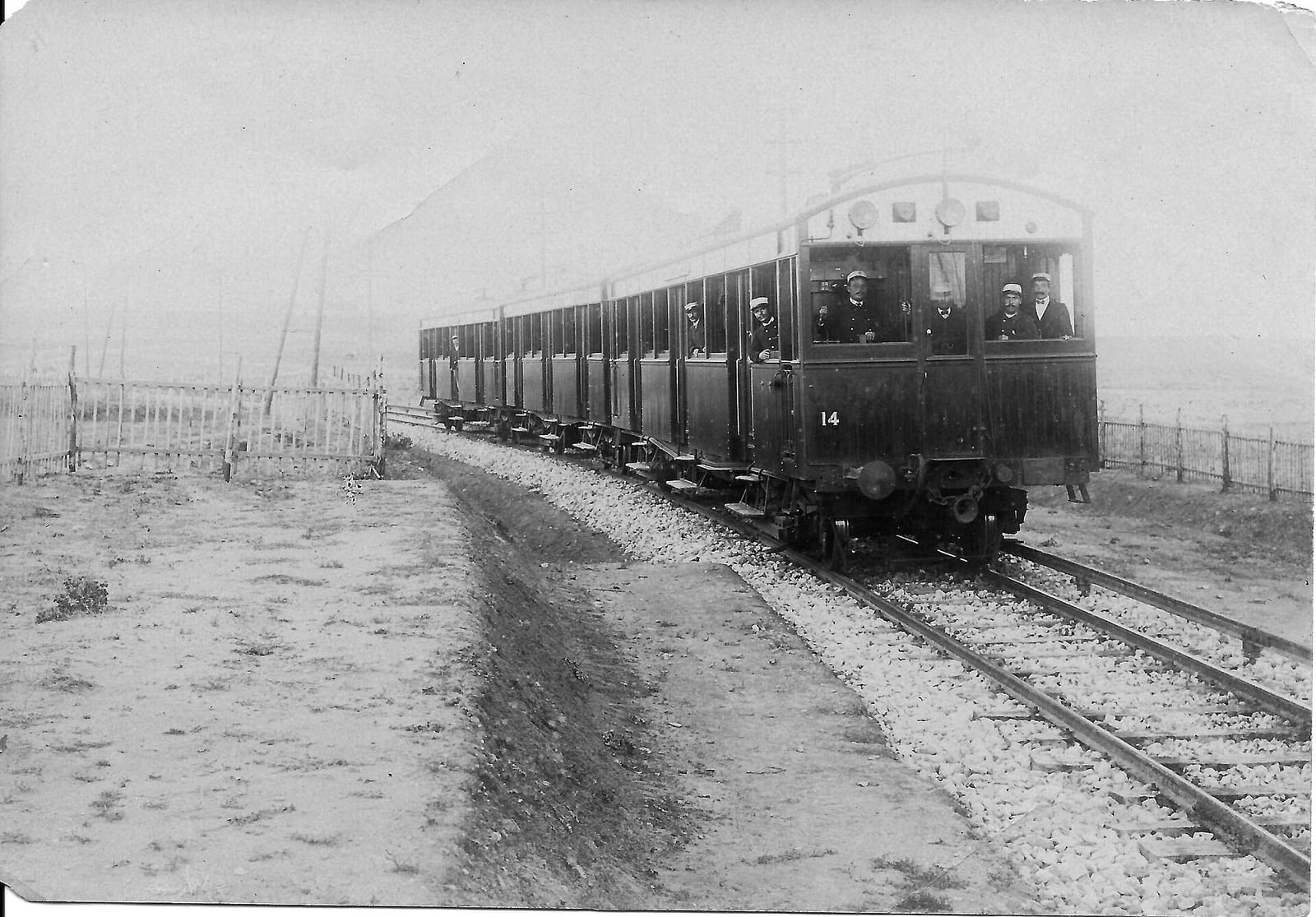
The first section, Tunis to La Goulette, opened in 1872; the extension on to La Marsa followed in 1874. Both were built under British management, and both were in place nearly a decade before France declared its protectorate over Tunisia in 1881. This was Tunisia's first railway, and it arrived while the country was still, formally, being run by a Bey.
It is not the oldest railway in Africa — that distinction belongs several hundred kilometres east, to the Alexandria–Cairo line of 1854, which we cover separately. But it is very early, and it has been continuously in service ever since, which is rarer.
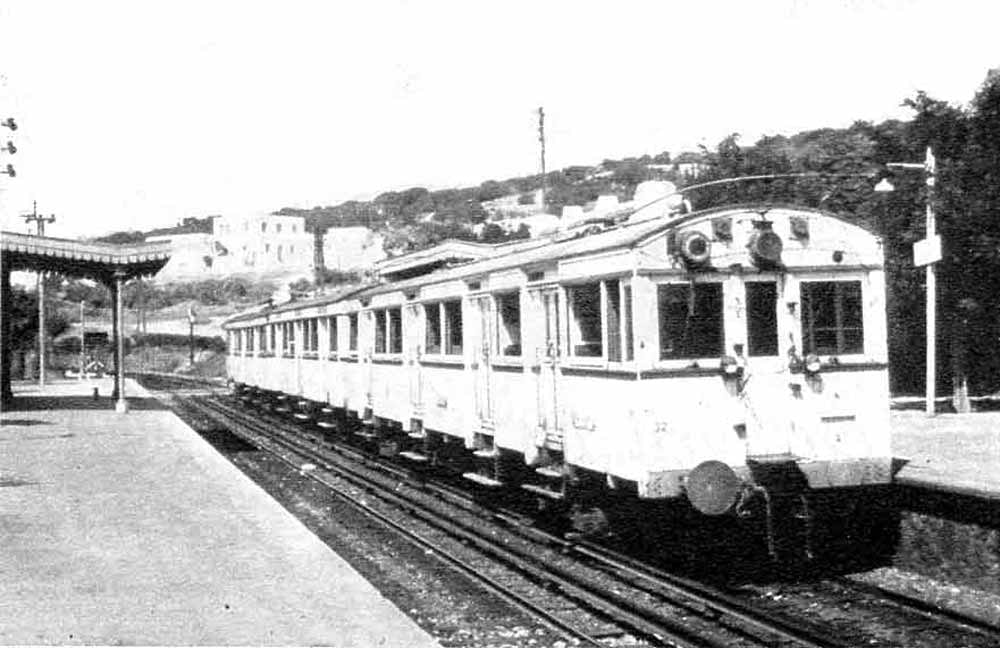
The name dates from 1905, when the line was reorganised and given a new alignment straight across the Lake of Tunis — a causeway that cut the run from the city out to the port from thirty minutes to sixteen. Electrification came between 1908 and 1910, at 750 volts direct current. The voltage has never changed.
What it actually does
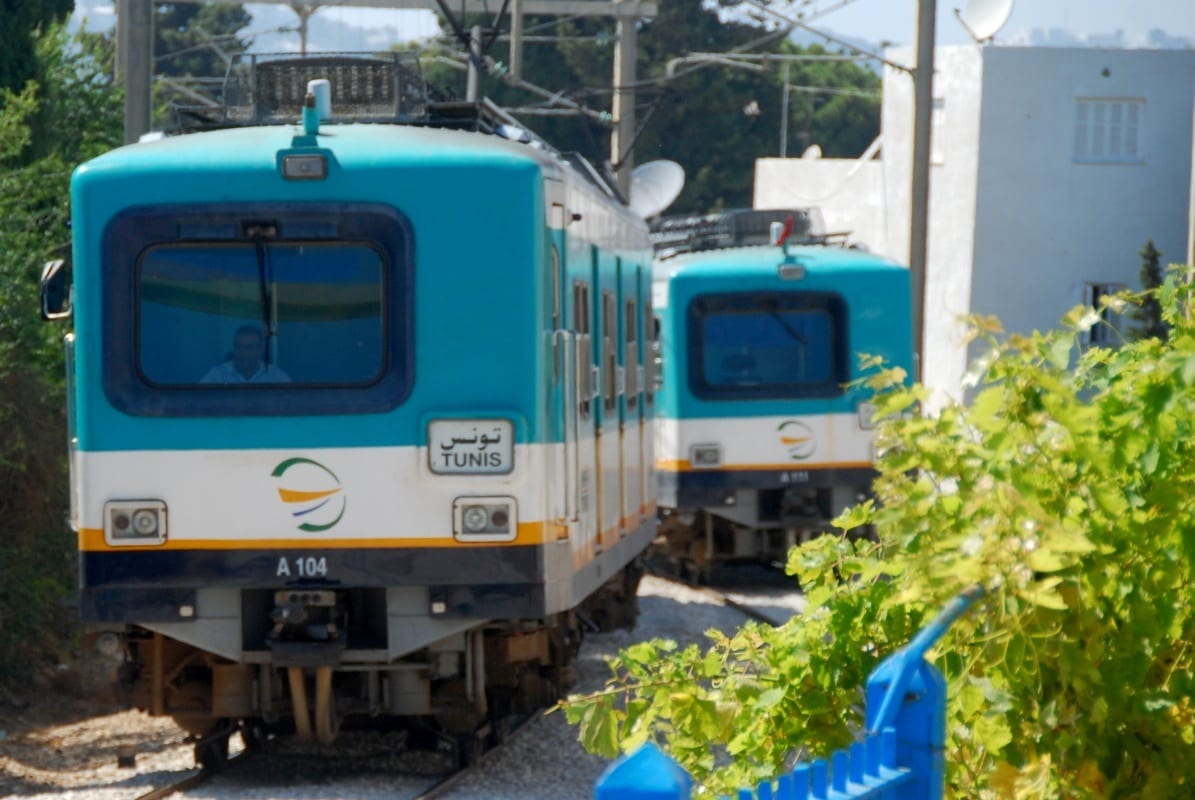
Eighteen stations. Double track the whole way. Roughly forty-five minutes end to end, from Tunis Marine at the foot of the Avenue Habib Bourguiba to Marsa Plage by the sea. In between it crosses the lake, runs through the port town of La Goulette, past Le Kram, and then threads the archaeological site of Carthage on five separate stations — Salammbô, Byrsa, Dermech, Hannibal and Présidence — before climbing to Sidi Bou Saïd and dropping down to La Marsa.
For a visitor this is an unusually good deal. Carthage is not a single walled site with a gate and a ticket office; it is a scatter of Punic and Roman remains spread over several square kilometres of a modern suburb, and walking between them in the heat is miserable. The railway solves it. One cheap ticket, a train every quarter of an hour, and each major part of the site is a few minutes' walk from a different platform. Most visitors never work this out and pay a driver instead.
A line in the middle of being rebuilt
Be straight about the current state of it. The TGM has had a difficult few years, and regular service along the whole line only resumed on 20 February 2026, as the third phase of a full modernisation of the track, the stations and the electrical installations. There was another closure for works at the end of April 2026.
More is coming, and it is substantial: a €90 million programme, funded equally by the European Investment Bank and the European Bank for Reconstruction and Development, will bring eighteen new electric trains from the Chinese manufacturer CRRC Nanjing Puzhen. The first is due in November 2027 and the rest through 2028 at roughly one a month, with the aim of running a train every four minutes at peak.
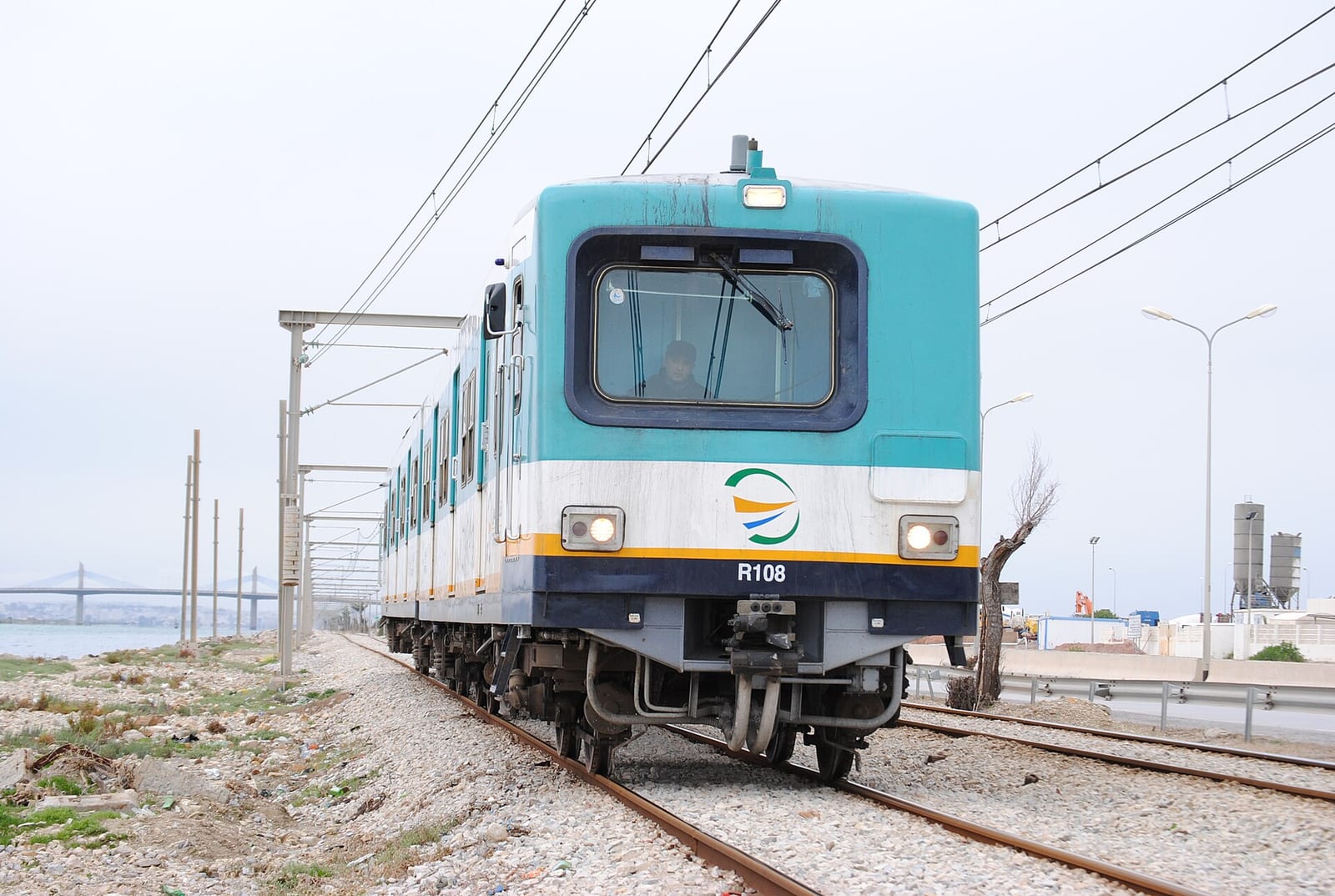
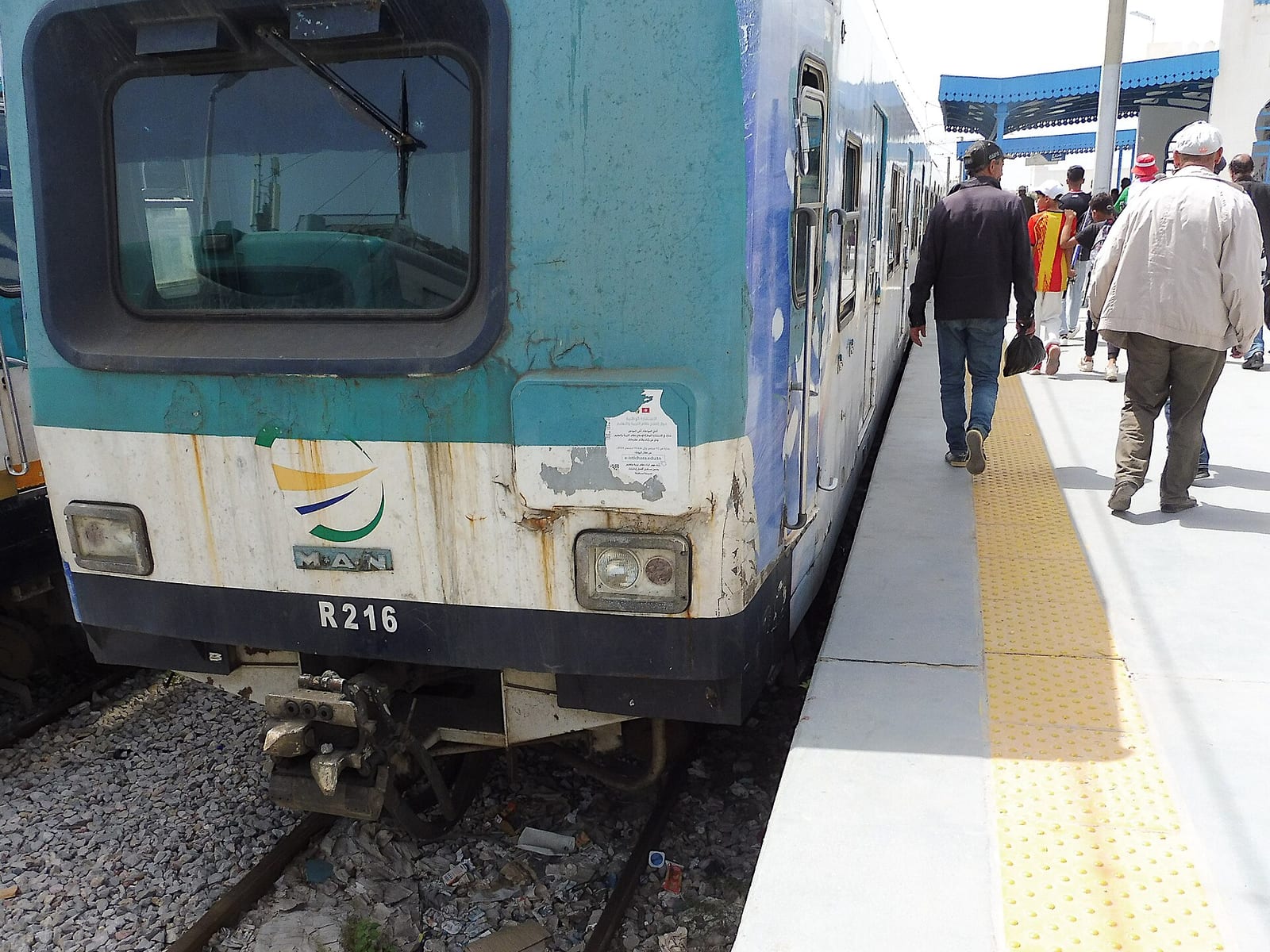
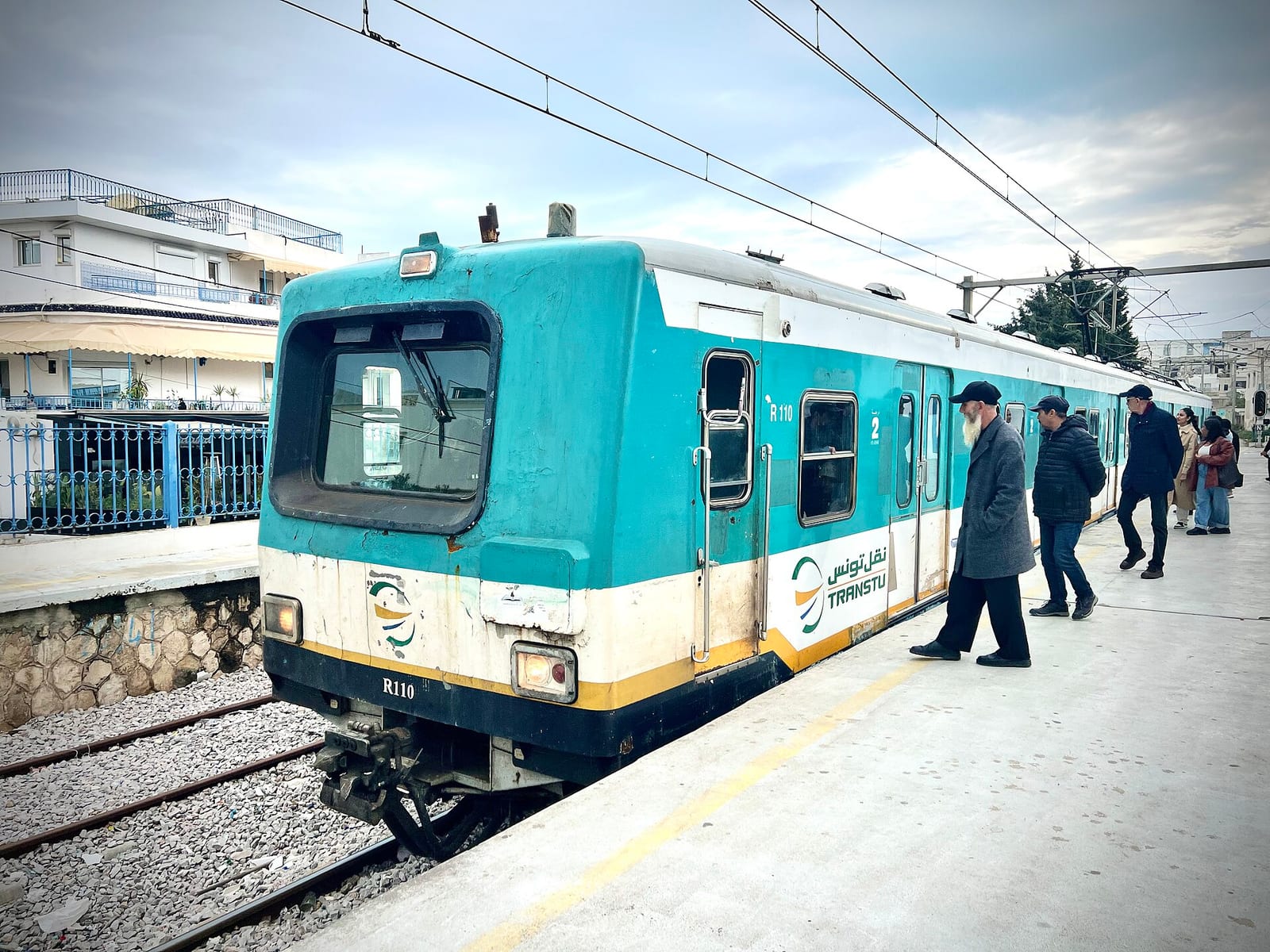
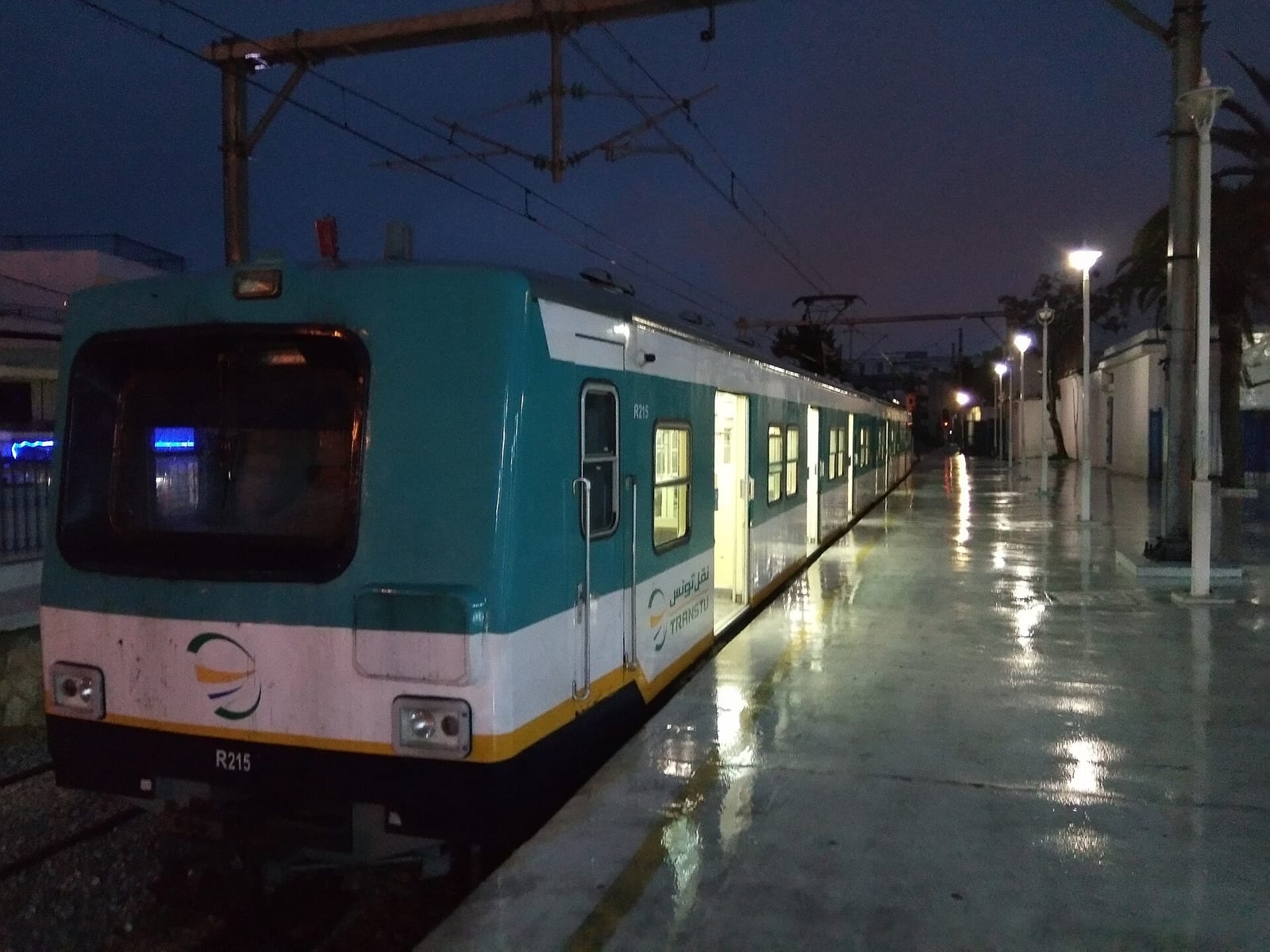
None of that has arrived yet. What you will ride in the meantime is old, well-worn stock on a line that is being rebuilt around it — which, if anything, makes it more interesting. Whether it is running end to end is worth knowing before anyone relies on it; past that, it is best used exactly as the people of La Marsa use it.
The Journey
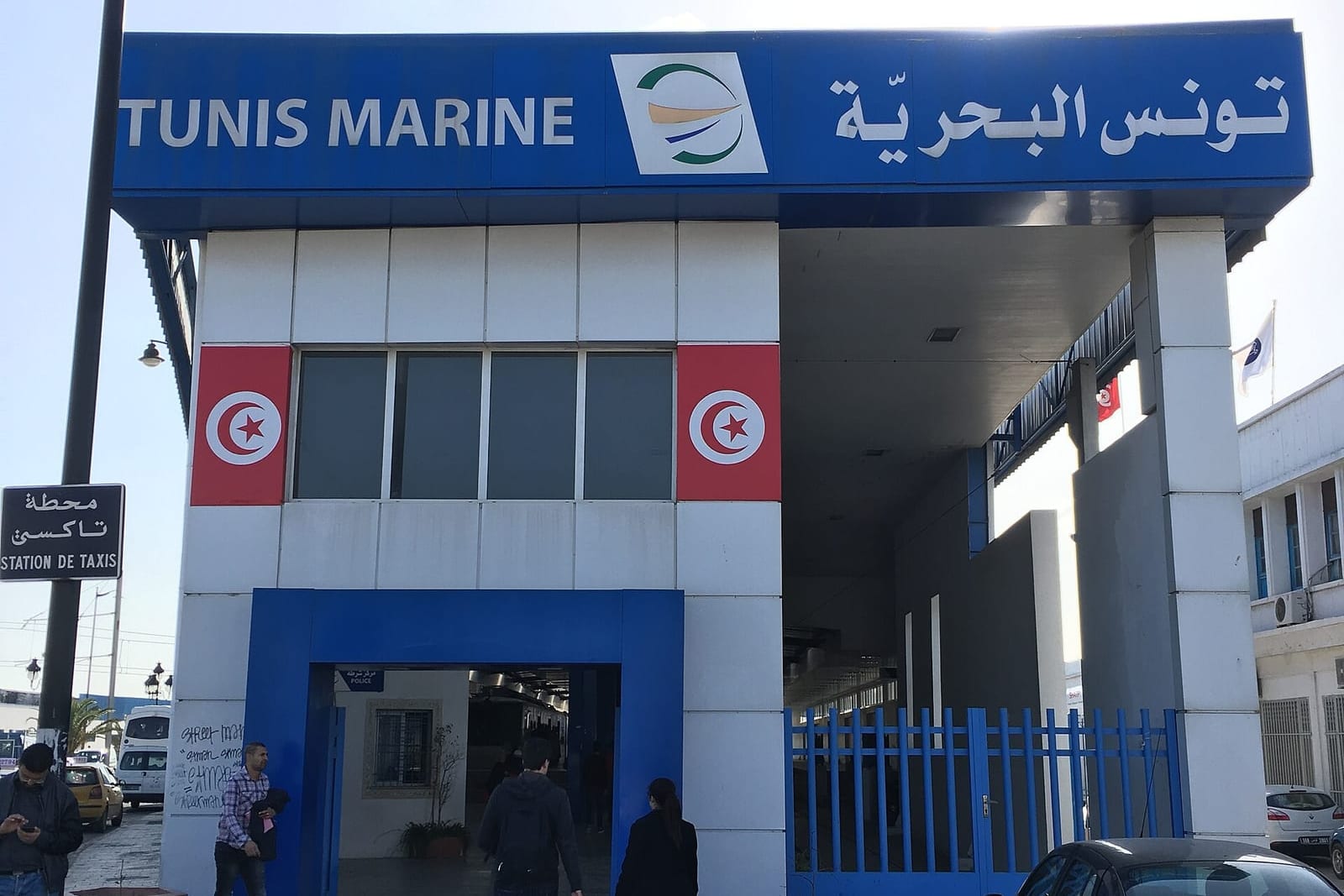
You start at Tunis Marine, which is not the main railway station and catches people out. The national railway's terminus, Tunis-Ville, is up at Place de Barcelone; the TGM has its own low station at the far end of the Avenue Habib Bourguiba, past the cathedral and the French embassy, where the avenue runs out at the water. Buy at the window, push through the barrier and get on.
Across the lake
The train pulls out and almost immediately runs onto the causeway. This is the 1905 alignment, driven straight across the Lake of Tunis — a shallow lagoon between the city and the sea, pink with flamingos in winter, flat and glassy in the early morning. On both sides there is water and low sky, and for four or five minutes the train appears to be running on the surface of it. It is the best bit of the whole line and it happens before most passengers have sat down.
La Goulette
The lake ends at La Goulette, the port of Tunis, where the cruise ships tie up and the ferries leave for Sicily and Marseille. It is a working harbour town with a Spanish fort in the middle of it, a long line of fish restaurants and a distinctly un-touristy air. It was also, until the middle of the twentieth century, the centre of the Tunisian Jewish and Sicilian communities, and the street names still show it.
From here the railway turns north and runs up the coast on a narrow strip between the sea and the lagoon.
Through Carthage
Then the stations start doing something strange.
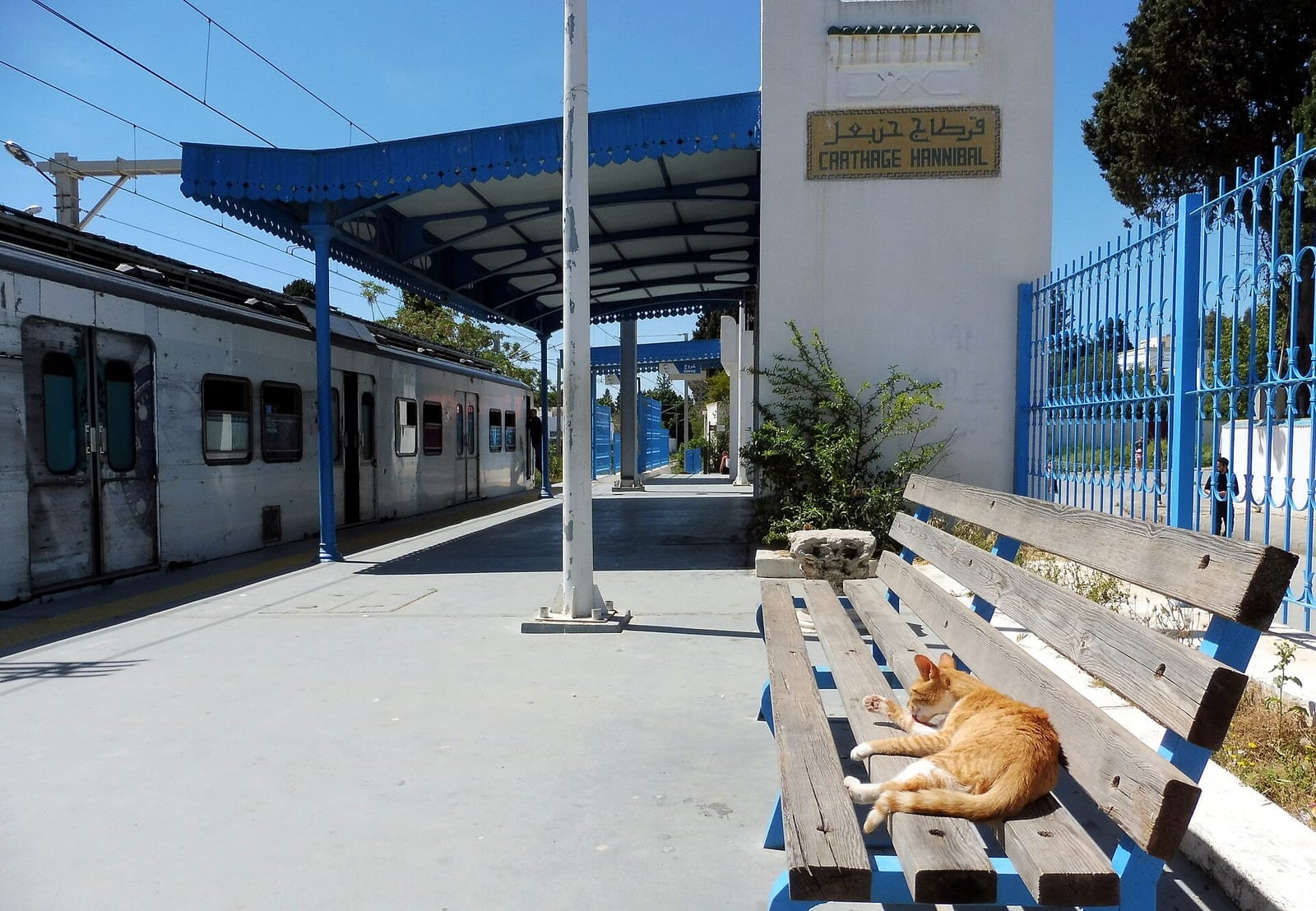
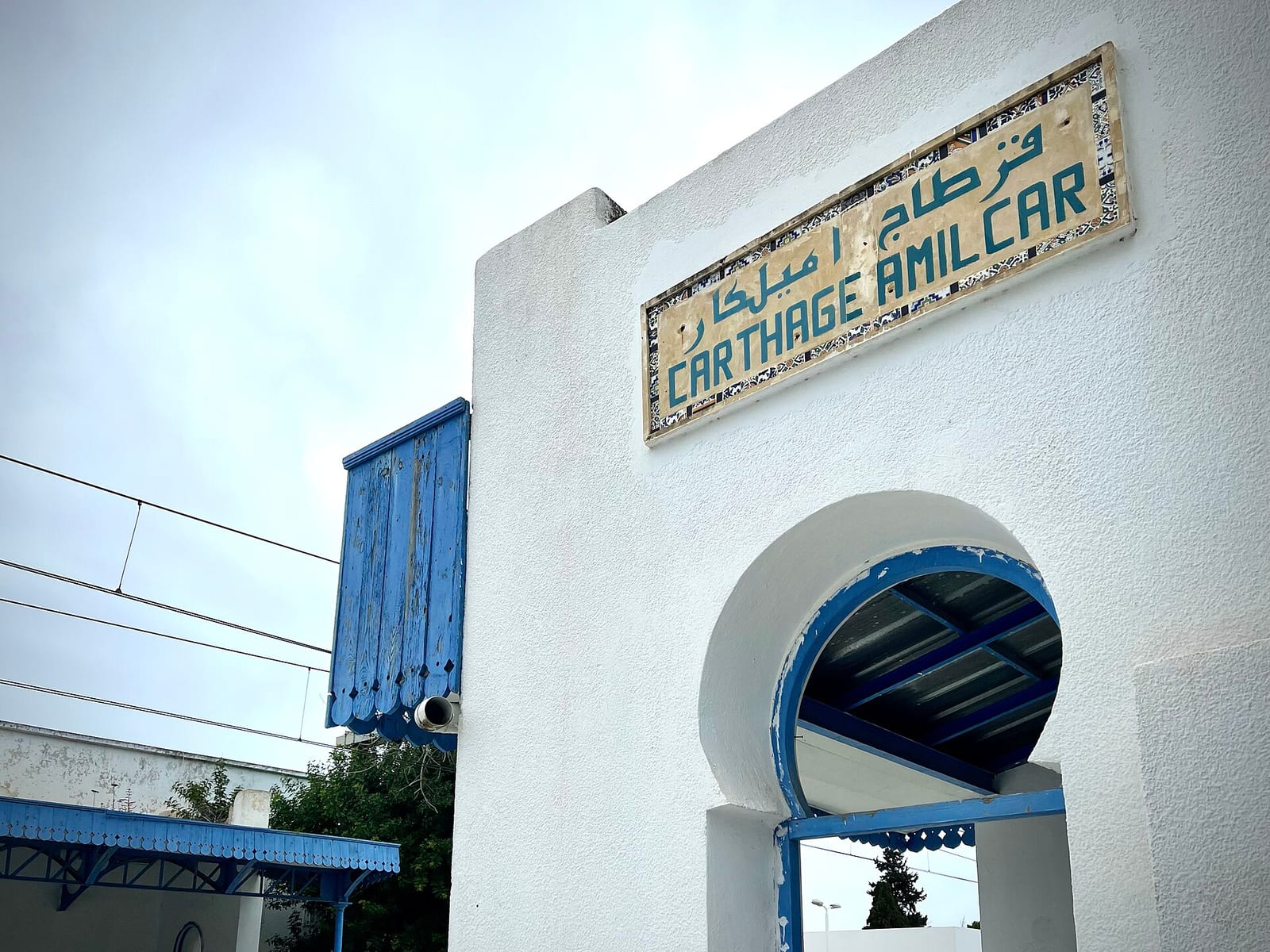
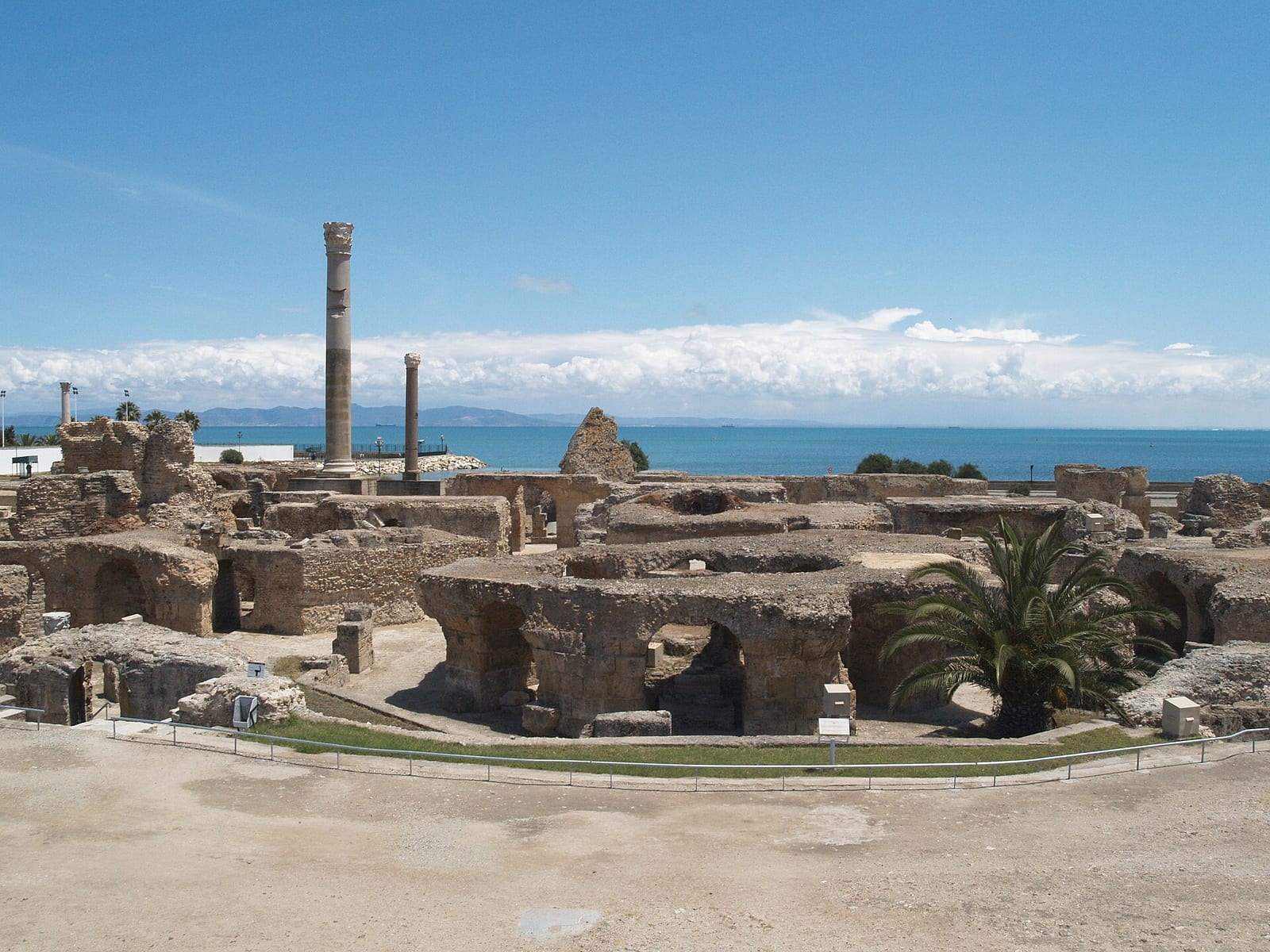
Le Kram, then Carthage Salammbô — named for the Punic quarter and Flaubert's novel — where you step off for the tophet and the astonishing circular and rectangular Punic ports, which are much smaller than you expect and much older than everything else. Then Carthage Byrsa, under the hill that was the heart of the Punic city, where the museum and the cathedral of Saint Louis stand on the acropolis. Then Carthage Dermech, then Carthage Hannibal, a short walk from the Antonine Baths, the largest Roman bath complex built anywhere in Africa, laid out on a terrace directly above the sea. Then Carthage Présidence, beside the presidential palace, and Carthage Amilcar beyond it.
Six stations, named for Hannibal and his father Hamilcar, for the Byrsa hill and the Punic ports, threaded through what is now a leafy, expensive residential suburb of embassies and walled villas. Roman columns stand in people's gardens. The stations themselves are modest — whitewash, blue railings, a canopy, a bench — and there is usually a cat asleep on the bench.
Sidi Bou Saïd
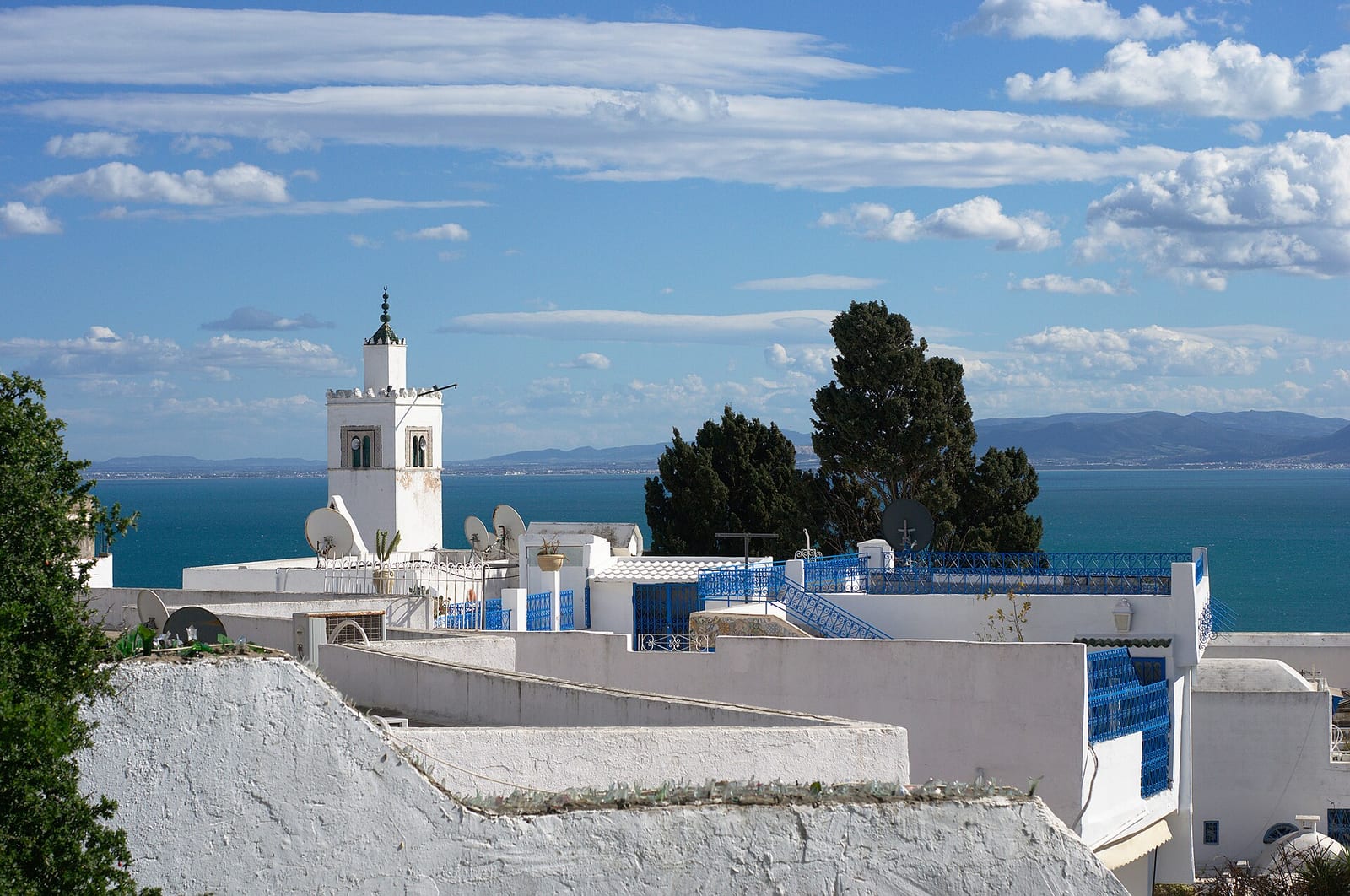
The line climbs slightly and reaches Sidi Bou Saïd, below the most photographed village in Tunisia. The station is down at the bottom; the village is up a steep cobbled climb of ten minutes or so. It is worth every step: whitewashed houses with cobalt-blue doors, windows and ironwork, jasmine over the walls, and a view along the cliff to the Gulf of Tunis. The blue-and-white rule is not an accident of taste but a preservation order dating back to 1915.
Go early in the morning or in the last hour of light. In the middle of a summer afternoon the main street is shoulder to shoulder.
La Marsa
Most visitors turn around at Sidi Bou Saïd. Don't. Two more stops and the line ends at Marsa Plage, a short walk from the sea.
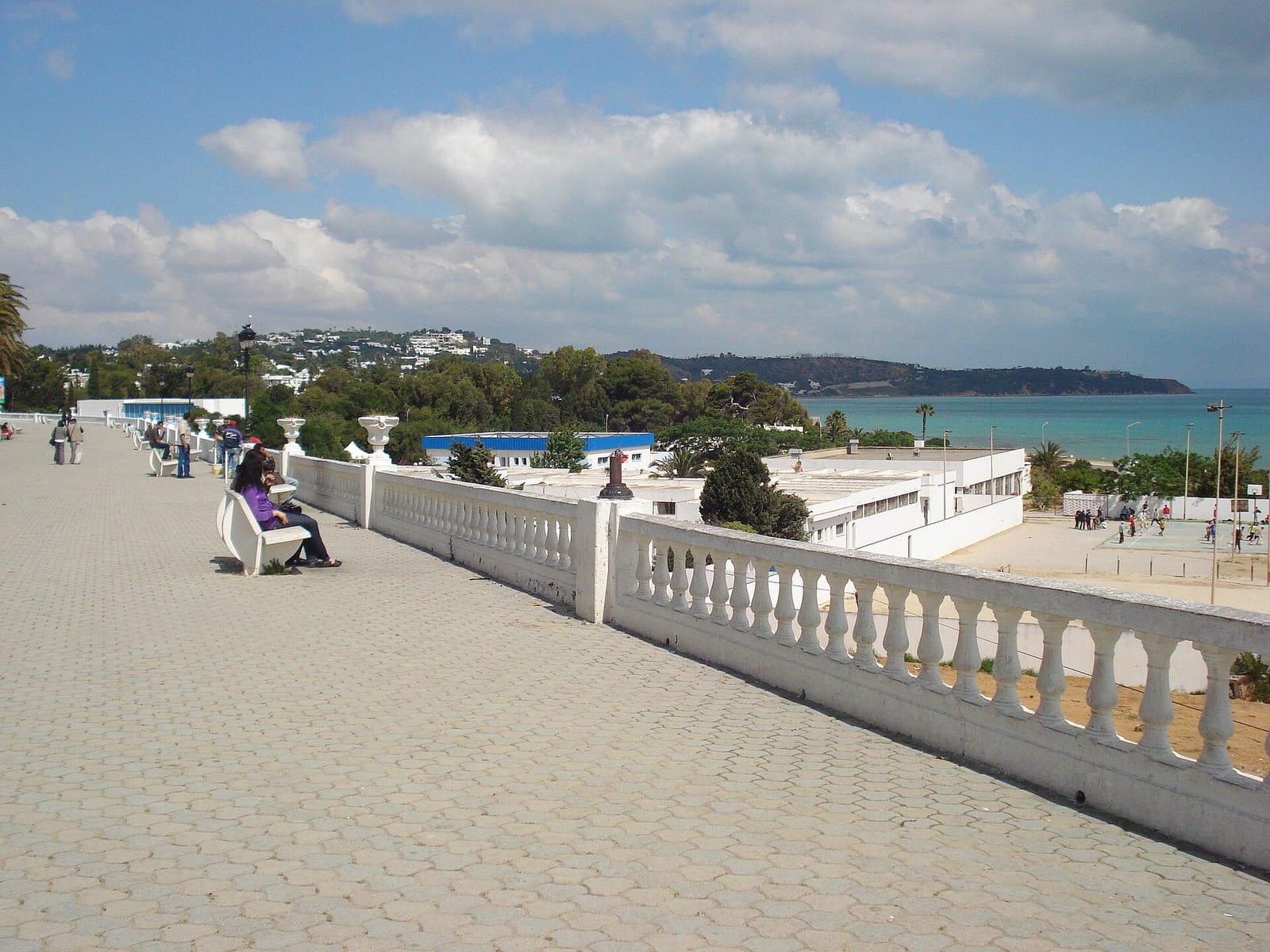
La Marsa is where Tunis goes at the weekend. There is a long corniche with a balustrade, cafés that spill onto the pavement, an ordinary town beach, families walking in the evening, and no ruins and no postcards. The Bey had a summer palace here and the diplomatic quarter still shades that way, but the atmosphere is entirely everyday. It is also the best place on the line to eat, and the natural end to a day that started in the medina.
Riding it
Trains run every ten to twenty minutes and take about 45 minutes end to end. There are two classes and the price difference is small; second class is perfectly comfortable and considerably more interesting. Windows open. Sit on the seaward side going north.
One practical note: this is a commuter railway, and at half past five in the afternoon it is packed. If you want the lake crossing to yourself, go out early.
Along the route
Unknown author / Wikimedia Commons · Public domainTunisia's first railway, and it beat the French here
The Tunis–La Goulette section opened in 1872 under British management, nearly a decade before France declared its protectorate. It has been the TGM since 1905, when a new line straight across the Lake of Tunis cut the run to sixteen minutes.Sharon Hahn Darlin / Wikimedia Commons · CC BY 2.0Five stations inside Carthage
The line does not pass near Carthage. It runs through it. Five stops are scattered across the archaeological site, so the ruins are not one museum but a suburb you get off at — the Punic ports, the Byrsa hill and the Antonine Baths each a walk from a different platform.ChrisDeLompret / Wikimedia Commons · CC BY-SA 3.0A commuter line to a World Heritage Site
This is not a heritage operation. It is the everyday railway of the northern suburbs — 19 kilometres, 18 stations, a train every ten to twenty minutes. That it happens to run through one of the most important archaeological sites in the Mediterranean is, to its regulars, unremarkable.A bit of history
Culture & experiences along the way
Institute for the Study of the Ancient World / Wikimedia Commons · CC BY 2.0Do Carthage the local way — one ticket, several stations
The site is far too spread out to walk in one go, and the railway is the answer. Get off at Salammbô for the Punic ports and the tophet, ride one stop to Byrsa for the hill, the museum and the cathedral, then on to Hannibal for the Antonine Baths above the sea. A single fare and a few minutes of waiting between each. Almost every visitor pays for a taxi tour instead.Habib M'henni / Wikimedia Commons · CC BY 4.0Climb to Sidi Bou Saïd
The station sits below the village and the walk up is steep, cobbled and worth it. Sidi Bou Saïd is the blue-and-white cliff town above the Gulf of Tunis — whitewashed walls, cobalt doors and studded ironwork, all of it protected by a preservation order that dates back to 1915. Go early or late; in the middle of a summer day it is very full.DrFO.Jr.Tn / Wikimedia Commons · CC BY-SA 3.0Ride it to the end, to the sea
Most visitors turn round at Sidi Bou Saïd. Stay on. La Marsa at the end of the line is where Tunis actually goes — a long corniche, cafés full of families, an unpretentious town beach, and none of the ruins-and-postcards atmosphere of the stops before it. It is also the best place on the line to eat.Timetables
The TGM is a turn-up-and-go urban railway, not a booked service. Transtu does not publish a station-by-station public timetable for it, and you do not need one — you need the frequency and the last train.
The service
| Frequency | A train every 10 to 20 minutes through the day |
| End to end | About 45 minutes, Tunis Marine to Marsa Plage |
| Stations | 18 |
| Route length | 19 km, double track throughout |
| Traction | 750 V DC overhead, since 1908–1910 |
| Operator | Transtu (Société des transports de Tunis) |
Trains run from early morning until late evening — this is how the northern suburbs get home, so the last departures are genuinely late rather than nominal. Frequency thins outside peak hours and on Sundays, and there is a reduced timetable during Ramadan, when the whole city's rhythm changes.
Journey times from Tunis Marine
Approximate, and useful for planning a day rather than catching a connection:
| Station | From Tunis Marine |
|---|---|
| La Goulette | about 16 min |
| Carthage Salammbô | about 25 min |
| Carthage Hannibal | about 30 min |
| Sidi Bou Saïd | about 35 min |
| Marsa Plage | about 45 min |
The sixteen minutes to La Goulette is a historical figure worth knowing: before the line was rebuilt across the Lake of Tunis in 1905, the same trip took thirty minutes.
Before you rely on it — the line is being rebuilt
This matters more than the frequency. The TGM has been through a long modernisation and has not been continuously available:
- 20 February 2026 — Transtu resumed regular, continuous traffic along the entire line after safety checks, as phase three of a programme covering the track, the stations and the electrical installations.
- 29 April – 3 May 2026 — traffic partially suspended again for renovation work, including scheduled intervention on the Chichly canal bridge.
Check locally, or with your hotel, that the section you want is open on the day. Replacement buses are run when it is not, but they are slow and they do not cross the lake.
What is coming
A €90 million investment programme, funded in equal parts by the European Investment Bank and the European Bank for Reconstruction and Development under an EU guarantee, will deliver 18 new electric trains built by CRRC Nanjing Puzhen, alongside further infrastructure modernisation. The first train is scheduled for November 2027, with the remaining seventeen arriving through 2028 at about one a month.
The stated target once the fleet is in service is a train every 4 minutes at peak and every 12 minutes off-peak, with ridership projected to rise fivefold. None of that is in place yet — the trains you will ride in 2026 are the old ones.
Operator: Transtu — transtu.tn (opens in a new tab). Service pattern above as of July 2026.
Tickets
There is nothing to arrange. Buy a ticket at the window in the station hall, keep it, and go. Fares are very low — the TGM is among the cheapest ways to travel anywhere in Tunisia — and the difference between the two classes is minor, with second perfectly comfortable and better ventilated in summer. Buy singles as you go, because there is no visitor day pass and a fresh ticket at each Carthage station costs very little. Keep small change, keep the ticket until you leave, and note it is cash only, in dinars, a currency you cannot buy before arriving.
For the Carthage stations themselves, the archaeological sites charge separately — but a single combined ticket covers the main ones, so buy it at the first site you visit and hold on to it as you hop from station to station. ⚠️ Check the line is running end to end before setting off.
Book your tickets
TGM single · Tunis Marine to La Marsa
Turn up, buy at the window, go
An ordinary urban fare on Tunisia's cheapest form of transport, bought at the ticket window at any station. First and second class are both available and the difference in price is small. No reservations, no advance booking — the line runs every ten to twenty minutes.
via TranstuA day on the line
Carthage, Sidi Bou Saïd and La Marsa in one trip
The classic day out from Tunis: hop off at two or three of the Carthage stations, climb to Sidi Bou Saïd, then run to the end of the line for lunch at La Marsa. Fares are low enough that a fresh ticket at each stop makes little difference. It is a full day.
via TranstuRail Passes
No rail pass covers the TGM. Interrail and Eurail are European schemes, and Tunisia is not among the 33 countries in Interrail's list of covered railway companies (opens in a new tab). Singles are bought at the station window, in cash, and there is no visitor day pass.
Checked October 2026 against Interrail's list of covered railway companies (opens in a new tab).
Places to Visit
Every stop on this line is worth getting off at, which is unusual for a commuter railway. Two of the six below — the Tunis medina and the Bardo — are not on the TGM at all, but they are the right way to begin, and the rest are strung along nineteen kilometres of track.
Carthage is much more than the Punic ports. Byrsa, one stop on, has the national museum, the excavated Punic housing quarter and the cathedral of Saint Louis on the hilltop; Hannibal has the Antonine Baths; and the Roman theatre, the villas quarter with its mosaics in situ and the basilica of Damous el Karita are all within walking distance of one platform or another. The railway works as the site's shuttle bus, because that is what it is.
 grolli77 / Wikimedia Commons · CC BY-SA 2.0 · cropped
The Tunis medina
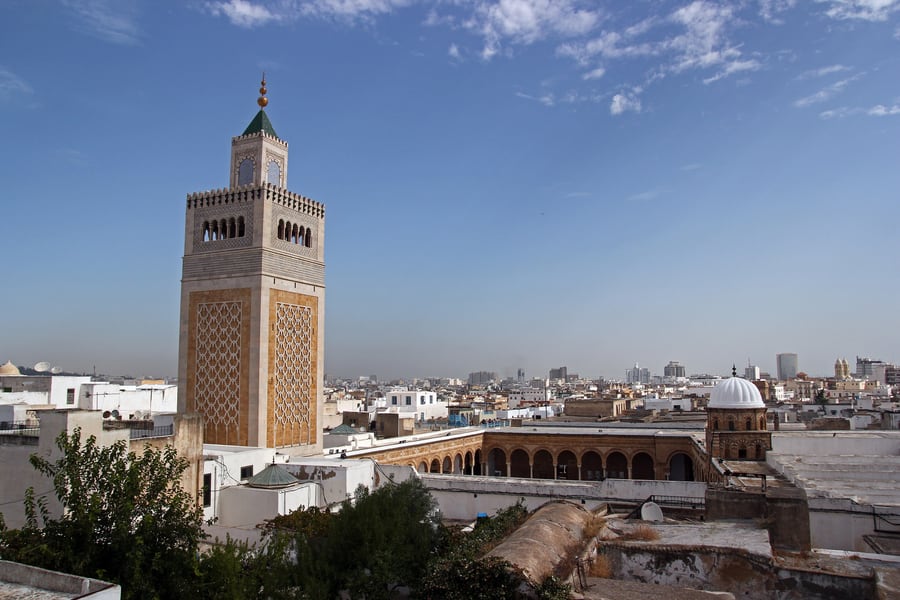
Fifteen minutes' walk from Tunis Marine, and a UNESCO World Heritage Site. At its heart the Zitouna Mosque was founded around 698; the prayer hall you see was rebuilt under the Aghlabids in 864–65 and stands on some 160 columns, most of them carried up from the ruins of Carthage. Around it the souks are still organised by trade — the perfumers, the chechia makers, the booksellers. Start here, then take the train out.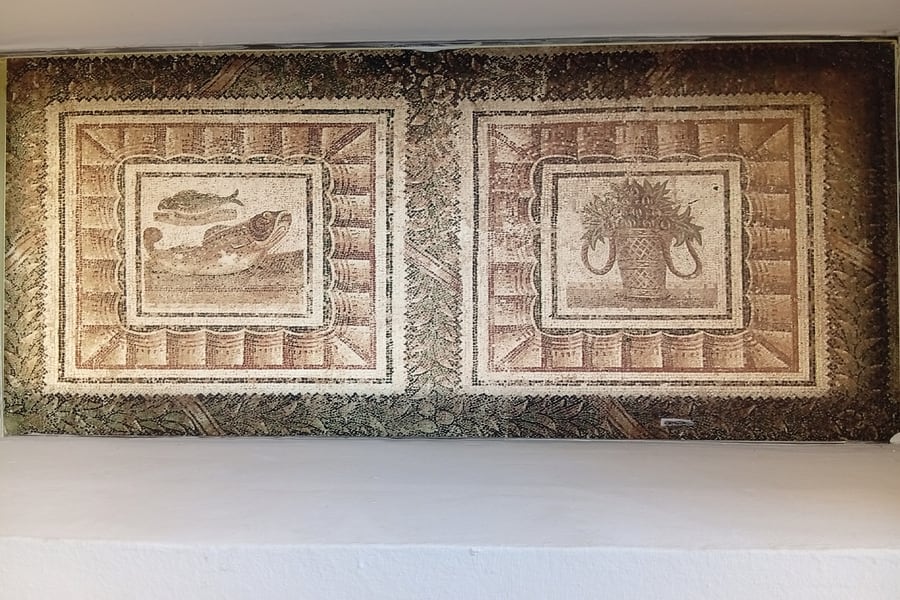 Houss 2020 / Wikimedia Commons · CC0 · cropped
The Bardo Museum
One of the world's great collections of Roman mosaics, in a nineteenth-century beylical palace that opened as a museum in 1888. See it before Carthage; it makes sense of the ruins. ⚠️ Check before you go: the Bardo sits next to the parliament and was shut from July 2021, reopening on 14 September 2023 with some rooms still closed. It was also the site of a terrorist attack on 18 March 2015 in which 24 people died.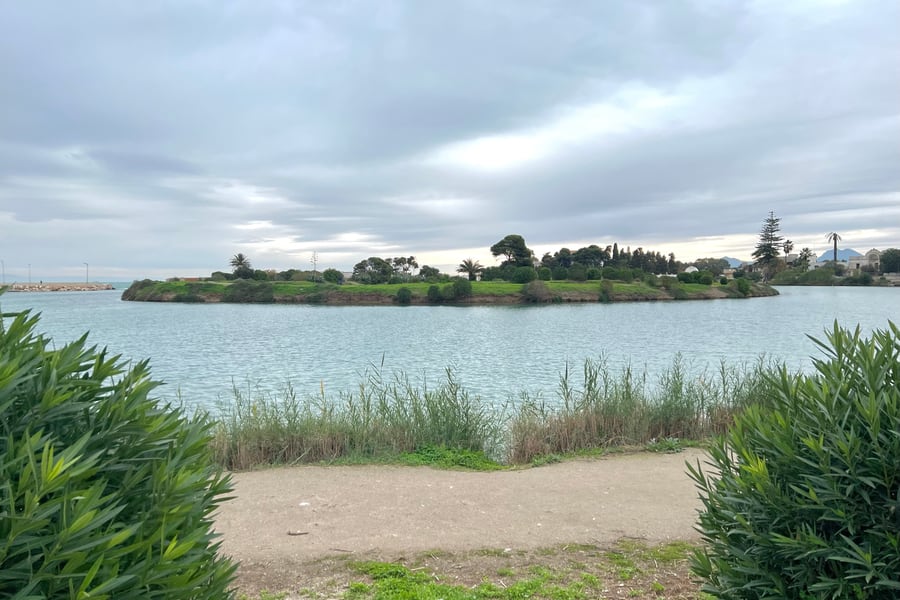 Sharon Hahn Darlin / Wikimedia Commons · CC BY 2.0 · cropped
The Punic ports
Two quiet lagoons in a residential street, and the most extraordinary thing on the line. A rectangular commercial harbour led into a circular naval one about 325 metres across, with an admiralty island in the middle from which the whole fleet could be seen — and which, Appian wrote, held 220 ship-sheds while remaining invisible from the open sea. Excavation has borne much of it out. Get off at Salammbô.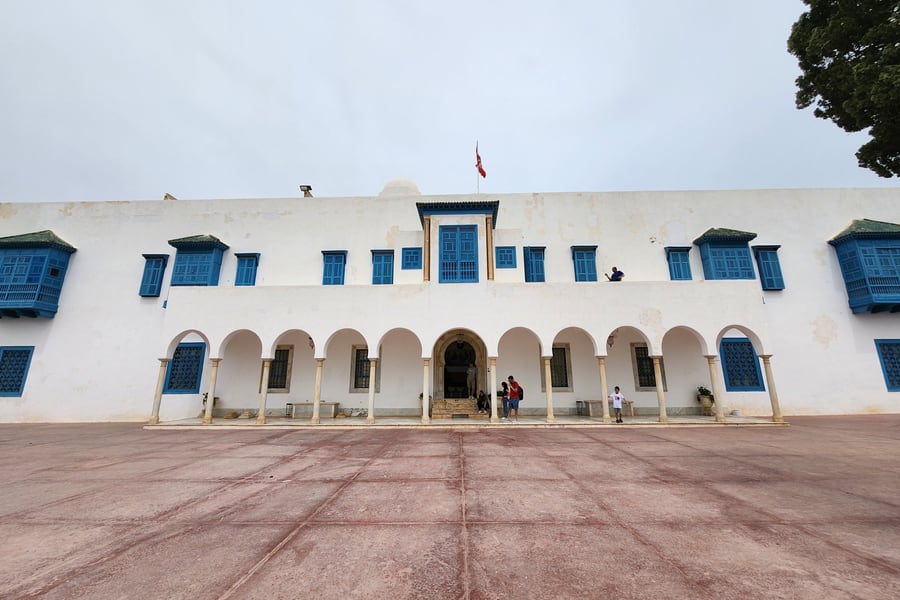 Habib M'henni / Wikimedia Commons · CC BY-SA 4.0 · cropped
Ennejma Ezzahra
Below the blue-and-white village, and much quieter than the main street above it. Baron Rodolphe d'Erlanger — Swiss-born, a painter and a scholar of Arab music — built this palace between 1912 and 1922 with craftsmen brought from Morocco and Tunisia, and filled it with the instruments and recordings he collected. Since 1991 it has been the Centre for Arab and Mediterranean Music, and it still puts on concerts.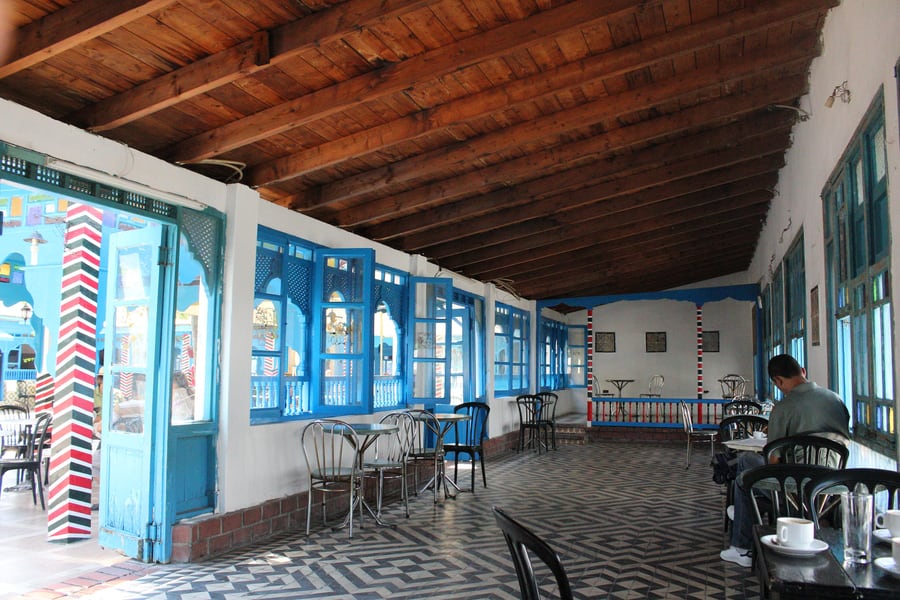 Sami Mlouhi / Wikimedia Commons · CC BY-SA 4.0 · cropped
Café Saf Saf
Stay on past Sidi Bou Saïd. La Marsa at the end of the line is where Tunis actually goes — a long corniche, an ordinary beach, unfussy fish restaurants and none of the ruins-and-postcards atmosphere of the stops before it. The Café Saf Saf near the old square is built around a working well with a camel-powered drawwheel, and is the right place to end a day on this railway.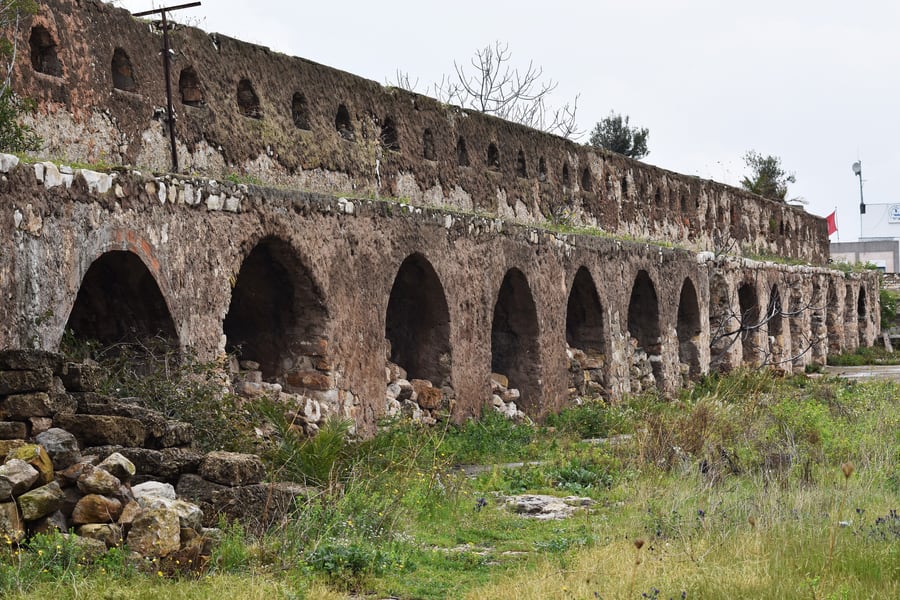 Noomen9 / Wikimedia Commons · CC BY-SA 4.0 · cropped
The Karraka
Worth breaking the outward journey for, especially at lunchtime — the main street is a run of grilled-fish restaurants that Tunisians drive out from the capital for. In the middle of town stands the Karraka, built by the Spanish in 1535 after Charles V took Tunis and retaken by the Ottomans in 1574. It served as a prison in the nineteenth century, and in Tunisian usage the word karraka came to mean exactly that.Where to Sleep
The line runs through four quite different places to stay, and the choice depends on whether you want a city or a coast.
Central Tunis
The obvious base if you are also seeing the medina and the Bardo, and the cheapest of the options. Hotels along and around the Avenue Habib Bourguiba range from grand colonial-era buildings to plain modern business places, and all of them are within walking distance of Tunis Marine and the start of the line. The medina itself has a growing number of restored dar guesthouses — courtyard houses with a handful of rooms — which are far more atmospheric than anything on the avenue.
Central Tunis is noisy and busy and shuts down late. That is either the appeal or the problem.
Sidi Bou Saïd
The most beautiful place to sleep on the line, and priced accordingly. A small number of hotels and guesthouses occupy the blue-and-white houses on the cliff, several with terraces looking down the coast. The village empties dramatically once the day visitors leave, and an evening and an early morning up there are a different experience from the crowded midday one.
Book well ahead — there are not many rooms — and be ready for the walk up from the station with luggage.
La Marsa
The best compromise for most people: a proper town rather than a showpiece, on the sea, at the end of the line, and a straight forty-five-minute run into the capital whenever you want it. Hotels are mid-range and unremarkable, the corniche and the restaurants are the point, and it is quiet at night. Good for families.
Gammarth
Just beyond La Marsa, off the railway but a short taxi ride from it, this is where the larger beach resorts are — the international chains, the big pools, the spas. Comfortable and rather cut off from everything the TGM is good for. Choose it if you want a beach holiday with a day trip to Carthage attached, rather than the other way round.
A note on timing
If you are arriving on a flight, be aware that Tunis–Carthage airport is not on the TGM despite the name — it sits inland, between the city and the lake, and you will need a taxi. From the airport it is about twenty minutes to central Tunis and a little more to La Marsa.
Questions or corrections
Planning this trip and stuck on something, or spotted a time, fare or detail that has changed? Send us a message about The TGM · Tunis to Carthage. We read every one, and we update this page when something has changed.