Tramway Touristique de l'Aisne
Frans Berkelaar / Wikimedia Commons · CC BY-SA 2.0 · cropped
- Distance11.2 km, metre gauge
- Duration1 h or 2 h round trip
- Best seasonApril–November · mainly Saturdays
Introduction
There were two kinds of Belgian vicinal tramway, and most people only picture one.
The famous kind ran down the middle of streets: metre-gauge track set into the cobbles of industrial towns, wires overhead, trams threading between carts and then between cars. You can still ride that version at Thuin, where the tracks go down a road into the lower town.
The other kind was quieter and, in the end, more characteristic of what the SNCV was actually for. It was a single line of rails laid across open country, with no street and no town at either end, existing for one reason: to connect a handful of villages too small and too far apart to interest the main-line railway to a station where the main-line railway stopped. Thousands of kilometres of the network looked like this. Almost none of it is left.
Eleven kilometres of it survive in the Ardennes, between Érezée and a hamlet called Lamorménil, and you can ride the whole length behind a diesel railcar built in 1935.
A line that only ever went to villages
The tramway was part of line 579A, which ran from Melreux — where there was, and still is, a station on the national network — through Manhay and on towards Comblain-la-Tour. It closed at the end of 1959, which is roughly when the rest of the rural vicinal closed: the buses were cheaper and the cars were coming.
What happened next was unusually early. In September 1964, members of the association that ran the vicinal museum at Schepdaal went looking for a stretch of line they could operate themselves, at a point when there was still a national tramway company to negotiate with. They found a sympathetic mayor at Dochamps, signed a contract with the SNCV on 1 April 1965 for the operating rights over 11.2 kilometres, and ran their first passengers on 25 June 1966.
That makes this one of the oldest preserved railways in Belgium — begun while the system it preserves was still winding down, rather than decades after the scrap merchants had finished.
What you actually get
Not steam. The association had steam locomotives once, and their boilers were condemned in 1989; one was sold to France, another is in a museum at Liège without its wheels, and the survivor stands complete but cold in the hall at Érezée. The operator says so plainly, and so does this page.
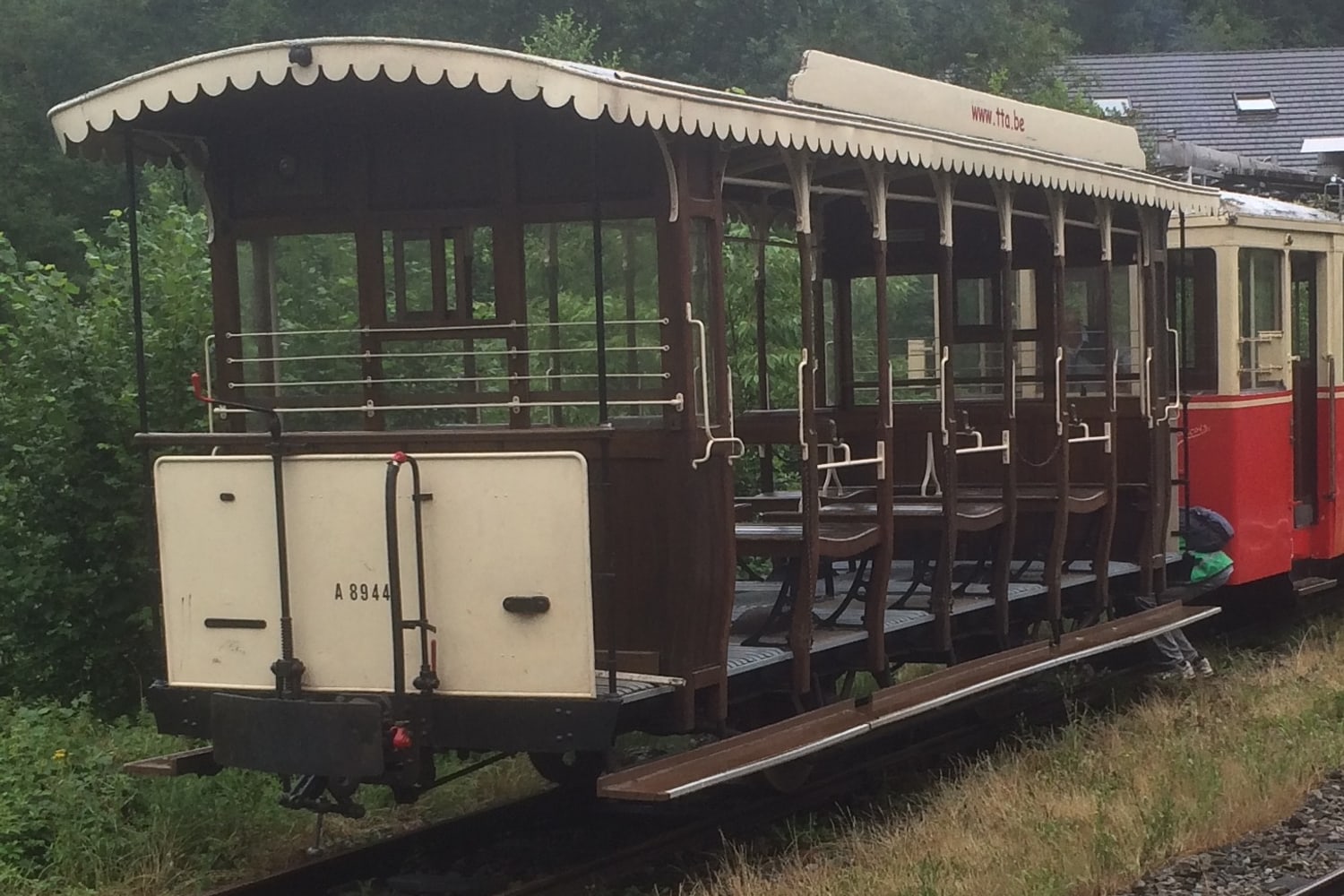
What you get instead is better than it sounds: a 1935 railcar hauling carriages that run from 1893 to 1953, including two open carriages of 1913 and 1916 with no sides at all — wooden benches under a canopy, and eleven kilometres of forest going past at the speed of a bicycle.
And you get a railway that very nearly did not survive the 2020s. Covid closed it; the flood of July 2021 broke the track; the volunteers ran out of road. It came back in July 2023 with three trips twice a week, and now runs four departures a day in high summer. That recovery is recent enough to be worth knowing about, and worth turning up for.
The Journey
Everything runs out and back from Pont d'Érezée, where the association built itself a proper station in 2005 — a booking hall, the local tourist office, a cafeteria, a playground, and an exhibition floor upstairs. There is a free car park. You are asked to arrive fifteen minutes before departure, which is sensible advice on a railway where the train is one railcar and it leaves when it says it will.
You then choose how far to go, because the two products are genuinely different rides.
The short run: Érezée to Forge-à-la-Plez
About an hour there and back, and the six kilometres the association started with in 1966. The line leaves Érezée, passes the depot at Blier — four roads under a shed built of local stone in 1967 — and runs up the valley through trees to a place called Forge-à-la-Plez, whose name is the only industrial thing about it now.
This is the leg that ran on its own for years. Between 2008 and 2014, the six kilometres to Forge were the whole of what passengers could ride; service trains went further, but the public did not.
The long run: Érezée to Lamorménil
Two hours, and the full 11.2 kilometres. The tram carries on past Forge, over the bridge across the Lue, through Dochamps, and out to the end of the rails at Lamorménil — a hamlet in the commune of Manhay, with no station building, no town, and no particular reason for a railway to exist except that in 1908 the state decided villages like this one should have one.
It is worth understanding what that last stretch cost. No tram ran between Dochamps and Lamorménil between 1959 and 2015. Reopening it meant clearing a platform that had been in the woods for half a century, rebuilding the bridge over the Lue with a new concrete bed, and relaying track from nothing — a €873,000 job, paid for by the Walloon Region, the Province of Luxembourg and the two communes at either end, and completed in 2014. The full line reopened on 5 April 2015.
For eleven kilometres of tourist tramway to a hamlet, that is a remarkable amount of public money and volunteer labour. It is also why the two-hour ticket is the one to buy.
The train
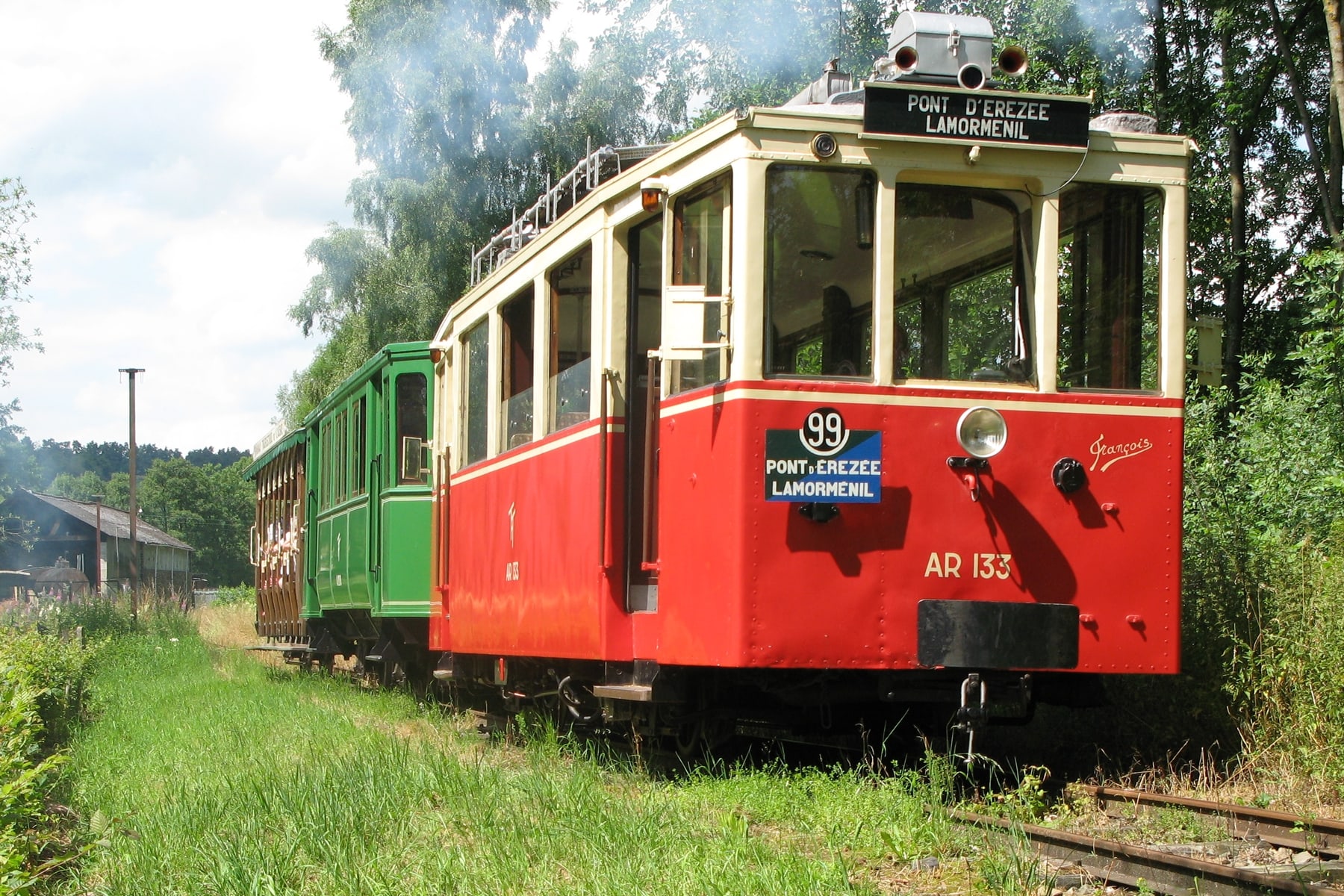
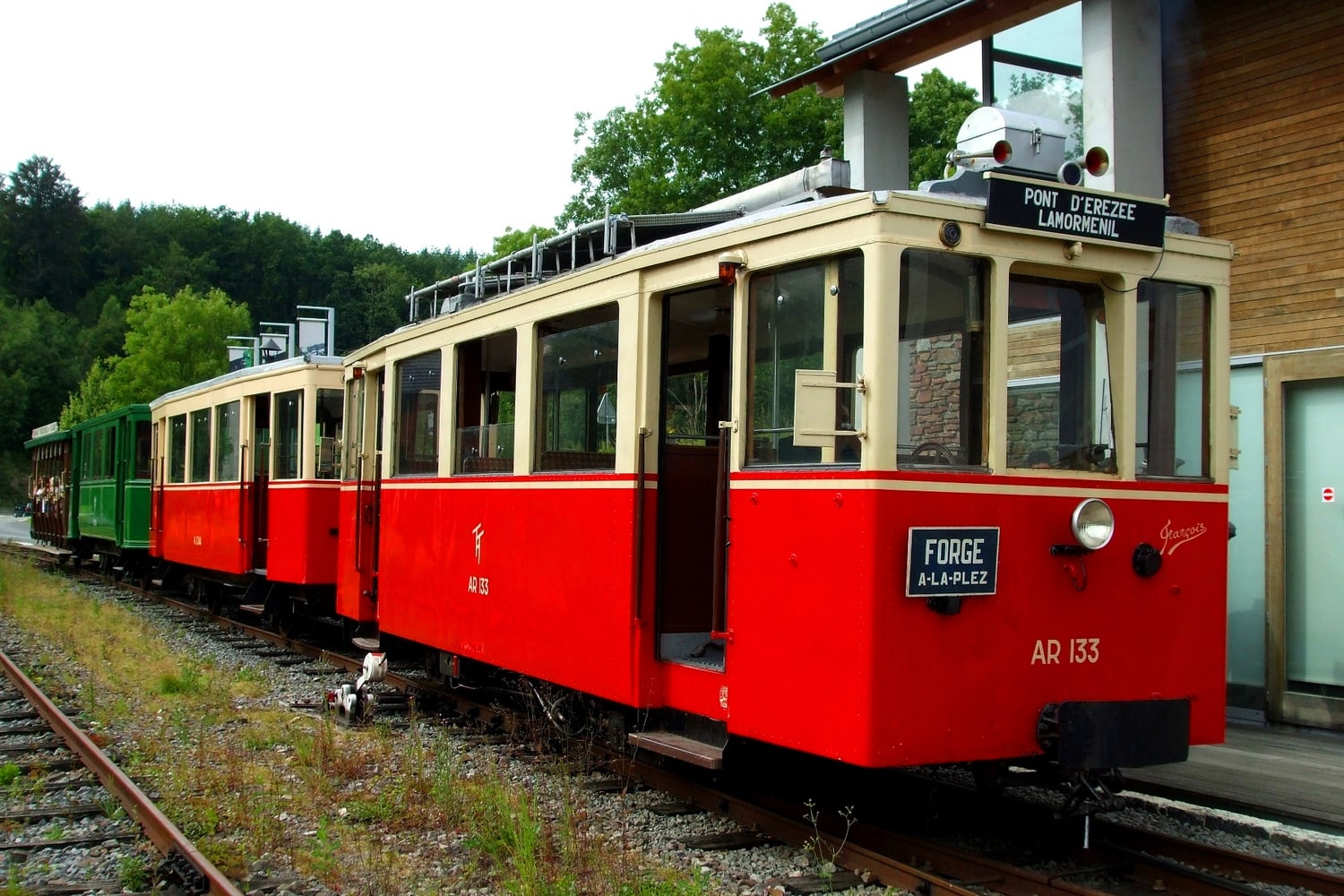
The regular motive power is AR.133, a diesel railcar built by the SNCV in 1935 with twenty-four seats. It is the association's first vehicle and it has been here since 1966, and before that it worked the last regular vicinal services in the province, between Bastogne and Martelange. The crews call it François, after one of the men who drove it on the real network. There are two rail tractors as well, ART.69 of 1933 and ART.123 of 1934 — the latter worked the trains that lifted the Bastogne line in 1966, which is a strange thing for a surviving vehicle to have on its record.
Behind the railcar the carriages are older than it is:
- B.8893 (1913) and B.8944 (1916) — the two open carriages, twenty-six seats each on wooden benches, canopy above and nothing at the sides.
- A.1584 (1893) — a "De Rechter" type car, the oldest thing here, restored by another Belgian tramway association.
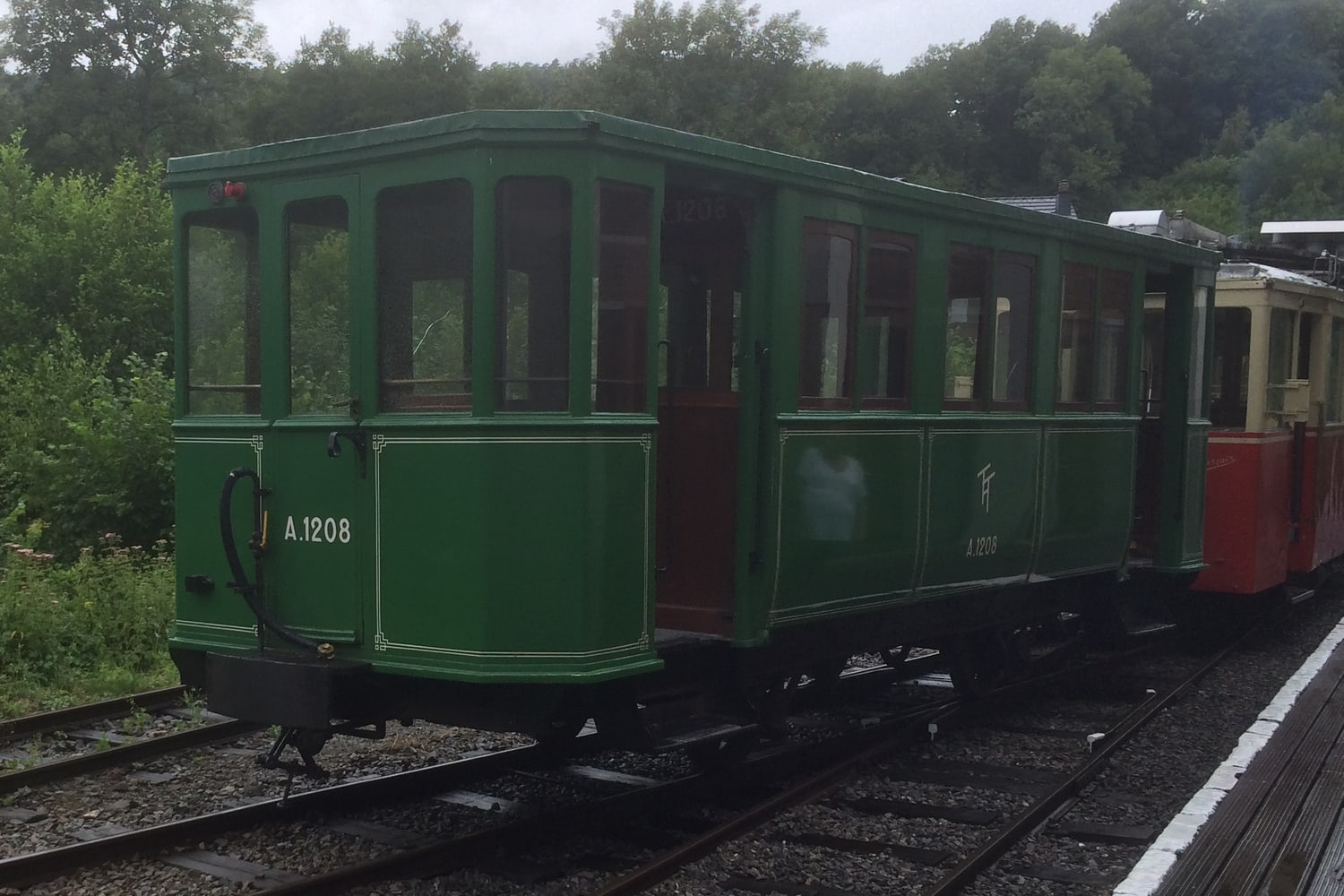
- A.1208 (1907) and A.1348 (1909) — closed second-class carriages.
- A.165 (1904) — the royal first-class saloon, twelve seats, normally on display in the hall but bookable if you hire the tram.
- 19538 (1952) and the restaurant carriage 19572 (1953), which comes with tables.
In the hall, cold, stands HL 1075, a vicinal steam locomotive of 1919. The operator's own description is honest and worth repeating: a complete locomotive, but not operational.
One curiosity
For a single season in 1975, the association ran an electric tram here — two former Verviers city cars with a generator van between them to make their own current. It was, as far as the record goes, the first electric tramway ever to operate in the province of Luxembourg, and it did not last. Nothing about that experiment survives on the line today except the story.
Along the route
Georges Colet / Wikimedia Commons · CC BY-SA 3.0 · croppedThe railcar that turned the lights out
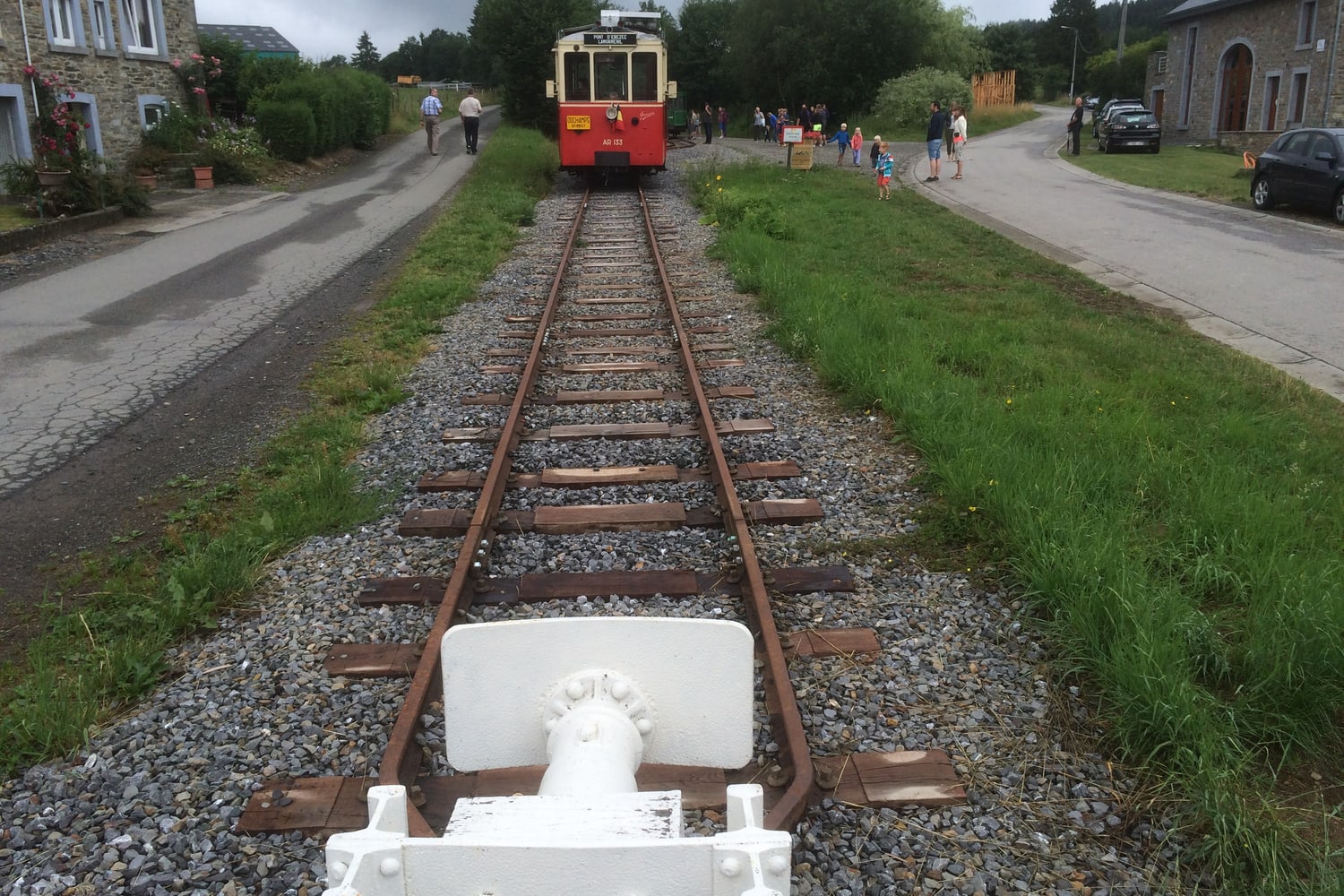
AR.133 was built in 1935 and worked the last regular vicinal services in the province of Luxembourg. It has been carrying passengers at Érezée since 1966 — considerably longer than it ever spent earning a living. Its crews call it François, after one of its last drivers on the real network.Hektor / Wikimedia Commons · CC BY-SA 4.0 · croppedCarriages with no sides
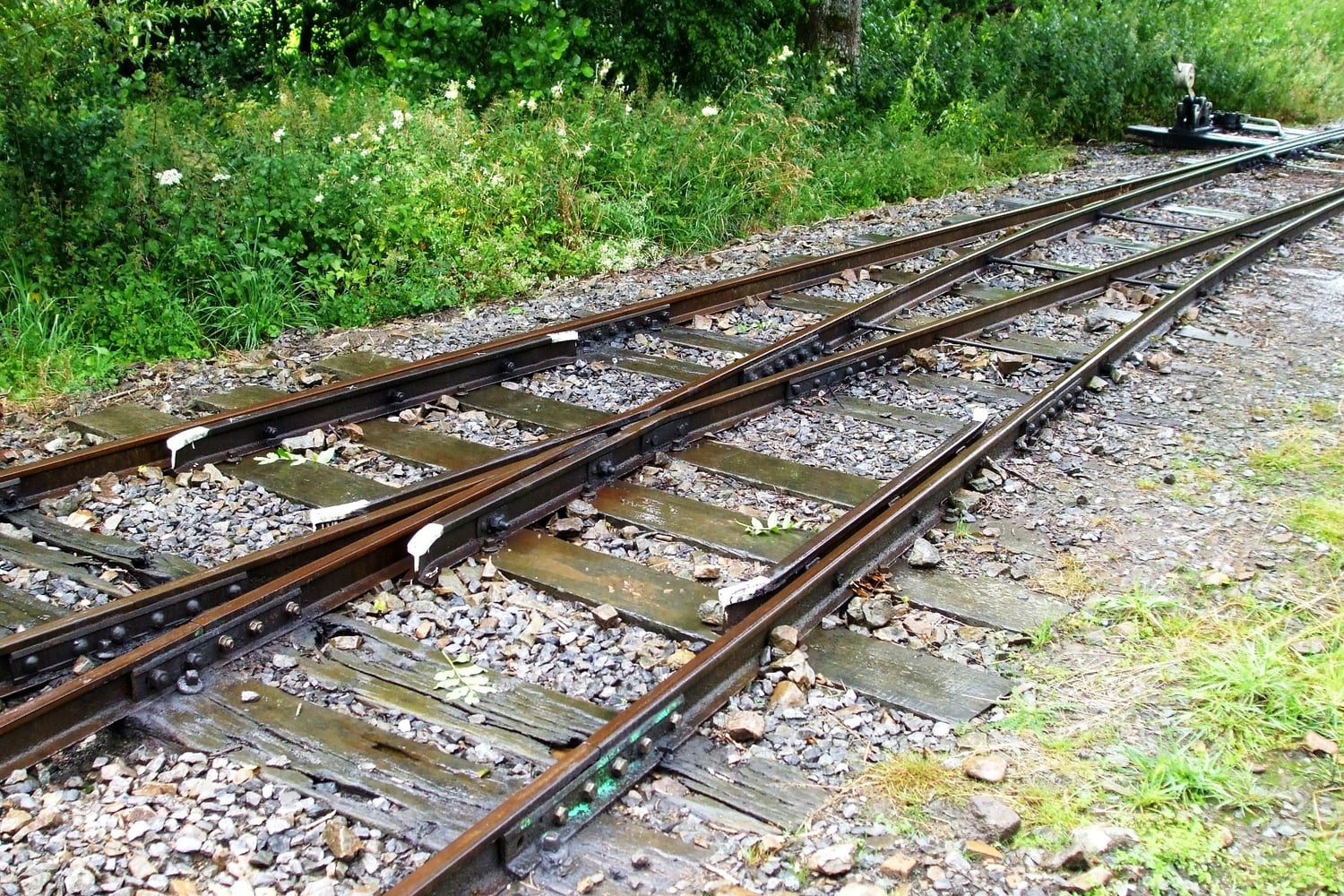
Two open carriages work this line, of 1913 and 1916 — twenty-six seats apiece on wooden benches under a canopy, and nothing between you and the forest. On the two-hour run that is eleven kilometres of Ardennes at walking pace.Frans Berkelaar / Wikimedia Commons · CC BY-SA 2.0 · croppedClosed by a flood, and back
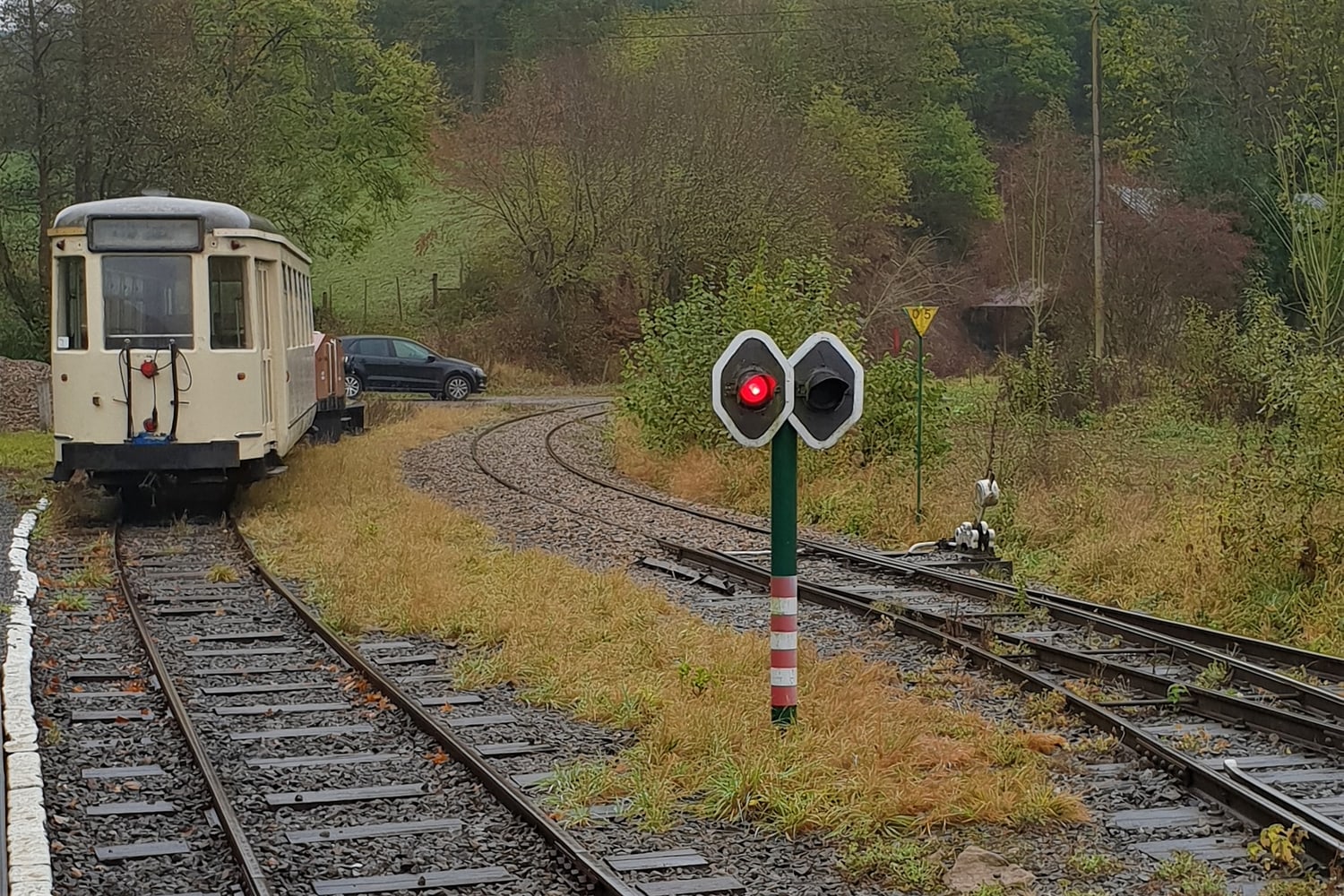
Covid stopped the trams in 2020, and in July 2021 the Aisne flooded and tore up the track. The association was reorganised in 2022 with the local communes taking a larger role, and the real restart came in July 2023 — two days a week, three trips.A bit of history
Culture & experiences along the way
 PJDespa / Wikimedia Commons · CC BY-SA 4.0 · cropped
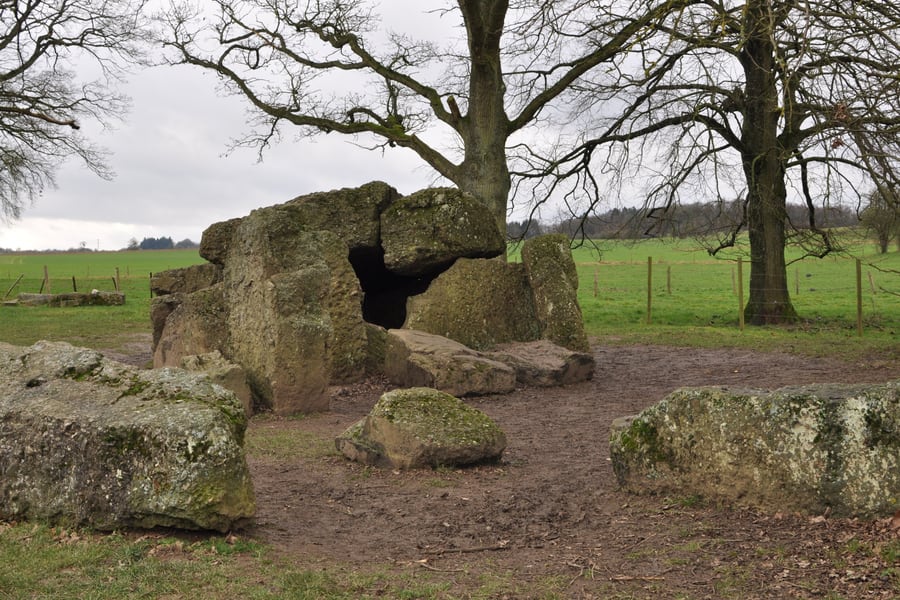
The megaliths at Wéris
Belgium has one megalithic field and it is fifteen minutes from Érezée: two dolmens and a scatter of menhirs in the fields around Wéris, cut from local puddingstone and set up around 3000 BC. They stand in open pasture with a footpath between them and nobody taking a ticket.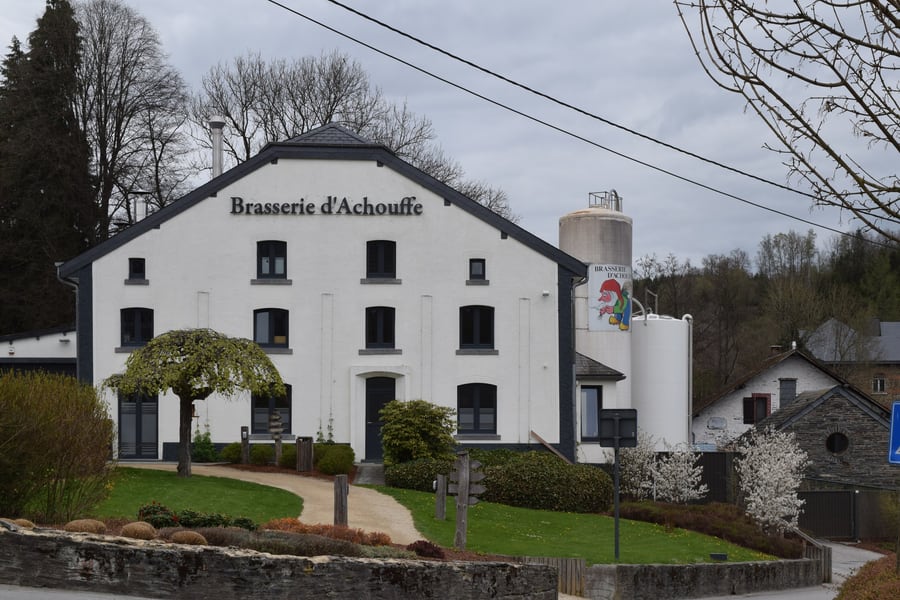 trougnouf / Wikimedia Commons · CC BY 4.0 · cropped
The brewery with the gnome on it
Two brothers-in-law started brewing at Achouffe, up the valley towards Houffalize, in 1982, put a red-hatted gnome on the label and made one of the best-known beers in the Ardennes. The brewery sits in a hamlet of grey stone and white render, and there is a bar attached to it.Timetables
Every journey is a round trip from Érezée, and the operator asks you to be there fifteen minutes before departure. Times below were read from the operator's own schedule page and its live booking system on 12 August 2026.
The four kinds of day
The TTA colour-codes its calendar, and the colour decides whether there are trams at all.
| Day type | Departures from Érezée | Museum & cafeteria |
|---|---|---|
| Blue (high summer) | 10:30 Lamorménil · 13:30 Forge · 15:00 Forge · 16:30 Lamorménil | 10:00–17:00 |
| Green (shoulder season) | 13:30 Forge · 15:00 Forge · 16:30 Lamorménil | 13:00–17:00 |
| Orange | No trams at all | 10:00–17:00 |
| Yellow | Special events, own times | varies |
So the 10:30 to Lamorménil only exists on blue days, and the 16:30 to Lamorménil is the one constant — on an ordinary green day it is the only chance at the full eleven kilometres.
What is actually bookable for the rest of 2026
These are the dates the booking system was selling on 12 August 2026, so they are the remainder of the season rather than the whole year:
- August — Sat 15, Mon 17, Wed 19, Sat 22, Mon 24, Sat 29 · all blue days, four departures
- September — Sat 5, 12, 19, 26 · green
- October — Sat 3, 10, 17, 24 and Wed 14, 21, 28 · green
- November — Sat 7 · green, and the last ordinary running day of the season
Notice the shape: Saturdays right through, plus Mondays and Wednesdays only while the school holidays last, and then Wednesdays again during the Belgian autumn half-term in October.
Ordinary running days are not Sundays. The Sundays in the calendar are the special events:
- 12 July and 16 August — Apéro Tram, an 11:00 departure with local aperitifs served on board
- 20 September — Tramway du marché, the market tram
- 6 April Easter · 4–5 July, the association's 60th anniversary · 31 October Halloween · 5 December Saint Nicholas · 19 December Christmas
Not all of the later specials were on sale yet when this was written, so if one of them is your reason for going, check before you travel.
Getting there, and the Saturday problem
This needs stating bluntly, because it is the single most awkward fact about visiting the TTA.
The railhead is Melreux-Hotton, nine kilometres away, on the main line through the Ardennes. Reaching it is easy: from Brussels-Central it is about two hours eleven minutes via Liège-Guillemins, with departures through the morning — the 07:01, 09:01, 11:01 and 13:01 were all running on Saturday 15 August 2026, arriving at 09:12, 11:12, 13:12 and 15:12. On weekdays there is a second route via Marloie as well.
The problem is the last nine kilometres. The operator's own access page says it plainly:
TEC line 11 Manhay–Melreux serves Erezée station and connects to Melreux-Hotton station (no bus service on Saturdays).
Saturday is the day the tram runs. The bus is the day it does not. There is no way to dress that up.
The honest options are:
- Come by bicycle. This is the answer the operator itself leans towards, and it works properly: there is cycle parking and electric-bike charging at the station, and bikes are carried on the tram if you book in advance. Ride the nine kilometres up from Melreux-Hotton, put the bike on board, and you have solved the transport and gained the best part of the day.
- Come on a Monday or Wednesday in high summer, or a Wednesday in the October half-term, when the bus runs and the tram runs on the same day.
- Drive. Parking is free and there is plenty of it. Érezée is 15 km from Durbuy, 21 km from La Roche-en-Ardenne, 9 km from Hotton and 17 km from Marche-en-Famenne.
If you are car-free and set on a Saturday, budget for a taxi from Melreux-Hotton in at least one direction, and book it before you travel — this is deep countryside and cabs do not cruise.
For the live calendar and to book, use the operator's own schedule and booking pages (opens in a new tab).
Tickets
Tickets are sold online through the operator's own booking system, one departure at a time, and at the station. Museum entry is included in every tram fare. Children under six travel free; the reduced rate covers people with special needs and groups of twenty or more, and there is no senior band. Prices read from the operator on 12 August 2026.
Buy the two-hour ticket to Lamorménil. The €5 difference is the difference between riding the stretch the association has always run and riding the one it spent €873,000 and fifty-six years getting back, where the line stops being an attraction and starts feeling like what it was. The catch is scheduling rather than money: on green days there is only one departure to Lamorménil, at 16:30. The tram can also be taken one way, with a walk or a bicycle back to Érezée — bicycles are carried with prior booking.
Book your tickets
Érezée to Lamorménil and back
€10 reduced · €6 child 6–11 · about two hours
The full run, out to the stretch reopened in 2019, with museum entry included.
Book Tickets (opens in a new tab, on tta.be)via tta.beÉrezée to Forge-à-la-Plez and back
€8 reduced · €6 child 6–11 · about an hour
The shorter run, and the only one that leaves in the middle of a green day.
Book Tickets (opens in a new tab, on tta.be)via tta.beThe whole tram to yourselves
€400 to Forge · €500 to Lamorménil
Private hire buys an empty tram, a choice of vehicles and photo stops, not a saving.
Book Tickets (opens in a new tab, on tta.be)via tta.beRail Passes
No rail pass is valid on the tramway, and none is worth buying for the journey to reach it. The detail below is about the leg that a pass can cover, and about why the last nine kilometres are the part that actually costs you something.
On the tramway: nothing applies
The TTA is a private non-profit association operating its own metre-gauge line, entirely separate from the national network. Interrail, Eurail and every SNCB product are invalid on it, and there is no pass-holder discount. The €10 and €15 fares are the fares.
The one discount that does exist is the group rate for parties of twenty or more, which drops the two-hour fare to €12 — and that is a group concession, not a pass.
On the train to Melreux-Hotton: a pass is valid but rarely worthwhile
Melreux-Hotton is an ordinary station on the national network, so a pass covers it and no reservation is needed. From Brussels-Central the journey is about two hours eleven minutes via Liège-Guillemins.
Whether to spend a travel day on it depends entirely on where you are coming from:
- From elsewhere in Belgium — buy an ordinary ticket. Belgian domestic fares are distance-based and modest, and a pass day is worth more than this trip costs.
- From outside Belgium, mid-Interrail — using a travel day here is defensible, because Melreux sits on a through route and you can arrive from Liège or Luxembourg and carry on afterwards rather than doubling back.
SNCB's own range, read from its site in August 2026, is age-banded — Child under 12, Youth under 26, Adult 26–64, Senior 65+ — plus Train+ for cheaper off-peak and weekend travel, season tickets in Standard, Unlimited, Flex and Student versions, and group fares starting at four people. That four-person mini-group threshold is worth noting precisely because the tramway's own group rate needs twenty — a family gets the cheaper deal on the train and pays full price on the tram.
The gap no ticket covers
The honest warning belongs here as much as in the timetable: a pass will deliver you to Melreux-Hotton, and then TEC bus line 11 does not run on Saturdays, which is the tramway's main operating day. No rail product solves that. The solutions are a bicycle — carried on the tram if you book ahead, with charging points at the station for an e-bike — a Monday or Wednesday visit in high summer, or a pre-booked taxi.
Budget for that nine kilometres separately from whatever pass or ticket gets you to the Ardennes. It is the only part of this journey where being car-free costs real effort.
Places to Visit
This is one of the better-placed heritage railways in Belgium, because the country around it is the reason most people come to the Ardennes in the first place.
Érezée sits between two rivers and their towns. The Aisne, which the tramway follows, is a modest thing — thirty-one kilometres from source to mouth, entirely inside the province of Luxembourg, and a tributary of the Ourthe rather than a river anyone travels to see on its own. The Ourthe is the draw, and both of the towns worth a half-day sit in bends of it: Durbuy fifteen kilometres north, La Roche-en-Ardenne twenty-one kilometres south.
The geology underneath explains the rest. This is the southern edge of the Famenne, along the limestone band called the Calestienne — which is why the region has caves, and why the one at Hotton, nine kilometres away and conveniently right at the station you arrive by, is worth the detour. It is also the wet-weather answer: the tramway runs in any weather, but an open carriage in persistent rain is a different proposition, and a cave is not.
If you have a car and a whole weekend, the four below make an obvious circuit. If you have arrived by train and bicycle, Hotton is on your way in and Érezée is where you already are.
 JackyM59 / Wikimedia Commons · CC BY-SA 4.0 · cropped
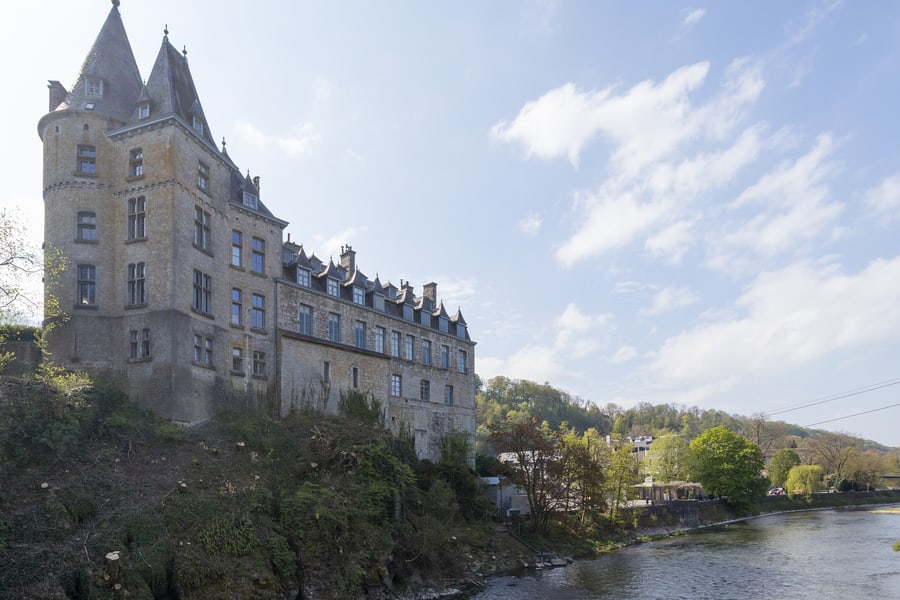
Durbuy
Fifteen kilometres away, wrapped inside a meander of the Ourthe beneath a turreted château, is the place often called the smallest town in the world — a knot of grey stone lanes that held a city charter from the counts of Durbuy. The claim comes with a Belgian punchline: since the communes were merged in 1977, Durbuy's name and its town title belong to a very large commune indeed, several of whose villages are far more populous than Durbuy itself.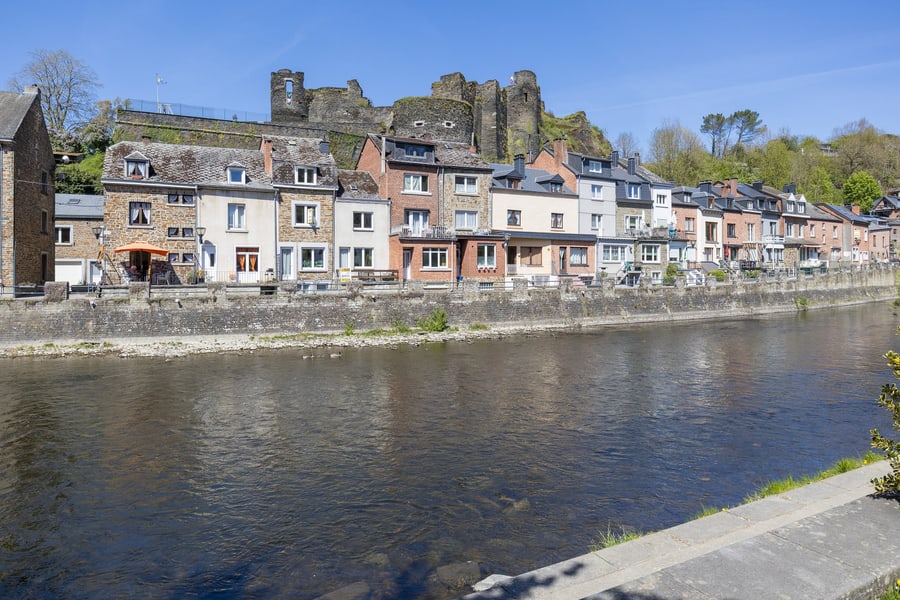 JackyM59 / Wikimedia Commons · CC BY-SA 4.0 · cropped
La Roche-en-Ardenne
Twenty-one kilometres south, in a tight bend of the same river, the ruins of a feudal castle stand on a crag directly above the rooftops — the seat of the old county of La Roche, and about as textbook an Ardennes town as exists: slate roofs, a quay along the Ourthe, and wooded hills closing in on every side. It makes the natural other half of a weekend built around the tramway.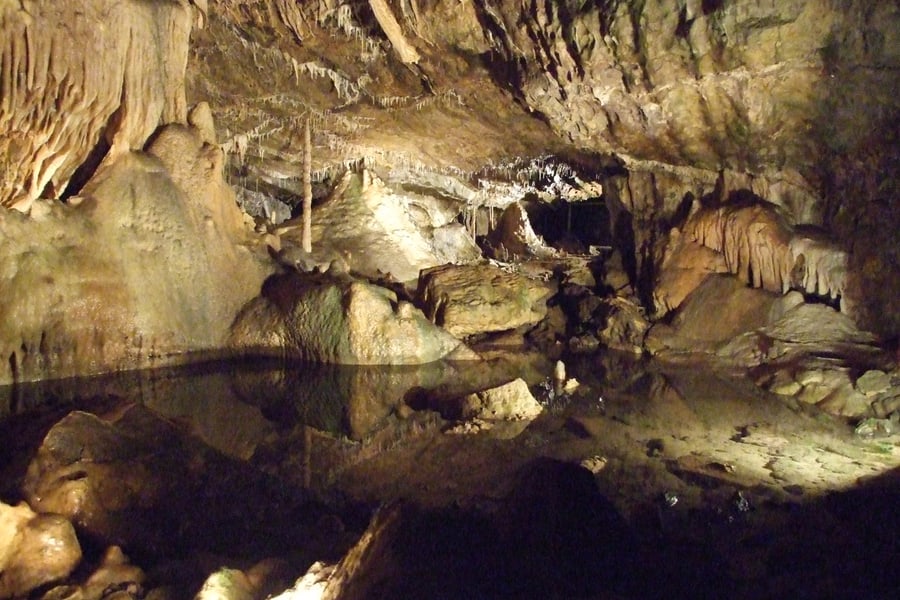 Wiki-uk / Wikimedia Commons · Public domain · cropped
The caves at Hotton
Nine kilometres away — and, usefully, at the railway station you arrive by — are the Grottes de Hotton, also called the Caves of the Thousand and One Nights. They lie on the southern edge of the Famenne along the limestone band called the Calestienne, the same geology that gives this corner of Belgium its caves and its river gorges. If the tram is not running the day you arrive, this is the answer.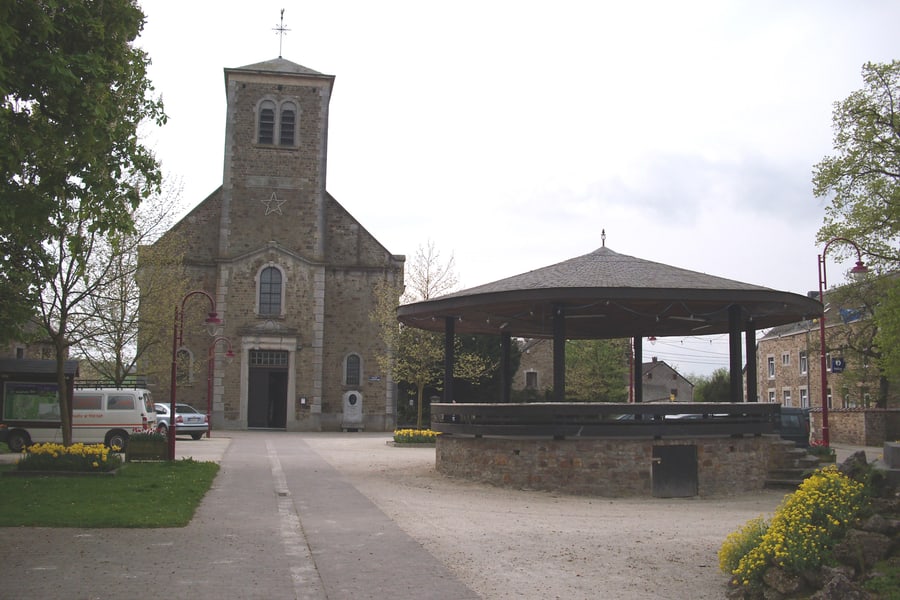 Spotter2 / Wikimedia Commons · CC BY-SA 3.0 · cropped
Érezée itself
The village the tramway starts from is worth ten minutes before you board: a stone church, a bandstand on the square, and the ordinary Ardennes architecture — grey stone, slate, deep window reveals — that the vicinal was built to serve. The railway's own station has a cafeteria, a playground and an exhibition hall upstairs, so waiting for a departure is no hardship either.Where to Sleep
A straight answer first: Érezée itself has no hotel we were able to verify. It is a village of a few hundred people with a church, a square and a tramway station, and the accommodation in the immediate area is guest houses, gîtes and bed and breakfasts rather than anything with a reception desk.
The two cards below are therefore both at Durbuy, fifteen kilometres north — which is not a compromise so much as the obvious base for this trip. Durbuy is the town people come to the Ardennes for, it has the restaurants, and the drive to the tramway takes twenty minutes.
Choosing between them is a question of scale rather than quality. Durbuy-Ô is six rooms above a restaurant in a hamlet outside the town, run by the couple whose name is on the door; it suits a two-night stay where dinner is part of the point. Le Sanglier des Ardennes is the large, long-established house in the middle of Durbuy itself, with several restaurants and a wellness suite, and it suits a trip where the Ardennes is the holiday and the tramway is one afternoon of it.
If you are car-free, note that both are at Durbuy and the tramway is at Érezée, and the bus that links Érezée to the railway does not run on Saturdays. Staying at Durbuy and reaching a Saturday tram without a car means a taxi or a long ride. On a Monday or Wednesday in high summer it is much easier.
As on every page here, the cards carry no price, no star rating and no review score — we have verified none of those. What we can vouch for is that both hotels' own websites were opened and read in August 2026: both are trading and both take direct bookings.
Where to stay
Durbuy-Ô
Six rooms and a restaurant at Warre
A small hotel and restaurant at Warre, just outside Durbuy, run by Laurence and Koen Timmerman — six rooms, a kitchen that is plainly the heart of the place, and an electric charging point. The scale suits this trip: the tramway is a half-day, and this is the sort of address where the other half of the day is dinner.
Check Availability (opens in a new tab, on durbuy-o.be)via durbuy-o.beLe Sanglier des Ardennes
The grand option, in Durbuy itself
The long-established hotel in the middle of Durbuy, and the most substantial in the area — rooms, several restaurants, a wellness suite and its own gastronomy. If you are making the Ardennes the trip rather than the tramway, this is the address that anchors it, fifteen kilometres from the Érezée terminus.
Check Availability (opens in a new tab, on sanglier-durbuy.be)via sanglier-durbuy.beQuestions or corrections
Planning this trip and stuck on something, or spotted a time, fare or detail that has changed? Send us a message about Tramway Touristique de l'Aisne. We read every one, and we update this page when something has changed.