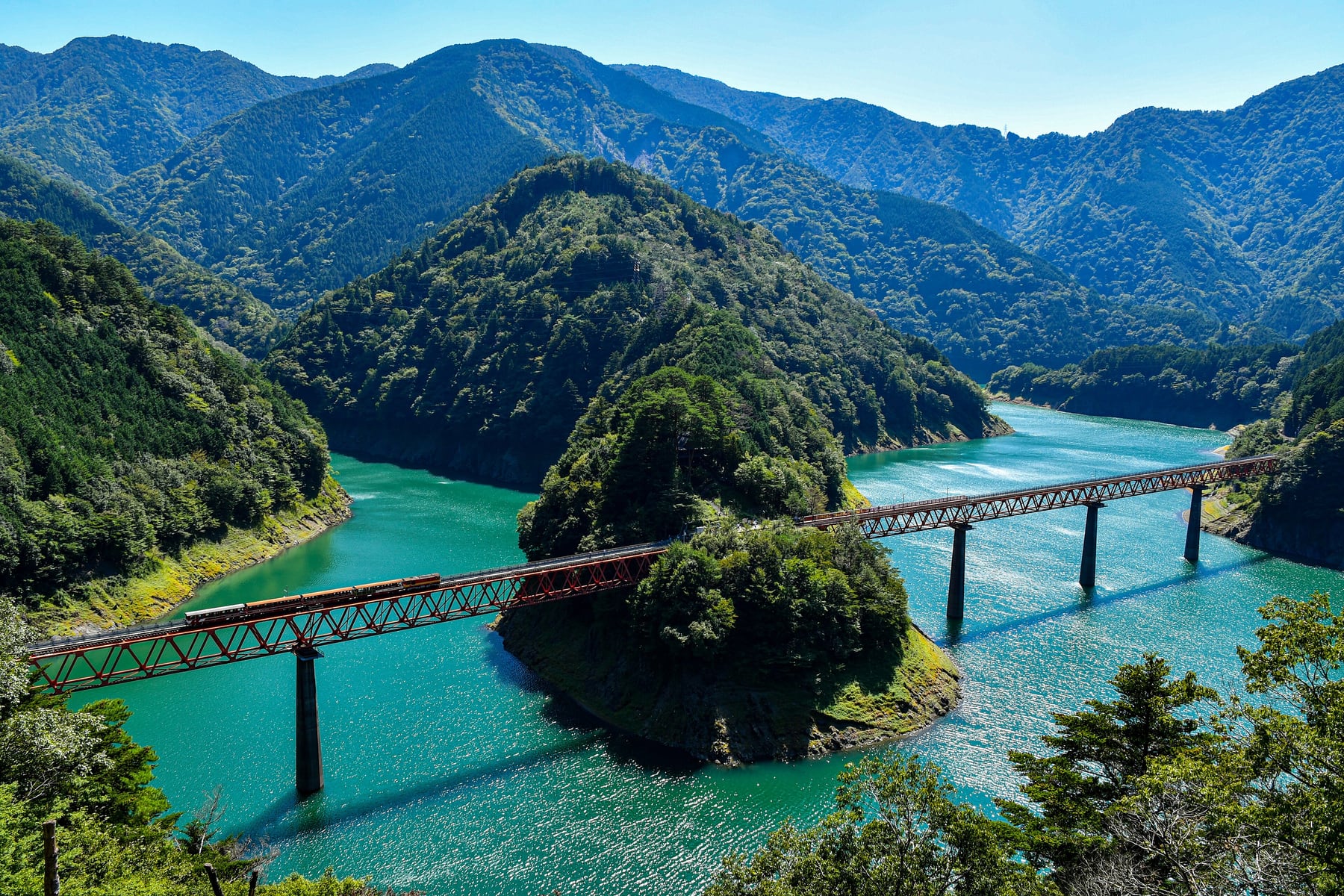
Ōigawa Railway
9689tatsuya / Wikimedia Commons · CC BY 4.0
- Distance65 km · Main Line 39.5 km, Ikawa Line 25.5 km
- DurationAbout 3 h 45 min from Kanaya to Ikawa, with a bus between
- Best seasonYear-round · cherry blossom in spring, autumn colour in mid-November
Introduction
The Ōigawa Railway follows the Ōi River north from Kanaya, on JR's Tōkaidō Line in Shizuoka Prefecture, into the foothills of the Southern Alps. It is two railways in one. The 39.5 km Main Line was the first in Japan to bring steam back for visitors, in 1976, and still runs old coaches behind electric locomotives. Beyond Senzu, the 25.5 km Ikawa Line, built to carry materials for the dams, climbs in small red trains to Ikawa, through the only rack railway in Japan and the steepest gradient on any ordinary line in the country.
Two things have changed. In September 2022 a typhoon cut the Main Line beyond Kawane-Onsen Sasamado, and a town bus from Ieyama now covers the gap to Senzu. And since 1 July 2026 every Ikawa Line train has been a reserved sightseeing train, sold at one flat price.
The Journey
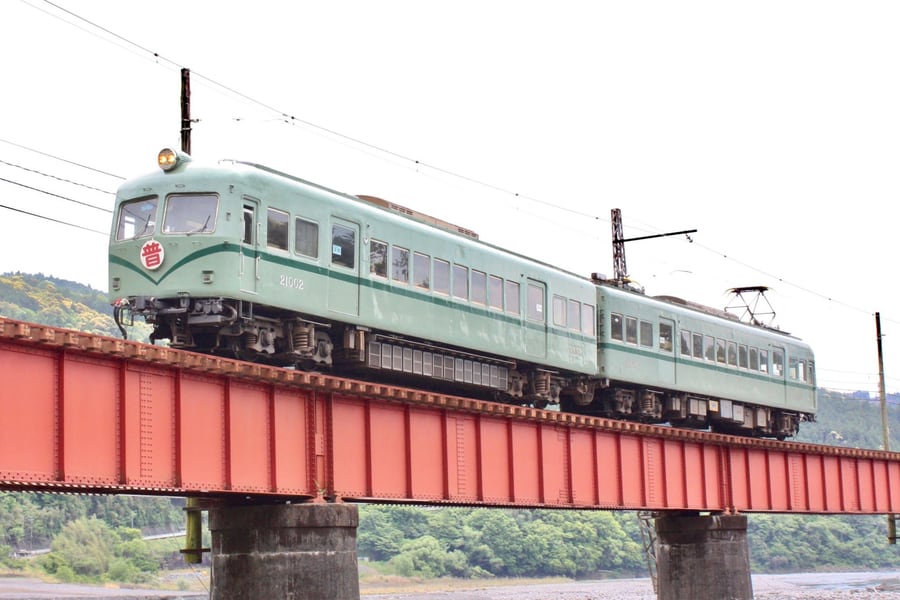
Local trains leave Kanaya, where the line meets JR, and call at Shin-Kanaya, home of the depot and the heritage trains. They are second-hand city trains on a second career: Nankai's 21000 series "Zoom Car" of 1958, a Kintetsu 16000 series of 1965, and 7200 series cars that came from Tokyu by way of a closed line in Aomori. The line climbs the widening valley past Ieyama and the tea fields of Nukuri, crosses the river on the Ōigawa First Bridge, and stops at the buffers of Kawane-Onsen Sasamado, about 45 minutes from Kanaya.
The bus to Senzu
From Ieyama the Kawanehon town bus follows the river to Senzu in about 45 minutes; the stop is right outside the station. It is the town's bus, not a replacement service run by the railway. It also stops by the Kawane Onsen roadside station, ten minutes' walk from Sasamado, which has a day-bathing house and somewhere to eat.
The Ikawa Line
At Senzu the Ikawa Line's little coaches wait behind a DD20 diesel. The line was built as a works railway to tiny dimensions, and its cars are under 1.85 m wide. At Abt Ichishiro an ED90 rack locomotive is coupled on for the 90‰ climb to Nagashima Dam. The train then crosses Lake Sesso to Oku-Ōi Laketop and reaches Sessokyō-Onsen, where three of the five daily trains turn back. The other two go on over the Sekinosawa Bridge to Ikawa, about two hours from Senzu.
The heritage trains
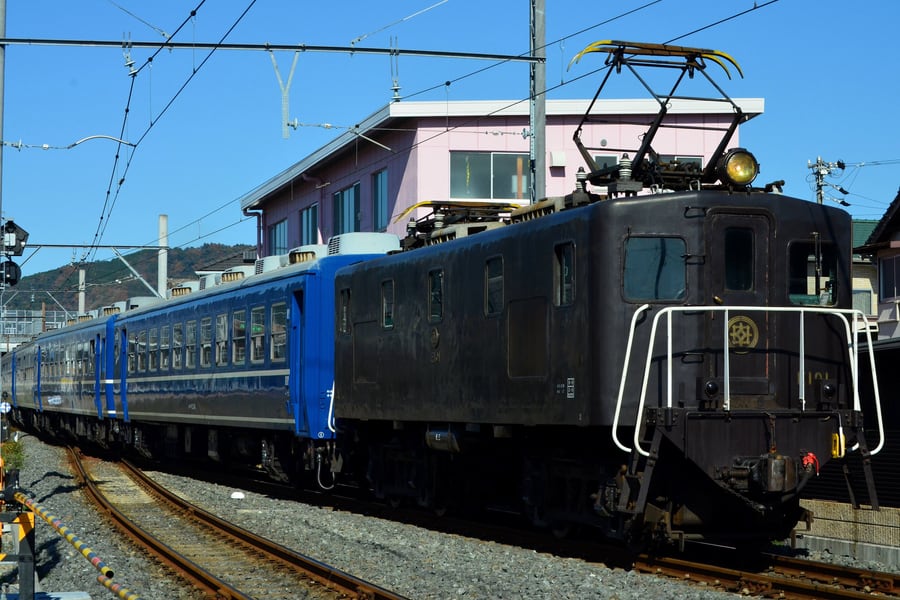
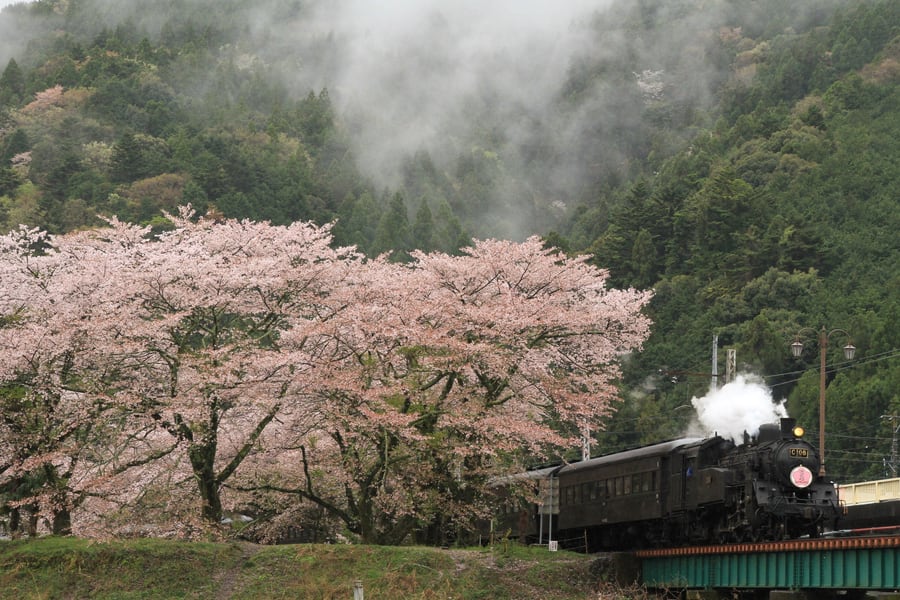
The EL Express runs on set days between Shin-Kanaya and Ieyama: old JNR coaches behind an electric locomotive, one of them in the blue livery of the old sleeper trains. Steam made the railway's name, but the black steam trains have been suspended since 13 January 2026 while C10 8 is modified. For now steam runs only in the guise of Thomas and Percy, the Day out with Thomas trains, between Shin-Kanaya and Kawane-Onsen Sasamado.
Along the route
 Miki Karashino / Wikimedia Commons · CC0
Nukuri
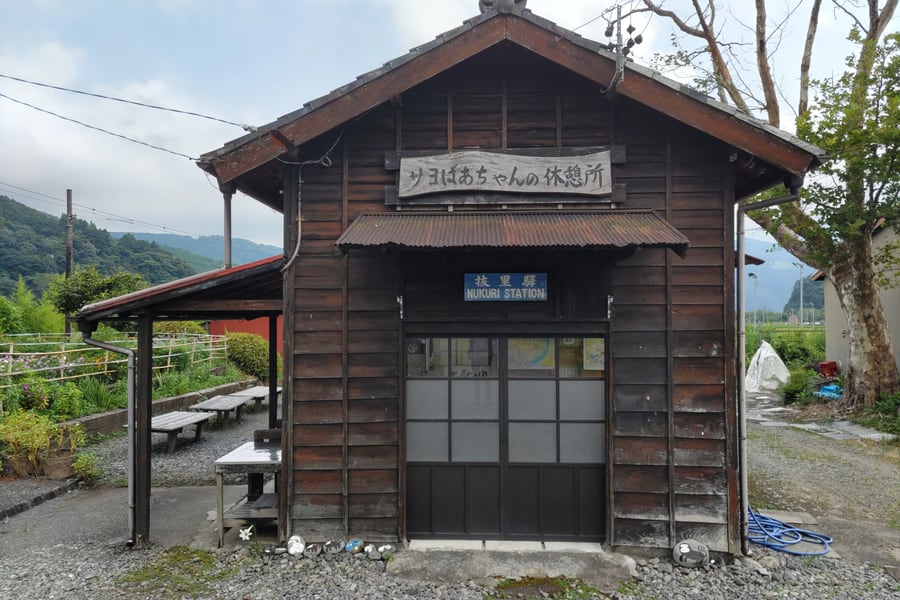
Nukuri keeps its wooden station of 1930, among tea fields. Its sign reads Granny Sayo's rest stop, after a local woman whose friendships with travellers became a television documentary; a café named for her opened inside in 2013 and closed in March 2026.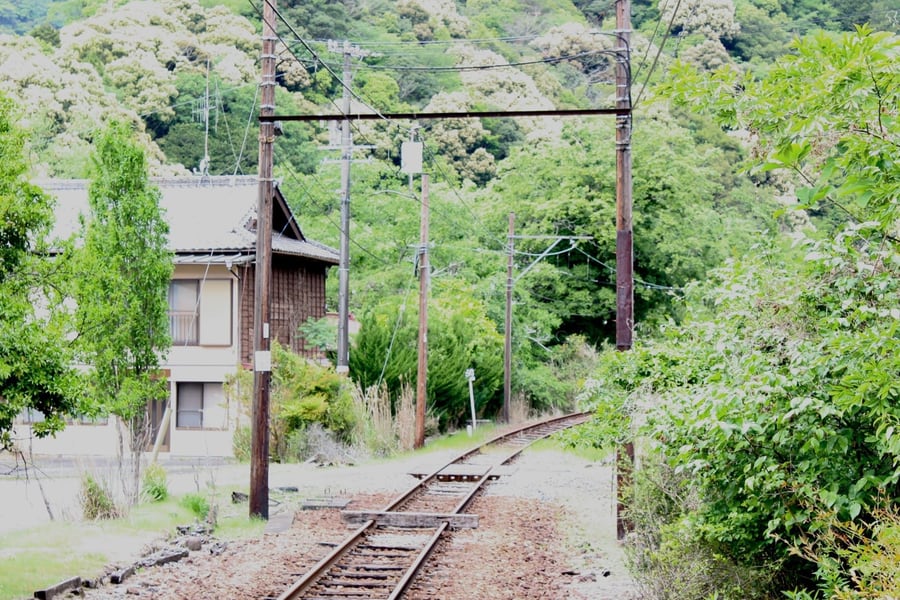 にぶさま / Wikimedia Commons · CC BY-SA 4.0
The end of the line, for now
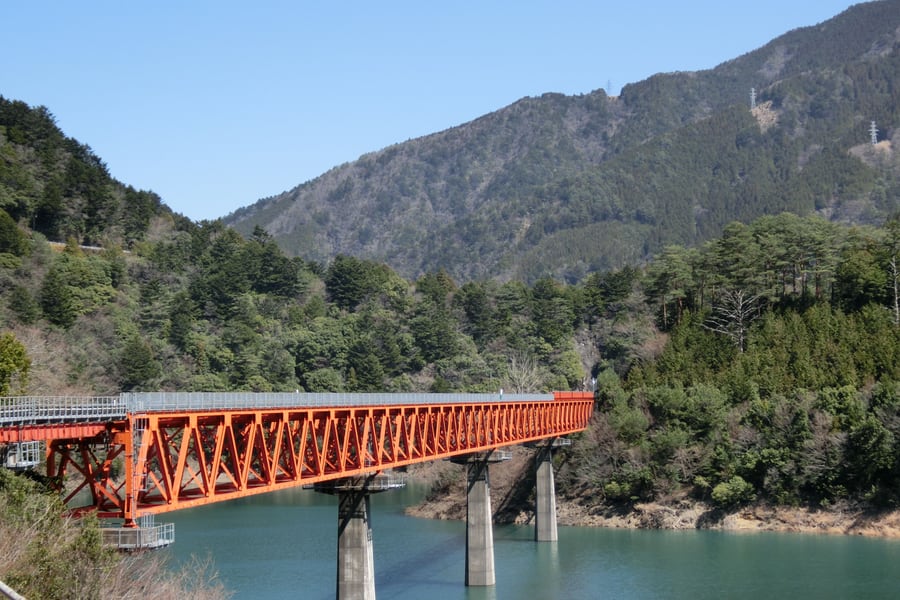
Trains stop at the buffers of Kawane-Onsen Sasamado. A typhoon in September 2022 closed the line on to Senzu, and its reopening is aimed at about 2029. Until then a town bus follows the river from Ieyama.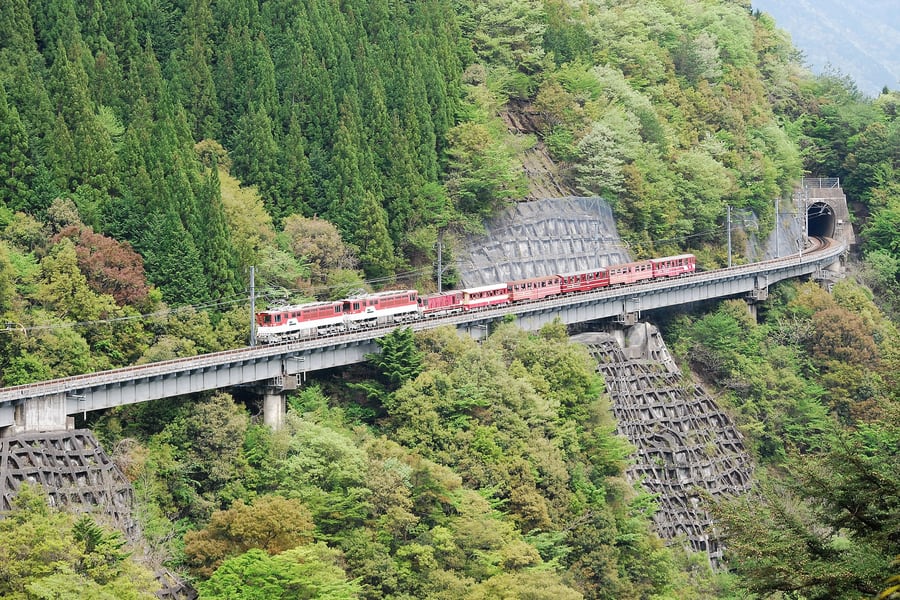 Toshinori baba / Wikimedia Commons · CC BY-SA 3.0
Ninety per mille
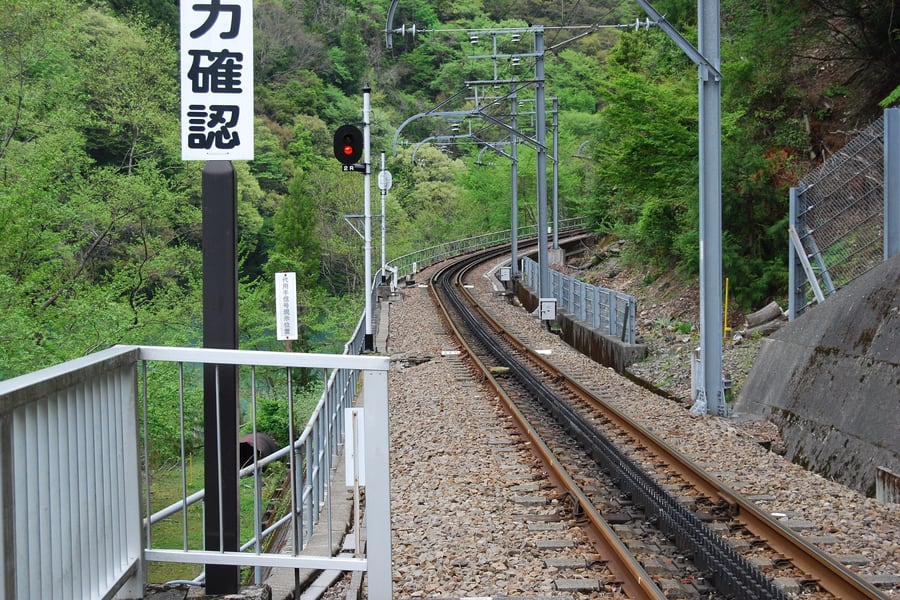
Between Abt Ichishiro and Nagashima Dam the line climbs 90 m in every kilometre, the steepest grade on any ordinary railway in Japan, with ED90 rack locomotives pushing from below. It was built in 1990, when the dam drowned the old route.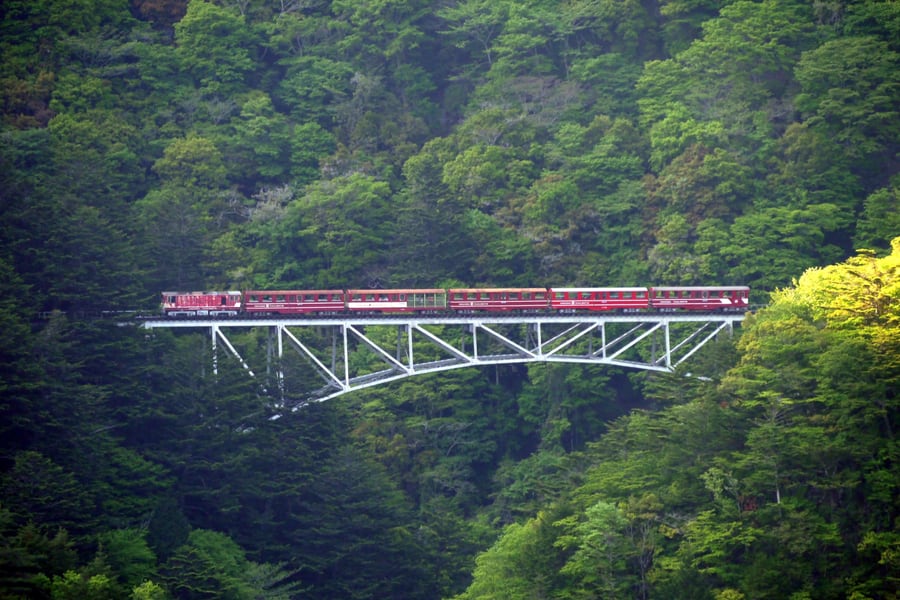 Konomi / Wikimedia Commons · CC BY-SA 4.0
The Sekinosawa Bridge
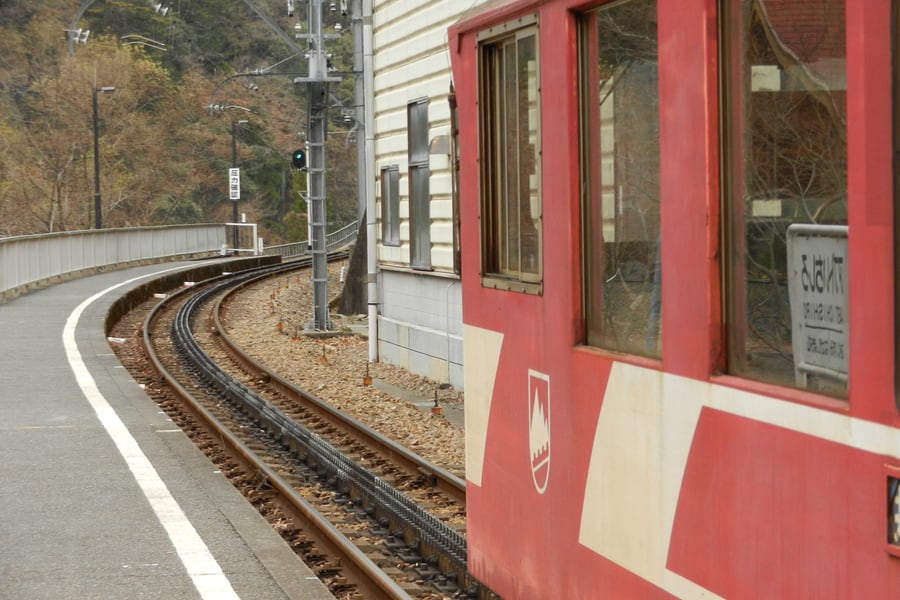
On the two trains a day that run through to Ikawa, the line crosses the Sekinosawa Bridge, 70.8 m above the riverbed and the highest railway bridge in Japan. The driver slows right down for the view into the gorge.A bit of history
Culture & experiences along the way
 Koichi Shibata / Wikimedia Commons · CC BY-SA 3.0
The coupling at Abt Ichishiro
At Abt Ichishiro the train waits while an ED90, Japan's only Abt rack locomotive, is coupled on to push it up to Nagashima Dam, where it comes off again; downhill, the order is reversed. You may step onto the platform to watch and take photographs without losing your booking.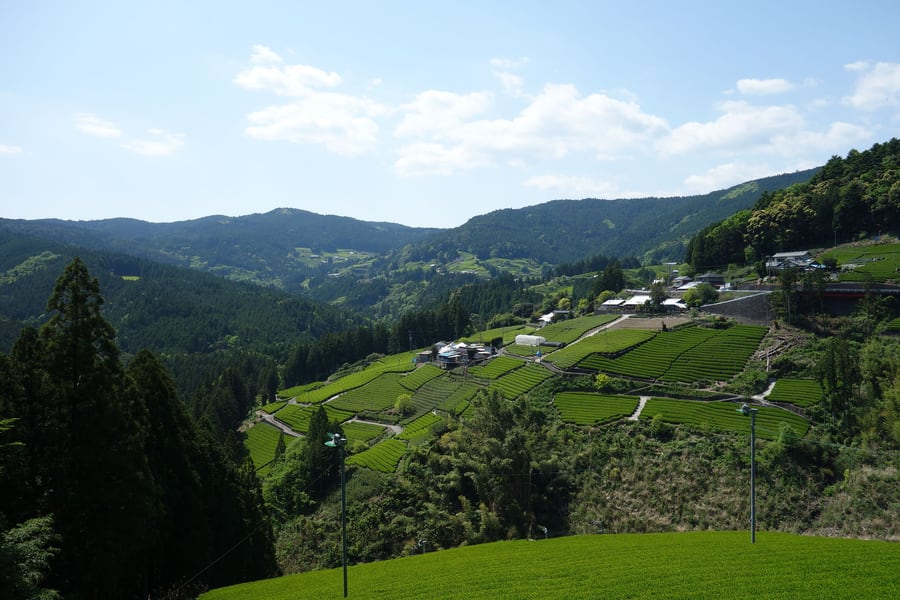 690 Noda / Wikimedia Commons · CC BY 3.0
Kawane tea
The middle Ōi valley is tea country, and Kawane tea grows on its steep slopes; the inns at Sumatakyō count it among the valley's pleasures. The fields around Nukuri turn bright green in May, says the railway, and the summer breeze carries their soft, sweet scent.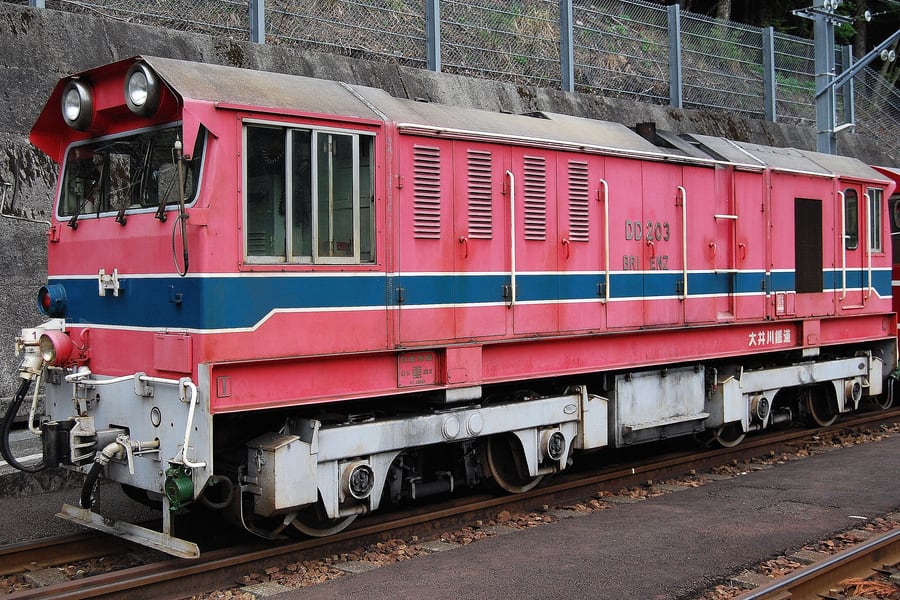 Toshinori baba / Wikimedia Commons · CC BY-SA 3.0
Sister railways
Since 1977 the line has been twinned with Switzerland's Brienz Rothorn Bahn, which also kept its steam, and since 1986 with Taiwan's Alishan Forest Railway. Two of the six DD20 diesels that work the Ikawa Line are named Rothorn and Brienz.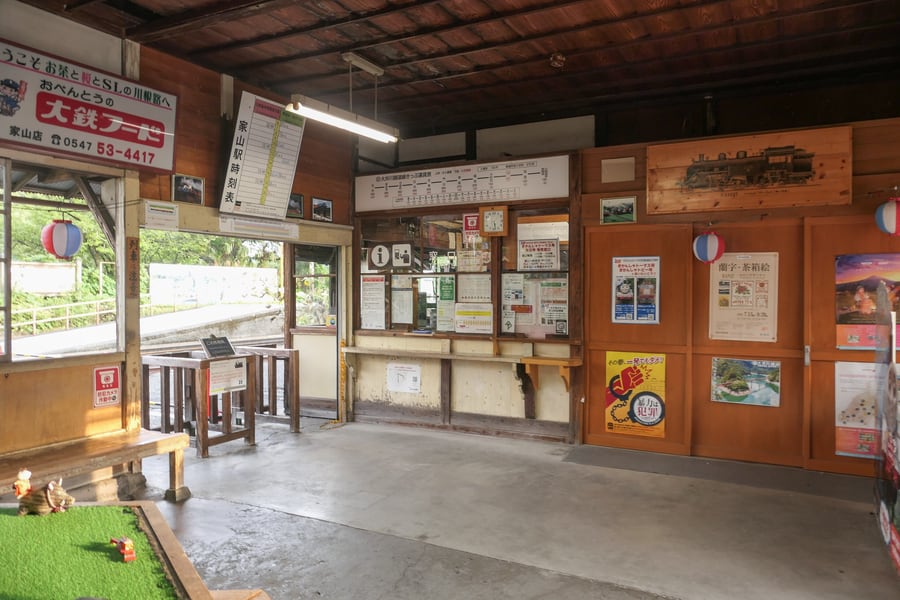 MaedaAkihiko / Wikimedia Commons · CC0
A ticket on card
The Ōigawa Railway still prints tickets on hard card, a kind now rare in Japan; ask the conductor if you may keep yours. Several stations on the Main Line, Ieyama among them, are timber buildings that have changed little since they were built.Timetables
Local trains on the Main Line, the town bus and the Ikawa Line all run every day of the year. The heritage trains on the Main Line run on set days only.
Main Line local trains (no booking)
| Kanaya | Ieyama | Kawane-Onsen Sasamado |
|---|---|---|
| 07:24 | 07:56 | — |
| 11:04 | 11:39 | 11:50 |
| 14:38 | 15:11 | 15:21 |
| 17:46 | 18:22 | 18:30 |
Back towards Kanaya, trains leave Kawane-Onsen Sasamado at 06:26, 09:45, 12:02, 15:32 and 18:40, about 40 minutes to Kanaya.
Town bus, Ieyama to Senzu (about 45 minutes): 06:30, 08:15, 12:05, 15:30, 18:40, 20:25. From Senzu: 05:35, 07:20, 11:10, 14:35, 17:45, 19:35.
Ikawa Line (booking required, from 1 July 2026)
| Senzu | Abt Ichishiro | Oku-Ōi Laketop | Sessokyō-Onsen | Ikawa |
|---|---|---|---|---|
| 09:15 | 10:03 | 10:25 | 10:31 | 11:07 |
| 10:05 | 10:51 | 11:12 | 11:18 | — |
| 12:20 | 13:08 | 13:29 | 13:35 | 14:12 |
| 13:35 | 14:21 | 14:42 | 14:48 | — |
| 14:35 | 15:21 | 15:42 | 15:48 | — |
| Ikawa | Sessokyō-Onsen | Oku-Ōi Laketop | Abt Ichishiro | Senzu |
|---|---|---|---|---|
| — | 10:45 | 10:53 | 11:17 | 11:55 |
| — | 12:10 | 12:18 | 12:41 | 13:18 |
| 12:25 | 13:01 | 13:09 | 13:37 | 14:20 |
| — | 15:15 | 15:23 | 15:48 | 16:25 |
| 15:20 | 15:56 | 16:04 | 16:28 | 17:05 |
Good to know:
- A connection that works. The 07:24 from Kanaya meets the 08:15 bus, which reaches Senzu at 09:00 for the 09:15 to Ikawa.
- Breaking the journey. A booking covers one train; get off at Oku-Ōi Laketop and the next train needs a new one.
- Without a booking. The 14:35 from Senzu and the 10:45 from Sessokyō-Onsen carry one ordinary car, about 25 seats, at normal fares.
- Heritage trains, October 2026. The EL Express leaves Shin-Kanaya at 10:10, 12:10 and 15:10 for Ieyama, mostly Friday to Monday; the Thomas and Percy steam trains leave at 10:39 and 13:58 for Kawane-Onsen Sasamado.
Times as of October 2026, from the operator's timetables. Check your date on the Ōigawa Railway's Main Line timetable (opens in a new tab) (in Japanese) and Ikawa Line page (opens in a new tab).
Tickets
On the Main Line, local trains need only a ticket from the station, priced by distance: ¥920 from Kanaya to Kawane-Onsen Sasamado, half for children under 13. The EL Express adds a ¥1,500 surcharge and every seat is reserved; the Day out with Thomas trains are sold through the ticket agencies listed on their own site, from ¥3,000 one way.
On the Ikawa Line every journey is a ¥3,500 booking for one named train, however far you ride, and seats are not numbered. Book online from 30 days ahead; on the day, any spare places are sold at staffed stations or on board, for cash. Many stations up the line have no mobile signal, so save or print the e-ticket before you leave Senzu. Fares checked October 2026 on the operator's site; Japanese yen.
Book your tickets
Ikawa Line sightseeing train
One way, adult · any distance, Senzu to Ikawa
A booked place on one train, the same price however far you ride; a child aged 6 to 11 pays ¥1,750.
Book Tickets (opens in a new tab, on Ōigawa Railway)via Ōigawa RailwayEL Express, Shin-Kanaya to Ieyama
One way, adult · fare and express surcharge
A reserved seat in old coaches behind an electric locomotive: ¥690 fare plus the ¥1,500 surcharge.
Book Tickets (opens in a new tab, on Ōigawa Railway)via Ōigawa RailwayŌigawa Main Line Free Pass
One day, adult · Kanaya to Kawane-Onsen Sasamado
Unlimited local trains on days the heritage trains run, sold at Kanaya and Shin-Kanaya.
Book Tickets (opens in a new tab, on Ōigawa Railway)via Ōigawa RailwayRail Passes
No rail pass covers this line. The Ōigawa Railway is a private company, and the Japan Rail Pass is valid only on JR. It does cover the way there, on JR's Tōkaidō Line to Kanaya. For this journey alone, a pass is not worth buying.
The railway's own Ōigawa Main Line Free Pass, ¥4,800, gives a day of local trains between Kanaya and Kawane-Onsen Sasamado on the days the heritage trains run, and lets you ride the EL Express without the surcharge if you stand or find a spare seat. A plain return from Kanaya to Sasamado costs ¥1,840, so it pays only for a day of getting on and off along the line.
Checked October 2026 against the operator's October notice (opens in a new tab) (in Japanese) and the Japan Rail Pass conditions of use (opens in a new tab).
Places to Visit
The Main Line's stops are for cherry blossom, tea and hot springs; the best of the scenery waits up the Ikawa Line, where a single booking covers one train, so choose your stop before you set out.
 にぶさま / Wikimedia Commons · CC BY-SA 4.0
Ieyama
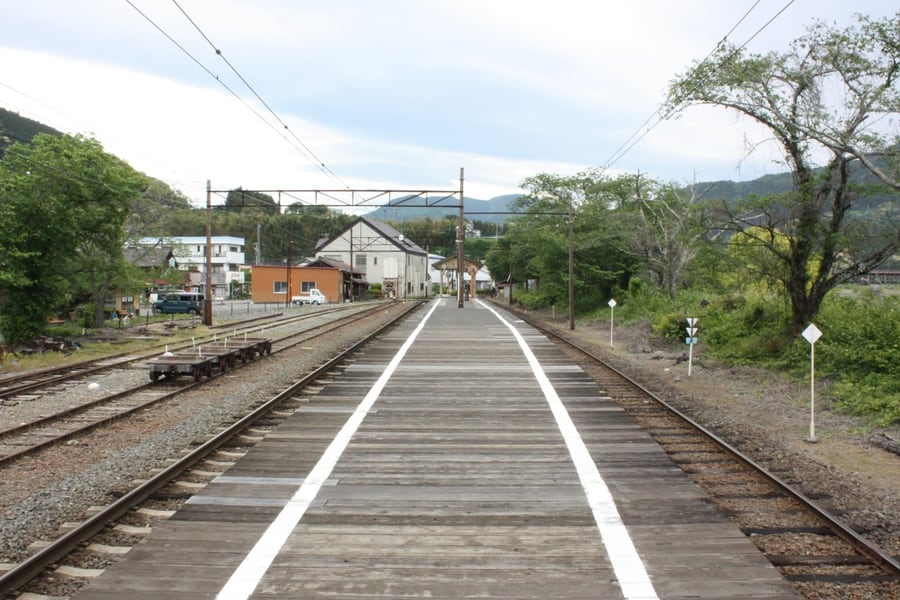
Ieyama has a long timber platform and cherry trees along the river bank that the railway calls spectacular in spring; a walk around the station is the way to see them. The EL Express turns back here, and the town bus to Senzu leaves from right outside the station building.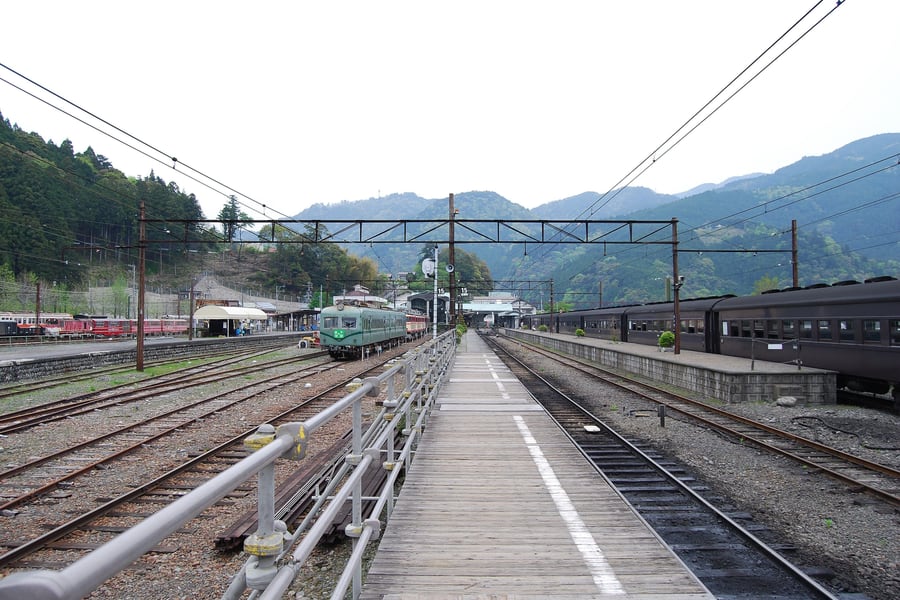 Toshinori baba / Wikimedia Commons · CC BY-SA 3.0
Senzu
The Main Line's terminus and the start of the Ikawa Line spread across a wide yard of sidings and stored coaches. Its turntable, installed in 1980 and registered as a tangible cultural property in 2001, is a British machine turned by hand. Buses leave from Senzu for Sumatakyō Onsen, about 40 minutes away.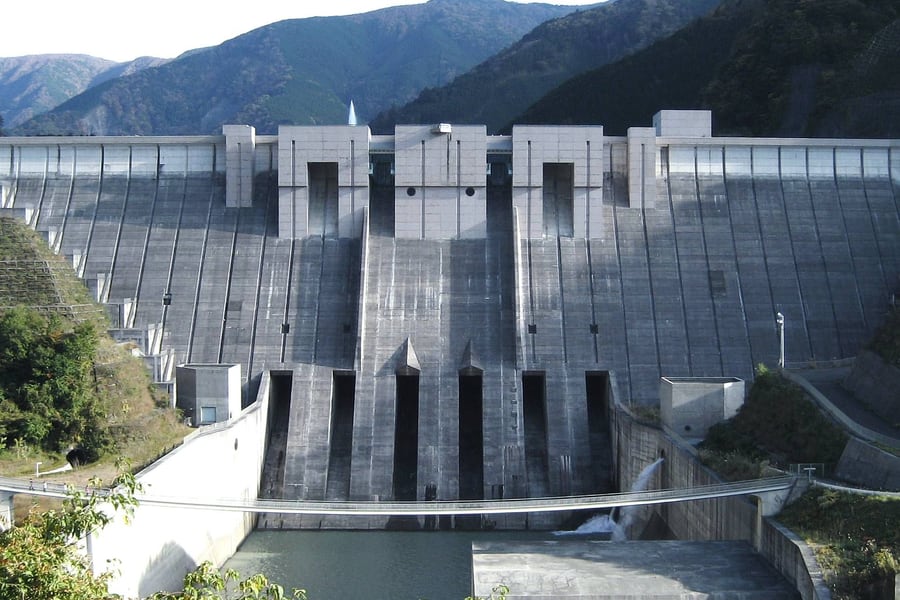 Qurren / Wikimedia Commons · CC BY-SA 3.0
Nagashima Dam
The 109 m concrete wall, completed in 2001, is the only multipurpose dam on the Ōi River, holding back floods and water for the towns downstream rather than making power. Its lake drowned part of the old line, which is why the rack section exists; from the far side of the station you can watch trains on the climb.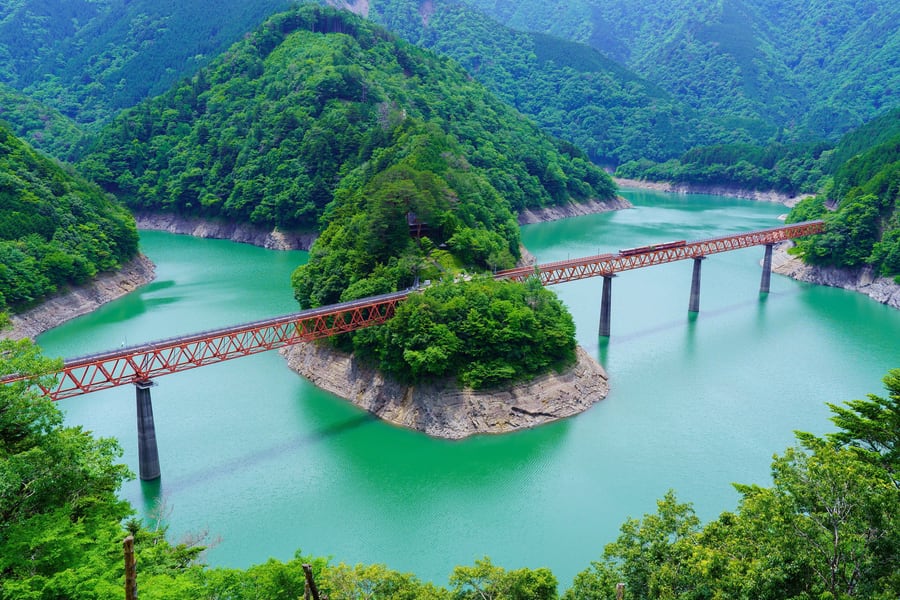 SHori / Wikimedia Commons · CC BY 4.0
Oku-Ōi Laketop
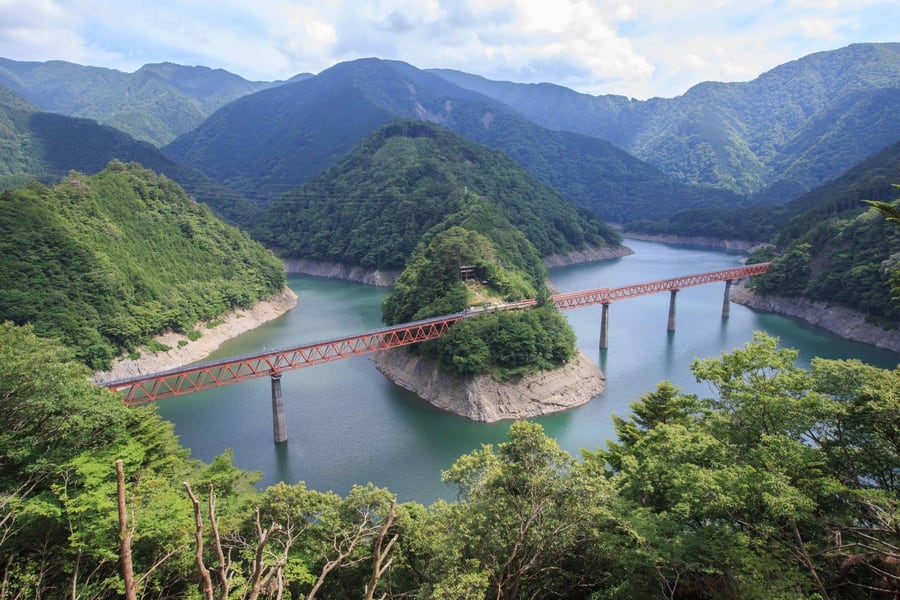
Opened in 1990, the station sits at the tip of a peninsula in Lake Sesso, 70 m above the drowned valley floor, between two red bridges. A walkway beside the track crosses to the shore, and a footpath climbs to the viewpoint from which it seems to float on the water. There is a small café, and a hiking path on to Sessokyō-Onsen.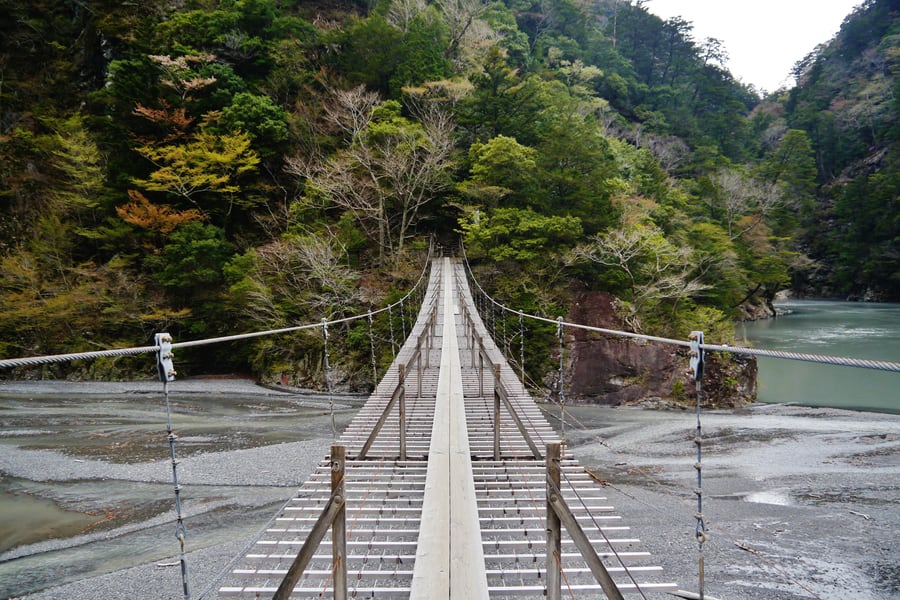 Zairon / Wikimedia Commons · CC BY-SA 4.0
Sumatakyō Onsen
A hot-spring village up a side valley, whose water the operator calls good for the skin. From the village it is about 30 minutes on foot to the Yume no Tsuribashi, a footbridge over emerald water that takes ten people at a time; cross it before 17:00. The autumn colour peaks in mid-November.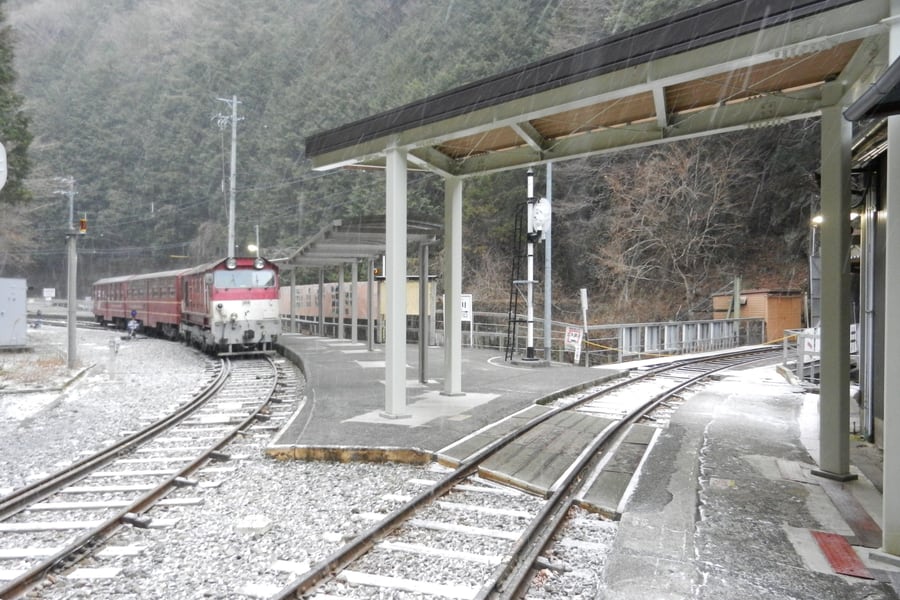 Koichi Shibata / Wikimedia Commons · CC BY-SA 3.0
Ikawa
At 686 m, the terminus is the highest station in Shizuoka Prefecture, beside the Ikawa Dam. A free museum at the dam tells how it was built, and outside winter a free ferry, the Akaishi-maru, crosses Lake Ikawa to the old village. Only two trains a day come this far, so check the time of the last one back.Where to Sleep
A night up the valley turns the journey into an easy two days: the Main Line and the bus on the first, the Ikawa Line on the second. The railway's own Kawane Onsen Hotel stands by the line at Kawane-Onsen Sasamado, and the inns of Sumatakyō Onsen are 40 minutes by bus from Senzu.
Where to stay
Kawane Onsen Hotel
Kawane-Onsen Sasamado · beside the line
A hot-spring hotel run by the Ōigawa Railway, with cottages that each have their own open-air bath.
Check Availability (opens in a new tab, on slonsen.jp)via slonsen.jpSumatakyō Onsen Suikoen
Sumatakyō Onsen · by bus from Senzu
A hot-spring inn in the village, half an hour's walk from the Yume no Tsuribashi, serving local food at an open hearth.
Check Availability (opens in a new tab, on suikoen.jp)via suikoen.jpQuestions or corrections
Planning this trip and stuck on something, or spotted a time, fare or detail that has changed? Send us a message about Ōigawa Railway. We read every one, and we update this page when something has changed.